Creative Space,Vol. 7, No. 1, July 2019, pp. 1–10
Creative Space
Journal homepage: https://cs.chitkara.edu.in/
Vol.-7 | No.-1 | July 2019
Visual Perception of Engineering Institutional Campuses’ Entrance Edifices of Tamil Nadu
Region, India
Babu Rajeswaran and Thirumaran Kesavaperumal
National Institute of Technology, Tiruchirappalli, India- 620015
Email: [email protected]
ARTICLE INFORMATION ABSTRACT
Received: February 22, 2019 Revised: March 06, 2019 Accepted: April 17, 2019
Published online: July 11, 2019
Institutional Campuses are increasing in numbers but struggling to market themselves in a highly
competitive business domain. The entrance edifice of these campuses is an Artifact, presenting a visual representation of their imperial status in society. To empirically analyze how these edifices create meaning in recently established campuses, this paper presents a series of qualitative case studies from the Tamil Nadu region of India. Specifically, it seeks to identify the visual elements of the entrance edifice that influence observers’ perceptions of the Institutional Campus. With this regard, visual elements of the entrance edifice and their physical characters were examined and expand into a questionnaire. Through follow-up interviews with observers on the campus and analyses of the entrance edifice at each Institution, several themes were identified in the observers’ perceptions. The empirical findings suggest that several visual elements can significantly impact the visual perception of an Institutional Campus’s image: Form Identity, Architectural Elements, Scale and Portion, and Color and Material. Integrating these elements into an Institutional Campus entrance edifice design can strengthen its image in urban settings, potentially building up the image for the urban populations
around the campus. Keywords:
Entrance Edifice, Imageability, Institutional Campus, Observers’ Perception, Visual
Elements
DOI: http://doi.org/10.15415/cs.2019.71001
1. Introduction
As far back as the pre-historic period, the architectural development of entrance gateways has indicated the structure’s purpose, content, and characteristics. The entrance design has extended utility for invasion of territories, marking of boundaries, religion, culture, trade, commerce, and dwelling settlement. Each design has a definite purpose and unique content: it can expose the image of the individual who developed the settings, hold the specific cosmological belief system of their culture, and convey the person competence or the complete settlement. Institutional Campus planning and design have been widely recognized positively in the profession, despite being understudied. While the planning and design concept of campus is idiosyncratic, the impact of its built environment and the character have been quantified and evaluated in most of the previous studies. Some of these studies have considered the perception of the physical characteristics of the settings, for both macro and micro-scale campus qualities (Hajrasouliha, 2016). The built environment conditions may specify a building’s “character” or “ambience,” as well as the relevant place. The built environment has been perceived by these aspects which give the visual perception of that environment to the observer.
So, while planning the building design(Manning, 1991), the development of building’s image or outward expression is a significant factor in the creation of public perception. The link between the observer and the built environment established the primacy of perception in the concreteness of the world.The visual recognition of the place included both the physical and perceptual layers those associated with the observer’s perception (Brown & Brabyn, 2012).
in urban settings. Based on a literature review of factors that can contribute to successful campus planning, a questionnaire was produced and distributed in the Tamil Nadu region. Along with interviews of observers, this instrument provided empirical data on how the visual elements of the entrance edifice induced several Institutional Campus images.
2. Literature Review
Visual perception is the competence to perceive the environment through the sensation (Carlson, 2013). The perception of built environment can be perceived as an individual experience (Rapoport, 1990). They possess a meaningful image which explicit the significance of the environment to the observers. Lynch (1960) stated that the observers’ have different perceptions on the image of the environment. He also mentioned the quality of tangible objects has more probability of inferring a robust image in a spectator’s thought. Rapoport (1990) similarly told that observers’ perceptions were about the place where they reside, while Susan (2007) stated that the qualitative aspects of the building depend on the people’s perceptions of the physical setting. Scholars like Gehl, Kaefer and Reigstad (2006) and Heffernan, Heffernan and Pan (2013) also contributed significantly to research on public perception of entrance facades. Hence, so far, the premises of perceived spatial quality characteristics have been studied; those studies have provided with the statistical data and have assessed spaces like streets, buildings, and landscapes (Franz, Von der Heyde, & Bulthoff, 2003; Stamps, 2011). Some of the other studies have quantitatively evaluated how the institutional campuses perceived images positively connected to place identity in the physical settings (Marcouyeux & Fleury-Bahi, 2011), including the physical landscapes on Institutional Campuses (Wong, Jusuf, Win, Thu, Negara & Xuchao, 2007). Sepe (2013) argued that an “important element of great visual suggestion is represented by… the context and whose main objective is aesthetic... capturing the attention of observers”. Fleming (2014) said that the observers’ visual perception directly recognizes particular physical elements rather than the entire scene. However, the understanding among the perceived image of the Institutional campuses (i.e., the qualitative built environment aspect) and its entrance edifice has not yet been determined regarding visual elements in the context of the Tamil Nadu Region.
An Educational Institution Campus is the physical setting in which various activities take place like, education, research, daily life and recreation. The campus’s character is about these activities that create a significant image on the built environment (Jiwoo & Mikyoung, 2015). Thus, the campuses exhibit their characters through the physical aspects to create the vivid image over the observers. The relationship among the physical settings, the built form,
overall campus design, and entrance edifice are presumed to function as visual representations of the institutions (Thirumaran & Babu, 2014). The interaction between the physical landscapes encourages the visual and psychological approach. The visual elements of the built structures will go with the greater perception of the built environment (Jonathan, 1994). Naser (1994) observed that the perceived environment characteristics have differences in the dimensions of the physical landscapes. Park and Kim (2000) stated that observers also remember the image of a physical environment. Stamps (2010) said that the visual elements for a built structure might gauge the size and proportion, and also may relate to other properties like quality. Tawfid (1997) argued that the facade elements of a built structure or form aim to explicit and convey the character of the environment.
3. Conceptual Framework for Assessing an
Institutional Campus’s Image
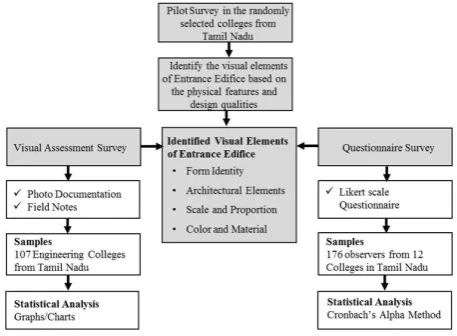
Within the literature review, an entrance edifice, as a physical model, stand like the structure by which the viewer carried their position connected to the institutional environment. To better understand the relationship between the perceived image of an Engineering Institutional Campus and its entrance edifice, this study aims to analyze how the visual elements of each entrance edifice affect the Institutional Campus’s image in urban settings. The Educational Institutions entrance edifices are considered with respect their addition to the entire image of the Institutional Campus within the selected case studies. Figure 1 illustrates the conceptual framework for the assessment of Institutional Campus images from the observers’ perceptions, based on the literature.
Creative Space,Vol. 7, No. 1, July 2019 pp.3
4. Methods and Materials
In the Tamil Nadu region, competition among Institutional Campuses is fierce. So, the architecture of the institutions is recognized and has great impact on their status. This region is familiar for its traditional Dravidian architecture, as the globalized style of modern architecture only appeared in recent decades. Because the region is in a mixed state of traditional and modern styles of architecture, a pilot survey was conducted to investigate observers’ perceptions of the elements present in the relevant entrance edifices.
4.1
Research Process
The study shows the importance of the findings which included the appropriate results and discussion sections. Precise literature of the previous studies are taken and discussed. The collected data demonstrated in the mode of the bar graph. The data attained from the selected educational institutions in Tamil Nadu, India during face-to-face interviews with the observers through the questionnaire survey to extract the particular view-points.
4.2
Visual Assessment Survey
During a three-month period, the author visited approximately 107 engineering colleges located in Tamil Nadu, India and established in the last few decades, i.e., since 1990 to 2010. Photo documentation and field notes were collected of each engineering college’s entrance edifice. The visual elements of the entrance edifice were observed carefully in great detail. Several visual elements of the edifices were identified, such as Form Identity, Architectural Elements, Scale and Proportion, and Color and Materials.
4.3
Questionnaire Survey
The observers’ perceptions for this study were measured with open questionnaire survey distributed to Engineering Institutional Campuses in Tamil Nadu. A random sampling method was used to select the campuses. The total of 12 campuses were surveyed based on their familiarity and urban locations (see Table 1). In the selected Engineering Institutional Campus, approximately 10 to 15 observers randomly were chosen and about to response the questions using a set of Likert scale options, ranging from “Very high” to “Not at all.” The questionnaire focused on the entrance edifice’s Form Identity, Architectural Elements, Scale and Proportion, and Color and Material. In general, the relationship between a Likert scale and its measures as a group is tested by Cronbach’s alpha. The consistency of the survey was tested with a Cronbach’s alpha (α) reliability test. If the alpha value was 0.7 or above, then the survey was considered trustworthy.
5. Results and Discussion
5.1
Visual Assessment Survey
5.1.1 Form IdentityForm Identity illustrates the form of the built structure and extend its coherence to the viewers. The buildings which possess the property of metaphor are commonly called “Expressions” (Goodman & Elign, 1988). The variations in the built form are consistently aspired to create visual interest, reduce the building massing and provide friendly character. The entrance structure form sometimes exhibits the cultural identity of the society and
Table 1. Distribution of Survey Locations in Tamil Nadu, India
Location Name of Institution Number of Observers
Chennai Anna University 15
Chennai Indian Institute of Technology 15
Kanchipuram Saveetha Engineering College 15
Villupuram Surya Group of Institutions 14
Tiruchirappalli National Institute of Technology, Tiruchirappalli 15
Tiruchirappalli M.A.M. College of Engineering 15
Madurai Thiyagaraya College of Engineering 15
Thanjavur SASTRA University 14
Coimbatore P.S.G. College of Technology 15
Coimbatore Coimbatore Institute of Technology 15
Hosur Adhiyamaan College of Engineering 14
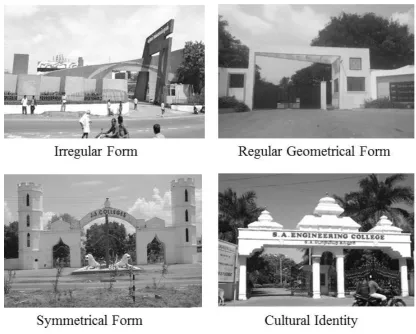
stand for their symbol. In Gestalt theory of perception, the law of organization stated that the human perceives the visual components as the whole (Humphrey, 1924). Lynch (1960) stated that identity and form emphasize the unique reference of inducing vivid images like the formal components to the viewers. Consistently the weird forms also fascinate the visual attention. Figure
2 shows samples of Form Identity in the entrance edifices of the engineering colleges. Most of the colleges exhibited this element, and observers identified high Form Identity among the college entrance edifices (see figure 3). Most of the colleges represented their cultural identity through their entrance edifices, often using symmetrical and regular geometrical forms.
Figure 2. Samples of Form Identity in entrance edifices of the engineering colleges (Source: Author)
Creative Space,Vol. 7, No. 1, July 2019 pp.5
5.2
Architectural Elements
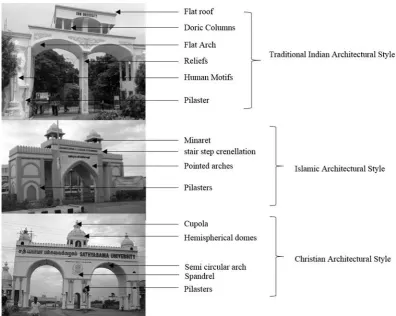
Architectural elements like arches, decorated cornices, barrel vaults, pediment, etc., are particular illustrations which show the architectural style of the building or the structure. Lynch (1960) mentioned that the strong influence of the architectural element reinforce the imageability. He also added that the architectural elements provide a distinct effect while they associated with coherence. In this study, the architectural elements of the entrance edifice like arches, domes, cornices, ornamented columns, etc., were evaluated through the field survey. Figure 4 shows samples of architectural elements in the entrance edifices of the surveyed engineering colleges. Figure 5 shows the number of colleges and their architectural elements in the entrance edifice. The results show that the architectural elements in these edifices highly contributed to the institutional images, especially which exhibit cultural identity.
5.3
Scale and Proportion
Observers also considered the scale and proportion of the built structure to be significant elements in the environment. Usually, the observers experience the large-scale object which conveys the context message to the community. Similarly,
the designers concentrated in the particular portion of the building or the structure which intensify the appearance. While scale is considered as absolute, and the proportion is treated as truly relative. This let the observers to realize the actual size of the space with respect to the building. Hence, the viewer recognize the image from the scale and proportion of the building or any physical structure.
Figure 5. The number of colleges and their architectural elements in the entrance edifice (Source: Author)
Figure 6. Percentage of Colleges with Scale and Proportion
(Source: Author)
Figure 6 shows the results of scale and proportion data in the entrance edifices of the engineering colleges. For reference, the golden ratio is used in the assessment. The results show that most of the colleges used the golden ratio in their entrance edifices to highlight their institutional images.
5.4
Color and Material
Colors and materials provide the visual language to the physical landscapes by both the natural environment as well as manmade. When it comes to the building material, it displays the presence of aesthetic value and strengthens the visual quality of the buildings and the overall appearance. Colors and materials of the space plays a vital role in the observers’ perception with its darker and lighter shades which adjust the proportion of the buildings. Thus, the colors and materials of the built environment have major impact on the observer’s perception. Figure 7 shows samples of the color and material in the entrance edifice of the engineering colleges. The author observed that most of the edifices used dominant colors, aluminium panels, exposed materials, and the color codes used in the college’s logo (see figure 8). Some of the colleges used bright colors just to draw attention, but most of the colleges used contextual colors, i.e. colors with respect to their surroundings.
Figure 7. Picture (a) and (b) showing College Entrances with dominant colors with aluminum panels, representing the college logo colors; (c) Using bright colors to highlight its appearance. (Source: Author)
Figure 8. The number of colleges using each type of color and materials (Source: Author)
5.5
Questionnaire Survey
A total of 176 observers participated in the questionnaire survey, which was conducted randomly in the engineering
colleges of Tamil Nadu. Table 2 shows the observers’ perceptions of the institutional image based on its entrance edifice. Based on the results attained from the observers, the entrance edifices of the engineering colleges were high in Form Identity (M= 4.62, SD=0.53, SE=0.04), followed by Architectural Elements (M=4.36, SD=0.74, SE=0.05), Scale and Proportion (M=4.20, SD=0.66, SE=0.05), and Color and Material (M=3.04, SD=0.86, SE=0.06). Here the mean score ranges from 4.62 to 3.04, illustrating that the Color and Material of the entrance edifice were less significant for the institution’s image. The mean values show that the observers associated a high-level image with visual elements such as Form Identity, Architectural Elements, and Scale and Proportion. Table 2 presents the Cronbach’s alpha reliability test. The results of the reliability test show an alpha value of 0.91, higher than the minimum acceptable value of 0.7. Table 2. Observers’ perceptions of Institution Image based on entrance edifices
Mean Standard Deviation Standard Error
Creative Space,Vol. 7, No. 1, July 2019 pp.7
Architectural
Elements 4.36 0.74 0.05
Scale and
Proportion 4.20 0.66 0.05
Color and
Materials 3.04 0.86 0.06
Reliability Test Reliability
Statistics Cronbach’s Alpha 0.91
Conclusion
The study demonstrates that entrance edifices of Engineering Institution have the potential to build an image for a more significant content and purpose through their visual elements. As the visual elements of the entrance edifices were heightened, so did the observers’ perceived appreciation of the Institutional Campus image in urban settings. The Form Identity of the entrance edifices had the strongest influence in these images, as did their Architectural Elements and other visual elements. This study provides a statistical analysis of how observers perceive the entrance edifice and how each visual aspect of the entrance edifice induce in an Engineering Institutional Campus Image.
Given the possible meaningful relationships between institutional image and visual elements of entrance edifices, institutional campus planners should design these edifices carefully. The thoughtful study of perception in design decisions can enhance the architecture as well as the image of the built environment. Specifically, designers should consider how observers perceive entrance edifices in urban settings, in order to produce more positive perceptions and build up the Engineering Institutions’ images. As a future study, the various elements of the built forms can be studied with respect to the observers’ perceptions, to strengthen the image of the built environment and its urban settings.
References
Berg, P. O. and Kreiner, K. (1990). Corporate architecture: Turning physical settings into symbolic resources. Symbols and artifacts: Views of the corporate landscape,
41, 67.
Brown, G., and Brabyn, L. (2012). An analysis of the relationships between multiple values and physical landscapes on a regional scale using public participation GIS and landscape character classification. Landscape and urban planning, 107(3), 317–331.
Carlson, N. R. (2012). Physiology of behavior 11th edition. Pearson.
Fleming, R. W. (2014). Visual perception of materials and their properties. Vision research, 94, 62–75.
Franz, G., Von der Heyde, M. and Bulthoff, H. (2003). An empirical approach to the experience of architectural space in VR. Retrieved from http://www.kyb.tuebingen. mpg.de/publications/pdfs/pdf2232.pdf
Gehl, J., Kaefer, L. J. and Reigstad, S. (2006). Close encounters with buildings. Urban design international,
11(1), 29–47.
Goodman, N. and Elgin, C. Z. (1988). Reconceptions in philosophy and other arts and sciences. Hackett Publishing.
Hajrasouliha, A. (2017). Campus score: Measuring university campus qualities. Landscape and Urban Planning, 158, 166–176.
Heffernan, E., Heffernan, T. and Pan, W. (2014). The relationship between the quality of active frontages and public perceptions of public spaces. Urban Design International, 19(1), 92–102.
Humphrey, G. (1924). The psychology of the gestalt. Journal of Educational Psychology, 15(7), 401.
Jonathan, R. (1994). Facadism. USA: Routledge.
Kim, J. and Ha, M. (2015). A study of the environmental elements affecting campus images. Journal of Asian Architecture and Building Engineering, 14(1), 1–8. Lynch, K. (1960). The image of the city (Vol. 11). MIT press. Manning, P. (1991). Environmental aesthetic design:
Identifying and achieving desired environmental effects, particularly “image” and “atmosphere”. Building and Environment, 26(4), 331–340.
Marcouyeux, A. and Fleury-Bahi, G. (2011). Place-identity in a school setting: Effects of the place image. Environment and Behavior, 43(3), 344–362.
Nasar, J. L. (1994). Urban design aesthetics: The evaluative qualities of building exteriors. Environment and behavior, 26(3), 377–401.
Park, H. and Kim, J. (2000). Environmental Cognition and Usage Behavior on University Campus. Journal of Human Ecology, 2(1), 25–41.
Rapoport, A. (1990). System of activities and system of settings. Domestic architecture and the use of space. Rebano-Edwards, S. (2007). Modelling perceptions of
building quality—A neural network approach. Building and Environment, 42(7), 2762–2777.
Stamps III, A. E. (2011). Effects of area, height, elongation, and color on perceived spaciousness. Environment and Behavior, 43(2), 252–273.
Stamps, A. E. (2010). Effects of permeability on perceived enclosure and spaciousness. Environment and Behavior,
42(6), 864–886.
Tawfid, M. A. G. (1997). Signs, Advertising and the Visual perception of Buildings: A Perceptual Selection in the View from the Street in Amman, Jordan. Habitat International, 21(2), 225–267.
Thirumaran, K. and Babu, A. R. (2014). An Experiential Study On The Ability Of Institutes Entrance Design
Elements And Physical Features In Inducing Perceived Image Among The Observers: With Reference To Entrance Edifice Of Technical Institutes In Tiruchirappalli and Thanjavur Region. International Journal of Scientific & Technology Research, 3(2),
191–200.
Wong, N. H., Jusuf, S. K., La Win, A. A., Thu, H. K., Negara, T. S., and Xuchao, W. (2007). Environmental study of the impact of greenery in an institutional campus in the tropics. Building and environment,