The Thirty-First AAAI Conference on Innovative Applications of Artificial Intelligence (IAAI-19)
eRevise: Using Natural Language Processing to Provide
Formative Feedback on Text Evidence Usage in Student Writing
H. Zhang, A. Magooda, D. Litman, R. Correnti, E. Wang, L.C. Matsmura, E. Howe, R. Quintana
Learning Research and Development Center University of Pittsburgh
Pittsburgh, Pennsylvania 15260
Abstract
Writing a good essay typically involves students revising an initial paper draft after receiving feedback. We present eRe-vise, a web-based writing and revising environment that uses natural language processing features generated for rubric-based essay scoring to trigger formative feedback messages regarding students’ use of evidence in response-to-text writ-ing. By helping students understand the criteria for using text evidence during writing, eRevise empowers students to bet-ter revise their paper drafts. In a pilot deployment of eRevise in 7 classrooms spanning grades 5 and 6, the quality of text evidence usage in writing improved after students received formative feedback then engaged in paper revision.
Introduction
With benefits such as minimizing human effort and assur-ing scorassur-ing consistency, natural language processassur-ing (NLP) has been used to develop many Automatic Essay Scoring (AES) systems that can reliably assess the content, structure, and quality of written prose (Shermis and Burstein 2003; 2013). However, before providing students with final essay scores, engaging students in cycles of essay drafting and revising after feedback is also essential (Graham, Harris, and Santangelo 2015). This is because scoring without feed-back is typically not enough to guide students on how to revise an essay for further improvement. Standalone AES systems are thus increasingly being incorporated into Au-tomated Writing Evaluation (AWE) systems (Dikli 2006; Roscoe et al. 2014; Weigle 2013), which provide students with formative feedback in addition to (or instead of) essay scores. Formative feedback can guide students during revi-sion in ways that help students compensate for identified essay weaknesses. Although Foltz and Rosenstein (2015) showed that student writing could improve with revisions based on AWE feedback and Chapelle, Cotos, and Lee (2015) showed that successful revising is related to feedback accuracy, much AWE research remains to be done.
This paper presents the design and first classroom eval-uation of eRevise, an AWE system for improving students’ ability to use text evidence – a dimension of writing that is important for college and career readiness. eRevise has been
Copyright c2019, Association for the Advancement of Artificial Intelligence (www.aaai.org). All rights reserved.
designed for students in grades 5-6 taking the Response to Text Assessment (RTA) (Correnti et al. 2013), where stu-dents first write an essay in response to a source text and are then assessed using a detailed Evidence scoring rubric.1 In particular, eRevise has been developed for deployment in a formative/classroom environment over two class pe-riods (in contrast to a summative/high-stakes usage). Stu-dents write their essays in the first period, then revise their essays in the second period after receiving formative feed-back automatically selected based on first draft AES. In con-trast to many AES systems that achieve high scoring relia-bility but do not address construct validity (Condon 2013; Perelman 2012), eRevise uses a rubric-based AES system to ensure that dimensions of the construct are well represented by the indicators used for scoring (Loukina et al. 2015). This in turn enables the development of an AWE algorithm for converting internal AES data structures into formative feed-back messages that are both tailored to each student’s writ-ing needs and aligned to the constructs of the scorwrit-ing rubric. eRevise is also notable in focusing on evidence usage rather than on surface writing features, and on upper elementary rather than middle or high school students, which makes the application of NLP techniques particularly challenging.
The next two sections describe the eRevise workflow, and the NLP techniques supporting eRevise’s AES and AWE components, respectively. This is followed by a class-room deployment and evaluation section demonstrating the promise of eRevise in supporting essay revision. Our de-ployment tested whether eRevise helped students: 1) im-prove the overall quality of their drafts when evaluated by human scorers using the RTA evidence rubric, and 2) in-crease the quantity and relevance/specifity of their text ev-idence usage when evaluated using NLP. Analyses of 143 essays created by 5th and 6th grade students from 7 differ-ent classes support both hypotheses.
System Usage and Architecture
During the first class, a teacher reads an article aloud (with students following along on a hardcopy) about an effort by
1
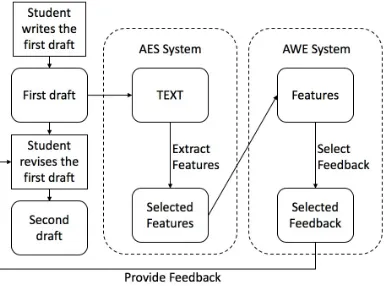
Figure 1: The architecture of the eRevise system.
the Millenium Villages Project (MVP) to eradicate poverty in a Kenyan village.2After the teacher discusses predefined vocabulary and asks standardized questions at designated points, there is a prompt at the end of the article which asks students: “Based on the article, did the author provide a con-vincing argument that winning the fight against poverty is achievable in our lifetime? Explain why or why not with 3-4 examples from the text to support your answer.” At this point students use eRevise to write an essay in response to the prompt. Both the source article and the prompt appear on the screen, with students typing their drafts into a text area below the prompt. The purpose of this first usage of eRevise is to electronically collect students’ first drafts.
Figure 1 shows the architecture of eRevise. After stu-dents submit their first drafts, eRevise’s AES component uses a previously developed RTA Evidence scoring algo-rithm (Zhang and Litman 2017) to extract features repre-senting the quality of text-based evidence usage in terms of constructs in the RTA Evidence rubric. Some of these fea-tures (described in the next section) are then passed as input to the AWE system’s feedback selection algorithm, which will in turn output a subset of predefined feedback messages that are believed to best address the problems of the first draft based on the features. These formative feedback mes-sages (although not the AES Evidence scores themselves) will be shown to students during the second class period.
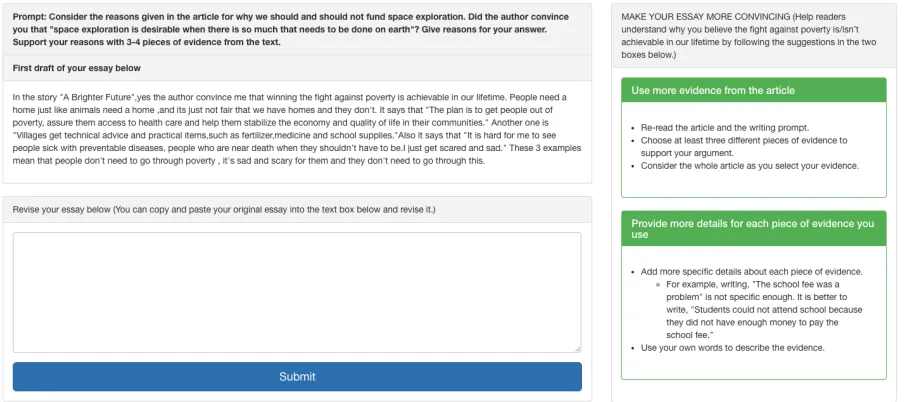
During the second class period, students login to eRe-vise and now reeRe-vise their first drafts using eReeRe-vise. Figure 2 shows a screenshot illustrating revision guided by formative feedback. The left top box shows a student’s first draft. This helps students to recall their first drafts and eases revising (e.g., by allowing cutting and pasting). The right-hand side of the screen shows the feedback on the first draft that was automatically selected by the AWE system. The left bottom box shows where students create their second drafts, hope-fully guided by the feedback displayed on the right.3
2
While the RTA has three forms (i.e., articles), eRevise cur-rently only supports AES forRT AM V P.
3
After a student clicks submit, the AES system also scores the revised version of the student’s essay. Although eRevise does not share AES scores with students (due to its focus on formative feed-back rather than summative assessment), AES scores are included
Essay Analysis and Feedback Selection
The ultimate goal of our research is to dynamically generate formative feedback that incorporates excerpts from students’ essays. However, to simplify the first version of eRevise, the current AWE system instead dynamically selects two of four pre-defined feedback messages to guide students in revis-ing first drafts. Table 1 shows these messages, ordered by a typical progression of evidence usage in student writing de-velopment. The messages reflect research on effective feed-back and conceptual frameworks for effective text evidence use (Wang, Matsumura, and Correnti 2018), and were cre-ated by content experts after an analysis of previously scored RTA essays (Correnti et al. 2013; Rahimi et al. 2014; 2017; Zhang and Litman 2017). These 4 messages were then or-ganized into groups of two based on the appropriateness of the messages for essays with differing evidence sophistica-tion (messages 1 and 2 for the least sophisticated, messages 2 and 3 for more sophisticated, and messages 3 and 4 for the most sophisticated essays). Based on AES feature anal-ysis of evidence usage in the first draft (and further feature processing, described below), each student thus receives two feedback messages based on the group assigned to the essay.
AES Feature Extraction
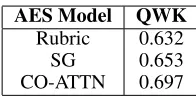
We have developed several AES systems for RTA assess-ment (Rahimi et al. 2017; Zhang and Litman 2017; 2018). Our first model (denoted by Rubric) (Rahimi et al. 2017) used NLP to represent an essay in terms of features that largely correspond to cells in the RTA Evidence rubric. This rubric, as well as the correspondence between the rubric and features that serve as input to the scoring model, are shown in Table 2. A subsequent model (denoted bySG) (Zhang and Litman 2017) introduced skip-gram word embeddings into the feature extraction process, in order to increase robust-ness by moving from lexical to semantic similarity compu-tation. Most recently, Zhang and Litman (2018) developed a neural network model with a co-attention layer (denoted by CO-ATTN) to eliminate human feature engineering. Table 3 shows performance figures for each of these AES mod-els when evaluated using cross-validation on a previously collected RT AM V P corpus of 2970 essays. Although the neuralCO-ATTNmodel has the best performance, to select formative feedback messages that address essay weaknesses in terms of rubric constructs, a more interpretable represen-tation of the essay is necessary. Therefore,SGis the AES system used in eRevise. In particular, two of the features used bySGfor score prediction, namely Number of Pieces of Evidence (NPE) and Specificity (SPC), form the basis of eRevise’s feedback selection algorithm.4 Table 4 shows an example first and second draft (with AES Evidence scores of 2 and 3, respectively), along with NPE and SPC values.
Number of Pieces of Evidence (NPE)is an integer en-coding the number of evidence topics in the article that are
in summary reports later shared with teachers. 4
Figure 2: A formative feedback screenshot of the eRevise system.
No. Name Feedback
1 Use more evidence
from the article
•Re-read the article and the writing prompt.
•Choose at least three different pieces of evidence to support your argument.
•Consider the whole article as you select your evidence. 2 Provide more details for
each piece of evidence you use
•Add more specific details about each piece of evidence.
–For example, writing, “The school fee was a problem” is not specific enough. It is better to write, ”Students could not attend school because they did not have enough money to pay the school fee.”
•Use your own words to describe the evidence.
3 Explain the evidence •Tell your reader why you included each piece of evidence. Explain how the evidence helps to make your point.
4 Explain how the evi-dence connects to the main idea & elaborate
•Tie the evidence not only to the point you are making within a paragraph, but to your overall argument.
•Elaborate. Give a detailed and clear explanation of how the evidence supports your argument.
Table 1: Four feedback messages predefined by content experts, based on progression of evidence use.
mentioned in the essay. A fixed size sliding window algo-rithm is used to extract this feature. If a window5 contains at least two similar words from a manually crafted list of main topics and associated words from the article6, the win-dow is determined to contain text-based evidence related to the topic. Word embedding is used to calculate word simi-larity, with two words considered as similar after threshold-ing, thus enabling both lexical and semantic matching (e.g., a student’s use of “power” will match “electricity” in the article). In Table 4, the NPE features indicate that the stu-dent used text evidence from more topics after revision, i.e., AES identifies one topic (Hospital) in the first draft versus three (Hospital, Farming, and Malaria) in the revised draft -although Malaria is actually a false positive.
5
In eRevise, all windows are of size 6, which optimized AES performance on previously scored training essays.
6
For the RTA article, the 4 topics are Hospital, Malaria, Farm-ing, and School (Rahimi et al. 2017). Computing similarity with pre-defined topics is typical in content-based AES (Liu et al. 2014).
Specificity (SPC)is a vector of integers that encodes the number of specific article examples mentioned in the es-say. The length of this vector is the number of manually crafted categories, which is 8 for the RTA article (Rahimi et al. 2017). A window-based algorithm is again used for feature extraction, now using a different manually crafted list of words associated with examples and categories from the article, where all examples are assigned to different cate-gories. For example, in the sliding window “see people sick with preventable diseases”, the essay words “preventable” and “diseases” match the article word list (“malaria com-mon disease preventable treatable”) for one of the 6 exam-ples associated with SPC category 47. Therefore, the algo-rithm increments the value of SPC4 by 1.
AWE Feedback Selection
Although the SPC values (which count the number of times the student mentions specific examples from the article) were useful for developing the AES system via supervised
7
1 2 3 4 Number of Pieces of
evi-dence
Features one or no pieces of evi-dence (NPE)
Features at least 2 pieces of evi-dence (NPE)
Features at least 3 pieces of evi-dence (NPE)
Features at least 3 pieces of evi-dence (NPE)
Relevance of evidence Selects inappropriate or irrelevant details from the text to support key idea (SPC); references to text fea-ture serious factual errors or omis-sions
Selects some appropriate and rele-vant evidence to support key idea, or evidence is provided for some ideas, but not actually the key idea (SPC); evidence may contain a fac-tual error or omission
Selects pieces of evidence from the text that are appropriate and rele-vant to key idea (SPC)
Selects evidence from the text that clearly and effectively supports key idea
Specificity of evidence Provides general or cursory evi-dence from the text (SPC)
Provides general or cursory evi-dence from the text (SPC)
Provides specific evidence from the text (SPC)
Provides pieces of evidence that are detailed and specific (SPC) Elaboration of Evidence Evidence may be listed in a
sen-tence (CON)
Evidence provided may be listed in a sentence, not expanded upon (CON)
Attempts to elaborate upon evi-dence (CON)
Evidence must be used to support key idea / inference(s)
Plagiarism Summarize entire text or copies heavily from text (in these cases, the response automatically receives a 1)
Table 2: Rubric for scoring the Evidence dimension of RTA. The abbreviations in the parentheses identify features used by the AES system that are aligned with specific assessment criteria (Rahimi et al. 2017).
AES Model QWK Rubric 0.632
SG 0.653
CO-ATTN 0.697
Table 3: Quadratic Weighted Kappa (QWK) of different AES models. The CO-ATTN model significantly outper-forms theRubricandSGmodels, respectively (p <0.05).
machine learning, we found them to be less useful for de-veloping a feedback selection algorithm because the count included duplicate cases, and because the use of word-embedding meant false positive examples were identified during AES. The AWE system thus calculates a new fea-ture namedSP C T otal M erged, which is a count of the number of non-duplicate, unique article examples from the SPC feature vector. For example, in the sentence “for me to see people sickwith preventable diseases”, bolding shows the first example found by the algorithm (window-size is 6, matched words are “people” and “sick”), while underlin-ing shows the second (matched words are “preventable” and “diseases”). While the SPC feature considers these as 2 ex-amples,SP C T otal M erged considers them as 1 unique example. For the first draft in Table 4, the algorithm thus re-duces the SPC total of 11 (from AES, equation below) to a smaller merged total of 6 (for AWE).
After extracting the above features for our previously col-lected corpora of scored essays, AWE feedback selection was guided by three assumptions: 1) the NPE feature indi-cates the breadth of unique topics, 2) the SPC Total Merged feature indicates the number of unique pieces of evidence the student located and used; and 3) a matrix of these two indicators could match each essay to appropriate feedback. Given we did not need to modify NPE, the following equa-tions were used to calculateSP CAW Efor feedback selec-tion.
SP Ctotal = N
X
i=1
SP Ci (1)
SP Ctotal, whereNis the number of categories in SPC, cal-culates the total number of matches the computer finds be-tween students’ first drafts and examples we are looking for.
SP Cimportant= E
X
i=S
SP Ci (2)
SP Cimportant, where S and E are the start and end in-dices of important categories, calculates the total number of matched examples from four primary topics for evi-dence usage (hospital, malaria, farming and school). In the RT AM V P, content experts identified these categories as pri-mary because they are the topics on which students can pro-vide specific examples of improvement, while other SPC categories refer to more general examples from the article.
DR=SP Ctotal−SP C T otal M erged
SP Ctotal
(3)
DRcalculates the duplication rate of matched examples, by using SP C T otal M erged to calculate the proportion of duplicate evidence fromSP Ctotal.
SP CAW E=RN D(SP Cimportant∗(1−DR)) (4) SP CAW E adjusts the number of important matched ex-amples by the duplication rate. This produces a new score for generating feedback, representing the number of unique matched examples from four primary topics. We round the number to get an integer used in the conditional statement below.
SP Clmh=
L, ifSP CAW E<3
M, ifSP CAW E≥3andSP CAW E≤5 H, otherwise
(5) SP Clmh is a categorical variable forSP CAW E that indi-cates low (L), medium (M), or high (H) values.
Finally, the AWE system uses N P E (computed during AES) andSP Clmhto select the two most appropriate feed-back messages for the essay based on Table 5. The content experts used a previously scored corpus (Zhang and Litman 2017) as development data to manually design this table.
For the first draft in Table 4,N P E = 1,SP Ctotal= 11, SP C T otal M erged = 6, SP Cimportant = 6, DR =
First Draft
Essay In the story “A Brighter Future”,yesthe author convince me that winningthe fight against poverty is achievable in our lifetime. People need a home just like animals need ahome ,and its just not fair
that we have homes and they don’t. It says that “The plan isto get people out of poverty, assure them access to health care and help them stabilizethe economy and quality of lifein their communities.” Another one is “Villages get technical advice and practicalitems,such as fertilizer,medicine and school supplies.”Also it says that “It is hardfor me to see people sick with preventable diseases, people who are near death when they shouldn’t have to be.I just get scared and sad.” These 3 examples mean that people don’t need to go through poverty , it’s sad and scary for them and they don’t need to go through this.
Features NPE SPC1 SPC2 SPC3 SPC4 SCP5 SCP6 SCP7 SPC8 SPC Total Merged
1 1 2 1 3 0 1 1 2 6
Second Draft
Essay In the story “A Brighter Future” yesthe author convince me that winningthe fight against poverty is achievable in our lifetime. Yes we need to win the fight against poverty because everybody needs a home, shelter, food,and money. Itsay that “Their crops were dying because they could not affordthe necessary fertilizer and irrigation”Another one is that “Its hardfor me to see people sick with preventable diseases,people who are neardeath when they shouldn’t have to be.”Also “.Little kids were wrapped in clothon theirmothers backs,or running around in barefeet and tattered clothing.” These three examples mean that we need tohelp them have a better lifeand a better home than the busty,dirty ground.
Features NPE SPC1 SPC2 SPC3 SPC4 SCP5 SCP6 SCP7 SPC8 SPC Total Merged
3 2 1 2 3 2 1 0 1 6
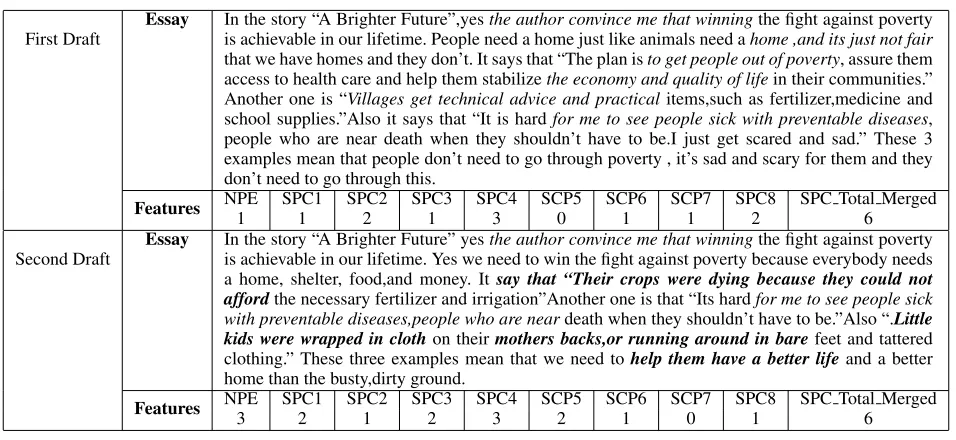
Table 4: Examples of a student’s first and second essay drafts, showing the NLP analyses during AES that are needed for AWE. For each essay, the text-based evidence identified during AES that is used to compute the essay’s SPC values is shown in italics (and in bold if only identifed in the second draft). eRevise would display feedback messages 1 and 2 for the first essay draft.
Feature Value
N P E 0 0 0 1 2 3 4 1 1 2 2 3 4 3 4
SP Clmh L M H L L L L M H H M M M H H
Feedback Messages 1,2 1,2 1,2 1,2 1,2 1,2 1,2 1,2 1,2 1,2 2,3 2,3 2,3 3,4 3,4
Table 5: Lookup table for feedback selection.
consulting Table 5, eRevise would display feedback mes-sages 1 and 2 for this essay (as for the essay displayed in Figure 2).
In sum, the AWE process results in all students receiv-ing two (of four possible) feedback messages that are se-lected based on the AES feature analysis and are thus tar-geted to improving the quality of each student’s particular essay. Note that students will receive feedback even when AES predicts a score of 4 for the first draft. In most cases, such students will receive the third and fourth feedback mes-sages focusing on evidence elaboration.
Experimental Deployment and Results
Our first deployment of eRevise took place in two public rural parishes in Louisiana. Seven 5th and 6th-grade teach-ers had all students in one of their English Language Arts classes write and revise an essay using eRevise. A total of 143 students completed all tasks. We test two hypotheses:
H1: eRevise helps students improve the overall quality of their drafts, as evaluated by human scorers using the RTA evidence rubric.
H2: eRevise increases the quantity and rele-vance/specificity8 of evidence that students use from the RTA source text, as evaluated using NLP features.
8
Corresponding to row 1 and rows 2-3 of Table 2.
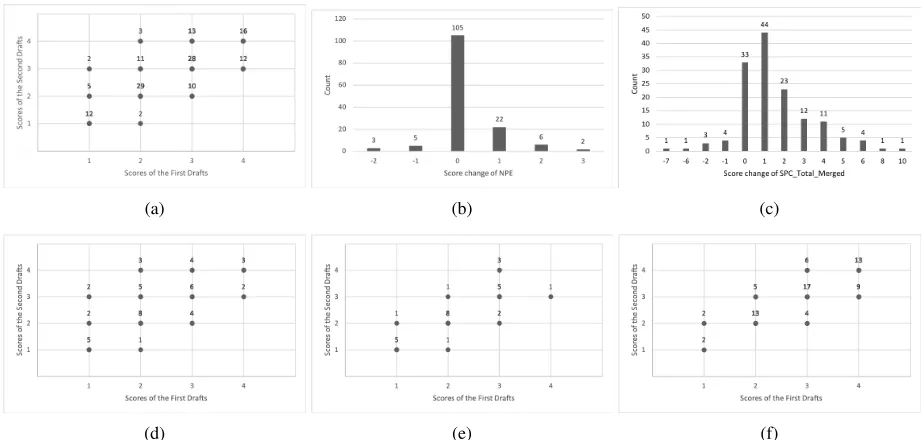
The outcome measure for testing H1 is a human-produced RTA Evidence score. After the deployment, a trained hu-man grader used the rubric from Table 2 to score all es-says, without knowing whether an essay was a first or sec-ond draft. A paired t-test comparing the first and secsec-ond draft Evidence scores (n=143) supports H1, as the scores improved from first (M EAN = 2.62,SD = 0.95) to sec-ond (M EAN = 2.72,SD = 0.92) drafts with trending statistical significance (p ≤ 0.08). The grader also scored essays for the other four RTA dimensions (recall footnote 1). In contrast to Evidence (for which eRevise provided for-mative feedback to guide revision), there were no signifi-cant or trending score improvements for any of these other RTA dimensions (all p ≥ .29). Finally, the scatter plot in Figure 3a shows that the overall improvement in the Evi-dence dimension was observed despite potential ceiling ef-fects: 28 students received the maximum score of 4 on their first drafts, 16 of whom also received the maximum on their second drafts. The plot also shows that although the scores increased for 34 students, the scores did not change for the majority of students (and less often even decreased).
ap-(a) (b) (c)
(d) (e) (f)
Figure 3: (a) RTA Evidence scores before and after revision. (b) Value changes for the NPE feature. (c) Value changes for the SPC Total Merged feature. (d) RTA Evidence scores for essays receiving feedback messages 1 and 2. (e) RTA Evidence scores for essays receiving feedback messages 2 and 3. (f) RTA Evidence scores for essays receiving feedback messages 3 and 4.
proximate evidence quantity and relevance/specificity, re-spectively. Paired t-tests (n=143) for both support H2. The N P E feature values improved significantly (p ≤ 0.003) from first (M EAN = 2.61,SD = 1.27) to second draft (M EAN = 2.81,SD= 1.08). TheSP C T otal M erged feature values also improved significantly (p≤0.001) from first (M EAN = 9.65, SD = 4.94) to second drafts (M EAN = 11.15,SD = 5.39). For NPE, the histogram in Figure 3b shows that more students added rather than re-moved evidence (30 versus 8 students). Although 105 stu-dents showed no evidence change, 43 were already at ceil-ing with NPE values of 4 in the first draft. For SPC, the his-togram in Figure 3c shows that a large majority of students (101) increased the number of specific article examples that they incorporated into their essays. 33 other students showed no change, while only 9 students removed specific examples. Recall the 16 students in Figure 3a who were at ceiling when the RTA Evidence score was used as the outcome mea-sure. By instead using theSP C T otal M ergedvalues as the outcome, these 16 students can now be seen to show im-provement from their first drafts (M EAN = 12.69,SD= 4.63) to the second drafts (M EAN = 13.25,SD = 5.20), with trending statistical significance (p≤0.095).
Finally, Figure 3d shows how evidence scores changed for the 45 essays receiving feedback messages 1 and 2. The evidence score improvements from first (M EAN = 2.33, SD = 0.93) to second (M EAN = 2.64,SD = 0.98) drafts were statistically significant (p = 0.02). Figure 3e shows the score changes for the 27 essays receiving feed-back messages 2 and 3. The evidence scores only slightly improved from first (M EAN = 2.22,SD = 0.85) to sec-ond (M EAN = 2.26,SD= 0.94) drafts. Figure 3f shows that for the 71 essays receiving messages 3 and 4, the
evi-dence scores were almost the same from first (M EAN = 2.94, SD = 0.89) to second (M EAN = 2.94, SD = 0.81) drafts. These three figures suggest that drafts with the least sophisticated evidence usage had the most room for improvement. It is also interesting to relate these three feedback-based groupings to essay RTA Evidence scores. 40.63% of drafts receiving Evidence scores of 1 or 2 re-ceived feedback messages 1 and 2. 62.03% of drafts receiv-ing Evidence scores or 3 or 4 received messages 3 and 4. Although only 27 essays received messages 2 and 3, 71.43% of these drafts received Evidence scores of 2 or 3.
Current and Future Directions
We are about to begin the next deployment of eRevise, which will extend our work in two ways. First, to better determine the benefit of using AES to adaptively guide re-vision, we have added a control condition where eRevise will display the same generic feedback message to all students: “MAKE YOUR ESSAY MORE CONVINCING -Help readers understand why you believe the fight against poverty is/isn’t achievable in our lifetime.” This is in con-trast to the existing eRevise adaptive feedback, where dents receive different messages based on AES. Second, stu-dents will use eRevise for two different forms of the RTA (i.e.,RT Aspace in addition toRT AM V P). While we have already trained aSG model for scoringRT Aspace (Zhang and Litman 2017), Table 5 needs to be verified to ensure the validity of our feedback selection algorithm. We are also ex-ploring addingCO-ATTNscores to the lookup table.
While we have developed pilot data-driven methods that can extract such topical components automatically (Rahimi and Litman 2016), our methods need to be improved so that they do not degrade SG model performance. eRevise will also be enhanced to provide feedback for Organization, a second substantive RTA writing dimension for which we already have a pilot AES (Rahimi et al. 2017). We also plan to move from feedback selection to more personalized feedback gen-eration, and to create a teacher dashboard which can auto-matically generate summaries such as Figure 3a. Finally, since eRevise’s feedback encourages students to add more concrete examples from the article, some students may sim-ply copy and paste examples rather than use their own words as the feedback suggests. While the human RTA rubric (last row in Table 2) addresses plagiarism, eRevise currently does not. We thus plan to incorporate the detection of different types of adversarial essays into AES.
Conclusions
eRevise is an AWE system for text evidence usage that uses NLP features produced by a rubric-based AES system to au-tomatically select formative feedback messages most appro-priate to a student’s needs. By increasing access to feedback on a substantive and important writing dimension, eRevise has the potential to reduce demands on teachers and to build students’ knowledge of effective text evidence usage. We first described how eRevise uses NLP techniques to evalu-ate draft essays and to select approprievalu-ate formative feedback messages to guide later revision. Experimental results from a first deployment in 7 classrooms showed that eRevise helped students improve their text evidence usage after receiving formative feedback and engaging in essay revision.
Acknowledgments
The research reported here was supported, in whole or in part, by the Institute of Education Sciences, U.S. Depart-ment of Education, through Grant R305A160245 to the Uni-versity of Pittsburgh. The opinions expressed are those of the authors and do not represent the views of the Institute or the U.S. Department of Education.
References
Chapelle, C. A.; Cotos, E.; and Lee, J. 2015. Validity ar-guments for diagnostic assessment using automated writing evaluation. Language testing32(3):385–405.
Condon, W. 2013. Large-scale assessment, locally-developed measures, and automated scoring of essays: Fish-ing for red herrFish-ings? Assessing Writing18(1):100–108.
Correnti, R.; Matsumura, L.; Hamilton, L.; and Wang, E. 2013. Assessing students’ skills at writing analytically in response to texts.Elementary School Journal114:142–177. Dikli, S. 2006. An overview of automated scoring of es-says. The Journal of Technology, Learning and Assessment 5(1):4–35.
Foltz, P. W., and Rosenstein, M. 2015. Analysis of a large-scale formative writing assessment system with automated
feedback. InProceedings of the Second (2015) ACM Con-ference on Learning@ Scale, 339–342. ACM.
Graham, S.; Harris, K. R.; and Santangelo, T. 2015. based writing practices and the common core: Meta-analysis and meta-synthesis. The Elementary School Jour-nal115(4):498–522.
Liu, L.; Brew, C.; Blackmore, J.; Gerard, L.; Madhok, J.; and Linn, M. 2014. Automated scoring of constructed-response science items prospects and obstacles. Educational Mea-surement: Issues and Practice33(2):19–28.
Loukina, A.; Zechner, K.; Chen, L.; and Heilman, M. 2015. Feature selection for automated speech scoring. In Proceed-ings of the Tenth Workshop on Innovative Use of NLP for Building Educational Applications, 12–19.
Perelman, L. 2012. Construct validity, length, score, and time in holistically graded writing assessments: The case against automated essay scoring. International advances in writing research: Cultures, places, measures121–131. Rahimi, Z., and Litman, D. 2016. Automatically extract-ing topical components for a response-to-text writextract-ing as-sessment. InProceedings of the 11th Workshop on Inno-vative Use of NLP for Building Educational Applications, 277–282.
Rahimi, Z.; Litman, D. J.; Correnti, R.; Matsumura, L. C.; Wang, E.; and Kisa, Z. 2014. Automatic scoring of an an-alytical response-to-text assessment. InInternational Con-ference on Intelligent Tutoring Systems, 601–610. Springer. Rahimi, Z.; Litman, D.; Correnti, R.; Wang, E.; and Mat-sumura, L. C. 2017. Assessing students’ use of evidence and organization in response-to-text writing: Using natural language processing for rubric-based automated scoring. In-ternational Journal of Artificial Intelligence in Education 27(4):694–728.
Roscoe, R. D.; Allen, L. K.; Weston, J. L.; Crossley, S. A.; and McNamara, D. S. 2014. The writing pal intelligent tutor-ing system: Usability testtutor-ing and development. Computers and Composition34:39–59.
Shermis, M. D., and Burstein, J. C. 2003. Automated essay scoring: A cross-disciplinary perspective. Routledge. Shermis, M. D., and Burstein, J. 2013. Handbook of au-tomated essay evaluation: Current applications and new di-rections. Routledge.
Wang, E.; Matsumura, L. C.; and Correnti, R. 2018. Stu-dent writing accepted as high-quality responses to analytic text-based writing tasks. The Elementary School Journal 118(3):357–383.
Weigle, S. C. 2013. English language learners and auto-mated scoring of essays: Critical considerations. Assessing Writing18(1):85–99.
Zhang, H., and Litman, D. 2017. Word embedding for response-to-text assessment of evidence. InProceedings of ACL 2017, Student Research Workshop, 75–81.