Abstract — Web recommendation systems usually brings a
content list to users based on previous ratings made by them to other similar contents through some social voting mean. This paper aims to present a comparison of the main explicit rating methods used by web recommendation systems. The goal of this survey is to determine which of the studied methods fits better to user preferences when they rate a content on the web; based on the obtained results, a recommendation system can be implemented using an explicit feedback method to achieve this goal.
Keywords — Recommendation system, explicit feedback,
explicit rating, method “5 stars”, method “Like”.
I. INTRODUCTION
ue to the large amount of information available on the Internet, sometimes it is difficult for users to find the content that they really need in a quick and easy way. The user tends to: seek for recommendations from others who have previously had the same needs; or select those items that are closest to what they were looking for [1].
The use of recommender system as an information retrieval technique attempts to solve the problem of data overload. They filter the information available on the web and help users to find more interesting and valuable information [2-4].
For recommendation systems to be more effective we believe that is necessary to determine which method is more suitable for the feedback process. The most common solutions and wider spread methods are those based on explicit ratings. which two main methods are "5 stars" and “Like”. In this sense our goal is to determine which method is preferred by the users.
In this paper is presented a comparative study between two methods of explicit feedback process: "5 stars" and “Like”. The paper is structured as follows: in section 2 we explain the feedback techniques, section 3 describes the problems into explicit feedback, section 4 shows our case study and prototype, section 5 presents the analysis of the obtained results, and finally in section 6 we explain our conclusions.
II. RECOMMENDATIONS SYSTEMS
The use of recommendations system as an information retrieval technique attempts to solve the problem of data overload. They filter the information available on the web and help users to find more interesting and valuable information [2-4].
In general, a recommendation system is defined by [5] as "A system that has as its main task, choosing certain objects that meet the requirements of users, where each of these objects are stored in a computer system and characterized by a set of attributes."
Recommendation systems consist of a series of mechanisms and techniques applied to information retrieval with the purpose to solve the problem of data overload on the Internet. These help users to choose the objects that can be useful and interesting for them, these objects can be any type, such as books, movies, songs, websites, blogs [6].
Recommendation systems are based on personalized information filtering, used to predict whether a particular user likes a particular item (prediction problem), or identify a set of N items that may be of interest to certain users (top-N recommendation problem) [7].
A. Feedback techniques
The information feedback is a fundamental process of the recommendation systems, and the reason is that it provides the information these systems need to make recommendations to the users. In this sense the feedback techniques are classified into two types: Implicit and Explicit feedback [7-9], being the last one the most used in the recommendation systems in force, this is caused because is the user himself whoever value the importance of interest objects.
Implicit feedback
This process consists on evaluate the objects without users interventions. This evaluation is performed without the user being aware, capturing the information obtained from the actions made by the users in the application. For example,
Social Voting Techniques: A Comparison of the
Methods Used for Explicit Feedback in
Recommendation Systems
Edward Rolando Nuñez-Valdez1, Juan Manuel Cueva-Lovelle1, Oscar Sanjuan1, Carlos E. Montenegro-Marin2, Guillermo Infante Hernandez1
1Informatic Department, Oviedo University, Oviedo, Spain 2Engineering Faculty, Distrital University, Bogotá, Colombia.
when the user accesses to news or read an article online, according to the time it takes for reading, the system could automatically infer whether the content is on its interest.
Implicit feedback techniques have been used to retrieve, filter and recommend a variety of items: movies, journal articles, Web documents, online news articles, books, television programs, and others. These techniques take advantage of user behavior to understand user interests and preferences [10].
Types of implicit feedback include web purchase history, browsing history, search patterns, or even mouse movements. For example, an user that purchased many books by the same author probably likes that author [11].
Explicit feedback
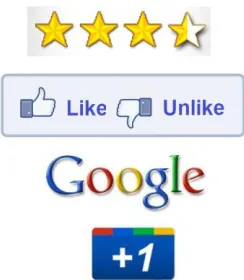
Through a survey process, the user evaluates the system by assigning a score to an individual object or a set of objects. Explicit feedback provides users with a mechanism to unequivocally express their interests in objects [12]. Figure
1¡Error! No se encuentra el origen de la referencia. shows
the most common explicit feedback system used by users on the web to express their interest by objects.
Figure 1: Most common explicit feedback systems.
For example, Amazon online store, Film affinity, Movies and other, use the “5 stars” ratings system that allows users to indicate which products are of their interest.
On the other hand, social networks as Facebook, YouTube and others use the “Like” rating system to allow the users to rate the contents.
Finally, Google+1 is a new feature that Google added to its search engine so users can evaluate explicitly the websites they like. So, they recommend websites to their contacts.
Although there are different ways of explicit rating, the most used in the majority of applications are:
Explicit rating “5 stars”
As shown in Figure 2, through the explicit rating “5 stars”, the users gives each content a value between 1 and 5 stars. These values are defined as follows:
One star: The content is not interesting. Two stars: The content is a bit interesting. Three stars: The content is interesting. Four stars: The content is very interesting. Five stars: The content is essential.
Figure 2: Explicit rating “5 stars”
Explicit rating “Like”
As shown in figure 3, through the explicit rating “Like”, the users gives a positive or negative rating to contents. If this method of rating is compared with the “5 stars" method it could be said, that it uniquely assign values of 1 or 5 stars.
When the user push the button “Like”, it means that user likes the content, but if the users push the button "Unlike" it means that content does not like to user. The Figure 3 shows the buttons used in this type of rating.
Figure 3: Explicit rating “Like”
III. PROBLEMS OF THE EXPLICIT FEEDBACK
In the recommendation systems the most effective way to know the users interest to determine objects is across of the explicit rating, due to the user express its liking for an object. But normally the users do not like to rate the objects, mainly because they are not interested or will not receive any benefit in return. In this sense the main problem of the explicit rating is the low interest from users to rate the content.
Other of the problems of the explicit rating as according to Claypool [13], is the alteration in the reading sequence and the normal navigation of the users, because they must stop the interaction with the system to rate the objects.
In order to find a solution to these problems, this work presents a study that determines an approximation to a better way of rating the objects explicitly.
IV. CASE OF STUDY AND PROTOTYPE
The goal of this section of the study is to measure the most comfortable and easy way the users use to rate a content explicitly in order to determine which of the two methods of rating is more effective and most used by users.
To achieve an approach to the solution of the explicit feedback, we developed an application based on eInkPlusPlus
project; it contains a series of photo books sorted by categories. Each category and photo book is composed by the same amount of objects. Specifically, each category contains 10 photo books and each photo book contains 10 pictures, this is so that each object has the same assessment probability. We choose photo books because we think that the interaction with them is more comfortable, fast and efficient than the complete e-books reading. This enables the users to navigate through several photo books in the shortest time possible, allowing us to extend the tests to a greater number of users. The application is designed like a library books that consists in:
Categories: Categories represent the classifications of books (e.g., comics, computer and internet, novels, biographies, science, etc.).
Photo books: Each photo book represents a reading object (e.g., a book, a magazine, a scientific paper, etc.). From now on we will call it "content". Photos: Each photo is a page of a content, which
users can view and interact with it, allowing the user to go forward or back one page to another. From now on we will call it "items".
The users that interacts with the application can browse the different categories, contents and items. Each user can view individual items of the contents, comment the contents, send these to his friends and explicitly assess them, indicating which are of his interest.
On the other hand, transparently to users, we recorded the user's interaction with each object (category, content and item) of the application, to capture the implicit parameters and determine the number of times a user visits a category, content or item, the time taken per session reading it, etc.
This application has been distributed to 58 users with different skill levels, different ages, without prior knowledge of the contents and selected at random, which provided the data necessary to carry out the study said.
Later we will describe how the data were obtained and the relations established between them. Subsequently, an analysis of the same and will present final conclusions.
A. Graphic User Interface
The Graphical User Interface is a ubiquitous web application developed in RubyOnRails and can be run on any device with a Web browser (e.g., Mozilla Firefox, Microsoft Internet Explorer, Google Chrome, etc.). In this Web application we can register as a user, create contents, add items to the contents, comment the contents, browse the different options of the application, etc.
As Figure 4 shows, when a registered user is logged in the application shows the homepage with different categories, through which the user can navigate and access different content.
Each category shows the contents that belong to it, including the content cover image, title and author of contents. Clicking on the title or on the cover the users access the selected content.
Figure 4: Graphical User Interface.
B. Catching explicit parameters
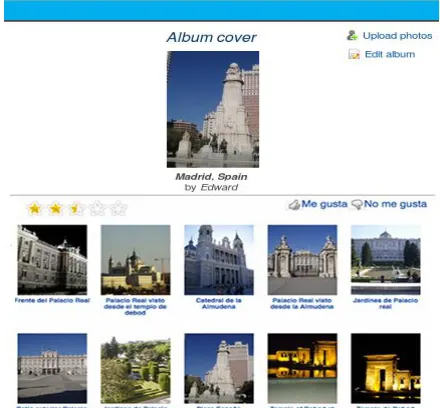
To perform the analysis and comparison between “5 Stars” and “Like” System, we need some way to know the real value of the user regarding to the content (explicit evaluation). When the user is registered in the recommendation system, it has the option to rate the different contents in an explicit way. This way, the user can give a rating between 1 or 5 stars to content or push the button "Like" or "Unlike". Each user can rate the content only using one of the given ways. In other words, rate cannot be assigned to the same content (by same user) with the method “5 stars" and the method "Like" at the same time. The Figure 5 shows the graphic interface that implements the before condition.
Figure 5: Presentation of the photo album for explicit rating.
V. ANALYSIS OF DATA
series of charts, these will represent which are the most used feedback techniques by the users at the moment of rating an object.
A. Comparison between explicit rating methods "5 stars” and "Like".
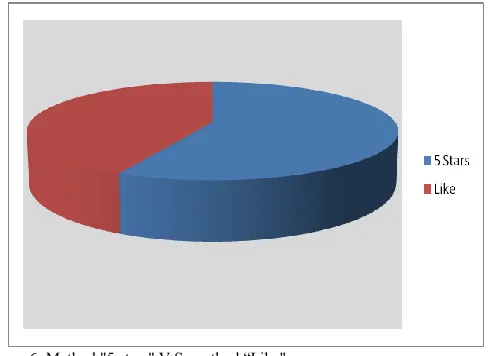
The first scenario to study is the amount of users that have used some of the two rating methods, the figure 6 shows the percentage of the contents that have been rated by some of two methods ("5 stars" or "Like") and the method more used is "5 stars".
Figure 6: Method "5 stars" V.S. method “Like"
B. Method "5 stars" classified by assigned punctuation. The next scenario shows the information from the users that used the rating method "5 stars". In this method the user have to rate the contents with values between 1 to 5, where 1 means that does not like it and 5 that likes it a lot. The figure 7 shows the results of the users performance in the process of assignment value to contents.
The Figure 7 also indicates that the vast majority of the contents were liked by users, in this sense the 3% of the users did not like the contents. The 83% of the users has assigned a rate between 4 and 5 stars; it means that they likes the content. The 48% of the rates is 5 stars, this indicates that the user likes the content, it trend is to assign a rate with 5 stars.
Figure 7: Method "5 stars" classified by punctuation.
C. Method "Like" classified by assigned punctuation. The next scenario shows the information from the users that used the rating method "Like". In this method the user have rated the contents with two unique cases "Like" or "Unlike", The figure 8 shows the results of the users performance in the process of assignment value to contents.
This is a similar case to the method "5 stars", the vast majority of contents have liked to users, in this sense the 17% of the users considered that does not like the contents and the 83% of the users has assigned "Like" to the contents. Precisely this value matches with the percentage of the contents that users been assigned a rate between 4 and 5 stars, in others words users likes it. .
Figure 8: Method "Like" classified by assigned punctuation.
D. Method of rating with "5 stars" and "Like" classified by gender
Figure 9: Method of rating with "5 stars" and "Like" classified by gender.
E. Method of rating with "5 stars" classified by gender. Figure 10 shows the amount of ratings by gender with the method "5 stars", as shown, women prefer to assign a rate of 5 stars when they like the content. In this method, the number of ratings of women is twice bigger than men. The men prefer to assign a rate of 4 stars when they like the content.
In conclusion, when the women registered in the system likes the content , they assign the maximum rating, but generally the men in this case assign a rating of 4 stars.
Figure 10: Method of rating with "5 stars" classified by gender.
F. Method of rating with "Like" classified by gender Figure 11 illustrate the amount of ratings by gender rated with the "Like" and "Unlike" methods. As shown, "Like" method is more used by men that women.
Figure 11: "Like" rating method classified by gender.
G. Method of rating with "5 stars" classified by category Figure 12 shows the amount of ratings by category with the method "5 stars", as shown, in all categories, the distribution is similar, the most used is "5 stars", then follows "4 stars" and so on until "1 star".
Figure 12: Method of rating with "5 stars" classified by category.
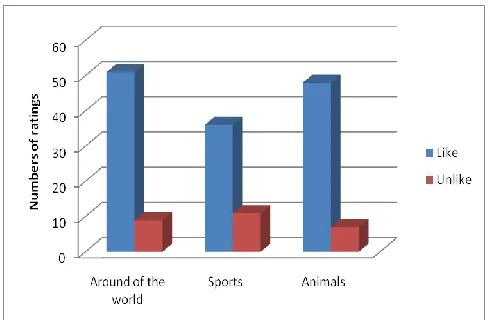
Figure 13: Method of rating with "Like" classified by category.
VI. CONCLUSIONS
According to users ratings in the recommendation system, they preferred to use the method "5 stars" with 57% of the total, respect to method "Like" that represents the 43% of the total, however this is not a significant difference to assert that method "5 stars" is more used by the users.
The 83% of the contents, have been positively rated with the two methods, this means that the users liked the contents.
The 48% of the contents, have been rated with 5 stars, this means that almost the half of the contents of the recommendation system are very much liked by users or that their rates are usually 5 stars when they likes the content.
Each user in the recommendation system assigned a rating with average 1.84 times with the method "5 stars" and 1.83 times with the method "Like".
The male users have used more the method "Like" than the method "5 stars", on the contrary, the female users have used more the method "5 stars" than the method "Like". This means that the men do like the method "Like" and the women do like the method "5 stars".
In the recommendation system when a men use the method "5 stars" he prefer to assign a qualification of 4 stars to the contents they like while women prefer to assign a qualification of 5 stars. The method "Like" is more used by the men than women, in total men have qualified 122 contents and the women 40 contents through the method "Like".
Despite the similarity of the evaluation results retrieved from both methods, we believe that the "like" method could be more accurate than the five star method which tends to be like the first. The gathered data shows that the user that likes a content assigns the maximum score, in this case (between 4 and 5 star) and if do not like it then assigns the lowest score (1 star), which is equivalent to "Like" or "Un like".
Finally, the single button mechanism, in this case the "Like" button would be a good alternative since users do not rate the content if they do not like it.
VII. REFERENCES
[1] O. Sanjuan Martínez, Pelayo G-Bustelo,C., González Crespo, R., Torres Franco, E., "Using Recommendation System for E-learning Environments at degreelevel," International Journal of Artificial Intelligence and Interactive Multimedia, vol. 1, pp. 67-70, 2009.
[2] J. O'Donovan and B. Smyth, "Trust in recommender systems," presented at the Proceedings of the 10th international conference on Intelligent user interfaces, San Diego, California, USA, 2005.
[3] N. Taghipour and A. Kardan, "A hybrid web recommender system based on Q-learning," presented at the Proceedings of the 2008 ACM symposium on Applied computing, Fortaleza, Ceara, Brazil, 2008.
[4] S. Noor and K. Martinez, "Using social data as context for making recommendations: an ontology based approach," presented at the Proceedings of the 1st Workshop on Context, Information and Ontologies, Heraklion, Greece, 2009.
[5] P. Wang, "Why recommendation is special?," Workshop on Recommender Systems, part of the 15th National Conference on Artificial Intelligence, pp. 111-113, 1998.
[6] R. González Crespo, et al., "Recommendation System based on user interaction data applied to intelligent electronic books," Comput. Hum. Behav., vol. 27, pp. 1445-1449, 2011.
[7] P. Resnick and H. R. Varian, "Recommender systems," Commun. ACM, vol. 40, pp. 56-58, 1997.
[8] G. Adomavicius, et al., "Incorporating contextual information in recommender systems using a multidimensional approach," ACM Trans. Inf. Syst., vol. 23, pp. 103-145, 2005.
[9] C.-N. Ziegler, et al., "Improving recommendation lists through topic diversification," presented at the Proceedings of the 14th international conference on World Wide Web, Chiba, Japan, 2005.
[10] D. Kelly and J. Teevan, "Implicit feedback for inferring user preference: a bibliography," SIGIR Forum, vol. 37, pp. 18-28, 2003.
[11] Y. Hu, et al., "Collaborative Filtering for Implicit Feedback Datasets," presented at the Proceedings of the 2008 Eighth IEEE International Conference on Data Mining, 2008.
[12] G. Jawaheer, et al., "Comparison of implicit and explicit feedback from an online music recommendation service," presented at the Proceedings of the 1st International Workshop on Information Heterogeneity and Fusion in Recommender Systems, Barcelona, Spain, 2010.