The Thirty-Third AAAI Conference on Artificial Intelligence (AAAI-19)
Structured Two-Stream Attention Network for Video Question Answering
Lianli Gao,
1Pengpeng Zeng,
1Jingkuan Song,
1Yuan-Fang Li,
2Wu Liu,
3Tao Mei,
3Heng Tao Shen
1∗ 1Center for Future Media and School of Computer Science and Engineering,University of Electronic Science and Technology of China2Monash University3JD AI Research
[email protected],{is.pengpengzeng,jingkuan.song}@gmail.com,{liuwu,tmei}@live.com, [email protected]
Abstract
To date, visual question answering (VQA) (i.e., image QA and video QA) is still a holy grail in vision and language understanding, especially for video QA. Compared with im-age QA that focuses primarily on understanding the associ-ations between image region-level details and corresponding questions, video QA requires a model to jointly reason across both spatial and long-range temporal structures of a video as well as text to provide an accurate answer. In this paper, we specifically tackle the problem of video QA by proposing a Structured Two-stream Attention network, namely STA, to answer a free-form or open-ended natural language question about the content of a given video. First, we infer rich long-range temporal structures in videos using our structured seg-ment component and encode text features. Then, our struc-tured two-stream attention component simultaneously local-izes important visual instance, reduces the influence of back-ground video and focuses on the relevant text. Finally, the structured two-stream fusion component incorporates differ-ent segmdiffer-ents of query and video aware context represdiffer-entation and infers the answers. Experiments on the large-scale video QA datasetTGIF-QAshow that our proposed method signifi-cantly surpasses the best counterpart (i.e., with one represen-tation for the video input) by 13.0%, 13.5%, 11.0% and 0.3 for Action, Trans., TrameQA and Count tasks. It also outper-forms the best competitor (i.e., with two representations) on the Action, Trans., TrameQA tasks by 4.1%, 4.7%, and 5.1%.
Introduction
Recently, tasks involving vision and language have attracted considerable interests. Those include captioning (Gu et al. 2018; Chen et al. 2018; Song et al. 2017; 2018a) and vi-sual question answering (Antol et al. 2015; Gao et al. 2015; Ren, Kiros, and Zemel 2015b; Song et al. 2018b; Gao et al. 2018b). The task of captioning is to generate natural lan-guage descriptions of an image or a video. On the other hand, visual question answering (VQA) (i.e., image QA and video QA) aims to provide the correct answer to a question regard to a given image/video. It has been regarded as an important Turing test to evaluate the intelligence of a ma-chine (Lu et al. 2018a). The VQA problem plays a signifi-cant role in various applications, including human-machine
∗
Heng Tao Shen and Jingkuan Song are corresponding authors. Copyright c2019, Association for the Advancement of Artificial Intelligence (www.aaai.org). All rights reserved.
interaction and tourist assistance. However, it is a challeng-ing task, as it is required to understand both language and vision content to consider necessary commonsense and se-mantic knowledge, and to finally make reasoning to obtain the correct answer.
Image QA, which aims to correctly answer a question about an image, has achieved great progress recently. Most existing methods for image QA use the attention mechanism (Antol et al. 2015), and they can be divided into two main types: visual attention and question attention. The former at-tention focuses on the most relevant regions to correctly an-swer a question by exploring their relationships, which ad-dresses “where to look”. The latter attention attends to spe-cific words in the question about visual information, which addresses “what words to listen to”. Some works jointly per-form visual attention and question attention (Lu et al. 2016). In comparison, video QA is more challenging than image QA, as videos contain both appearance and motion informa-tion. The main challenges to video QA are threefold: first, a method needs to consider long-range temporal structures without missing important information; second, the influ-ence of video background needs to be minimized to local-ize the correspond video instances; third, segmented infor-mation and text inforinfor-mation need to be well fused. There-fore, we need more sophisticated video understanding tech-niques that can understand frame-level visual information and the temporal coherence during the progression of the video. Video QA models also requires reasoning ability on spatial and long-range temporal structures of both video and text to infer an accurate answer.
Attention mechanisms has also been adopted for video QA, including spatial-temporal attention (Jang et al. 2017) and co-memory attention (Gao et al. 2018a). Temporal at-tention learns which frames in a video to attend to, which is captured as whole-video features. Co-memory proposes a co-memory attention mechanism: an appearance attention model to extract useful information from spatial features, and a motion attention model to extract useful cues from op-tical flow features. It concatenates the attended spatial and temporal features to predict the final results.
whole-video-level features, may ignore important frame-level in-formation. Motivated by this observation, we introduce a new structure, namely structured segment, that divides video feature intoNsegments and then takes each segment as in-put for a shared attention model. Thus, we can obtain many important frames from multiple segments. For better link-ing and fuslink-ing information from both video segments and the question, we propose a Structured Two-stream Attention network (STA) to learn high-level representations. Specifi-cally, our model has two levels of decoders, where the first-pass decoder infers rich long-range temporal structures with our structured segment, and the second-pass encoder simul-taneously localizes action instance and avoids the influence of background video with the assistance of structured two-stream attention.
Our STA model achieves state-of-the-art performance on a large-scale dataset:TGIF-QAdataset. To summarize, our major contributions include: 1) We propose a new architec-ture, Structured Two-stream Attention network (STA), for the video QA task by jointly attending to both spatial and long-range temporal information of a video as well as text to provide an accurate answer. 2) The rich long-range tem-poral structures in videos are captured by our structured segment component, while our structured two-stream atten-tion component can simultaneously localize acatten-tion instance and avoid the influence of background video. 3) Experi-mental results show that our proposed method significantly outperforms the state-of-the-arts in the Action, Trans. and FrameQA tasks on theTGIF-QA. Notably, we represent our videos using only one type of visual features.
Related Work
Image Question Answering
Image QA (Antol et al. 2015; Gao et al. 2015; Ren, Kiros, and Zemel 2015b; Lu et al. 2018b; Nam, Ha, and Kim 2017; Yang et al. 2016; Xu and Saenko 2016; Lu et al. 2016; Patro and Namboodiri 2018; Teney et al. 2018), the task that infers answers to questions on a given image, has achieved much progress recently. Based on the framework of im-age captioning, most early works adopt typical CNN-RNN models, which use Convolutional Neural Networks (CNN) to extract image features and use Recurrent Neural Net-works (RNN) to represent question information. They in-tegrate image features with question features using some simple fusion methods such as concatenation, summation and element-wise multiplication. Finally, the fused features are fed into a softmax classifier to infer a correct answer. It has been observed that many questions are only related to some specific regions of an image, and various atten-tion mechanisms has been introduced into image QA in-stead of using the global image features. There are two main types of attention mechanisms: visual attention and question attention. Specifically, visual attention learns which specific regions in the image to focus on for the ques-tion, while question attention attends to specific words in the question about vision information. The work in (Yang et al. 2016) designs a Stacked Attention Networks which can search question-related image regions by performing
multi-step visual attention operations. In (Lu et al. 2016; Nam, Ha, and Kim 2017), they present a co-attention mech-anism that jointly performs question-guided visual attention and image-guided question attention to address the ‘which regions to look’ and ‘what words to listen to’ problems re-spectively. The typically used, simple fusion methods (e.g., concatenation, summation and element-wise multiplication) on visual and textual features cannot sufficiently exploit the relationship between images and questions. To tackle this problem, some researchers introduced more sophisti-cated fusion strategies. Bilinear (pooling) method (Gao et al. 2016) is one of the pioneering works to efficiently and expressively combine multimodal features by using an outer product of two vectors. Based on MCB (Gao et al. 2016), lots of variants have been proposed, including MLB (Kim et al. 2016) and MFB (Yu et al. 2017b). The work in (Nguyen and Okatani 2018) proposes a dense co-attention network (DCN) that computes an affinity matrix to obtain more fine-grained interactions between an image and a question.
Video Question Answering
Compared with image QA, video QA is more challenging. The LSMDC-QA dataset (Rohrbach et al. 2017) introduced the movie fill-in-the-blank task by transforming the LSMDC movie description dataset to the video QA domain. The MovieQA dataset (Tapaswi et al. 2016) aims to evaluate au-tomatic story comprehension from both videos and movie scripts. The work in (Jang et al. 2017) introduces a new large-scale dataset namedTGIF-QAand designs three new tasks specifically for video QA. The attention mechanism has also been widely used in video QA. The work in (Yu et al. 2017a) proposes a semantic attention mechanism, which detects concepts from the video first and then fuses them with text encoding/decoding to infer an answer. The work in (Jang et al. 2017) proposes a dual-LSTM based approach with both spatial and temporal attention. The spatial atten-tion mechanism uses the text to focus attenatten-tion over spe-cific regions in an image. The temporal attention mechanism guides which frames in the video to look at for answering the question. The work in (Gao et al. 2018a) proposes a co-memory attention network for video QA, which jointly mod-els motion and appearance information to generate attention on both domains. They introduce a method called dynamic fact ensemble to dynamically produce temporal facts in each cycle of fact encoding. These methods usually extract com-pact whole-video-level features, while not adequately pre-serving frame-level information. However, a question to a video might be relevant to a sequence of frames, e.g., ‘How many times does the man step’. The compact whole-video-level features are not as informative as more fine-grained frame-level features. To address this issue, we propose to split a video into multiple segments in order to achieve a better balance between information compactness and com-pleteness. We introduce our method in the next section.
Methodology
fu-Input Video V
LSTM Fus
ion F C R egr es si on S of tm ax LSTM LSTM LSTM LSTM LSTM LSTM LSTM LSTM Weight Sharing LS TM LS TM LS TM L S T M L S T M L S T M Weight Sharing
Question Q Multiple Choices O
F us ion S e g m e n t_ 1 S e g m e n t_ i S e g m e n t_ N Structured Segment
Question Embedding Options Embedding
1
e eM
11 ve 1 VE E FC FC ATT ATT SP SP 1 V 1 E i VE E FC FC ATT ATT SP SP i V i E E FC FC ATT ATT SP SP E SP SP FC FC Output Output Structured Two-stream Attention Structured Two-stream Fusion
SP Sum Pooling
Attend Operation
ATT
FC Fully Connected Layer
i
VE The i-th Segmented
Video Features
E The Encoded
Text Features NK ve 1 N ve k i ve 1K ve N V N E N VE 1 i ve
Figure 1: The framework of our proposed Structured Two-stream Attention Network (STA) for video QA.
sion of video and text representations to provide an accu-rate answer. As discussed in the Introduction, the primary challenges are threefold: (1) the incorporation of long-range temporal structures without missing important information; (2) the minimization of the influence of video background to localize the correspond video instances; and (3) the adequate fusion of segmented information with text information.
Our proposed framework is shown in Fig.1. Formally, the input is a videoV, a questionQand a set of answer options
O. In addition, only multiple choice type questions require the input ofO, as shown in the purple dashed box in Fig.1. Specifically, our framework consists of a number ofa struc-tured segmentsthat focuses on obtaining video long-range temporal information,a structured two-stream attentionthat fuses language and video visual features repeatedly, on top of which is a structured two-stream fusion based answer prediction modulethat fuses multi-modal segmental repre-sentations to predict answers. Below, we present the details of the above three major components.
Structured Segment
Video Feature Extraction.Following previous work (Gao et al. 2018a; Yu et al. 2017a), we employ Resnet-152 (He et al. 2016), pre-trained on the ImageNet 2012 classification dataset (Russakovsky et al. 2014), to extract video frame ap-pearance features. More feature pre-processing details are given in Experiments section. For each video frame, we ob-tain a 2048-D feature vector, which is extracted from the pool5 layer and represents the global information of that frame. Therefore, an input video can be represented as:
V = [v1, v2, ..., vT], vt∈R2048 (1)
whereT is the length of a video.
For encoding sequential data streams, Recurrent Neural Networks (RNN) are widely and successfully used, espe-cially in machine translation research. In this paper, we em-ploy Long Short-term Memory (LSTM) networks to further encode video features {vt}
T
t=1 to extract useful cues. For
each step, e.g.,t-th step, the LSTM unit takes thet-th frame features and the previous hidden statehvt−1as inputs to
out-put thet-th hidden statehvt ∈RD, where we set the
dimen-sionD= 512.
hvt= LSTM(vt,hvt−1) (2)
Structured Segment. Previous work such as TGIF-QA (Jang et al. 2017) adopts a dual-layer LSTM to encode video features and then concatenates the last two hidden states of the dual-layer LSTM to represent whole-video-level in-formation. This poses a risk of missing important frame-level information. To solve this problem, we introduce a new structure, namely structured segment, that firstly uti-lizes one-layer LSTMs to obtainT hidden states ({hv
t} T t=1)
and then divides the T hidden states into N segments ({V Ei}Ni=1). After this stage, a video can be represented as
{V Ei}Ni=1, and thei-th segmentV Eiis represented as:
V Ei={vei1, vei2, ..., veiK}, veik∈R512 (3)
whereveikis the hidden states of thek-th frame in thei
-th segment, K the total number of hidden states for each segment. The value ofKis the same for each segment.
Text Encoder
the question and answer options as the text input. The final text feature is represented asE.
Question Encoding.A question, consisting ofM words, is first converted into a sequence Q = {qm}
M
m=1, where
qm is a one-hot vector representing the word at position
m. Next, we employ the word embedding GloVe (Penning-ton, Socher, and Manning 2014) pre-trained on the Common Crawl dataset, to process each word to obtain a fixed word vector. After GloVe, them-th word is represented as xq
m.
Next, we utilize a one-layer LSTM on top of the word em-beddings to model the temporal interactions between words. The LSTM takes the embedding vectors {xq
m} M
m=1 as
in-puts, and finally we obtain a question featureE for answer prediction process. As a result, the question encoding pro-cess can be defined as below:
xqm = Weqqm (4)
eqm = LST M(xqm, eqm−1) (5) whereWq
e is an embedding matrix. The dimension of all the
LSTM hidden states is set toD= 512. Finally, after question encoder,Qis represented asE={eq1,· · ·, eqM}.
Multi-choice Encoding.For the task of Multi-choice, the input involves a question and a set of answer candidates. To process answer candidates, we follow the above question en-coding procedure to transform each word of the options into a one-hot vector and then further embed it the GloVe. We consider answer candidates as complementary to the ques-tion. Therefore, the text input of our framework becomes
Q0 = [Q, O], where O is the answer candidate features
and[,]represents concatenation. Furthermore, the one-layer LSTM unit takes the mergedQ0 as the input to extract text featureE. We formulate this encoding process as below:
Q0 = [Q, O] ={q10,· · ·, qM0 } (6)
xqm=Weqqm0 (7)
eqm=LST M x q m, e
q m−1
(8)
whereM is the sum of the length of question words and the length of all candidate words. Finally, after the multi-choice encoder,Q0is represented asE={eq1,· · ·, eqM}.
Structured Two-stream Attention Module
We now describe the second major component, the Struc-tured Two-stream Attention layer (seen Fig.1), which links and fuses information from both video segments and text. This attention layer consists ofNtwo-stream (i.e., text and video features) attentions and all the attention models share parameters.
For thei-th two-stream attention model, it takes thei-th segmented video encoded featureV Ei and text feature E
as input to learn interactions between them to update both
V Ei and E. Here, we denote the input to the i-th
two-stream attention by V Ei = {vei1,· · ·, veiK} ∈ RD×K
andE = {e1,· · ·, eM} ∈ RD×M. Unlike previous video
QA methods such as TIGF-QA (Gao et al. 2018a) and Co-memory (Gao et al. 2018a), which simply concatenate video frame features with text question features to form a new fea-ture for answer prediction, our two-stream attention mech-anism calculates attention in two directions: from video to
question as well as from question to video. Both attention scores are computed from a shared affinity matrixAi, which
is computed by:
Ai= (V Ei)TWsE (9)
whereWsis a learnable weight matrix. For the convenience
of calculation, we replace Eq.(9) by two separate linear pro-jections. Thus, Eq.(9) is re-defined as below:
Ai= (WvV Ei) T
(WqE) (10)
where Wv and Wq are linear function parameters. In
essence, Ai encodes the similarity between its two inputs
V Ei andE. WithAi, we can compute attentions and then
attend to the two-stream features in both directions. 1st-stream: Visual Attention.Visual attention vector in-dicates which frames in a video shot to attend to or most relevant to each question word. GivenAi∈RK×M, the
at-tention vector is computed by the following function:
Ci =sof tmax(maxcol(Ai)T) (11)
whereCi∈RK×1,maxcolindicates column-wise max
op-eration on Ai. After column-wise max operation, we use softmaxoperation to normalize the value to produce the at-tention vector Ci. Specifically, PKk=1cik = 1. Next, we
conduct the following operation to obtain the attend video featureV˜i:
˜
Vi=
XK
k=1cikveik (12)
whereV˜i ∈R1×D, which contains the attended visual
vec-tors respect to the entire question.
2nd-stream: Text Attention.Textual attention vector in-dicates which question word to attend to. Given Ai ∈ RK×M, we normalizeAiin row-wise withsoftmaxto derive
the attention map on question words conditioned by each video frame. Formally, the attention vector is computed by the following function:
Bi=sof tmax(Ai) (13)
whereBi ∈ RK×M. With the generated attention mapBi,
we utilize it to attend to the question words to produce a more representative question feature E˜i. Formally, E˜i is
computed by the following function:
˜
Ei =BiET (14)
whereE˜i ∈RK×D. Finally, we conduct column-wise sum
to obtain the finalE˜i∈R1×D. Hence the generatedE˜
con-tains the attended question words vectors for the entire video segments.
Structured Two-stream Fusion
After computing the attended feature representationsV˜ and ˜
E, whereV˜ = nV˜1,· · · ,V˜N
o
andE˜ = nE˜1,· · ·,E˜N
o
, we first fuse them respectively.
˜
V = XN
i=1 ˜
Vi (15)
˜
E = XN
i=1 ˜
Followed by a sum pooling, the attended video vector V˜
and attended question vector E˜ are pooled and combined together to yieldHfor answer prediction.
H =Relu(Wf vV˜ +bv)⊗Relu(Wf qE˜+bq) (17)
where Wf v and Wf q are parameters; bv and bq are bias
terms;⊗is the element-wise multiplication,Reluis the ac-tivation function.
Answer Decoder Moduler
Our output layer (i.e. answer decoder) is application-specific. Our framework allows us to easily swap the output layer based on the task type with the rest of the architecture remaining exactly the same. Following previous work (Jang et al. 2017; Gao et al. 2018a), we treat the four tasks (i.e. Count, Action, State Trans., and FrameQA) in the TGIF-QAdataset as three different type decoders: multiple choice, open-ended numbers and open-ended words. Here, we de-scribe the three types of answer decoders for each specific video QA task.
Multiple Choice. For the TGIF-QA dataset, both State Trans. and Action tasks belong to the multiple choice cat-egory QA. In order to solve both tasks, we apply a linear regression function for the above final outputH and derive a real-valued score for each answer option.
s=Wh0H (18)
whereWh0 are weight parameters. We definespandsnas the
real-valued scores derived from the positive and negative an-swers, respectively. In order to train our mode, we minimize the hinge loss of pair comparisons,max(0,1 +sn−sp).
Open-ended Numbers. For the TGIF-QA dataset, the Count task requires a model to count the number of repe-titions of an action, and the answer ranges from0to10. For this task, we define a linear regression function which takes a predicted outputHas input and produces an integer-valued answer, ranging from0to10. The output score is defined as:
s= [W0hH+bh] (19)
where[.]means rounding,W0
hare model parameters andbh
is the bias. In order to train the model, we adopt the Mean Square Error (MSE) loss between the real value and the pre-dicted value.
Open-ended Words.Similar to the task of image QA, we treat video FrameQA as a multi-class classification problem, in which each class corresponds to a distinct answer (i.e., a dictionary word, a type of object, color, number or location). For video QA, we use a softmax classifier to infer the final answer. The candidate with the highest probability is con-sidered as the final answer. This output is defined as:
o=sof tmax(W0hH+bh) (20)
whereW0
h are weight parameters and bh is the bias. The
model is optimized by minimizing the cross-entropy loss. Note that, in this paper we deal with four tasks. For each task, we separately train each model with the corresponding answer decoder and loss function mentioned above. Eventu-ally, each model is evaluated separately.
Table 1: Statistics of the TGIF-QA dataset. Task Train Test Total Repetition Count 26,843 3,554 30,397 Repeating Action 20,475 2,274 22,749 State Transition 52,704 6,232 58,936 Frame QA 39,392 13,691 53,083 Total 139,414 25,751 165,165
Evaluation
In this section, we first describe the dataset, evaluation met-rics and implementation details. Then we report and analyze the experimental results.
Dataset and Evaluation Settings
To evaluate the performance of the video QA models, we follow two recent video QA work (Jang et al. 2017; Gao et al. 2018a) to evaluate our method on the large-scale public video QA dataset TGIF-QA.
TGIF-QA Dataset.It is a large-scale dataset collected by (Jang et al. 2017), which is designed specifically for video QA to better evaluate a model’s capacity for deeper video understanding and reasoning. Janget al.collected 165k QA pairs from 71k animated Tumblr GIFs (Li et al. 2016) and defined four task types: repetition count (Count), repeating action (Action), state transition (Trans.) and video frame QA (FrameQA). Each of them has approximately 30k, 22k, 58k and 53k questions, respectively. The specific setting (e.g., train and test splits) are demonstrated in Tab.1, following the original setting of (Jang et al. 2017). Compared with FrameQA which can be answered by analyzing the content of one particular video frame, other three tasks Count, Ac-tion and Trans. can only be answered accurately only via reasoning across multiple frames. In addition, both Count and FrameQA contain open-ended questions, while Action and Trans. contain multi-choice questions.
Four Tasks Settings.In this paper, we deal with four spe-cific video QA tasks: Count, Action, Trans. and FrameQA. Specifically, each Count question has 11 possible answers, ranging from zero to ten. It requires a model to calculate how many times an action has been repeated. For instance, “How many times does the woman chew food?”. Compared with Count, Action focuses on the actions appearing in a video. Instead of asking how many times an action is per-formed, it asks which action is repeated a given number of times in a video. For example, “What does the woman do 4 times?”. For Trans., each question provides five candidate options and all the questions are about the understanding of the transition of two action states in a video. For instance, “What does the woman do before places hands in lap?”. For FrameQA, it is similar to image QA, but more complex. To provide an accurate answer, a model must locate the specific frame and its specific regions that the question refers to. For example, “what is the color of the hair?”. We treat FrameQA as a multi-class classification problem.
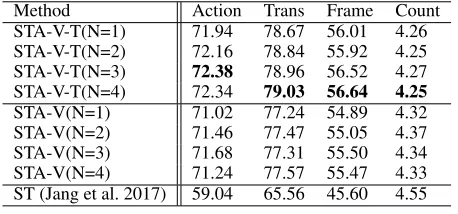
Table 2: Ablation study on theTGIF-QAdataset. For eval-uation metric, Action, Trans. and FrameQA use ACC (%), while Count adopts Mean Square Error (MSE). V and T in-dicates visual attention and text attention. N indicates the number of video segments. ST is the best published meth-ods using the same features as our model uses.
Method Action Trans Frame Count
STA-V-T(N=1) 71.94 78.67 56.01 4.26
STA-V-T(N=2) 72.16 78.84 55.92 4.25
STA-V-T(N=3) 72.38 78.96 56.52 4.27
STA-V-T(N=4) 72.34 79.03 56.64 4.25
STA-V(N=1) 71.02 77.24 54.89 4.32
STA-V(N=2) 71.46 77.47 55.05 4.37
STA-V(N=3) 71.68 77.31 55.50 4.34
STA-V(N=4) 71.24 77.57 55.47 4.33
ST (Jang et al. 2017) 59.04 65.56 45.60 4.55
FrameQA, Action and Trans., the accuracy (ACC.) is em-ployed to evaluate model performance. Thus, the higher the ACC. is, the better the model is. The performance of Count is measured by Mean Square Error (MSE) between the true answer and the predicted answer. Therefore, lower MSE value indicates better performance of the model.
Implementation Details
For fair comparisons with recent work (Jang et al. 2017; Gao et al. 2018a), we use the same network ResNet152 (He et al. 2016) pre-trained on ImageNet 2012 classification to extract frame features. More specifically, all the frame fea-tures are obtained from the same pooling layer (pool5) and their dimension is2048. In all tables in the experimental sec-tion, we useRto indicates that the input video’s feature is extracted from ResNet152 feature. In addition, to reduce re-dundant information and reduce computation cost, we sam-ple 36 frames from each video with equal spacing.
For text representation, we first encode each word with a pre-trained GloVe embedding to generate a 300-D vector following (Jang et al. 2017; Gao et al. 2018a). All the words are further encoded by a one-layer LSTM, whose hidden state has the size of 512. All the hidden states are concate-nated and used for co-attention.
Training Details.In our experiments, the optimization al-gorithm is Adamax. The batch size is set as 128. The train epoch is set as 30. In addition, gradient clipping, weight nor-malization and dropout are employed in training. In addi-tion, our implementation is based on the Pytorch library.
Ablation Study
The framework of our proposed STA consists of multiple major components. In order to evaluate the contribution of each component to the final performance, we conduct sev-eral ablation studies on theTGIF-QAdataset. Experimental results are shown in Tab. 2.
The Role of Structured Segmentation.The first block of Tab. 2 shows the effect ofN, which is the number of struc-tured segments. From the first block, we found thatN = 4 improves performance of all four tasks to a certain extent. One possible reason is that dividing a video into multiple
Table 3: Comparison with the state-of-the-art method on the
TGIF-QAdataset. R indicates ResNet152 features. For video representation, all methods take video spatial vectors only as the visual inputs.
Model Action Trans. Frame Count
VIS+LSTM(agg)(R) 46.8 56.9 34.6 5.09
VIS+LSTM(avg)(R) 48.8 34.8 35.0 4.80
VQA-MCB(agg)(R) 58.9 34.3 25.7 5.17
VQA-MCB(avg)(R) 29.1 33.0 15.5 5.54
CT-SAN(R) 56.1 64.0 39.6 5.13
ST(R) 59.0 65.5 45.6 4.55
STA(R) 72.3 79.0 56.6 4.25
Table 4: Comparison with the state-of-the-art multi-feature based methods on theTGIF-QAdataset. R, C and F indicate Resnet152, C3D and Optical Flow features, respectively. Sp and Tp indicate spatial attention and temporal attention re-spectively.
Model Action Trans Frame Count ST (R+C) 60.1 65.7 48.2 4.38 ST-Sp (R+C) 57.3 63.7 45.5 4.28 ST-Sp-Tp (R+C) 57.0 59.6 47.8 4.56 ST-Tp (R+C) 60.8 67.1 49.3 4.40 ST-Tp (R+F) 62.9 69.4 49.5 4.32 Co-memory (R+F) 68.2 74.3 51.5 4.10 STA (R) 72.3 79.0 56.6 4.25
segments to conduct attention has the potential to locate the most relevant frames as well as to learn the long structures. However, the performance improvement with the increase in N is minor and the reason might be the nature of the GIF videos, which are well segmented and carefully curated, with an average length of 47 frames. Thus the advantages of our structured segment are not fully exploited.
The Role of Two-stream Attention.To analyze the con-tribution of two-stream attention: 1st-stream visual attention and 2nd-stream text attention, we conduct the second abla-tion study by removing the text attenabla-tion and keeping the vi-sual attention, which is represented as STA-V in Tab.2. From the table, we can see that with the same setting ofN, STA-V-T performs better than STA-V. WhenN = 4, STA-V-T surpasses STA-V by 1.1% on Action, 1.46% on Trans. and 1.17% on FrameQA, and reduces MSE to 4.25 on Count. This ablation study shows the beneficial effects of our text attention.
In order to examine the influence of the visual attention, we compare our STA-V with the best published results ob-tained by the spatial-temporal reasoning (ST) method (Jang et al. 2017). From the last block we can see that our STA-V significantly outperforms ST by a large margin (12.24%, 12.07%, 9.87% on Action, Trans. and FrameQA, respec-tively). In addition, for Count, compared with ST with MSE of 4.55, STA-V-T reduces the error score to 4.33.
Qualitative Results
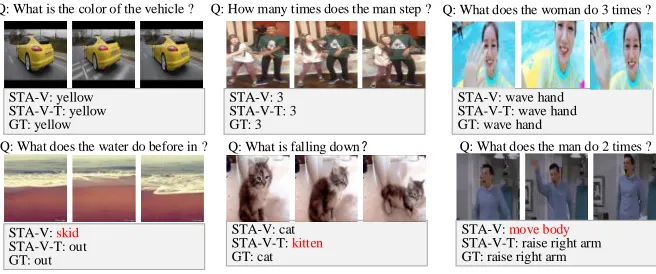
STA-V: yellow STA-V-T: yellow GT: yellow
STA-V: 3 STA-V-T: 3 GT: 3
STA-V: cat STA-V-T: kitten GT: cat
STA-V: move body STA-V-T: raise right arm GT: raise right arm STA-V: wave hand STA-V-T: wave hand GT: wave hand
STA-V: skid STA-V-T: out GT: out
Q: What is the color of the vehicle ? Q: How many times does the man step ? Q: What does the woman do 3 times ?
Q: What does the water do before in ? Q: What is falling down? Q: What does the man do 2 times ?
Figure 2: Some qualitative results produced by our models. Text in orange indicates incorrect answers.
three positive examples, where both models (i.e., STA-V and STA-V-T) can provide correct answers. The second row shows other examples. More specifically, the first and the third examples show that STA-V-T answers the questions correctly, while STA-V fails. The middle examples shows that occasionally STA-V can provide the correct answer.
Comparing with State-of-the-Arts on the TGIF-QA
Dataset
To date, a few studies have been conducted on the video QA task. Existing methods can be divided into two cate-gories: 1) image-based approaches including VIT+LSTM (Ren, Kiros, and Zemel 2015a) and VQA-MCB (Fukui et al. 2016); and 2) video-based approaches including ST (Jang et al. 2017) and Co-memory (Gao et al. 2018a). Our method belongs to the second category. Usually, videos contain two types of features: spatial and temporal. Spatial features are usually extracted from a CNN network, while temporal fea-tures are extracted from optical flows or via a C3D network. Therefore, in this case, we can divide the existing methods into two categories: single feature based methods and multi-feature based methods.
Our method STA utilizes single feature for represent-ing videos. Therefore, in this section, we first compare our method with existing methods which take only ResNet152 frame features as visual inputs to conduct answer prediction. The experimental results are shown in Tab. 3. In order to ap-ply image-based approach, multiple frames’ spatial features must be firstly merged into a vector, which is considered as the alternative of image features to be fed into an image-based agg. or avg. image-based model. Agg. and avg. are proposed in (Jang et al. 2017) to directly apply image-based methods. The agg. is conducted by averaging all frames’ features and uses the average spatial feature as input to the model. Com-pared with agg., avg. is more complicated. It runs answer prediction on each frame, and then averages all frames’ pre-dicted answers to obtain the final result. It can be seen from Tab. 3 that our method outperforms the best publish results ST(R) by 13.3%, 13.5% and 11.0% on Action, Trans. and FrameQA, respectively. For count, STA reduces the error score to 4.25.
Furthermore, we compare our method STA with multi-feature based methods, which include ST (Jang et al. 2017) and Co-memory (Gao et al. 2018a). Specifically, ST com-bines ResNet152 features (marked as R in Tab.4) with C3D features (C) or optical flow features (F), while Co-memory incorporates both R and F. The comparison re-sults are given in Tab. 4. From these rere-sults, we can ob-serve that Co-memory (R+F) outperforms all variants of ST, and achieves the best performance on the Count task. Compared with Co-memory (R+F), our STA model only takes ResNet152 features as input. However, for Action, Trans. and FrameQA tasks, it significantly outperforms Co-memory (R+F) (68.2%, 74.3%, and 51.5%, respectively) and yields the best performance reaching 72.3%, 79.0%, 56.6%, respectively. Even for the Count task, our STA achieves the second best and comparable result.
Conclusion
In this work, we propose a novel Structured Two-stream Attention Network (STA) for Video Question Answering. We first utilize our structured segment component to infer rich long-range temporal structures in videos and also en-code questions to features. Then, instead of simply concate-nating video and question features to answer the questions, we utilize a two-stream attention mechanism to simultane-ously localize visual instances relevant to the questions and to avoid the influence of background video or irrelevant text. Finally, the structured two-stream fusion component incor-porates different segments of query- and video-aware con-text representations and infers the answers for different types of questions. Our comprehensive evaluation on the TGIF-QAdataset shows our STA model outperforms state-of-the-art methods significantly.
Acknowledgements
References
Antol, S.; Agrawal, A.; Lu, J.; Mitchell, M.; Batra, D.; Zit-nick, C. L.; and Parikh, D. 2015. VQA: visual question answering. InICCV, 2425–2433.
Chen, H.; Ding, G.; Zhao, S.; and Han, J. 2018. Temporal-difference learning with sampling baseline for image cap-tioning. InAAAI.
Fukui, A.; Park, D. H.; Yang, D.; Rohrbach, A.; Darrell, T.; and Rohrbach, M. 2016. Multimodal compact bilinear pool-ing for visual question answerpool-ing and visual groundpool-ing. In
EMNLP, 457–468.
Gao, H.; Mao, J.; Zhou, J.; Huang, Z.; Wang, L.; and Xu, W. 2015. Are you talking to a machine? dataset and methods for multilingual image question answering. CoRR
abs/1505.05612.
Gao, Y.; Beijbom, O.; Zhang, N.; and Darrell, T. 2016. Com-pact bilinear pooling. InCVPR, 317–326.
Gao, J.; Ge, R.; Chen, K.; and Nevatia, R. 2018a. Motion-appearance co-memory networks for video question answer-ing.CoRRabs/1803.10906.
Gao, L.; Zeng, P.; Song, J.; Liu, X.; and Shen, H. T. 2018b. Examine before you answer: Multi-task learning with adaptive-attentions for multiple-choice VQA. InACM MM, 1742–1750.
Gu, J.; Cai, J.; Wang, G.; and Chen, T. 2018. Stack-captioning: Coarse-to-fine learning for image captioning. In
AAAI.
He, K.; Zhang, X.; Ren, S.; and Sun, J. 2016. Deep residual learning for image recognition. InCVPR, 770–778.
Jang, Y.; Song, Y.; Yu, Y.; Kim, Y.; and Kim, G. 2017. TGIF-QA: toward spatio-temporal reasoning in visual question an-swering. InCVPR, 1359–1367.
Kim, J.; On, K. W.; Lim, W.; Kim, J.; Ha, J.; and Zhang, B. 2016. Hadamard product for low-rank bilinear pooling.
CoRRabs/1610.04325.
Li, Y.; Song, Y.; Cao, L.; Tetreault, J. R.; Goldberg, L.; Jaimes, A.; and Luo, J. 2016. TGIF: A new dataset and benchmark on animated GIF description. InCVPR, 4641– 4650.
Lu, J.; Yang, J.; Batra, D.; and Parikh, D. 2016. Hierarchical question-image co-attention for visual question answering. InNIPS, 289–297.
Lu, P.; Ji, L.; Zhang, W.; Duan, N.; Zhou, M.; and Wang, J. 2018a. R-VQA: learning visual relation facts with semantic attention for visual question answering. InSIGKDD, 1880– 1889.
Lu, P.; Li, H.; Zhang, W.; Wang, J.; and Wang, X. 2018b. Co-attending free-form regions and detections with multi-modal multiplicative feature embedding for visual question answering. InAAAI.
Nam, H.; Ha, J.; and Kim, J. 2017. Dual attention networks for multimodal reasoning and matching. InCVPR, 2156– 2164.
Nguyen, D.-K., and Okatani, T. 2018. Improved fusion of
visual and language representations by dense symmetric co-attention for visual question answering. InCVPR.
Patro, B., and Namboodiri, V. P. 2018. Differential attention for visual question answering. InCVPR.
Pennington, J.; Socher, R.; and Manning, C. D. 2014. Glove: Global vectors for word representation. InEMNLP, 1532– 1543.
Ren, M.; Kiros, R.; and Zemel, R. S. 2015a. Exploring models and data for image question answering. In NIPS, 2953–2961.
Ren, M.; Kiros, R.; and Zemel, R. S. 2015b. Image question answering: A visual semantic embedding model and a new dataset. CoRRabs/1505.02074.
Rohrbach, A.; Torabi, A.; Rohrbach, M.; Tandon, N.; Pal, C. J.; Larochelle, H.; Courville, A. C.; and Schiele, B. 2017. Movie description. International Journal of Computer Vi-sion123(1).
Russakovsky, O.; Deng, J.; Su, H.; Krause, J.; Satheesh, S.; Ma, S.; Huang, Z.; Karpathy, A.; Khosla, A.; Bernstein, M. S.; Berg, A. C.; and Li, F. 2014. Imagenet large scale visual recognition challenge. CoRRabs/1409.0575. Song, J.; Gao, L.; Guo, Z.; Liu, W.; Zhang, D.; and Shen, H. T. 2017. Hierarchical LSTM with adjusted temporal attention for video captioning. InIJCAI, 2737–2743. Song, J.; Guo, Y.; Gao, L.; Li, X.; Hanjalic, A.; and Shen, H. T. 2018a. From deterministic to generative: Multimodal stochastic rnns for video captioning. IEEE Transactions on Neural Networks and Learning Systems1–12.
Song, J.; Zeng, P.; Gao, L.; and Shen, H. T. 2018b. From pixels to objects: Cubic visual attention for visual question answering. InIJCAI, 906–912.
Tapaswi, M.; Zhu, Y.; Stiefelhagen, R.; Torralba, A.; Urta-sun, R.; and Fidler, S. 2016. Movieqa: Understanding sto-ries in movies through question-answering. InCVPR, 4631– 4640.
Teney, D.; Anderson, P.; He, X.; and van den Hengel, A. 2018. Tips and tricks for visual question answering: Learn-ings from the 2017 challenge. InCVPR.
Xu, H., and Saenko, K. 2016. Ask, attend and answer: Ex-ploring question-guided spatial attention for visual question answering. InECCV, 451–466.
Yang, Z.; He, X.; Gao, J.; Deng, L.; and Smola, A. J. 2016. Stacked attention networks for image question answering. InCVPR, 21–29.
Yu, Y.; Ko, H.; Choi, J.; and Kim, G. 2017a. End-to-end concept word detection for video captioning, retrieval, and question answering. InCVPR, 3261–3269.