The Thirty-Third AAAI Conference on Artificial Intelligence (AAAI-19)
Consensus Adversarial Domain Adaptation
Han Zou,
1∗Yuxun Zhou,
1Jianfei Yang,
2Huihan Liu,
1Hari Prasanna Das,
1Costas J. Spanos
11Department of Electrical Engineering and Computer Sciences, University of California, Berkeley, USA 2School of Electrical and Electronics Engineering, Nanyang Technological University, Singapore
{hanzou, yxzhou, liuhh, hpdas, spanos}@berkeley.edu, [email protected]
Abstract
We propose a novel domain adaptation framework, namely Consensus Adversarial Domain Adaptation (CADA), that gives freedom to both target encoder and source encoder to embed data from both domains into a common domain-invariant feature space until they achieve consensus during adversarial learning. In this manner, the domain discrep-ancy can be further minimized in the embedded space, yield-ing more generalizable representations. The framework is also extended to establish a new few-shot domain adapta-tion scheme (F-CADA), that remarkably enhances the ADA performance by efficiently propagating a few labeled data once available in the target domain. Extensive experiments are conducted on the task of digit recognition across multi-ple benchmark datasets and a real-world problem involving WiFi-enabled device-free gesture recognition under spatial dynamics. The results show the compelling performance of CADA versus the state-of-the-art unsupervised domain adap-tation (UDA) and supervised domain adapadap-tation (SDA) meth-ods. Numerical experiments also demonstrate that F-CADA can significantly improve the adaptation performance even with sparsely labeled data in the target domain.
Introduction
In recent years, a booming development of deep learning methods has been witnessed, partially as a consequence of the availability of a large amount of labeled data to train and validate more advanced models. More often than not, these recognition models trained with the large datasets perform extremely well in one domain, i.e., the source domain. How-ever, they often fail to generalize well to new datasets or new environments, i.e., the target domain, due to domain shift or dataset bias (Tzeng et al. 2017).
To alleviate the issue of domain shift, a large body of research has been carried out on domain adaptation, which aims to distill the shared knowledge across domains and therefore improving the generalization of the learned model. Domain adaptation methods can be categorized into 2 classes, unsupervised domain adaptation (UDA) and su-pervised domain adaptation (SDA), depending on whether
∗
Han Zou is the corresponding author.
Copyright c2019, Association for the Advancement of Artificial Intelligence (www.aaai.org). All rights reserved.
labeled data is available in the target domain. In many real-world cases, it is time-consuming, labor-intensive and ex-pensive to collect and annotate a huge number of samples in the target domain. Thus, in practice, research on UDA is arguably more popular than SDA since collecting unla-beled target data is usually a trivial task. Conventional UDA methods (e.g., DDC (Tzeng et al. 2014), RevGrad (Ganin and Lempitsky 2015) and DRCN (Ghifary et al. 2016)) map data from both domains into a common feature space to re-duce the domain shift. This is achieved by minimizing some measure of distance between the target and source feature distributions, e.g., correlation distances or maximum mean discrepancy. The goal is to identify a feature space in which samples from both target and source domain are indistin-guishable. Once the task is accomplished, the model con-structed in the source domain can be applied to the tasks in the target domain by embedding the dataset with the learned transformation.
GAN’s exactly, where the real image distribution remains fixed and synthesized one is learned to match it. Similar to GAN, the source feature representation is considered as an absolute good reference for the target, leading to the stag-nated parameters of the source encoder. However, in prac-tice, the domain discrepancy between source and target is considerably significant. This assumption, therefore, might not always hold and the target data cannot be completely embedded into the imposed representation space. Both of the aforementioned concerns would result in sub-optimal adap-tation, particularly when the target representation is far from source features in the latent space or the source encoder al-ready exhibits over-fitting.
In this paper, we proposeConsensusAdversarialDomain
Adaptation (CADA), a novel unsupervised ADA scheme that gives freedom to both target encoder and source en-coder. As such, they can achieve consensus and transform data from both domains into a general domain-invariant fea-ture space to further accommodate the domain discrepancy and avoid over-fitting models in neither domain. After ob-taining a source encoder and a source classifier as a good reference in the source domain, CADA trains a target en-coder and also gives freedom to the source enen-coder by fine-tuning it through adversarial learning. In this manner, both unlabeled target data and labeled source data are embedded to a domain-invariant feature space defined by both domains, in a way that a domain discriminator cannot distinguish the domain labels of them. The original source classifier is fur-ther fine-tuned as a shared classifier with the source dataset and the source encoder is refined via ADA. In the target do-main, we employ the trained target encoder to embed the target samples into the domain-invariant feature space and infer its class using the shared classifier. In certain appli-cations, a few labeled data samples can be collected oppor-tunistically in the target domain. This availability is scarce in practice but is precious for model improvement. To leverage the extra information, we also propose a few-shot version of CADA (F-CADA) which exploits the prior labeled data by greedy label propagation for further performance enhance-ment. In a nutshell, given a well-defined metric in the latent feature space, F-CADA assigns presumptive labels to unla-beled data points in the target domain, by greedily minimiz-ing an information entropy loss function. The target encoder is then fine-tuned and a target classifier is constructed using both the prior and presumptively labeled data. The whole process can be repeated until convergence. The class of each target test sample is inferred using the final target encoder and classifier.
The performance of CADA and F-CADA are validated to the task of digit recognition across domains on standard digit adaptation dataset (MNIST, USPS, and SVHN digits datasets) and the task of spatial adaptation for WiFi-enabled device-free gesture recognition (GR). Experimental results demonstrate that CADA achieves outstanding domain adap-tation results and outperforms state-of-the-art methods on both digit adaptation and spatial adaptation for GR. For the challenging SVHN⇒MNIST scenario, it improves the digit recognition accuracy from 60% to 91%. It also enhances the GR accuracy by 25% over non-adapted classifier under
environmental dynamics. Moreover, F-CADA achieves fur-ther performance gain over the best few-shot ADA methods when only one labeled target sample per class is available. It validates that the proposed label learning method indeed contributes to the overall performance improvement.
Related Work
Unsupervised Domain Adaptation The performance of conventional classifiers degrade severely when the data dis-tribution in source domain and target domain are different. Unsupervised domain adaptation (UDA) aims to reduce the difference in the feature distribution between the source and target domain to improve generalization performance with-out requiring any labeled data in target domain (Tzeng et al. 2017). Some metrics have been proposed to measure the domain shift between source and target domains for their difference minimization. For instance, maximum mean dis-crepancy is leveraged by DDC (Tzeng et al. 2014), that es-timates the norm of mean difference and matches higher or-der statistics of the two distributions in a reproducing kernel Hilbert space. RevGrad (Ganin and Lempitsky 2015) and DRCN (Ghifary et al. 2016) treat domain invariance as a bi-nary classification problem and maximize the classifier loss by reversing its gradients.
Adversarial Domain Adaptation Recently, with the booming development of Generative Adversarial Network (GAN) (Goodfellow et al. 2014), researchers have proposed to construct an adversarial loss to accommodate the domain shift, which is commonly referred to as adversarial domain adaptation (ADA) (Shen et al. 2018). Similar to the learn-ing configuration of GAN, the generator of ADA aims to fool the discriminator to make the target domain samples look like the source domain ones, and the discriminator tries to identify the domain labels (source or target) instead of fake or real image in GAN. CoGAN (Liu and Tuzel 2016) trains 2 GANs to synthesize both source and target images and achieves a domain invariant feature space by tying the high-level layer parameters of the 2 GAN to solve the do-main transfer problem. ADDA (Tzeng et al. 2017) learns a discriminative representation using the labels in the source domain and then a separate encoding that maps the target data to the same space using an asymmetric mapping learned through a standard GAN loss without weights sharing. A cycle-consistency loss is designed in CyCADA (Hoffman et al. 2017) to enforce both structural and semantic consistency during ADA. One major limitation for these methods is that the adversarial discriminative models focus on aligning fea-ture embeddings of target domain to source domain defined by the source encoder. Since the parameters of source en-coder are fixed during ADA, there is no freedom for the source encoder. Thus, the ADA performance is not guaran-teed when the target representation is far from source fea-tures.
Figure 1: An overview of CADA. Step 1: A source encoder and a source classifier are trained with the labeled source data. Step 2: A target encoder is trained and the source encoder is fine-tuned through unsupervised adversarial domain adaptation to map both target data and source data to a domain-invariant feature space such that a domain discriminator cannot distinguish the domain labels of the data. Step 3: A shared classifier is constructed with the labeled source data. Step 4: During testing, the class of each target test sample is inferred using the target encoder trained in Step 2 and shared classifier obtained in Step 3. The network parameters in solid line boxes are fixed and those in dashed line boxes are trained in each step.
(SDA) can efficiently transfer the knowledge from source domain to this sparsely labeled target domain. Also, SDA does not demand large annotation overhead commonly re-quired by standard supervised learning approaches. In (Luo et al. 2017), the authors propose a framework that learns a representation transferable across different domains and tasks in a label efficient manner. It tackles the problem of high sensitivity and overfitting during fine-tuning stage us-ing a novel end-to-end SDA approach. Apart from feature-based SDA method, Ren et al. (2018) designed a proto-typical network from the perspective of metric learning. It maps the samples into a space where the samples from the same class are close and those from different classes are far apart. Recently, few-shot learning has become attractive because only a few labeled data is required for adaptation. In domain adaptation, few-shot adversarial domain adapta-tion (FADA) (Motiian et al. 2017a) is proposed to trans-fer knowledge with only several annotated samples in each class. It exploits adversarial learning to learn an embedded subspace that simultaneously maximizes the confusion be-tween two domains while semantically aligning their em-beddings. However, they only consider a few labeled target samples but never use unlabeled target samples that are more easily obtained. In our approach, we build the few-shot do-main adaptation based on semi-supervised learning, which minimizes the domain confusion via adversarial training and guides the adaptation process in a few-shot manner.
Consensus Adversarial Domain Adaptation
The objective of CADA is to improve the generalization capability of a classifier across domains without collecting labeled data in the target domain via ADA. The rationale behind CADA is to embed data from both domains into a common feature space until they achieve consensus during ADA. It is different from existing methods, which force rep-resentation alignment of the target to the source. The system-atic training procedure of CADA is demonstrated in Fig. 1, which is consisted of 4 steps. The detailed methodology of each step is elaborated as follows.
Step 1:SupposeNssamplesXswith labelsYs are
col-lected in the source domain with L possible classes. As
the first step of CADA, we train a source encoder Msand
a source classifier Cs so that the source samples can be
recognized with high classification accuracy. Mathemati-cally, Step 1 solves the following minimization via back-propagation:
min
Ms,Cs
LCs(Xs, Ys) =
−E(xs,ys)∼(Xs,Ys) L
X
l=1
[I[l=ys]logCs(Ms(xs))] (1)
This is indispensable since a good baseline of the feature space and the classifier for the sub-sequent steps is needed.
Step 2: More often than not, data labeling in the target domain is a time-consuming and expensive process. On the other hand, accumulating unlabeled data in the target do-main, denoted byXt, is usually a trivial task. As the most
essential step of CADA, in Step 2 we train a target encoder
Mtand fine-tune the source encoderMssuch that a
discrim-inatorDcannot tell whether a sample is from the source do-main or from the target dodo-main after the associated feature mapping. In other words, after the feature embedding in the target and source domain viaMt(Xt)andMs(Xs),
respec-tively, the domain label cannot be effectively recognized by a well-formed discriminator D. This task is similar to the original GAN, that aims to generate a fake image that is in-distinguishable from the real image. In our case, the labels for the discriminatorD are domain labels (source and tar-get) instead of fake and real. We formulate this step as an optimization of the following adversarial loss,
min
Ms,Mt
max
D LD(Xs,Xt, Ms, Mt) =
Exs∼Xs[logD(Ms(xs))] +Ext∼Xt[log(1−D(Mt(xt)))]
(2)
The GAN loss for the source encoderMsis
min
Ms
LMs(Xs,Xt, D) =−Exs∼Xs[logD(Ms(xs))] (3)
and the inverted label GAN loss (Goodfellow et al. 2014) is employed to train the target encoderMtas follows,
min
Mt
Figure 2: An overview of F-CADA. Step 1 and Step 2 are the same as CADA. Step 3: in the target domain, presumptive labels are generated for target unlabeled data with target few labeled data. Then, the target encoder is fine-tuned and a target classifier is constructed with unlabeled and few labeled target data. Step 4: During testing, the class of each target test sample is inferred using the target encoder and target classifier obtained in Step 3. The network parameters in solid line boxes are fixed and those in dashed line boxes are trained in each step.
The parameters inMtandMsare initialized with those of
the source encoder Ms learned in the Step 1 for burn-in
training. It is worth pointing out the novelty of CADA and its difference from the state-of-the-art ADA methods (e.g. ADDA (Tzeng et al. 2017) and DIFA (Volpi et al. 2017)). Under previous methods, the parameters of the source coder are fixed during the training process of the target en-coder via ADA. Consequently, the feature mapping is de-fined by the source encoder and ADA essentially tries to align the feature embeddings of the target domain with the source domain. In this way, the obtained source encoder is used as an absolute reference, which may deteriorate the do-main adaptation performance because the alignment could be sub-optimal when the target samples cannot be com-pletely embedded into the imposed representation space. The issue can be substantial particularly when the source and the target domain exhibit material discrepancy or the source encoder already bears some overfitting. This bottle-neck is well-addressed in the proposed CADA framework, where the parameters of the source encoder are not fixed but are instead given the freedom to be fine-tuned together with the target encoder. Therefore, the feature space is defined by the consensus betweenMtandMs, yielding better
general-ization in both the domains.
Step 3:When the discriminatorD in Step 2 is not able to identify the domain label of target samples and source samples, it is an indication that the target encoderMtand
the source encoderMsachieved consensus by mapping the
corresponding input data to a shared domain-invariant fea-ture space. Given that, we fix the parameters of the source encoderMsand train a shared classifier Cshusing the
la-beled source domain data{Xs, Ys}. The learning process is
equivalent to minimizing the cross-entropy loss:
min
Csh
LCsh(Xs, Ys) =
−E(xs,ys)∼(Xs,Ys) L
X
l=1
[I[l=ys]logCsh(Ms(xs))] (5)
The shared classifierCshcan be directly used in the target
domain since the target encoderMthas embedded the target
samples to the domain-invariant feature space.
Step 4:During testing in the target domain, we map the target test samples to the domain-invariant feature space through the target encoder Mt trained in Step 2, and then
use the shared classifierCsh obtained in Step 3 to identify
category of the samples in the target domain without collect-ing any labeled target data.
In summary, the complete learning objective of CADA can be formulated as follows:
LCADA(Xs,Xt, Ys, D, Ms, Mt) =LCs(Xs, Ys) (6)
+LD(Xs,Xt, Ms, Mt) +LMs(Xs,Xt, D)
+LMt(Xs,Xt, D) +LCsh(Xs, Ys)
The training of CADA is thusly equivalent to solving:
min
Csh
min
Mt,Ms
max
D Mmins,Cs
LCADA(Xs,Xt, Ys, D, Ms, Mt)
As is illustrated in Fig. 1, we firstly train a source en-coderMsand a source classifierCswith the labeled source
data by optimizingLCs as described in equation (1). After
that, in Step 2, we train a target encoderMtand fine-tune
the source encoderMsvia adversarial learning by
optimiz-ingLD,LMsandLMt, i.e., equation (2)-(4). Then, a shared
classifierCshis constructed in Step 3 with the labeled source
domain data by optimizing LCsh as described in equation
(5). During testing in Step 4, we employ the trained target encoderMtto map the test sample from the target domain
into the domain-invariant feature space and use the shared classifierCshdirectly to identify the category of each
test-ing sample in the target domain.
Few-shot Consensus Adversarial Domain
Adaptation (F-CADA)
A powerful extension of the CADA learning framework is to enrich it with the ability to integrate a few labeled data that may be available in the target domain for information fusion and model improvement. This task, although seems chal-lenging in many other learning paradigms, can be achieved efficiently with F-CADA. Notation-wise, we assume thatNs
samples Xswith labels Ys are available in the source
do-main and the target dodo-main containsNu
t unlabeled samples
byXlt, are assumed available with associated labelsYtl in
the target domain. To conform with the scenario of few-shot learning, the number of labeled samples in the target do-main is much smaller than the that of unlabeled ones, i.e.,
Nl
tNtu. Moreover, it is also much smaller than the
num-ber of source domain samples, i.e.,NtlNs.
The overall training procedure of F-CADA is presented in Fig. 2. All the other steps are pretty much similar to CADA except for step 3, detailed below:
Step 3:Suppose few labeled samples{Xlt,Ytl}are
avail-able in the target domain. As the most vital step in F-CADA, we design a label learning algorithm to assign presumptive labels Y˜l
t to target unlabeled samplesXut. Then, we
fine-tune the target encoder obtained in Step 2 and build up a target classifierCtusing both unlabeled target samples with
presumptive labels {Xu
t, Y˜tl } and labeled target samples {Xlt,Ytl}.
Assumekilabeled samples are available for classiin the
target domain, we can compute in the embedded space (1) the centroid vectorcifor each class and (2) a similarity
met-ric between each unlabeled target samplexu
t,j ∈Xut and the
specific centroid, denoted byψ f(xut,j), ci
. Depending on the dimension of the transformed feature space, this simi-larity metric can simply be a Gaussian kernel to capture lo-cal similarity (Maaten and Hinton 2008), or the inverse of Wasserstein distance (Shen et al. 2018) for better general-ization with complex networks.
Ideally, the semi-supervised scheme should be able to (1) identify the correct labels of unlabeled target samples, and (2) update the encoder with the additional information. Us-ing information entropy as the measure of “goodness of sep-aration”, we can formulate the joint objective into the fol-lowing minimization:
min
yu
t,j∈Y˜tu,f∈H
LU(Xut,X l t,Y˜
l t) =
X
xu t,j∈Xut
Hσ(ψ(f(xut,j), cyu t,j)/τ)
where theH(·)is the entropy function,σ(·)is the softmax function, andτ is a decay factor that controls the neighbor-hood proximity. The above problem is combinatorial in na-ture due to the discrete presumptive labelsyut,j. We establish an alternating approach that recursively performs (1) fixing the feature mappingf and propagating presumptive labels using a greedy assignment, i.e., thejthunlabeled sample is
presumed to have the same label to its closest centroid, and (2) updating the feature mapping (the encoder) as supervised learning by treating the presumptive labels as true labels.
The proposed greedy propagation, intuitively simple and practically easy to implement, in fact has theoretical guar-antees since the entropy objective is approximately submod-ular when the feature mapping is fixed. Interested readers are referred to (Zhou and Spanos 2016) for a detailed theo-retical analysis. The above is conducted alternately until the convergence of the feature mapping and presumptive label assignment. In practice, it is observed that the convergence is usually achieved in few iterations. Adding the above ob-jective function to that of CADA in equation (6), we obtain
the overall learning formulation of F-CADA. In the testing step (step 4 in Fig. 2), we map the target testing samples to the latent feature space through the updated target encoder
Mt, and then apply the updated target classifierCtto
iden-tify their classes.
Experiments
We evaluate CADA and F-CADA for 2 real-world domain adaptation problems: 1) digit classification adaptation across 3 benchmark splits of public digit datasets; 2) spatial adap-tation for WiFi-enabled device-free gesture recognition.
Digit Adaptation
3 public digit datasets, MNIST (LeCun et al. 1998), USPS (Hull 1994), and SVHN (Netzer et al. 2011), which con-sist 10 classes of digits are used in our digit adaptation experiments. We evaluate our methods across 3 adaptation shifts: MNIST⇒USPS, USPS⇒MNIST, and SVHN⇒
MNIST, that are commonly adopted for digit adaptation as-sessment. The models are trained using the full training sets and evaluated on the full testing sets. We leverage a variant of the LeNet architecture as the encoder and the classifier for CADA and F-CADA for all digit shifts. We repeat the exper-iment 50 times for each digit adaptation case and performed model selection based on the recent Bayesian optimization technique (Malkomes, Schaff, and Garnett 2016) to identify optimal choices of all hyper-perimeters, e.g., the structure and dropout rate of the encoder, the decay fact of F-CADA, etc.
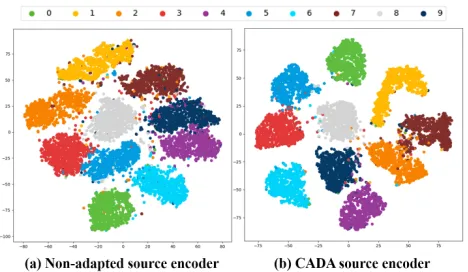
Figure 3: The t-SNE visualization of features embedded us-ing distinct encoders in target domain. (SVHN⇒MNIST).
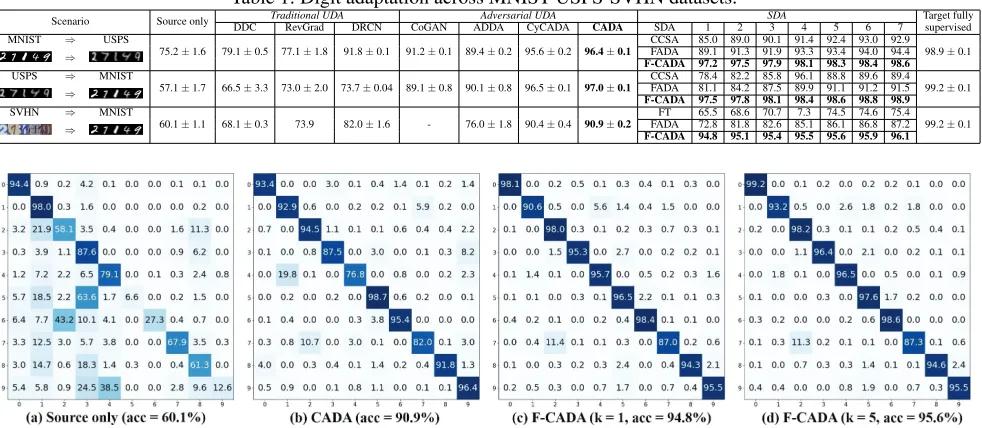
Performance of CADA We compare the performance of CADA with 3 traditional UDA methods (DDC, RevGrad, DRCN), and 3 state-of-the-art adversarial UDA methods (CoGAN, ADDA, CyCADA). Table 1 reports the classifi-cation accuracies of these methods for each shift. The2nd
Table 1: Digit adaptation across MNIST-USPS-SVHN datasets.
Scenario Source only Traditional UDA Adversarial UDA SDA Target fully supervised DDC RevGrad DRCN CoGAN ADDA CyCADA CADA SDA 1 2 3 4 5 6 7
MNIST ⇒ USPS
75.2±1.6 79.1±0.5 77.1±1.8 91.8±0.1 91.2±0.1 89.4±0.2 95.6±0.2 96.4±0.1
CCSA 85.0 89.0 90.1 91.4 92.4 93.0 92.9 98.9±0.1
⇒ F-CADAFADA 89.197.2 91.397.5 91.997.9 93.398.1 93.498.3 98.494.0 94.498.6
USPS ⇒ MNIST
57.1±1.7 66.5±3.3 73.0±2.0 73.7±0.04 89.1±0.8 90.1±0.8 96.5±0.1 97.0±0.1
CCSA 78.4 82.2 85.8 96.1 88.8 89.6 89.4 99.2±0.1
⇒ F-CADAFADA 81.197.5 84.297.8 87.598.1 89.998.4 91.198.6 98.891.2 91.598.9
SVHN ⇒ MNIST
60.1±1.1 68.1±0.3 73.9 82.0±1.6 - 76.0±1.8 90.4±0.4 90.9±0.2
FT 65.5 68.6 70.7 7.3 74.5 74.6 75.4 99.2±0.1
⇒ F-CADAFADA 72.894.8 81.895.1 82.695.4 85.195.5 86.195.6 95.986.8 87.296.1
Figure 4: Confusion matrices for the digit adaptation (SVHN⇒MNIST).
for all the aforementioned digit adaptation scenarios. For rel-atively easy shift between MNIST and USPS (both greyscale hand-written digit datasets), CADA enhances the accuracy in both adaptation directions byat least 21%compared to the lower-baseline. It elevates the performance closer to su-pervised learning methods as well as the upper-baseline as demonstrated in Table 1.
The adaptation for SVHN⇒MNIST is much more chal-lenging since SVHN is a color digit dataset of house num-ber plates while MNIST contains unified greyscale digits. Even in this case, CADA improves the accuracy by 31%
over the lower-baseline and outperforms the prior works. We use t-SNE (Maaten and Hinton 2008) to map the em-bedded feature representations through different encoders to a 2-D space for better visualization of the domain shift. Fig. 3(a) and Fig. 3(b) depict the embedded features using the non-adapted source encoder and the CADA source en-coder, respectively (different color represents different dig-its). Confusion matrices before and after using CADA for this adaptation are presented in Fig. 4(a) and Fig. 4(b). If we directly apply the non-adapted source encoder in the target domain, as shown in Fig. 3(a), the clusters of 3s and 5s, 4s and 9s overlap with each other, which leads to correspond-ing large misclassification among these digits as shown in Fig. 4(a). After employing CADA, the digit clusters of these common confusions are separated in the latent feature space (Fig. 3(b)), that indeed contributes to the corresponding per-formance gain as presented in confusion matrix (Fig. 4(b)).
Performance of F-CADA We randomly chose (k = 1, . . . ,7) labeled samples per class as the labeled target sam-ples and utilized them for Step 3 label learning of F-CADA. The performance of F-CADA is compared with one SDA method: CCSA (Motiian et al. 2017b), and one advanced few-shot adversarial SDA method: FADA (Motiian et al.
Figure 5: Impact of number of labeled target samples on labeling accuracy and classification accuracy (SVHN ⇒
MNIST). The shaded area is the 5% and 95% percentile.
Table 2: Spatial adaptation for gesture recognition across different environments.
Scenario source only Traditional UDA Adversarial UDA F-CADA Target fully
supervised
RevGrad DRCN GoGAN ADDA CADA 1 3 5
Large⇒Small 58.4±0.7 68.1±0.2 69.3±0.3 69.4±0.2 71.5±0.3 88.8±0.1 92.3 96.3 98.7 99.2±0.1 Small⇒Large 62.2±0.6 66.6±1.1 65.8±0.7 70.2±0.5 67.7±0.6 87.4±0.1 91.7 96.0 98.3 99.1±0.1
Figure 6: Confusion matrices for gesture recognition (large conference room⇒small conference room).
Figure 7: Floor plan of the testbeds for the spatial adaptation experiments and sample CSI frames from different spatial sources.
MNIST when distinct numbers of labeled target samples are available. We can easily observe the positive correlation be-tween label learning accuracy and classification accuracy as the number of labeled target samples is increased. Compar-ing the confusion matrices between CADA (Fig. 4(b)) and F-CADA (k = 1) (Fig. 4(c)), the digit misclassification be-tween 1s and 4s is reduced significantly by F-CADA with only one labeled target sample per class. It leads to4% over-all accuracy improvement. These analyses prove the excel-lent few-shot domain adaptation performance of F-CADA even when the number of labeled target samples is tiny.
Spatial Adaptation for Gesture Recognition
We also implement our methods to enhance the spatial adap-tation capability of WiFi-enabled device-free gesture recog-nition (GR). By leveraging fine-grained channel measure-ment (Channel State Information (CSI)) from WiFi physi-cal layer and advanced machine learning methods, numer-ous occupancy sensing tasks, e.g. crowd counting (Zou et al. 2018b), human activity recognition (Zou et al. 2018c), and even human identification (Zou et al. 2018a), have been re-alized in a device-free, privacy-preserving and non-intrusive manner. Since human gestures also alter the WiFi signal
propagation among WiFi-enabled IoT devices, we can iden-tify the gestures in a device-free manner via the Channel State Information (CSI) enabled sensing platform proposed in (Zou et al. 2018a). One major bottleneck being, tedious data collection and labeling process required to train a new gesture classifier when the system is to be employed in a new environment. The classifier is also vulnerable to spa-tial variations. Thus, we aim to use our methods to improve the accuracy and resilience of the classifier over spatial dy-namics without collecting 1) any labeled target samples, 2) sparsely labeled ones. As shown in Fig. 7, the experiments were conducted in 2 conference rooms with different sizes (i.e. a large conference room (7m×5m) and a small confer-ence room (6.1m×4.4m). Volunteers performed 6 common gestures, moving a hand right and left, up and down, push and pull between the two IoT devices. 200 samples per ges-ture were collected in each room during different days. Af-ter transforming CSI time series data into CSI frames (each CSI frames size: 400×228 as depicted in Fig. 7), we modi-fied the LeNet architecture and designed a dedicated encoder and classifier for our methods.
Performance of F-CADA We randomly chose (k = 1,3,5) labeled samples per gesture as the labeled target samples and used them for the Step 3 of F-CADA train-ing process. Similar to the digit adaptation results, F-CADA achieves significant performance gain over UDA methods byat least 3.5%when only one labeled sample per gesture is available in the target domain. Moreover, as demonstrated in Table 2 and Fig. 6, its accuracy is further increased when a little more labeled samples are available and employed. Its accuracy reaches98.5%with 5-shot learning, which is only 0.6% lower than the upper-baseline (train a new classifier with full labeled target samples).
Conclusion
In this paper, we proposed Consensus Adversarial Domain Adaptation (CADA) that gives freedom to both target en-coder and source enen-coder in adversarial learning, by em-bedding data from both domains into a consensus domain-invariant feature space. In this manner, the domain discrep-ancy can be further minimized. CADA’s feature represen-tations are more robust to large domain shift and have the capacity to avoid over-fitting models in both domains. A novel few-shot domain adaptation scheme (F-CADA) is also proposed to enhance the ADA performance by exploring few labeled target data in an efficient way. By inheriting CADA’s feature representation, F-CADA assigns presump-tive labels to unlabeled data points in the target domain, by greedily minimizing an information entropy loss function. The greedy label learning method has theoretical guaran-tees since the entropy objective is approximately submod-ular. Extensive real-world experiments on digit recognition across multiple benchmark digit datasets and WiFi-enabled device-free gesture recognition under spatial dynamics are conducted. The results validate that CADA achieves com-pelling results and outperforms state-of-the-art UDA and SDA methods. F-CADA can further enhance the adaptation performance even with sparsely labeled target data.
Acknowledgments
This work is supported by a 2018 Seed Fund Award from CITRIS and the Banatao Institute at the University of Cal-ifornia. We gratefully acknowledge the support of NVIDIA Corporation with the donation of the Titan Xp GPU used for this research.
References
Ganin, Y., and Lempitsky, V. 2015. Unsupervised domain adapta-tion by backpropagaadapta-tion. InInternational Conference on Machine Learning, 1180–1189.
Ghifary, M.; Kleijn, W. B.; Zhang, M.; Balduzzi, D.; and Li, W. 2016. Deep reconstruction-classification networks for unsuper-vised domain adaptation. InEuropean Conference on Computer Vision, 597–613. Springer.
Goodfellow, I.; Pouget-Abadie, J.; Mirza, M.; Xu, B.; Warde-Farley, D.; Ozair, S.; Courville, A.; and Bengio, Y. 2014. Genera-tive adversarial nets. InAdvances in neural information processing systems, 2672–2680.
Hoffman, J.; Tzeng, E.; Park, T.; Zhu, J.-Y.; Isola, P.; Saenko, K.; Efros, A. A.; and Darrell, T. 2017. Cycada: Cycle-consistent ad-versarial domain adaptation.arXiv preprint arXiv:1711.03213. Hull, J. J. 1994. A database for handwritten text recognition re-search. IEEE Transactions on pattern analysis and machine intel-ligence16(5):550–554.
LeCun, Y.; Bottou, L.; Bengio, Y.; and Haffner, P. 1998. Gradient-based learning applied to document recognition. Proceedings of the IEEE86(11):2278–2324.
Liu, M.-Y., and Tuzel, O. 2016. Coupled generative adversarial networks. InAdvances in neural information processing systems, 469–477.
Luo, Z.; Zou, Y.; Hoffman, J.; and Fei-Fei, L. F. 2017. Label efficient learning of transferable representations acrosss domains and tasks. InAdvances in Neural Information Processing Systems, 164–176.
Maaten, L. v. d., and Hinton, G. 2008. Visualizing data using t-sne. Journal of machine learning research9(Nov):2579–2605. Malkomes, G.; Schaff, C.; and Garnett, R. 2016. Bayesian op-timization for automated model selection. InAdvances in Neural Information Processing Systems, 2900–2908.
Motiian, S.; Jones, Q.; Iranmanesh, S.; and Doretto, G. 2017a. Few-shot adversarial domain adaptation. InAdvances in Neural Information Processing Systems, 6673–6683.
Motiian, S.; Piccirilli, M.; Adjeroh, D. A.; and Doretto, G. 2017b. Unified deep supervised domain adaptation and generalization. In The IEEE International Conference on Computer Vision (ICCV), volume 2.
Netzer, Y.; Wang, T.; Coates, A.; Bissacco, A.; Wu, B.; and Ng, A. Y. 2011. Reading digits in natural images with unsupervised feature learning. InNIPS workshop on deep learning and unsuper-vised feature learning, volume 2011, 5.
Ren, M.; Triantafillou, E.; Ravi, S.; Snell, J.; Swersky, K.; Tenen-baum, J. B.; Larochelle, H.; and Zemel, R. S. 2018. Meta-learning for semi-supervised few-shot classification.arXiv preprint arXiv:1803.00676.
Shen, J.; Qu, Y.; Zhang, W.; and Yu, Y. 2018. Wasserstein distance guided representation learning for domain adaptation. InAAAI. Tzeng, E.; Hoffman, J.; Zhang, N.; Saenko, K.; and Darrell, T. 2014. Deep domain confusion: Maximizing for domain invariance. arXiv preprint arXiv:1412.3474.
Tzeng, E.; Hoffman, J.; Saenko, K.; and Darrell, T. 2017. Adversarial discriminative domain adaptation. arXiv preprint arXiv:1702.05464.
Volpi, R.; Morerio, P.; Savarese, S.; and Murino, V. 2017. Adver-sarial feature augmentation for unsupervised domain adaptation. arXiv preprint arXiv:1711.08561.
Zhou, Y., and Spanos, C. J. 2016. Causal meets submodular: Subset selection with directed information. InAdvances In Neural Infor-mation Processing Systems, 2649–2657.
Zou, H.; Zhou, Y.; Yang, J.; Gu, W.; Xie, L.; and Spanos, C. J. 2018a. Wifi-based human identification via convex tensor shapelet learning. InAAAI.
Zou, H.; Zhou, Y.; Yang, J.; and Spanos, C. J. 2018b. Device-free occupancy detection and crowd counting in smart buildings with wifi-enabled iot.Energy and Buildings174:309–322.