The Global Perception of Industry 4.0 For Reverse Logistics
Satya Shah 1*, Galeboe Dikgang2, Sarath Menon3
1Off Campus/Institute of Management, University of Bolton, United Kingdom
Abstract. Industry 4.0 (I 4.0) is currently recognised as a collective expression for different technologies. The gradual but steady adoption of different technologies in industry 4.0 plays a vital role in different areas of industries. Reverse logistics has been now a growing research area including identifying ways for industries to operate efficiently with industry 4.0. The potentials for cost reduction and profit maximisation have been realised by the involved corporations and a significant number of them is already investing heavily on the new technologies that result in efficient reverse logistics and performance. Researchers now believe that improving the reverse logistics results in sustainable developments in the current competitive market. In this paper researcher aims to focus on the impacts of Industry 4.0 over the reverse logistics.
1
Introduction
Procurement practices dates back to pre-industrial revolution and was practiced as a tactical contributor in the organization. Procurement evolved to mass production activities due to growth in demand and it became part of business planning. Transportation of goods became a vital aspect of procurement as well as warehouses for storing the goods. Production was based on push demand because the producer decided the quantities according to how they perceived demand. Push demand resulted in lots of products which were not consumed resulting in the need for storage to keep the goods that has resulted in increased inventory cost. When the mass production resulted in loss of profits and increased wastage for the manufacturer Toyota introduced the concept Just-in-Time. With Just-in-Time, customers pull goods from the manufacturer; therefore production is made as per order. However Just-in-Time did not take into consideration the disposal of goods at the end of shelf life [1]. This resulted in a lot of waste from used goods, landfills were filled up and as a results there was a problem of environment degradation, pollution and carbon-footprint as well as depletion of raw materials. One of the trends influencing in current industrial revolution is the need for industries and sectors to increase or improve productivity and efficiency by improving the purchasing and supply chain management. It has been important for competing firms to deliver satisfaction of benefits to achieve favor and loyalty from consumers through the right product, price, and distribution and promotion at the right time. As defined by many researchers, the industry 4.0 or the fourth industrial revolution is the combination of the existing information and communication technologies together towards the production of products and services [2]. The industry 4.0 is the mainstream, up to date digitalised industry which is in the path of development since 2011.
2 Literature Review
The methodology used to prepare this article is comparative. Several publications including international scientific journals or key-word conferences and books have been analysed with the keywords such as "Reverse Logistics", "industry 4.0", "industrial revolution", “Industry 4.0 impacts", "reverse supply chain".
2.1 Reverse Logistics
Reuse of products and materials is not a new phenomenon. Metal scrap brokers, waste paper recycling, and deposit systems for soft drink bottles are all examples that have been around for a long time. Waste reduction efforts have promoted the idea of material cycles instead of a 'one way' economy. The reuse opportunities give rise to a new material flow from the user back to the sphere of producers. The management of this material flow opposite to the conventional supply chain flow is the concern of the recently emerged field of reverse logistics [3]
as well as returned equipment and machines from the hardware leasing business [5]. Normally, logistics deal with events that bring the product towards the customer. In the case of reverse logistics, the resource goes at least one step back in the supply chain. For instance, goods move from the customer to the distributor or to the manufacturer. An effective reverse logistics is believed to result in direct benefits, including improved customer satisfaction, decreased resource investment levels, and reductions in storage and distribution costs.
During the literature review it has been identified that different authors has classified external and internal barriers for reverse logistics [6]. Internal barriers are the hindrance that exists within the industries while external barriers involve obstruction from outside the firms for the adoption of reverse logistics that pave way for green efforts[7]. The main barriers for reverse logistics are classified in table 1 [8][9]:
Table 1. Main barrier for reverse logistics
No. Clusters Description
01 Technology and infrastructure
It includes technology barriers, technical skills barrier and lack of infrastructure for development 02 Supply chain
process
This cluster includes reverse supply chain barriers including performance measurement
03 Governance and economic
This cluster includes cooperation issues, financial and economic barriers 04 Process and
knowledge
It consist of the information flow and reverse logistics awareness within the industries.
2.2 Industry 4.0
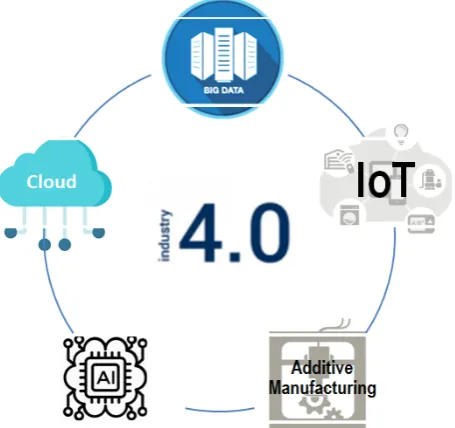
Industry 4.0 as explained “is a fourth industrial revolution of high technology strategy plan introduced by academia, industrials and the German government to achieve comprehensive transformation of the entire industrial production through the emergence of internet and information as well as communication technologies with traditional processes in order to strengthen competitiveness of manufacturing sector” [10]. The technology continues to be growing on as it is proving that it can reshape the logistics and supply chain environment in the Digital Age. Technologies that play a vital role in industry 4.0. major technologies in industry 4.0 are shown in figure 2.
Industry 4.0 is enabling the commercial activities to occur not only in the factory environment but also outside the markets. While automation already existed Industry 4.0 is enabling greater computerisation with increased flexibility and efficiency in manufacturing processes that results in enhancing the ability to satisfy customer requirements. These innovations of industry 4.0 technologies have led to a reduction in manufacturing down-time and improved customer satisfaction [11].
Figure 2: Technologies in Industry 4.0
Industry 4.0 adds value proposition to the customer involved in the reverse logistics by constant contact with the manufacturer through data collection and connectivity to used device to afford a customer tailor made services [12]. Operational costs are reduced through end-to-end digital integration. Industry 4.0 has the potential to improve factory in terms of technology, economically and on social performance through integration of technologies. The technology ensures safe working conditions in the assembly line through use of picking equipment that minimizes human effort and at the same time optimizes the process
.
Technology allows smart working through optimization of assembly activities, ensuring ergonomic work conditions.
Industry 4.0 is the integration of multiple heterogeneous networks, and it should address security and connectivity issues between different networks. Industry 4.0 applications are a stream of innovative technologies and services that focus more on the functions for improved production and efficiency that results economical improvements with increased customer satisfaction for the industry [13].2.3 Integration of Industry 4.0 in reverse Logistics
In the 20th century, creation of internet has resulted in a dynamic role for procurement [14]. Industries invest in technology so that they can derive more benefit and save costs. The following technologies are discussed as some of the techniques used to enhance reverse logistics processes.
Optiturn
contributes to reduction in gas emissions from transports thus better car for the environment. It inputs supporting infrastructure across big data processing, warehouse management, market place management and data analytics reporting. Stored data avails information on returned items, frequency of returns, condition of returned items and regulations for returns. The data is analysed to provide prize and condition of the returned item. The warehouse management system distinguishes different units of items. It has the ability to receive, put-away, stock, count, allocate, pick and ship items.
The flow of inventory is faster, thus adds value to a retailer’s bottom line. The platform has disposition engine where data is analysed to provide information on how returned items should be handled, i.e. returned to store shelf, routed to remarketing channels or end-of-life. The system evaluates condition of returned items, performs velocity optimization and allows users a criteria to target specific recovery. This information feeds on to the market place management engine, enabling an automatic listing process to allow returned items to be sold at the highest possible recovery net. Then the market place management engine, generates information that has bearing on price and it is able to generate required information in a fraction of a second. The system allows pricing of the items based on its conditions and secondary market supply and demand. It allows business to business disposals, listing on multiple marketplaces at the same time and real-time response to market conditions to avoid overselling of the product. It gives users an opportunity to get information on reasons for returns so as to understand trends and apply remediation tactics. Benefits for using Optiturn include inventory recovery, reduction of warehouse costs, include increased visibility into reverse logistics lifecycle.
Blockchain
The technology was initially invented to monitor transport services so that an organization is able to trace the movement of transport, decide on perfect routes and be on the alert when the transport has to be put on service. It also allows the organization to gauge the amount of fuel consumption. This gives the organization an opportunity to monitor good or misuse of the transport. Blockchain has also been adopted as technology for logistics management using RFID chips to encompass the whole logistics channel from the manufacturer through to a reseller so that there is seamless exchange of goods and information, high security, transparency and traceability amongst all parties. Items are barcoded at the manufacturer and allows every player along the supply chain to perform their part in ensuring smooth movement of items. The customer also has an opportunity to view history of the purchased item when they resell and are able to track the items along supply chain. This is another technology that is believed to be capable of altering reverse logistics management.
Blockchain is decentralized ledger that uses peer-to-peer consensus to verify and authenticate all information
recorded within the ledger. Blockchain if incorporated in ISO standard on safe way of goods disposal, recovery of raw materials as well as deleting personal information from electronic devices[15]. The technology is ideal for online transactions but also used by the automotive industry. “It enhances information flow in reverse logistics, allowing manufacturers to understand full product cycle even after disposal”[16]. Information contained in the ledger is available to all users in the supply chain making it easier to trace and verify transactions. Contracts developed in blockchain compels every player in the supply chain to perform their obligations, and cuts out the middleman and as a result saves costs for users. It allows implementation of new payment systems, hence thorough mapping of payments. It allows easy tracking of initial orders and returns, allowing customers to make returns free of charge. When dealing with returns, the system validates sales history of the product and quickly facilitates a return and refund to the customer. Blockchain increases savings in returns and creates positive customer experience and positive interactions. Warehouse processes are also enhanced because the technology uses improved warehouse tools which results in reduction processing costs. It allows for a holistic approach to logistics because the system is able to provide end-to-end solutions resulting in enhanced inventory value and reduction of waste which enables the manufacturer of retailer to have maximized profits as well as better relationships with their customers.
Radio Frequency Identification (RFID) Technology. Before RFID, barcodes were used in supply chain to track goods and were not very effective. As a result RFID was introduced as an improved technology that does more than barcodes, for example, while barcodes reads individually, multiple RFID tags can read simultaneously. RFID is a non-contact automatic identification technology signal that uses radio frequency automatic identification and has access to relevant target data [17]. It does not require manual intervention to identify jobs.
2.4 Impacts of Industry 4.0 over reverse logistics
Increased environmental regulations and economical consciousness of customers is forcing industries to start implementing new operational models with the help of reverse logistics [19]. It looks like the more mature implementation of industry 4.0 technologies like IoT, Big Data, 3D printings are from which valid data are available for the research purposes, as it is already in a phase of adoption by many industries (Apple for example) [20]. The following table (table 1) will present some basic advantages on, implementation of Industry 4.0 within reverse logistics in different industries [21], [22], [23], [24], [25], [26], [27].
Table 2. Advantages of Industry 4.0 for improved reverse logistics
Advantages of Industry 4.0 over reverse logistics based on specialist reviews.
Asset Tracking Efficiencies- The use of GPS and RFID tracks products from the customer back to manufacturer and can utilise IoT sensors even to gain information about the product and analyse for further process. The information provided enables companies to continuously improve quality control mechanisms, product forecasting and timely deliveries.
Enhanced Responsiveness- Better information and
sophisticated analytics can help accelerate responses to competitors’ moves, technology shifts, and changing demand and supply signals.
Forecasting - The use of industry 4.0 technologies allows forecasting and planning for effective reverse logistics models and process. It therefore helps in monitoring goods and tracking them for placing replacements, or recycling of returned products. This improves efficiency in meeting lead times while adequate stock is timeously delivered to the right place without increased inventory for reversed products.
Connected Fleets- Industry 4.0 proves to be more efficient as it helps in connecting supply chain fleet to a common database for tracking. This includes all the companies’ carriers, shipping containers, suppliers’ delivery trucks which are out for sourcing and delivery. Therefore technology industry 4.0 helps the companies to get customers, suppliers and other related information faster and accurately on products in reverse logistics.
Performance management system – Integrating the Industry 4.0 technologies like IoT, big data helps to analyse the data collected from the products involves in reverse logistics that makes the performance metrices and performance management system for efficient reverse logistics
Revenue Opportunities- Enabling the industry 4.0 technologies in reverse logistics enables an in-depth understanding of customer requirements such as their buying behaviour which is critical for the
organisational planning. Closer relationships are formed that results in improved revenue opportunities for the industries.
Recycling – The complexity of design to recycle/reuse used products are minimized with innovative technologies in industry 4.0.Variety of recycling or design technologies for recycling products are available by integrating different technologies like 3D printing, AI , within the industry 4.0.
Improved Inventory Practices – Industry 40 technologies like IoT helps organization to monitor inventory within the reverse logistics in a more effective and efficient way. This includes checking inventory levels at different times and getting alerts on products reaching the recycling plants and increase on products being in reverse supply chain. Apart from monitoring inventory, there exists some additional information which a business can gain from the up to date information on customer demands from the reverse logistics process. The usage of different materials and products can helps to identify trends and these trends can help to manage more effectively.
3. Conclusion
Industry 4.0, unlike previous technologies developed in the past, uses internet to connect machines, tools, workers, customers and products in real-time. Technology involves the customer giving them opportunity for late customization. Industry 4.0 encompasses improvements throughout the supply chain such as reduced time of transactions, improved quality of products, security of information, transparency of the movement of goods allowing customers an opportunity to trace orders with ease. This results in trust by customers, collaborative relationships between suppliers and customers and maximized profits for businesses. Technology allow smart planning at the manufacturer, it allows selection of best routes for transportation that results in cost savings because with best routes comes cost saving on fuel and minimum impact on the environment from gas emissions. Technology also improves care of the environment because of minimum use of raw materials, better management of transport which results in less frequency of travel and less carbon gas emissions. With such improved technologies, reverse logistics will be better managed and increase in customer satisfaction realized.
are returned over and over again and the volume of such returns so that corrective measure are applied if the same item is returned many times; the percentage of sales lost to returns and taking relevant measures to minimize the revenue lose, assessing the condition of the product returned so that if it is faulty, corrective measures could be taken to rectify the error and measuring financial value derived from reverse logistics. Customers will have their returns dealt with efficiently and timeously, hence customer satisfaction and loyalty. Manufacturers and retailers will be able to manage inventories and reduce overhead costs that come with keeping inventory. Inventory overheads such as insurance of goods, security for the goods and so on. Manufacturers will be able to save cost by making proper plans for returns and keep required quantities of inventories. Organizations will have an opportunity to derive maximum value from returns because technology will allow correct categorization of returned items. Organizations will be able to keep their customer because customer queries will be dealt with in the most amiable manner. Dealing with returns will be dealt with faster as there will be more effective communication within the supply chain. With use of Industry 4.0 reverse logistics will bring increased revenue for business and maximized satisfaction and cost saving to the customer because the 4th revolution technology unlike previous inventions, encompasses more software such as I-cloud and many others to connect cyber and physical
References
1. Govindan, Kannan, and Marina Bouzon. "From a literature review to a multi-perspective framework for reverse logistics barriers and drivers." Journal of Cleaner Production187 318-337, (2018)
2. Blunck, Erskin, and Hedwig Werthmann. "Industry 4.0–An Opportunity To Realize Sustainable Manufacturing And Its Potential For A Circular Economy." DIEM: Dubrovnik International Economic Meeting. 3(1) (2017)
3. Stock, J.R., Reverse Logistics. Council of Logistics Management, Oak Brook, IL (1992)
4. Mangla, S. K., Govindan, K., & Luthra, S,. Critical success factors for reverse logistics in Indian industries: a structural model. Journal of cleaner production, 129, 608-621, (2016)
5. Ho, G. T. S., K. L. Choy, C. H. Y. Lam, and David WC Wong. "Factors influencing implementation of reverse
logistics: a survey among Hong Kong
businesses." Measuring Business Excellence,16, no. 3, 29-46, (2012)
6. Srivastava, Samir K. "Issues and challenges in reverse logistics." Reverse supply chains–Issues and analysis, 61-82, (2013)
7. Hillary, Ruth. "Environmental management systems and the smaller enterprise." Journal of cleaner production12, no. 6, 561-569 (2004)
8. Gonzalez-Torre, P., Alvarez, M., Sarkis, J., & Adenso-Díaz, B., Barriers to the implementation of environmentally oriented reverse logistics: evidence from the automotive industry sector. British Journal of Management, 21 (4), 889-904, (2010)
9. Govindan, K., Soleimani, H., & Kannan, D, Reverse logistics and closed-loop supply chain: A comprehensive review to explore the future. European Journal of Operational Research, 240 (3), 603-626, (2015)
10.Baena, Felipe, et al. "Learning factory: The path to industry 4.0." Procedia Manufacturing, 9, 73-80, (2017)
11.S. Kothari1, S. V. Jain and A. Venkteshwar ,International Research Journal of Engineering and Technology (IRJET) e-ISSN: 2395-0056 05, 08 Aug (2018).
12.de Man, Johannes Cornelis, and Jan Ola Strandhagen. "An Industry 4.0 research agenda for sustainable business models." Procedia Cirp63, 721-726, (2017)
13.Wang, Y.H., Hsieh, C.C,. Explore technology innovation and intelligence for IoT (Internet of Things) based eyewear technology. Technology Forecast Society. Chang. 127, 281–290, (2018)
14.CSCMP & Tate, W. (2014. The essential concept of purchasing and supply management. Accessed from https://www.informit.com Accessed on 21st March 2019 15.Thompson, S. (2019) How Blockchain can address Reverse
Logistics challenges. Available from www.rlmagazine.com Accessed on 23rd March 2019
16.Jodejko-pietruczuk, A. N. N. A., & Marcin, P. Components’ rejuvenation in production with reused
elements. International Journal of Performability
Engineering, 10 (6), 567, (2014).
17.Sun, C.. Application of RFID technology for logistics on internet of things. AASRI Procedia, 1, 106-111 .(2012)
18.Gulcin Buyukozkan, and Fethullah G, “Digital Supply Chain: Literature review and a proposed framework for future research”, Computers in Industry, 97 , 157– 177,(2018)
19.Bouzon, M., Govindan, K., & Rodriguez, C. M. T. Evaluating barriers for reverse logistics implementation under a multiple stakeholders’ perspective analysis using grey decision making approach. Resources, conservation and recycling, 128, 315-335, (2018)
20.Vanpoucke, E., Vereecke, A., & Muylle, S., Leveraging the impact of supply chain integration through information technology. International Journal of Operations & Production Management, 37 (4), 510-530.(2017)
21.Liu, W., & Gao, Z., Study on IOT based architecture of logistics service supply chain. International Journal of Grid and Distributed Computing, 7 (1), 169-178 (2014)
22.Perera, C., Member, C. H. L., Jayawardena, S., & Chen, M., Context-aware Computing in the Internet of Things: A Survey on Internet of Things From Industrial Market Perspective. IEEE Access, 2(1ng), 1660-1679, (2015).
23.Borgia, E., The Internet of Things vision: Key features, applications and open issues. Computer Communications,
54, 1-31,(2014).
24.Abdulrahman, M. D., Gunasekaran, A., & Subramanian, N.. Critical barriers in implementing reverse logistics in the Chinese manufacturing sectors. International Journal of Production Economics, 147, 460-471,(2014)
25.Shaharudin, M. R., Zailani, S., & Tan, K. C. , Barriers to product returns and recovery management in a developing country: investigation using multiple methods. Journal of Cleaner Production, 96, 220-232, (2015)
26.Bouzon, M., Govindan, K., & Rodriguez, C. M. T. (2015). Reducing the extraction of minerals: Reverse logistics in the machinery manufacturing industry sector in Brazil using ISM approach. Resources Policy, 46, 27-36, (2015)
27.Menon, Sarath, Satya Shah, and Alec Coutroubis. "An Overview of Smart Manufacturing for Competitive and Digital Global Supply Chains." 2018 IEEE International Conference on Technology Management, Operations and Decisions (ICTMOD). IEEE, (2019).