The Thirty-Third AAAI Conference on Artificial Intelligence (AAAI-19)
Multi-Matching Network for Multiple Choice Reading Comprehension
Min Tang, Jiaran Cai, Hankz Hankui Zhuo
∗School of Data and Computer Science, Sun Yat-sen University, Guangzhou, China. {tangm28, caijr5}@mail2.sysu.edu.cn, [email protected]
Abstract
Multiple-choice machine reading comprehension is an im-portant and challenging task where the machine is required to select the correct answer from a set of candidate an-swers given passage and question. Existing approaches ei-ther match extracted evidence with candidate answers shal-lowly or model passage, question and candidate answers with a single paradigm of matching. In this paper, we propose
Multi-MatchingNetwork (MMN) which models the semtic relationship among passage, question and candidate an-swers from multiple different paradigms of matching. In our
MMNmodel, each paradigm is inspired by how human think and designed under a unified compose-match framework. To demonstrate the effectiveness of our model, we evaluate
MMNon a large-scale multiple choice machine reading com-prehension dataset (i.e. RACE). Empirical results show that our proposed model achieves a significant improvement com-pared to strong baselines and obtains state-of-the-art results.
Introduction
As a fundamental task and a long-standing goal in the field of natural language processing, machine reading compre-hension (MRC) aims to enable machines to automatically answer questions according to passages in hand. There have been many researches on machine reading comprehension. For example, (Yin et al. 2016) proposed to match passages against sequences that concatenate both questions and candi-date answers; (Dhingra et al. 2017; Chen, Bolton, and Man-ning 2016; Lai et al. 2017; Zhu et al. 2018) proposed to first match passages to questions and then select answers based on the matching result; etc. Despite the success of pre-vious approaches on reading-comprehension scenarios that answers can be directly extracted from the given passages, such as SQuAD (Rajpurkar et al. 2016) and CNN/Daily Mail (Hermann et al. 2015), they do not work on questions whose answers need to be inferred from the given questions and passages, i.e., answers cannot be directly extracted from passages. One example of such reading-comprehension sce-narios is RACE, which was recently released by (Lai et al. 2017). RACE was built from middle and high school En-glish examinations in China. As mentioned in (Lai et al.
∗
Corrsponding Author
Copyright c2019, Association for the Advancement of Artificial Intelligence (www.aaai.org). All rights reserved.
2017), RACE is more challenging and requires more infer-ences compared to the above-mentioned datasets.
For example, in Table 1, we can see that there is contra-diction between ”Mikeneverwashed them well” in the pas-sage and combination of ”Mike” in Question 1 and ”washed them clean” in candidate answerA; there is entailment be-tween ”Mike never washed them well” in the passage and combination of ”Mike” in Question 1 and ”never washed them clean” in candidate answerC.
To address this problem, (Wang et al. 2018) propose to jointly model the sequence triplets (i.e. passage, question and candidate answer) assuming that questions and candi-date answers are equally important in reading comprehen-sion. Triplet matching, however, usually encodes the loca-tional information of the question and the candidate answer matched to a specific context of the passage (Wang et al. 2018), which ignores scenarios that there are multiple evi-dence snippets in the passage, which are significant for an-swering the questions. For example, in Question 2, “the main idea of this passage” depends on the evidence snippets as de-scribed by all sentences in the passages, which produces the answer ”D”, i.e., ”The job market has changed dramatically over the past 4 years”. In this paper, we aim to build a novel framework to capture multiple evidence snippets and entail-ment relationships among passages, questions and answers, which is challenging since we cannot find answers by locally matching words among passages, questions and answers.
To overcome the challenge, we observe that humans usu-ally answer multiple choice questions by two ways. The first one is to extract evidence snippets from passages according to questions, and then match evidence snippets with candi-date answers. The other way is to read candicandi-date answers and questions together to form pseudo statements and then recognize entailment relationships between pseudo state-ments and passages. After that, human fuse different con-siderations to verify answers and make final decisions.
in-Table 1: Examples in RACE. The text in bold is the supportive evidence or related premise to answer the questions.
Passage:· · · Three or four times every day his mother said to him,” Mike, your hands are very dirty again, go and wash them.”Mike never really washed them well. He only put his hands in the water for a few seconds and then took them out again.· · ·
Question 1:When Mike washed his hands, . Golden answer: C
A. He washed them clean. C. He never washed them clean.
B. He used soap and water. D. He felt very happy.
Passage:· · · This year’s college graduates are facing one of the worst job markets in years.· · · many people already working are getting laid off and don’t have jobs, so it’s even harder for new college graduates to find jobs.· · ·
Other popular fields (like information system management, computer science, and political science) have seen big declines in starting salaries.· · · which would be great in bad economy.”· · ·
Question 2: The main idea of this passage is that ? Golden answer: D
A. A lot of graduates are losing their jobs. C. Salaries in some fields have increased in the past year.
B. Ryan Stewart has not been able to find a job. D. The job market has changed dramatically over the past 4 years.
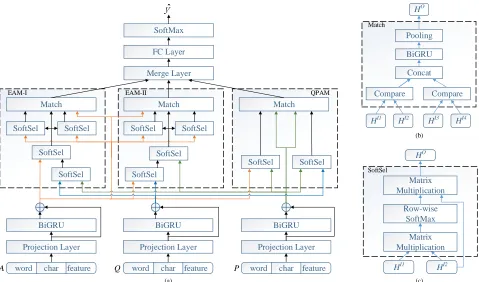
formation into word embeddings and generate the contextu-alized word representations with GRUs (Chung et al. 2014) and gate mechanism. After that, we develop Evidence-Answer Matching to extract multiple evidence snippets to form evidence sequences, which are then matched to can-didate answers. Meanwhile, we build Question-Passage-Answer Matching to learn semantic relationships among passages, questions and candidate answers. Finally, we inte-grate multiple aggregated matching results as final matching representations to make final decisions.
The remainder of this paper is organized as follows. We first describe ourMMNapproach in detail in Section 2 and present our experimental results in Section 3. After that, we present previous work related to our work in Section 4 and conclude our work with future work in Section 5.
Our Proposed Model
In this section, we introduce the task definition and describe our MMN model in detail. The illustration of MMN is shown in Figure 1(a). Our model is composed of following major components: input embedding, projection layer, con-text encoding, multi-matching component, merging layer and answer prediction. We will address each component in detail in the following subsections.
Task Definition
In the scenario of multiple choice reading comprehension, given a passage, a question and a few candidate answers, our goal is to select the correct answer from candidate answers. Formally, we represent the dataset as{P, Q,A, y}Ni=1, where
P = {wtP}lp
t=1 is a passage composed of a sequence of wordswPt,Q ={w
Q t }
lq
t=1is a question composed of a se-quence of wordswQt ,Ais a set of answers, each of which
isA ={wA t}
la
t=1 ∈A, andyindicates the index of golden answer.lp, lq, laare lengths of the passage, question and an-swer, respectively. In the sequel, for the simplicity of de-scription, we will omit the superscript (P,QorA) ofwP,
wQandwA, and the subscript (p,q, ora) ofl
p,lqandla.
Input Embedding and Projection Layer
The goal of input embedding is to map one-hot encoded word vectors into low dimensional vector space. The output
of input embedding consists of three parts: pretrained word-level word embedding vector, char-word-level word embedding vector and exact word matching feature. Following (Seo et al. 2016), char-level word embeddings are generated by ap-plying convolution and max-over-time-pooling operation to each word. Then, we pass the the output e ∈ Rn×l of
in-put embedding into a projection layer to learn task-specific representationE∈Rd×las follows:
E=ReLU(WPe+bP), (1)
where WP ∈
Rd×n, bP ∈ Rd are weights and biases,
ReLU is the Rectified Linear Unit,ndenotes the number of dimensions of input embedding vector andddenotes the number of hidden units in the projection layer. The projec-tion layer outputs a sequence of d-dimensional vectors for input sequences (i.e., passages, questions and answers).
Context Encoding
In order to accumulate contextual representations for words, we employ a bi-directional recurrent network (BiRNN) to read sequences from both sides, i.e. the bottom part in Fig-ure 1(a). Specifically, we use Gated Recurrent Unit (GRU) (Chung et al. 2014) as the basic building block and con-catenate the hidden states of both directions at each time step. We denote the operation of BiGRU on a sequence s
as BiGRU(s). Thus, we have contextualized word
repre-sentationsH ∈Rd×las follows:
H =BiGRU(E). (2)
Inspired by (Srivastava, Greff, and Schmidhuber 2015), we exploit gate mechanism to control the information flow from word representations and contextualized representa-tions. Thus, we have gated contextualized representations
˜
H ∈Rd×las shown below:
z=σ(WEE+WHH+b), (3)
˜
H =E∗z+H∗(1−z), (4)
whereWE, WH ∈ Rd×d, b ∈ Rd are weights and biases,
andz∈Rd×lis theupdate gate. Essentially, the gated
(a) (c) (b) Match
HI1 HI2
Concat
Compare BiGRU
HO
HI3 HI4
Compare Pooling
SoftSel
HI1 HI2
Row-wise SoftMax
Matrix Multiplication
Matrix Multiplication
HO
QPAM
word
FC Layer SoftMax
EAM-I
SoftSel SoftSel
SoftSel
SoftSel
SoftSel SoftSel
SoftSel SoftSel
SoftSel SoftSel Match
Match Match
Merge Layer
EAM-II
feature char Projection Layer
BiGRU ``
word char feature Projection Layer
BiGRU
word char feature Projection Layer
BiGRU
A Q P
`` ``
Figure 1: (a) Illustration of MMN (Left: Evidence-Answer Matching I; Middle: Evidence-Answer-Matching II; Right: Question-Passage-Answer Matching) (b) Match operation. (c) SoftSel operation.
Multi-Matching Component
In the multi-matching component, there are two types of matching modules, i.e. Evidence-Answer Matching mod-ule (denoted by EAM-I and EAM-II in Figure 1(a)) and Question-Passage-Answer Matching module (denoted by QPAM in Figure 1), which are constructed under a uni-fied framework. Both of them consist of two submodule:
composing submodule andmatching submodule. Compos-ing submodule is used to build attended sequences accordCompos-ing to the attention mechanism, while matching submodule is used to model the semantic relationship between sequences. Before we describe them in detail, we define two operations, SoftSelandMatchas follows.
• SoftSel (i.e. Figure 1(c)): This operation takes two se-quences as input, and outputs a sequence. After calculat-ing the cartesian similarity between all possible combi-nations of vectors of the two input sequences, we apply a row-wise softmax function to the similarity, and then we use the normalized similarity matrix as weights to cal-culate weighted sum of vectors of the first sequence. Let
HI1 ∈
Rd×l1andHI2 ∈
Rd×l2be the input. We calculate the outputHO∈
Rd×l1as follows:
G=HI1TWGHI2, (5)
˜
G=row-wise sof tmax(G), (6)
HO=HI2G˜T, (7)
whereW ∈ Rd×d are weights,G,G˜ ∈ Rl1×l2 are
im-mediate similarity matrices. Intuitively,HO
i encodes the most relevant part of the second sequence w.r.t.ith word in the first sequence.
• Match (i.e. Figure 1(b)): This operation takes four sequences as input, which are denoted by
HI1, HI2, HI3, HI4 ∈
Rd×l, respectively, and
out-puts the aggregated matching representationHf ∈
R2d.
To do this, we first divide four inputs into two groups, i.e., the first two as one group and the last two as the other group. We then calculate the matching representation
M1, M2∈
Rd×lwithin each group by:
M1=ReLU(WM
HI1∗HI2
HI1−HI2
+bM), (8)
M2=ReLU(WM
HI3∗HI4
HI3−HI4
+bM), (9)
whereWM ∈
Rd×2dandbM ∈Rdare learnable weights
and biases and
· ·
denotes column-wise concatenation,
∗and−denote element-wise multiplication and substrac-tion, respectively. After that, we project the concatenation ofM1andM2tod-dimensional space and aggregate the projected matching informationHM ∈ Rd×lwith a
Bi-GRU layer as follows:
HM =BiGRU(WHM
M1
M2
where WHM ∈ Rd×2d and bH
M
∈ Rd are learnable
weights and biases. Finally, we extract the salient feature with max pooling and attentive pooling operation over ag-gregating representation to obtainHmax, Hatt∈
Rdand
concatenate them as final outputHf ∈
R2das follows:
Hmax=max-pooling(HM), (11)
α=sof tmax(ReLU(WHMHM+bHM)), (12)
Hatt=HMα, (13)
Hf=
Hmax
Hatt
, (14)
whereWHM
∈ Rd andbH
M
∈ Rare learnable weights
and biases andα∈Rlis the normalized weights.
Evidence-Answer Matching Evidence-Answer Match-ing module is depicted at left and middle part of Figure 1(a), which aims to form matching information between the extracted evidences and candidate answers. There are two ways to reach this. We describe one of them in detail. The second one is similar to the first one so that we describe it briefly. We denote the first Evidence-Answer Matching module as EAM-I and the second Evidence-Answer Match-ing module as EAM-II. Evidence-Answer MatchMatch-ing mod-ules (EAMs) indicate both of them.
We first begin by forming evidence sequence according to passage and question. We achieve this by applying a SoftSeloperation which takes passage and question as in-put, which is formulated as: H˜Q = Sof tSel(HQ, HP). From the definition ofSoftSel, we can see thatH˜Qhas the same length as the question, where each position atH˜Q is a weighted sum of all time steps of passage representation. Note thatH˜Qis not a continuous slice ofHP and each po-sition ofH˜Q can be seen as a synthesized evidence vector. Due to different length of synthesized evidence and answer, it may be not suitable to match the answer and evidence di-rectly, because there is huge semantic gap between them. As such, we utilize the answer to refine evidence further.
˜
HQA = Sof tSel(HA,H˜Q), whereH˜QA ∈
Rd×la.
In-tuitively, the most related evidence to answer is extracted, which will benefit the matching with the candidate answers. Directly matching them may not be effective, so we explore a deeper fashion to model the deeper relation-ship. We calculate the attended sequence w.r.t. each other as follows: HQA = Sof tSel( ˜HQA, HA), HA =
Sof tSel(HA,H˜QA). Together with two input sequences,
we feed them intoMatchoperation to get final aggregated matching representation Hf1 ∈
R2d as follows: Hf1 =
M atch( ˜HQA, H
QA
, HA, HA).
For the other way to form evidence, we first attend ques-tion with candidate answer. Then, attended quesques-tion is used to interact with the passage to obtain evidence with the same length as the candidate answers. The intuition behind it is that some words in question is more important for extracting evidence. Finally, we feed extracted evidence sequence and answer into matching submodule to obtain final aggregated matching representationHf2 ∈
R2d.
Question-Passage-Answer Matching Differing from Evidence-Answer Matching module, the Question-Passage-Answer Matching module (i.e. right part of Figure 1(a)) aims to model passage, question and candidate answer together, which we call QPAM for short. Like Evidence-Answer Matching, Question-Passage-Evidence-Answer Matching is also designed under our unified compose-match framework. Following our framework, we first compose passage-aware question HP Q ∈
Rd×lp and passage-aware candidate
answer HP A ∈ Rd×lp with SoftSel operation, which
is formulated as follows: HP Q = Sof tSel(HP, HQ),
HP A =Sof tSel(HP, HA).Each position ofHP Q, HP A
represents the most relevant part of the question and the can-didate answers, respectively. Next, we match HP Q, HP A withHP using Match operation to obtain the aggregated matching representationHf3 ∈
R2d, which is formulated
as follows: Hf3 = M atch(HP Q, HP, HP A, HP). Intu-itively, the question and answer are combined implicitly to match with specific snippet in the passage to decide its entailment relationship.
Merging Layer
In this section, we merge the output vectors of Evidence-Answer Matching module and Question-Passage-Evidence-Answer Matching module. In practice, merging outputs from differ-ent modules is proved to be very effective. Empirically, we concatenate all output vectors to obtain the summary of ag-gregated informationHf ∈
R6das follows:
Hf = [Hf1;Hf2;Hf3], (15)
where[·;·;·]denotes row-wise concatenation operation.
Answer Prediction
The input to the final prediction layer is the output of merg-ing layer. We pass it to a hidden layer which outputsv∈R2d
as follows:
v=ReLU(WvHf+bv), (16)
whereWv ∈
R2d×6d andbv ∈ R2d are trainable weights
and biases. Then we apply a softmax classification layer to obtain the probability distribution over classesyˆas follows:
ˆ
y=sof tmax(W v+b), (17)
whereW ∈R2d, b∈Rare trainable weights and biases.
Optimization Objective
We perform optimizing our proposed model with multi-class cross-entropy loss withL2regularization. The objec-tive function is given as
J(θ) =−
N X
i=1 L X
j=1
yj(i)log ˆyj(i)+λ||θ||2, (18)
Experiments
To evaluate the effectiveness of our model, we conduct ex-periments on RACE (Lai et al. 2017) which is a large-scale multiple choice reading comprehension dataset. Our model achieves the state-of-the-art performance on this dataset.
Datasets and Implementation Details
RACE consists of two subsets collected from English exams for middle and high school students, which we call RACE-M and RACE-H respectively by following (Lai et al. 2017). All questions and candidate answers in RACE are generated by human experts. There is only one correct answer among 4 candidates for each question. We partition the train/dev/test sets in the same way as ((Lai et al. 2017)) does and use accu-racy as the evaluation metric. Accuaccu-racy is calculated as fol-lows:accuracy =N+/N, whereN+andN are the num-ber of correct predictions and the total numnum-ber of questions. The statistics of RACE dataset are shown in Table 2.
Table 2: Statistics of dataset. #w/p, #w/q and #w/a represent the average length of passage, question and candidate an-swers respectively. #a/q is the number of candidate anan-swers for each question.
Dataset Train Dev Test #w/p #w/q #w/a #a/q RACE-M 25421 1436 1436 249.9 10.1 4.9 4 RACE-H 62445 3451 3498 374.9 11.4 6.8 4 RACE 87866 4887 4934 342.9 11.0 6.3 4
We tokenize all sentences using SpaCy toolkit1 and low-ercase all tokens. Our model is implemented with Ten-sorFlow2 (Abadi et al. 2016) and all hyperparameters are
tuned according to performance on the development set. We use 300D GloVe3 (Pennington, Socher, and Manning 2014)
word embeddings which remain fixed during training. Out-of-vocabulary words are initialized to zero vectors. Each Bi-GRU holds 1 layer and 100 hidden units for each direction. To alleviate overfitting, we apply dropout (Srivastava et al. 2014) to the input of every layer with the dropout rate set to 0.2. The model is updated using mini-batch stochastic gradi-ent descgradi-ent with batch size of 32. We train our model using ADAM (Kingma and Ba 2014) with learning rate of 0.0003, where gradients are clipped in L2-norm to no larger than 10. Regularization coefficient is set to 1e-7. Early stopping technique is adopted after 50 epochs. All experiments were conducted on a NVIDIA TITAN XP GPU Card.
Comparison against Baselines
We compare our model with the following baselines. • SAR (Chen, Bolton, and Manning 2016) builds bilinear
attention to obtain evidence representation and compare it to candidate answers.
• GAR (Dhingra et al. 2017) applies multi-hop gated atten-tion mechanism between passage and quesatten-tion to obtain question-aware evidence representation.
1https://spacy.io/ 2
https://www.tensorflow.org/
3
https://nlp.stanford.edu/projects/glove/
• ElimiNet (Parikh et al. 2018) tries to eliminate candidate answers in a multi-hop manner, which is built on top of gated attention layer(s).
• HAF (Zhu et al. 2018) employs hierarchical attention flow to extract evidence and also considers correlation among candidate answers.
• DFN (Xu et al. 2017) utilizes various matching function to model sequences and selects the best policy optimized by reinforcement learning technique.
• Hier-Co-Matching (Wang et al. 2018) proposes a new co-matching approach to jointly model whether a passage can match both a question and a candidate answer.
• BiAttention (MRU) (Tay, Tuan, and Hui 2018) adopts bidirectional attention to obtain matching representation among sequences encoded by Multi-range Reasoning Units (MRU).
Performance comparison against all baseline models are shown in Table 3. From Table 3, we can observe thatMMN outperforms all baselines and achieves state-of-the-art accu-racy, which verifies the efficacy of our model. More specifi-cally, on RACE-M subset,MMNoutperforms the currently most competitive models BiAttention (MRU) and Hier-Co-Matching by 3.4 percentages and 5.3 percentages, respec-tively. On RACE-H subset,MMNachieves higher accuracy by 4.7 percentages and 4.0 percentages than BiAttention (MRU) and Hier-Co-Matching. Overall,MMNachieves an accuracy of 54.7%, which demonstrates the effectiveness of MMN. For further comparison, we also report results of the ensemble model. Following (Xu et al. 2017) and (Tay, Tuan, and Hui 2018), we build an ensemble model of 9 single mod-els, where all single models are initialized with different ran-dom seeds and hyperparameters. We observe that ensemble models also obtains a significant performance gain. We also report the performace of Amazon Turkers tested on a sam-pled subset of RACE and the percentage of the unambiguous question in a subset of the test set (i.e. Ceiling Performance). Note that there is still a huge performance gap between ma-chine reading model and human, which indicates the great potential for future research.
Ablation Study
Table 3: Experimental results on test set. Best machine model result is in boldface.∗indicates ensemble model.
Model RACE-M RACE-H RACE
SAR 44.2 43.0 43.3
GA 41.9 43.4 42.9
ElimiNet 44.4 44.5 44.5
HAF 46.2 46.4 46.0
DFN 51.5 45.7 47.4
Hier-Co-Matching 55.8 48.2 50.4 BiAttention (MRU) 57.7 47.5 50.4 MMN(Our model) 61.1 52.2 54.7 GA+ElimiNet∗ 47.4 47.4 47.2
DFN∗ 55.6 49.4 51.2
BiAttention (MRU)∗ 60.2 50.3 53.3 MMN∗(Our model) 64.7 55.5 58.2 Turkers 85.1 69.4 73.3 Ceiling Performance 95.4 94.2 94.5
effective matching representation in merging layer. By re-moving QPAM module, the model only achieves accuracy of 53.2% and 48.8% on RACE-M and RACE-H respectively. We believe the reason is that there are many fill-in-blank questions in which recognizing entailment would be more suitable for selecting the correct answer.
Table 4: Results of ablated model on development set. CWE: Char-level Word Embedding. GCE: Gated Context Encod-ing.
Model RACE-M ∆ RACE-H ∆ RACE ∆
Full-Model 63.8 - 54.7 - 57.4 -w/o CWE 62.3 -1.5 54.2 -0.5 56.7 -0.7 w/o GCE 61.2 -2.6 52.3 -2.4 54.9 -2.5 w/o EAM-I 62.6 -1.2 53.8 -0.9 56.3 -1.1 w/o EAM-II 62.0 -1.8 53.1 -1.6 55.7 -1.7 w/o EAMs 59.4 -4.4 50.5 -4.2 53.1 -4.3 w/o QPAM 53.2 -10.6 48.8 -5.9 50.1 -7.3
Accuracy w.r.t. Question Types
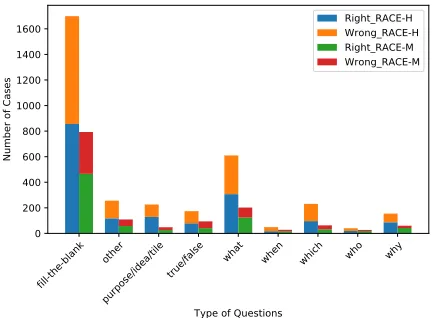
We first divide all examples in development set of RACE into many categories according to question type. Question types are decided by respective words, such as what, where, why, who. Besides questions whose types are indicated by some certain words, there are many fill-in-blank questions (e.g. is the movie capital of the world.) and statement-justification checking questions (e.g. which of the following is not true?), which are also categorized intofill-in-blankand
true/falserespectively.
Figure 2 shows how well our model performs with respect to different types of questions. In this experiment, we would like to see the performance on some particular type of ques-tions. We can see that the performances for ”why” questions are higher than others. The length of candidate answers of ”why” question is usually longer than other types of ques-tions, such as ”when” and ”where” question, which could provide richer information when matched with passage or
evidence. However, performance gap against other question types is not large, which indicates that our model has ro-bust performance in different type of questions. Our model works poorly for the true/false questions. Because it is dif-ficult to utilize the sequence matching to handle questions with negative words, where flipping the semantic polarity of the sentence is required.
Accuracy w.r.t. Answer Length
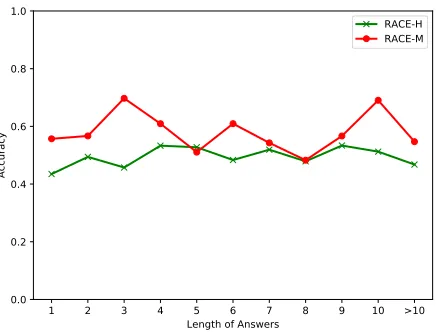
We next evaluate the performance of our model with regard to the answer length. Since the length of answers varies in a large range, we divide all examples into several groups according to the average length, i.e. the number of words, of 4 candidate answers. In Figure 3, we see that our model performs better on RACE-M than on RACE-H in almost all groups of questions with different lengths of answers. It is not surprising because RACE-M is collected from exams in middle school. Note that it is not obvious that our model performs better when answering question with shorter can-didate answers. The reason we believe is that longer candi-date answers may provide more information as our model is based on sequence matching.
fill-the-blank other
purpose/idea/tile
true/false what when which who why
Type of Questions 0
200 400 600 800 1000 1200 1400 1600
Number of Cases
Right_RACE-H Wrong_RACE-H Right_RACE-M Wrong_RACE-M
Figure 2: performance on different types of questions.
Case Study
To demonstrate the effectiveness of each subcomponent of MMN, we design an experiment to analyze the outputs of MMN and ablated model at final softmax classifica-tion layer. We sample two illustrative cases, which are also shown in Section 1. Normalized logits and predicted an-swers of different models are shown in Table 5. It is intrigu-ing to note that our model can handle them well.
1 2 3 4 5 6 7 8 9 10 >10 Length of Answers
0.0 0.2 0.4 0.6 0.8 1.0
Accuracy
RACE-H RACE-M
Figure 3: Performance on different lengths of answers.
predict the answer correctly and QPAM predicts the answer wrongly. Furthermore, It can be observerd that the output logit corresponding correct answer ofMMNis higher than both EAMs and QPAM for both two questions. Intuitively, combining EAMs and QPAM is beneficial toMMNto learn richer representation in the merging layer.
Table 5: Output logits and prediction of different model
Sample Model Candidates Prediction Golden
A B C D Answer
1
MMN 0.02 0.01 0.94 0.03 C
EAMs 0.01 0.14 0.03 0.82 D C QPAM 0.29 0.06 0.53 0.12 C
2
MMN 0.03 0.02 0.05 0.90 D
EAMs 0.29 0.12 0.05 0.54 D D QPAM 0.01 0.10 0.78 0.11 C
Related Work
Machine Reading Comprehension (MRC) has been studied extensively in the literature. The emergence of many large-scale datasets promotes the research in this field. (Hermann et al. 2015) generated a large cloze-style dataset from CNN news corpus automatically. (Rajpurkar et al. 2016) released Stanford Question Answer Dataset (SQuAD), where the question is generated by the human according to wikipedia articles and the answer is a span of the passage. Compared to these datasets where answer is extracted from passage directly, answers to questions in MS-MARCO (Nguyen et al. 2016), DuReader (He et al. 2018), MCtest (Richardson, Burges, and Renshaw 2013) and RACE (Lai et al. 2017) are human-generated, which is more challenging. This can be seen that the current state-of-the-art model can only achieve almost 50% accuracy on RACE, though there are only 4 can-didate answers for each question.
Most recent works involving multiple choice reading comprehension attempt to synthesize evidence representa-tion according to attenrepresenta-tion mechanism (Bahdanau, Cho, and
Bengio 2014; Wang and Jiang 2016). (Parikh et al. 2018) proposes ElimiNet which tries to use soft-eliminating to ex-clude the incorrect candidate answers. However, it is usu-ally ignored to model semantic relationship between ev-idence and answer deeply, which is expecially important when answer is a long sequence and almost complete sen-tence. Among existing works, DFN (Xu et al. 2017) and Hier-Co-Matching (Wang et al. 2018) are a bit similar to MMN. The key differences betweenMMNand them lie in following aspects: (1)MMNmatches attended context se-quences directly instead of using multi-perspective match-ing (Wang, Hamza, and Florian 2017), where the input fed to match is similarity scores. (2)MMNutilizes both triple se-quences matching and pairwise sese-quences matching. These two matching are unified under our proposed compose-match framework. Furthermore, MMN aggregates the in-formation with both max pooling and attentive pooling. (3) MMNemploys sequential variant of highway network (Srivastava, Greff, and Schmidhuber 2015) to improve the performance further. (4) Comparing our Question-Passage-Answer Matching to Hier-Co-Matching, we adopt the flatten structure instead of hierarchical structure used in Hier-Co-Matching when encoding passage. Though the flatten struc-ture performs worse than hierarchical strucstruc-ture in Hier-Co-Matching, we still show its effectiveness when matched with Evidence-Answer Matching in our model.
Conclusion
In this work, we propose a novelMulti-MatchingNetwork for multiple choice machine reading comprehension. Our MMNlearns the relationship among passage, question and candidate answer in two different ways. Both ways guide us to design our model which is intuitive and effective. Empiri-cal results on RACE dataset demonstrateMMN’s effective-ness, which achieves state-of-the-art results. However, on RACE dataset, there is a huge performance gap compared to human performance. This indicates the difficulty of the task and huge improvement potential of our model.
In the future, it would be interesting to incorporate com-monsense knowledge to further improve our approach. An-other future direction is to extract evidence sequences to build interpretable reading comprehension model based on planning approaches (Feng, Zhuo, and Kambhampati 2018; Zhang, Huang, and Zhao 2018) or leverage theMMNmodel to help acquire planning domain models (Zhuo, Mu˜noz-Avila, and Yang 2014; Zhuo and Kambhampati 2017) from texts.
Acknowledgements
References
Abadi, M.; Agarwal, A.; Barham, P.; Brevdo, E.; Chen, Z.; Citro, C.; Corrado, G. S.; Davis, A.; Dean, J.; Devin, M.; Ghemawat, S.; Goodfellow, I. J.; Harp, A.; Irving, G.; Isard, M.; Jia, Y.; J´ozefowicz, R.; Kaiser, L.; Kudlur, M.; Leven-berg, J.; Man´e, D.; Monga, R.; Moore, S.; Murray, D. G.; Olah, C.; Schuster, M.; Shlens, J.; Steiner, B.; Sutskever, I.; Talwar, K.; Tucker, P. A.; Vanhoucke, V.; Vasudevan, V.; Vi´egas, F. B.; Vinyals, O.; Warden, P.; Wattenberg, M.; Wicke, M.; Yu, Y.; and Zheng, X. 2016. Tensorflow: Large-scale machine learning on heterogeneous distributed sys-tems.CoRRabs/1603.04467.
Bahdanau, D.; Cho, K.; and Bengio, Y. 2014. Neural ma-chine translation by jointly learning to align and translate.
CoRRabs/1409.0473.
Chen, D.; Bolton, J.; and Manning, C. D. 2016. A thorough examination of the cnn/daily mail reading comprehension task. InACL, 2358–2367.
Chung, J.; C¸ aglar G¨ulc¸ehre; Cho, K.; and Bengio, Y. 2014. Empirical evaluation of gated recurrent neural networks on sequence modeling.CoRRabs/1412.3555.
Dhingra, B.; Liu, H.; Yang, Z.; Cohen, W. W.; and Salakhut-dinov, R. 2017. Gated-attention readers for text comprehen-sion. InACL.
Feng, W.; Zhuo, H. H.; and Kambhampati, S. 2018. Extract-ing action sequences from texts based on deep reinforce-ment learning. In Lang, J., ed.,Proceedings of the Twenty-Seventh International Joint Conference on Artificial Intelli-gence, IJCAI 2018, July 13-19, 2018, Stockholm, Sweden., 4064–4070. ijcai.org.
He, W.; Liu, K.; Liu, J.; Lyu, Y.; Zhao, S.; Xiao, X.; Liu, Y.; Wang, Y.; Wu, H.; She, Q.; Liu, X.; Wu, T.; and Wang, H. 2018. Dureader: a chinese machine reading comprehension dataset from real-world applications. InACL Workshop on Machine Reading for Question Answering, 37–46.
Hermann, K. M.; Kocisk´y, T.; Grefenstette, E.; Espeholt, L.; Kay, W.; Suleyman, M.; and Blunsom, P. 2015. Teaching machines to read and comprehend. InNIPS.
Kingma, D. P., and Ba, J. 2014. Adam: A method for stochastic optimization.CoRRabs/1412.6980.
Lai, G.; Xie, Q.; Liu, H.; Yang, Y.; and Hovy, E. 2017. Race: Large-scale reading comprehension dataset from examina-tions. InEMNLP.
McIlraith, S. A., and Weinberger, K. Q., eds. 2018. Pro-ceedings of the Thirty-Second AAAI Conference on Artifi-cial Intelligence, New Orleans, Louisiana, USA, February 2-7, 2018. AAAI Press.
Nguyen, T.; Rosenberg, M.; Song, X.; Gao, J.; Tiwary, S.; Majumder, R.; and Deng, L. 2016. MS MARCO: A human generated machine reading comprehension dataset. InNIPS Workshop on Cognitive Computation.
Parikh, S.; Sai, A.; Nema, P.; and Khapra, M. 2018. Elim-inet: A model for eliminating options for reading compre-hension with multiple choice questions. InIJCAI.
Pennington, J.; Socher, R.; and Manning, C. D. 2014. Glove: Global vectors for word representation. In
Mos-chitti, A.; Pang, B.; and Daelemans, W., eds.,Proceedings of the 2014 Conference on Empirical Methods in Natural Language Processing, EMNLP 2014, October 25-29, 2014, Doha, Qatar, A meeting of SIGDAT, a Special Interest Group of the ACL, 1532–1543. ACL.
Rajpurkar, P.; Zhang, J.; Lopyrev, K.; and Liang, P. 2016. Squad: 100, 000+ questions for machine comprehension of text. InEMNLP.
Richardson, M.; Burges, C. J. C.; and Renshaw, E. 2013. Mctest: A challenge dataset for the open-domain machine comprehension of text. InProceedings of the 2013 Confer-ence on Empirical Methods in Natural Language Process-ing, EMNLP 2013, 18-21 October 2013, Grand Hyatt Seat-tle, SeatSeat-tle, Washington, USA, A meeting of SIGDAT, a Spe-cial Interest Group of the ACL, 193–203. ACL.
Seo, M. J.; Kembhavi, A.; Farhadi, A.; and Hajishirzi, H. 2016. Bidirectional attention flow for machine comprehen-sion.CoRRabs/1611.01603.
Srivastava, N.; Hinton, G. E.; Krizhevsky, A.; Sutskever, I.; and Salakhutdinov, R. 2014. Dropout: a simple way to pre-vent neural networks from overfitting. Journal of Machine Learning Research15:1929–1958.
Srivastava, R. K.; Greff, K.; and Schmidhuber, J. 2015. Highway networks.CoRRabs/1505.00387.
Tay, Y.; Tuan, L. A.; and Hui, S. C. 2018. Multi-range rea-soning for machine comprehension. CoRRabs/1803.09074. Wang, S., and Jiang, J. 2016. Machine comprehension using match-lstm and answer pointer.CoRRabs/1608.07905. Wang, S.; Yu, M.; Jiang, J.; and Chang, S. 2018. A co-matching model for multi-choice reading comprehension. In
ACL, 746–751.
Wang, Z.; Hamza, W.; and Florian, R. 2017. Bilateral multi-perspective matching for natural language sentences. In IJ-CAI.
Xu, Y.; Liu, J.; Gao, J.; Shen, Y.; and Liu, X. 2017. To-wards human-level machine reading comprehension: Rea-soning and inference with multiple strategies. CoRR
abs/1711.04964.
Yin, W.; Sch¨utze, H.; Xiang, B.; and Zhou, B. 2016. ABCNN: attention-based convolutional neural network for modeling sentence pairs. TACL4:259–272.
Zhang, T.; Huang, M.; and Zhao, L. 2018. Learning struc-tured representation for text classification via reinforcement learning. In McIlraith and Weinberger (2018), 6053–6060. Zhu, H.; Wei, F.; Qin, B.; and Liu, T. 2018. Hierarchical attention flow for multiple-choice reading comprehension. In McIlraith and Weinberger (2018).
Zhuo, H. H., and Kambhampati, S. 2017. Model-lite plan-ning: Case-based vs. model-based approaches. Artif. Intell.
246:1–21.