162
Copyright © 2018. IJEMR. All Rights Reserved.
Volume-8, Issue-3, June 2018
International Journal of Engineering and Management Research
Page Number: 162-167
DOI:
doi.org/10.31033/ijemr.8.3.22
Risk Management in Construction Project
Mahi Raj1 and Nakul Kumar Wadsamudrakar2
1M. Tech Scholar, Department of Civil Engineering, AISECT University, Madhya Pradesh. INDIA 2Assistant Professor, Department of Civil Engineering, AISECT University, Madhya Pradesh, INDIA
1Corresponding Author: [email protected]
ABSTRACT
Risks have a significant impact on a construction project’s performance in terms of cost, time and quality. As the size and complexity of the projects have increased, an ability to manage risks throughout the construction process has become a central element preventing unwanted consequences. How risks are shared between the project actors is to a large extent governed by the procurement option and the content of the related contract documents. Therefore, selecting an appropriate project procurement option is a key issue for project actors.
The overall aim of this research is to increase the understanding of risk management in the different procurement options: bid-build contracts, design-build contracts and collaborative form of partnering. Deeper understanding is expected to contribute to a more effective risk management and, therefore, a better project output and better value for both clients and contractors. The study involves nine construction projects recently performed in Sweden and comprises a questionnaire survey and a series of interviews with clients, contractors and consultants involved in these construction projects.
The findings of this work show a lack of an iterative approach to risk management, which is a weakness in current procurement practices. This aspect must be addressed if the risk management process is to serve projects and, thus, their clients. The absence of systematic risk management is especially noted in the programme phase, where it arguably has the greatest potential impact. The production phase is where most interest and activity are to be found. As a matter of practice, the communication of risks between the actors simply does not work to the extent that it must if projects are to be delivered with certainty, irrespective of the form of procurement.
A clear connection between the procurement option and risk management in construction projects has been found. Traditional design-bid-build contracts do not create opportunities for open discussion of project risks and joint risk management. A number of drivers of and obstacles to effective risk management have been explored in the study.
Every actor’s involvement in dialogue, effective
communication and information exchange, open attitudes
and trustful relationship are the factors that support open discussion of project risks and, therefore, contribute to successful risk management.
Based on the findings, a number of recommendations facilitating more effective risk management have been developed for the industry practitioners.
Keywords--- Risk Management, Risk Allocation, Construction Project, Construction Contract, Design-Bid-Build, Design-Design-Bid-Build, Partnering
I.
INTRODUCTION
1.1 Overview
The aim of this study is to determine the risk factors in construction industry, allocation of these factors, methods used to deal with risks and the techniques adopted in analysing these risks. The results of the study are illustrated in this here. Mainly, the severity of risk factors, allocation of each, methods of dealing with risks and techniques of analysis. Then, a comparison will be held between contractors and owners’ perspectives regarding the severity and allocation of each risk factor. Also, in this chapter the results and findings of this research are discussed in detail.
163
Copyright © 2018. IJEMR. All Rights Reserved.
be a major feature of the Project management of construction projects in an attempt to deal effectively with Uncertainty and unexpected events and to achieve project success. Construction projects are always unique and risks raise from a number of the different sources. Construction projects are inherently complex and dynamic, and involving multiple feedback processes. A lot of participants – individuals and organizations are actively involved in the construction project, and they interest may be positively or negatively affected as a result of the project execution or project completion. Different participants with different experience and skills usually have different expectations and interests. This naturally creates problems and confusion for even the most experienced Project managers and contractors.
1.2 Objective
To apply Risk Management fundamentals to identify Human Risk Factors
To introduce a new methodology to analyses Human Risk Factors using Systems Theory and Financial Modelling techniques
To identify and propose solutions to problems which pose risk in the area of occupational and environmental health and safety
To identify and minimize the exposure to hazards in the area of fi re and life safety
To investigate health and safety concerns of staff, faculty and students
To procure liability, automobile, property, workers’ compensation and other insurance that protects university assets and manage all insurance claims in these areas
To manage cash reserves to cover uninsured claims
To assess the risk of new and existing programs or activities and suggest ways to minimize liabilities and accidents
To conduct training on safety and health relating to driving, ergonomics, chemical use, exposure to blood borne pathogens, and environmental awareness
To conduct campus inspections to assess fi re, chemical and other safety hazards, as well as non-compliance issues
To advise campus safety committees including Institutional Radiation Safety, Institutional Bio safety Committee, Institutional Review
Board, Students at Risk, and Emergency
Identifying key risk factors that could stand in front of construction processes by reviewing the literature and through the additions that could be made by the industry practitioners, i.e. contractors and owners.
Investigating the severity and the allocation of each identified risk factor according to the perspectives of contractors and owners.
Examining the risk management actions
efficiency that are applied in the industry by each category (contractors and owners).
1.3 Overview on Risk Involved in Construction
The construction industry generally has a bad reputation for its work. The industry has a reputation for time and cost overruns at present. This bad reputation is due to many reasons. One of them is that the construction industry is one of riskiest of all business types. There are many types of risk in the construction contracts; they are:
Physical works Delay and disputes Direction and supervision
Damage and injury to persons and property External factors
Payment
Law and arbitration
1.4 Causes of Risk as Threats
There exists no comprehensive study explaining the causes of risks among construction companies, moreover research covering the subject matter has tended to identify the12symptoms rather than causes, general threats in construction industry are:
A highly fragmented industry.
Industry highly sensitive to economic cycles. Fierce competition as result of an
over-capacitated market. Relative ease of entry. Management problems. Trading including: Competitive quoting. Outsize projects. High gearing. Resistance to change.
Accounting, where inconsistencies occur in the financial data generated for management.
Increase in project size.
Unfamiliarity with new geographic area. Moving into new type of construction. Change in key personnel.
1.5 Sources of Risks
Commercial risk. Financial risk. Legal risks. Political risks. Social risks.
164
Copyright © 2018. IJEMR. All Rights Reserved.
Technological risks. Operational risks. Demand/product risks. Management risks.
II.
LITERATURE REVIEW
2.1 Related Work
Risk management is probably the most difficult aspect of project management. A project manager must be able to recognize and identify the root causes of risks and to trace these causes through the project to their consequences. Furthermore, risk management in the construction project management context is a comprehensive and systematic way of identifying, analyzing and responding to risks to achieve the project objectives. The use of risk management from the early stages of a project, where major decisions such as choice of alignment and selection of construction methods can be influenced, is essential. The benefits of the risk management process include identifying and analyzing risks, and improvement of construction project management processes and effective use of resources. The construction industry is heterogeneous and enormously complex. There are several major classifications of construction that differ markedly from one another: housing, non-residential building, heavy, highway, utility, and industrial. Construction projects include new construction, renovation, and demolition for both residential and non-residential projects, as well as public works projects, such as streets, roads, highways, utility plants, bridges, tunnels, and overpasses. The success parameters for any project are in time completion, within specific budget and requisite performance (technical requirement). The main barriers for their achievement are the change in the project environment. The problem multiplies with the size of the project as uncertainties in project outcome increase with size. Large construction projects are exposed to uncertain environment because of such factors as planning, design and construction complexity, presence of various interest groups (owner, consultants, contractors, suppliers, etc.), resources (manpower, materials, equipment, and funds) availability, environmental factors, the economic and political environment and statutory regulations.
Construction projects can be unpredictable. Managing risks in construction projects has been recognized as a very important process in order to achieve project objectives in terms of time, cost, quality, safety and environmental sustainability. Project risk management is an iterative process: the process is beneficial when is implemented in a systematic manner throughout the lifecycle of a construction project, from the planning stage to completion. In the European Union construction is the sector most at risk of accidents, with more than 1300
people being killed in construction accidents every year. Worldwide, construction workers are three times more likely to be killed and twice as likely to be injured as workers in other occupations. The costs of these accidents are immense to the individual, to the employer and to society. They can amount to an appreciable proportion of the contract price. Construction activities in Lithuania provided employment to an estimated 93.7 thousand persons in 2011, while an annual turnover in excess of EUR 1.91 billion. Construction is one of Lithuania’s largest industries. Unfortunately, it has also the occupational health and safety problems. More construction workers are killed, injured or suffer ill-health than in any other industry. In 2011, 13 construction workers killed whilst at work, compared to 7 industrial workers and 4 agricultural workers. In comparison with 2010, the number of fatal accidents in construction enterprises increased by more than 2 times, i.e. from 6 to 13 cases has been reported. The risk analysis and management techniques have been described in detail by many authors. A typical risk management process includes the following key steps.
Risk identification Risk assessment Risk mitigation Risk monitoring
2.2 Current industry trends indicate that there is also
Increasing demand for efficient and
technologically Complex solutions in shorter timescales and within Tighter financial constraints;
High demand for an accurate completion date, as required by many commercial and public benefit projects;
A growing trend for employers to require the contractor to take more of the risk that is traditionally taken by the Employer,
A growth in the use of design and build (D&B), Guaranteed maximum price (GMP) and engineer Procure and construct contracts (EPC); and Potentially devastating consequences of the
failure to manage time in construction projects.
2.3 The main purpose of this research is to
Further awareness in the industry of time-management Issues;
Identify the current level of understanding of the Importance of project engineers and project
schedulers in the management of time;
Gauge members’ opinions on the state of standards of education and training; and
Determine the use of available technology.
2.4 The research also helped to identify the
165
Copyright © 2018. IJEMR. All Rights Reserved.
Degree of understanding in the industry of project Control techniques by different disciplines; and Need and support for training and accreditation of
Planners and project schedulers.
III.
RESERCH METHODOLOGY
3.1 Research design
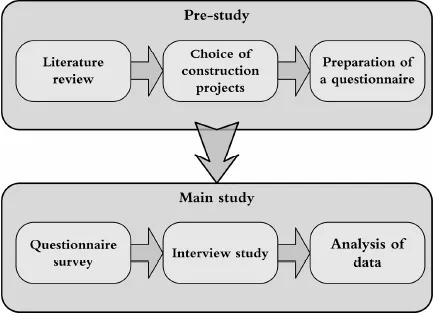
Research design is about turning research questions into the research project (Robson 2002). It means that in order to answer research questions, the appropriate strategies, methods and techniques should be chosen. Yin (1994) proposes that the types of research questions determine the most suitable strategy. The research questions in this study focus mainly on “what” questions. To answer this type of question, a survey strategy is suggested (Yin 1994).
Figure 1. Research Design
3.2 Survey Area
Superintending Wngineer
Building Design Circle-3
Building construction Department Bihar, Patna
Chief Engineer
Building construction Department Bihar, Patna
Assistant Engineer
Building Design Circle-3
Building construction Department Bihar, Patna
IV.
EXPERIMENTAL RESULTS
Survey on Construction Related Problems
During construction period of any structure, lot of problems are generated. Here I am doing a Survey on the same through a table consisting of some of the most critical problems arising during construction works.
V.
CONCLUSION
In this study, identifying the risk factors faced by construction industry is based on collecting information about construction risks, their consequences and corrective actions that may be done to prevent or mitigate the risk effects. Risk analysis techniques were investigated too. However, determination of severity and allocation of these risk factors was the main result of this research.
166
Copyright © 2018. IJEMR. All Rights Reserved.
Professionals in the construction industry areusing techniques described in the literature concerning RM but are not aware of it. Risks are being managed every day in the industry, but not in such a structured way as the literature describes. As also other researchers confirmed, the knowledge of RM and RMP is close to zero, even though the concept of risk management is becoming more popular in the construction sector.
There is a willingness among respondents to start using RMP, but it has to bring profits to the organization.
By applying a simple method, it is possible to identify potential risks in an easy way. Moreover, it gives possibility to detect which of the identified risks has the biggest impact on time, cost and quality. Those risks should be eliminated or mitigated by taking an appropriate action. The research showed that the most common action was risk mitigation. Moreover, it was proven that the results from probability and impact method may differ among projects due to the fact that each project and its scope are unique.
It was important to establish during the interview which phase of the PLC the respondents were taking part in and what their role in the project was. Based on that, we could systematize the answers and see types of risks identified in various phases of the PLC. The conclusion was that there are risks which are characteristic for each project stage.
As the research showed, unstructured form of RM is to some extent used in the construction sector. Thus, application of actual RM into companies should not be difficult. As proved by the research, knowledge is the factor which is missing for organizations to implement RM. Thus, this aspect of application of RM could be further investigated in terms of how to facilitate use of RM in a construction sector. Moreover, a simple RM manual could be developed including basic theoretical information as well as ready-to use guidance for one of the RM methods.
REFERENCES
[1] Akintoye, A. & Main, J. (2016). Collaborative relationships in construction: The UK contractors' perception. Engineering, Construction and Architectural
Management,14(6), 597- 617.
[2] Akintoye, A. S. & MacLeod, M. J. (2014). Risk analysis and management in construction. International
Journal of Project Management, 15(1), 31-38.
[3] Andi. (2016). The importance and allocation of risks in Indonesian construction projects. Construction
Management and Economics,24(1), 69-80.
[4] Atkin, B. (2016).Notes in course on research
methodology. Lund University. Available at:
https://www.diva-portal.org/smash/get/diva2:1009460/FULLTEXT01.pdf [5] Baccarini, D. & Archer, R. (2011). The risk ranking of projects: a methodology. International Journal of Project
Management, 19(3), 139-145.
[6] Baker, S., Ponniah, D., & Smith, S. (2013). Techniques for the analysis of risks in major projects. The journal of
the Operational Research Society, 49(6), 567-572.
[7] Baker, S., Ponniah, D.,& Smith, S. (2014). Risk response techniques employed currently for major projects.
Construction Management & Economics, 17(2), 205-213.
[8] Baloi, D. & Price, A. D. F. (2013). Modelling global risk factors affecting construction cost performance.
International Journal of Project Management, 21(4),
261-269.
[9] Barber, R. B. (2015). Understanding internally generated risks in projects. International Journal of
Project Management, 23(8), 584-590.
[10] BKK. (2014).General Conditions of Contract for Building, Civil Engineering and Installation Work AB04,
Stockholm, the Building Contracts Committee. Available at:
http://foreningenbkk.se/the-construction-contracts-committe/
[11] Dr. Mohamed El Mikawi, Dr. Ayman Hussein Hosny Khalil, & Mohamed Kamal Asaad. (2017). Integrated earned value management and risk management approach in construction projects. International Journal of
Engineering and Management Research, 7(4), 286-291.
[12] Chapman, C. & Ward, S. (2012).Managing project risk and uncertainty: a constructively simple approach to
decision making. Chichester: Wiley. Available
at:https://www.wiley.com/en-us/Managing+Project+Risk+and+Uncertainty%3A+A+Co nstructively+Simple+Approach+to+Decision+Making-p-9780470847909
[13] Chapman, C. & Ward, S. (2014). Why risk efficiency is a key aspect of best practice projects. International
Journal of Project Management, 22(8), 619-632.
[14] Ashutosh Kumar Jha, Supriya Jha, & D.K.Ghosh. (2016). Foreign exchange risk management: Review of exchange rate forecasting models for use of banks & its customers in India. International Journal of Engineering
and Management Research, 6(4), 344-349.
[15] Del Cano, A. & De la Cruz, M. (2012). Integrated methodology for project risk management. Journal of
Construction Engineering and Management, 128(6),
473-485.
[16] Dikmen, I. & Birgonul, M. T. (2016). An analytic hierarchy process-based model for risk and opportunity assessment of international construction projects.
Canadian Journal of Civil Engineering, 33(1), 58-68.
167
Copyright © 2018. IJEMR. All Rights Reserved.
Construction Engineering and Management, 126(4),
293-297.
[18] Fellows, R. & Liu, A. (2013).Research methods for
construction. Oxford, UK: Blackwell.
[19] Flanagan, R. & Norman, G. (1993).Risk management
and construction. Oxford, UK: Blackwell Scientific
Publications.
[20] Grasberg, D. D. & Molenaar, K. (2014). Analysis of owner's design and construction quality management
approaches in design/build projects. Journal of
management in engineering, 20(4), 162-169.
[21] Harris, F., McCaffer, R. & Edum-Fotwe, F. (2016).Modern construction management. Oxford, UK: Blackwell.