Solving Graphically Sine Wave Second Order
Boundary Value Problem using Laplace
Transform and Finite Difference Method
M.Shalini
#1, M.Sathyavathy*
2Assistant Professor & Mathematics, M.Kumarasamy college of Engineering (Autonomou
s
),
Thalavapalayam,Karur, India.
Abstract
In this paper the FDM & LT method has been established for the numerical solution of a two-point
second order boundary value problem’s (BVP) are analyzed. Numerical solutions of both methods were
implemented and are tabulated. Finally it was observed that the finite-difference method is numerically more
strengthen and converges the nearer to LT solution by taking the lengthen intervals.
Keywords
-
Boundary value problem (BVP), Laplace Transform (LT), Finite difference Method (FDM).
I.INTRODUCTION
In Mathematics, Two-point bvp’s have received a major concentration due to its priority in many areas
of sciences and engineering field. Different types of differential equations arise very frequently in optimal
control, aerodynamics, fluid mechanics, chemical–reactor theory, quantum mechanics, reaction-diffusion process
and geophysics .
Different types of logical and computational ideas used for the result of differential equations are given
in the survey literature; Differential Transform Method
[1-6],
Bernoulli Polynomials
[7]
, Adomain
Decomposition Method
[8-13]
, Block Method
[14-16]
, Modified Picard Technique
[17]
, Sinc Collocation
Method
[18],
Runge-kutta 4
thOrder Method
[19]
, Cubic Spline Method
[20]
, Homotopy Perturbation Method
[21-23]
.
In this Paper, we use FDM for the result of two-point boundary value problems has been extensively
used
[24-27]
. In the example problems the step length is elongated and it is examined that the access strengthen
the convergence of the result when compared with the explicit from Laplace Transforms (which gives a close
form of solution), see Table 1.
II.EVALUATION OF FDM
Consider the second order BVP as,
𝝌
′′+ 𝒔 𝝔 𝝌
′+ 𝒕 𝝔 𝜻 = 𝒖 𝝔 , 𝝔 ∈ 𝜸, 𝜹
(1)
With the boundary conditions
𝜻 𝜸 = 𝐌 𝐚𝐧𝐝 𝜻 𝜹 = 𝚴
(2)
The period
𝒗, 𝒘
is partitioned into into
𝑛
equal subintervals. The subintervals length is denoted as
ℎ
,
i.e)
𝒉 =
𝜹−𝜸𝒏
(3)
Let us examine the following points
𝜸 = 𝝔
𝟎, 𝝔
𝟏= 𝝔
𝟎+ 𝒉, 𝝔
𝟐= 𝝔
𝟎+ 𝟐𝒉, … … . . 𝝔
𝒎= 𝝔
𝟎+ 𝒎𝒉, … … . , 𝝔
𝒏= 𝝔
𝟎+ 𝒏𝒉
(4)
The analytical solution at any point
𝝋
𝒎is indicated by
𝜻
𝒎and abstract solution is denoted as
𝝌 𝝔
𝒎.
The Central difference approximation for the differential equation is given below
𝜒𝑚′=2ℎ1 𝜒𝑚 +1−𝜒𝑚
𝜒𝑚′′=ℎ 2 1 𝜒𝑚 +1−2𝜒𝑚+𝜒𝑚 −1
(5)
Substitute (5) in (1)
ℎ12
𝜒
𝑚 +1− 2𝜒
𝑚+ 𝜒
𝑚 −1+ 𝑠 𝜚
12ℎ
𝜒
𝑚 +1− 𝜒
𝑚+ 𝑡 𝜚 𝜒
𝑚= 𝑢 𝜚
(6)
2 𝜒
𝑚 +1− 2𝜒
𝑚+ 𝜒
𝑚 −1+
ℎ 𝑠 𝜚 𝜒
𝑚 +1− 𝜒
𝑚 −1+ 2ℎ
2𝑡 𝜚 𝜒
𝑚= 2ℎ
2𝑢 𝜚
(7)
Equation (7) can be written as
Where
𝑖
𝑚= 2 −
ℎ 𝑠(𝜚)
𝑗
𝑚= −4 + 2ℎ
2𝑡(𝜚)
𝑘
𝑚= 2 +
ℎ 𝑠(𝜚)
𝑙
𝑚= 2ℎ
2𝑤(𝜚)
(9)
The following equations are obtained from (8)
𝑖
1𝜒
0+ 𝑗
1𝜒
1+ 𝑘
1𝜒
2= 𝑙
(10)
𝒊
𝟐𝝌
𝟏+ 𝒋
𝟐𝝌
𝟐+ 𝒌
𝟐𝝌
𝟑= 𝒍
𝟐(11)
etc.
Hence the result of the above equations to a logical order of equations of the form
𝐴𝜒 = 𝑙
for the undistinguished
𝜒
1, 𝜒
2, 𝜒
3, … . 𝜒
𝑛−1, where
𝐴
is the co-efficient matrix determine the logical order of equations above provide
the results of the bvp’s.
III.NUMERICAL EXAMPLES
A. Problem 3.1:
Evaluate the two-point BVP of χ
′′𝜚 +
χ
𝜚 = 0,
χ
′0 = 1,
χ
𝜋 2
= 0
, by Laplace transform and
Finite difference method.
Solution:
Given:
χ
′′ϱ + χ ϱ = 1, χ
′0 = 1, χ π 2
= 0
(12)
The general solution of (12) is
χ ϱ = sin ϱ
(13)
Solving by Laplace Transform
Equation (12) gives
L χ
′′+ L χ = L 0
(14)
s
2χ − sχ 0 − χ
′0 + χ = 0
(15)
Let
L χ 0
=
ς
(16)
Substituting equation (16) in (15), we get
s
2χ − sχ 0 − 1 + χ = 0
(17)
And simplifying, we obtain
χ =
sςs2+1
+
1
s2+1
(18)
Converting into partial fraction ,
χ ω =
sςs2+1
+
𝟏
𝐬𝟐+𝟏
(19)
Taking inverse Laplace transform
χ ω = sinϱ + ςcosϱ
(20)
Using
χ π 2
= 0
, we obtain
0 = sin
π2
+ ςcos
π
2
(21)
Which gives
ς = 0
, then
χ ϱ = sin ϱ + 0 cos ϱ
(22)
Then,
𝛘 𝛠 = 𝐬𝐢𝐧 𝛠
(23)
Which is explicit solution
Solving by Finite difference Method
The following steps are written using equation
(12)
i.e)
n = 10 , h =
ν−υ10
=
π 2 −0 10=
π20
(24)
From the above we have
χ 0 = 1, χ π 20
=? , χ 2π 20
=? , … … … χ π 2
= 0
(25)
Equation (12) is expressed by central difference approximations as follows
400
π2
χ
m+1− 2χ
m+ χ
m−1+ χ
m= 0
(26)
m = 2 ∶ 400χ
1+ (−800 + π
2)χ
2+ 400χ
3= 0
(28)
m = 3 ∶ 400χ
2+ (−800 + π
2)χ
3+ 400χ
4= 0
(29)
:
m = 9 ∶ 400χ
10+ (−800 + π
2)χ
9+ 400χ
8= 0
(30)
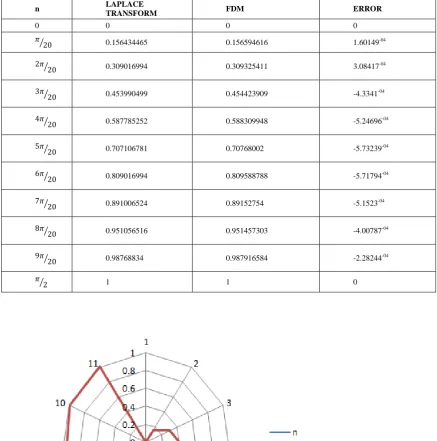
Deriving the logical of equations (27-30) gives the result of the bvp’s; and the comparison with the nearer form
result is presented in table 1.
IV. Table 1 NUMERICAL SOLUTION OF PROBLEM
1
n LAPLACE
TRANSFORM FDM ERROR
0 0 0 0
𝜋
20 0.156434465 0.156594616 1.60149-04
2𝜋
20 0.309016994 0.309325411 3.08417-04
3𝜋
20 0.453990499 0.454423909 -4.3341-04
4𝜋
20 0.587785252 0.588309948 -5.24696-04
5𝜋
20 0.707106781 0.70768002 -5.73239-04
6𝜋
20 0.809016994 0.809588788 -5.71794-04
7𝜋
20 0.891006524 0.89152754 -5.1523-04
8𝜋
20 0.951056516 0.951457303 -4.00787-04
9𝜋
20 0.98768834 0.987916584 -2.28244-04
𝜋
2 1 1 0
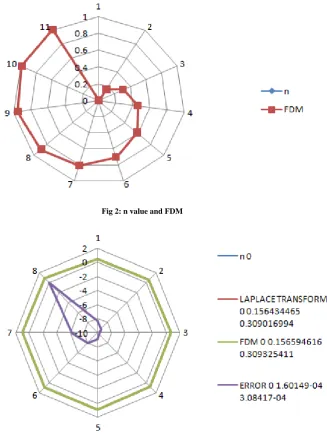
Fig 2: n value and FDM
Fig 3: Comparison of n value, LT, FDM and Error
V.CONCLUSION
In this paper, LTM and FDM technique are proposed to solve two point boundary value problems. The
step length is extended in FDM to enhance the convergence of the method; the results are compared with the
close form solution of LT in table
ACKNOWLEDGEMENT
This work was supported by
Ms.M.sathyavathy. I hereby take the opportunity to thank her, who helped me
to make this paper. and also we wish to thank our administrative assistance.
REFERENCES
[1] A.A. Opanuga, J.A. Gbadeyan, S.A. Jyase and H.I. Okagbue, “Effect of Thermal Radiation on the Entropy Generation of
Hydromagnetic Flow through Porous Channel”, the Pacific Journal of Science and Technology, vol. 17, no 2, pp. 59-68, 2016.
[2] M. El-Shahed, “Application of Differential Transform Method to non Linear Oscillatory Systems”, Communication in Nonliear
Simulation,Vol. 13, pp. 1714-1720, 2008.
[3] A.A.Opanuga, o.o.agboola, H.I.Okagbue, “Approximate Solution of Multipoint Boundary Value Problems”, Journal of Engineering
and Applied Sciences, Vol. 10,no 4, pp. 85-89,2015.
[4] J.Biazar and M.Eslami, “Analytic Solution for Telegraph Equation by Differential Transform Method”, Physics Letters a, Vol. 374,
2010, pp. 2904-2906. doi:10.0.16/jphysleta.2010.05.012
[6] A.A.Opanuga, H.I.Okagbue, S.O.Edeki and O.O.Agboola “Differential Transform Technique for Higher order Boundary Value Problems”, Modern Applied Science, vol. 9, no 13, pp. 224 230, 2015
[7] MD Shafiqul Islam and Afroza Shirin, “Numerical Solution of a Class of Second Order boundary Value Problems on using Bernoulli
Polynomials”, Applied Mathematics, Vol. 2, pp. 1059-1067, 2011. doi:10.4236/am.2011.29147.
[8] G. Adomian, “Solving Frontier Problems of Physics, the Decomposition Method” , Boston, Kluwer Academic 1994.
[9] G. Adomian, “Nonlinear Stochastic Systems and Application to Physics”, Kluwer Academic. the Netherland, 1989.
[10] S. O. Adesanya, E. S. Babadipe and s. A. Arekete, a “New Result on Adomian Decomposition Method for Solving Bratu’s Problem”,
Mathematical Theory and Modeling, vol. 3, no 2, pp. 116-120, 2013.
[11] M. Tatari and M. Dehghan, “The use of the Adomian Decomposition Method for Solving Multipoint Boundary Value Problems”,
Phys. Scr. vol. 73, pp. 672-676, 2006. doi:10.1088/0031 8949/73/6/023
[12] R. Jebari, I. Ghanmi and a. Boukricha, “Adomian Decomposition Method for Solving Nonlinear Heat Equation with Exponential
Nonlinearity”, int. Journal of Maths. Analysis, Vol. 7, no 15, pp. 725-734, 2013
[13] M. Paripoura, E. Hajiloub, A. Hajiloub, H. Heidarib, “Application of Adomian Decomposition Method to Solve Hybrid Fuzzy
Differential”, Journal Of Taibah University For Science, vol. 9, pp. 95–103, 2015.
[14] Z. Omar and j. O. Kuboye, “derivation of block methods for solving second order ordinary differential equations directly using
direct integration and collocation approaches”, indian journal of science and technology, vol. 8, no 12, 2015. Doi: 10.17485/ijst/2015/v8i12/70646
[15] J. O. Kuboye and z. Omar, “new zero-stable block method for direct solution of fourth order ordinary differential equations”, indian
journal of science and technology, vol. 8, no 12, 2015. Doi: 10.17485/ijst/2015/v8i12/70647
[16] T. A. Anake, d. O. Awoyemi and a. O. Adesanya, “one-step implicit hybrid block method for the direct solution of general second
order ordinary differential equations”, iaeng international journal of applied mathematics, vol. 42, no 4, pp. 224 -228, 2012.
[17] H. A. El-arabawy and i. K. Youssef, “a symbolic algorithm for solving linear two-point boundary value problems by modified picard
technique”, mathematica and computer modelling, vol. 49, pp. 344-351, 2009.
[18] B. Bialecki, “sinc-collocation methods for two point boundary value problems”, the ima journal of numerical analysis, vol. 11, no
3, pp. 357-375, 1991. Doi:10.1093/imanum/11.3.357
[19] Anwar ja'afar mohamad-jawad, “second order nonlinear boundary value problems by four numerical methods”, eng &tech journal,
vol. 28, no 2, pp. 1-12, 2010.
[20] E. A. Al-said, “cubic spline method for solving two point boundary value problems”, korean journal of computational and applied
mathematics”, vol. 5, pp. 759-770, 1998. Doi:10.1016/j.mcm.2008.07.030
[21] A. A. Opanuga, o. O. Agboola, h. I. Okagbue, g. J. Oghonyon, “solution of differential equations by three semi-analytical
techniques”, international journal of applied engineering research, vol. 10, no 18, pp. 39168-39174, 2015.
[22] S. Abbasbandy, “iterated he’s homotopy perturbation method for quadratic riccati differential equation”, appl. Math. Comput., vol.
175, pp. 581-589, 2006. Proceedings
[23] D. D. Ganji and a. Sadghi, “application of homotopy-perturbation and variational iteration methods to nonlinear heat transfer and
porous media equations”, journal of computational and applied mathematics, vol. 207, pp. 24-34, 2007.
[24] E.u. Agom and a.m. Badmus, “correlation of adomian decomposition and finite difference methods in solving nonhomogeneous
boundary value problem”, the pacific journal of science and technology, vol. 16, no 1, pp. 104-109, 2015
[25] S. R. K. Iyengar and r. K. Jain, “numerical methods”, new age international publishers, 2009, new delhi, india.
[26] M. L. Dhumal1, s. B. Kiwne, “finite difference method for laplace equation”, international journal of statistika and mathematika, vol.
9, no 1, pp. 11-13, 2014.
[27] Rajkumar meel, yogesh kandhalwal et.al, “a comparative study of boundary value problem with iterative method”, ijmtt, 2017,