The Thirty-Third AAAI Conference on Artificial Intelligence (AAAI-19)
Multi-Attribute Transfer via Disentangled Representation
Jianfu Zhang,
1Yuanyuan Huang,
1Yaoyi Li,
1Weijie Zhao,
2Liqing Zhang
1∗ 1Shanghai Jiao Tong University,2VersaAbstract
Recent studies show significant progress in image-to-image translation task, especially facilitated by Generative Adver-sarial Networks. They can synthesize highly realistic im-ages and alter the attribute labels for the imim-ages. However, these works employ attribute vectors to specify the target domain which diminishes image-level attribute diversity. In this paper, we propose a novel model formulating disen-tangled representations by projecting images to latent units, grouped feature channels of Convolutional Neural Network, to disassemble the information between different attributes. Thanks to disentangled representation, we can transfer at-tributes according to the attribute labels and moreover re-tain the diversity beyond the labels, namely, the styles inside each image. This is achieved by specifying some attributes and swapping the corresponding latent units to “swap” the at-tributes appearance, or applying channel-wise interpolation to blend different attributes. To verify the motivation of our pro-posed model, we train and evaluate our model on face dataset CelebA. Furthermore, the evaluation of another facial expres-sion dataset RaFD demonstrates the generalizability of our proposed model.
Introduction
Image-to-image translation gains significant popularity in recent years, benefiting from the progress of generative models like Generative Adversarial Network (Goodfellow et al. 2014) and Variational Auto-Encoder (Kingma and Welling 2013). Generally speaking, image-to-image trans-lation is defined as a task to translate an image from one domain to another, with representative applications such as colorization(Isola et al. 2017; Zhang, Isola, and Efros 2016), super-resolution(Ledig et al. 2017; Dong et al. 2016) and facial attribute transfer(Choi et al. 2018; Bouchacourt, Tomioka, and Nowozin 2018), etc.
We define adomainas a set of images sharing the same attribute labels, where the term attribute is denoted as a meaningful instance-level feature inherent in an image such as hair color or style, gender or age, and smiles. For each attribute, there can be different attribute labels such as black/blond/brown for hair color, or male/female for gender.
∗
correspondence author
Copyright c2019, Association for the Advancement of Artificial Intelligence (www.aaai.org). All rights reserved.
(a) Attribute swapping
(b) Attribute blending
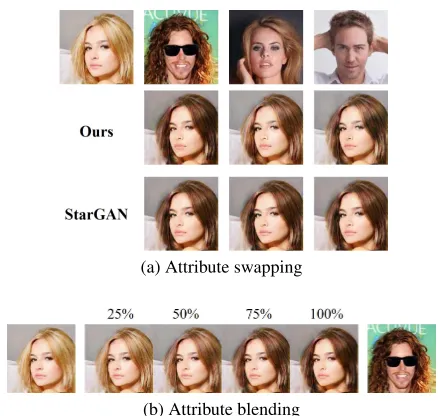
Figure 1: An illustration of the motivation for our proposed model. We want to change the source image on the upper left, a lady with blond hair, to target images with brown hairs in the upper row. Give the target label, brown hair, previous methods like StarGAN (Choi et al. 2018) can only change the hair color to one style. However, for our pro-posed method, the target attribute is specified with another image, i.e., the hair color is transferred from the topmost im-ages, and the color shade is retained, as shown in the second row. Besides, we can blend different attribute values by in-terpolating hidden units, changing hair color from golden to brown gradually.
Furthermore, beyond the attribute label, there can be image-level diversity in the style of different image instances with the same attribute label which can not simply be depicted by labels. For example, bang hairs may vary in directions, and smiles can have different attitudes. We call this diversity as concept, which can be formulated as a distribution of certain attribute appearance.
Ma 2017). However, these works either are only capable of mapping between a paired domains with poor flexibility for multi-domain translation or employing attribute vectors to specify the target domain which diminishes image-level at-tribute diversity.
In this paper, we propose a method which conducts at-tributes translation by transferring atat-tributes from one im-age to another and keep the styles for each imim-age at the same time. We implement our model using an auto-encoder, training on labeled input data pairs by swapping designated parts of embeddings. The transfer process is implemented via embedding images in disentangled representations and substituting the corresponding part of the embeddings.A dis-entangled representation can be defined as one where sin-gle latent units are sensitive to changes in sinsin-gle genera-tive factors while being relagenera-tively invariant to changes in other factors (Higgins et al. 2017; Bengio, Courville, and Vincent 2013). The disentangling process aims at learning dimension-wise interpretable representations from data, and the attributes which are independent of each other can be disentangled into a well-defined feature space. For exam-ple, given an image dataset of human faces, the generative factors in the aforesaid definition is equivalent to the inter-pretable attributes like facial expression, and disentangling should produce representations or embeddings for each part corresponding to the attribute. Thanks to disentangled rep-resentations, we formulate our model with a manipulable and interpretable representation of images, transferring at-tributes from one to another and keep the image-level diver-sity in the style of attributes.
Specifically, our model differs from the previous image-to-image translation and disentangling models in the follow-ing aspects, which are also shown in Figure 1:
• We propose a model that learns disentangled represen-tations for multiple different attributes, implementing a function that user can select some specific attributes and swap the corresponding parts of embeddings to “swap” the attributes, or apply embedding interpolation to manip-ulate different attributes;
• By disentangling different attributes, we synchronously transfer the attributes and retain the intra-attribute diver-sity, preserving the styles of each image;
• Experiments show that we provide qualitative results on selected datasets with high quality synthesized images and disentangled representation.
Related Works
In this section, we review several previous works for image-to-image translation applications which are closely related to our proposed method, especially for those which are based on Generative Adversarial Network and Disentangled Rep-resentation.
Image-to-image transformation applications (Gong et al. 2018; Chang et al. 2018; Isola et al. 2017; Zhu et al. 2017; Choi et al. 2018; Yan et al. 2016) progress rapidly with the help of Generative Adversarial Network (GAN)(Good-fellow et al. 2014) and Variational Auto-Encoder (VAE)
(Kingma and Welling 2013) frameworks. Thanks to the re-cent progress (Arjovsky, Chintala, and Bottou 2017; Gulra-jani et al. 2017; Miyato et al. 2018), GAN has now achieved improved stability and better performance. Pix2Pix (Isola et al. 2017) converts images from source style to destination style, using conditional GAN trained with pair-wised exam-ples. Cycle-GAN (Zhu et al. 2017) breaks the limitation of pair-wised data by training mapping and reverse mapping networks cross two domains, but still suffering from limited flexibility for multi-domain transformation since one model can only deal with a single pair of domains. StarGAN (Choi et al. 2018) framework trains a multi-domain model using only one single model which further improve the scalability and efficiency of image-to-image translation tasks. However, these aforementioned methods translate images according to the specified target attribute labels, while image-level vari-ances for attributes are dropped for synthesized images.
The goal of Disentangled Representation (Bengio, Courville, and Vincent 2013) is to extract explanatory fac-tors of the data in the input distribution and generate a more meaningful representation. Recently, there are many excit-ing works based on this topic (Jha et al. 2018; Mathieu et al. 2016; Hadad, Wolf, and Shahar 2018; Donahue et al. 2018; Huang et al. 2018), here we will discuss some classic and related methods. InfoGAN (Chen et al. 2016) utilizes GAN framework and maximizes the mutual information between a subset of the latent variables to learn disentangled repre-sentations in an unsupervised manner.β-VAE (Higgins et al. 2017) . Although these unsupervised methods are unable to learn specific meaningful attributes, they provided elegant baselines for the later works to learn to disentangle repre-sentations for annotated attributes. ML-VAE (Bouchacourt, Tomioka, and Nowozin 2018) separates the latent represen-tation into semantically meaningful parts, i.e., style and con-tent. The content is common for a group, while the style can differ within the group. DC-IGN (Kulkarni et al. 2015) was proposed to disentangle factors by changing a single attribute and constraining other factors by feeding other at-tributes with average attribute values.
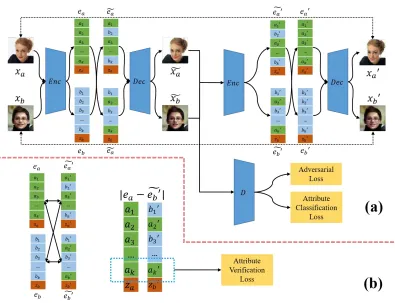
Figure 2: (a). An illustration of the training pipeline of our work. Given two input images(xa, xb), we encode each of them into embeddings(ea, eb), and divide each embedding into latent units as the filled rectangles in the diagram. Each unit in green indicates the information of a specific attribute fromxa, blue forxband orange for attribute-irrelevant parts. Subsequently, we select and swap some of the units and decode the embeddings into synthesized images. The whole process will be repeated to reconstruct the input images with the same encoder and decoder. (b). An illustration of the structure of Attribute Verification Loss. We compute and optimize attribute verification loss for four pairs of embeddings. For each pair, say ea ande˜0b, we calculate the absolute difference between the two selected embeddings. Then a binary classification loss will be applied to each latent unit pair to recognize whether the two units are representing attribute information from the same input image.
Method
The goal of our model is to exchange some of the attributes between a pair of images. To this end, an auto-encoder ar-chitecture G = (Enc,Swap,Dec)first project images to embeddings which comprise different latent units, such that attribute exchanging can be accomplished by swapping the corresponding latent units, and then decodes the embeddings to synthesize images. To synthesize plausible images, we employ a discriminator D to formulate a cycle-consistent GAN framework for our model. The overall pipeline of our proposed model is shown in Figure 2.
Define a dataset of multi-label images X with a set of labelsY.kdenotes the number of different attributes inY
that for anyx∈ X there is a labely = (y1, . . . , yk) ∈ Y
with k different attribute annotations. Given two images (xa, xb) ∈ X2 with label (ya, yb) ∈ Y2, Enc encodes (xa, xb)intoattribute embeddings (ea, eb), whereea (and the same foreb) can be further divided intok+1different la-tent unitsea = (a1, a2, . . . , ak, za). Each of the unit, which consists of a specific number of channels of feature map,
represents a single attribute in all kattributes(a1, . . . , ak)
or attribute-irrelevant partzasuch as image background. Af-ter encoding the images into embeddings,Swapis applied. We select some of the attributes following specific strate-gies and swap the corresponding latent units, transforming
(ea, eb)to(˜ea,e˜b). Afterwards, a decoderDecis adopted to
generate synthetic images(˜xa,x˜b), taking(˜ea,e˜b)as input. For discriminator network D : x 7→ {Dadv(x), Dcls(x)},
Finally we apply Dec to(e0a, e0b)and generate two recon-structed images (x0a, x0b). To attain disentanglement of the mutual information between different attributes and con-strain the generated images with given attribute information, we design four different losses: adversarial loss, attribute classification loss, attribute verification loss and reconstruc-tion loss.
Attributes Swapping Strategy
Before we describe the losses we used to train our model, let’s see how we swap the attributes for training. For two input imagesxa andxb, labeled asya = (y1a, . . . , yka)and
yb = (y1b, . . . , y k
b)and embedded asea = (a1, . . . , ak, za) andeb= (b1, . . . , bk, zb), we have two different strategies to choose an attribute setS and swap the units corresponding to all attributes inS, changing the attribute embeddings to (˜ea,˜eb)and the labels to(˜ya,y˜b). We divide all the attributes into two setsP = {i|yai = ybi} andN = {j|yia 6= yib}. Then randomly choose one swapping strategy from the fol-lowings:
• Randomly choose an subsetA ⊆ P and letS =A ∪ N, theny˜a=ybandy˜b=ya.
• Randomly choose an subsetA ⊆ Pand letS =A, then ˜
ya =yaandy˜b =yb;
These two choices ensure that afterSwap, the new em-beddings labelsy˜a andy˜bsatisfyy˜a ∈ Y andy˜b ∈ Y. Un-der this circumstance, the generatorGcan only synthesize images with observed attribute label combinations, which means that the real and the synthesized image will have the same attribute label distribution, making the whole GAN framework more robust. Note that the background embed-dings z will never be swapped and the two strategies are chosen with equal probability during training.
Adversarial Loss
GAN(Goodfellow et al. 2014) loss is involved in our frame-work to improve the quality of images generated by the gen-erator G. We leverage WGAN (Arjovsky, Chintala, and Bot-tou 2017) with gradient panelty (Gulrajani et al. 2017) which is a variation of GAN framework and also PatchGAN (Isola et al. 2017) which discriminate whether local patches are real or fake. The loss function is defined as
Ladv=LD+LG+λgpExˆ[(||OˆxD(ˆx)||2−1)2]
LD=Ex[ReLU(1−Dadv(x))] +Ex[˜ReLU(1 +Dadv(˜x))] LG=−Ex˜[Dadv(˜x)], (1)
wherexandx˜ represent real and synthesized images and ˆ
x=x+ (1−)˜x, the random number∼U[0,1]. Hinge loss is adopted to stabilize the training process. For techni-cal details of GAN frameworks please refer to Gulrajani et al. (2017); Isola et al. (2017); Arjovsky, Chintala, and Bot-tou (2017). Note thatLD only optimizesD whileLGonly optimizesG.
Attribute Classification Loss
Attribute classification loss (Odena, Olah, and Shlens 2017) is introduced to helpGgenerate images with corresponding
attribute labels properly which will ensure that our model swaps the attributes correctly, also preserve and disentangle the information for different latent units. To achieve this goal we first train a standard classifier by applying binary cross-entropy losses to optimizeDwith the real images(xa, xb) and their attribute labels(ya, yb)
LDcls=Ex,y[−logDcls(y|x)] (2) then optimize G with synthesized images (˜xa,x˜b) and swapped attribute labels(˜ya,y˜b)
LGcls=Ex,˜y[˜−logDcls(˜y|x˜)]. (3)
Note that we learn a classifier and a discriminator with a shared weights network. It has been proved in Odena, Olah, and Shlens (2017); Choi et al. (2018) that it is stable to train and synthesize high-quality images using shared weights for the classifier and discriminator.
Claim of Disentanglement. The attribute classification loss guarantees that attribute labels keep unchanged for un-swapped attributes. Hence we can say the un-swapped units will not affect the attribute appearance that corresponds to un-swapped ones.
Cycle-Consistency Loss
The aforementioned adversarial loss and attribute losses are merely beneficial to the reality and attribute exactitude of synthesized images, whereas they are unable to preserve de-tailed information in the original images including details of attributes and attribute-irrelevant part. Inspired by the previ-ous work (Zhu et al. 2017), we apply a cycle consistency loss to incentivize the generator to retain pixel-wise information. Suppose input images(xa, xb)are translated to(˜xa,x˜b) af-ter aEnc-Swap-Decprocess with a specific attribute swap-ping choices, we re-apply the same process with the same attribute swapping choice s to(˜xa,x˜b), thus synthesizing reconstructed images (x0a, x0b). Then the cycle-consistency loss is defined as
Lrec=||xa−x0a||1+||xb−x0b||1. (4) where L1 loss is adopted as the reconstruction loss. Note that (xa, xb)and(x0a, x0b)share the same attribute labels respec-tively since the same latent units are swapped during the two
Swapsteps.
Attribute Verification Loss
To further disentangle information among different at-tributes and preserve image-level style diversity within a do-main, We introduce the attribute verification loss to verify whether a pair of two latent units corresponding to the same attribute (e.g.,a1 anda˜01) are extracted from the same
like the difference of labels, to avoid a trivial embedding which only contains the information of attribute labels and lose the intra-attribute diversity.
We compute and optimize attribute verification loss on four pairs of attribute embeddings:(ea,e˜0a),(ea,e˜0b),(eb,e˜0a)
and(eb,e˜0b). For each pair, channel-wise absolute difference
is calculated between the paired latent units. Then we apply a fully-connected layer within each unit pair outputting the predicted verification label, and optimize a binary classifica-tion loss with logistic regression.
The verification labelliis defined as1for latent unit pairs (ai,a˜0i)and(bi,b˜0i), and 0 for latent unit pairs (ai,b˜0i)and
(bi,a˜0i), wherei∈ {1, ..., k}. Note that for those unit pairs
with same attribute labels but from different images, namely (ai,b˜0i)withyia = ybi, the attribute verification process is supposed to classify them as the unit pairs with different at-tribute labels. The atat-tribute verification loss betweeneaand
˜
e0bcan be defined as:
V(ea,e˜0b) = 1
k
k
X
i=1
[−lilog(pi)−(1−li)log(1−pi)]. (5)
Where pi is the predicted label corresponding to the groundtruth labelli. Then the equation for the attribute ver-ification loss is the sum of the verver-ification loss for four dif-ferent pairs of attribute embeddings:
Lver=V(ea,e˜a0)+V(ea,e˜0b)+V(eb,e˜0a)+V(eb,e˜0b). (6)
Since the latent unit pair from the same image, like(ai,a˜0i), is expected to be identical after aEnc-Decprocess (in con-trast to the unit pairs from different images). The attribute verification loss can also be partially viewed as an embed-ding reconstruction loss, which promotes robustness of the auto-encoder.
Claim of Disentanglement. With attribute verification loss, the feature embeddings extracted from synthesized images (i.e.,e˜0) can reflect the attribute changes in corresponding
la-tent units. Hence the unit pairs containing these units come from different images will be pushed away with different verification labels, even if two latent units in a pair have the same attribute labels. The latent units corresponding to those unchanged attributes tend to be relatively invariant with the same verification labels, which is reminiscent of the afore-mentioned definition of disentangled representation. This loss ensures that the changes in attributes indeed affect and only affect the corresponding latent units, which enhances the disentanglement of latent units.
Full Objective and Implementation Details
Finally, we combine all these losses as the objective function to optimize our model,
L=Ladv+λclsLcls+λverLver+λrecLrec. (7)
We useλcls = λver = 0.1 andλrec = 10 in our experi-ments. We followed the network structure proposed by Zhu et al. (2017); Choi et al. (2018), which contains two down-sampling blocks inEncan six residue blocks similar to the
model proposed in He et al. (2016). We use Adam optimizer (Kingma and Ba 2014) with β1 = 0.5 and β2 = 0.999. Random horizontal flip are applied for data augmentation. We set batchsize to 16 and train our model with 200000 it-erations with learning rate 0.0001. Spectral Normalization Layers (Miyato et al. 2018) and Batch Normalization Lay-ers (Ioffe and Szegedy 2015) are applied to boost and sta-bilize the convergence of the network. We perform the up-date to Gand D with the same frequency. We assign 16 channels of feature map for each latent unit and 160 chan-nels for attribute-irrelevant parts. The whole traning process takes about one and a half days on a single NVIDIA Tesla P100 GPU.
Experiments
In this section, we show the experimental results of our pro-posed model. To demonstrate the effectiveness and gener-alizability of our proposed model, we train the model on a large public face dataset CelebA and test on CelebA and an-other facial expression dataset RaFD.
CelebA Dataset The CelebFaces Attributes (CelebA) (Liu et al. 2015) contains 202599 face images of celebrities around the world. Each of the images is annotated with 40 binary attributes. The original image size is178×218, we apply center crop with the size of178×178and resize the image to128×128. Following the setting of (Choi et al. (2018), we randomly select 2000 images from the whole dataset as the test set and the rest images are used for train-ing. We select two attributes to transfer: hair color and smil-ing, which are clearly two attributes that can be represented in a disentangled fashion.
RaFD Dataset The Radboud Faces Database (RaFD) (Langner et al. 2010) contains 4824 images collected from 67 different persons. There are eight different facial expres-sions from 3 different gaze directions and camera angles captured from each person. We affine all the images accord-ing to the midpoint of the eyes of each image and crop the image with the size of512×512then resize the image to
128×128
Qualitative Results for CelebA Dataset
Note that all the results are generated by a single model, showing that we can disentangle different attributes and deal with multi-domain transfer with one single model. We only swap the specific latent units in the image embeddings and keep the other units (e.g., attribute-irrelevant part) un-changed to show the experimental results of attribute trans-lation. Figure 3(a), Figure 3(b) and Figure 3(c) show the syn-thetic images after transferring a single facial attribute or a combination of two attributes. The leftmost column and the topmost row of each figure are real input images, and the 5x5 grid in the center of each figure exhibits synthesized images after transferring the specified attributes in the leftmost real images to the topmost ones.
(a) CelebA: hair color (b) CelebA: smiling
(c) CelebA: hair color and smiling (d) RaFD: hair color and smiling
Figure 3: Qualitative results for our model transferring the attributes from the leftmost real images to the topmost ones.
color transfer and generate sharp images with remarkable quality. Notably, all the other attributes remain intact, un-affected by the hair color transfer. In particular, the details of ears, skin color and background are perfectly preserved without any brightness variation. The experimental results validate that our multi-attribute transfer framework indeed facilitates the disentangling of different attributes. Although different persons have different hairstyles, our model only change the hair color in the image, indicating that the hair color attribute is well disentangled from other attributes.
For Figure 3(b), the attribute smiling is transferred at this time. As seen in Figure 3(b), synthesized images retain more detailed information beyond the attribute label, smiling or not smiling. We can also observe the difference between the smile, beam and grin in the figure. The reason is that our model clearly retains image-level details by use of at-tribute verification loss, preserving the style diversity within the same domain.
Figure 3(c) demonstrates the synthesized results of trans-ferring two different attributes, smiling and hair color. Com-pared with Figure 3(b), the corresponding synthesized im-ages are identical in every detail except for hair color. The style diversities of each attribute are preserved respectively, and we can say that the attributes of generated faces are swapped independently. Furthermore, the transfer of multi-attribute does not incur any background variation in the syn-thesized images, consistent with the previous experimental results. These results confirm the disentanglement of our ex-planatory feature representation.
Interpolation of the Latent Units
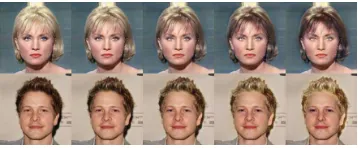
Figure 4: Example results for interpolation of latent units for the hair color attribute. The real images are put on the left side.
attribute label changed. Then we apply channel-wise linear interpolation to this latent unit between the real and synthe-sized image, which turn the discrete label value into a con-tinuous one. Three more images are generated with different attribute styles from each interpolation process. In Figure 4, we display two results on the interpolation of latent units. The leftmost column is the input real images and the right-most column shows the synthesized images with different hair color label. In the first row, we transfer blond hair to brown hair and change brown to blond in the second row. Three columns in the middle show the result of linear in-terpolation of the latent units learned by our model. All the other attributes and attribute-irrelevant parts stay unaltered during the linear interpolation process, while the hair color changes smoothly between blond and brown. This interpola-tion experiment provides one more evidence to confirm that our framework embeds the image to an explanatory disen-tangled representation.
Qualitative Results for RaFD Datset
To further prove the generalizability of our proposed model, we evaluate the model on the facial expression dataset RaFD. The model used for evaluation is trained on face dataset CelebA without any fine-tuning process.
The results of generated images are shown in Figure 3(d). The quality of images in Figure 3(d) is comparable to the experimental results of dataset CelebA. The appearance of unchanged attributes and background is consistent in each column and swapped latent unit leads to a proper attribute transfer. We also employ the squared image matrix as exper-iments on CelebA to illustrate that the proposed method can achieve attribution transfer between every image pair with-out any constraints. The synthesized images show the im-pressive generalizability of our model. Note that the results are not as good as CelebA. There are domain shifts issues between CelebA (i.e., the source domain) and RaFD (i.e., the target domain). In particular, backgrounds are complex while in RaFD backgrounds are pure white. It is well-known that the model trained on the source domain may perform much worse on the target domain when the data distribu-tions between the two domains are considerably different (Torralba and Efros 2011).
Quantitative Results
Here we put quantitative results to show the performance comparisons between our model and the others. We only
Methods StarGAN DNA-GAN Ours
FID 78.90 76.08 45.23
Table 1: Comparison among our method and other methods.
λver 0 0.01 0.1 1 10
FID 55.15 52.39 45.23 60.98 70.72
Table 2: Ablative studies for attribute verification loss.
choose Star-GAN (Choi et al. 2018) and DNA-GAN (Xiao, Hong, and Ma 2017) which are designed for facial expres-sion transfer task. We split the test set of CelebA into two parts A and B with equal quantity and construct pairs based on one-to-one matching between part A and part B. For StarGAN: We swap the attribute values for the images in A with the corresponding attribute values for the images in B, and vice versa. We use Frechet Inception Distance (FID), which is a sound measurement to evaluate the image qual-ities for GANs and introduced in (Heusel et al. 2017), to evaluate the models. For more details, please refer to the pa-per. Note that for smaller FID indicates better performance. For DNA-GAN: For all the images in A we swap the at-tributes which have different attribute values compared with the corresponding images in B, and vice versa. For ours: we swap the attributes with the same rule as for DNA-GAN. Since DNA-GAN is not able to transfer hair color attribute, we choose three other independent attributes to train: bangs, smiling and eyeglasses. The results are shown in Table 1, we can see that we significantly improved the quality of synthe-sized images compared with StarGAN and DNA-GAN.
To show the effect of the attribute verification loss, we also run experiments to conduct ablative studies by changing
λver. The results are shown in Table 2, we can see that veri-fication loss does help our model improve the quality of syn-thesized images because our model is not able to fully pre-serve the intra-attribute diversity without verification loss. Andλver= 0.1is about the optimal hyper-parameter.
Conclusions
Acknowledgement
The work was supported by the National Basic Research Program of China (Grant No. 2015CB856004), the Key Basic Research Program of Shanghai Municipality, China (15JC1400103,16JC1402800).
References
Arjovsky, M.; Chintala, S.; and Bottou, L. 2017. Wasserstein gan. InICML.
Bengio, Y.; Courville, A.; and Vincent, P. 2013. Repre-sentation learning: A review and new perspectives. IEEE transactions on pattern analysis and machine intelligence. Bouchacourt, D.; Tomioka, R.; and Nowozin, S. 2018. Multi-level variational autoencoder: Learning disentangled representations from grouped observations. InAAAI. Chang, H.; Lu, J.; Yu, F.; and Finkelstein, A. 2018. Pairedcy-clegan: Asymmetric style transfer for applying and remov-ing makeup. InCVPR.
Chen, X.; Duan, Y.; Houthooft, R.; Schulman, J.; Sutskever, I.; and Abbeel, P. 2016. Infogan: Interpretable representa-tion learning by informarepresenta-tion maximizing generative adver-sarial nets. InNIPS.
Choi, Y.; Choi, M.; Kim, M.; Ha, J.-W.; Kim, S.; and Choo, J. 2018. Stargan: Unified generative adversarial networks for multi-domain image-to-image translation. InCVPR. Donahue, C.; Balsubramani, A.; McAuley, J.; and Lipton, Z. C. 2018. Semantically decomposing the latent spaces of generative adversarial networks. InICLR.
Dong, C.; Loy, C. C.; He, K.; and Tang, X. 2016. Image super-resolution using deep convolutional networks. IEEE transactions on pattern analysis and machine intelligence. Feng, Z.; Wang, X.; Ke, C.; Zeng, A.; Tao, D.; and Song, M. 2018. Dual swap disentangling. InNIPS.
Gong, Y.; Karanam, S.; Wu, Z.; Peng, K.-C.; Ernst, J.; and Doerschuk, P. C. 2018. Learning compositional visual con-cepts with mutual consistency. InCVPR.
Gonzalez-Garcia, A.; van de Weijer, J.; and Bengio, Y. 2018. Image-to-image translation for cross-domain disentangle-ment. InNIPS.
Goodfellow, I.; Pouget-Abadie, J.; Mirza, M.; Xu, B.; Warde-Farley, D.; Ozair, S.; Courville, A.; and Bengio, Y. 2014. Generative adversarial nets. InNIPS.
Gulrajani, I.; Ahmed, F.; Arjovsky, M.; Dumoulin, V.; and Courville, A. C. 2017. Improved training of wasserstein gans. InNIPS.
Hadad, N.; Wolf, L.; and Shahar, M. 2018. A two-step dis-entanglement method. InCVPR.
He, K.; Zhang, X.; Ren, S.; and Sun, J. 2016. Deep residual learning for image recognition. InCVPR.
Heusel, M.; Ramsauer, H.; Unterthiner, T.; Nessler, B.; and Hochreiter, S. 2017. Gans trained by a two time-scale update rule converge to a local nash equilibrium. InNIPS.
Higgins, I.; Matthey, L.; Pal, A.; Burgess, C.; Glorot, X.; Botvinick, M.; Mohamed, S.; and Lerchner, A. 2017.
beta-vae: Learning basic visual concepts with a constrained vari-ational framework. InICLR.
Huang, X.; Liu, M.-Y.; Belongie, S.; and Kautz, J. 2018. Multimodal unsupervised image-to-image translation. In ECCV.
Ioffe, S., and Szegedy, C. 2015. Batch normalization: accel-erating deep network training by reducing internal covariate shift. InICML.
Isola, P.; Zhu, J.-Y.; Zhou, T.; and Efros, A. A. 2017. Image-to-image translation with conditional adversarial networks. InCVPR.
Jha, A. H.; Anand, S.; Singh, M.; and Veeravasarapu, V. 2018. Disentangling factors of variation with cycle-consistent variational auto-encoders. InECCV.
Kingma, D. P., and Ba, J. 2014. Adam: A method for stochastic optimization. arXiv preprint arXiv:1412.6980. Kingma, D. P., and Welling, M. 2013. Auto-encoding vari-ational bayes. arXiv preprint arXiv:1312.6114.
Kulkarni, T. D.; Whitney, W. F.; Kohli, P.; and Tenenbaum, J. 2015. Deep convolutional inverse graphics network. In NIPS.
Langner, O.; Dotsch, R.; Bijlstra, G.; Wigboldus, D. H.; Hawk, S. T.; and Van Knippenberg, A. 2010. Presentation and validation of the radboud faces database.Cognition and emotion.
Ledig, C.; Theis, L.; Husz´ar, F.; Caballero, J.; Cunningham, A.; Acosta, A.; Aitken, A. P.; Tejani, A.; Totz, J.; Wang, Z.; et al. 2017. Photo-realistic single image super-resolution using a generative adversarial network. InCVPR.
Liu, Z.; Luo, P.; Wang, X.; and Tang, X. 2015. Deep learning face attributes in the wild. InICCV.
Mathieu, M. F.; Zhao, J. J.; Zhao, J.; Ramesh, A.; Sprech-mann, P.; and LeCun, Y. 2016. Disentangling factors of variation in deep representation using adversarial training. InNIPS.
Miyato, T.; Kataoka, T.; Koyama, M.; and Yoshida, Y. 2018. Spectral normalization for generative adversarial networks. InICLR.
Odena, A.; Olah, C.; and Shlens, J. 2017. Conditional image synthesis with auxiliary classifier gans. InICML.
Torralba, A., and Efros, A. A. 2011. Unbiased look at dataset bias. InCVPR.
Xiao, T.; Hong, J.; and Ma, J. 2017. Dna-gan: Learning dis-entangled representations from multi-attribute images.arXiv preprint arXiv:1711.05415.
Yan, X.; Yang, J.; Sohn, K.; and Lee, H. 2016. At-tribute2image: Conditional image generation from visual at-tributes. InECCV.
Zhang, R.; Isola, P.; and Efros, A. A. 2016. Colorful image colorization. InECCV.