Volume 2, Issue 3, March 2013
Page 379
A
BSTRACTThe proposed system is developed for face detection which increases security in different areas viz.banks,military,industry, stadiumetc. Face detection using adaboost algorithm highly improves the accuracy and reliability of the system.In certain methods used for face detection like eigen vector images are preprosed before extraction of feature as they may be affected by light condition or change in facial expressions. The adaboost method overcomes all these drawbacks & removes the noisy regions in an image.This system detects mutual information and includes cross correlation. Experimental results show that the proposed system obtains the 3D view with more accuracy information.
Keywords: Face detection, adaboost algorithm, cross correlation, mutual information, position.
1.
INTRODUCTION
Face detection is a very important concept in applications like face recognition, videosurveillance, human computer interface, face image database management,and querying image databases.There have been various approaches proposed for face detection viz.Template matching methods,Featurebased methods, Knowledge-based methods[1], and Machine learning methods.In template matching methoddepending upon features like scale,rotation the decision is made between the given template and the given image. Feature-based approaches extract salient features from the sensed and reference data sets and aim to find the transformation that minimizes the distance between corresponding features. The extracted features can be regions, edges, or interest points. , detect maximally stable extremal regions and set up the correspondence between pairs of images based on these stable regions. [3,4].Knowledge-based methods[5] detects an isosceles triangle (for frontal view) or aright triangle (for side view). Machine learning
methods use a lot of training samples to make themachine to be capable of judging face or non-face.Though machine learning method has gained tremendous success still its complexity and efficiency need to be improved.
Among all these methods of face detection the area based methods is an important category.This paper proposes a system for 3D view information. The entire final image regions are obtained using adaboost algorithm. The mutual information and cross correlation is applied to detect the 3D view.
2.
PREVIOUS
WORK
Although there is a large amount of literature on face detection,certain papers are performed to verify the effectiveness of the face detection using colour images Most of thecommonly used databases for face detection, includingthe Carnegie Mellon University (CMU) databasecontain gray scale images only. Therefore, the systemhas constructed the database for face detection frompersonal photo collections, these images containmultiple faces with variations in color, position, scale,orientation, and facial expression.Some sample imagesfrom Internet compose training set and testing set.The initial scheme integrates AdaBoostalgorithmand skin color information to improve detectionprecision, meanwhile, to reduce computational cost.Results using the proposed method showthat the new approach can detect face with highdetection rate and low false acceptance rate andperformance better than skin color detection andAdaBoostalgorithm.But false alarms and misses arestill present.
3.
3D
ESTIMATION
3-D motion estimation has been studied for some time, but now, improved computation and memory resources make higher performance methods increasingly feasible. In 3-D registration,motion can occur along all three dimensions. Previous work on image registration can be broadly classified into feature-based and area-based methods. Feature-based approaches extract salient features from the sensed and reference data sets and aim to find the transformation that
3D Face Identification and detection by using
Adaboost Method
Er. Priyanka Kulkarni1, Er.Kantilal P Rane2, Er. VijayChaudhari3
1
PG Student, Department of E&TC, GF’s Godavari COE, Jalgaon
2
Asso. Prof., Department of E&TC, GF’s Godavari CoE, Jalgaon
3
Volume 2, Issue 3, March 2013
Page 380
minimizes the distance between corresponding features. The extracted features can be regions, edges, or interest points, detect maximally stable extremal regions and set
up the correspondence between pairs of images based on these stable regions..Proposed a contour-based method, which uses region boundaries and other strong edges as matching primitives. Features from Accelerated Segment and perform descriptor matching to estimate the image transformation. In contrast to feature-based methods, area-based methods attempt to perform registration without extracting salient features. Common area-based approaches include cross correlation (CC) methods and mutual information methods.
The ability to represent or display a 3 dimensional object is fundamental to the understanding of the shape of that object. Furthermore, the ability to rotate, translate, and project views of that object is also, in many cases, fundamental to understand its shape. Manipulation, viewing, and construction of three-dimensional graphic images require the use of three-dimensional geometric and coordinate transformations. In geometric transformation, the coordinate system is fixed, and the desired transformation of the object is done with respect to the coordinate system. In coordinate transformation, the object is fixed and the desired transformation of the object is done on the coordinate system itself. These transformations are formed by composing the basic transformations of translation, scaling &rotation. Each of these transformations can be represented as a matrix transformation. This permits more complex transformations to be built up by use of matrix multiplication or concatenation. We can construct the complex objects/pictures, by instant transformations. In order to represent all these transformations, we need to use homogeneous coordinates.
Hence, if P(x,y,z) be any point in 3-D space, then in HCS, we add a fourth-coordinate to a point. That is instead of (x,y,z), each point can be represented by a Quadruple (x,y,z,H) such that H≠0; with the condition that x1/H1=x2/H2;
y1/H1=y2/H2; z1/H1=z2/H2. For two points (x1, y1, z1, H1) = (x2, y2, z2, H2) where H1 ≠ 0, H2 ≠ 0. Thus any point
(x,y,z) in Cartesian system can be represented by a four-dimensional vector as (x,y,z,1) in HCS. Similarly, if (x,y,z,H) be any point in HCS then (x/H,y/H,z/H) be the corresponding point in Cartesian system. Thus, a point in 3dimensional space (x,y,z) can be represented by a four-dimensional point as:
(x’,y’,z’,1)=(x,y,z,1).[T], where [T] is some transformation matrix and (x’,y’z’,1) is a new coordinate of a given point (x,y,z,1), after the transformation.
The generalised4X4 transformation matrix for 3D homogenous co-ordinate is:
[T]=
The upper left (3x3) sub matrix produces scaling,shearing, rotation and reflection transformation. The lower left (1x3) sub matrix produces translation, and the upper right (3x1) sub matrix produces a perspective transformation, which we will study in the next unit. The final lower right-hand (1x1) sub matrix produces overall scaling.The generalized 4x4 transformation matrix for three-dimensional homogeneous coordinates is:
[T] =
The upper left (3x3) sub matrix produces scaling, shearing, rotation and reflection transformation. The lower left (1x3) sub matrix produces translation, and the upper right (3x1) sub matrix produces a perspective transformation, which we will study in the next unit. The final lower right-hand (1x1) sub matrix produces overall scaling.
3.1 TRANFORMATION for 3-D TRANSLATION
Let P be the point object with the coordinate (x,y,z). We wish to translate this object point to the new position say, P’(x’,y’,z’) by the translation Vector V=tx.I+ty.J+tz.K , where tx , ty and tz are the translation factor in the x, y, and z directions respectively, as shown . That is, a point (x,y,z) is moved to (x+ tx,y+ ty,z+ tz). Thus the new coordinates of a point can be written as:
x’=x+ tx – y’=y+ty } =Tv z’=z+tz
a b c w d e f x g h i y l m n z
Volume 2, Issue 3, March 2013
Page 381
3.2 TRANSFORMATION FOR 3-D ROTATIONRotation in three dimensions is considerably more complex then rotation in two dimensions. In 2-D, a rotation is
prescribed by an angle of rotation θ and a centre of rotation, say P.
However, in 3-D rotations, we need to mention the angle of rotation and the axis of rotation. Since, we have now three axes, so the rotation can take place about any one of these axes. Thus, we have rotation about x-axis, y-axis, and z-axis respectively.
3.3 ROTATION ABOUT Z-AXIS
Rotation about z-axis is defined by the xy-plane. Let a 3-D point P(x,y,z) be rotated to P’(x’,y’,z’) with angle of rotation
θ see Figure 9. Since both P and P’ lies on xy-plane i.e., z=0 plane their z components remains the same, that is z=z’=0.
Thus, P’(x’y’,0) be the result of rotation of point P(x,y,0) making a positive (anticlockwise) angle φ with respect to z=0
plane, as shown in fig. From figure ,
P(x,y,0) = P(r.cosφ,r.sinφ,0)
P’(x’,y’,0)=P[r.cos(φ+θ),rsin(φ+θ),0]
The coordinates of P’ are:
x’=r.cos(θ+φ)=r(cosθcosφ – sinθsinφ) =x.cosθ – y.sinθ (where x=rcosφ and y=rsinφ)
Similarly;
y’= rsin(θ+φ)=r(sinθcosφ + cosθ.sinφ) =xsinθ+ycosθ
Thus,
x’= x.cosθ – y.sinθ
[Rz]θ= y’= xsinθ + ycosθ
z’=z
In matrix form, (x’y’,z’)=(x,y,z)
[cosθsinθ 0---(a) –sinθcosθ 0
0 0 1 ]In terms of HCS, above equation (a) becomes (x’y’,z’,1)=(x,y,z,1)
[cosθsinθ 0 0
–sinθcosθ 0 0
0 0 1 0 0 0 0 1]
That is, P’h = Ph.[Rz]θ ---(b)
Volume 2, Issue 3, March 2013
Page 382
Fig 2Rotation about the x-axis can be obtained by cyclic interchange of x y z x in equation of the z-axis rotation i.e.,
x’= x.cosθ-y.sinθ
[Rz]θ= y’= xsinθ+ycosθ
z’=z
After cyclic interchange of x y z x
y’= y.cosθ-z.sinθ
[Rx]θ= z’= y.sinθ+z.cosθ ---(c) x’= x
So, the corresponding transformation matrix in homogeneous coordinates becomes
(x’y’,z’,1)=(x,y,z,1)
That is, P’h = Ph.[Rx]θ ---(d)
Similarly, the rotation about y-axis can be obtained by cyclic interchange of x y z x in equation (c) of the x-axis rotation [Rx]θi.e.,
y’= y.cosθ-z.sinθ
[Rx]θ= z’= y.sinθ+z.cosθ
x’= x
After cyclic interchange of x y z x
z’= z.cosθ-x.sinθ
[Ry]θ= x’= z.sinθ+x.cosθ ---(e) y’= y
So, the corresponding transformation matrix in homogeneous coordinates becomes
(x’y’,z’,1)=(x,y,z,1)
That is, P’=P. [Ry]θ---(f)
3.4TRANSFORMATION FOR 3-D SCALING
As we have seen earlier, the scaling process is mainly used to change the size of an object. The scale factors determine whether the scaling is a magnification, s>1, or a 35
reduction, s<1. Two-dimensional scaling, as in equation (8), can be easily extended to scaling in 3-D case by including the z-dimension.
1 0 0 0 0 cos0 sin0 0 0 -sin0 cos0 0 0 0 0 1
cos0 0 -sin0 0 0 1 0 0
Volume 2, Issue 3, March 2013
Page 383
For any point (x,y,z), we move into (x.sx,y.sy,z.sz), where sx, sy, and sz are the scaling factors in the x,y, and z-directions respectively.
Thus, scaling with respect to origin is given by: x’= x.sx
Ssx,sy,sz= y’= y.sy ---(g) z’= z.sz
reduction, s<1. Two-dimensional scaling, as in equation (8), can be easily extended to scaling in 3D case by including the z-dimension.
For any point (x,y,z), we move into (x.sx,y.sy,z.sz), where sx, sy, and sz are the scaling factors in the x,y, and z-directions respectively.
Thus, scaling with respect to origin is given by: x’= x.sx
Ssx,sy,sz= y’= y.sy ---(g) z’= z.sz
In matrix form,
(x’y’,z’)=(x,y,z)
In terms of HCS, equation (g) becomes
(x’y’,z’,1)=(x,y,z,1)
That is, P’=P. Ssx,sy,sz---(i)
3.5 Transformation for 3-D Shearing
Two-dimensional xy- shearing transformation, as defined in equation (19), can also be easily extended to 3-D case. Each coordinate is translated as a function of displacements of the other two coordinates. That is,
x’=x+a.y+b.z
Shxyz= y’=y+c.x+d.z---(j) z’=z+e.x+f.y
wherea,b,c,d,e and f are the shearing factors in the respective directions. In terms of HCS, equation (j) becomes
(x’y’,z’,1)=(x,y,z,1)
That is, P’h = Ph.Shxyz ---(k)
Note that the off-diagonal terms in the upper left 3x3 sub matrix of the generalized 4x4 transformation matrix in equation produce shear in three dimensions.
3.6 TRANSFORMATION FOR 3D SCALING
For 3-D reflections, we need to know the reference plane, i.e., a plane about which the reflection is to be taken. Note that for each reference plane, the points lying on the plane will remain the same after the reflection.
4.
TRANSFORMATION
MIRROR
REFLECTION
ABOUT
XY
PLANE
Let P(x,y,z) be the object point, whose mirror reflection is to be obtained about xy-plane(or z=0 plane). For the mirror reflection of P about xy-plane, only there is a change in the sign of z-coordinate
Sx 0 0 0 0 Sy 0 0 0 0 Sz 0 0 0 0 1
Volume 2, Issue 3, March 2013
Page 384
x’=x
Mxy= y’=y ---(l) z’=-z
Fig 3
In matrix form,
(x’y’,z’)=(x,y,z)
In terms of HCS (Homogenous coordinate systems), equation (l) becomes
(x’y’,z’,1)=(x,y,z,1)
That is, P’=P.Mxy---(m)
Similarly, the mirror reflection about yz plane shown in Figure 12 can be represented as: x’=-x
Myz= y’=y ---(n) z’=z
In matrix form,
(x’y’,z’)=(x,y,z)
In terms of HCS, equation (n) becomes
(x’y’,z’,1)=(x,y,z,1)
That is, P’=P. Myz; ---(o)
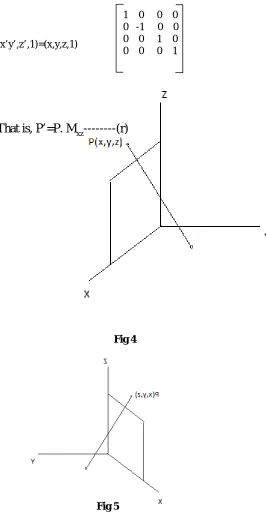
similarly, the reflection about xz plane, shown in Figure , can be presented as: x’=x
Mxz= y’= − y ---(p) z’=z
In matrix form,
(x’y’,z’)=(x,y,z)
In terms of HCS, equation (q) becomes 1 0 0 0 0 1 0 0 0 0 -1 0 0 0 0 1
Volume 2, Issue 3, March 2013
Page 385
(x’y’,z’,1)=(x,y,z,1)
That is, P’=P. M
xz---(r)
5.
EXPERIMENTAL
RESULT
Experiments are performed to verify the effective
result of the proposed scheme. In 3-D registration, motion can occur along all three dimensions. Previous work on image registration can be broadly classified into feature-based&area-based methods. Proposed a contour-based method, which uses region boundaries and other strong edges as matching primitives.Features from Accelerated Segment and perform descriptor matching to estimate the image transformation. In contrast to feature-based methods, area-based methods attempt to perform registration without extracting salient features. Common area-based approaches include cross correlation (CC) methods and mutual information (MI) methods. The proposed system integrates the adaboost algorithm and area based methods to improve the 3D information for more accurate result. Experimental results using the proposed show that the new approach can increase the speed and give 3D output with excellent accuracy.
1 0 0 0 0 -1 0 0 0 0 1 0 0 0 0 1
Fig 4
Volume 2, Issue 3, March 2013
Page 386
6.
CONCLUSION
This paper presents a face detection approach with high speed and 3 dimentaional information with accuracy.The transformations are formed by composing the basic transformations of translation, scaling, and rotation. Each of these transformations can be represented as a matrix transformation. This permits more complex transformations to be built up by use of matrix multiplication orconcatenation. We can construct the complex objects/pictures, by instant transformations. We represent all these transformations usinghomogeneous coordinates. The results obtained from the proposed approach are illustrated as effective and practical.
REFERENCES
[1] Chiunhsiun Lin and Kuo-Chin Fan, "Triangle-basedApproach to the Detection of Human Face," PatternRecognition, Vol. 34, No. 6,2001, pp. 1271-1283.
[2] Kwok-Wai Wong, Kin-Man Lam, and Wan-Chi Siu, "AnEfficient Algorithm for Human Face Detection and FacialFeature Extraction under Different Conditions," PatternRecognition, Vol. 34, 2001, pp. 1993-2005.
[3] Ing-Sheen Hsieh, Kuo-Chin Fan, and Chiunhsiun Lin, "AStatistic Approach to the Detection of Human Faces in ColorNature Scene," Pattern Recognition, Vol. 35, 2002, pp. 1583-1596.
[4] J. G. Wang and T. N. Tan, "A New Face DetectionMethod Based on Shape Information," Pattern RecognitionLetters, No21, 2000,pp463-471.
[5] M. Turk and A. Pentland, "Eigenfaces for Recognition,"Journal of Cognitive Neuroscience, Vol. 3, No. 1, March1991, pp 71-86.
[6] Jie Yang and A. Waibel, "A Real-time Face Tracker,"Applications of Computer Vision (WACV'96), Proceedingsof the 3rd IEEE Workshop, December 1996, pp. 142-147.
[7] P.Viola and M.J.Jones. “Robust real-time objectdetection”, Proc. of IEEE Workshop on Statistical andCompurational Theories of Vision, 2001.
[8] C. Papageorgiou, M. Oren, and T. PoPgio, “A generalframework for object detection”, International conference oncomputer vision, 1998.
[9] Yan-Wen Wu,Xue-Yi Ai.’Face detection in colour images using adaboost algorithm based on skin colour 2008’
ACKNOWLEDLEMENT
We would like to acknowledge Prof. K.P.Rane Associate Prof Godavari COE Jalgaon&Prof.V.D.ChaudhariAssistant Prof Godavari COE for their support.
A
UTHORProf. PriyankaKulkarni