A Note on the First Geometric
Arithmetic Index of
Hexagonal Systems and Phenylenes
ZAHRA YARAHMADI
Department of Mathematics, Faculty of Science, Khorramabad Branch, Islamic Azad University, Khorramabad, I. R. Iran
(Received March 10, 2011)
ABSTRACT
The first geometric-arithmetic index was introduced in the chemical theory as the summation
of 2 dudv /(du dv)overall edges of the graph, where du stand for the degree of the vertex u. In this paper we give the expressions for computing the first geometric-arithmetic index of hexagonal systems and phenylenes and present new method for describing hexagonal system by corresponding a simple graph to each hexagonal system.
Keywords: Geometric-arithmetic index, hexagonal system, phenylenes.
1.
INTRODUCTION
Throughout this paper G is a simple connected graph with vertex and edge sets V(G) and
E(G), respectively. A topological index is a numeric quantity from the structural graph of a molecule. The concept of the first geometric-arithmetic index was introduced in the chemical graph theory. This index is defined as
, )
( 2 )
(
G E uv
v d u d
v d u d G
GA
where uv is an edge of the molecular graph G and du stand for the degree of the vertex u,
see [1].
A hexagonal system is a connected geometric figure obtained by arranging congruent regular hexagons in a plane, so that two hexagons are either disjoint or have a common edge. This figure divides the plane into one infinite external region and a number of finite internal all internal region must be regular hexagons. Hexagonal systems are considerable importance in theoretical chemistry because they are the natural graph
representation of benzenoid hydrocarbon. A vertex of a hexagonal system belongs to at most three hexagons. A vertex shared by three hexagons is called an internal vertex; the number of internal vertices of a hexagonal system is denoted by ni. A hexagonal system is
called catacondensed if ni=0, otherwise (ni>0), it is called precondensed, For more details
and new results about hexagonal systems, see [2−9].
Lemma 1.1. (See [4]). For any hexagonal system with n vertices, m edges and h hexagons and ni internal vertices,
n=4h+2-ni and m=5h+1-ni.
Phenylenes are a class of chemical compounds in which the carbon atoms form squares and hexagons. Each square is adjacent to two disjoint hexagons, and no two hexagons are adjacent. Their respective molecular graphs are also referred to as phenylenes. By eliminating, squeezing out, the squares from a phenylene, a catacondensed benzenoid system (which may be jammed) is obtained, called the hexagonal squeeze of the respective phenylene. Clearly, there is a one-to-one correspondence between a phenylene (PH) and its hexagonal squeeze (HS). Both possess the same number (h) of hexagons. In addition, a phenylene with h hexagons possesses h − 1 squares. The number of vertices of such a PH and its HS are 6h and 4h + 2, respectively. We recall some concept about hexagonal systems that will be used in the paper. A hexagon H of a catacondensed hexagonal system has either one, two or three neighboring hexagons. If H has one neighboring hexagon, it is called terminal, and if it has three neighboring hexagons it is called branched. A hexagon H
adjacent to exactly two other hexagons posses two vertices of degree 2. If these two vertices are adjacent, H is angularly connected. Each branched and angularly connected hexagons in a catacondensed hexagonal system is said to be kink, in Figure 1(a) the kinks are marked by K. The linear chain Lh with h hexagons is the catacondensed system without
kinks, see Figure 1(b). Our notation is standard and mainly taken from [10, 11].
K K
1 2 h-1 h
(a) (b)
2.
MAIN RESULT AND DISCUSSION
At first we define a concept related to a hexagonal system and use it to obtain the GA index of a hexagonal system.
Definition 2. 1. A hexagon in a hexagonal system is called cubic hexagon if the degree of all vertices are equal to 3.
Throughout this paper, we suppose that HS is a hexagonal system with n vertices, m
edges, h hexagons, hi cubic hexagons and ni internal vertices. If we partition the edge set of
HS into three subsetsE1, E2andE3, as follows:
} 4 |
{
1 euv du dv
E ,
} 5 |
{
2 euv du dv
E ,
} 6 |
{
3 euv du dv
E . Therefore, 1 2 ) 1 5 6 2 ( )
(HS m E
GA . (1)
Theorem 2. 2. Let HS be a hexagonal system, then the first geometric-arithmetic index is computed as follows:
, 1 ) 2 5 6 4 ( ) 5 6 4 2 ( ) 5 6 4 3 ( ) (
1 HS h hi ki ni
GA
where kiis the number of hexagons with exactly two parallel edges in E3.
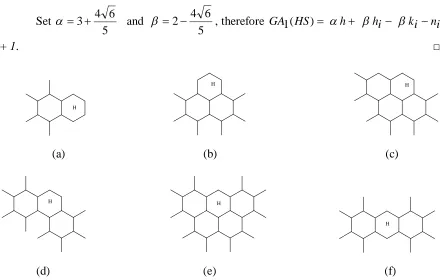
Proof. Let H be a hexagon in a hexagonal system such that it has at least one vertex of degree 2. There are six cases, see Figure 2(a)-(f). In cases (a)-(e), there are two edges in E2
and in case (f), there are four edges in E2. In case (f) a hexagon with two vertices of degree
2, has just two edges in E3 such that these edges are parallel. Suppose ki is the number of
these hexagons (the hexagon with exactly two parallel edges in E3). Then,
) ( 2 2 ) ( 2
2 h hi ki h hi ki
E . By Eq(1) we have:
) ( 2 ) 1 5 6 2 ( ) (
1 HS m h hi ki
GA
) ( ) 1 5 6 2 ( 2 1
5hni hhi ki
. 1 ) 2 5 6 4 ( ) 5 6 4 2 ( ) 5 6 4 3 (
Set
5 6 4 3
and
5 6 4 2
, therefore GA1(HS) h hi ki ni
+ 1. □
H
H
H
(a) (b) (c)
H
H
H
(d) (e) (f)
Figure 2. Six Different Cases for a Hexagon in HS with at Least One Vertex of Degree 2.
Corollary 2. 3. Let CHS be a catacondensed hexagonal system with h hexagons. Then
. 1 )
(
1 CHS h hi ki
GA
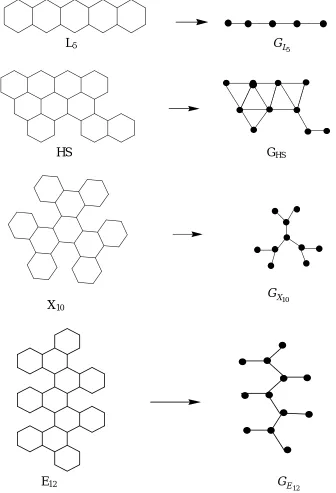
Definition 2. 4. For each HS the related graph GHS is defined as follows:
}}. { ),
( |
{ ) (
}, |
{ ) (
2 1 2
1H e E X H H e
H G
E
system hexagonal
in hexagon a
be H H G
V
HS HS
Example 2. 5. In Figure 3 the hexagonal systems L5, HS, X10 and E12 with their related
graphs are shown.
It is easy to see that for each hexagonal system HS,GHS is simple planner graph and
. 6 )
(
GHS
Lemma 2. 6. (i) The hexagonal system HS is catacondensed if and only if GHS is a tree,
(ii) A hexagon H, in a catacondensed system is a cubic hexagon if and only if
. 3
degG H
HS
Proof. By definition of catacondensed hexagonal system and related graph, the proof is straightforward. □
L5 GL5
HS GHS
X10 10 X
G
E12 GE12
Theorem 2. 7. Let CHS be a catacondensed hexagonal system with h hexagons, then ) ( ) ( )
( 1 1
1 Lh GA CHS GA Xh
GA .
Proof. By Corollary 2.3 and since 0, then minimum value of GA1 for catacondensed
hexagonal systems with h hexagons, is happened for a catacondensed hexagonal system, such that hi=0 and ki has maximum value. In a linear chain with h hexagons, it is easy to
see that hi=0 and ki=h-2 there is no hexagonal system such that ki=h or h-1, for h3 then
) ( )
( 1
1 L GA CHS
GA h . Also the maximum value of GA1 for catacondensed hexagonal
systems with h hexagons, is happened for a catacondensed hexagonal system, such that hi
has maximum value and ki=0. A catacondensed hexagonal system Xh has the maximum
value of hi if and only if the tree
h X
G has maximum number of vertices of degree 3. By
Lemma 2.6, for a catacondensed hexagonal system X, 3
X
G . The maximum number of
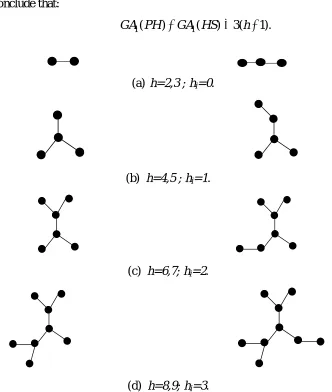
vertices of degree 3 in GX is equal to [(h2)/2], in fact hi = [(h2)/2] for h=1 it is trivial that hi=0 and for h 2 by induction on h, see Figures 4 (a)-(d). Therefore,
) ( 1 ) (
1 CHS GA Xh
GA and this completes the proof. □
Theorem 2. 8. Let PH be a Phenylenes with h hexagons, then the geometric-arithmetic
index is computed as follows:
, 2 ) 2 5 6 4 ( ) 5 6 4 2 ( ) 5 6 4 6 ( ) (
1 PH h hi ki
GA
where ki is the number of hexagons with exactly two parallel edges in E3 .
Proof. By Eq(1) and |E(PH)|m8h2
. 2 ) 2 5 6 4 ( ) 5 6 4 2 ( ) 5 6 4 6 ( ) ( 2 ) 1 5 6 2 ( 2 8 ) ( 2 ) 1 5 6 2 ( ) ( 1 i k i h h i k i h h h i k i h h m PH GA Set 5 6 4 2 5 6 4
3
and , thus GA1(PH)( 3)hhi ki 2. □
Theorem 2. 10. Let PH be a Phenylenes with h hexagons and HS its hexagonal squeeze. Then the geometric-arithmetic of PH and HS are related as:
). 1 ( 3 ) ( ) ( 1
1 PH GA HS h
Proof. It easy to see that HS is a catacondensed hexagonal system. Then by Corollary 2.3 and Theorem 2.8,
1 )
(
1 HS h hi ki
GA
2 )
3 ( ) (
1 PH h hi ki
GA
Then we conclude that:
GA1(PH)GA1(HS)3(h1). □
(a) h=2,3 ; hi=0.
(b) h=4,5 ; hi=1.
(c) h=6,7; hi=2.
(d) h=8,9; hi=3.
Figure 4. Graphs for Hexagonal Systems with h Hexagons, Maximum Value of hiand ki= 0.
REFERENCES
2. J. Zheng, The general connectivity indices of catacondensed hexagonal systems, J.
Math. Chem. 47 (2009) 11121120.
3. Z. Yarahmadi and S. Moradi, Second and third extremals of catacondensed hexagonal systems with respect to the PI index, Iranian J. Math. Chem. 1 (2010) 95–103.
4. I. Gutman, Hexagonal Systems. A Chemistry Motivated Excursion to Combinatorial Geometry, The Teaching of Mathematics 10 (2007) 110.
5. J. Rada, O. Araujo and I. Gutman, Randic Index of Benzenoid Systems and Phenylenes, Croat. Chem. Acta 74 (2001) 225-235.
6. I. Gutman and S. J. Cyvin, Introduction to the Theory of Benzenoid Hydrocarbons, Springer-Verlag, Berlin, 1989.
7. S. J. Cyvin and I. Gutman, Kekule Structures in Benzenoid Hydrocarbons, Springer-Verlag, Berlin, 1988.
8. S. J. Cyvin and J. Brunvoll, The number of catacondensed benzenoids with thirteen hexagons and enumerations of some chemical benzenoid and coronoid isomers,
Chem. Phys. Letters 170 (1990) 364-367.
9. H. Deng, Extremal catacondensed hexagonal systems with respect to the PI index,
MATCH Commun. Math. Comput. Chem. 55 (2006) 461−476.
10. P. J. Cameron, Combinatorics: Topics, Techniques, Algorithms; Cambridge University Press:, Cambridge, 1994.