Volume 3, Special Issue 1, ICSTSD 2016
171
Online Knowledge Recommender System
in Collaborative Environment for
Organization
Ms. Shruti G. Taley1
1M.E (Scholar), Department of Computer Science and Engineering, P.R.M.I.T &
R,Badnera.
Abstract--In working areas like collaborative environments, members may try to acquire similar information on the web in order to gain knowledge in one domain and to make their search easy and efficient knowledge sharing is needed. In this paper work analysis is done on fine-grained knowledge sharing in collaborative environments. In this work a methodology is proposed to analyze member’s web surfing data to summarize the fine-grained knowledge acquired by them and keep a record. In proposed model, for mining fine-grained knowledge web surfing data is clustered into tasks by a k-means algorithm and, the classic expert search method is applied to the mined results to find proper advisor for knowledge sharing. Finally, ranking method is used to employ comparison among same searches.
Keywords: knowledge sharing, k-means algorithm, fine-grained knowledge, expert search, ranking method, collaborative environment.
1. INTRODUCTION
Interacting with the web and with colleagues or friends to acquire information is a daily practice of many human beings. In a collaborative
Dr.G.R.Bamnote2
2Professor, Department of Computer Science and Engineering, P.R.M.I.T & R,
Badnera
environment, it might be frequent that members try to acquire similar information on the web in order to gain specific knowledge in one domain. Knowledge is a key resource that must be managed within organizations and across joint enterprise networks. In particular, the two main challenges that face such organizations are; ensuring that they have the appropriate knowledge to support their operations and ensuring that they optimize these knowledge resources available to them. The competitiveness and sustainability of a modern organization depends on its ability to perform in an entrepreneurial manner and innovate successfully [1]. Knowledge sharing and collaboration facilitate the cross fertilization of ideas and enhanced creativity. In information era, knowledge is becoming a critical organizational resource that provides competitive benefit and giving rise to knowledge management (KM) initiatives. Numerous organizations are employing information technology in knowledge management to assist creation, sharing, integration, and distribution of knowledge.
Volume 3, Special Issue 1, ICSTSD 2016
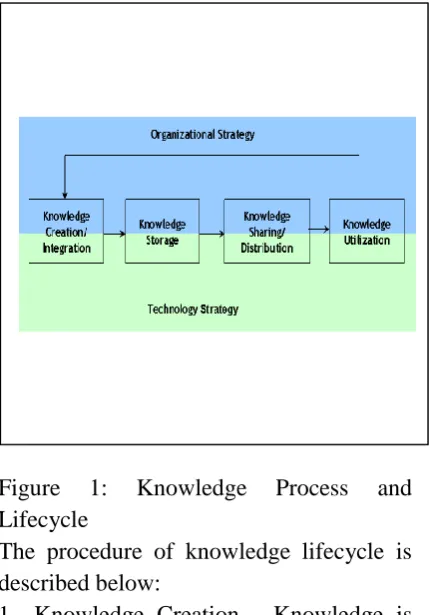
172 facilitate implementation of insights and experiences. Knowledge Management center on organizational objectives such as enhanced routine, competitive advantage, originality, the sharing of lessons learned, combination and continuous development of the organization. To implement Knowledge Management practices in higher educational institutions, it needs to adopt a securable knowledge- based system. Figure 1 illustrates the Knowledge Process and Life Cycle.
Figure 1: Knowledge Process and Lifecycle
The procedure of knowledge lifecycle is described below:
1. Knowledge Creation - Knowledge is created from the person and stored in the form of document as knowledge repository.
2. Knowledge Storage - Knowledge is stored and structured in a repository. The evaluation on how and where lies with the organization. But the purpose of this phase to facilitate organization to be able to contribute, categorize and share knowledge with.
3. Knowledge Sharing - Knowledge is pooled and right to utilize by people.
They can also search or find the way to the knowledge items.
4. Knowledge Utilization - The knowledge management does not have any significance if knowledge created is not utilized to its potential. The new knowledge is created as knowledge is applied and utilized [2].
2. LITERATURE SURVEY
In organization, knowledge is a important resource. Management of knowledge resources has turn out to be a strong demand for development. Discovering the valuable knowledge has also significant approach for management and decision making.
In information retrieval research, retrieval can be seen as the main task in interacting with an information resource, not browsing. The capability to tailor retrieval by means of obtaining user response to retrieved items has been implemented in several information retrieval systems through retrieval clustering (Cutting, et al., 1992) and through relevance feedback [3].
In year 2003 D. M. Blei, A. Y. Ng, and M. I. Jordan [5] had analyzed topic modeling. Topic modeling is a accepted tool for analyzing topics in a document collection. The most prevalent topic modeling method is Latent Dirichlet Allocation (LDA). It is a generative probabilistic model for collections of discrete data. Topic modeling decomposes a document into topics.
Volume 3, Special Issue 1, ICSTSD 2016
173 modeling methods on session data, it is still hard to find the correct advisor by using the mined topics.
In year 2005 X. Liu, W. B. Croft, and M. Koll [4] has also been studied expert retrieval in other scenarios, e.g. online question answering communities. People using such services are like a community – anyone can ask, anyone can answer, as well as everyone can share, since all of the questions and answers are public and searchable directly.
But there are hundreds of questions asked each day but some portion of them may not be answered or there may be a interval between the time when a question is asked and when it is answered. Also the answers may not be satisfactory.
In year 2006 K. Balog, L. Azzopardi, and M. de Rijke [6] proposed a language model framework for expert search. Expert search aims at retrieving people who have proficiency on the given query topic. Their Model 2 is a document-centric approach which first computes the importance of documents to a query and then accumulates for each candidate the relevance scores of the documents that are related with the candidate. It locates documents on topic, and then finds the associated expert. Balog showed that Model 2 performed better.
But the nature of these methods is still accumulating relevance scores of related documents to candidates. Traditional expert search does not explicitly retrieving people who are most likely possessing the desired piece of fine grained knowledge it focused on finding experts only rather than to mine fine-grained aspects for each task.
Wang & Wang (2008) point that data mining can be helpful for KM in two main manners: (i) to share general
knowledge of business intelligence (BI) context among data miners and (ii) to use data mining as a means to extend human knowledge. Thus, data mining tools could help organizations to discover the hidden knowledge in the vast amount of data [7].
Hariton A. Efstathiades (2013) describes knowledge extraction from social network. The information was retrieved from online social network mostly through a manual programming method by making use of application
programming interface. Though, the
majority of social science researchers
typically have little programming
experience. Thus the method from data retrieval to knowledge extraction is not a trivial job for them [8].
Kuo et al. (2014) intended to examine the degree to which interaction as well as other predictor contributes to student satisfaction in online education settings. The effects of student background variables on predictors were explored. The outcome showed that learner-instructor
communication, learner-content
interaction, and Internet self-efficacy were good predictors of student satisfaction as interactions between students and self-regulated learning did not add to student satisfaction. As a result a better interaction has to be integrated for encouraging e-learning environment [9].
Volume 3, Special Issue 1, ICSTSD 2016
174
users. The level of knowledge transmitted all the way through social network tool is in high-end since the mutual environment is provided with the aid of web 2.0.
Moreover the knowledge sharing
phenomena is discussed in this framework (Verónica Marín-Díaz et al., 2014) [10].
3. ANALYSIS OF PROBLEM
In collaborative environment members make an effort to learn and gain new information however they may not discover it if they work in isolation. The creation of knowledge is considered necessary to be aligned with sharing activities. There is a need of sharing knowledge and working together to accomplish stated goals and objectives. Approaching to a right person are often way more efficient than finding out by oneself, since people can provide digested information, insights and live interactions, compared to the net.
Many people pointed out the problem of finding a right advisor due to the variety of information needs.
Repeating efforts occurs when people try to acquire similar information on the web in order to gain precise knowledge in one domain.
These repeating efforts cause waste of time and energy.
Users don’t seem to be obtaining information sharing environment which can enhance their knowledge.
Studying on the web individually is not as efficient as learning from an advisor.
4. SYSTEM IMPLIMENTATION
The flow of this work is illustrated step by step as follows:
1. User entered web surfing data including queries and name is analyzed and extracted.
2. This web surfing data is clustered into tasks by a k-means algorithm.
3. These tasks can be further decomposed into fine grained aspects (called micro-aspects).
4. Then an expert search method is applied over the mined micro aspects for advisor search.
5. Finally, ranking method is used to employ comparison among same searches.
5. EXPERIMENTAL RESULTS AND DISCUSSIONS
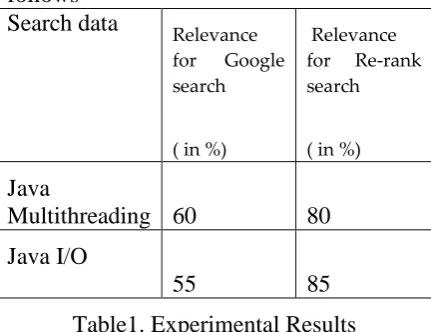
After the extraction and implementation of the Re-ranking method, the results are as follows-
Search data
Relevance for Google search
( in %)
Relevance for Re-rank search
( in %)
Java
Multithreading
60
80
Java I/O 55
85
Table1. Experimental Results Table 1 shows the results, the percentage of relevant data to the user. This table shows the result for different data, using the different search engine and their percentage of relevance for that search.
6. CONCLUSION
Volume 3, Special Issue 1, ICSTSD 2016
175 search. It provides ease of access of desired information and save time of repetitive efforts. This method proposed a framework to mine fine-grained knowledge and integrated it with the classic expert search method for finding right advisors. This environment assists in several stages of the KM process also being a useful tool in the recognition of each person’s competences. Effective knowledge management enables higher levels of collaborative performance. In order that the right information flows to the right people at the right time to make the right decisions.
7. REFERENCES
[1] Kathryn Cormican and Lawrence Dooley, “Knowledge Sharing in a Collaborative Networked Environment”, Journal of Information and Knowledge Management, 16, 2, 105-115.
[2] S. Rajalakshmi and R. S. D. Wahidabanu, “Sharing and capturing tacit knowledge in higher education”,
International Journal of Computer Theory and Engineering, Vol. 3, No. 3, June 2011.
[3] Cutting, D. R.; Pederson, J. O.; Karger, D.; and Tukey, J. W. 1992, “Scatter/Gather: A cluster-based approach to browsing large document collections”, In Proceedings of the 15th Annual International ACM/SIGIR Conference, pp. 318-329. New York: ACM Press.
[4] X. Liu, W. B. Croft, and M. Koll, “Finding experts in community based question-answering services,” in Proc.
14th ACM Int. Conf. Inf. Knowl. Manage. 2005, pp. 315–316.
[5] D. M. Blei, A. Y. Ng, and M. I. Jordan, “Latent Dirichlet allocation,” J. Mach.
Learn. Res., vol. 3, pp. 993–1022, 2003.
[6] K. Balog, L. Azzopardi, and M. de Rijke, “Formal models for expert finding in enterprise corpora,” in Proc.
29th Annu. Int. ACM SIGIR Conf. Res. Develop. Inf. Retrieval, 2006, pp. 43 50.
[7] Wang, H. & Wang, S. (2008), “A knowledge management approach to data mining process for business intelligence”, Industrial Management & Data Systems, 108(5), 622-634.
[8] Hariton A. Efstathiades (2013),
“Extract knowledge from social
networks”, Thesis Web Information
Systems, Department of Software Technology Faculty EEMCS, Delft University of Technology.
[9] Yu-Chun Kuo, Andrew E. Walker,
Brian R. Bellan, and Kerstin E. E. Schroder.(2014), “A Predictive Study of Student Satisfaction in Online
Education Programs”, The
International Review of Research in Open and Distance Learning, 15(3).
[10]Verónica Marín-Díaz, Ana Isabel
Vazquez Martinez, and Karen
Josephine McMullin (2014), “First steps towards a university social
network on personal learning
environments”, The International