ROI Estimation in a Scrum Project:
A case study
Rita Cortés Chavarria, Fulvio Lizano Madriz
Universidad Nacional de Costa Rica.[email protected], [email protected]
Abstract
Financial metrics are necessary to inform decisions about the beginning or continuity of a software development project to justify investments. This research discuses initial ROI (Return on Investment) estimates in a software project using Scrum and how to analyze variations in the initial calculations to make return on investment decisions during partial deliveries of the product. The case study included a survey, a review of documentation, two focus group sessions, and an exercise involving application of the proposed technique. Twenty-four professionals participated, of which 4 were Scrum trainers (17%), 4 were officials of the company where the estimation technique was applied (17%), and 16 were project managers of domestic and foreign software development companies (66%), all of whom had experience in project management. This study provides elements to be considered in future research on ROI calculation in projects using Scrum, and can be used as a guide to estimate and review financial metrics during the execution of an actual project.
1
Introduction
When a Software Development Project is initiated, best practices suggest performing a financial analysis using methods such as ROI, NPV (Net Present Value) and IRR (Internal Rate of Return) [4] [14] [15]. However, organizations and their environment change during project execution, and project objectives and scope must consequently be adjusted, causing variations in initial costs and benefits. Scrum is a framework that enables managing changes naturally, seeking to provide the value that businesses require [14]. A literature review found only a few documented cases of ROI estimates and financial analysis of changes during the execution of software development projects using Scrum. This article documents the research carried out, which proposes a technique for ROI estimation and describes its application in a software development project. It begins with a literature review, which is presented in Section 1; Section 2 describes the method used, whose results and discussion are presented in Sections 3 and 4. Finally, Sections 5 and 6 presents the conclusions, and bibliographical references.
Volume 64, 2019, Pages 78–87
2
Related work
Estimations are used to analyze and predict the resources or time necessary to implement the requirements of a software development project. There are several types of techniques used to make these estimations, which can be classified into groups such as expert opinion, analogy, estimation by parts, parametric methods and statistical methods [4], or primary techniques such as estimates by an expert, estimates based on reasoning by analogy, Price-to-Win, estimates based on available capacity, and estimates based on the use of parNametric models [18]. The most frequently used techniques are those based on experience in similar previous projects [3] [17].
However, the results of the application of models to estimate costs of software projects are often unsatisfactory. For example, some authors mention a certain natural resistance of software developers to doing the necessary paperwork, and most developers ignore metrics when their use is not mandatory [9]. Likewise, other authors point out that it is necessary to emphasize measurements that support making decisions such as when a software project should be abandoned [3], and that metrics can provide important information with a minimum cost and no negative impacts for the business, but do not consider factors such as the time value of money and are therefore most appropriately used in projects of limited duration; for longer projects, Net Present Value (NPV) should be calculated for the metrics for each year [7].
Return on investment (ROI) is a financial metric whose use poses interesting challenges in the software development process. It is a measure of a company’s or business unit’s profitability: the proportion of money earned or lost (whether realized or not) on an investment relative to the amount of money invested [4]. Twenty-nine cases were analyzed using productivity and quality data that allowed the estimation of ROI, and a comparison was made between the ROI of Agile Methods and the ROI of Traditional Methods [13]. Information was gathered on costs and benefits, and ROI was calculated as follows: ROI = (Benefits - Cost) / Cost * 100. Costs and benefits were measured in five categories: cost; duration; productivity; quality; and satisfaction. Even considering that there is a lack of proven and accepted methods for calculating ROI, actions are being implemented to take advantage of the maturity/level of development and capacity in software development [11].
ROI calculations have been a challenge in the context of agile methodologies. Scrum assumes that the development process is complicated and difficult to predict; therefore, the creators of Scrum proposed progressive planning and development using controls to manage the process and its inherent risks [16]. Experiences with the use of ROI with historical data in agile projects have been analyzed [13] and its use is recommended to justify Scrum projects and provide continuous evaluation of project value according to frequent service or product increments. [14].
3
Method
3.1
Participants
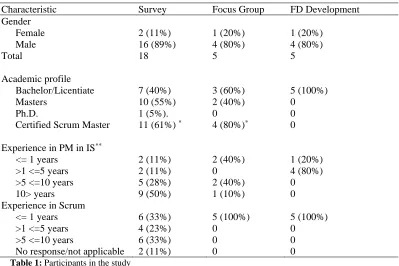
Several individuals participated in the case study. Eighteen professionals in software engineering participated in the survey; 5 engineers from the organization where FD was implemented participated in the focus group, and 3 engineers from the development team, the Scrum Master and the Product Owner participated in the development team; the Product Owner was a professional in business administration. The documentary observations did not involve participation of people. The demographic characteristics of these participants are summarized in "Table 1: Participants of/in the study".
3.2
Procedure
The survey used in this study was designed to obtain the opinions of experts in software project management who use Scrum. A pilot test of the survey was conducted with 3 participants and necessary adjustments were made. Subsequently, each of the 23 potential participants was contacted by telephone to inform them, obtain their commitment to participate, and make them aware of the importance of completing the survey. The survey was then applied using the Lime Survey tool; it was sent to 23 participants, of whom 18 completed it (78%).
Characteristic Survey Focus Group FD Development
Gender Female Male 2 (11%) 16 (89%) 1 (20%) 4 (80%) 1 (20%) 4 (80%) Total Academic profile Bachelor/Licentiate Masters Ph.D.
Certified Scrum Master
18
7 (40%) 10 (55%) 1 (5%). 11 (61%) *
5
3 (60%) 2 (40%) 0 4 (80%)*
5
5 (100%) 0 0 0
Experience in PM in IS** <= 1 years
>1 <=5 years >5 <=10 years 10> years 2 (11%) 2 (11%) 5 (28%) 9 (50%) 2 (40%) 0 2 (40%) 1 (10%) 1 (20%) 4 (80%) 0 0 Experience in Scrum
<= 1 years >1 <=5 years >5 <=10 years
No response/not applicable
6 (33%) 4 (23%) 6 (33%) 2 (11%) 5 (100%) 0 0 0 5 (100%) 0 0 0 Table 1: Participants in the study
The review of documentation consisted in revising the procedures and templates used by the company during the development of FD. The observation took into account some elements of the process proposed by Levy and Ellis [12]. First, the instruments were studied, then their content and application in the company were discussed, their relationship with ROI was analyzed, and those instruments that were highly related to ROI were adjusted to be able to use them as guides in the application of the technique.
Subsequently, two focus groups were carried out: the first after the survey and the second after the implementation of the FD. In both cases, a guide was prepared and the sessions were recorded. The first focus group was carried out with the development team and was intended to consider the elements, difficulties and successes mentioned in the survey by project managers in relation to the cost, benefit and profitability of software engineering projects that use Scrum. The second focus group was carried out at the end of the development process with the same participants as the first one; its purpose was to compile their insights, lessons learned and proposals for adjusting the technique.
Finally, the FD was developed, applying the ROI estimation technique proposed in the study. At the beginning of implementation, a workshop was held with the objective of presenting the proposed instruments and preparing the work team for the execution of the first Sprint. Researchers provided assistance during the development process and collected data for the case study.
3.3
Data collection and analysis
The survey used in this study had 12 closed-ended questions, 1 semi-open question and 6 open-ended questions. A Likert scale was used for the closed-open-ended questions; for semi-open questions, elements identified in the literature review were included, such as a list of options, and participants were allowed to add new options. The survey consisted of 5 sections: the first included general data about the participants, the second section evaluated the knowledge of project managers about ROI, the third was related to elements necessary to quantify cost and benefits, the fourth evaluated perceptions of difficulties in estimating ROI, and the fifth collected information about perceptions of facilitators concerning other aspects of estimating ROI.
The review of documentation included 41 documents of the company that were related to cost or benefit estimations. These forms are part of the Rational Unified Process (RUP) development methodology currently used in the company. The forms were in Word format, and some of them contained a description of each field used and a sequence of steps to complete them. In both focus groups, a guide of generating questions related to the objective of each focus group was used, and sessions were recorded for later analysis. The first focus group had a duration of 1 hour and 5 minutes, and the second one lasted for 1 hour and 15 minutes. Finally, in the development of the FD the technique was applied in each of the 4 proposed Scrum processes: Start, Plan and estimate, Implement and Review, and Retrospective. These processes were documented in forms prepared to support the implementation of the technique: (1) Internal project profile, (2) Listing of projects requirements (Backlog), (3) Sprint Planning, (4) Recording of the real costs of a Sprint, and (5) Delivery of the product Increment.
4
Results
This section presents the results of previously described activities related to the perceptions of ROI and Scrum, the analysis of the company's methodological documents, the main findings of the focus groups, and the results of applying the technique in the development of the FD.
4.1
Perceptions of ROI and Scrum
The survey provided information on whether project managers consider it important to quantify performance of a software project using Scrum; the majority either agreed (37.5%, 6 participants) or strongly agreed (50%, 8 participants). From a list of 18 cost elements found in the literature review, participants indicated that when estimating the costs of implementing an information system using Scrum, the three main elements are: human resources (contracting, social security costs, insurance), work breakdown structure (WBS) activities (scope), and duration, hours of effort and quality assurance. They also identified other cost elements, such as learning curves, financing, and risks. Likewise, the main benefits identified were: increased productivity, customer satisfaction, reduction of processing time, and avoiding fines and penalties.
The main difficulties in estimating ROI were: lack of experience, lack of maturity, and flexibility in the face of changes, to which can be added lack of historical data and integration of the work teams. These difficulties were also mentioned in the literature reviewed.
4.2
Review of existing documents
The review of documentation took survey results into account when estimating elements of costs and benefits suggested by project managers. After analyzing 41 documents, 5 of them were selected for further use, and necessary changes were made to be able to collect data and document the application of the estimation technique. The suggested methodological instruments to apply the technique and estimate the ROI were:
1. PI-01 Internal project profile
2. PI-02 Listing of projects requirements (Backlog) 3. PI-03 Sprint Planning.
4. PI-04 Recording of the real costs of a Sprint 5. PI-05 Delivery of the product Increment
4.3
Focus group sessions
Subsequently, cost and benefit elements suggested in the 5 methodological instruments recommended were verified in the first focus group session, and compliance with the deadline for releasing the product was highlighted as an additional and important benefit; for example, one participant added that "the greatest benefit is compliance with the development deadline, because the company can see the added value of the software product and release IT resources to carry out other activities".
The second focus group session allowed a retrospective analysis of lessons learned during application of the technique; while concluding that it is easy to use, it was also noted that it is necessary to apply it in other projects and train the company's personnel in aspects of estimation and the Scrum framework. Some of the opinions expressed that illustrate these results are: "It’s the first time we applied
the technique; it is easy to use, but this is the first time Scrum was used, we used an ALM tool that was new to us and we still got the job done and the user obtained the product"; another participant stated that "the most complicated part is calculating the income of the project. Since what is done is a qualitative evaluation, it is necessary to work with project managers; it’s not that it can’t be done, but there is not enough information to make the estimation."
4.4
FD
In the development of the FD, the steps suggested by the technique were carried out and the results were collected in the 5 methodological instruments as a result of the execution of the 4 processes of the Scrum framework: Start, Plan and Estimate, Implementation and Review, and Retrospective.
In the Start process, the company estimated costs and benefits based on their experience and available records; the elements suggested by the technique were used as a guide, and the initial estimate of ROI was -0.48. Later, during a ROI review process, some omissions were identified in indirect costs, such as use of facilities, electricity, water and telephone. Neither the administrative nor the contingent reserve was estimated, and some elements of hardware and software costs were also omitted. An underestimation of benefits was also identified, since the reduction in the costs of the electronic invoice registration process was only considered for the first year. After this revision and adjustment, the ROI of the project was estimated at 2.07.
In addition, the project’s IRR and NPV were calculated, and both were positive. These calculations also permitted obtaining the costs and benefits for the five years of useful life of the FD. The calculations of the financial ratios are shown in Table 2.
Year 0 Year 1 Year 2 Year 3 Year 4 Year 5 Income
Savings in process 1 Savings in process 2 Savings in process 3
$74,039 $5,764 $3,571 $632 $1,562 $11,528 $7,141 $1,263 $3,124 $16,213 $9,521 $2,526 $4,166 $20,267 $11,902 $3,158 $5,207 $20,267 $11,902 $3,158 $5,207 Expenses Startup costs Appl. maintenance Equip. maintenance Depreciation $33,731 $23,781 $1,990 $750 $1,240 $4,756 $1,990 $750 $1,240 $4,756 $1,990 $750 $1,240 $4,756 $1,990 $750 $1,240 $4,756 $1,990 $750 $1,240 $4,756
Net flow $-23,781 $3,374 $9,538 $14,223 $18,277 $18,277
Accumulated cash flow $-23,781 $-20,007 $-10,468 $3,755 $22,032 $40,308
Estimations
ROI 2.11
NPV $83,533
IRR 0.54
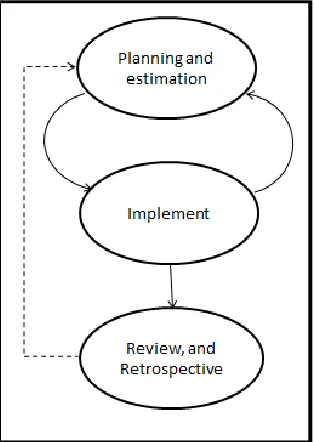
The remaining processes are described in "Figure 1: Scrum Processes: Plan, Implement and Review, and Retrospective."
Figure 1: Scrum Processes: Plan, Implement and Review, and Retrospective
Planning and estimation were carried out in the Scrum Sprint Planning ceremony. The requirements for the first and only Sprint were selected, and estimates were made of the tasks, Scrum team capacity (244 hours) and the Planned Value of Sprint 1 ($13,281). Calculations and documentation were carried out using the instruments suggested for the technique: PI-01 Internal project profile, PI-02 Listing of projects requirements (Backlog), and PI-03 Sprint Planning. The FD process was then implemented, during which daily meetings were held, tasks were assigned and, at the end of each week, the work carried out was compared to the work planned. The Sprint lasted 2 weeks and had a total cost of $11,310, which covered the work of the development team and of the other participants in the project. Data related to this process were documented in the Sprint instrument PI-04 Recording of the real costs of a Sprint. Product validation was carried out in the Scrum Sprint Review and Sprint Retrospective ceremonies during the revision and retrospection processes. During the validation of the 7 user stories, it was found that all user stories were incomplete; therefore, the Sprint was rejected. Based on the presentation of evaluations by each developer, followed by a vote by all developers, the development team estimated that overall progress in the project was 80%.
Following the steps suggested in the technique, the product owner decided to reject the Sprint. Therefore, the value generated by Sprint 1 was zero, the total cost of the project was $11,310, and the estimated cost to complete the project was $24,590.
At the end of each Sprint, ROI is reviewed and analyzed. Subsequently, planning of the next Sprint begins, followed by its implementation, review, and retrospective analysis; all in accordance with the Scrum framework.
5
Discussion
Initial estimation of the ROI requires quantitative data, but organizations do not always have this type of data available due to lack of experience, changes in the projects, and a lack of organizational culture in the quantification of costs and benefits [5]. This is confirmed by several authors [9], who highlight the difficulty of obtaining historical data and complications related to the paperwork used to collect them. The results of this study confirmed that the estimation of benefits is one of the most difficult tasks to perform satisfactorily; for example, in the application of the technique, costs were initially estimated at $3,375, while a more exhaustive analysis found the amount to be $73,117.
The results of the study also showed that the ROI estimation technique is simple to apply, but requires the support of a financial specialist for data identification and validation, which is in agreement with observations of several other authors [1], who consider that software development projects suffer from deficiencies in financial areas, due to the difficulty that software engineers have in quantifying project benefits for the organization. For example, in the process of cost estimation, there was difficulty in discriminating between aspects of project performance when considering variations in time (IRR) and Return on Investment (ROI), as well as in understanding concepts such as sunk costs, investment costs and post-investment costs such as maintenance and depreciation. This required further financial study and analysis to improve initial ROI estimates. Process automation is also required, using tools for Application Lifecycle Management (ALM) and Development and Operations Administration (DevOps) that allow streamlining administration and product release, as well as the calculation of the value gained from software development projects.
In the case study, factors that assisted in the use of the technique were training in the Scrum framework and in the application of the technique, as well as an open mind on the part of participants. These success factors were highlighted both in the focus group and by other authors [2] [10], who indicated that experience and training of the Scrum team are influential factors in Scrum implementation.
Based on the results of the study, the main element that has an influence on estimating the cost of a software development project is Human Resources (Work Breakdown Structure, or WBS). Therefore, the technique proposes an assessment of ROI deviation at the end of each Sprint by estimating the value gained. In this case study the first Sprint was valued at zero. However, the continuous analysis of value provided elements for making decisions related to project continuity. As companies mature in their use of metrics for estimation, they will create an appropriate culture and will have more information to make estimates related to their software development projects.
6
Conclusion
This article summarizes the results of a case study of the implementation of a ROI metrics management technique in a software development process under the Scrum framework. The case study included a survey, a revision of documentation, two focus group sessions and an application of the technique in the development of software under the Scrum framework.
of software development projects, and to provide financial instruments for decision making, such whether to invest more resources, reduce costs, analyze other software options available in the market, change implementation strategies, or close the project. As a response to this finding, the technique suggests reviewing performance of the project at the end of each Sprint and defining acceptable minimum deviation parameters, which would streamline analysis of gained and continuous values without interrupting the delivery of product advances. Companies should invest in training and creation of a culture in financial and methodological areas, as well as provide automatic tools that streamline the processes of administration, development and implementation of software. The processes of the Scrum framework require and facilitate estimation of the ROI both at the beginning of the project and during its execution.
The main limitations of the study were the lack of experience of the company in the use of the Scrum framework and in financial estimations for software development projects. To overcome these limitations, a certified external professional Scrum Master was integrated into the project and a Scrum workshop was held before beginning the development of the FD, and assistance was provided in the identification of project quantitative costs and benefits.
In future work it is recommended to implement the estimation technique in larger projects, using multiple Scrum teams working in parallel to deliver Products. Future research could analyze application of the technique in different companies, and document criteria for improving ROI cost and benefit estimation in the development of software projects.
7
References
[1] Ampatzoglou, A., Ampatzoglou, A., Chatzigeorgiou, A., & Avgeriou, P. (2015). The financial aspect of managing technical debt: A systematic literature review. Information and Software Technology, 64, 52-73.
[2] Ashraf1, M., & Ali2, N. ( November-December de 2013). Impact Agile Project Management: Identification and analysis of problems in Scrum implementatation. . (V. T. Sciences, Ed.) 2(2), 1-10.
[3] Boehm, B., & Sullivan, K. (1999). Software economics: status and prospects. Information and Software Technolog, 41, 937-946.
[4] Bourque, P.; Farley, R. (2014). SWEBOK: Guide to the Software Engineering Body of Knowledge: IEEE Computer Science.
[5] Cortés, R.: Técnica de estimación del Retorno sobre la Inversión RSI utilizando Scrum en los proyectos internos de software de la Empresa de Servicios Públicos de Heredia ESPHSA (Tesis de Maestría) [Technique for estimating the Return on Investment ROI using Scrum in internal software projects of the Public Services Company of Heredia ESPHSA]. Master's Thesis, Universidad Nacional de Costa Rica. (2018)
[6] France, J. (August 17, 2017). Scrum no es una metodología es un Framework [Scrum isn’t a methodology, it’s a Framework]. (S. newsletter, Ed.)
[7] Fenton, N., & Neil, M. (2006). Software project economics: a road map . Computer Science Department Queen Mary and Westfield College, 357-370.
[9] Johnson, P. M., Kou, H., Agustin, J., Chan, C., Moore, C., Miglani, J., ... & Doane, W. E. (2003, May). Beyond the personal software process: Metrics collection and analysis for the differently disciplined. In 25th International Conference on Software Engineering, 2003. Proceedings. (pp. 641-646). IEEE.
[10] Jönsson, M. (Agosto de 2013). Agile System Development: An investigation of the challenges and possibilities of using Scrum. UMEA University, 1-36.
[11] Keil, P., & Kuhrmann, M. (2006). An Approach to Model the Return on Investment of Organization-wide Improvement Projects Using the concept of Externa Effects. En Proceedings of the 2006 international workshop on economics driven software engineering research, 19-24.
[12] Levy, Y., & Ellis, T. (2006). A systems approach to conduct an effective literature review in support of information systems research. Informing Science: International Journal of an Emerging Transdiscipline, 9(1), 181-212.
[13] Rico, D. (2008). What is the Return on Investment (ROI) of agile methods. Methods, 1-7.
[14] Satpathy, T., Hackmann, W., Malone, G., Nations, J., Peacock, B., & Kim, R. (2017). Una guía para el cuerpo de conocimiento de Scrum (Guía SBOK™). Avondale, Arizona: Scrumstudy.
[15] Systems Audit and Control Association ISACA. (2012). COBIT 5 Implementación.
[16] Schwaver, K., & Sutherlad, J. (2013). La guía de Scrum.Scrum.org and Scruminc.