Iranian Rehabilitation Journal, Vol. 9, No. 14, 2011
Original Article
Effects of Task Related Training and Hand Dominance on Upper
Limb Motor Function in Subjects with Stroke
Mohammed Azam Khan; Fuzail Ahmad;
Jamia Hamadard. New Delhi. IndiaJamal Ali Moiz, PhD.; Majumi M.Noohu
*, PhD;
Jamia Millia Islamia,New Delhi. IndiaIntroduction: Recovery of upper limb motor function in stroke is limited. Different approaches are used
to improve the upper limb function, but none has satisfactory results. The present study investigated the effect of task related training and role of hand dominance in upper limb motor function rehabilitation in stroke population.
Method an Material: A convenient sample of 32 subjects divided into 4 groups with 8 subjects each
took part in the study with an experimental design. The group 1, experimental dominant hand group, consisted of subjects with dominant hand paresis, the group 2 consisted of subjects with non dominant, group 3 & 4 consisted of dominant (dominant hand control group) and non dominant hand paresis (non dominant hand control group) .The group 1 and 2 received task related training and conventional therapy, while group 3 & 4 received conventional physiotherapy. All patients were assessed prior to training 4 weeks & after the 4 weeks of training program by using Chedoke Arm & Hand activity Inventory Score form, this score were used to find the difference between and within groups.
Results: A within group analysis showed that there is a statistical significant difference for Chedoke
Scores between pre training and post training in group 1, 2 and 3 but no significant difference in group4. There was no significant difference between group1 post training scores; there was a significant difference in post training scores group 1 and group 3. There was no significant difference in post training scores between group 3 and group 4. The comparison between group 2 and 4 group showed no significant difference in post training scores.
Conclusion: From this study it is evident that task related training and hand dominance play an important
role in upper limb rehabilitation.
KeyWords: Task related training, hand dominance, stroke, upper limb function
Submitted: 10 Sep 2010 Accepted: 04 Nov 2010
Introduction
Stroke has devastating consequences on individual’s physical and cognitive abilities.(1) The likelihood of improvement after stroke varies with nature and severity of the initial deficit. Approximately 35% of survivors with initial paralysis of the leg do not regain useful function. Six months after stroke, about 65% of patient cannot incorporate the affected hand into their usual activities.(2)
Studies report that 45 to 50% of individuals sustain a left hemisphere lesion and therefore right-sided paresis. In as much as up to 80% of people are right side dominant, a significant proportion of individuals who experience a stroke will have their dominant
Task-specificity, practice, goal-setting, feedback and motivation are considered important elements in motor learning. In practice, it appears that repetition alone is less effective than repetition with variable practice (7)As we know that in motor learning the degree of performance improvement is dependent on the amount of practice. It is also known from the motor learning literature that variable practice is more effective than massed practice. Introducing task variability in any given session increases retention (8) Task related training provides variability during treatment session as different objects are used. Many different task oriented practice strategies have shown significantly greater benefits from more intensive therapies that involve training in specific skills, as compared with only general rehabilitation.(4)
There are not many studies which have reported the effect of task related training and effect of hand dominance in functional regain in stroke survivors. The current study was done to find out the effect of task related training and to examine do hand dominance play a role in reaching activities in stroke survivors.
Method
A convenient sample of 32 subjects took part in the study with an experimental design. The group 1 consisted of subjects with dominant hand paresis and received task related training and conventional therapy (experimental dominant hand group). The group 2 consisted of subjects with non dominant hand paresis and received task related training and conventional therapy (experimental non dominant hand group). Group 3 & 4 consisted of dominant (dominant hand control group) and non dominant hand paresis (non dominant hand control group) respectively and they received conventional physiotherapy. All subjects were right hand dominant. Subjects were randomly assigned to different groups. The study was approved by research and ethics committee of Jamia Hamdard, New Delhi, India.
The age, gender and duration of onset of hemiplegia were obtained from the patient’s history and medical records. Stroke location was identified by computed tomography or magnetic resonance imaging of the brain. The subjects were selected on the basis of following criteria, such as, 6 months post stroke, arm/hand paresis and subjects with aphasia and cognitive deficits were excluded. The consent of the subjects was obtained before enrollment into the
study and they were thoroughly explained about the study process. Subjects were matched by using two subsets of the Motor Assessment Scale (MAS).(9) On the upper arm subset, seated subjects were asked to hold their arm in 900 of the shoulder flexion for 2 seconds, while maintaining some external rotation. On the hand movement subset, subjects were asked to extend the wrist while holding a cup upright, with the forearm resting on the table.
Subjects in group 1 and 2 received physiotherapy and task related training. For Task related training familiar objects were used that vary in size, shape & weight (50-500 gm) including coffee mugs, tea cups, plastic balls, books and writing and eating utensils. The objects were placed ipsilateral, contra lateral and midline on the table. Participants got an hour therapist-supervised reach-to-grasp training 5 times per week for 4 weeks (total 20 sessions)8 Progression criteria were established by increasing repetitions, increasing object size and weight, as well as increasing the distance at which objects were manipulated. The subjects in l group 3 and 4 received conventional physiotherapy program for upper limb. Trunk movements (sagital displacement, rotation) were prevented by verbal cues and therapist support. Rest periods of 1 to 2 minutes were permitted when necessary to avoid fatigue.
All patients were assessed prior to training 4 weeks & after the 4 weeks of training program by using Chedoke Arm & Hand activity Inventory Score Form. Scoring is done on a 7-point ordinal scale (1=total assistance and 7=complete independence). Scoring is based on the percentage of contribution of each task by the paretic upper limb. For example the individual will score 7 on the jar opening task if he or she were able to hold the jar in the non paretic hand and open it with paretic hand. A score of 3 means that the individual is able to use the paretic hand to stabilize and manipulate the jar but requires hand over hand guidance (50%-75% contribution of the paretic upper limb). High internal consistency (Cronbach alpha=.98) and excellent inter rater reliability (ICC= .98),
Construct validity (r=.81-.93) and face and content validity have been reported (10).
Data Analysis
analysis were Chadoke hand inventory scale scores. Within group comparison was done by using Wilcoxon-Singed Ranks Test and for the between group analysis Mann-Whiteny test was used. A level of significance of p < 0.05 was used for all analysis to determine the statistical significance.
Results
A total of 32 patients with 8 subjects in each group and (mean±SD) age of the subjects were 53.18 ±5.56 years who participated in this study. The duration of stroke (mean±SD) was 16.50±5.09 months. The mean +SD of age and duration of stroke, group wise is summarized in table 1.
Table 1. Demographic profile of the subjects
Group (Mean±SD) Age (years) Duration of the stroke (months) (Mean±SD) Group 1(n=8) 55.58 + 6.43 14.38 + 3.06
Group 2(n=8) 52.00 + 3.92 15.00 + 4.75 Group 3(n=8) 54.63 + 4.20 16.13 + 5.66 Group 4(n=8) 50.75 + 6.81 16.87 + 5.89
A within group analysis showed that in group 1 and group 2 there is a statistical significant difference for Chedoke Scores between pre training and post training scores, group 1 (z=2.54, p=0.005) and group
2 (z=1.84, p=0.033) . In the group, group 3 There was significant difference (z=2.00, p=0.023) but no significant difference in group 4 (z=1.63, p=0.051) (table 2).
Table 2. Within Group Comparison of Chadoke hand inventory scores
Group Chadoke Hand Inventory Pre training Score (Median±SD)
Post training
Chadoke Hand Inventory Score (Median±SD)
Z P
Group 1(n=8) 21.00±1.66 23.50±1.06 2.54 0.005
Group 2(n=8) 21.50±2.85 22.50±3.56 1.84 0.033
Group 3(n=8) 20.50±1.18 21.00±1.12 2.00 0.023
Group 4(n=8) 20.50±1.66 21.00±1.38 1.63 0.051
Using Mann-Whitney Test for Chedoke Post Score it was found that there was no significant difference between group1 and group 2 on both pre training (z=0.37, p=0.70)(table 3) as well as post training scores(z=0.96, p=0.33)(table 4).
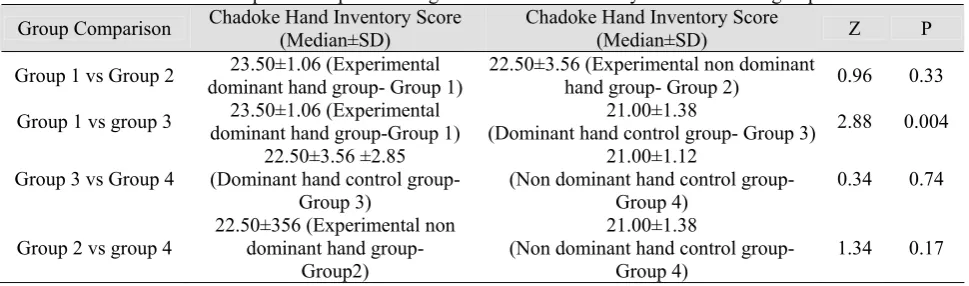
Between group comparison of group 1 and group 3 showed no significant difference in pre training scores (z=0.75, p=0.44) (table 3) but there was a significant difference in post training scores (z=2.88,
p=0.004) (table 4). There was no significant difference between the pre training (z=0.16, p=0.87) (table 3) and post training (z=0.32, p=0.74) (table 4) scores between group 3 and group 4. The comparison between group 2 and 4 group showed no significant difference in pre training (z=1.12, p=0.26) (table 3) and post training scores (z=1.34, p=0.17) (table 4).
Table 3. Comparison of pre training Chadoke hand inventory scores between groups
Group Comparison Chadoke Hand Inventory Score (Median±SD) Chadoke Hand Inventory Score (Median±SD) Z P
Group 1 vs Group 2 (Experimental dominant hand group-21.00±1.66 Group 1)
21.50±2.85
(Experimental non dominant hand group-
Group 2) 0.37 0.70
Group 1 vs Group 3 (Experimental dominant hand group-21.00±1.66 Group 1)
20.50±1.18
(Dominant hand control group- Group 3) 0.75 0.44
Group 3vs Group 4
21.50±2.85
(Dominant hand control group- Group 3)
20.50±1.18
(Non dominant hand control group-
Group 4) 0.16 0.87
Group 2 vs group 4 (Experimental non dominant hand 21.50±2.85 group- Group 2)
20.50±1.66
(Non dominant hand control group- Group 4)
Table 4. Comparison of post training Chadoke hand inventory scores between groups
Group Comparison Chadoke Hand Inventory Score (Median±SD) Chadoke Hand Inventory Score (Median±SD) Z P
Group 1 vs Group 2 dominant hand group- Group 1) 23.50±1.06 (Experimental 22.50±3.56 (Experimental non dominant hand group- Group 2) 0.96 0.33
Group 1 vs group 3 dominant hand group-Group 1) 23.50±1.06 (Experimental (Dominant hand control group- Group 3) 21.00±1.38 2.88 0.004
Group 3 vs Group 4
22.50±3.56 ±2.85 (Dominant hand control group-
Group 3)
21.00±1.12
(Non dominant hand control group-
Group 4) 0.34 0.74
Group 2 vs group 4 22.50±356 (Experimental non dominant hand group- Group2)
21.00±1.38
(Non dominant hand control group- Group 4)
1.34 0.17
Discussion
As hypothesized, subjects with dominant hand paresis improved significantly. Subjects in group 1 were given additional task related training. There was also significant improvement in subjects of group 2 and group 3 but this was lesser than experimental dominant hand group. These results support the use of task-related training during stroke rehabilitation and influence of hand dominance in rehabilitation. The result of the present study gets the support from the work done by Blennerhassett et al (6). There was significant improvement in their subjects in terms of functions after applying additional task related training but in their study hand dominance was not taken in to account.
The subjects of the present study improved their reaching and grasping ability after four weeks of intervention. Again this was most significant in group 1 subjects. The reason behind this gain may be that during intervention familiar objects were given. It has been proved by Thielman et al that the stroke subjects may gain functional improvement when they are given familiar object and emphasis is given on functional goals (8). This can be due to that patient gets more encouragement and motivation when he can use objects of daily living. Another possible explanation of the results of this study may be “use dependent plasticity”. We know that in the chronic stages of a stroke, the brain is still “plastic” and can reorganize in response to appropriate stimulus (4).
The gain in group 3 subjects were less but significant. In the present study the subjects in group 3 were given conventional physiotherapy including passive active movements and strengthening. It has been proved that repetitive passive active movement training can improve upper limb motor function and activities in patients with chronic stroke with all degrees of upper extremity paresis. Strength gain
and repetitive movements may be attributed to this significant difference.
There are studies that have examined the role of hand dominance in stroke patients. In the present study task related training and the role of hand dominance in stroke rehabilitation was examined. Subjects in dominant hand paresis improved after the treatment session. Harris et al showed that the tendency to use the dominant hand may lead to a better pre stroke neuromuscular condition of the dominant hand (e.g., stronger muscles, more efficient motor unit recruitment) compared to the non dominant hand (3). However their study was unable to show any difference between dominant and non dominant hand scores for activities of daily livings. Its being suggested that the more use of the dominant hand may produce a training effect, giving it and benefit over the non dominant hand. The issue of handedness in healthy individuals using transcranial magnetic stimulation found that the threshold required to produce movement was higher in the non dominant hand. This suggests differences in motor cortical output for dominant and non dominant hand movement. Therefore, if the dominant hand is affected by the stroke, it may demonstrate less impairment immediately following the stroke owing to its protective effect (3).
the patients with non dominant hand and this should be kept in mind while formulating and implementing treatment for stroke survivors. The study should be carried on larger sample for better understanding of task related training and effect of hand dominance in recovery process after stroke.
Conclusion
The results of the study showed that task related training is effective in treatment of stroke patients and patients with dominant hand paresis may recover better than the subjects with paresis of non-dominant hand. However it cannot be neglected that the patients in later stage of stroke develops compensatory or adaptive behavior to accomplish the activities of daily living.
References
1. O'Connor RJ, Cassidy EM, Delargy MA. Late multidisciplinary rehabilitation in young people after stroke. Disabil Rehabil. 2005;27:111-116.
2. Dobkin BH. Clinical practice. Rehabilitation after stroke. N Engl J Med. 2005; 352:1677-1684.
3. Harris JE, Eng JJ. Individuals with the dominant hand affected following stroke demonstrate less impairment than those with the nondominant hand affected. Neurorehabil Neural Repair. 2006;20:380-389.
4. Ward NS, Cohen LG. Mechanisms underlying recovery of motor function after stroke.Arch Neurol. 2004 ;61:1844-1848.
5. Salbach NM , Mayo NE ,Robichaud-Ekstrand S, Hanley JA, Richards CL,Wood-Dauphinee S,The Effect of a Task-Oriented Walking Intervention on Improving. Balance Self-Efficacy Poststroke: A Randomized, Controlled Trial.J Am Geriatr Soc 2005; 53:576–582.
6. Blennerhassett J, Dite W Additional task-related practice improves mobility and upper limb function early after stroke: a randomised controlled trial. Aust J Physiother. 2004;50:219-224.
7. Kollen B, Kwakkel G, Lindeman E. Functional recovery after stroke: a review of current developments in stroke rehabilitation research.Rev Recent Clin Trials. 2006;1:75-80.
8. Thielman GT, Dean CM.A.M. Gentile, PhD Rehabilitation of reaching after stroke: Task-related training versus progressive resistive exercise. Arch Phys Med and Rehabil. 2004:85;1613-1618.
9. Carr JH, Shepherd RB, Nordholm L,Lynne D. Investigation of a New Motor Assessment Scale for Stroke Patients. Phys Ther.1985; 65:175-180..