Copyright: ©2017 The Author(s); Published by Shahid Sadoughi University of Medical Sciences. This is an
JCHR
Journal of Community Health Research 2017; 6(1): 64-73.A Look into Anthrax as a Biological Weapon,
from the Past to Today
Babak Shiravand 1, Ibrahim Salmani 2, Mohammadreza Shokouhi 2, Farokhlegha Servat 3, Negar Karami 1
1. Student Research Committee, School of Public Health, Shahid Sadoughi University of Medical Sciences, Yazd, Iran 2. Department of Health in Disaster and Emergency, School of Public Health, Shahid Sadoughi University of Medical
Sciences, Yazd, Iran
3. Department of Health Education, School of Health, Shahid Sadoughi University of Medical Sciences, Yazd, Iran
ARTICLE INFO ABSTRACT
Review
Received: 15 Dec2016
Accepted:15 Feb 2017
Introduction: Biological attack a phenomenon which has seriously started in the 20th- century and is expanding every day. Plague agent is one of factors listed as a biological weapon by the disarmament convention. Therefore, the risk of biological or bioterrorism applications is probable and serious. The purpose of this study was to update health professionals' information on plague and bioterrorism aspect of this disease.
Methods: This article is a literature review written based on search on articles from library and internet resources (1990- 2016).
Results: More than 2,000 species of bacteria have been identified in three main groups of bacillus (rod-shaped), cocci (round and oval), and spiral. But only about 100 of them are known as pathogens and Less than 10 species are used as biological agents for military application and one of them is plague agent. Yersinia pestis is a Gram negative, rod-shaped, anaerobic, member of the enterobacteriaceae family, and if be painted by Colors Wright, Giemsa or Leeson will be seen bipolar under a microscope.
Conclusion: Nowadays, in spite of the progresses made in science and technology, human knowledge is relatively incapable to anticipate the time and place of biological attacks. Therefore, being prepared and ready for its unavoidable occurrence is necessary. So, regarding the importance and necessity of readiness, officials and experts have to make an effort and plan against these hazards.
Key words: Bioterrorism, Plague, Biological attacks
Corresponding Author:
Ibrahim Salmani [email protected]
How to cite this paper:
Shiravand B, Salmani I, Shokouhi MR, Servat F, Karami N. A Look into Anthrax as a Biological Weapon, from the Past to Today. J Community Health Research. 2017; 6(1): 64-73.
Introduction
Bioterrorism refers to abusing microbial, viral, and parasitic or their byproducts to intimidate or destruct human beings, animals, or plants. As defined by the international police in 2007 bioterrorism refers to releasing biological or toxic agents aimed at killing or injuring humans, animals, and plants with a prior intention to terrorize into, intimidate, and compel a government or a group of people to do something or fulfil social or political demands (1). The history of biological warfare goes back to many years ago. During World War I, German army contaminated animals' feed and sent for allies. Sheep were exported from Romania to Russia with Anthrax bacillus and Burkholderia mallei (Glanders agent) and 4500 mules belonging to French cavalry with Burkholderia mallei (2, 3). Argentinian livestock, supposed to be used by allied forces were also infected with Bacillus anthracis and Burkholderia mallei agents, as a result, more than 200 mules were lost from 1917 to 1918 (4).
From 1932 to 1945, Japan founded the biological weapons program in Harbin, China. Accordingly, 150 buildings, 5 garrisons equipped with satellite systems, and about 3,000 specialists and scientists were prepared. At least 11 states of China were attacked. Most aicroorganisms
used included Bacillus anthracis, Neisseria
meningitidis, Vibrio cholerae, Yersinia pestis, and Shigella species. Food and drinking water were contaminated; bacterial cultures were thrown toward houses and poisonous gases were sprayed by planes. In the meantime, about 15 million fleas infected with plague on average per attack were thrown out of aircrafts. Thousands of prisoners were killed from experimental infection. About 10 thousand wounded and 1,700 killed were seen among the Japanese troops and about 270 thousands of people were killed in rural areas (5). From 1942 to 1969, the US founded the biological weapons program in Fort Detrick in Maryland with experimental sites in Mississippi and Utah. Sites specialized to produce microorganisms were located in Terhaut, Indiana, and Pine Bluff in Arkansas, Maryland. Armed and stored biological
agents included Bacillus anthracis, botulinum toxin, Francisella tularensis, Staphylococci B, Swiss Brucella, Coxiella burnetii, Anthroxin, and Venezuelan equine encephalitis viruses (5). In the 1940s, experts continued their activities to extend their ability through biological weapons produced by Bacillus anthracis. After the experiences of microbial bombs explosion in a small island called Gruinard in north coast of Scotland, the island was dangerously contaminated and became unsafe, while spores resistant of Bacillus anthracis remained in the island and subsequently in 1986, the island was cleaned using sea water and high volumes of formalin with very high costs (1, 5).
In 1970, The World Health Organization estimated that 50 kg of B. anthracis distributed within a population of 5 million people could lead to contamination of 125,000 and the death of 95,000 people. The largest epidemic outbreak of anthrax in Zimbabwe occurred between 1979 -1985 with about 10,000 cases. From 1976 to 1900, 18 cases of inhalation anthrax were reported in the United States America and that the most serious complications have been observed in this type (6). In 1993, a group attributed to the Shirinkyo
religion used the microorganisms in an
unsuccessful attempt in Tokyo that did not result in any casualties (7).
The most important bioterrorism event in the new millennium was the spread of letters containing anthrax spores (agent causing anthrax) in America. On 18 September 2001, the first case of cutaneous anthrax was observed due to letters containing anthrax spores; however, the patients were cured through taking antibiotics. By this time, the number of cutaneous anthrax cases increased until October, when two cases of respiratory anthrax were reported as the first respiratory anthrax cases in recent years in America. It was followed by Robert Stevens’ failure to survive the deadly disease which made him the first victim of bioterrorism in the new millennium (8). From this date onwards, the number of contaminated letters sent to different parts of America, including the Senate also increased and as a result the number of
victims was also on the rise. In mid-October, again two post office employees died due to respiratory anthrax and approximately many federal offices were closed indefinitely. In late October, The Ministry of Health began administering the Ciprofloxacin antibody in a 10-day period to more than 2,200 post office employees, vaccines were also administered among the army and military forces (9).
After occurrence of this predesigned event, the neoconservative government, having a suitable pretext provided research centers with outpouring of public funds for countering biological threats of terrorist groups such as al-Qaeda to apparently provide solutions to deal with these attacks. To enjoy the flood of money, many organizations that worked on infectious diseases associated their work with bioterrorism and conducted a wide range of research and experiments, the results of which will appear in near future. In the American biological security rating system, degree 4 is given
to the most dangerous experiments and
laboratories. Before September 11, there were only five laboratories with the highest degree of biological security, i.e., grade 4, actively studying lethal biological agents. However, in 2009, the number rose upward to 15, this trend has been increasing since then and further laboratories are under construction. Right now, there are over 400 active research centers with biological security levels of 3 and 4 in America with the ability to produce agents such as anthrax bacteria and its products. More than 14,000 people are working in such institutes on production of such fatal agents. Most of these centers work for the private sector and have to economically accept politicians’
projects (10). Spore-forming bacterium called
Bacillus anthracis caused Anthrax (11). Animals and human beings can be infected by this disease in the case of being in contact with infected animals or their byproducts such as wool, hair, skin, and bone. Further, being exposed to whiting inhalation sprays used in wool spinning factories or intentional release of spores by bioterrorist, and eating
contaminated materials can lead tocontagion. This
disease not only causes death in animals and paves
the way for economic and political affiliation, but also, increases mortality in humans (12). In addition, nowadays it is considered as one of the powerful "bioterrorism" weapons.
Methods: This paper as a review article is written after search in websites such as Google,
Pubmed, and Googlescholar. The words
Bioterrorism, Bioweapon, and Anthrax were used in searching.
Results
Bacillus anthracis is spores generator non-motile aerobic bacillus which belongs to Bacillaceae in two forms of vegetative and spore (12). There is significant differences between vegetative and spore forms of anthrax’ resistance. So that vegetative forms of bacteria do not have much resistance against heat and chemical materials and lose their lives at a temperature of 55 ° C within an hour (13). If animal carcasses infected with anthrax be in the summer heat at a temperature of around 30-28 ° C all anthrax bacilli included in it will be lost within 80 hours and organisms activity will be stopped if this takes place in temperature of 5-10° C. Growth forms of anthrax bacilli can be found in carcasses up to 4-3 weeks (13). When animal carcasses come into contact with the ground, the ground is infected by these bacteria, but in ambient temperatures around 20 ° C or less, they may be ruined by other organisms in the soil due to their low speed of sporing before it takes place. However, if the ambient temperature is high, the spores are formed quickly and continue to survive
(13)
. Anthrax bacillus spores, in contrast to their growth form are largely resistant to all drugs. For example, disinfectant, such as mercuric chloride has only bacteriostatic properties against it. So that mercuric chloride 1.0 % which was a strong disinfectant does not have a negligible effect on spores. It seems that oxide materials' effect on anthrax spores will be more so that potassium permanganate 4 % within 15 minutes and hydrogen peroxide 4 % within an hour will end spores' lives. Formaldehyde also has an effect on spores and is used in industry to disinfect wool and animal hair (13). Anthrax spores usually will be lost
at a temperature of 150 ˚C within one hour and boiling for 15 minutes terminate their life. Spores
will show high resistance in very cold
environments and survive for several years at a temperature of -5 to - 75˚C, they sometimes survive in laboratory stained Lam for many years. Dry anthrax spores survive from a season to another one for several years in fields and some years later they will make disease and death in animals which feed from the environment (13). Anthrax bacillus rapidly produce spores at a temperature of 32 ° C and higher, while the speed of sporing is low at temperatures below 20 ° C (13). This disease will be presented as cutaneous, gastrointestinal, pulmonary, injectable, and rarely meningitis anthrax (14).
Cutaneous anthrax: A large part of endemic anthrax cases is skin type produced as a result of close contact with the skin, eyes, bones, and other
grazing products of contaminated animals (15). This disease will be present as small papules at the entry point of bacilli followed by a 3-10 days of skin incubation period and will turn to vesicle after a few days, it makes its surrounding red and engulfed. Then, black area appears in the central part of vesicle within a few days. A mired ulcer with a black scar in the middle of it will appear which will be separated during 1-3 weeks.
However, sometimes cutaneous anthrax is
accompanied with the formation of urine, edema, high fever, and toxemia that is known as malignant edema. It must be mentioned that antibiotic treatment has no effect on progression of cutaneous anthrax lesion and can only prevent from secondary septicemia and infection (16, 17). Cutaneous anthrax is common in Asia and Africa but rarely seen in America (15).
Figrue 1. Skin anthrax: lesion on a man's arm who has been infected 6 days ago. Extensive edema and
bleeding urine are the lesion's typical before formation of black scar (18).
If lesion be in lower part of face or neck, obtained edema can surround the neck, push the chip, involve laryngeal, it will lead to breathing difficulties, choking, and finally tracheotomy will be needed. Most lesions will improve and leave negligible effects. But lesions on the jaw and eye, sometimes turned to gangrenous, which eventually needs plastic surgery. Patients, who see a doctor too late, may suffer from blood circulation
collapse, intestinal severe bleeding, and
hemorrhagic mediastinitis. But those who refer to their doctor on time will response to the medical
attention, immediately. Although sometimes it takes several weeks until the scar is removed from its place, but after treatment with penicillin, anthrax bacilli is completely destroyed within 1-2 days, and the lesion is not found (19). The rate of death from meningitis and anthrax, in spite of appropriate treatment, is approximately 100 % (8). Also, pulmonary mortality rate is about 100-80 and the type of gastrointestinal is 75-25 %, if Cutaneous anthrax is left untreated, in 20 -25 % of cases it would be fatal (20).
Anthrax: The disease is caused by consuming raw or inadequately baked meat and is associated with severe abdominal pain with fever and signs of septicemia. The incubation period is about 1-7 days. Gastrointestinal anthrax may occur in the forms of oral, pharyngeal, and abdominal. Obstruction of throat is usually presented with lesions in the base of tongue with difficulty in swallowing (dysphagia), fever, and swollen of lymph nodes in the neck. Inflammation in lower part of intestinal nausea, specifically causes
nausea, loss of appetite, and fever with abdominal pain, blood vomiting (hematemesis), and bloody diarrhea. Hemorrhagic meningitis is seen in 50 % of cases. Chest radiography at the end of disease course may show mediastinal widening. Pleural effusion of blood is also seen at this stage. Gastrointestinal anthrax fatality rate sometimes reaches to 100 % and its most important causes are loss of body fluids, electrolyte imbalance, and shock (21, 22).
Figure 2. Gastrointestinal of anthrax: CT scans with contrast enhancement of the abdomen and pelvis A: Large amount of ascite fluid thickens the center of intestinal wall in a large part of small intestine (B) A large number of lymph nodes (Lymph node) in the small intestine mesenteric and retroperitoneal clear (18)
Inhalation anthrax (regarded as a bioterrorism): It is used more than other types of anthrax bioterrorism. When spores less than 5 microns of this bacillus are inhaled into the respiratory tract, inhaled anthrax occurs (18). The disease starts with an introductory course like respiratory tract viral infection. Then it causes hypoxia and dyspnea associated with wide mediastinum on chest radiographs and is considered as deadliest clinical form of this disease. The disease is caused by
inhalation of 8-50 thousand spores of Bacillus anthracis. The incubation period in humans is about 7-1 days, but sometimes it takes up to 60 days. Factors such as hosting, the number of spores inhaled, chemoprophylaxis, and latent period affect the disease. Initial symptoms include fever, muscle aches, and malaise mode that may progress to respiratory failure, shock, and meningitis may occur along with (14).
A
B
Figure 3. Anthrax inhalation. CT scan with contrast enhancement from patients with inhalation anthrax disease suffering from parenchymal of lung umbilical
A: Broadening the mediastinum, inguinal lymphadenopathy, lung effusion. B: Diseases of air spaces around Bronchial, especially on the right side
C-E: Histopathologic slices of soft tissue around the lung navel from patients with vessel bleeding around the bronchi
and necrosis in Autopsy (18).
Injectable Anthrax: In recent years, the spread of anthrax among injecting drug users has led to identification of another type of disease called injectable anthrax which is marked by severe infection of soft tissue. So far, fewer than 100 cases of different injectable anthrax have been reported in areas such as UK and Germany (23, 24).
Global, regional, and geographical distribution of the disease:
Anthrax has global transition, only its transfer way and rate is different in different countries. About 80 % of reported cases in the United States was related to the industry and 20 % was in relation to agriculture, still no digestive anthrax has been reported. However, according to the CDC report in 2001, cases of inhalational anthrax
resulted from bioterrorism-related have occurred in that country (22). Annually about 20000 - 2000 cases of anthrax have been reported around the world (12). The final anthrax bacillus reservoir is soil.
Sources, storage, and transmission capabilities
period
:
In western countries, where cases of industrial diseases are more prevalent, the origin of the disease is claimed to include goat hair, wool, hides, skins, and bones which entered their country from Asian countries (9). The life cycle of this Basil in soil is poorly understood, but it is obvious that simple contact of animals with soil containing spores of Bacillus, cannot cause infection, the spores should take the growth stage in soil, and multiply in sufficient numbers. EnvironmentalA
B
C
D
E
conditions in early spring cause favorable
opportunities of pathogenicity (16). If the
environmental factors be favorable to proliferation of bacteria, anthrax bacilli, and anthrax bacilli can survive in soil for several years and reproduce regularly. Meanwhile, according to a report in one of the laboratories the spores were found after 60 years in dry soil (16).
The measures taken during bioterrorism attacks, epidemics, and pandemics of the disease must be calculated:
Human anthrax usually occurs individually, but Bacilli of anthrax used as a biological weapon, may face epidemics. Therefore, in this part the measures taken during outbreak caused by intentional release of anthrax spores in the last quarter of 2001 in the United States are investigated. Centers for Disease Control (CDC) in late 2001 has formally declared through numerous reports that Bacillus anthracis spread in the United States intentionally via mail or other postal packages and claimed that these were the first cases of anthrax through intentional release in the United States; this is indeed known as some kind of bioterrorism that threatens a country's health (14). According to CDC report from the third October to 14 November 2001, 22 cases of anthrax in relation to the current bioterrorism attack in the United States have been identified. In this regard, 17 cases have been conclusive, five were suspected, and four people have lost their lives within those dates. As cases of discussed anthrax are due to the intentional release of spores in the environment, FBI and competent authorities are studying these events as a criminal case and also taking steps to detect and remove their resources
(25)
. In epidemics, quarantine at home and care for patients should be considered. Progress in diagnosis, proper vaccination, post-exposure prophylaxis, infection control, and decontamination can be
powerful tools in dealing with a biological weapon. Government should provide finance infrastructure, equipment, and resources necessary to ensure the proper response of public health and health care system in emergency situations. These measures include development of laboratory capabilities for diagnostic tests, development, maintenance of medical supplies, early diagnosis of events, as well as careful planning for response (11). Early detection of terrorist event is a key step in its controlling. The integrity of monitoring public health and terrorist attacks system is the basic and main step. Training local health service providers, such as health houses, health centers, and emergency care teams is part of the response (11). According to the CDC doctors and laboratory staffs' recommendations, it is necessary to be fully conscious about clinical signs and laboratory findings of anthrax, especially among people who have been in contact with mailings. For doctors, response to a bioterrorism attack is similar to a response used for the control of a communicable disease (26).
Laboratory diagnosis of anthrax
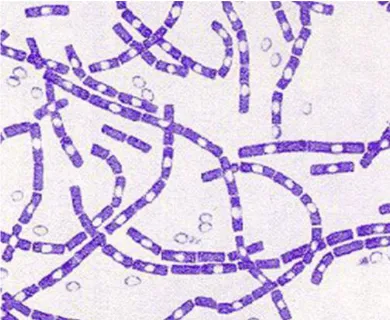
Some developments in the diagnosis of anthrax occurred in the Center for Disease Control and Prevention in 2001. Certain anthrax consists of two things: 1) Clinical signs consistent with cutaneous anthrax, inhalation or gastrointestinal anthrax in addition to positive result for the presence of anthrax bacilli; or 2) at least two positive test backups (14). Bacillus anthracis can be separated from multiple clinical samples such as blood, skin, wound secretions, cerebrospinal fluid, liquid crystals, mucus, and feces (27). If Gram stain shows high number of chains, i.e., gram-positive bacilli growing, quickly it is needed to be suspected to anthrax (28).
Figure 4. Gram stain 500 times more than Bacillus anthracis
Anthrax vaccines: anthrax Vaccine is provided from cultivation of Bacilli capsule without non-pathogenic anthrax. Bacilli release antigens were cultured synthetically during their growth and thus were used to make the vaccine. This vaccine must be used only for those who are in imminent danger of the disease such as individuals who are in contact with animals infected by animals' wool, hair, and bone, or laboratory staffs who are in
contact with anthrax bacilli (16). But US
Department of Defense in relation to bioterrorism preparedness argued that all fixed personnel of its army must be vaccinated against this disease (29). The mentioned vaccine in the 92/5 % cases is effective. It should be injected in 5.0 mL intramuscularly three times at two-week intervals, next another three times in six months intervals, followed by a 12-month interval (16). It should be noted that its effectiveness in relation to cutaneous anthrax has been reported about 93 % (29).
Treatment consisted of 4 steps:
Antimicrobial treatment: Many experts believe that effective drug for treating victims of biological attacks with anthrax is ciprofloxacin (400 mg IV every 12 hours). Doxycycline (100 mg IV every 12 hours) is an acceptable alternative (27). Ciprofloxacin and doxycycline are considered as important drugs in treatment of cutaneous anthrax. Of course, if there is a systemic illness, severe edema or when there is a wound in the head and neck, treatment with intravenous medications (such
as inhaled type) are recommended. If there is severe edema or swelling of the head and neck area combined with skin anthrax, corticosteroids must be prescribed (30). Time for the treatment of cutaneous anthrax is 7-10 days and inhaled anthrax it is 60 days. Since it is possible to have inhalation anthrax at the same time in bioterrorism attack, regardless of whether skin infection can lead to effective safety, and late spores activation in the body cannot be completely ruled out, it is recommended for those who are currently suffering from skin anthrax to be treated in 60 days (14).
2- Post-exposure prophylaxis: Prophylaxis after
exposure to anthrax takes place through
ciprofloxacin (500 mg IV every 12 hours) or doxycycline (100 mg IV every 12 hours). In the absence of vaccines, prophylaxis continues for 60 days (31).
3- Treatment with antitoxin: This procedure is still under investigation. Immunoglobulin prepared from people vaccinated against anthrax, is the same as the antitoxin used on a trial basis (6).
4- Care treatment: This procedure is for patients with severe anthrax in shock stage (32).
Conclusion
Early detection of threats and application of appropriate measures can prevent the occurrence of
anthrax. People in contact
with contaminated objects or certain infected environments should be covered by prophylaxis. It
is recommended to post personnel who are in touch with letters; i.e., engineers in contact by postal facilities, to use protective equipment. Clinicians and laboratory staff should be very vigilant about signs, symptoms, and laboratory test results of anthrax. Suspected letters' characteristics include inappropriate or unusual labels, abnormal sender addresses or absence of them, addresses without the name of the city, or containing a city name other than which the letter must come from. If there is a suspicious package, it should not be opened, it must be carried with caution and least
contact, and eventually the competent authority should be notified.
Acknowledgment
This research was funded by the Shahid Sadoughi University of Medical Sciences, Yazd, Iran.
Conflict of Interest
There is not conflict of interest between the authors.
References
1- Akbarein H, Bahonar A, Dabbagh Moghaddam A, et al. Glanders, a new vision on an old biological weapon. Ann Mil Health Sci Res. 2012;10(2):143-62.
2- Hatami H. Biological defence and its important in public health. Textbook of Public Health. Tehran: Arjmand Press; 2005.[Persian]
3- Hatami H. Clinical epidemiology and control of Melioidosis and Glanders. Hatami H Clinical epidemiology and control of diseases related to bioterrorism Tehran: Seda Publication; 2002.[Persian]
4- Mehrabi A. The use of biological warfare in history. Tehran: Research Center of Health and Nutrition of Military Medicine Institutte; 2002. [Persian]
5- Jahani M, Shirzad H. Public Health issues in Disaster Preparedness focus on Bioterrorism. Tehran: Jahan jame jam press; 2004. [Persian]
6- Inglesby TV, O'Toole T, Henderson DA, et al. Anthrax as a biological weapon, 2002: updated recommendations for management. Jama. 2002;287(17):2236-52.
7- Dewan PK, Fry AM, Laserson K, et al. Inhalational anthrax outbreak among postal workers, Washington, DC, 2001. Emerging infectious diseases. 2002;8(10):1066-72.
8- Vietri NJ, Purcell BK, Tobery SA, et al. A short course of antibiotic treatment is effective in preventing death from experimental inhalational anthrax after discontinuing antibiotics. Journal of Infectious Diseases. 2009;199(3):336 -41. 9- Bisher J. During World War I, terrorists schemed to use anthrax in the cause of Finnish independ ence. Military
History. 2003;20(3):18-20.
10- Keim P, Van Ert MN, Pearson T, et al. Anthrax molecular epidemiology and forensics: using the appropriate marker for different evolutionary scales. Infection, Genetics and Evolution. 2004;4(3):205-13.
11- Wallin A, Luksiene Z, Zagminas K, Surkiene G. Public health and bioterrorism: renewed threat of anthrax and smallpox. Medicina (Kaunas). 2007;43(4):278-84.
12- Cherry F. Textbook of pediatric infectious diseases 4th edition. 1998.
13- Velimirovic B. Infectious diseases in Europe: a fresh look. WHO Regional Office for Europe; 1984.
14- Control CfD, Prevention. Update: Investigation of anthrax associated with intentional exposure and interim public health guidelines, October 2001. MMWR Morbidity and mortality weekly report. 2001;50(41):889.
15- Doganay M, Metan G, Alp E. A review of cutaneous anthrax and its outcome. Journal of infection and public health. 2010;3(3):98-105.
16- Perret C, Maggi L, Pavletic C, et al. Ántrax (Carbunco). Revista chilena de infectología. 2001;18(4):291-9.
17- Mohsen A, El-Kersh K. Variable ECG findings associated with pulmonary embolism. BMJ case reports. 2013;2013:bcr2013008697.
18- Hicks CW, Sweeney DA, Cui X, et al. An overview of anthrax infection including the recently identified form of disease in injection drug users. Intensive care medicine. 2012;38(7):1092 -104.
19- Warrell DA, Cox TM, Firth JD. Oxford textbook of medicine: Oxford University Press; 2003.
20- Meselson M, Guillemin J, Hugh-Jones M, et al. The Sverdlovsk anthrax outbreak of 1979. Science. 1994;266(5188):1202-1208.
21- Holty J-EC, Bravata DM, Liu H, et al. Systematic review: a century of inhalational anthrax cases from 1900 to 2005. Annals of Internal Medicine. 2006;144(4):270-80.
22- Meselson M, Guillemin J, Hugh-Jones M, et al. The Sverdlovsk anthrax outbreak of 1979. Science. 1994;266(5188):1202.
23- Ringertz SH, Hoiby EA, Jensenius M, et al. Injectional anthrax in a heroin skin -popper. Lancet. 2000;356(9241):1574-1575.
24- Beaumont G. Anthrax in a Scottish intravenous drug user. Journal of forensic and legal medicine. 2010;17(8):443-5. 25- Outbreak News Anthrax. United States of America: Weekly Epidemiological Record, World Health Organization,
2001;(44): 337-344.
26- Gerberding JL, Hughes JM, Koplan JP. Bioterrorism preparedness and response: clinicians and public health agencies as essential partners. JAMA. 2002;287(7):898-900.
27- Case I. Update: investigation of bioterrorism-related anthrax and interim guidelines for clinical evaluation of persons with possible anthrax. 2001.
28- Ramsay C, Stirling A, Smith J, et al. An outbreak of infection with Bacillus anthracis in injecting drug users in Scotland. Euro Surveill. 2010;15(2):19465.
29- Klietmann WF, Ruoff KL. Bioterrorism: implications for the clinical microbiologist. Clinical Microbiology Reviews. 2001;14(2):364-81.
30 Radun D, Bernard H, Altmann M, et al. Preliminary case report of fatal anthrax in an injecting drug user in North -Rhine-Westphalia, Germany, December 2009. Euro surveillance: bulletin europeen sur les maladies transmissibles = European communicable disease bulletin. 2010;15(2):298.
31- Meaney-Delman D ,Zotti ME, Rasmussen SA, et al. Anthrax cases in pregnant and postpartum women: a systematic review. Obstetrics & Gynecology. 2012;120(6) :1439-49.
32- Sweeney DA, Hicks CW, Cui X. Anthrax infection. American journal of respiratory and critical care medicine. 2011;184(12):1333-41.