The Role of Internal Organizational Factors in Implementing the
Budgeting System Based on Performance: An Interpretative Structural
Modeling Approach (Case: Tehran Municipality)
Ali Heydari
Assistant Professor, Department of MBA, Faculty of Management, University of Tehran, Tehran, Iran Mojtaba Amiri
Associate Professor, Department of Public Administration, Faculty of Management, University of Tehran, Tehran, Iran
Hossein Jamour*
Master in Executive Management, Faculty of Management, University of Tehran, Tehran, Iran Received: 2017/11/10 Accepted: 2018/06/11
Abstract: It is essential to create the context for the strategic change in the organization. One of the necessities of reforming the municipal economic structure, modifying the method of budgeting and distributing resources, from traditional budgeting to an advanced budgeting system. Performance-based budgeting (PBB) by assigning targeted credit to activities can provide operational monitoring and facilitate access to resource allocation results while clarifying the distribution of resources. Accordingly, in this research, while introducing the internal factors affecting the implementation of the PBB, it has been attempted to express the relation between factors in the form of a conceptual model according to the extent of the impact and the effectiveness of each of the factors. This research is qualitative-quantitative in nature and is an applied in target dimension. In the process of identifying the factors, the content analysis method is used and in the classification stage of the known factors, an interpretative structural modeling tool is used. Data collection was gathered through reviewing organizational documents and interviewing managers, advisors and deputies of the Directorate of Program and Budget of Tehran Municipality. The results of the research show that in general, 11 main internal organizations are effective in implementing PBB. The citizenry agent has the least impact on the integrated information systems and has the most impact. According to the results of MICMAC analysis, none of the factors in the self-management area and two factors in the dependent region and eight factors in the communication area and the only factor of "integrated information systems" in the independent region.
Key words: PBB, Intra-organizational factors, Interpretative structural modeling, Tehran Municipality
JEL Classification: C54, L32, H30, E63
* Corresponding author: [email protected]
To cite this document: Heydari, A., Amiri, M., & Jamour, H. (2018). The Role of Internal Organizational Factors in Implementing the Budgeting System Based on Performance: An Interpretative Structural Modeling Approach.
Urban Economics and Management, 6(4(24)), 533-549. www.iueam.ir
Indexed in: ISC, EconLit, Econbiz, SID, EZB, GateWay-Bayern, RICeST, Magiran, Civilica, Google Scholar, Noormags, Ensani ISSN: 2345-2870
1- Introduction
The municipalities are considered non-government public organization for governing cities; which in Municipalities Laws the main issues concerning their establishment and handling is mentioned. Proper understanding of civic phenomena and their properties is a must for their effective management. Budgeting is one of the relevant issues in handling of cities. Regarding the rule of budget as the paramount financial document of every organization, determining its annual program on revenues and costs and the approach to reach preset aims on them, municipalities cannot deliver an effective management without optimal budgeting, so for them focusing on issues such as optimal budget allocation, management of relevant revenues and costs is inevitable (Bahrami, 2008)
The budgeting process in the Tehran municipality, like other municipalities, has four stages: first, the budget preparation and budgeting instructions are formulated in terms of general tasks by the program and budget department, then in each district of the municipality, according to this instruction, the expenditures for the implementation of al l servi ces and activities to be carried out during the year are estimated and the revenues necessary to cover these costs are anticipated in coordination with the Office of Program and Budget (Preparation and Settlement) . Settlement budget, after the necessary review in the form of a proposed budget is submitted to the approval authority; that is, the Islamic Council of Tehran, which has the parliamentary decree for the municipality. The proposed budget is applicable when approved by the Islamic city council (approval). Budget is returned to the municipality after approval by the
city council, and it is communicated to the units through the Office of the Program and Budget and the expenses are within the limits specified in the budget and compliance with the municipal financial regulation is enforceable (Implementation). Budget revenues are also reported by the Office of Planning and Budget at the end of each year after the completion of the budget implementation (Jamour, 2016).
In general, the current municipal budget planning system has two main constraints in the formulation of the relevant guidelines and the lack of conformity with the guidelines based on the fundamentals of program budget (Sadaat Amoli, 2011). Insufficiencies in the economic classification of costs rather than financial classification, failure to categorize revenues and sources of financing, failure to classify operations and ... are among the major constraints in the municipality.
Operational Budgeting by linking costs and results describes the relationship between them and has an important role in making strategic decisions; which manifest it in enhancing productivity and efficiency.
Operational Budgeting can be defined as a budget, which is set according to functions, operations and the projects of government organizations. The focus of this approach is on activities themselves and their related expenses instead of supplies and facilities needed for carrying out activities (Mcgill , 2006).
Operational Budgeting seeks to link performance criteria and resource allocation. Although such links are often tenuous, they can facilitate budgeting policies and legislators’ supervision on possible results and achievements stemming from Public expenses (Diamond, 2002).
From a regulatory prospective, also, Tehran Municipality is required to establish operational budgeting system according to article 219 of Five Development Plan., article 142 of 2th five-year plan, and resolutions of Islamic City Council of Tehran.
Thus, changing the budgeting system from a traditional system to an advanced one like operational budgeting system is a must. Today, change management is a pervasive challenge of organizations. Due to speediness, complexity and domain of change in environment, organizations need a comprehensive, flexible and continuous change (Worley & Mohrman, 2014) .
Organizational ability for carrying out immediate strategic changes is the thing, which determines its failure or success. Flexibility for swift reaction to environmental changes is necessary to maintain competitive edge. Agility is also important in inside adaption which must be carried out to gain coordination between factors contributing to strategic change (A'arabi, 2009).
According to (Schick, 2007), carrying out operational budgeting system and converting it to a decision making tool requires having at least following abilities:
Government needs information and expertise to decompose activities and outputs to standard units; then allocate cost to such units; and measure output of every unit. Melkers & Willoughby (1998), the most important requirement of operational budgeting system is commitment to continuous development of performance criteria and to reconsidering them in response to strategic plans and selective activities. According to Barzelay, (2001), success in reform program like Operational Budgeting s ystem entails change in
organizational structure and entire budgeting
In broad terms, preparing ground for strategic change in the organization is very necessary. For this reason, in this research, In addition to understanding organizational contributing factors in strategic shift from traditional budgeting system to operational budgeting, we try to introduce the model of relationship between such factors. As a final practical aim, we want to facilitate the trending shift from traditional budgeting system to operational budgeting system in Tehran Municipality.
2. Literature Review a) Foreign Researches
Cummings et al., 2016, in a review paper titled “unfreezing change as three steps: Rethinking Kurt Lewin’s legacy for change management” review a three stage model for change which is composed of following stages: unfreezing, change and anew freezing. They, addressing the criticisms of this model, emphasize its importance in human dimension and conclude that basis and main hypothesis of all models on this issue can be found in Kort louin's three stage model.
Yi Lu, & Willoughby (2015), in a research titled “operational budgeting in the US: a framework to link outputs to budgeting process”’ by probing the factors impacting operational budgeting, identified the nature of relationship between political, economic, regulatory and organizational factors and conclude that regulatory standards, performance management, common tasks and responsibilities and possibility of creating ability and capability are from major factors in operational budgeting and environmental factors are not statistically significant in this process.
Zinyama & Nhema (2016) in their research titled “performance based budgeting: concepts and factors contribute to its success” have introduced regulatory framework, strategic programing, capability and ability, expenses prioritizing, budgeting formula and structure, creating motivation, motivation strategy, accountability, reporting, supervision and evaluation as the key factors for success in operational budgeting process.
Gonzalez Lopez has shown that models for financial resource allocation in public organization impact their organizational behavior making them to decentralize. According to this study, particularly when such models are result-oriented, the municipalities are encouraged to care their performance in order to attract more financial resources. In performance-based financial resource allocation also in step with independence, the accountability of the managers increases. In addition, it brings more flexibility and transparency in government credit allocation process and prompt managerial unit to be more concerned on profitability.
b) Iranian Researches
Poorali & Kakvan (2014) reviewed the requirements for deployment of operational budgeting. The statistical population of the study consisted of 30 heads and deputies, financial and program and budget managers, university budget experts, heads of departments of hospitals affiliated to Babol University of Medical Sciences and Health Services. Using a census, their comments were analyzed by SPSS software. Findings showed that currently, Babol University of Medical Sciences and Health services has the ability to assess performance, manpower, and technical skills necessary for implementation of operational budgeting
and, on the other hand, the factors of gender, education and work experience in this ability are not effective.
Shiekholaslami et al., (2015) investigated internal and external factors affecting the establishment of operational budgeting system in Khuzestan province’s management and planning organization using SWOT matrix. The results show that planning, cost management and performance management in terms of employing in the first to third rank and change management, motivation and accountability systems, the lowest rank in terms of employing the organization have implemented operational budgeting system and the organization has more problems in terms of performance management, change management and accountability and motivation, and finally, in SWOT Matrix, each of the weaknesses, strengths, opportunities and threats in each one these factors are expressed.
Pakmaram et al., (2012) in a titled “ identifying and prioritizing the contributing factors in operational budgeting implementation in Telecommunication Companies through TOPPSIS method” concluded that in Telecommunication Company of East Azerbaijan Province environmental, organizational and operational controlling factors are necessary in proper implementation of operational budgeting such that the lack of them can prevent this process. They also argued that environmental factors are the paramount factor and controlling and are the next important ones.
3- Theoretical Background Strategic Change Management
Strategic change means a coordinated and measured process, which leads to a systematic change in relationship between
strategic orientation of an organization, and its surrounding environment and its result can be traced in productivity and performance improvement. This definition shows that there are reasons and implications for a change and being satisfied with a change depends on bringing a change in strategic orientation of an organization. This also shows that strategic change is a process (Anderson et al., 2008).
Change management is a brunch of management studies. Bay (2005) describes in his definition of change management the process of continuously refining the organization's orientations, structure and capabilities to meet the changing needs of both its internal and external customers. Armstrong also points out that change management provides facilitators for organizations in their work to change. In change management, at least three areas are examined: the current status of the organization, the si tuation that the organization must achieve in the future, and finally, how to guide the transformation of the organization from the current state to the desired state (Fadai & Nakhoda, 2010). Change management in large organizations is difficult (Worley & Mohrman, 2014). However, organizational change management is a process that continuously understands and controls the implications of the change process. In organizational change processes, in addition to focusing on goals and objectives, the consequences of changes and developments should also be given special attention. The main concern of managers is the proper impact through decision making in the processes of change and implementation and proper implementation of the process steps. This concern and concern, the result of uncertainty in the consequences of
change, especially in behavioral outcomes, is uncertainty about the proper impact of the process of change in organizational performance or the sustainability of these benefits (Rack Gomez, 2009). Recent studies on organizational change also indicate that over 70% of all organizational change efforts have failed. The unfamiliarity with change management has been studied as one of the factors contributing to the failure of the change projects in studies. Managers can make four kinds of changes in the organization in the organization: change in goods and services, change in strategy and structure, change in staff and culture, and change in technology (Andrews et al., 2008).
Strategic management of change and strategic change can be considered as the essence of strategic management. Topics or strategic change factors include organization strategy, structure strategy, human resource strategy, and technology strategy and organizational processes. These strategic changes take place at organizational, team and individual levels. As explained, the process of strategic change during the diagnosis, design, expansion, evaluation and enhancement stages is realized in a continuous cycle. The life cycle of this cycle is shrinking, and speed is the main source of excellence in the current situation (Arabi, 2015).
Organizational development and improvement experts are working to bring about organizational value creation through a strategic change based on creativity. Organizational capabilities for rapid implementation of strategic changes determine its failure or victory. The flexibility to respond quickly to environmental changes is essential in order to gain competitive advantage. Agility is also
necessary to perform internal settings in order to achieve synergy between strategic change factors. Coordination is also the essence of strategic change and it will bring about synergy. Creating and maintaining coordination is the main organizational capital and the true task of today's organizations (Arabi, 2015).
Budget and Budgeting
The budget, targets, and strategies are expressed in terms of financial terms and the way to implement the program and control their progress is determined. Organizations require three main reasons for budgeting (Farajvand, 1999):
1. To demonstrate the financial implications of the programs
2. To identify the resources needed to run the programs
3. To obtain the criteria for measuring, monitoring and controlling the results compared to the programs
According to the definition proposed by Organization for Economic Co-operation and Development, operational budgeting is a form of budgeting that links the allocated funds to measurable results. In fact, operational budgeting is the proper use of performance information at each stage of the budget cycle and the distribution of this information among those who decide on the optimal allocation of resources (Yang, 2003). On the other hand, operational budgeting is, in fact, the same as plan budgeting that more accurately and transparently analyzes the implementation of programs from the point of view of cost and profit, and helps managers through revealing the causes of the price increase. The deployment of this system requires accurate information on the implementation of each program's operations, activities and operations, and therefore, moving to the operational budget increases and maintains accounts and
details on the financial affairs of the organization (Ravand et al., 2010).
Renald (2006) s tat es that the implementation of an outcome-based operational budgeting system, which connects the budget data with its outcomes, requires following basic conditions:
The first requirement is the consistent support of legislators and their agreement on the organization's goals to implement them (Robbins, 2006). The legislator should use performance measures to evaluate service and production activities and decisions related to resource allocation.
This use requires a change in the culture of governments that consider budgeting as the only means of financial control. Along with the need for continuous and strong legal support, a credible, uniform, and robust reporting system for performance provides a database for operational budgeting. The performance monitoring system helps state administrators understand the mechanisms that represent the way in which data is converted to outputs and outcomes. The most difficult task in operational budgeting is to understand how the budgetary implications affect resource allocation. Governments should try to collect credible, valid and principled data about performance in order to solve this problem (Grizzly & Pettigon, 2000).
Among other requirements of this new budgeting system, in order to increase accountability and enhance performance, are special emphasis on products, transparency of performance and public participation; performance evaluation through the establishment of feedback mechanisms; the establishment of system of reward and punishment for strong and weak functions, promotion of management tools to access accurate, timely and relevant
information through restructuring the accounting system, upgrading the information system, strengthening the necessary internal control systems, and creating more flexibility and freedom for managers and eliminating redundant central controls (Diamond, 2003).
Organizational Factors: McKinsey 7s Model
The results of the previous studies in the literature show that the most influential factors affecting the implementation of the operational budgeting are intra-organizational factors: Andrius has extracted operational budgeting through the institutional model proposed by Sheh (2004) in terms of three dimensions of performance appraisal power, human resource capability, and technical capability. In addition, Taherpour Kalantari et al., (2011), in a study entitled "Identifying the effective factors on the implementation of the operational budget law in governm ent organiz ations", concluded that the factors affecting the deployment of the operational budget law in the order of priority in state institutions are: 1) attention to culture and leadership; 2) commitment to the implementation; 3) the conditions of the target group; 4) attention to knowledge and structure; 5) the conditions for the formulation of law; 6) attention to the tendency of the administrators and the atmosphere of the organization; 7) attention to simplicity of enforcing law and technology.
One of the models for evaluating in-house factors is McKinsey 7s Model. In this model, while considering the soft and hard dimensions of the organization, several influential factors affecting the internal environment of the organization have been identified and the relationship between network-based factors rather than hierarchical factors have been
considered. This means that it is not possible to improve one of the factors without improving other factors (Waterman et al., 1980). These factors in their totality led to this model being considered as a comprehensive model. McKinsey 7s Model is a management model that defines and describes seven organizational factors with a top down approach. All in all, these factors determine the way an organization operates. This model was presented by Tom Peters and Robert Waterman in 1978 in collaboration with Richard Pascal and Anthony Atus, all being members of the Mackenzie Consultation Services Company.
Regarding the research done on the importance of intra-organizational factors in implementing operational budgeting, firstly, management of the phenomenon of change (program budgeting to operational budgeting) is an internal organization that addresses the importance of these factors in comparison with factors outside The organization doubles. Secondly, intra-organizational factors play a key role in establishing operational budgeting, and most of the issues in this area relate to the internal dimension of organizations. On the other hand, internal and external research has usually focused on identifying effective factors in deploying operational budgeting from a technical or human dimension. Therefore, research that identifies organizational factors to examine the communication model and how these factors are influenced and influenced is necessary. . In this paper, we intend to first consider the conceptual relationship between identified factors with the use of the 7-Macintosh framework to identify the internal factors affecting operational budgeting using structural-interpretation modeling.
Fig1. Research theoretical framework
4- Research Method
The main objective of this study is to develop a model of intra-organizational factors affecting operational budgeting in Municipality of Tehran. Therefore, this study is an applied research in terms of its objectives and a case study in terms of the methodology used. The present research employs a quantitative-qualitative approach. The factors extracted from a thesis on “Assessment of Intra-Organizational Factors Affecting the Implementation of Operational Budgeting” (Jamour, 2016) have been identified as effective factors. These factors were interviewed by 20 people with expertise in the field of budgeting (14 in the Office of Planning and Budget, Municipal Planning and 6 experts) in the framework of the 7S McKinsey framework using the Content Analysis Technique Extracted.The selection of contributors to research and sampling was judged by experts from the field of budgeting until the saturation of the theory. Finally, Interpretative Structural Modeling (ISM) has been used in the design of the communication model to communicate the factors affecting operational budgeting and achieving its structural model.
Interpretative Structural Modeling: is an interactive learning process in which a set of different and interconnected elements are developed into a comprehensive systematic model. This methodology helps to create and orient complex relationships between elements of a system. One of the main logics of this method is that the elements that have a
more powerful effect on other elements are always more important. A model obtained using this method represents the structure of a complex subject and a system with a field of study, as a well-designed model (Nishat Faisal et al., 2006). This method first identifies the effective factors and then the relationships between these factors and the way to achieve progress by these factors are presented.
The interpretive structural model is able to determine the relationship between measures that are dependent on each other individually or collectively. This method analyzes the relationship between the indicators by analyzing them at several different levels (Kanan, 2009).
In brief, the stages of the implementation of interpretive structural modeling are described below, each of which is described in the following sections:
1. To identify effective intra-organizational factors on operational budgeting
2. To determine the conceptual relationship between factors using the structural interpretive modeling approach
2.1. Formation of Structural Self-Interaction Matrix (SSIM)
2.2. Formation matrix
2.3. Determining relations and ranking between factors
3. To draw a model and network of intra-organizational factors affecting operational budgeting.
Identifying Effective Intra-Organizational Factors on Budgeting Establishment
Determining the Relationship between Intra-Organizational
Factors
Designing network interactions model
5- Results
Step 1: Identifying the Factors
Extracting factors from Master thesis of (Jomoor, 2016) through interviewing experts and using content analysis techniques
are structure, staff strategy, systems, management style, shared skills and values (culture) as factors and components have been considered in this research (Table 1):
Table1. Intra-organizational factors and sub-factors
Factors Sub-factors
Citizenship Accountability before clients, respect and mutual trust
Organizational Culture
Not abusing occupational position
The role of senior managers’ behavior in formation of organizational culture Equality and justice in administrative and official procedures
Existence of commitment and belief in operational budgeting Transparency in the provision of services
Changing the approach from adaptive to outcome-oriented Focused and top-down decisions
Communication and coordination
Vertical communication is stronger than horizontal communication
The lack of effective communication between departments and offices of the same level Multiplicity of units and creation of various tasks
Island acting units
A meaningful program structure for missions
The need for strategic planning
The existence of a five-year strategic plan in the municipality Quantitative and measurable targeting is done in the form of programs
The need for 22 regions and different deputies to participate in the preparation of the program for the acquisition of ownership
Coordination and communication between running programs and sub-programs with budget funding The need for program
communication with budget funding
The need for transparency between the resources used and the outcomes of each program Categorization of activities in the form of each program
Changing the accounting system from cash to accrual
Activity-Based Costing
Semi-accountable accounting system
Determining the effectiveness of activities and services The need to access the data needed by each unit
System Information Seamlessly
The need to change the procurement phase and to complete the implementation phase and implement the necessary systems
Speed, accuracy and timeliness of information flow
Determine specific performance indicators for programs and activities
Comprehensive Performance Management System
Precise identification of the responsibility for running programs Extract functional information based on the same
Performance evaluation and feedback to staff Create a Responsive Performance Mechanism Style in the order of doing things
Leadership
The need for people to participate in planning activities and strengthening human capital Creating flexibility and freedom of action for more managers
Appointment and dismissal based on the suitability of individuals
Establishment of Motivational System
The need for transparency in the performance of senior executives Creating flexibility and freedom of action for more managers Rewards and punishments
The ability to develop a function-based program in such a way that applications directly connected to a credit line
Special Skills
Proper classification and costing skills Skills in the costing of activities and services
Ability to communicate between expenditures and results
Skill and Ability to work with defined systems and specialized software
Source: Assessment of Intra-Organizational Factors Affecting the Implementation of Operational Budgeting (Jomour, 2016)
Step 2: Determining the Relationship between Factors
a) Self-Interaction Structural Matrix (SSIM) At t his st age, for each pair of measures, experts are asked to comment
on the relationship between them. So that factors i and j are considered in pair. The following scale has been used to examine this relationship:
The row factor can lead to the column factor.
3: It's completely effective. 2: It’s effective.
1: It’s slightly effective. 0: It’s ineffective.
Accordingly, considering the identification of the effective intra-organizational factors on the implementation of the operational budgeting system for the Tehran municipality, the results of the paired comparison between the 11 identified factors are as follows:
Table2. Results from the paired comparison of identified factors
Row Factors 1 2 3 4 5 6 7 8 9 10 11
1 Citizenship 0 12 14 17 15 18 19 18 14 18 16
2 Organizational culture 26 0 23 18 13 12 17 16 17 15 20 3 Communication and coordination 21 22 0 19 16 19 15 19 14 21 18 4 The need for strategic planning 23 21 25 0 17 16 17 19 16 19 15
5 The need for program communication
with budget funding 22 21 20 24 0 21 19 17 19 24 20 6 Activity-Based Costing 21 23 20 27 23 0 17 25 16 14 11 7 Integrated Information System 23 26 28 15 20 22 0 25 26 23 21
8 Comprehensive Performance
Management System 24 27 14 21 19 16 14 0 22 25 21 9 Leadership and management style 26 29 27 21 24 21 22 25 0 24 20 10 Establishment of Motivational System 24 25 22 18 19 17 13 16 15 0 23 11 Special skills 20 23 18 17 14 18 16 24 22 13 0
b) Early Access Matrix
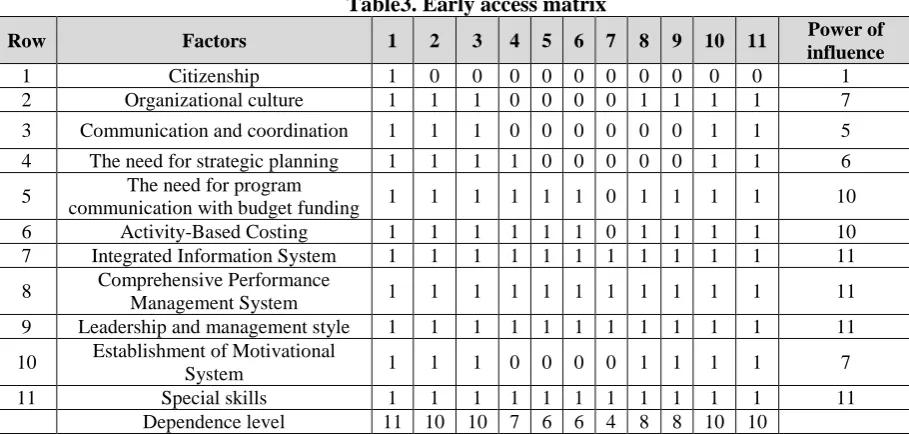
The access matrix is obtained by assigning relations in the form of zero and one using the previous matrix during two steps: We first consider a single numerical scale and compare the numbers in the table from the previous step. If the corresponding number in the table is larger than the scale, in the new table, we
use one and otherwise we use zero (Bolans et al., 2005):
m a 0
a
m a 1
a M
ij ij
ij ij
m = 2 × n, where n is the number of respondents. In this study, the number of respondents is 10, and the scale number is: m = 2 × 10 = 20. Therefore, the access matrix is equal to:
Table3. Early access matrix
Row Factors 1 2 3 4 5 6 7 8 9 10 11 Power of
influence
1 Citizenship 1 0 0 0 0 0 0 0 0 0 0 1
2 Organizational culture 1 1 1 0 0 0 0 1 1 1 1 7
3 Communication and coordination 1 1 1 0 0 0 0 0 0 1 1 5
4 The need for strategic planning 1 1 1 1 0 0 0 0 0 1 1 6
5 The need for program
communication with budget funding 1 1 1 1 1 1 0 1 1 1 1 10 6 Activity-Based Costing 1 1 1 1 1 1 0 1 1 1 1 10 7 Integrated Information System 1 1 1 1 1 1 1 1 1 1 1 11
8 Comprehensive Performance
Management System 1 1 1 1 1 1 1 1 1 1 1 11 9 Leadership and management style 1 1 1 1 1 1 1 1 1 1 1 11
10 Establishment of Motivational
System 1 1 1 0 0 0 0 1 1 1 1 7
11 Special skills 1 1 1 1 1 1 1 1 1 1 1 11
Dependence level 11 10 10 7 6 6 4 8 8 10 10
C. Factor Relationships and Ranking
In order to determine the relations and ranking of the measures, the output and input sets for each measure should be extracted from the obtained matrix. The output set includes the measure itself and the measures that affect it. The input set includes the measure itself and the measures that affect it. Then the set of bilateral relations of the measures is determined. The first line that makes the interface of the two sets equal to the access set (inputs) will determine the first level of priority. If the interface of the
input set and the preceding set (outputs) are equal, the corresponding variable in the ISM matrix hierarchy is placed at the highest level. After determining the level, the measure with the determined level is eliminated from the entire set in the table, and again the set of inputs and outputs is formed and the next variable level is determined (Agarwal et al., 2007). In this study, five levels were obtained through five steps which, for the sale of brevity, the results of the first and last replication of the classification of access matrix levels are presented:
Table4. Results of the first classification replication of the matrix levels
Factors Output set Input set Interface Level
1 1 1, 2, 3, 4, 5, 6, 7, 8, 9, 10, 11 1 1
2 1, 2, 38, 9, 10, 11 2, 3, 4, 5, 6, 7, 8, 9, 10, 11 2, 3, 8, 9, 10, 11 3 1, 2, 3, 10, 11 2, 3, 4, 5, 6, 7, 8, 9, 10, 11 2, 3, 10, 11 4 1, 2, 3, 4, 10, 11 4, 5, 6, 7, 8, 9, 11 4, 11 5 1, 2, 3, 4, 5, 6, 8, 9, 10, 11 5, 6, 7, 8, 9, 11 5, 6, 8, 9, 11 6 1, 2, 3, 4, 5, 6, 8, 9, 10, 11 5, 6, 7, 8, 9, 11 5, 6, 8, 9, 11 7 1, 2, 3, 4, 5, 6, 7, 8, 9, 10, 11 7, 8, 9, 11 7, 8, 9, 11 8 1, 2, 3, 4, 5, 6, 7, 8, 9, 10, 11 2, 5, 6, 7, 8, 9, 10, 11 2, 5, 6, 7, 8, 9, 10, 11 9 1, 2, 3, 4, 5, 6, 7, 8, 9, 10, 11 2, 5, 6, 7, 8, 9, 10, 11 2, 5, 6, 7, 8, 9, 10, 11 10 1, 2, 3, 8, 9, 10, 11 2, 3, 4, 5, 6, 7, 8, 9, 10, 11 2, 3, 8, 9, 10, 11
11 1, 2, 3, 4, 5, 6, 7, 8, 9, 10, 11 2, 3, 4, 5, 6, 7, 8, 9, 10, 11 2, 3, 4, 5, 6, 7, 8, 9, 10, 11
Table5. Results of the last classification replication of the matrix levels
Factors Output set Input set Interface Level
5 5, 6, 8, 9, 11 5, 6, 7, 8, 9, 11 5, 6, 8, 9, 11 4 6 5, 6, 8, 9, 11 5, 6, 7, 8, 9, 11 5, 6, 8, 9, 11 4 7 5, 6, 7, 8, 9, 11 7, 8, 9, 11 7, 8, 9, 11
8 5, 6, 7, 8, 9, 11 5, 6, 7, 8, 9, 11 5, 6, 7, 8, 9, 11 4 9 5, 6, 7, 8, 9, 11 5, 6, 7, 8, 9, 11 5, 6, 7, 8, 9, 11 4 11 5, 6, 7, 8, 9, 11 5, 6, 7, 8, 9,, 11 5, 6, 7, 8, 9, 11 4
Step 3: Drawing Model and Factor Interactions Network
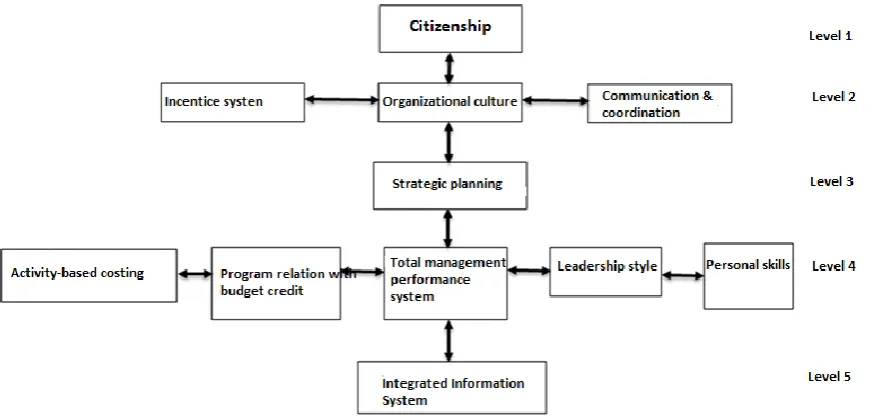
After determining the relationships and level of variables, they can be mapped into a model. For this purpose, the variables are firstly ordered from top to bottom according to their level. Using the leveling, a diagraph is formed the model of the intra-organizational factors
affecting operational budgeting in the Tehran municipality. Thus, factor 1 (Citizenship), which is known as the first level, is at the first level of the diagraph followed by the other factors at other levels. This diagraph is presented in the following figure.It needs to be explained that as we move from higher levels to
lower levels, the impact of indicators diminishes and their impact increases, so citizenship can be said to be most influential and integrated information system has the least impact. Thereafter, the comprehensive system of performance, the relationship of the program with budget credits, leadership style, specialized skills, and activity-based costing are least
influential, which affects only the integrated information system. After Level 4 agents, Level 3 (Strategic Planning) factors have a moderate impact. On the other hand, after citizenship, Level 2 (communication and coordination , motivational system and organizational culture) have the most impact. This diagram is presented in the following way:
Fig2. The model of effective intra-organizational factors on operational budgeting in Municipality of Tehran
D. Clustering factors
In order to segment the factors in the final access matrix, we must calculate each of driving and dependence power factors. Driving power of a factor is the number of factors that are affected by that factor, including the factor itself. The dependence power is also the number of factors that affect the factor and contribute
to achieving it. These driving and dependence powers are categorized and used in the Impact Matrix Cross -Reference Multiplication Applied to a Classification (MICMAC), in which the factors are divided into four autonomous, dependent, associative and independent groups (Azar et al., 2010).
Table6. Guidance - Dependency of factors
Variables 1 2 3 4 5 6 7 8 9 10 11
Driving Power 1 7 5 6 10 10 11 11 11 7 11
Dependence Power 11 10 10 7 6 6 4 8 8 10 10
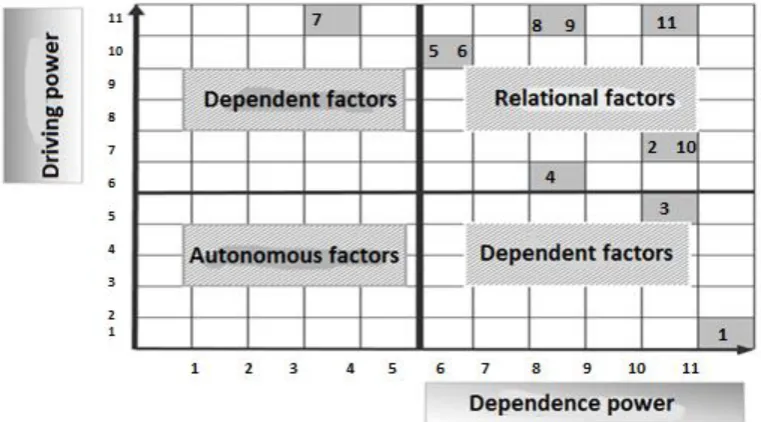
The purpose of the MICMAC analysis is to investigate driving and dependence power variables (Matthias Hagan et al., 2013). As shown in the figure below, the factors and components
are divided into four clusters. The first cluster includes factors that have a driving power and weak dependence. These variables are roughly separated from the system because they have poor
connections with the system. As shown in Table 6, in this study none of the variables are located in this cluster, implying the strong relationship of variables with each other in the model of factors affecting operational budgeting. The dependent variables in the second cluster are weak in terms of driving power but strong in terms of power dependence. Citizenship, communication, and coordination are placed in the dependent cluster. This means that the change in other factors and components of the operational budgeting budget causes changes in these factors. Of the two factors mentioned, citizenship with the dependence degree of 11 has the highest impact. The third cluster includes communication factors that have both high driving and dependence powers. These factors are non-stationary, because due to their high driving and dependence power, any change in them can affect the system. Of the intra-organizational factors affecting the implementation of the operational budgeting system, some factors including organizational culture,
the necessity of strategic planning, the necessity of the relationship of the program with budget financing, activity-based costing, comprehensive performance management system, leadership and management style, deployment of the motivational system and specialized skills are placed this cluster, although the components of the need for program communication with budget and activity-based budgeting are more effective than being affected. The fourth cluster includes independent measures that have high driving power and low power dependence. The integrated information system with driving power of 11 and dependency power of 4 is located in this cluster, which as a key and fundamental factor has a significant effect on other factors. It should be noted that among the 11 factors affecting operational budgeting, factor 7 (Integrated Information System) was recognized as the most influential and, consequently, the most fundamental factor.
Fig3. The power of guidance and dependency of factors
6- Conclusion and Discussion Recent literature on organizational change suggests that over 70% of all organizational change efforts have failed. The unfamiliarity with change management has been discussed as one of the factors contributing to the failure of change projects in the literature (Andrew et al., 2008). Managing change from traditional budgeting to operational budgeting in Tehran’s municipality has always been one of the challenges of the municipality’s economic system due to its complexity. Change management not only needs to be aware of what to be changed, but also how and when different factors must be considered in a strategic orientation (Aarabi, 2015). In changing the budgeting system of the Tehran municipality, it is essential to understand the effective factors on change along with how to change the factors. The effective factors on the establishment of operational budgeting in the municipality of Tehran include 43 components in the form of 11 main factors: citizenship, organizational culture, communication and coordination, the necessity of strategic planning, the necessity of the relationship of the program with budget financing, activity-based costing, integrated information system, comprehensive performance management system, leadership, deployment of motivational system and specialized skills (Jomour, 2016). The identified factors are consistent with the factors recognized in the previous studies. Operational budgeting can be achieved through focusing on culture and leadership, commitment and support of implementation, target group conditions, paying attention to cost and measuring index, and paying attention to organizational climate (Safdarinahahd et al., 2015).
In order to find out how the factors were related, interpretive structural modeling was used. According to the expert opinions and analysis, the structural model of the factors affecting the operational budgeting of the municipality of Tehran, the relationship between the factors in Figure 1 was determined. In Figure 1, the factors that are at the higher levels are of primary importance and play a key role in the implementation of the operational budgeting system in Tehran Municipality. The results of the present study indicate that the integrated information system is the basis of other factors, so that the process of changing the budgeting system should begin with this factor. It is worth mentioning that operational budgeting is a systematic use of information generated through performance information systems (Farzib, 2002). In MICMAC analysis, it has the highest driving power and the least dependence power on integrated information systems. This means that for the change process, the integrated information system has the most impact and has the least effect on other factors. As a result, success in the process of changing the budget system in the municipality requires the attention and special focus of managers on this factor. The most important factors at the fourth level are the need for the program to communicate with budget financing, activity-based costing, comprehensive performance management system, leadership and management style, and specialized skills. Integrated information system (Level 1) plays a key role in shaping level factors. These factors can also have an interactive and two-way relationship. For example, changing the budgeting system may happen in a
s i t u a t i o n w h e r e a c o m p r e h e n s i v e performance management system can first be changed, and then affects other four-level factors (leadership and management style, activity-based costing, and specialized skills), or vice versa. Leadership style and management may form the other factors of level four. Each of these factors is at four levels is considered a necessity for strategic planning in the organization. Although they are related to strategic planning in a cluster, they are more important in terms of driving power and effectiveness in operational budgeting process. The third level of this model also belongs to strategic planning, which covers relational factors in terms of their effectiveness. In this way, to be effective, this factor depends on the factors of the higher level. This factor is essential for the next factors, such as the motivational system, organizational culture and communication and coordination are at the second level of the model. Finally, citizenship is placed in the first level of the model, which has the highest level of dependence on other factors, in a way that the total of the mentioned factors is an introduction to citizenship. Of course, it is worth mentioning that the necessary condition for the successful implementation of this system in the municipality of Tehran is the attention to all intra-organizational components.
In general, by recognizing the inter-organizational factors affecting operational budgeting in the municipality of Tehran and developing a model of the relationships and importance of each of the factors, it is suggested that Tehran Municipality managers focus on comprehensive management system, management style, activity-based costing and specialized
skills with emphasis on strengthening integrated information systems, because this factor enhances other components and factors and ultimately strengthens operational budgeting. Since municipalities have similarities in organizational structure, it is suggested that the findings of this study to be used to implement an operational budgeting system. In the end, considering that the communication model has been developed for the main factors, it is recommended that future research assess and evaluate the communication model and the degree of importance of each of the sub-components.
*The article is taken from the master thesis titled “Evaluation of Organizational Components for Establishing a Budgeting System Based on Performance” under the supervision of Dr. Ali Heidari and counseled by Dr. Mojtaba Amiri.
7- References
Abdesabour, F., & Ravand, M. (2010). Operational requirements and budget constraints based organizations “make the three-factor model,” case study: Tehran Regional Electricity Company. Journal of Industrial Management, Faculty of Humanities, Islamic Azad University of Sanandaj, 17(20), 110-112. Agarwal, A., Shankar, R., & Tiwari, M. K. (2007). Modeling agility of supply chain. Industrial marketing management, 36(4), 443-457.
Andrews, J., Cameron, H., & Harris, M. (2008). All change? Managers' experience of organizational change in theory and practice. Journal of Organizational Change Management, 21(3), 300-314.
Andrews, M., (2004), Authority, Acceptance, Ability and Performance-Based Budgeting Reforms”, The International Journal of Public Sector Management, 17(4), 332-344. Arabi, S.M. (2010). Designing a model for
increasing performance through the
coordination of organizational change strategies. Management Studies in Iran, 14(3). (In Persian).
Azar, A., Tizro, A., Moghbel, A., & Anvari, A. (2010). Designing Supply Chain Agility Model; Interpretative-Structural Modeling Approach. Management Research in Iran, 14(4), 1-25. (In Persian).
Bar zel a y, M. ( 2001) . The new publ i c management: Improving research and policy dialogue. Berkeley: University of California Press.
Cummings, S., Bridgman, T., & Brown, K. G. (2016). Unfreezing change as three steps: Rethinking Kurt Lewin’s legacy for change management. human relations, 69(1), 33-60.
Diamond, J. (2002). Performance Budgeting--Is Accrual Accounting Required? (Vol. 2). International Monetary Fund.
Diamond, M. J. (2003). Performance budgeting: managing the reform process (No. 3-33). International Monetary Fund.
Fadayi, Gh. & Nakhoda, M. (2010). Designing Change Management Model in Iranian Academic Libraries: A Delphi Study. Journal of Information Research and Public Libraries. 16 (3(62)), 145-168. (In Persian).
Grizzle, G. A., & Pettijohn, C. D. (2002). Implementing Performance‐Based Program Budgeting: A System‐Dynamics Perspective. Public Administration Review, 62(1), 51-62. Jomoor, H. (2016). Evaluation of
Intra-Organizational Factors for Implementation of the Operational Budgeting System Based on the S-Mackenzie Model (Case Study: Tehran Municipality). Master Degree in Executive Management, University of Tehran.(In Persian).
Kannan, G., Pokharel, S., & Kumar, P. S. (2009). A hybrid approach using ISM and fuzzy TOPSIS for the selection of reverse logistics provider. Resources, conservation and recycling, 54(1), 28-36. Lu, E. Y., & Willoughby, K. (2015). Performance
budget i ng i n Amer i can st at es: A framework of integrating performance
with budgeting. International Journal of Public Administration, 38(8), 562-572. Lu, Y., Willoughby, K., & Arnett, S. (2011).
Performance budgeting in the American States, What's law got to do with it?. State and Local Government Review, 43(2), 79-94.
McGi l l , R. (2006) . Achi evi ng resul t s: performance budgeting in the least developed countries. UN.
Melkers, J. E., & Willoughby, K. G. (2001). Budgeters' views of state performance-budgeting systems: Distinctions across branches. Public Administration Review, 61(1), 54-64.
Melkers, J., & Willoughby, K. (1998). The state of the states: Performance-based budgeting requirements in 47 out of 50. Public Administration Review, 66-73. Nishat Faisal, M., Banwet, D. K., & Shankar,
R. (2006). Supply chain risk mitigation: modeling the enablers. Business Process Management Journal, 12(4), 535-552. Pakmaram, A., Esg, K., Koshteli, H. B., &
Khalili, M. (2012). Identifying and prioritizing effective factors in the performance based budg et i ng i n telecommunications company with TOPSIS method. African Journal of Business Management, 6(24), 7344-7353. Panahi, A. (2006). Operational Budgeting
Concepts and Requirements: Journal of Parliament and Research, 12(47), Majlis Research Center. (In Persian).
Poorali, M., & Kakvan, S. (2014). Requirements for Operational Budgeting (Case Study: Babol University of Medical Sciences and Health Services). Journal of Audit Science, 14(57), 191-217. (In Persian). Robbins, S. (2006). Essentials of organizational
behavior. Prentice-Hall.
Safdari, M., Memarzadeh, M., & Ezati, M. (2015). The Role of Organizational Factors on Operational Budgeting in Implementation of Article 195 of the Fifth Development Planning Act: Quarterly Journal of Strategic and Capital Policies, 11, 27-48. (In Persian).
Schick, A. (2007). Performance Budgeting and Accrual Budgeting. OECD Journal on Budgeting, 7(2), 109-138.
Sheykholeslami, Sh., Tehrani, R., & Mahmudi, V. (2015). Investigating the Establishment of Operational Budgeting System Based on Diamond Model in Khuzestan Province Management and Planning Organization Using SWOT Matrix. International Conference on Management, Economics and Industrial Engineering. (In Persian).
Taherpoor, H., Daneshfard, K., & Rezayi, F. (2011). Identifying the factors influencing the establishment of operational budget law in governmental organizations. Journal of Planning and Budget Research, 16 (2), 56-31.(In Persian).
Worley, C & Mohrman, S. (2014). Is change mana ge ment obs ol et e? Journal of Organizational Dynamics, 43(3), 214-224. Young, R. D. (2003). Performance-based budget systems. Public Policy and Practice, 2(2), 11-24.
Zinyama, T., & Nhema, A. G. (2016). Zimbabwe Performance-Based Budgeting: Concepts and Success Factors. Public Policy and Administration, 4(1), 33-60.