Intermolecular Hydroamination of Methylenecyclopropane
Catalyzed by Group IV Metal Complexes
Elena Smolensky, Moshe Kapon, and Moris S. Eisen*
Schulich Faculty of Chemistry and Institute of Catalysis Science and Technology, TechnionsIsrael Institute of Technology, Haifa 32000, Israel
ReceiVed May 24, 2007
The intermolecular hydroamination of methylenecyclopropane (MCP) and phenylmethylenecyclopropane (PhMCP) promoted by group IV metal complexes is presented. The reactivity and chemoselectivity of two titanium complexes having two different ancillary ligands, Ti(Ph2PNpy)2(NEt2)2and Ti(NMe2)4, are
presented and compared to those of the zirconium complexes Zr(Ph2PNpy)3NEt2and Zr(NMe2)4. For the
titanium complexes, the linear imine product A is always the predominant species, having E stereochemistry. For the zirconium complexes, the branched imine product B is obtained preferentially. Comparison of the activity of the complex Ti(Ph2PNpy)2(NEt2)2with that of Ti(NMe2)4reveals a strong
relationship between the ancillary ligand at the catalytic complex and the suitability of the amine for the MCPs hydroamination reaction. A complex with a bulky ancillary ligand is suitable for the hydroamination of aliphatic amines and small aromatic amines, whereas a complex with a small ancillary ligand (steric hindrance) will allow the hydroamination of MCPs with bulky aromatic amines. Kinetic studies show that the hydroamination promoted by the homoleptic titanium complex exhibit a first-order dependence in complex and olefin and an inverse order dependence in amine. A plausible mechanism is presented on the basis of the obtained products, kinetic measurements, and syntheses of key intermediates.
Introduction
The hydroamination reaction, an addition of an N-H bond to an unsaturated hydrocarbon, is an especially attractive transformation for industrial, environmental, and basic synthetic purposes. This reaction offers an atom-economical transforma-tion that produces desired products in a high yield with no side products. The hydroamination reaction catalyzed by early-transition-metal organometallic complexes1-55 manages to
combine interesting and unique benefits. Among these benefits
are the high general reactivity of the metals and their ubiquitous availability as compared to toxic metals (Hg,56,57Tl,58U, and
Th59-62) or the more expensive lanthanides and
late-transition-* To whom correspondence should be addressed. E-mail: chmoris@ tx.technion.ac.il.
(1) Bytschkov, I.; Doye, S. Eur. J. Org. Chem. 2003, 935-946. (2) Doye, S. Synlett 2004, 1653-1672.
(3) Muller, T. E.; Beller, M. Transition Met. Org. Synth. 1998, 2, 316 -330.
(4) Nobis, M.; Driessen-Holscher, B. Angew. Chem., Int. Ed. 2001, 40, 3983-3985.
(5) Odom, A. L. Dalton Trans. 2005, 225-233.
(6) Pohlki, F.; Doye, S. Chem. Soc. ReV. 2003, 32, 104-114. (7) Watson, D. A.; Chiu, M.; Bergman, R. G. Organometallics 2006,
25, 4731-4733.
(8) Thomson, R. K.; Bexrud, J. A.; Schafer, L. L. Organometallics 2006,
25, 4069-4071.
(9) Mueller, C.; Loos, C.; Schulenberg, N.; Doye, S. Eur. J. Org. Chem.
2006, 2499-2503.
(10) Esteruelas, M. A.; Lopez, A. M.; Mateo, A. C.; Onate, E.
Organometallics 2006, 25, 1448-1460.
(11) Buil, M. L.; Esteruelas, M. A.; Lopez, A. M.; Mateo, A. C.
Organometallics 2006, 25, 4079-4089.
(12) Ayinla, R. O.; Schafer, L. L. Inorg. Chim. Acta 2006, 359, 3097 -3102.
(13) Wang, H.; Chan, H.-S.; Xie, Z. Organometallics 2005, 24, 3772 -3779.
(14) Tillack, A.; Khedkar, V.; Jiao, H.; Beller, M. Eur. J. Org. Chem.
2005, 5001-5012.
(15) Petersen, J. R.; Hoover, J. M.; Kassel, W. S.; Rheingold, A. L.; Johnson, A. R. Inorg. Chim. Acta 2005, 358, 687-694.
(16) Kim, H.; Lee, P. H.; Livinghouse, T. Chem. Commun. 2005, 5205 -5207.
(17) Khedkar, V.; Tillack, A.; Michalik, M.; Beller, M. Tetrahedron 2005,
61, 7622-7631.
(18) Kaspar, L. T.; Fingerhut, B.; Ackermann, L. Angew. Chem., Int.
Ed. 2005, 44, 5972-5974.
(19) Heutling, A.; Pohlki, F.; Bytschkov, I.; Doye, S. Angew. Chem.,
Int. Ed. 2005, 44, 2951-2954.
(20) Hazari, N.; Mountford, P. Acc. Chem. Res. 2005, 38, 839-849. (21) Esteruelas, M. A.; Lopez, A. M.; Mateo, A. C.; Onate, E.
Organometallics 2005, 24, 5084-5094.
(22) Bexrud, J. A.; Beard, J. D.; Leitch, D. C.; Schafer, L. L. Org. Lett.
2005, 7, 1959-1962.
(23) Banerjee, S.; Shi, Y.; Cao, C.; Odom, A. L. J. Organomet. Chem.
2005, 690, 5066-5077.
(24) Ward, B. D.; Maisse-Francois, A.; Mountford, P.; Gade, L. H. Chem.
Commun. 2004, 704-705.
(25) Tillack, A.; Khedkar, V.; Beller, M. Tetrahedron Lett. 2004, 45, 8875-8878.
(26) Tillack, A.; Jiao, H.; Castro, I. G.; Hartung, C. G.; Beller, M. Chem.
Eur. J. 2004, 10, 2409-2420.
(27) Ramanathan, B.; Keith, A. J.; Armstrong, D.; Odom, A. L. Org.
Lett. 2004, 6, 2957-2960.
(28) Pohlki, F.; Bytschkov, I.; Siebeneicher, H.; Heutling, A.; Koenig, W. A.; Doye, S. Eur. J. Org. Chem. 2004, 1967-1972.
(29) Lorber, C.; Choukroun, R.; Vendier, L. Organometallics 2004, 23, 1845-1850.
(30) Li, Y.; Shi, Y.; Odom, A. L. J. Am. Chem. Soc. 2004, 126, 1794 -1803.
(31) Knight, P. D.; Munslow, I.; O’Shaughnessy, P. N.; Scott, P. Chem.
Commun. 2004, 894-895.
(32) Hoover, J. M.; Petersen, J. R.; Pikul, J. H.; Johnson, A. R.
Organometallics 2004, 23, 4614-4620.
(33) Gribkov, D. V.; Hultzsch, K. C. Angew. Chem., Int. Ed. 2004, 43, 5542-5546.
(34) Cao, C.; Li, Y.; Shi, Y.; Odom, A. L. Chem. Commun. 2004, 2002 -2003.
(35) Ackermann, L.; Born, R. Tetrahedron Lett. 2004, 45, 9541-9544. (36) Zhang, Z.; Schafer, L. L. Org. Lett. 2003, 5, 4733-4736. (37) Shi, Y.; Hall, C.; Ciszewski, J. T.; Cao, C.; Odom, A. L. Chem.
Commun. 2003, 586-587.
(38) Li, C.; Thomson, R. K.; Gillon, B.; Patrick, B. O.; Schafer, L. L.
Chem. Commun. 2003, 2462-2463.
(39) Khedkar, V.; Tillack, A.; Beller, M. Org. Lett. 2003, 5, 4767-4770.
4510 Organometallics 2007, 26, 4510-4527
10.1021/om700455e CCC: $37.00 © 2007 American Chemical Society
metal complexes (Ru,63-72Rh,73-77Ir,74,78-80Pd,54,63,81-109Ni,110
Pt,63,86,111-116Cu,63,117-119Ag,120-123and Au124-133). This “win
-win” combination has motivated widespread interest over the past decade and has made the hydroamination reaction catalyzed,
especially by early-transition-metal complexes, a highly ad-vantageous transformation. The hydroamination reaction allows the formation, upon concomitant reactions, of substituted a-mines,19,28,36,39,45,134,135 R,β-unsaturated imines,14,25,29,39
ke-tones,14,28hydrazines,23,30pyrroles,5,27,35indoles,5,17,26,35,48and
other cyclic amines.14However, to date, this field has remained
limited mainly to alkyne and allene substrates.136 The main
challenge of this topic is to expand the reaction scope to include the discovery of new group IV organometallic complexes that
(40) Garcia Castro, I.; Tillack, A.; Hartung, C. G.; Beller, M. Tetrahedron
Lett. 2003, 44, 3217-3221.
(41) Bytschkov, I.; Siebeneicher, H.; Doye, S. Eur. J. Org. Chem. 2003, 2888-2902.
(42) Ackermann, L.; Bergman, R. G.; Loy, R. N. J. Am. Chem. Soc.
2003, 125, 11956-11963.
(43) Ackermann, L. Organometallics 2003, 22, 4367-4368. (44) Tillack, A.; Castro, I. G.; Hartung, C. G.; Beller, M. Angew. Chem.,
Int. Ed. 2002, 41, 2541-2543.
(45) Pohlki, F.; Heutling, A.; Bytschkov, I.; Hotopp, T.; Doye, S. Synlett
2002, 799-801.
(46) Ong, T.-G.; Yap, G. P. A.; Richeson, D. S. Organometallics 2002,
21, 2839-2841.
(47) Duncan, A. P.; Bergman, R. G. Chem. Rec. 2002, 2, 431-445. (48) Cao, C.; Shi, Y.; Odom, A. L. Org. Lett. 2002, 4, 2853-2856. (49) Ackermann, L.; Bergman, R. G. Org. Lett. 2002, 4, 1475-1478. (50) Straub, B. F.; Bergman, R. G. Angew. Chem., Int. Ed. 2001, 40, 4632-4635.
(51) Shi, Y.; Ciszewski, J. T.; Odom, A. L. Organometallics 2001, 20, 3967-3969.
(52) Pohlki, F.; Doye, S. Angew. Chem., Int. Ed. 2001, 40, 2305-2308. (53) Johnson, J. S.; Bergman, R. G. J. Am. Chem. Soc. 2001, 123, 2923 -2924.
(54) Cloke, F. G. N.; Hitchcock, P. B.; Nixon, J. F.; Wilson, D. J. Chem.
Commun. 2000, 2387-2388.
(55) Wartchow, R.; Doye, S. J. Organomet. Chem. 1998, 566, 287 -291.
(56) Barluenga, J.; Aznar, F. Synthesis 1975, 704-705.
(57) Barluenga, J.; Aznar, F.; Liz, R.; Rodes, R. J. Chem. Soc., Perkin
Trans 1980, 2732-2737.
(58) Barluenga, J.; Aznar, F. Synthesis 1977, 195-196.
(59) Wang, J.; Dash, A. K.; Kapon, M.; Berthet, J.-C.; Ephritikhine, M.; Eisen, M. S. Chem. Eur. J. 2002, 8, 5384-5396.
(60) Stubbert, B. D.; Stern, C. L.; Marks, T. J. Organometallics 2003,
22, 4836-4838.
(61) Haskel, A.; Straub, T.; Eisen, M. S. Organometallics 1996, 15, 3773-3775.
(62) Straub, T.; Haskel, A.; Neyroud, T. G.; Kapon, M.; Botoshansky, M.; Eisen, M. S. Organometallics 2001, 20, 5017-5035.
(63) Ozawa, F.; Yoshifuji, M. Dalton Trans. 2006, 4987-4995. (64) Kuninobu, Y.; Nishina, Y.; Takai, K. Org. Lett. 2006, 8, 2891 -2893.
(65) Chang, S.; Lee, M.; Jung, D. Y.; Yoo, E. J.; Cho, S. H.; Han, S. K.
J. Am. Chem. Soc. 2006, 128, 12366-12367.
(66) Yi, C. S.; Yun, S. Y.; Guzei, I. A. J. Am. Chem. Soc. 2005, 127, 5782-5783.
(67) Yi, C. S.; Yun, S. Y. Org. Lett. 2005, 7, 2181-2183.
(68) Yi, C. S.; Yun, S. Y.; Guzei, I. A. J. Am. Chem. Soc. 2005, 127, 5782-5873.
(69) Yi, C. S.; Yun, S. Y. Org. Lett. 2005, 7, 2181-2183.
(70) Takaya, J.; Hartwig, J. F. J. Am. Chem. Soc. 2005, 127, 5756 -5757.
(71) Utsunomiya, M.; Hartwig, J. F. J. Am. Chem. Soc. 2004, 126, 2702 -2703.
(72) Tokunaga, M.; Eckert, M.; Wakatsuki, Y. Angew. Chem., Int. Ed.
1999, 38, 3222-3225.
(73) Takemiya, A.; Hartwig, J. F. J. Am. Chem. Soc. 2006, 128, 6042 -6043.
(74) Field, L. D.; Messerle, B. A.; Vuong, K. Q.; Turner, P.
Organo-metallics 2005, 24, 4241-4250.
(75) Utsunomiya, M.; Kuwano, R.; Kawatsura, M.; Hartwig, J. F. J. Am.
Chem. Soc. 2003, 125, 5608-5609.
(76) Hartung, C. G.; Tillack, A.; Trauthwein, H.; Beller, M. J. Org. Chem.
2001, 66, 6339-6343.
(77) Beller, M.; Thiel, O. R.; Trauthwein, H.; Hartung, C. G. Chemistry
2000, 6, 2513-2522.
(78) Zhao, J.; Goldman, A. S.; Hartwig, J. F. Science 2005, 307, 1080 -1082.
(79) Li, X.; Chianese, A. R.; Vogel, T.; Crabtree, R. H. Org. Lett. 2005,
7, 5437-5440.
(80) Hsu, R.-H.; Chen, J.-T.; Lee, G.-H.; Wang, Y. Organometallics
1997, 16, 1159-1166.
(81) Vcelak, J.; Cermak, J.; Czakoova, M.; Storch, J. J. Mol. Catal. A:
Chem. 2006, 259, 41-45.
(82) Takei, I.; Enta, Y.; Wakebe, Y.; Suzuki, T.; Hidai, M. Chem. Lett.
2006, 35, 590-591.
(83) Sakai, N.; Ridder, A.; Hartwig, J. F. J. Am. Chem. Soc. 2006, 128, 8134-8135.
(84) Patil, N. T.; Lutete, L. M.; Wu, H.; Pahadi, N. K.; Gridnev, I. D.; Yamamoto, Y. J. Org. Chem. 2006, 71, 4270-4279.
(85) Michael, F. E.; Cochran, B. M. J. Am. Chem. Soc. 2006, 128, 4246 -4247.
(86) Krogstad, D. A.; Cho, J.; DeBoer, A. J.; Klitzke, J. A.; Sanow, W. R.; Williams, H. A.; Halfen, J. A. Inorg. Chim. Acta 2006, 359, 136-148. (87) Johns, A. M.; Utsunomiya, M.; Incarvito, C. D.; Hartwig, J. F. J.
Am. Chem. Soc. 2006, 128, 1828-1839.
(88) Johns, A. M.; Sakai, N.; Ridder, A.; Hartwig, J. F. J. Am. Chem.
Soc. 2006, 128, 9306-9307.
(89) Jimenez, O.; Muller, T. E.; Sievers, C.; Spirkl, A.; Lercher, J. A.
Chem. Commun. 2006, 2974-2976.
(90) Hii, K. K. Pure Appl. Chem. 2006, 78, 341-349.
(91) Abbiati, G.; Beccalli, E.; Broggini, G.; Martinelli, M.; Paladino, G.
Synlett 2006, 73-76.
(92) Zotto, A. D.; Baratta, W.; Felluga, A.; Rigo, P. Inorg. Chim. Acta
2005, 358, 2749-2754.
(93) Trost, B. M.; Tang, W.; Toste, F. D. J. Am. Chem. Soc. 2005, 127, 14785-14803.
(94) Siriwardana, A. I.; Kamada, M.; Nakamura, I.; Yamamoto, Y. J.
Org. Chem. 2005, 70, 5932-5937.
(95) Phua, P. H.; de Vries, J. G.; Hii, K. K. AdV. Synth. Catal. 2005, 347, 1775-1780.
(96) Patil, N. T.; Pahadi, N. K.; Yamamoto, Y. Tetrahedron Lett. 2005,
46, 2101-2103.
(97) Gischig, S.; Togni, A. Eur. J. Inorg. Chem. 2005, 4745-4754. (98) Bajracharya, G. B.; Huo, Z.; Yamamoto, Y. J. Org. Chem. 2005,
70, 4883-4886.
(99) Vo, L. K.; Singleton, D. A. Org. Lett. 2004, 6, 2469-2472. (100) Lutete, L. M.; Kadota, I.; Yamamoto, Y. J. Am. Chem. Soc. 2004,
126, 1622-1623.
(101) Kumar, K.; Michalik, D.; Garcia Castro, I.; Tillack, A.; Zapf, A.; Arlt, M.; Heinrich, T.; Bottcher, H.; Beller, M. Chemistry 2004, 10, 746 -757.
(102) Ackermann, L.; Kaspar, L. T.; Gschrei, C. J. Chem. Commun. 2004, 2824-2825.
(103) Nakamura, I.; Bajracharya, G. B.; Yamamoto, Y. J. Org. Chem.
2003, 68, 2297-2299.
(104) Li, K.; Hii, K. K. Chem. Commun. 2003, 1132-1133. (105) Shimada, T.; Yamamoto, Y. J. Am. Chem. Soc. 2002, 124, 12670 -12671.
(106) Nettekoven, U.; Hartwig, J. F. J. Am. Chem. Soc. 2002, 124, 1166 -1167.
(107) Minami, T.; Okamoto, H.; Ikeda, S.; Tanaka, R.; Ozawa, F.; Yoshifuji, M. Angew. Chem., Int. Ed. 2001, 40, 4501-4503.
(108) Lober, O.; Kawatsura, M.; Hartwig, J. F. J. Am. Chem. Soc. 2001,
123, 4366-4367.
(109) Kadota, I.; Shibuya, A.; Lutete, L. M.; Yamamoto, Y. J. Org.
Chem. 1999, 64, 4570-4571.
(110) Pawlas, J.; Nakao, Y.; Kawatsura, M.; Hartwig, J. F. J. Am. Chem.
Soc. 2002, 124, 3669-3679.
(111) Tsipis, C. A.; Kefalidis, C. E. Organometallics 2006, 25, 1696 -1706.
(112) Qian, H.; Widenhoefer, R. A. Org. Lett. 2005, 7, 2635-2638. (113) Krogstad, D. A.; Owens, S. B.; Halfen, J. A.; Young, V. G. Inorg.
Chem. Commun. 2005, 8, 65-69.
(114) Karshtedt, D.; Bell, A. T.; Tilley, T. D. J. Am. Chem. Soc. 2005,
127, 12640-12646.
(115) Brunet, J.-J.; Chu, N. C.; Diallo, O.; Vincendeau, S. J. Mol. Catal.
A: Chem. 2005, 240, 245-248.
(116) Bender, C. F.; Widenhoefer, R. A. J. Am. Chem. Soc. 2005, 127, 1070-1071.
(117) Taylor, J. G.; Whittall, N.; Hii, K. K. Org. Lett. 2006, 8, 3561 -3564.
(118) Joseph, T.; Shanbhag, G. V.; Halligudi, S. B. J. Mol. Catal. A:
Chem. 2005, 236, 139-144.
(119) Xu, L.-w.; Li, J.-w.; Xia, C.-g.; Zhou, S.-l.; Hu, X.-x. Synlett 2003, 2425-2427.
(120) Robinson, R. S.; Dovey, M. C.; Gravestock, D. Tetrahedron Lett.
2004, 45, 6787-6789.
will catalyze intermolecular hydroamination reactions for simple inactivated alkenes.137-145A comparison of the already known
substrates suitable for the hydroamination reactions shows that both allenes and alkynes contain a carbon with an sp orbital. Looking for additional compounds containing an orbital with a sp charater led to the assumption that methylenecyclopropanes (MCPs) can also be an appropriate substrate for these reactions.
Although MCPs are highly strained compounds, they are remarkably stable and have been tested in hydroamination reactions promoted by late transition metals94,103,146,147 and
lanthanides,148producing allylamines and imines,
correspond-ingly. We have recently found that MCP hydroamination can also be performed using the well-designed octahedral titanium catalyst Ti(Ph2PNpy)2(NEt2)2.149
However, two main basic questions concerning the MCP’s hydroamination reaction remain unanswered. Both of them
pertain to the main structural motifs that an organometallic com-plex should contain in order to function as a catalyst in this process and the possibility of fine-tuning the hydroamination. The first question involves the ligands surrounding the metal center. For most alkyne and allene inter- and intramolecular hydroamination reactions promoted by Cp-free catalysts, our catalyst was designed to contain two alkylamido groups and at least one additional ancillary ligand. The roles of the alkylamido groups are involved in the formation of a presum-ably imido titanium species, as can be seen from both the alkyne and allene hydroamination reaction mechanisms (Schemes 1 and 2).2With regard to the generality of the reaction,
the first basic question refers to the role of the ancillary ligand in the regio- and chemoselectivity of the reaction. This issue has been recently elegantly investigated by Beller and co-workers, showing the different role of aryloxo and alkoxo ancillary ligands in the titanium-catalyzed intermolecular hy-droamination of alkynes.14 Hence, in order to answer this
question regarding the MCP’s hydroamination reaction, we present here a thorough study which compares the reactivity and selectivity of a titanium complex having two ancillary ligands, Ti(Ph2PNpy)2(NEt2)2, with that of the homoleptic
Ti(NMe2)4.
The second basic question to be addressed in this study concerns the metal center. We were interested in finding out the impact of switching of the metal center from titanium to zirconium on the reactivity and selectivity of the catalysts in the MCP’s hydroamination reaction. To illuminate the ques-tion, we present a comparative study between titanium- and zirconium-catalyzed intermolecular hydroamination reactions of MCP’s.
(122) Robinson, R. S.; Dovey, M. C.; Gravestock, D. Eur. J. Org. Chem.
2005, 505-511.
(123) Sun, J.; Kozmin, S. A. Angew. Chem., Int. Ed. 2006, 45, 4991 -4993.
(124) Zhou, C. Y.; Chan, P. W.; Che, C. M. Org. Lett. 2006, 8, 325 -328.
(125) Zhang, J.; Yang, C. G.; He, C. J. Am. Chem. Soc. 2006, 128, 1798 -1799.
(126) Shi, M.; Liu, L.-P.; Tang, J. Org. Lett. 2006, 8, 4043-4046. (127) Nishina, N.; Yamamoto, Y. Angew. Chem., Int. Ed. 2006, 45, 3314-3317.
(128) Liu, X.-Y.; Li, C.-H.; Che, C.-M. Org. Lett. 2006, 8, 2707-2710. (129) Kang, J. E.; Kim, H. B.; Lee, J. W.; Shin, S. Org. Lett. 2006, 8, 3537-3540.
(130) Kadzimirsz, D.; Hildebrandt, D.; Merz, K.; Dyker, G. Chem.
Commun. 2006, 661-662.
(131) Han, X.; Widenhoefer, R. A. Angew. Chem., Int. Ed. 2006, 45, 1747-1749.
(132) Brouwer, C.; He, C. Angew. Chem., Int. Ed. 2006, 45, 1744 -1747.
(133) Mizushima, E.; Hayashi, T.; Tanaka, M. Org. Lett. 2003, 5, 3349 -3352.
(134) Heutling, A.; Doye, S. J. Org. Chem. 2002, 67, 1961-1964. (135) Heutling, A.; Pohlki, F.; Doye, S. Chem. Eur. J. 2004, 10, 3059 -3071.
(136) Except for the work of Ackermann and co-workers, who showed unique examples of activated alkene (norbornane and vinylarenes) hy-droamination reactions promoted by the Lewis acid TiCl4.18,49The
mech-anisms of those reactions have not yet been studied.
(137) As early as 1993, the catalytic anti-Markovnikov addition of amines to olefins was mentioned as one of the top 10 challenges for catalysis: Haggin, J. Chem. Eng. News 1993, 71, 6.
(138) Ackermann, L.; Kaspar, L. T.; Gschrei, C. J. Org. Lett. 2004, 6, 2515-2518.
(139) Anderson, L. L.; Arnold, J.; Bergman, R. G. Org. Lett. 2004, 6, 2519-2522.
(140) Beller, M.; Eichberger, M.; Trauthwein, H. Angew. Chem., Int.
Ed. 1997, 36, 2225-2227.
(141) Casalnuovo, A. L.; Calabrese, J. C.; Milstein, D. J. Am. Chem.
Soc. 1988, 110, 6738-6744.
(142) Dorta, R.; Egli, P.; Zuercher, F.; Togni, A. J. Am. Chem. Soc.
1997, 119, 10857-10858.
(143) Fadini, L.; Togni, A. Chem. Commun. 2003, 30-31.
(144) Kawatsura, M.; Hartwig, J. F. J. Am. Chem. Soc. 2000, 122, 9546 -9547.
(145) Kawatsura, M.; Hartwig, J. F. Organometallics 2001, 20, 1960 -1964.
(146) Nakamura, I.; Itagaki, H.; Yamamoto, Y. J. Org. Chem. 1998, 63, 6458-6459.
(147) Nakamura, I.; Itagaki, H.; Yamamoto, Y. Chem. Heterocycl.
Compd. 2001, 37, 1532-1540.
(148) Ryu, J. S.; Li, G. Y.; Marks, T. J. J. Am. Chem. Soc. 2003, 125, 12584-12605.
(149) Smolensky, E.; Kapon, M.; Eisen, M. S. Organometallics 2005,
24, 5495-5498.
Scheme 1. Simplified Mechanistic Scheme for the Hydroamination of Alkynes
Results and Discussion
Ti(Ph2PNpy)2(NEt2)2(1) as a Catalyst in the Hydroami-nation Reaction. The octahedral titanium complex Ti(Ph2
-PNpy)2(NEt2)2 (1; py ) pyridine) is a well-characterized
compound that was initially designed to contain two non-Cp (Cp)cyclopentadianyl) ancillary ligands and two labile amido groups. The idea was to design a catalyst that, upon activation
with MAO (methylalumoxane), will have a dynamic behavior toward the formation of elastomeric polypropylene.150-152Back
in 2002, Bergman,42,49Odom,37,48,51and Schafer36reported on
titanium complexes containing two dialkylamido groups and at least one additional ancillary ligand, which were found to be a new generation of catalysts for the hydroamination reaction, all of them performing with high activities and regioselectivities. These researches motivated us to study complex 1 as a suitable active catalyst in the hydroamination reaction.
In order to test complex 1 as a catalyst in the intermolecular hydroamination reaction, 2 mol % of complex 1 was added to an equimolar mixture of (TMS)CtCH and iPrNH2(eq 1). The
reaction mixture was slowly heated and monitored by NMR spectroscopy, to detect possible intermediates. After the mixture was heated to 45 °C, the enamine intermediate was clearly detected by NMR as the sole product. Heating the reaction mixture up to 70°C resulted in the formation of the expected imine. The product was obtained in high yield (95%) and excellent selectivity (>99%). NOE-NMR ana-lysis confirmed that the product obtained exhibited E stereochemistry.
Catalyst 1 showed high activity and regioselectivity si-milar to those of the known “new generation hydroamination
catalysts” toward alkyne hydroamination. Encouraged by
the performance of the complex in the hydroamination of alkynes, we decided to expand the substrate scope to MCP’s.
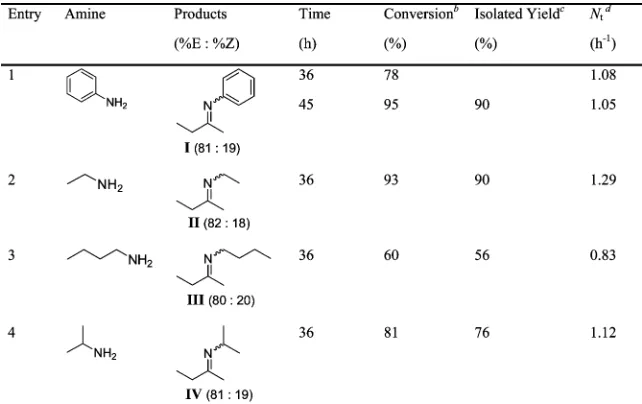
Catalyst 1 was found to be an efficient catalyst in MCP hydroamination with either aliphatic amines or small aromatic amines. Table 1 summarizes the results obtained in the hy-droamination of a symmetrical MCP with various amines, toward the formation of N-substituted imine products (I-IV) (eq 2).
The imines I-IV were obtained as the single products, with no side reactions. The conversion and the yield in these reactions were found to vary from moderate to high values, and in all cases the isomer with E stereochemistry was ob-tained as the main product. The ratio between the E and Z forms (80:20) is the same for all the substrates, indicating that the equilibrium among the two stereochemistries is governed by the reaction temperature.
(150) Smolensky, E.; Kapon, M.; Woollins, J. D.; Eisen, M. S.
Orga-nometallics 2005, 24, 3255-3265.
(151) Volkis, V.; Smolensky, E.; Lisovskii, A.; Eisen, M. S. J. Polym.
Sci., A: Polym. Chem. 2005, 43, 4505-4516.
[image:4.612.145.466.62.264.2](152) Xavier, K. O.; Smolensky, E.; Kapon, M.; Aucott, S. M.; Woollins, J. D.; Eisen, M. S. Eur. J. Inorg. Chem. 2004, 4795 -4802.
Table 1. Symmetrical MCP Hydroamination Results with Complex 1 as Precatalyst
aAll of the hydroamination reactions were performed with 2 mol % catalyst in toluene as the solvent at 110°C; with low-boiling-point amines, the
reactions were performed in heavy-duty glass Schlenk vessels.bDetermined by following the reaction using1H NMR spectroscopy in toluene-d
8.cPercent
yield of the isolated product.dTurnover frequencies (n
For the hydroamination reaction of unsymmetrical MCP’s two products were obtained: the linear imine A and the branched imine B (eq 3).
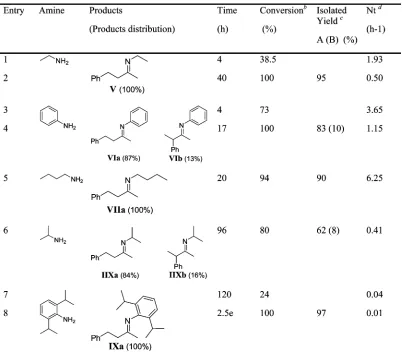
The scope and chemo- and regioselectivity of the intermo-lecular hydroamination of phenylmethylenecyclopropane (Ph-MCP) promoted by complex 1 is summarized in Table 2. As can be seen from Table 2, in all cases, the linear imine product A was always obtained as the only or main product. In the intermolecular hydroamination of unsymmetrical MCPs with aliphatic amines, a slightly decreased trend in turnover frequen-cies (Nt) is observed as compared to values for the aromatic
amine (entries 2, 4, 6, in addition to entry 5). This result may reflect the increased nucleophilicity of the aliphatic amines, promoting the formation of the bis(amido) species (vide infra). Interestingly, in comparison to organolanthanide complexes, the opposite effect was observed for similar substrates.148 It is
noteworthy that the hydroamination of an ortho-disubstituted amine (entries 7 and 8) is extremely slow, presumably due to
the steric hindrance between the ortho substituent of the amine and the diphenylphosphino motif of the ligands, inhibiting the insertion of the olefin into the titanium-imido complex 3 since the ortho substitutes at the amine ring will be disposed preferentially on the plane of the imido moiety.
With regard to the stereoselectivity of the reaction, unlike the case for the symmetrical MCP, in every hydroamination reaction of the unsymmetrical MCP, the E stereoisomer was the only product obtained.
[image:5.612.106.508.60.413.2]Hydroamination of MCP’s Promoted by Ti(NMe2)4. As shown above, catalyst 1 has shown good activity toward the hydroamination of MCP and PhMCP substrates with small aliphatic and aromatic amines, whereas a slower catalytic Table 2. Unsymmetrical PhMCP Hydroamination Results with 1 as Precatalyst
aAll of the hydroamination reactions were performed with 5 mol % catalyst in toluene as the solvent at 110°C; with low-boiling-point amines the
reactions were performed in heavy-duty glass Schlenk vessels.bDetermined by following the reaction by1H NMR in toluene-d
8.cPercent yield of the
isolated products.dTurnover frequencies (n
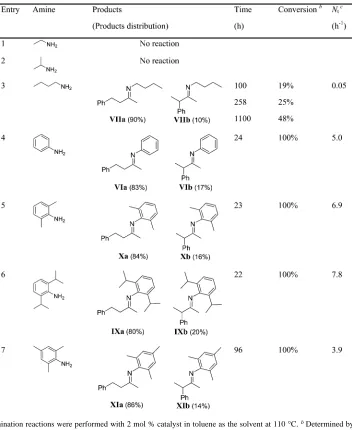
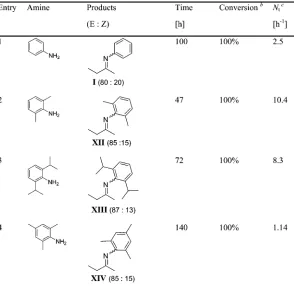
activity was achieved with bulky aromatic amines, due to expected steric hindrance. Therefore, we anticipated that the homoleptic tetrakis(dimethylamido)titanium compound, which probably will not induce such a large steric hindrance of the ancillary ligands, will show a better catalytic efficacy toward the hydroamination of MCPs with bulky aromatic amines. Tables 3 and 4 summarize the results obtained for Ti(NMe2)4
as a catalyst in the hydroamination reactions of PhMCP and MCP, correspondingly. As can be seen from entries 1-3 in Table 4, Ti(NMe2)4showed only slight or no catalytic activity
toward the hydroamination of PhMCP with aliphatic amines, as expected, due to the greater nucleophilicity of the aliphatic imines impeding the formation of the metal-imido motif. The reaction of the homoleptic complex with small aliphatic amines rapidly produces an oligomeric solid precipitate that was found to be totally insoluble. However, the reaction of the oligomeric solid with acids produces TiO2. For the bulkier butylamine,
while a precipitate was also formed, a slow reaction was also observed. However, as expected, the homoleptic Ti(NMe2)4
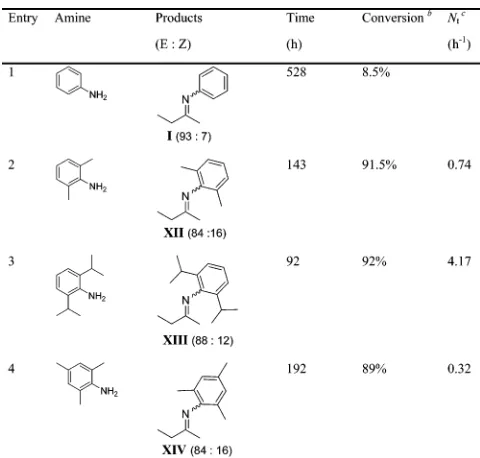
complex was found to be an efficient catalyst for the hydroami-nation of PhMCP with bulky aromatic amines (entries 4-6, Table 4). Interestingly, for the bulkier ortho-disubstituted aniline similar turnover frequencies for the hydroamination reaction
were observed (entries 4-6, Table 4). A comparison of entry 7 with entries 4-6 in Table 4 shows that a para substituent on the aniline ring dramatically decreases the reaction rate, due to the enhanced nucleophilicity of the amine increasing the imido character of the TidN bond. Similar observations were recorded in the hydroamination of the symmetric MCP with aromatic amines (Table 3).
Hydroamination of MCP with bulky aromatic amines cata-lyzed by Ti(NMe2)4has allowed us to synthesize new highly
steric hindered aromatic imine products (XII-XIV). It is important to point out that the imine XII was reported already as an extremely difficult compound to make.153 Hence, the
catalytic hydroamination of MCP offers an efficient synthetic route to produce bulky imines from simple and commercially available reactants.
Importantly, for both titanium catalysts the main product obtained in all PhMCP hydroamination reaction was the linear product (A). A comparison of the results observed in Tables 1 and 2 with those in Tables 3 and 4 demonstrates a strong relationship between the ancillary ligand of the catalytic complex and the suitability of the amine for the hydroamination reaction.
[image:6.612.130.482.60.490.2](153) Lai, J. T. Tetrahedron Lett. 2002, 43, 1965-1967.
Table 3. PhMCP Hydroamination Results with Ti(NMe2)4as Precatalyst
aAll of the hydroamination reactions were performed with 2 mol % catalyst in toluene as the solvent at 110°C.bDetermined by following the reaction
by1H NMR in toluene-d
A complex with bulky ancillary ligands is suitable for the hydroamination reaction with aliphatic and small aromatic amines, whereas a complex with small ancillary ligands will allow the hydroamination preferentially of bulky aromatic amines. A similar trend has been previously observed for intermolecular hydroamination of alkynes.134
Plausible Mechanism for MCP Hydroamination Promoted by Titanium Organometallic Complexes. On the basis of the well-studied mechanisms for the hydroamination of alkynes and allenes promoted by group IV metal complexes,52,154,155 a
plausible mechanism for the intermolecular hydroamination of MCPs, which might explain the obtained products and their distribution, is presented for titanium organometallic complexes (Scheme 3).
The first step of the mechanism is the transformation of complex 1 to complex 2; this is a fast step, as shown by the immediate changes in color after the addition of the amine to complex 1. In addition, the evolution of diethylamine is also instantaneously observed, when the reaction is followed by NMR spectroscopy. The concomitant amine elimination from complex 2 produces the active imido complex 3 when the reaction mixture is heated. This complex was found to produce the dimeric complexes 4 and 5 in the absence of MCP. When MCP is present, the concerted 1,2-insertion of the MCP double bond into the TidN imido bond results in the formation of the azatitanacyclobutane complex 6 as the rate-determining step.24,156
Complex 6 may undergo two different ring-opening transforma-tions to form more stable five-membered-ring complexes (7A and 7B). The cleavage of the C2-C3 bond (pathway a) will result in the formation of 7A, whereas the cleavage of the C2 -C4 bond (pathway b) will induce the formation of complex 7B. Complex 7A is more stable than 7B, since the metal in the former complex is bonded to a benzylic carbon, whereas at the latter complex the metal is bonded to a primary carbon.
Therefore, pathway a is expected to be the preferential route, as observed from the product distribution in Table 1. Rapid protonolysis of complexes 7A and 7B will form the correspond-ing bis(amido) complexes (8A and 8B). As in the hydroami-nation of alkynes, we suggest that the associated elimihydroami-nation of the enamines will regenerate the imido complex 3. Products A and B will most likely be obtained by the tautomerization of 9A and 9B, correspondingly. With regard to regioselectivity, one or two regioisomers are observed (A and B, eq 3). It is most likely that both isomers are produced via 1,2-addition of the TidN into the MCP exo methylene. For the metalla-cyclic complex 6, two regioisomers can be expected (6a and 6b).24Complex 6a will be the preferred isomer, due to the lack
of steric hindrance between the amine substituent (R′) and the diphenylphosphine moiety.
Kinetic calculations for the proposed catalytic cycle shown in Scheme 3 were derived157by assuming steady-state conditions
for the species 3 and 6-8, since none of them were observed when all the reactions were followed via1H NMR spectrometry
[image:7.612.162.456.62.348.2]at all reaction times. The insertion of the methylene group into the TidN bond was assumed to be the slower reaction step. The rate law obtained for this mechanism is presented in eq 4. Table 4. MCP Hydroamination Results with Ti(NMe2)4as Precatalyst
aAll of the hydroamination reactions were performed with 2 mol % catalyst in toluene as the solvent at 110°C.bDetermined by following the reaction
by1H NMR in toluene-d
8.cTurnover frequencies determined at 25% conversion (nproduct/(ncath)), measured in toluene-d8.
d[enamine]
dt )
k1k2(k6[2]+k5[4]1/2)[PhMCP]
(k-1+k2)(k-6[amine]+k-5)
Trapping Key Intermediates. To shed some light on the fate of the Ti(NMe2)4 complex in the first steps of the
hydroamination process, its reactivity with various primary amines in a catalyst to amine ratio of 1:10 was studied using NMR spectroscopy. When the amines were added to the Ti-(NMe2)4 solution in toluene-d8, the reaction mixture color
changed immediately. Heating the reaction mixture to 110°C resulted in the formation of a precipitate residue. Monitoring the reaction solution of Ti(NMe2)4with PhNH2by 1H NMR
revealed that the singlet signal atδ3.1 ppm, corresponding to the four dimethylamido groups, disappears and is replaced with one set of signals for the four exchanged aromatic primary amines (eq 5). FTIR spectroscopy of the precipitate residue
indicates that the residue contains an N-H bond (band at 3450 -3370 cm-1for amine stretching and additional bands at 1460
-1619 cm-1 for N-H bending). In the formation of the
homoleptic complex, the reaction is presumably in equilibrium, since when a lower catalyst to amine ratio, 1:4, was applied, a myriad of complexes were obtained. It was also interesting for us to characterize the same type of reactions with complex 1. To shed some light on the fate of the precatalyst 1 in the first steps of the hydroamination process, the reactivity of complex
1 with various primary amines was also studied. The reaction of complex 1 with an excess of ethylamine or aniline produces rapidly the dimeric titanium complexes Ti2(Ph2PNpy)2(µ-NEt)2
(4)150and Ti
2(Ph2PNpy)2(µ-NPh)2(5),149 respectively (eq 6).
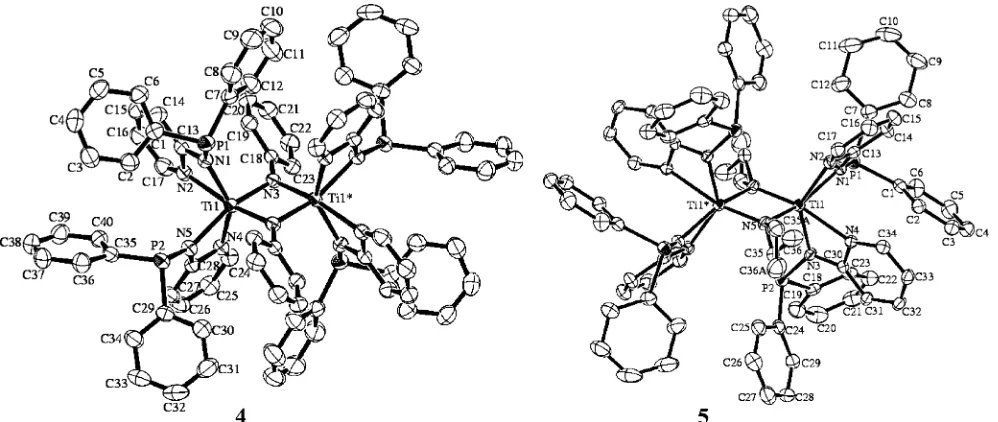
The ORTEP plot of complex 5 is shown in Figure 1. In complex 5, both titanium atoms exhibit an octahedral environ-ment, with N1 and N4 disposed in apical positions. The four-membered ring Ti-N(3)-Ti-N(3)* is totally planar (sum of internal angles 360.0°), although both bridging nitrogen atoms are placed asymmetrically (Ti(1)-N(3) )2.0117(14) Å; Ti-(1)-N(3)# ) 1.8794(14) Å). Complex 4 was found to be isostructural with complex 5.
(154) Walsh, P. J.; Baranger, A. M.; Bergman, R. G. J. Am. Chem. Soc.
1992, 114, 1708-1719.
(155) Swartz, D. L.; Odom, A. L. Organometallics 2006.
(156) NMR studies of the reaction of 1 equiv of complex 1 with 2 equiv of aniline and 1 equiv of PhMCP show, after a short time of heating (110°C), the disappearance of the signal (5.50 ppm, doublet of quartets) associated with the exocyclic methylene group of the PhMCP and the appearance of new signals (5.446, 5.455 ppm, two doublets with2J
HH)
4.5 Hz) associated with the-CH2-group of the azatitanacyclobutane 6.
(157) The full mathematical derivation of eq 4 can be found in the Supporting Information.
The dimeric complexes 4 and 5 showed only negligible solubility in toluene, even with large solvent volumes and high temperatures. Therefore, we can assume that the transformation of the bis(amido) complex 2 to the corresponding imido complex 3 occurs much more quickly than the cleavage of dimeric complexes 4 and 5 to the corresponding complexes 3 (R′) Ph, Et). Hence, we can assume that k6[2].k5[4]1/2. Combining
this assumption along with eq 4 allows us to obtain a simplified rate law, as presented in eq 7. This rate law suggests a general
reaction having first-order dependence in PhMCP, first order in the titanium imido catalyst, and probably an inverse order in the amine.
Kinetic Studies on the Hydroamination of PhMCP with Aniline Catalyzed by Ti(NMe2)4. To test the proposed mech-anism, and to learn about the MCP, amine, catalyst, and temperature influences on the reaction rate, kinetic experiments were conducted. Kinetic studies of the Ti(NMe2)4-catalyzed
hydroamination of PhMCP with aniline in toluene-d8 were
carried out, followed by in situ1H NMR spectroscopy, using
1,3,5-trimethylbenzene as an internal standard.
To check the influence of the catalyst concentration on the reaction rate, different concentrations of the catalyst Ti(NMe2)4,
within a 10-fold range, were used, while PhMCP and amine concentrations were kept constant. The kinetics of the reaction was monitored using the intensity changes in the substrate resonance (on NMR spectroscopy) over 3 or more half-lives. The rate constant kobs (M s-1) was calculated from the
pseudolinear part of the plot, showing the product concentration vs time. Figure 2 shows a linear increase of the product formation with an increase of the catalyst concentration until a catalyst to PhMCP ratio of 1:20. For higher catalyst concentra-tions, a red precipitate of complex 4 was observed in the reaction mixture. This precipitation process limits the catalyst concentra-tion and therefore limits the reacconcentra-tion rate. Thus, the rate of product formation as a function of the catalyst concentration follows a first-order behavior only until its solubility limit.
To check the influence of the PhMCP concentration on the reaction rate, the concentration of PhMCP was varied, over a
10-fold range, while the catalyst and amine concentrations were kept constant. The kinetics of the reaction was monitored using the intensity changes in the substrate PhMCP. The rate constant,
kobs, was calculated from the pseudolinear part of the plot showing the product concentration vs time (Figure 3). As can be seen from Figure 3, the higher the PhMCP concentration, the faster the hydroamination reaction proceeds in a good linear fitting (Figure 4). Consequently, the kinetic rate law shows a first-order dependence on the PhMCP concentration. This result corroborates the suggested catalytic cycle.
The influence of the amine concentration on the reaction rate was studied at different concentrations of amine, within a 10-fold range, while PhMCP and catalyst concentrations were kept constant. For low concentrations of amine (below 10-2M), no
[image:9.612.59.558.46.257.2]reaction was observed. In this case, k-5 becomes larger than k-6[amine] (see eq 7) and, as shown above, the reaction follows the formation of the dimeric complexes (such as complexes 4 and 5), which are inactive in the hydroamination reaction. For higher amine concentrations, a nonlinear relationship between the rate (d[amine]/dt) and amine concentration was observed. Figure 1. ORTEP plot of the structures of the complexes Ti2(Ph2PNpy)2(µ-NEt)2(4) and Ti2(Ph2PNpy)2(µ-NPh)2(5). Thermal ellipsoids are given at the 50% probability level.
d[enamine]
dt )
k1k2k6[2][PhMCP]
k-5(k-1+k2)(k-6[amine]+k-5)
(7)
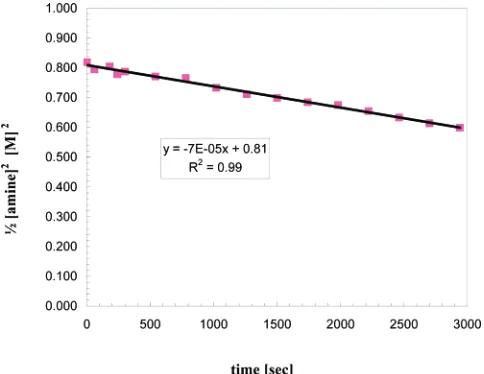
[image:9.612.318.556.293.485.2]However, as can be seen from Figure 5, plotting1/
2[amine]2
versus reaction time did show good linear fitting. This is
consistent with an inverse order dependence on the amine concentration as presented in eq 8 and its integrated form (eq 9).
The kinetic studies of the hydroamination reaction of PhMCP with aniline catalyzed by Ti(NMe2)4showed that the
reaction is first order in PhMCP, first order in the titanium catalyst, and inverse order in the amine (beyond a minimum concentration). These findings can be summarized as a general rate law, as presented in eq 10. The experimental rate law in eq
10 corroborates with the proposed mechanism shown in Scheme 3 and the theoretical calculated rate law presented in eq 7.
The temperature influence on the reaction rate was also investigated by repeating the same experiment at different temperatures, keeping the concentrations of the catalyst, PhMCP, and amine constant (Figure 6). The rate constant, kobs, was
calculated at each temperature from the pseudolinear part of the plot showing the PhMCP concentration as a function of time. From the plot of ln kobsversus 1/T the energy of activation for
the rate-determining step was calculated to be Ea)19.5(0.3
kcal/mol.
The enthalpy of activation (∆Hq) and entropy of activation
(∆Sq) for the rate-determining step was derived from the Eyring
equation.∆Hqwas calculated from the slope of the Eyring plot
graph (Figure 7) to be 18.8(0.4 kcal/mol, whereas from the intersection the value of∆Sq) -29.2(0.2 eu was obtained.
This highly negative value of∆Sqindicates a highly organized
transition state. Thus, the value obtained is consistent with a four-centered transition intermediate, as is encountered in the insertion of the PhMCP’s double bond into the titanium-imido bond, corroborating it as the rate-determining step.
Hydroamination of MCPs Promoted by Zr(NMe2)4. In order to study the role of the metal center in the MCP hydroamination reactions, we were interested in testing how the replacement of the titanium metal center with zirconium may affect the activity and regioselectivity of the catalysts. It is worth noting that the homoleptic Zr(NMe2)4 was reported
[image:10.612.317.558.46.188.2]previously as an active catalyst for the intramolecular hydroami-nation of allenes42and alkenes.7Table 5 summarizes the results Figure 3. Plot of PhMCP concentration as function of time for
[image:10.612.53.295.47.185.2]various initial concentrations of PhMCP measured in toluene-d8at 110°C.
[image:10.612.55.294.240.427.2]Figure 4. Plot of the PhMCP concentrations versus pseudo-first-order rate constants, for the PhMCP hydroamination reaction. The line represents the least-squares fit to the data points.
Figure 5. Plot of concentration of1/
2[amine]2versus reaction time for the hydroamination reaction of PMCP promoted by the complex Ti(NMe2)4. The line represents the least-squares fit to the data points.
Figure 6. Plot of PhMCP concentration as function of time at different temperatures measured for the hydroamination of PhMCP with aniline catalyzed by Ti(NMe2)4in toluene-d8.
-d[amine] dt )kobs
[image:10.612.54.296.483.670.2]1
[amine] (8)
1
/2[[amine]2-[amine]02])kobst (9)
rate)kobs[cat][PhMCP]
obtained for the hydroamination of symmetric MCP with various amines catalyzed by the homoleptic Zr(NMe2)4. Comparison
of the results obtained for Ti(NMe2)4 (Table 4) with those
obtained with Zr(NMe2)4 (Table 5) indicates that similar
tendencies are observed when both isolobal complexes are compared. Both catalysts showed no activity toward aliphatic amines; however, both of them showed high activities for ortho-substituted aromatic amines and a reduced activity for para-substituted amines. Interestingly, the activity of the zirconium complex was found to be much lower (by an order of magnitude) than that of the corresponding titanium, similar to cases reported previously.42 The results for the hydroamination of PhMCP
promoted by the homoleptic Zr(NMe2)4are presented in Table
6 (eq 11). For aliphatic amines, similarly to the titanium
complex, an oligomeric complex precipitate is formed, and no hydroamination is observed. For the aromatic amines, the reac-tion proceeds much more slowly than that for the corresponding titanium complex. The most important finding is that the main products obtained with the zirconium complex for those reac-tions are the branched imines, in contrast to the results obtained when the titanium analogue was utilized (Table 3, eq 11).
Interestingly, we observe that the selectivity in the hydroami-nation of PhMCP depends on the nature of the metal center. A similar observation has been made by Bergman and co-workers in the intramolecular hydroamination of allenes using bis-(sulfonamide) complexes. Hence, a titanium bisbis-(sulfonamide) complex has converted an aminoallene to the six-membered imine product, while the corresponding zirconium complex yielded the corresponding five-membered product.42In view of
the fact that we are observing different selectivities in the hydroamination of PhMCP for comparable titanium and zirco-nium complexes, we propose different mechanistic pathways for titanium and zirconium complexes. Since complex 7A (Scheme 3), which is responsible for the formation of the linear product A, is more stable than complex 7B, we can assume
that the formation of the branched product B, as the main product, will not proceed through the cleavage of complex 6 to 7. As an alternative pathway, we propose that 11, the zirconium analogue of complex 6, will first undergo a protonolysis by an additional amine to form the putative complex 12. Rearrange-ment of complex 12 will result in the formation of the imido zirconium complex and the corresponding enamines, which will rapidly tautomerize to the imine products (Scheme 4). In this proposed mechanism, both isomers can be obtained. However, pathway b is now preferred, since the amine will react with the cyclopropyl ring mainly via the opposite side of the phenyl ring; therefore, the branched products are obtained as the main products. As compared to Scheme 3, the protonolysis is expected to occur preferentially at the zirconium center rather than at the titanium center, due to the larger ionic radii of the former as compared to that of the latter. Of course, it is possible that both schemes are operative simultaneously, each one producing the preferred product.
Synthesis and Characterization of the Complex Zr-(Ph2PNpy)3NEt2 (13). In order to synthesize the zirconium analogue of complex 1, 2 equiv of the neutral ligand Ph2
-PNHpy (L-H) was reacted with 1 equiv of the homoleptic complex Zr(NEt2)4. Recrystallization of the resulting complex
showed that, instead of the desired L2Zr(NEt2)2complex, we
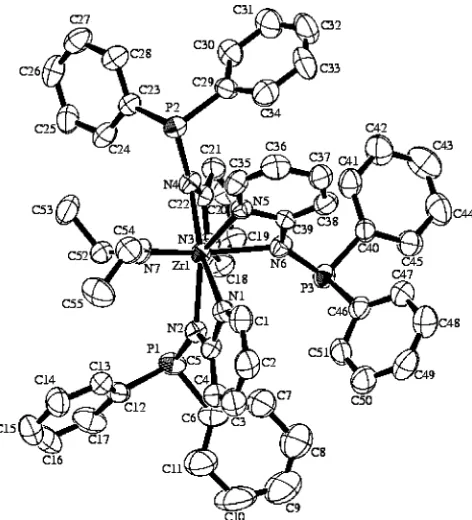
have obtained a zirconium complex containing three ancillary ligands L and only one amido group. The single-crystal X-ray diffraction studies of the obtained complex 13 show that the metal is disposed in a distorted-pentahedral-bipyramidal environment. Seven nitrogen atoms are bonded to the zirconium metal center. The diethylamido nitrogens N(7) and N(6) are located at the axial positions (N(6)-Zr(1) -N(7) ) 146.52(19)°), and the ligand nitrogens N(1), N(2), N(3), N(4), and N(5) are located at the equatorial positions (the total sum of the angles is equal to 363.1°). There are three different Zr-N bond lengths. The Zr-N(diethylamido) bond (Zr(1)-N(7) ) 2.018(4) Å) is shorter than any of the Zr -N(phosphinoamido) bond lengths (Zr(1)-N(5))2.324 Å, Zr-Figure 7. Eyring plot for the hydroamination of PhMCP with
[image:11.612.57.290.47.210.2]aniline catalyzed by Ti(NMe2)4in toluene-d8. The line represents the least-squares fit to the data points.
Table 5. Data for the MCP Hydroamination Reaction Promoted by Zr(NMe2)4as a Precatalyst
aAll the hydroamination reactions were preformed with 2 mol % catalyst
in toluene as the solvent at 110°C.bDetermined by following the reaction
by 1H NMR in toluene-d
8.cTurnover frequencies determined at 25%
[image:11.612.317.557.69.298.2](1)-N(1) ) 2.342 Å, Zr(1)-N(3) ) 2.345 Å) or the Zr -N(pyridine) bond lengths (Zr(1)-N(2))2.240 Å, Zr(1)-N(4)
)2.247 Å, Zr(1)-N(6))2.253 Å) (Figure 8).
All attempts to synthesize the desired L2Zr(NEt2)2structure
were unsuccessful. This result indicates that the replacement of the third diethylamido group at the larger zirconium atom occurs too fast to be controlled. This result suggests that the equilibrium replacement of the third ligand lies strongly toward the formation of complex 13.
Hydroamination Reaction Catalyzed by the Complex Zr-(Ph2PNpy)3NEt2(13). As can be seen from the unsuccessful attempts to synthesize the bis(amido) zirconium complex L2
-Zr(NEt2)2, complex 13 cannot be directly transformed into the
bis(amido) complex, even in the presence of excess amine. Therefore, we assume that if complex 13 were to be active in the hydroamination reaction, since the imido zirconium complex ZrdNR would not be generated from 13, a mechanism similar to that encountered for a cationic uranium complex or recently for constrained-geometry organoactinides would be opera-tive.59,158,159Complex 13 was found to be an active catalyst in
the intermolecular hydroamination of alkynes (eq 12). The
results for the hydroamination reaction of (trimethylsilyl)-acetylene are summarized in Table 7. However, as can be seen from Table 7, catalyst 13 showed a very low catalytic activity as compared to complex 1. In order to obtain higher conversions (>99%), a larger amount of the catalyst and longer reaction times were required, as presented in entries 2 and 3 in Table 7. In a previous report, we showed that the cationic uranium complex [(Et2N)3U][BPh4] mediates the addition of secondary
amine to alkynes.59This transformation can be obtained only
through an insertion of an unsaturated carbon-carbon bond into a U-NHR bond. Since the ZrdNR complex was not generated by the reaction of complex 13 with an excess of primary amine, we expected that if the hydroamination of an alkyne catalyzed by complex 13 were to proceed, it would be operative via a
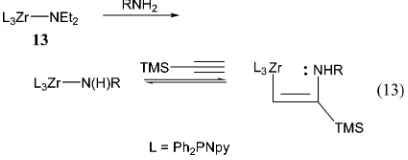
σ-bonded Zr-N(H)R species (eq 13).
The slow catalytic activity of complex 13 in the hydroami-nation of an alkyne and the failure of complex 13 to carry out the hydroamination of secondary amines indicate that
[image:12.612.336.540.637.717.2]presum-(158) Stubbert, B. D.; Marks, T. J. J. Am. Chem. Soc. 2007, 129, 6149. (159) Stubbert, B. D.; Marks, T. J. J. Am. Chem. Soc. 2007, 129, 4253-4271.
Table 6. Data for the PhMCP Hydroamination Reaction Promoted by Zr(NMe2)4as a Precatalyst
aAll of the hydroamination reactions were performed with 2 mol % catalyst in toluene as the solvent at 110°C; with low-boiling-point amines the
reactions were performed in heavy-duty glass Schlenk vessels.bDetermined by following the reaction by1H NMR in toluene-d
8.cTurnover frequencies
ably a very small catalytic amount of the bis(amido) species is formed in the presence of the alkyne, which must be responsible for the catalysis. Complex 13 was also found to be inactive for the hydroamination of MCP. Presumably, in the hydroamination of MCP a more coordinative unsaturated complex is required to allow a stronger coordination to the double bond as compared to that of the terminal alkynes. We believe that different ligand environments should allow tailoring the catalytic activity of these complexes to induce the hydroamination reaction with secondary amines.
Conclusions
In this research the hydroamination of symmetrical and unsymmetrical MCPs promoted by group IV catalysts was studied. The goals of this research were to answer two main questions: (i) the effect of the ligands surrounding the metal centerr and (ii) the influence of the metal center. With regard to the first question, a strong relationship was found between the ancillary ligand at the catalytic complex and the suitability of the amine for the MCP hydroamination reaction. A complex with a bulky ancillary ligand is suitable for the hydroamination of aliphatic amines and small aromatic amines, whereas a complex with a small ancillary ligand (steric hindrance) will allow the hydroamination of MCPs with bulky aromatic amines. The second basic question that was addressed in this study was the metal center. We have found that titanium catalysts will promote the formation of linear imines A, while the main products obtained for those reactions catalyzed by the analogous zirconium complex are the branched imines B. The mechanism of the MCP hydroamination reaction was studied using kinetic measurements and synthesis of intermediates.
Experimental Section
[image:13.612.126.491.56.335.2]General Remarks. All manipulations of air-sensitive materials were carried out with the vigorous exclusion of oxygen and moisture in flamed Schlenk-type glassware on a dual-manifold Schlenk line or interfaced to a high-vacuum (10-6Torr) line or in a nitrogen-filled Vacuum Atmospheres glovebox with a medium-capacity Scheme 4. Proposed Mechanism for the Hydroamination of PhMCP Promoted by Zr(NMe2)4
Figure 8. ORTEP plot of the structure of the complex Zr(Ph2 -PNpy)3NEt2 (13). Thermal ellipsoids are given at the 50% prob-ability level.
Table 7. Catalytic Hydroamination of (TMS)CtCH and RNH2Promoted by Complex 13
entry no.
amt of 13 (mol %)
R on RNH2
reacn time (days)
Nt
(h-1)a
conversion (%)b
1 2 Ph 9 0.018 8
2 2 Et no reacn
3 10 Et 20 0.020 >99
aTurnover frequencies (n
product/(ncath)).bDetermined by following the
reaction by1H NMR in toluene-d
[image:13.612.57.293.463.723.2]recirculator (1-2 ppm of O2). Argon and nitrogen were purified by passage through an MnO oxygen removal column and a Davison 4 Å molecular sieve column. Toluene-d8 and Et2O were freshly distilled under argon from Na-K alloy. The reagent 2-phenylm-ethylenecyclopropane was purchased from Merck and was vacuum-distilled from CaH2. Methylenecyclopropane (Aldrich) was dried over Na-K and freshly distilled. Aniline, isopropylamine, buty-lamine, and 2,6-diisopropylaniline (Aldrich) were distilled from barium oxide and stored over activated molecular sieves (4 Å). Ethylamine (Aldrich) was degassed and freshly vacuum-distilled. 2,6-Dimethylaniline and 2,4,6-trimethylaniline (Aldrich) were vacuum-distilled from KOH. Tetrakis(dimethylamido)titanium and tetrakis(dimethylamido)zirconium (Aldrich) were stored in a glove-box and used as received. Complex 1 was prepared by following procedures given in the literature.150NMR spectra were recorded on Avance-300 and Avance-500 spectrometers. Chemical shifts for 1H NMR and13C NMR are referenced to internal solvent resonances
and are reported relative to tetramethylsilane. The NMR experiments were conducted with sealed-tube Schlenk vessels (J. Young stopcock). GCMS spectra were recorded on a Finigan MAT TSQ 700 instrument equipped with a DB5 MS column (length 30 m, internal diameter 0.25 mm, phase thickness 0.25µm). IR spectra were recorded on a Bruker Vector 22 instrument. Samples for IR measurement were prepared with KBr inside the glovebox.
Hydroamination of TMSCtCH with i-PrNH2 by Ti(Ph2
-PNpy)2(NEt2)2 (1). In a glovebox, 0.1 g (0.134 mmol) of the precatalyst 1 was loaded into a heavy-duty glass Schlenk tube containing 5 mL of toluene and 0.96 mL (6.7 mmol) of TMSCt CH. Approximately 1 mL (6.7 mmol) of iPrNH2 was vacuum-transferred into the tube. The tube was heated by means of a thermostated oil bath ((0.1°C) to 45°C for 3 days and for 70°C for another week to obtain 95% conversion and 100% of the product. The product was characterized by comparison of1H and 13C NMR spectra to published data.62
General Procedure for the Intermolecular MCP Hydroami-nation Reaction. In a typical procedure, the specific amount of MCP and an equimolar amount of the respective amine were loaded into a Schlenk vessel containing a solution of the catalyst in 3 mL of toluene-d8. Low-boiling-point amines (ethylamine and isopro-pylamine) were loaded into a heavy-duty glass Schlenk vessel by vacuum transfer. The Schlenk vessel was heated by means of a thermostated oil bath to 110(0.1°C, over a particular amount of time. The reaction was monitored by1H NMR. The products were isolated and then identified by1H,13C, and 2D (COSY, HMBC, HMQC) NMR spectroscopy. The stereochemistry around the nitrogen atom was determined by 1H-NOE NMR experiments. Conversion was determined by1H NMR analysis; product distribu-tion was determined by GC analysis. The product structures were confirmed by GCMS analyses. The E and Z stereochemistry was determined by1H NOE experiments.
Characterization of N-(4-Phenylbutane-2-ylidene)ethanamine (Va). The product Va (CAS registry no. 35021-89-7) was reported previously,160but to our knowledge, NMR and MS data have not been reported, and therefore, we present the data here.
1H NMR (300 MHz, toluene-d
8): δ 1.23 (t, 3H,3JHH)7.2 Hz, H(e)), 1.38 (s, 3H, H(c)), 2.33 (dd, 2H,3J
HH)7.5 Hz,3JHH)8.0 Hz, H(b)), 2.87 (dd, 2H,3J
HH )7.5 Hz,3JHH)8.0 Hz, H(a)), 3.40 (q, 2H,3J
HH)7.2 Hz, H(d)), 6.85-7.14 (Ph).13C NMR (125
MHz, toluene-d8): δ 15.7 (C(c)), 16.7 (C(e)), 32.5 (C(a)), 43.8 (C(b)), 45.6 (C(d)), 126-132 (Ph).
The stereochemistry was confirmed by a1H NOE experiment. H(e) shows a NOE correlation with H(c), atδ1.23 ppm. H(c) atδ
1.38 ppm exhibited a strong NOE correlation with H(e) atδ1.23 ppm, and a weak NOE correlation with H(d) atδ3.40 ppm. No NOE correlation was found between H(a) atδ2.87 ppm and H(e) at δ 1.23 ppm or H(d) at δ 3.40 ppm, which confirmed the
E isomer:
GC/MS (EI): m/z 175 (M+), 160 (M+-CH3), 146 (M+-CH2 -CH3), 132 (M+-C3H8), 105 (M+-C(CH3)dNEt), 91 (CH2Ph), 84 (M+-CH2C(CH3)dNEt), 77 (Ph), 70 (M+-NdCCH2CH2 -Ph).
Characterization of N-(Butan-2-ylidene)benzenamine (I). The product I (CAS registry no. 40296-03-5) was reported previous-ly,16,161-165but to our knowledge, NMR and MS data have not been reported, and therefore we present the data here.
E stereoisomer: 1H NMR (500 MHz, toluene-d
8)δ1.12 (t, 3H, 3J
HH)7.5 Hz, H(a)), 1.43 (s, 3H, H(c)), 2.12 (q, 2H,3JHH)7.5 Hz, H(b)), 6.3-7.2 (Ph);13C NMR (125 MHz, toluene-d
8)δ10.1 (C(a)), 18.7 (C(c)), 34.2 (C(b)); GC/MS (CI): m/z 147 (M+), 132 (M+-CH3), 118 (M+-CH2CH3).
Z stereoisomer: 1H NMR (500 MHz, toluene-d
8)δ0.74 (t, 3H, 3J
HH)7.5 Hz, H(a)), 1.86 (q, 2H,3JHH)7.5 Hz, H(b)), 1.92 (s, 3H, H(c));13C{1H} NMR (125 MHz, toluene-d
8) δ 11.3 (C(a)), 24.8 (C(c)), 26.9 (C(b)).
Characterization of N-(Butan-2-ylidene)ethanamine (II). The product II (CAS registry no. 55007-49-3) was reported previ-ously,166but to our knowledge, NMR data have not been reported, and therefore we present the data here.
E stereoisomer: 1H NMR (500 MHz, toluene-d
8)δ1.06 (t, 3H, 3J
HH)7.5 Hz, H(a)), 1.24 (t, 3H,3JHH)7.5 Hz, H(e)), 1.42 (s, 3H, H(c)), 2.07 (q, 2H,3J
HH)7.5 Hz, H(b)), 3.14 (q, 2H,3JHH) 7.5 Hz, H(d));13C{1H}NMR (125 MHz, toluene-d
8): δ10.5 (C(a)), 16.2 (C(a)), 16.3 (C(c)), 35.2 (C(b)), 45.5 (C(d)).
(160) Warren, R. G.; Chow, Y.; Ferguson, L. N. J. Chem. Soc. D: Chem.
Commun. 1971, 1521-1522.
(161) Martorell, A.; Claver, C.; Fernandez, E. Inorg. Chem. Commun.
2000, 3, 132-135.
(162) Brunel, J. M.; Buono, G. Synlett 1996, 177-8.
(163) Cho, B. T.; Chun, Y. S. Tetrahedron: Asymmetry 1992, 3, 1583 -90.
(164) Becalski, A. G.; Cullen, W. R.; Fryzuk, M. D.; James, B. R.; Kang, G. J.; Rettig, S. J. Inorg. Chem. 1991, 30, 5002-5008.
(165) Cho, B. T.; Chun, Y. S. J. Chem. Soc., Perkin Trans. 1 1990, 3200-3201.
Z stereoisomer: 1H NMR (500 MHz, toluene-d
8)δ0.79 (t, 3H, 3J
HH)7.5 Hz, H(a)), 0.91 (t, 3H,3JHH)7.5 Hz, H(e)), 1.84 (s, 3H, H(c)), 1.86 (q, 2H,3J
HH)7.5 Hz, H(b)), 2.51 (q, 2H,3JHH) 7.5 Hz, H(d));13C{1H}NMR (125 MHz, toluene-d
8)δ10.7 (C(a)), 19.2 (C(e)), 24.2 (C(b)), 26.0 (C(c)), 37.0 (C(d)).
Characterization of N-(Butan-2-ylidene)butanamine (III). The product III (CAS registry no. 20764-17-4) was reported previous-ly,167-172but to our knowledge, NMR and MS data have not been reported, and therefore we present the data here.
E stereoisomer: 1H NMR (500 MHz, toluene-d
8): δ0.94 (t, 3H, 3J
HH)7.5 Hz, H(g)), 1.06 (t, 3H,3JHH)7.5 Hz, H(a)), 1.44 (sextet, 2H,3J
HH)7.5 Hz, H(f)), 1.46 (s, 3H, H(c)), 1.66 (quint, 2H,3JHH )7.5 Hz, H(e)), 2.09 (q, 2H,3J
HH)7.5 Hz, H(b)), 3.13 (t, 2H, 3J
HH)7.5 Hz, H(d));13C{1H}NMR (125 MHz, toluene-d8)δ9.5 (C(a)), 13.0 (C(g)), 13.1 (C(c)), 19.2 (C(f)), 33.0 (C(e)), 41.3 (C(b)), 50.1 (C(d)); GC/MS (CI) m/z 127 (M+), 112 (M+-CH3), 98 (M+ -CH2CH3), 84 (M+-CH2CH2CH3), 70 (M+-C4H9).
Z stereoisomer: 1H NMR (500 MHz, toluene-d
8)δ0.82 (t, 3H, 3J
HH)7.5 Hz, H(a)), 0.99 (t, 3H,3JHH)7.5 Hz, H(g)), 1.44 (sextet, 2H,3J
HH)7.5 Hz, H(f)), 1.66 (quint, 2H,3JHH)7.5 Hz, H(e)),1.85 (s, 3H, H(c)), 1.92 (q, 2H,3J
HH)7.5 Hz, H(b)), 3.17 (t, 2H,3JHH )7.5 Hz, H(d));13C{1H}NMR (125 MHz, toluene-d
8)δ9.7 (C(a)), 15.5 (C(g)), 23.7 (C(b)), 25.1 (C(c)), 34.3 (C(e)), 49.4 (C(d)).
Characterization of N-(Butan-2-ylidene)isopropylamine (IV). The product IV (CAS registry no. 33836-39-4) was reported previously,161,173but to our knowledge, NMR data have not been reported, and therefore we present the data here.
E stereoisomer:1H NMR (500 MHz, toluene-d
8)δ1.04 (t, 3H, 3J
HH)7.5 Hz, H(a)), 1.06 (d, 6H,3JHH)6 Hz, H(e)), 1.45 (s, 3H, H(c)), 2.05 (q, 2H,3J
HH)7.5 Hz, H(b)), 3.48 (sept, 1H,3JHH )6 Hz, H(d));13C{1H}NMR (125 MHz, toluene-d
8)δ9.6 (C(a)), 15.0 (C(c)), 22.9 (C(e)), 34.3 (C(b)), 49.5 (C(d)).
Z stereoisomer:1H NMR (500 MHz, toluene-d
8) δ0.8 (t, 3H, 3J
HH)7.5 Hz, H(a)), 1.06 (d, 6H,3JHH)6 Hz, H(e)), 1.81 (s, 3H, H(c)), 1.91 (q, 2H,3J
HH)7.5 Hz, H(b)), 3.07 (sept, 1H,3JHH )6 Hz, H(d));13C{1H}NMR (125 MHz, toluene-d
8)δ10.6 (C(a)), 23.0 (C(e)), 23.4 (C(b)), 25.3 (C(c)), 49.0 (C(d)).
Characterization of N-(4-Phenylbutan-2-ylidene)benzenamine (VIa). The products VIa (CAS registry no. 334709-21-6) was reported previously,12but to our knowledge, NMR and MS data have not been reported, and therefore we present the data here.
1H NMR (500 MHz, toluene-d
8): δ1.41 (s, 3H, H(c)), 2.41 (dd, 2H,3J
HH)5.0 Hz,3JHH)7.7 Hz, H(b)), 2.94 (dd, 2H,3JHH)5.0 Hz,3J
HH)7.7 Hz, H(a)), 6.3-7.3 (Ph).13C{1H}NMR (125 MHz, toluene-d8): δ19.6 (C(c)), 32.3 (C(a)), 42.7 (C(b)), 115-132 (Ph). GC/MS (CI): m/z 147 (MH+-Ph), 131 (MH+-CH2Ph), 118 (MH+-CH2CH2Ph), 105 (MH+-C(CH3)(dNPh)), 91 (M+ -CH2C(CH3)(dNPh)), 77 (M+-(CH2)2C(CH3)(dNPh)).
Characterization of N-(3-Phenylbutan-2-ylidene)benzenamine (VIb). The product VIb (CAS registry no. 94660-15-8) was reported previously,174but to our knowledge, NMR and MS data have not been reported, and therefore we present the data here.
1H NMR (500 MHz, toluene-d
8): δ 1.39 (s, 3H, H(3)), 1.52 (d, 3H,3J
HH)4.2 Hz,-H(1)), 3.45 (q, 1H,3JHH)4.2 Hz, H(2)), 6.3 -7.3 (Ph).13C{1H} NMR (125 MHz, toluene-d
8): δ 18.4 (C(1)), 19.3 (C(3)), 50.8 (C(2)), 115-132 (Ph). GC/MS (CI): m/z 224 (MH+), 223 (MH+-H) 146 (MH+-Ph), 131 (MH+-CHPh), 118 (MH+-CH(CH3)Ph), 104 (MH+-C(CH3)dNPh), 91 (CH2 -Ph), 77 (Ph).
Characterization of N-(4-Phenylbutan-2-ylidene)butanamine (VIIa).
1H NMR (300 MHz, toluene-d
8): δ 0.94 (t, 3H,3JHH)7.5 Hz, H(g)), 1.39 (sext, 2H,3J
HH)7.5 Hz, H(f)), 1.41 (s, 3H, H(c)), 1.63 (quint, 2H,3J
HH)7.5 Hz, H(e)), 2.37 (dd, 2H,3JHH)7.5 Hz,3J
HH)8.0 Hz, H(b)), 2.86 (dd, 2H,3JHH)7.5 Hz,3JHH)8.0 Hz, H(a)), 3.12 (t, 2H,3J
HH)7.5 Hz, H(d)), 7.02-7.14 (Ph).13 C-{1H} NMR (125 MHz, toluene-d
8): δ 14.3 (C(g)), 17.2 (C(c)), 20.3 (C(f)), 32.5 (C(a)), 33.8 (C(e)), 43.9 (C(b)), 51.1 (C(d)), 126-132 (-Ph). GC/MS (CI): m/z 203 (M+), 188 (M+-CH3), 174 (M+- CH2CH3), 160 (M+ -CH2 CH2CH3), 146 (M+ -C4H9), 132 (M+-C4H9N), 126 (M+-Ph), 112 (M+-CH2Ph), 105 (CH2CH2Ph), 98 (M+-CH2CH2Ph), 91 (CH2Ph), 77 (Ph), 70 (C4H9N).
Characterization of N-(4-Phenylbutan-2-ylidene)isopropy-lamine (VIIIa).
1H NMR (500 MHz, toluene-d
8): δ 1.06 (d, 6H, 3JHH )6 Hz, H(e)), 1.42 (s, 3H, H(c)), 2.31 (dd, 2H,3J
HH)7.5 Hz,3JHH)8.0 Hz, H(b)), 2.85 (dd, 2H,3J
HH )7.5 Hz,3JHH)8.0 Hz, H(a)), 3.49 (sept, 1H,3J
HH)6 Hz, H(d)), 6.95-7.18 (Ph).13C{1H}NMR (125 MHz, toluene-d8): δ16.7 (C(c)), 23.9 (C(e), 32.5 (C(a)), 43.8 (C(b)), 124-142 (Ph), 163.5 (C(d)). GC/MS (CI): m/z 189 (M+), 174 (M+-CH3), 146 (M+-NC2H6), 132 (M+-NC3H7), 126 (M+-Ph), 98 (M+-CH2Ph), 91 (CH2Ph), 77 (Ph).
(167) Tehrani, K. A.; De Kimpe, N. Sci. Synth. 2004, 27, 313-348. (168) Suzuki, K.; Matsu-Ura, N.; Horii, H.; Sugita, Y.; Sanda, F.; Endo, T. J. Appl. Polym. Sci. 2002, 83, 1744-1749.
(169) Wieczorek, J. S.; Gancarz, R.; Bielecki, K.; Grzys, E.; Sarapuk, J.