Rutynskyi Mykhailo. A historical and geographical analyses of peculiarities of establishing Yaremche-Vorokhta resort area, the largest in the Eastern Carpathians of the Austro-Hungarian period. Journal of Education, Health and Sport. 2015;5(7):475-488. ISSN 2391-8306. DOI 10.5281/zenodo.21156
http://ojs.ukw.edu.pl/index.php/johs/article/view/2015%3B5%287%29%3A475-488 https://pbn.nauka.gov.pl/works/593179
http://dx.doi.org/10.5281/zenodo.21156
Formerly Journal of Health Sciences. ISSN 1429-9623 / 2300-665X. Archives 2011–2014 http://journal.rsw.edu.pl/index.php/JHS/issue/archive
Deklaracja.
Specyfika i zawartość merytoryczna czasopisma nie ulega zmianie.
Zgodnie z informacją MNiSW z dnia 2 czerwca 2014 r., że w roku 2014 nie będzie przeprowadzana ocena czasopism naukowych; czasopismo o zmienionym tytule otrzymuje tyle samo punktów co na wykazie czasopism naukowych z dnia 31 grudnia 2014 r.
The journal has had 5 points in Ministry of Science and Higher Education of Poland parametric evaluation. Part B item 1089. (31.12.2014). © The Author (s) 2015;
This article is published with open access at Licensee Open Journal Systems of Kazimierz Wielki University in Bydgoszcz, Poland and Radom University in Radom, Poland
Open Access. This article is distributed under the terms of the Creative Commons Attribution Noncommercial License which permits any noncommercial use, distribution, and reproduction in any medium, provided the original author(s) and source are credited. This is an open access article licensed under the terms of the Creative Commons Attribution Non Commercial License (http://creativecommons.org/licenses/by-nc/3.0/) which permits unrestricted, non commercial use, distribution and reproduction in any medium, provided the work is properly cited. This is an open access article licensed under the terms of the Creative Commons Attribution Non Commercial License (http://creativecommons.org/licenses/by-nc/3.0/) which permits unrestricted, non commercial
use, distribution and reproduction in any medium, provided the work is properly cited. The authors declare that there is no conflict of interests regarding the publication of this paper.
Received: 20.06.2015. Revised 15.07.2015. Accepted: 15.07.2015.
A HISTORICAL AND GEOGRAPHICAL ANALYSES OF PECULIARITIES OF ESTABLISHING YAREMCHE-VOROKHTA RESORT AREA, THE LARGEST IN THE
EASTERN CARPATHIANS OF THE AUSTRO-HUNGARIAN PERIOD
Mykhailo Rutynskyi*
*Ivan Franko National University of Lviv,
41, Doroshenko St., UA – 79000 L’viv, Ukraine, [email protected] Abstract
This paper analyses the historical and geographical conditions and the peculiarities of formation of the spa and climatic health resort area along the Prut river in the Eastern
Carpathians at the end of XIX-th and the beginning of the XX-th century. The main centers of that climatic health resort area were mountainous villages Yaremche, Dora, Tatariv,
Mykulychyn, Vorokhta located along the Trans-Carpathian railway line opened at the end of the nineteenth century. The peculiarities of establishing the health-recreation specialization of the settlements within the studied mountainous area were analyzed. The process of consolidation of the Hutsul villages in the polycentric Yaremche-Vorokhta resort area of the Alpine spa and climatic health resorts type is found out.
INTRODUCTION
Spa and climatic health resort areas of the Ukrainian Carpathians have a number of specific historical and geographical features of development considering the peculiarities of their nature and durable time they were part of Austrian-Hungarian Empire and then Poland.
Retrospective-geographic study of these specific features are particularly topical in our time - the period of the revival of traditional for that area forms of management of nature primarily recreational management of nature, and on this basis, formation of the priority objectives and guides of the region sustainable development.
The aim of this work is a brief historical and geographical analysis of the peculiarities of establishing and organizing the Yaremche-Vorokhta resort area in the late XIX - In the early twentieth century. It was time when recreation became one of the leading sectors of economic specialization of the studied area and earned for it fame as one of the most popular resort areas of Central Europe.
STUDY AREA
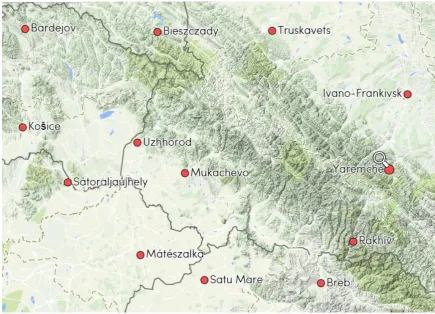
Fig. 1. Location of the study area with respect to other centers of the Carpathian Euroregion.
Formation of the health-recreation specialization of the settlements within the studied mountainous climatic resort area occurred still in the Austro-Hungarian period during the last quarter of the nineteenth century (Heksch, Kowszewicz 1882).
METHODS, DATA AND TOOLS FOR THE HISTORICAL AND GEOGRAPHICAL ANALYSES
Conceptual approaches, theory and methodology of historical and geographical studies is highlighted in the modern geographical literature. Conceptual and terminology grounds and principles of regional historical and geographical study are based on the works of a number of the following distinguished geographers: A. Baker (1977, 1979, 1982, 1984), D. Gregory (1982, 1984), R. Dennis (1984), C. Harris (1991), R. Butlin (1993), N. Johnson (2000), S. Naylor (2005), M. Hall and S. Page (2014) and others.
[image:3.595.100.536.55.369.2]subject of numerous scientific papers and investigations of Ukrainian geographers. Some aspects of historical geography of tourism in Ukraine are highlighted in the writings of O. Bejdyk (2001), M. Rutynskyi and O. Stecuk (2008), V. Krul (2008). When it comes to studying Central Europe historical geography attention is paid to that region by R. Butlin and R. Dodgshon (1998), D. Turnock (1989), N. Pounds (1990) and other geographers of the EU.
We conducted historical and geographical analysis of the peculiarities of establishing the Yaremche-Vorokhta resort area, the largest in the Eastern Carpathians of the Austro-Hungarian period according to the methodological approaches provided in the works of E. Gagen, H. Lorimer and A. Vasudevan (2007), J. Entrikin (2008) , R. Butlin (2013), R. Kitchin and N. Tate (2013), J. Morrissey, D. Nally, U. Strohmayer and Y. Whelan (2014).
Austrian and Polish tourist and resort guide books, maps and map-schemes, photographs and postcards, travelers’ information and memoirs, materials of regional magazines and newspapers, advertising brochures etc are the sources of historical and geographical information about the development of recreational facilities in the Eastern Carpathians in the second half of the XIX-th - early XX-th century, when the region used to be part of the Austro-Hungarian Empire. The systematization of the factual material scattered by these sources allows to reconstruct historical and geographical picture of the initial stage of resort-recreational development of the Eastern Carpathians, of the origin of climatic resorts as well as of establishing boundaries of the key resort areas in that mountainous region.
RESULTS
guide book of that time informed potential travellers: “Duration of the journey by direct train: from Krakiw - 12 hours, from Lviv - 5 hours, from Chernivtsi - 5 hours, from Stanislaviv - 2 hours” (Lewicki, Orłowicz, Praschil 1912, 116).
At the railway stations, in restaurants and sleeping carriages of passenger trains, for those holidaymakers who dared to travel to the Eastern Carpathians, there was another detailed tourist guide book at the disposal in which the author - A. Inlender - announced: “the line Stanislaviv - Voronenka will be very interesting for tourists, because starting from the foot of the Carpathians in the area from Nadvirna to Delyatyn landscapes are extremely picturesque. And in the area from Delyatyn to Voronenka the track winds through the valley of the Prut river and will take the the breath of every holidaymaker by magnificent panoramas of Chornohora’s peaks, the Prut’s waterfall in Dora and the gorgeous views of canyons, fogs and peaks of the Carpathians covered in pine virgin forest” (Inlender 1892, 96).
With the first passenger trains to that locality more and more numerous groups of holidaymakers and travellers were arriving at the mountains. And just at the turn of the XIX - XX centuries the work on recreational improvement of the territory and building up facilities of recreational infrastructure was started. Since that time until now the Yaremche-Vorokhta resort area has been an established “business card” of resort and recreational localities in Galicia.
Within the area the multifunctional resort and recreation centers – Yaremche, Vorokhta, Dora, Mykulychyn, Tatariv, Yablunytsa were formed and closely interacted with each other.
The railway stations Mykulychyn, Tatariv, Dora and Vorokhta formed administrative-and-economic, communication and infrastructure-and-guest axis-core of that resort area where all streams of tourists stopped and then redistributed on to the periphery. The streams of tourists arrived by trains from Lviv and other cities in the Austro-Hungarian monarchy and from Polish (Polish Kingdom) and Ukrainian (Volyn’, Podillia, Naddniepryanshchna, Slobozhashchyna) provinces of the Russian Empire.
diversify by their profile recreational specialization. Mykulychyn, Tatariv, Dora and Yaremche began to dynamically develop as seasonal spa and climatic health resorts as well as localities where holidaymakers did the whey diet-therapy course in combination with health paths and body hardening, Vorokhta – as both summer and winter center of active tourism and recreation.
The center of the area - Yaremche town acquired the status of the resort capital of Galicia and the Eastern Carpathians. In 1897 H. Hoffbauer, the first researcher of the resort potential of the region gave the following description of the status and prospects of developing the resort Yaremche: “After opening the railway line ... life started to swirl in that picturesque mountainous corner. A few dozen gorgeous Swiss style villas were built among a few wooden and stone ones ... constructed for staying in summer period. They are partly occupied by their owners, partly – by guests from Lviv, Stanislaviv, Kolomyia etc. For two years that lovely place in the woods turned... into a new climatic health resort with a spa-curative institution, hotels, a candy store, a restaurant for Christian public with a spacious hall and so on.
(...) Due to its convenient location among mountains and framing by wooded mountains Yaremche is the best place to function as a climatic resort – so far from early June to late September, because in only this period you can usually get food. Since the climate in Yaremche is so gentle ... you should believe that already in the near future Yaremche will become a climatic health resort, where the sick will be able to comfortably stay in winter as well, all the more, aesthetically the winter landscapes ... of Yaremche and its outskirts are really magnificent and in no way inferior to the Alpine ones” (Hoffbauer 1898, 70-71).
The hotel infrastructure of the fashionable resort center, according to S. Lewicki, M. Orłowicz, T. Praschil, looked like this: “Hotels and restaurants: Skryzhynski’s hotel opposite the railway station has 14 rooms, richly furnished ... Open all year round. Hanus’s hotel ... has 16 rooms ... Shteynhraber’s hotel is near the station. Skryzhynski’s restaurant ... with spacious, very richly decorated hall for meals and a spacious shaded veranda. Daily in the evening they have a concert by musicians from Stanislaviv ...
Recreational opportunities: during the summer season Hradel’s spa health improving institution is operating, where, along with hydrotherapy treatment they provide massage, electrical (physio)therapy and sunbathing ...” (Lewicki, Orłowicz, Praschil 1912, 117-118).
The owners of the most luxurious resorts and villas, built in the late nineteenth century in Yaremche, were both the local Jews and representatives of the bourgeois circles of Vienna, Lviv and other major cities.
Administratively, in the late XIX-th - early XX-th century Yaremche remained the outskirts of Dora. However, already at that time, powerful recreational building up assigned to the outskirts the features of the health resort capital of the Hutzul Carpathians. Those who were indifferent united around that idea and thanks to their efforts the tourist “Yaremche Club” was set up on August, 25 1896. Mr. Zonnenvend was elected its head. The “Yaremche Club” developed a set of measures on recreational improvement of the area to attract holidaymakers and to separate Yaremche from Dora.
magazines, place for team games, tennis court, bowling, boats for fishing etc.
In 1899, Leon Zabalevych, the publisher, organized issuing the newspaper “Yaremche”, published weekly during a recreation season. In 1902 Mr. Artyhovskyy, a photographer from Stanislaviv, opened photo salons in his two villas. He also sold postcards with views of the Yaremche-Vorokhta health resort and the climatic spa area.
So already in the late nineteenth century recreational specialization of Yaremche as prestigious resort locality for public recreation and entertainment of burghers from Vienna, Warsaw, Krakiw, Lviv and other cities was stated. Due to the influx of holidaymakers increasing with every year, by the special government resolution as of September 28, 1910 Yaremche, the outskirs of Dora, was transformed into an independent administrative unit under the same name. In a year its population grew to 1,000 people.
Despite the fact that Yaremche had not yet been separated from Dora, in 1900, the first elections of “summer” manager of local government head of the settlement were held. He was Vladislav Lutskyi, a retired counselor of the regional court. Local newspapers in 1902 wrote that Yaremche was developing thanks to Mr. Lutskyi, who was doing his best. Due to his efforts pavilions for having rest were built, the serpentine road to the Dovbush caves was paved, 250 g.
of state forest were allotted for recreational leisure of Yaremche guests.
In 1905-1906 years during one season 1500 holidaymakers spent their holidays in Yaremche, which earned up to 200 thousand corons of profit for the owners of the villas annually. Construction costs of the villas paid off in 3-5 years.
from festivals – 1048 corons, from tickets for the rest in specially designated walking places - 513 corons, from selling places for fishing - 88 coron, from selling postcards - 67 corons.
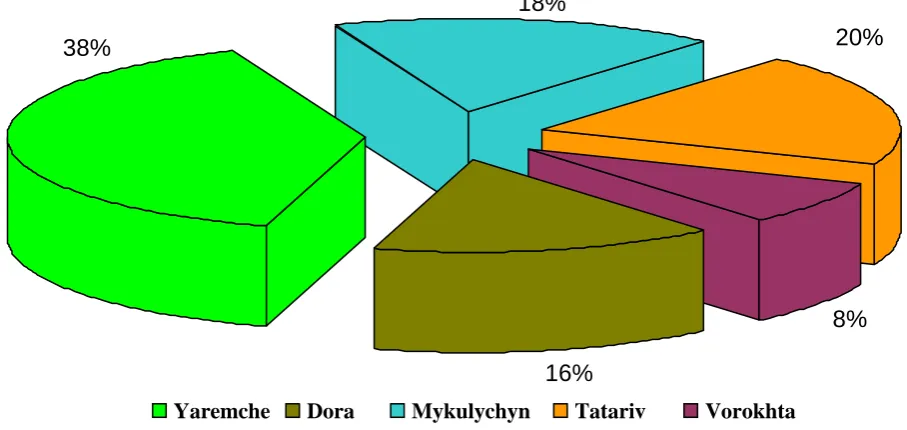
Fig. 2. Correlation of the holidaymakers registered for continual rehabilitation in the settlements of Yaremche-Vorokhta resort area as of 1911, %.
By the nature of developing the recreational infrastructure the neighboring centers of the resort area did not lag behind the “capital” either. Here is how the guide books of the early twentieth century characterized their recreational potential:
Dora – “The tourist spot has 18 large villas and 35 houses specially built for holidaymakers. In addition to these, one can easily get a more modest accommodation with local Hutsuls. There are also two boarding-houses; one V.Levyc'kyj’s, which is open a year round, and the second O. Hrosikova’s, which operates only in summer. In general, except for the Hutsul houses, there are about 300 well-equipped rooms to be rented by guests. Their number is growing every year and has already outnumbered the familiar figure of 2,000 persons... the Prut flowing through the village, makes it possible to use high-quality mountain river bathing. At the river side there are two indoor bathrooms. Entertainment: there is “The Club of Holiday Guests in Dora”, whose work is to improve holidaymakers’ life in the tourist spot, they lay a park, put benches along walking paths, look after them, arrange composite journeys about picturesque
16% 18%
8%
38% 20%
[image:9.595.90.544.125.340.2]neighbourhoods ...” (Lewicki, Orłowicz, Praschil 1912, 46-47).
In Dora Hutsuls kept dozens cleaned festively decorated riding horses for the needs of tourists (1 day hire – 2 corr.), despite ancient superstition, starting from the 90-ies of the XIX-th century every second or third household began to sell to strangers brynza (sheep’s milk cheese), budz and whey (medical whey from mountain valleys was worth 0.05 zloty for a 0.25 litre glass), kept dairy cows and goats, cultivated vegetables for vitamin and dietary meals of holidaymakers from cities.
n – “Restaurant with Anne Bauerova’s guest house (2 cor.), and Dr. Hlushkevych’s several villas and a boarding-house (6 cor. / Day) ...”Shelter for printers” in Mykulychyn (lodging for tourists – 1 cor., full-board – 2 cor. 70 g) ... in summer several hundred people come here - accommodation also with Hutsuls ... the shop of the Hutsul Union with Hutsul art products, then comes the recently laid park, in which in summer Hutsul bands play” (Orłowicz 1919, 184-185); “The annual number of visitors amounts for more than two thousand people ... Holidaymakers take the advantage of the refreshing swimming in the river Prut. Resort rehabilitation with dairy products. The area displays features of a year-round climate-health-improving station” (Lewicki, Orłowicz, Praschil 1912, 114-116). It is worth paying attention to the fact that in 1901 in Mykulychyn along with several Polish hotels next to the railway station the first resort hotel of Galicia Ukrainians “People hotel” was opened. The hotel with Ukrainian-speaking staff was a two-storeyed building with 8 apartments and a big guest hall.
– “Near the Station behind the viaduct over the Prut river there is a Chornohirskyi house of Tatranskyi LTD with a small restaurant, bed – 2 cor. Dudzikova’s boarding-house "Lena" (open a year round) with a spacious hall and a restaurant, from 7 corr. per day. Perkatyuk’s household, besides many private villas. Dr. Mihalik’s big sanatorium, Priestly Health Home, vacation colony for railway workers’ children ... in summer about 500 persons play here, besides them – lots of tourists ...” (Orłowicz 1919, 186).
Price policy of the guest fund institutions of the Yaremche-Vorokhta resort area varied from moderate to the highest in Galicia. For renting one room in a boarding-house or a villa one had to pay 60-80 zlotys per month. Medical care in boarding-houses should also be paid and was provided mainly by doctors, who came from Warsaw, Krakiw, Lviv, Stanislaviv and started seasonal treatment and diagnostic.
CONCLUSION
Rapid development of the recreational infrastructure led to the situation that by the First World War the resort center Yaremche had surpassed all other resorts in the Ukrainian lands by the number of visitors and became the most mass international tourist destinations in the Eastern Carpathians. The number of recreational streams to the resort area were growing exponentially every year. According to the statistics, in 1912 only in Yaremche 2403 persons spent their holidays.
Official statistics for 1911, according to which we can state:
1) in the early twentieth century by the number of recreational streams (for continual stay from a week to 1-3 months) three resorts singled out and clearly dominated in Galicia with their 3-5 thousand tourists / year - Truskavets, Velykyi Lubin and Yaremche;
Generally in the Austro-Hungarian period (1909-1913), according to the statistics, within the Yaremche-Vorokhta resort area the number of holidaymakers reached 8 000 guests, leaving aside 20 - 30 thousand one-day visitors and tourists who set off from Yaremche and Vorohta for a hiking (Lewicki, Orłowicz, Praschil 1912, Rutynskyi, Stecuk 2008).
During the First World War, the recreational infrastructure of the Yaremche-Vorokhta resort area suffered devastating damages, since that territory was the scene of fierce fighting, several times cut by the front line. It was there that Austrian, Russian, Romanian and Polish troops concentrated. From 1919, mass restoration of recreational infrastructure of the Yaremche-Vorokhta resort area started, thanks to the efforts of the new Polish administration and local entrepreneurs. The local administration and investors (Shtrum, Hanus, Makarevych, etc.) were implementing the far-reaching plans to transform the territory into a modern resort and recreation area of the Alpine type.
REFERENCES
BAKER, A.R.H. (1977). Historical Geography. Progress in Human Geography, 1, 465–474. BAKER, A.R.H. (1979). Historical Geography: a New Beginning. Progress in Human
Geography, 3, 560–570.
BAKER, A.R.H. (1982). On ideology and historical geography. In Baker, A.R. H., Billinge M. eds. Period and Place, Research Methods in Historical Geography. Cambridge (CUP), 233–243.
BAKER, A.R.H., GREGORY, D. eds. (1984) Explorations in Historical Geography. Cambridge (Cambridge University Press).
BEJDYK, О. (2001). Rekreacijno-turystycni resursy Ukrainy. Кyiv (VC Кyiv. Un-t).
BUTLIN, R. (1993). Historical Geography: Through the Gates of Space and Time. Oxford (Oxford University Press).
BUTLIN, R. (2013). Theory and Methodology in Historical Geography. In Pacione, M., ed.
Historical Geography: Progress and Prospect. London (Routledge), 5–43.
BUTLIN, R., DODGSHON, R. (1998). An Historical Geography of Europe. Oxford (Oxford University Press).
ENTRIKIN, J. ed. (2008). Regions: Critical Essays in Human Geography. Aldershot.
GAGEN, E., LORIMER, H., VASUDEVAN, A. eds. (2007). Practising the Archive: Reflections
on Method and Practice in Historical Geography. London (HGRG. Royal Geographical
Society).
GREGORY, D. (1982). Action and structure in historical geography. In Baker, A.R. H., Billinge M. eds. Period and Place, Research Methods in Historical Geography. Cambridge (CUP), 244–250.
HALL, M., PAGE, S. (2014). The Geography of Tourism and Recreation: Environment, Place
and Space. London (Routledge).
HARRIS, C. (1991). Power, Modernity and Historical Geography. Annals of the Association of American Geographers, 81, 671–683.
HEKSCH, A., KOWSZEWICZ, W. (1882). Führer durch die Ungarischen Ostkarpathen,
Galizien, Bukowina und Rumänien. Wien; Leipzig (Hartleben Verlag).
HOFFBAUER, H. (1898). Przewodnik na Czarnohorę i do Wschodnich Beskidów. Z. 2,
Wycieczki ze stacyj kolejowych: Nadwórna, Delatyn, Dora, Jaremcze i Mikuliczyn.
Kolomya.
INLENDER, A. (1892). Przewodnik ilustrowany po c. k. austr. kolejach państwowych: na
szlakach: Lwów – Krasne – Podwołoczyska, Krasne – Brody, Lwów – Stanisławów – Kołomyja – Śniatyn – Czerniowce, Kołomyja – Słoboda rungurska, Kołomyja – Kniażdwór,
Stanisławów – Buczacz – Husiatyn, Stanisławów – Woronienka, Koleje Podolskie. Wieden
(Drukiem i nakładem drukarni i zakładu artystycznego “Steyrermühl”).
JOHNSON, N. (2000). Historical geographies of the present. In Graham, B. and C., Nash. eds.
Modern Historical Geographies. Harlow (Prentice Hall), 251–272.
KITCHIN, R., TATE N. (2013). Conducting Research in Human Geography: Theory,
Methodology and Practice. London (Routledge).
KRUL, V. (2008). Istoryczna geografija Zachidnoji Ukrainy. Czernivci (CNU).
LEWICKI, S., ORŁOWICZ, M., PRASCHIL, T. (1912). Przewodnik po zdrojowiskach i miejscowościach klimatycznych Galicyi obejmujący zdrojowiska, uzdrowiska, miejscowości klimatyczne oraz miejscowości posiadające źródła mineralne, wreszcie stacye turystyczne i
sportów zimowych. Lwów (Grafil).
MORRISSEY, J., NALLY, D., STROHMAYER, U., WHELAN Y. (2014). Key Concepts in
Historical Geography. London (SAGE).
NAYLOR, S. (2005). Historical geographies of science: Places, contexts, cartographies. British Journal for the History of Science, 38, 1–12.
Cieszyńskim. Lwów (Grafil).
POUNDS, N. J. G. (1990). An Historical Geography of Europe. Cambridge (CUP).
RUTYNSKYI, M., STECUK O. (2008). Тurystycný kompleks Karpatskogo regionu Ukrainy. Czernivci (Knygy–ХХІ).