Physics and Astronomy Publications
Physics and Astronomy
2-2007
Quadratic Contact Process: Phase Separation with
Interface-Orientation-Dependent Equistability
Da-Jiang Liu
Ames Laboratory, [email protected]
Xiaofang Guo
Iowa State University, [email protected]
James W. Evans
Iowa State University, [email protected]
Follow this and additional works at:
http://lib.dr.iastate.edu/physastro_pubs
Part of the
Astrophysics and Astronomy Commons
,
Mathematics Commons
, and the
Physics
Commons
The complete bibliographic information for this item can be found athttp://lib.dr.iastate.edu/physastro_pubs/205. For information on how to cite this item, please visithttp://lib.dr.iastate.edu/howtocite.html.
Dependent Equistability
Abstract
The quadratic contact process is implemented on a square lattice as a model with random adsorption and correlated desorption requiring empty pairs of diagonal neighbors. The model exhibits a discontinuous phase transition between an active state and an absorbing state, but equistability between these states depends on the orientation of the separating interface. Correspondingly, for a generalized class of models, we find phase coexistence over a finite region of their two-dimensional parameter space. This is in stark contrast to behavior in equilibrium systems.
Keywords
computer simulation, ground state, mathematical models, molecular orientation, equistability, interface orientation, quadratic contact process, phase separation
Disciplines
Astrophysics and Astronomy | Mathematics | Physics
Comments
This article is fromPhysical Review Letters98 (2007): 050601, doi:10.1103/PhysRevLett.98.050601. Posted with permission.
Quadratic Contact Process: Phase Separation
with Interface-Orientation-Dependent Equistability
Da-Jiang Liu,1Xiaofang Guo,1,2and J. W. Evans1,3
1Ames Laboratory, U. S. Department of Energy, Ames, Iowa 50011-3020, USA 2Department of Physics & Astronomy, Iowa State University, Ames, Iowa 50011, USA
3Department of Mathematics, Iowa State University, Ames, Iowa 50011, USA (Received 10 October 2006; published 1 February 2007)
The quadratic contact process is implemented on a square lattice as a model with random adsorption and correlated desorption requiring empty pairs of diagonal neighbors. The model exhibits a discontinu-ous phase transition between an active state and an absorbing state, but equistability between these states depends on the orientation of the separating interface. Correspondingly, for a generalized class of models, we find phase coexistence over a finite region of their two-dimensional parameter space. This is in stark contrast to behavior in equilibrium systems.
DOI:10.1103/PhysRevLett.98.050601 PACS numbers: 05.70.Fh, 02.50.Ey, 05.50.+q
Stochastic spatial models for cooperative processes have broad applicability in describing dynamics and pattern formation in systems involving, e.g., chemical reactions, population dynamics, spread of epidemics or information, and other ecological and sociological phenomena [1–5]. In contrast to traditional Hamiltonian systems [6], such non-equilibrium models often incorporate irreversible steps and thus are not constrained by detailed-balance conditions on the microscopic rates governing evolution. Consequently, these models can display a richer variety of spatiotemporal behavior. Nonetheless, their steady states often exhibit continuous and discontinuous phase transitions which ap-pear analogous to equilibrium phase transitions in Hamiltonian systems [1–5]. However, the thermodynamic framework which facilitates the analysis of equilibrium transitions is lacking in the nonequilibrium case where understanding is limited.
Most investigation of nonequilibrium systems to date has focused on continuous transitions where the concept of universality carries over from equilibrium theory [1,4,5]. Less attention has been paid to discontinuous nonequilib-rium transitions [3,4]. However, a well-known example of the latter provided is by the ZGB model [7] for the two-component monomer-dimer surface reaction where a tran-sition to a monomer-poisoned absorbing state occurs for sufficiently high monomer adsorption rate. Various aspects of this transition have been characterized: epidemic prop-erties [3,8], interface propagation and nucleation [9,10], and metastability [9,11]. Some unusual features likely reflect a small effective interface tension. Single-component models purportedly exhibiting discontinuous transitions have also been developed [2], although this behavior is sometimes disputed for lower dimensions [5]. Here, we consider single-component ‘‘contact models’’ which describe the spread of disease or information by nearest-neighbor (NN) interaction on a square lattice of sites [1,2]. Individuals are either sick or healthy. Sick individuals recover at a fixed rate, and healthy individuals
are infected by sick neighbors according to specific rules. We prefer to recast these models in the language of adsorption-desorption where sick (healthy) corresponds to an empty (filled) site. This facilitates comparison with classic equilibrium adsorption-desorption models for in-teracting adlayers. In the standard contact process (SCP), particles adsorb randomly on the empty sites of a lattice at rate or ‘‘pressure’’,p, and desorb at a rate proportional to the number of empty NN sites. In the quadratic contact process (QCP), again particles adsorb randomly on empty sites at rate,p, but now desorb at a ratek=4, wherekequals the number of diagonally adjacent empty pairs of NN sites [2]. Thus, k0, 0, 2, and 4 for 0, 1, 3, and 4 empty NN sites, respectively, and k1 (0) for 2 empty NN sites which are diagonally adjacent (on opposite sides of the particle).
The SCP and QCP are in turn often identified with Schlo¨gl’s 1st and 2nd models for autocatalytic kinetics, respectively [2,12]:X$2XandX! ;for the 1st model, and2X$3XandX! ;for the 2nd model, whereX! ; denotes annihilation of a particle X. The mean-field ki-netics is quadratic (cubic) for the 1st (2nd) model suggest-ing a continuous (discontinuous) transition to the vacuum state. Indeed, Schlo¨gl’s 1st model does exhibit a continu-ous transition to the vacuum state, and correspondingly the SCP exhibits a continuous poisoning transition to a com-pletely covered surface in the directed percolation univer-sality class [1]. One careful study of a cellular-automata realization of Schlo¨gl’s 2nd model [13] reported a continu-ous transition (for spatial dimension D1–3). However, model behavior will depend on the specific discrete realization.
In this Letter, we show that the QCP on a square lattice does in fact exhibit a discontinuous transition, i.e., phase separation, between an active state with low coverage and an absorbing state corresponding to a completely covered surface. However, in marked contrast to equilibrium sys-tems, the adsorption rate or pressure for equistability be-PRL98,050601 (2007) P H Y S I C A L R E V I E W L E T T E R S 2 FEBRUARY 2007week ending
tween these states,peq, depends on the orientation of the interface separating them. This implies that bistability exists over a finite range of pressure. Furthermore, for a generalized class of models, we find a corresponding phase coexistence over a finite region of their two-dimensional parameter space.
Our model analysis is performed using kinetic Monte Carlo (KMC) simulation on LxLy site square-lattice systems with periodic boundary conditions. In con-ventional constant-p KMC simulation of the QCP, one specifies an adsorption rate,p, and then runs the simulation implementing adsorption and desorption with the appro-priate rates to determine dynamics and steady-state behav-ior. For lowerp, the system reaches a stable low-coverage active state with a steady-state coverage satisfyingp pOp2. For higher p above about 0.1, the system
quickly reaches a stable absorbing or poisoned state with p 1. See below.
In constant-coverage (CC) simulation [14], one specifies a target coverageand runs the simulation attempting to adsorb (desorb) if the actual coverage is below (above) the target . The fraction of adsorption attempts yields the pressurepp. CC and constant-psimulation become equivalent for sufficiently large systems. The CC approach is particularly useful for discontinuous transitions where specifying anywhere in the range of the discontinuous jump inversuspyields the same equistability pressure, peq. Here, we further exploit the CC approach to search for
dependence ofpeq peqS on the slope,S, of the
inter-face between active and absorbing phases. To this end, we perform simulations in rectangular systems withLySLx starting from an initial filled strip of the absorbing state of slope S for target 0:5. During simulation, the strip equilibrates but remains stable, its mean slope S being preserved due to the boundary conditions. Simulations performed with differentLyto check for finite-size effects indicate a clear slope dependence: peqLy ! 1
0:094 43, 0.094 00, and 0.092 83 (0:000 03), for S1, 2, and 4, respectively. See Fig.1(a). The special caseS 1is discussed below.
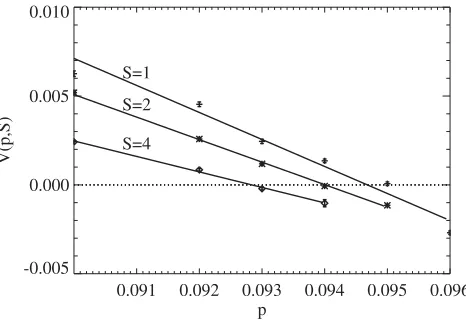
An independent assessment of equistability, as well as a more comprehensive analysis of interface propagation, can be obtained from standard constant-psimulations. Starting from an initial filled strip with slopeS, where1 S <1 in a rectangular system withLySLx, one monitors the rate of growth or shrinkage of the strip to obtain the propagation velocity, VS; p. Results for VS; p versus pare shown in Fig.2. For0 p < peqS, the more stable active state displaces the less stable absorbing state and VS; p>0. The opposite applies for p > peqS where
VS; p<0. Estimates ofpeqSfrom this plot are entirely consistent with but less precise than those above from CC simulation. For each S, VS; p increases smoothly with decreasingp to a maximum at p0. As an aside, we note that interface propagation for generalSin the QCP when p0 (i.e., irreversible shrinkage of an absorbing
strip) maps onto the exactly solvable 11D single-step deposition model for irreversible growth on a sloped sur-faces [15]. Previous results for the latter imply thatVS
1; p0 1=8p2andVS; p0 /SS11S2
11=2forS >1.
Next, we consider the ‘‘delicate’’ case of evolution of a vertical strip of filled sites, i.e., an interface with slopeS 1. As a direct consequence of the QCP desorption rules, particles within completely filled vertical columns of this strip can never desorb. Thus, the strip can never erode for any p0. However, let us assume that such a strip in an infinite system is stable against expansion for 0 p peqS 1. Then, we note that simulated behavior in this
pregime is ‘‘corrupted’’ in finite-size systems. Why? Con-sider the partially completed columns adjacent to the com-pleted columns of the strip. Completion of each such col-umn corresponds to falling into a 1D absorbing state. Con-sequently, this event must eventually occur with probabil-ity unprobabil-ity in a finite system. For conventional simulations, this results in strip expansion for anyp >0. In CC
simu-0 45 90
atan(S) (in degrees)
0.084 0.086 0.088 0.090 0.092 0.094 peq
(a)
0.000 0.002 0.004 0.006
[image:4.612.318.556.46.203.2]1/Ly 0.092 0.093 0.094 0.095 S=1 S=2 S=4 0.005 0.01 1/Ly t=104 t=105 t=106
(b)
S=
∞
FIG. 1. (a) Dependence of peq on interface slope S. Inset shows CC simulation analysis of system size effects forS1, 2, and 4. (b) Analysis of system size and CC simulation time (shown in MCS) on estimates forpeqS 1.
0.091 0.092 0.093 0.094 0.095 0.096
p -0.005 0.000 0.005 0.010 V(p,S) S=1 S=2 S=4
FIG. 2. Interface propagation velocity,Vp; S, versuspfrom constant-psimulations forS1, 2, and 4.
[image:4.612.321.554.538.699.2]lations, this results in a decrease in the coverage of the ac-tive state and a corresponding slow decrease in the effec-tive pressure with increasing time. To systematically re-move such finite-size effects, we perform CC simulations for a sequence of systems withLy2nL
xcontaining a ver-tical interface of length 2nL
x, and extrapolate behavior n! 1. We also compare behavior for different simulation times (longer times yield lower p). Results shown in Fig. 1(b) indicate that peqS 1 0:08690:0004,
forLy! 1.
For additional insight into vertical interface evolution, we consider the dynamics of the first incomplete column adjacent to a complete edge column bordering the absorb-ing state. There are three types of occupied sites in this column: (i) particles in the interior of vertical strings of two or more filled sites which cannot desorb; (ii) particles at the ends of vertical strings which have one empty neighbor in the same column, and which desorb at rateQe=4; (iii) par-ticles for which the neighboring upper and lower sites are both empty, and which desorb at rateQe=2. Here,Qe de-notes the conditional probability that the NN site in the neighboring incomplete column is empty, where we ne-glect any dependence of this conditional probability on other details of the local environment. Then, the process of column completion maps onto a classic 1D contact pro-cess. Based on previous simulation studies of this 1D con-tact process [1], it follows that column completion displays a continuous transition to an absorbing state for p peq1D 0:1516Qe which we identify aspeqS 1.
It remains to determineQe at the relevant equistability point where eq0:17taken from Fig.3. The sim-plest site-approximation sets Qe1eq 0:83, so
peq1D 0:126 (site). A pair-approximation for the
QCP (described elsewhere) yields Qe 1eq=1
eq 0:71, so peq1D 0:108 (pair). Alternatively,
one can utilize simulations to directly assess Qe. We have done this using CC simulations starting with a narrow vertical column of length 1024 in a2561024 site sys-tem. We set a target0:25, and collect statistics onQe once the number of completed rows in the growing absorb-ing strip reaches around 20, so the local coverage in the active state is just above 0.17. From this analysis, we obtain Qe 0:58, so that peq1D 0:088(simulation)
consis-tent with the above estimate.
From the above analyses, we conclude that peqS
de-creases monotonically with increasingSfrom a maximum of peqS1 0:0944 to a minimum ofpeqS 1
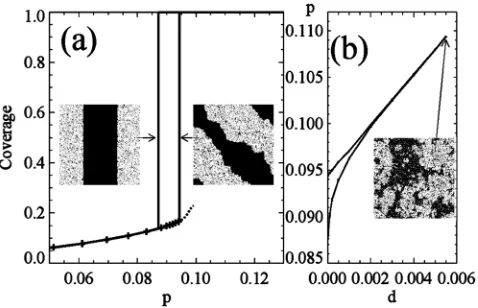
0:087. This is in marked contrast to behavior in equilibrium adsorption-desorption systems including appropriate at-tractive interactions. Here, a single equistability pressure exists corresponding to equality of the chemical potential for the coexisting 2D dilute and dense phases. A compre-hensive illustration of steady-state behavior in the QCP is provided by Fig.3(a): a unique stable absorbing state exists for p > peqS1; a stable active state exists for p < peqS 1; both the absorbing and active states are stable
for peqS 1< p < peqS1 in that either can
dis-place the other depending on interface orientation, i.e., there is true bistability. Forp < peqS 1the absorbing state is stable against isolated active droplets (see below). As for equilibrium systems [16], presumably the active state cannot be analytically extended to a unique meta-stable state, but there will exist a smooth C1 family of extensions forp > peqS1. One of these [17] is indi-cated in Fig.3. No precisely defined spinodal point termi-nates this metastable state, but the poisoning kinetics above the metastable region are found to depend strongly on the distance to an effective spinodal [9],ps0:1000:002. Further insight into the origin of true bistability over a finite range ofpcomes from an analysis of the dynamics of droplets of one phase embedded in the other. First, consider the evolution of droplets of the absorbing state embedded in the active state when peqS 1< p < peqS1.
Since we claim that active state is stable in this regime, we must rationalize why such (spontaneously forming) droplets ultimately disappear even though the absorbing state is stable. To focus on a ‘‘worst case scenario’’, con-sider a square-shaped droplet having sides orientated with slopesS0andS 1. Then, sincep > peqS 1, the sides of this droplet will initially tend to expand. If growth at the corners is inhibited, then a roughly octagonal shaped droplet will develop. Subsequently, the facets with slope S 1will tend to contract, since p < peqS1, and the sides withS0or1will grow out yielding a diamond shape droplet which will naturally shrink. (Large fluctua-tions hide this progression in geometric shapes. Even with an initial 6464 site droplet and ‘‘high’’ p0:094, shrinkage starting at the corners is more evident than growth of the S0 and S 1 sides.) Of course, the active state is unstable and droplets grow with finite proba-bility forp > peqS1.
FIG. 3. (a) Steady-state coverage behavior for the QCP. The dotted line gives one metastable extension of the active state. Vertical lines indicate the boundaries of true bistability, and insets indicate associated equistable interface configurations. (b) Bistability region for the generalized QCP with an additional pathway for random desorption at rate d. The inset shows a configuration near the Ising-like critical point.
PRL98,050601 (2007) P H Y S I C A L R E V I E W L E T T E R S 2 FEBRUARY 2007week ending
[image:5.612.319.558.46.200.2]Second, consider droplets of the active phase (or empty droplets) embedded in absorbing phase. A special feature of the desorption rules in the QCP is that such a droplet can never grow outside of a rectangle containing the droplet. Thus, trivially, the absorbing state is stable against such isolated droplets which must disappear for any p >0, a feature already noted by Durrett [2]. However, perturba-tions of the model dynamics to remove the above special feature allow growth of an empty droplet with finite proba-bility forp < peqS 1below the true bistable window
(see below).
How general is the feature of a finite range of true bistability in nonequilibrium lattice-gas adsorption-desorption type models? It is natural to generalize the QCP model to include an additional pathway for random desorption characterized by ‘‘small’’ rate d >0. In this model, the high-stable state is no longer absorbing. The system states are parameterized by both pressure, p, and the temperaturelike variable d (d0 recovering the QCP), so one can make a more complete comparison with equilibrium adsorption-desorption models. We find that the finite region of bistability persists for d >0, but shrinks to zero at a critical cusp point, ddc. See Fig.3(b). The boundaries of this finite region of bistability were obtained from CC simulations for interfaces with slope S1 and S 1, respectively. Detailed finite-size-scaling analysis of fluctuation behavior near the non-equilibrium critical point [11,18] indicates Ising-like be-havior with dc 0:055 and ppc0:1090. As an aside, we mention another generalized model motivated by the standard contact process: here additional desorption occurs with ratedm=4for particles withmNN empty sites (in addition to the QCP pathway). This model preserves the completely covered surface as an absorbing steady-state, and also has a finite region of bistability extending ford >
0similar to the first generalized model.
More broadly, the phenomenon of true bistability or generic two-phase coexistence has been noted in other nonequilibrium models. However, typically, it derives from a rather severe departure from traditional Hamiltonian-based dynamics. One example is Toom’s North-East-Center synchronous stochastic celullar autom-ata model which introduces an explicit artificial asymmetry into dynamic ‘‘voting’’ rules [19]. Continuum analogues incorporating this asymmetry also exhibit true bistability [20]. Here, behavior can be rationalized in terms of very unusual droplet dynamics. Another example is provided by models for interface pinning-depinning transitions where true bistability can derive from the feature that a greater driving force is required to depin an interface than to maintain motion [21]. Finally, we note that metastability is enhanced in nonequilibrium adsorption-desorption type models by introducing particle hopping [9,22]. However, true bistability is only achieved in the rapid-hopping hy-drodynamic limit [22].
In conclusion, we have shown that the QCP on a square lattice exhibits a discontinuous phase transition with true bistability. This QCP is closer to traditional equilibrium models than Toom-type models. The origin of its bista-bility is more delicate, deriving from a quite weak depen-dence of equistability on interface orientation.
This work was supported by the U. S. DOE-BES Chemical Sciences Division and performed at Ames Laboratory operated by ISU under Contract No. W-7405-Eng-82.
[1] J. Marro and R. Dickman, Nonequilibrium Phase Transitions in Lattice Models (Cambridge University Press, Cambridge, England, 1999).
[2] R. Durrett, SIAM Rev.41, 677 (1999).
[3] E. Loscar and E. V. Albano, Rep. Prog. Phys. 66, 1343 (2003).
[4] G. O´ dor, Rev. Mod. Phys.76, 663 (2004). [5] H. Hinrichsen, Adv. Phys.49, 815 (2000).
[6] J. D. Gunton, M. S. Miguel, and P. S. Sahni, Phase Transitions and Critical Phenomena (Academic, New York, 1983), Vol. 8.
[7] R. M. Ziff, E. Gulari, and Y. Barshad, Phys. Rev. Lett.56, 2553 (1986).
[8] J. W. Evans and M. S. Miesch, Phys. Rev. Lett. 66, 833 (1991).
[9] J. W. Evans and T. R. Ray, Phys. Rev. E50, 4302 (1994). [10] R. H. Goodman, D. S. Graff, L. M. Sander, P. Leroux-Hugon, and E. Cle´ment, Phys. Rev. E52, 5904 (1995). [11] E. Machado, G. M. Buenda, and P. A. Rikvold, Phys. Rev.
E71, 031603 (2005).
[12] F. Schlo¨gl, Z. Phys.253, 147 (1972). [13] P. Grassberger, Z. Phys. B47, 365 (1982).
[14] R. M. Ziff and B. J. Brosilow, Phys. Rev. A 46, 4630 (1992).
[15] J. Krug and H. Spohn, Europhys. Lett.8, 219 (1989). [16] R. H. Schonmann and S. B. Shlosman, Commun. Math.
Phys.194, 389 (1998).
[17] For pppeqS1>0, critical droplets of the absorbing state are created at rate k/expc=p
with c0:02, and then grow with velocity v/p.
Avrami theory implies a characteristic time for nucleation-mediated poisoning satisfying nuc
v2=3k1=3exp
c=3p. Then, C1 extensions can
be generated by constant-p evolution from an empty surface for a timesimexp=3pwith < c.
[18] D.-J. Liu, N. Pavlenko, and J. W. Evans, J. Stat. Phys.114, 101 (2004).
[19] A. L. Toom, inMulticomponent Random Systems, edited by R. L. Dobrushin and Y. G. Sinai, Advances in Probability and Related Topics, Vol. 6 (Marcel Dekker, New York, 1980), Chap. 18, p. 549.
[20] Y. He, C. Jayaprakash, and G. Grinstein, Phys. Rev. A42, 3348 (1990).
[21] M. A. Mun˜oz, F. de los Santos, and M. M. T. da Gama, Eur. Phys. J. B43, 73 (2005).
[22] J. W. Evans, D.-J. Liu, and M. Tammaro, Chaos12, 131 (2002).