Available online at:
ejournal.upi.edu/index.php/IJAL/article/view/13793
doi:10.17509/ijal.v9i1.13793
188
* Corresponding Author
Email:[email protected]
Exploring process ‘verbs’ in EFL postgraduates’ citations: A
Systemic Functional Linguistics approach
Nayef Jomaa Jomaa
1* and Siti Jamilah Bidin
21
Department of Western Languages and Literature, Faculty of Letters, Karabuk University, Karabuk, Turkey
2
Department of English Language Studies, School of Languages, Civilisation and Philosophy, Universiti Utara Malaysia, Sintok, Malaysia
ABSTRACT
Due to their significance in establishing a research background, citations have been under focus by several researchers. However, limited studies have applied the Functional Theory in analysing reporting verbs in citations. Hence, this study identifies citations in the literature review chapters of 20 PhD theses in Information Technology and Applied Linguistics by EFL postgraduates within the ESL context. These PhD theses were selected purposefully. This study explores qualitatively the processes based on the ideational metafunction of the Systemic Functional Linguistics. The findings show that the material processes were used dominantly, followed by relational, verbal, and mental processes, whereas the behavioural processes were less used. The use of processes ‘verbs’ is influenced by field and tenor as register variables. Thus, the findings imply that EFL postgraduates are unaware of using processes; therefore, they should receive discipline-specific instructions. Pedagogical textbooks for academic writing could be also developed based on the outputs of the present study.
Keywords: Academic writing; citations; EFL postgraduates; reporting verbs; Systemic Functional Linguistics; transitivity system
First Received: 6 November 2018
Revised: 25 April 2019
Accepted: 2 May 2019
Final Proof Received: 27 May 2019
Published: 31 May 2019 How to cite (in APA style):
Jomaa, N. J. & Bidin, S. J. (2019). Exploring process ‘verbs’ in EFL postgraduates’ citations: A Systemic Functional Linguistics approach. Indonesian Journal of Applied Linguistics, 9, 188-201. doi:10.17509/ijal.v9i1.13793
INTRODUCTION
Citation use implies familiarity with one’s field and establishes the research on a credible basis of knowledge, which allows the writer to argue, claim, and justify (Thompson & Ye, 1991; Hewings, Lillis & Vladimirou, 2010; Petric`& Harwood, 2013; Samraj, 2013; Swales, 2014). Positioning the writer within the academic community is also achieved by means of citations (Samraj, 2013; Petric` & Harwood, 2013), reporting verbs and modal verbs (Thompson & Ye, 1991; Hyland, 1999; Samraj, 2013; Yang, 2013). Thus, this high significance of using citation has attracted the interest of several studies (Swales, 1990, 2014; Hyland, 1999; Thompson, 2001, 2002; Thompson & Tribble, 2001; Samraj, 2013; Jomaa & Bidin, 2016, 2017; Park & Nam, 2017).
189
Copyright © 2019, IJAL, e-ISSN: 2502-6747, p-ISSN: 2301-9468 in the literature review chapters of PhD theses in
Information Technology and Applied Linguistics. Citations were classified by Swales (1990) into two types: integral and non-integral citations. The integral citation is characterized by giving more prominence to the cited author. On the other hand, in the non-integral citation, the name of the cited author is not integrated with the structure of the clause. Thus, the role of the cited author is less emphasised. In the integral citation, the name of the cited author, represented by a number or a pronoun, is integrated with the structure of the clause, thus functioning as a subject, an agent, a part of the noun phrase or an adjunct (Swales, 2014). In their study, Jomaa and Bidin (2016) analysed citations based on the Systemic Functional Linguistics employing two language metafunctions and could present a comprehensive taxonomy of the role of the cited author.
Choosing either type of citations is influenced by the discipline (Hyland, 1999; Thompson & Tribble, 2001; Thompson, 2002; Okamura, 2008; Harwood, 2009; Hyland, 2009; Shi, 2012; Petric` & Harwood, 2013; Hu & Wang, 2014), language (Monreal & Salom, 2011; Rowley-Jolivet & Carter-Thomas, 2014; Hu & Wang, 2014), writer’s experience (Mansourizadeh & Ahmad, 2011; Samraj, 2013), as well as genre (Yang, 2013; Samraj, 2013). Consequently, citation use forms a complicated procedure (Charles, 2006; Jalilifar & Dabbi, 2012) and due to the differences of citation practices of each discipline, it is a ‘danger’ to adopt
general rules related to citation practices because they cannot be “valid in certain contexts” (Shi, 2012, p. 145). In Hyland’s (1999) study, the integral citation was higher in the soft domain, whereas in the hard domain, the non-integral citation dominated. However, the findings of several studies related to the use of Verb controlling were inconsistent. For example, in their study, Mansourizadeh and Ahmad (2011) showed that published articles by expert writers in chemical engineering used Naming more than Verb controlling with 6.97 % and 6.56%, respectively, whereas unpublished papers by novice writers used Verb controlling more than Naming. The discourse-based interviews revealed that EFL students, particularly Vietnamese and Arab postgraduates, were not aware of the rhetorical functions implied in citations and they had linguistic difficulties in implicitly acquiring the conventions of citations (Nguyen & Pramoolsook, 2016; Jomaa & Bidin, 2017).
Studying citations was extended by several researchers, whose studies focused on denotative reporting verbs and their evaluative connotations. For instance, Yang (2013) studied reporting verbs, adopting Francis, Hunston and Manning’s (1996, pp. 97-101) classification of only verb that clause, whereby the reporting verbs were classified into three groups that are parallel to the categorization in previous studies (Thompson & Ye, 1991; Thomas & Hawes, 1994; Hyland, 1999), including ARGUE group, THINK group, and SHOW/FIND group, as in Figure 1.
Figure 1. Verb that clause pattern (Francis, Hunston, & Manning 1996)
In Yang’s (2013) study, ARGUE group was dominant, followed by FIND/SHOW, whereas THNK group occupied the lowest percentage. However, the findings of Yang (2013) and Hyland (1999) are in contrast with those of Manan and Noor (2014). Manan and Noor (2014) showed that Malaysian masters students in an ELS program used the Research verb category with the highest percentage (44.8%), followed by Cognition acts (30.2%), whereas the Discourse acts had only 25.0%. Genres of the soft domain, including the ELS program, should contain discourse verbs with the highest percentage, followed by research verbs, whereas cognition verbs should be less used.
An earlier study on reporting verbs by Hyland (1999) on a corpus of 80 research articles depended on a modified version of Thompson and Ye’s (1991) taxonomy. Over 400 different verbs were used in citations. Disciplinary variations were clear in the density of reporting structures and forms of the verbs. Consequently, Hyland re-classified the reporting verbs into three categories according to the type of the
activity: Research (real-world) Acts, Cognition Acts, and Discourse Acts. Hyland’s study follows the traditional distinction between hard and soft disciplines; Discourse acts of reporting verbs were used mostly in the soft domain, whereas Research acts were used mostly in the hard one.
190
Copyright © 2019, IJAL, e-ISSN: 2502-6747, p-ISSN: 2301-9468 Systemic Functional Linguistics is a social theory
of language use, that is structured to make simultaneously three kinds of meanings, specifically ideational, interpersonal, and textual (Halliday, 1985). Each language metafunction is associated with a register variable as demonstrated in Figure 2.
The ideational meaning, which is associated with the Field, is composed of two aspects: experiential and logical meanings. Experiential meanings express the real world by means of the processes ‘verbs’, as in Figure 3.
Figure 2. Metafunctional solidarity across planes (Halliday & Martin, 1993)
Figure 3. Processes in transitivity system (experiential meanings) (Halliday, 1985)
What distinguishes SFL from previous studies conducted on reporting verbs is the diversity of processes used in the Transitivity System, whereas in studies by Thompson and Ye (1991), Thomas and Hawes (1994), Francis et al. (1996), and Hyland (1999), only three types of verbs were involved, including textual: discourse verbs, mental: cognition verbs, and experimental: research verbs. Besides these three categories, other processes, such as behavioural, relational, and existential are also included in the Transitivity System of the SFL.
The contrasts in the findings related to citation practices and reporting verbs in previous studies and the limited studies on the performance of EFL Arab postgraduates within the ESL context (public Malaysian university) motivated the researchers in the present study to:
1) Explore the types of processes used in citations by EFL postgraduates in Information Technology and Applied Linguistics, employing the Systemic Functional Linguistics.
2) Identify the extent of variations/similarities in using the transitivity system in two different disciplines by EFL postgraduates.
METHOD
The study adopted the Systemic Functional Linguistics (Halliday, 1985) as a social theory of language, focusing mainly on analysing the processes used in citations. Swales’ (1990) integral and non-integral citations were employed to identify the types of citations in the literature review chapters of Applied Linguistics and Information Technology theses. Each citation that included a single or multiple citations was considered as one citation. The ideational metafunction was adopted in analysing citations, involving the experiential meaning (Transitivity System). Each clause (simplex or complex) used in citations was analysed in order to identify the types of processes and the patterns of using each process in the literature review chapters of Applied Linguistics and Information Technology. Figure 4 describes the conceptual framework that guides the present study.
Processes
Material Mental Verbal Behavioural Relational
Intensive Circumstantial Possessive Causative Existential
interpersonal textual
ide
at
iona
l
tenor
field
191
Copyright © 2019, IJAL, e-ISSN: 2502-6747, p-ISSN: 2301-9468 Figure 4. Conceptual framework of the present study
The present study analysed the citation types and processes qualitatively and supported the analyses by the technique of quantifying the findings. Citations that were analysed involved the integral citation, the non-integral citation, and a mixed type of citation. In the integral citation, the name of the cited author is integrated with the clause of the citation to represent one of its constituents, as demonstrated in examples (1) and (2).
(1) According to Biber, et al. (1998), language is
distinguished by structure and use. (P.2/AL/JO)
(2) Schneier (1996) posits that system security can be
strengthened by several modes of operations, namely, ECB, CBC, Cipher Feedback (CFB), Output Feedback (OFB), and Counter (CTR)
modes. (P.9/IT/IR)
In the non-integral citation, the name of the cited author is not integrated with the structure of the clause. Rather, it is used in parentheses. Example (3) illustrates this type of citation.
(3) People use language to express feelings and elicit meaning (Lyon, 1968, p. 424). (P.1/AL/IR)
Citations by EFL Arab postgraduates also included a mixed type of citation in which the integral and non-integral citations were used in the same citation, as in example (4) below.
(4) In spite of the fact that her classification of the five
categories seems to be overlapping and not quite distinct, Salager-Meyer’s study is quite revealing in showing the different distribution of hedging
categories (Crompton, 1997). (P.4/AL/YE)
In example (4), the integral citation represented by the name of the cited author ‘Salager-Meyer’ and the non-integral citation represented by the name of the cited author ‘Crompton’ are used at the same time in one citation.
Table 1.Types of citations in the literature review chapters of AL and IT
Integral citation Non-integral citation Mixed type of citation Applied Linguistics 2,350 (66.40%) 1,079 (30.48%) 96 (2.71%) Information Technology 1,184 (54.58%) 917 (42.27%) 60 (2.76%)
Table 1 includes the total number of citations in the literature review chapters of PhD theses by EFL Arab postgraduates in two disciplines: Applied Linguistics and Information Technology. The analysis in this study is based on analysing the processes ‘verbs’ used in these citations excluding quotations.
Participants
The present study employed a purposeful sampling in choosing the literature review chapters of 20 PhD theses in Applied Linguistics and Information Technology by EFL Arab postgraduates. According to Creswell (2008),
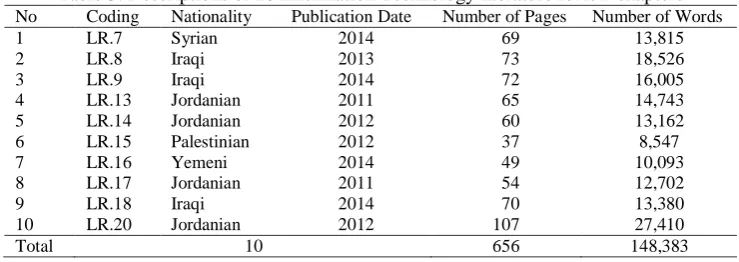
it is typical in qualitative studies to study only few cases since the goal is to obtain a detailed explanation of a specific phenomenon rather than to generalise the findings. Hence, two criteria were adopted in choosing these 20 PhD theses. First, all the authors of these PhD theses are Arab students whose native language is Arabic. Second, these PhD theses are from two different domains. These PhD theses were deposited in a library of one of the public Malaysian universities. Using these PhD theses for academic purposes was approved by the Dean of the Graduate Schools at the university. Tables 2 and 3 present details on these 20 PhD theses.
Table 2. Descriptions of 10 Applied Linguistics literature review chapters
No Coding Nationality Publication Date Number of Pages Number of Words
1. LR.1 Iraqi 2013 35 9,031
2. LR.2 Jordanian 2014 75 20,744
3. LR.3 Jordanian 2014 87 21,661
4. LR.4 Yemeni 2014 62 12,139
5. LR.5 Yemeni 2014 35 8,990
6 LR.6 Iraqi 2014 69 18,149
7. LR.10 Jordanian 2013 88 21,541
8. LR.11 Libyan 2014 89 22,080
9. LR.12 Iraqi 2013 117 31,872
10. LR.19 Yemeni 2015 79 19,000
Total 10 736 185,207
Ideational Meanings (Halliday, 1985)
192
Copyright © 2019, IJAL, e-ISSN: 2502-6747, p-ISSN: 2301-9468 Table 3. Descriptions of 10 Information Technology literature review chapters
No Coding Nationality Publication Date Number of Pages Number of Words
1 LR.7 Syrian 2014 69 13,815
2 LR.8 Iraqi 2013 73 18,526
3 LR.9 Iraqi 2014 72 16,005
4 LR.13 Jordanian 2011 65 14,743
5 LR.14 Jordanian 2012 60 13,162
6 LR.15 Palestinian 2012 37 8,547
7 LR.16 Yemeni 2014 49 10,093
8 LR.17 Jordanian 2011 54 12,702
9 LR.18 Iraqi 2014 70 13,380
10 LR.20 Jordanian 2012 107 27,410
Total 10 656 148,383
Ten PhD theses were from Information Technology discipline (IT), whereas ten PhD theses were from Applied Linguistics. Table 4 presents the coding of the extracted citations from the literature review chapters of the 20 PhD theses.
Table 4. Coding used in documenting the examples
Thesis Discipline Nationality P.1 AL Iraqi: IR P.7 IT Syrian: SY
RESULTS
The findings address the process types of ‘Transitivity System’ used in the clauses of the citations and the patterns of using these processes in the literature review chapters of 20 PhD theses. The first section presents descriptions of the process ‘verbs’ used in the clauses of
citations to reveal the experiential meanings.
Material process
Material processes imply doing something; these reveal that some entity did something, thus involving two participants: The Actor and the Goal, as well as another optional constituent called the circumstantial. In example (1), the material processes ‘conducted’ and ‘investigate’ were used, respectively.
(1) Selim (2002) conducted an empirical study to
investigate the students’ acceptance of course
website. (P.20/IT/JO)
These material processes were used dominantly in the literature review chapters of AL and IT by EFL Arab postgraduates, as in Table 5.
Table 5. Material processes in the literature review chapters of IT and AL
NO Discipline Participants Total
1 AL P.1 P.6 P.12 P.2 P.3 P.10 P.4 P.5 P.19 P.11 4225 (55.40%)
126 317 635 518 566 581 366 314 468 334
2 IT P.8 P.9 P.18 P.13 P.14 P.17 P.20 P.16 P.7 P.15 3398 (44.60%)
821 197 226 359 242 216 649 316 191 181
Although Applied Linguistics and Information Technology belong to two different fields, material processes dominated the literature review of both; this implies that the discipline as a field has an effect on student’s high use of material processes in IT. On the other hand, other factors such as students’ educational background, insufficient knowledge on using processes or other unknown reasons could probably be the motivation for students’ high use of material processes in the literature review of AL. EFL Arab students in both AL and IT PhD theses also followed a similar pattern of using the material processes; they used a high number of material processes in the sections related to the background of the study, theories, definitions, and concepts. Then, this was followed by a higher number of material processes in the sections related to previous related studies. Finally, the number of material processes decreased in the section related to the theoretical/conceptual framework. Figures (5) and (6) demonstrate the pattern of using the material processes in the literature review of AL and IT theses.
Mental process
Mental processes are used in clauses of citations to express realizations of thinking, feelings, and perceiving. Thus, these mental processes are classified into three subcategories: (A) Cognition, (B) Affection, and (C) Perception. These processes are used in a clause simplex as well as a clause complex, such as ‘consider’, ‘believes’, and ‘feels’ in the examples (2), (3), and (4), respectively.
(2) For example, in [22] the authors consider NoA
only in the current time interval.(P.15/IT/PA)
(3) Shapiro (1981), on the other hand, believes that
‘’the study of PD should be in terms of general concepts such as power, conflict, control, or
domination’’ (p.243) (P.12/AL/IR)
(4) Mehlinger (1995, p. 3) feels that there is no need to
be careful and thoughtful in editing the materials’’.
(P.6/AL/IR)
193
Copyright © 2019, IJAL, e-ISSN: 2502-6747, p-ISSN: 2301-9468
Figure 5. Pattern of using material processes in the literature review chapters of AL
Figure 6. Pattern of using material processes in the literature review chapters of IT
Table 6. Mental processes in the literature review chapters of AL and IT theses
NO Discipline Participants Total
1 AL P.1 P.6 P.12 P.2 P.3 P.10 P.4 P.5 P.19 P.11 975 (70.80%)
43 56 200 134 94 91 67 109 96 85
2 IT P.8 P.9 P.18 P.13 P.14 P.17 P.20 P.16 P.7 P.15 402 (29.20%)
45 12 26 54 34 54 91 43 12 31
Though mental processes were used differently in terms of number and patterns, they occupied the fourth rank in the literature review chapters of AL and IT. The use of mental processes in AL as a soft domain with a high percentage compared to IT reflects the effect of domain to which each discipline belongs. In other words, this performance highlights the effect of field as a probable variable that influences students’ use of processes in citations. Figure 7 demonstrates how mental processes were used with a high percentage in sections related to theories, background, and definitions,
then they decreased in the sections related to previous related studies, and finally they decreased sharply to 58 mental processes in the section related to the theoretical/conceptual framework.
On the other hand, in IT, 178 mental processes were used in sections related to theories, background and definitions. Then, they increased to 205 mental processes in the related studies section, followed by a decrease to reach 19 mental processes in the section of the theoretical/conceptual framework, as illustrated in Figure 8.
Figure 7. Pattern of using mental processes in the literature review chapters of AL 1809
2203
211 0
500 1000 1500 2000 2500
Theories, Concepts, and background
Previous related studies
Theoretical Framework
Material Process in Applied Linguistics
Material
1348
1996
54 0
1000 2000 3000
Theories, Concepts, and background
Previous related studies
Theoretical Framework
Material Process in Information Technology
Material
504 413
58 0
200 400 600
Theories, Concepts, and background
Previous related studies
Theoretical Framework
Mental Process in Applied Linguistics
194
Copyright © 2019, IJAL, e-ISSN: 2502-6747, p-ISSN: 2301-9468
Figure 8. Pattern of using mental processes in the literature review chapters of IT theses
Verbal process
Verbal processes imply saying and arguing which occupied the third rank in terms of frequencies. Examples (5), (6), and (7) demonstrate using ‘conclude’, ‘indicates’, and ‘mentions’ as verbal processes in citations, respectively.
(5) Xia and King (2002) conclude that alignment has
been reported as an organisation wide issue that directly influences the company’s overall
performance. (P.17/IT/JO)
(6) Tennen (1983) indicates that overlap is
unintentional in which it occurs naturally in
simultaneous speech. (P.12/AL/IR)
(7) He mentions that these two religious rituals are
practiced in the two cultures differently.
(P.11/AL/LI)
In Table 7, there is a demonstration of the number and percentage of using the verbal process in the literature review chapters of Applied Linguistics and Information Technology.
Table 7. Verbal processes in the literature review chapters of AL and IT
NO Discipline Participants Total
1 AL P1 P6 P12 P.2 P3 P10 P4 P5 P19 P11 2086
(72.40%)
97 149 289 231 249 439 132 70 193 237 2 IT P8 P9 P18 P13 P14 P17 P20 P16 P7 P15 796
(27.60%)
129 36 50 71 76 108 194 30 64 38
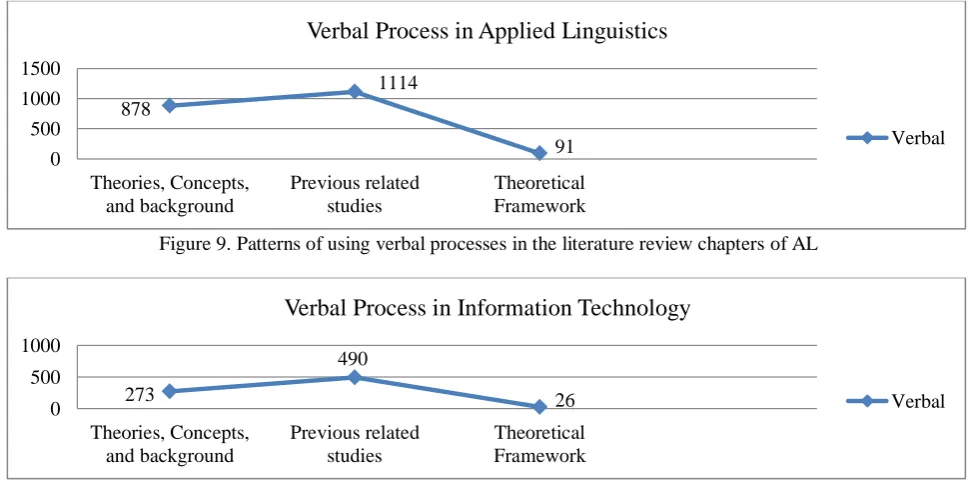
Similar to mental processes, using verbal processes in AL and IT was influenced by discipline; AL is a soft domain that is based on arguments, thus it included a high frequency of verbal processes, whereas IT is a hard domain that had a lower number of verbal process frequencies. In spite of the differences in the number and percentage of the verbal processes, AL and IT
shared a similar pattern represented by a somehow high usage in the sections related to theories, definitions and background, followed by an increasing number in the sections of the previous related studies. Then, the verbal processes decreased in the section related to the theoretical/conceptual framework, as demonstrated in Figures (9) and (10).
Figure 9. Patterns of using verbal processes in the literature review chapters of AL
Figure 10. Patterns of using verbal processes in the literature review chapters of IT 178
205
19 0
100 200 300
Theories, Concepts, and background
Previous related studies
Theoretical Framework
Mental Process in Information Technology
Mental
878
1114
91 0
500 1000 1500
Theories, Concepts, and background
Previous related studies
Theoretical Framework
Verbal Process in Applied Linguistics
Verbal
273
490
26 0
500 1000
Theories, Concepts, and background
Previous related studies
Theoretical Framework
Verbal Process in Information Technology
195
Copyright © 2019, IJAL, e-ISSN: 2502-6747, p-ISSN: 2301-9468 Behavioural process
Behavioural Processes are physiological and psychological behaviours which intermediate between material and mental processes, such as ‘noticed’ and ‘observed’ in examples (8) and (9), respectively.
(8) In examining the discourse of higher education,
Fairclough (1993) noticed interdiscursivity or mix not only on the discourse level, but also on the genre
and style levels (P.2/AL/JO)
(9) In another study, James (1984) observed the impact
of difficulties on a more comprehensive
communicative success. (P.3/AL/JO)
Table 8 shows the use of behavioural processes, including number and percentage in the literature review chapters of Applied Linguistics and Information Technology.
Table 8. Behavioural processes in the literature review chapters of AL
No. Discipline Participants Total 1 AL P.1 P.6 P.12 P.2 P.3 P.10 P.4 P.5 P.19 P11 67
76.14%
6 3 3 19 15 8 11 __ 1 1
2 IT P.8 P.9 P.18 P.13 P.14 P.17 P20 P.16 P.7 P15 21 23.86%
__ 1 3 2 4 1 5 1 3 1
The literature review chapters of Applied Linguistics and Information Technology shared similar characteristics represented by a low number of behavioural processes due to the tendency of EFL Arab students to use processes denoting material activities, statements or beliefs rather than behavioural ones. Only 67 behavioural processes were used in the literature review chapters of AL, whereas 20 processes were employed in the literature review chapters of IT.
Relational process
Relational processes refer to being processes which imply that something is. These relational processes are of two subtypes: (A) Attributive and (B) Identifying.
Intensive process
In Relational Attributive Intensive processes, a relationship is established between two terms using either the process ‘be’ or one of its synonyms, as in examples (10) and (11).
(10) It is Chomsky’s (1965, p.3) idealized way in
approaching language that aims to specify the
universal principles which characterize the innate
structure of language . (P.1/AL/IR)
(11) Halliday’s (1985) approach is functional grammar
as opposed to ‘formal grammar’ and functional as it intends to interpret the text, the system and the
linguistic structures. (P.2/AL/JO)
Relational intensive processes can be in the passive form when used as Identifying Intensive processes. Hence, the Identifying Intensive processes contrast with the Attributive Intensive processes semantically and grammatically. The semantic difference implies that the clause with an identifying intensive process is to define, whereas the clause with an Attributive Intensive process is to classify or describe. Examples (12) and (13) clarify how the Identifying Intensive processes ‘is’ and ‘are’ were used.
(12) Elbow (1973) is one of the most famous researchers
who follow this method. (P3/AL/JO)
(13) Dewey (1933) and Schon (1983, 1987) are two of
the most cited contributors to foundational concepts of reflective practice (York-Barr et al., 2006).
(P.5/AL/YE)
Table 9. Relational intensive processes in the literature review chapters of AL
No. Discipline Participants Total 1 AL P.1 P.6 P.12 P.2 P.3 P.10 P.4 P.5 P.19 P11 1557
65.30%
91 71 296 227 138 200 121 83 125 205
2 IT P.8 P.9 P.18 P13 P.14 P.17 P.20 P16 P.7 P15 827 34.70%
75 86 74 95 80 73 150 86 54 54
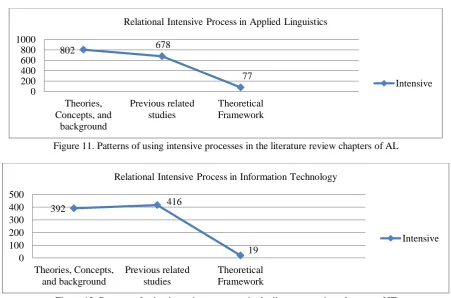
Relational Intensive processes occupied the second rank in terms of frequencies in the literature review chapters of Information Technology, whereas in AL Relational Intensive processes had the third rank following the verbal processes. In addition, the two fields, AL and IT, were also different in the patterns of using the Relational Intensive processes; AL started with a high number in sections related to theories, concepts and background, then the number of the Relational Intensive processes decreased in the related studies sections till it reached 77 processes. On the other hand, Relational Intensive processes in IT started with 392 processes in the theories, concepts and background sections, then the number increased in the sections
related to the previous studies, till it reached 19 processes. Disciplinary variations were evident due to the disciplinary influences represented by field, as illustrated by Figures (11) and (12).
196
Copyright © 2019, IJAL, e-ISSN: 2502-6747, p-ISSN: 2301-9468
Figure 11. Patterns of using intensive processes in the literature review chapters of AL
Figure 12. Patterns of using intensive processes in the literature review chapters of IT
Relational: circumstantial process
These types of processes imply meaning about the circumstantial dimension, such as location, time, manner, and cause, like the process ‘date back’ in example (14).
(14) This means that women are a subordinate minority
group. Research on men’s and women’s language use date back to the mid 1970s but these were
conducted largely in the English-speaking countries
(Holmes, 2009). (P.4/AL/YE)
Though the Circumstantial processes were higher in the literature review chapters of AL compared to IT, they were the least type of processes used by EFL Arab postgraduates due to utilising prepositional constituents as a circumstantial to refer to time or place rather than using circumstantial processes as in Table 10.
Table 10. Circumstantial processes in the literature review chapters of AL and IT
No. Discipline Participants Total 1 AL P.1 P.6 P.12 P.2 P.3 P.10 P.4 P.5 P.19 P.11 27
(69.23%)
___ 3 4 9 1 3 2 1 2 2
2 IT P.8 P.9 P.18 P.13 P.14 P.17 P.20 P.16 P.7 P.15 12 (30.77%)
3 __ 1 2 __ __ 3 1 ___ 2
Relational: Possessive process
Possessive processes imply meanings about ownership and possessions between participants of the clause, such as to have, had, belong, and have got, as in example (15).
(15) Al-Samawi’s study, however, (1995) has some
weaknesses. (P.19/AL/YE)
Table 11 shows the number and percentage of using the Relational Possessive processes.
Table 11. Relational possessive processes in the literature review chapters of AL and IT
No. Discipline Participants Total 1 AL P.1 P.6 P.12 P.2 P.3 P.10 P.4 P.5 P.19 P.11 517
66.37%
10 32 135 59 81 42 30 21 49 58
2 IT P.8 P.9 P.18 P.13 P.14 P.17 P.20 P.16 P.7 P.15 262 33.63%
38 19 25 37 31 24 51 18 12 7
Using the Relational Possessive processes in AL and IT theses was varied; the number of possessive processes in AL was higher. This finding might be
attributed to the disciplinary influences and the high density of citations in AL. The two fields represented by AL and IT are also different in terms of using the
802 678
77 0
200 400 600 800 1000
Theories, Concepts, and
background
Previous related studies
Theoretical Framework
Relational Intensive Process in Applied Linguistics
Intensive
392 416
19 0
100 200 300 400 500
Theories, Concepts, and background
Previous related studies
Theoretical Framework
Relational Intensive Process in Information Technology
197
Copyright © 2019, IJAL, e-ISSN: 2502-6747, p-ISSN: 2301-9468 patterns of possessive processes. In AL literature review
chapters, a high number of possessive processes was used in the theory and background sections, then it decreased moderately in the related studies sections, and the theoretical/conceptual framework. On the other hand, in the literature review chapters of IT, the highest
number of relational possessive processes was in the related studies sections. Figures 13 and 14 represent a demonstration of the Relational possessive pattern used in the literature review chapters of Applied Linguistics and Information Technology PhD theses.
Figure13. Pattern of using possessive processes in the literature review chapters of AL
Figure14. Pattern of using possessive processes in the literature review chapters of IT
Relational: Causative process
Causative processes were another subtype of relational processes used in the literature review chapters of AL and IT by EFL Arab postgraduates. These causative processes involve a nominal constituent that functions as an ‘Agent’. Clauses with causative processes involve another clause with either an explicit or an ellipsed process, particularly with Attributive Intensive processes. In such case, the ‘Agent’ has another function called an ‘Attributor’. Examples (16), (17), (18), and (19) are citations with clauses that include causative processes.
(16) This general reversal of thought from the Western
gender pattern made Ibrahim (1986, p. 116) to
conclude: Unlike women in the rest of the world, Arabic- speaking females tend to approximate Standard Arabic to a lesser degree than
Arabic-speaking males. (P.1/AL/IR)
(17) Eckert (1989) assumed that the fact that women
appear to be universally granted less power than
men will certainly not cause all women and men to
act alike, given all the other factors that are
involved. (P.1/AL/IR)
(18) However, they had not made it clear as to how far
does the slower congestion window growth may adversely effect short connections... (P.7/IT/SY)
(19) This causes Littlewood (1992) to affirm that
language and communication are very closely related but they are not the same phenomenon.
(P.19/AL/YE)
In example (16), the citation includes several clauses; the first clause has the causative process ‘made’, whereas the second clause involves the process ‘conclude’. The nominal group ‘This general reversal of thought from the Western gender pattern’ functions as an ‘Agent’ participant, whereas the cited author ‘Ibrahim’ is a nominal constituent that functions as the ‘Sayer’. In example (18), one of the clauses involves the causative process ‘made’. The ‘Agent: Attributor’ constituent is realized by the pronoun ‘they’. This clause is followed by another clause with an ellipsed process. Table 12 demonstrates the number of the causative processes used in the 20 literature review chapters of AL and IT.
Table 12. Causative processes in the literature review chapters of AL and IT
Discipline Frequency of the process for each thesis Total AL
F
P.1 P.6 P.12 P.2 P.3 P.10 P.4 P.5 P.19 P.11 120.00%
71.85%
4 22 10 21 8 14 4 23 10 4
IT F
P.8 P.9 P.18 P.13 P.14 P.17 P.20 P.16 P.7 P.15 47.00%
28.15%
5 __ 1 15 4 7 7 6 __ 2
286
202
30 0
100 200 300 400
Theories, Concepts, and background
Previous related studies
Theoretical Framework
Relational Possessive Process in Applied Linguistics
Relational: Possessive
122 130
10 0
50 100 150
Theories, Concepts, and background
Previous related studies
Theoretical Framework
Relational Possessive Process in Information Technology
198
Copyright © 2019, IJAL, e-ISSN: 2502-6747, p-ISSN: 2301-9468 The literature review chapters of AL have a higher
number of causative processes compared with IT. In general, causative processes were less used in the literature review chapters of AL and IT. This may reveal that writers of these PhD theses are affected by the sources from which they cite the information, and such sources involve only few examples of the causative processes. The tendency of EFL Arab postgraduates to use processes that are most common which refer to statements, suggestions, research analysis and procedures that attract the attention of the readers to something significant or really happened is another possible reason. In summary, the relational processes involved two types of processes. Clauses with attributive processes are not reversible; the passive cannot be made. On the other hand, clauses with identifying processes are reversible; passive can be made. Relational processes also included circumstantial, possessive and causative processes. The differences in frequencies and percentage between AL and IT show that field is a register variable that affects the use of the Transitivity System in clauses of citations.
Existential Process
Existential types of processes represent the existence of something or that something happened. In clauses that include existential processes, ‘there’ must be used, which does not have representational functions; ‘there’ is used because the clause needs a subject. Examples of Existential processes are ‘be, exist, arise’, as in (20), (21), and (22).
(20) According to al-‘Ubayd (2002), there are three
different methods for translating the Holy Quran:
literal, lexical and interpretive translation.
(P.11/AL/LI)
(21) Thus, sociolinguistics argue that language exists in
social context and it is ‘’a very social phenomenon’’
(Trudgill, 2000, p.21). (P.1/AL/IR)
(22) There has been a great emphasis on the importance
of teaching and instructional performance of college teachers (Wlodarsky & Walters, 2006) and on the improvement of higher education teaching quality
(Levine, 2005) .(P.5/AL/YE)
Based on the findings, Table 13 clarifies the number and percentage of using Existential processes in the literature review chapters of Applied Linguistics and Information Technology.
Table 13. Existential processes in the literature review chapters of AL and IT
No. Discipline Participants Total
1 AL P.1 P.6 P.12 P.2 P.3 P.10 P.4 P.5 P.19 P.11 97
58.80%
8 7 21 5 9 14 8 7 4 14
2 IT P.8 P.9 P.18 P.13 P.14 P.17 P.20 P.16 P.7 P.15 68
41.20%
2 1 10 6 8 10 8 10 6 7
Existential processes were also among the least type of processes in the literature review chapters of AL and IT.
Based on the abovementioned discussions related
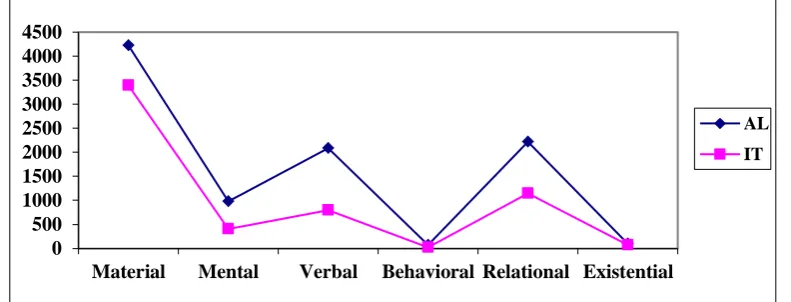
to types of processes in the literature review chapters of Applied Linguistics and Information Technology, Figure 15 summarises the frequencies for each type of processes in the clause of citations.
Figure 15. Frequencies of process ‘Transitivity System’ in the literature review chapters of AL and IT
In brief, six types of processes were found in the citations of the literature review chapters of AL and IT PhD theses. The main issue in using these processes is the dominance of material processes in the literature review chapters of the two groups of PhD theses in spite of their different domains of knowledge. Using the material process dominantly in the hard domain seems
reasonable and appropriate since this process reveals real-world and tangible actions. On the other hand, the overuse of the material process in AL contrasts with the conventions of using processes in the soft domain. This may highlight EFL Arab postgraduates’ unawareness of the implied evaluation of these types of processes. Another noticeable aspect is the dominance of relational 0
500 1000 1500 2000 2500 3000 3500 4000 4500
Material Mental Verbal Behavioral Relational Existential
AL
199
Copyright © 2019, IJAL, e-ISSN: 2502-6747, p-ISSN: 2301-9468 processes, particularly intensive processes in IT
following the material processes. It seems that the intensive processes add a kind of authenticity to studies in the hard domains because they reveal real and/or true aspects.
DISCUSSION
The present study is based on identifying the citation types and exploring the process ‘verbs’ in the literature review chapters of 20 PhD theses in Applied Linguistics and Information Technology by EFL Arab postgraduates at one of the public Malaysian universities. Swales’ (1990) classification of the citation types was adopted in identifying the citations types, and the Ideational Metafunction of the SFL (Halliday, 1985) was the basis for analysing the types of processes in each clause of the citation.
The influence of field as a register variable was evident in the use of the Transitivity System. In spite of their different fields, Applied Linguistics was similar to Information Technology in the high density of the material processes as in Jalilifar, White, & Malekizadeh (2017), whereas the behavioural and existential processes had the smallest number and percentage. Insufficient knowledge on using citations, the possible effect of the mother tongue, and unawareness of using the Transitivity System in the different disciplines can be a reason for EFL Arab postgraduates’ process performance. The realized variations in the employment of certain features, such as nominal groups in textbooks of hard and soft sciences, can be pedagogically inspiring (Jalilifar, White, & Malekizadeh, 2017). Therefore, Hyland (2006) argues that disciplines have shared features as a register of academic discourses. This argument could justify the similarities of the use of the transitivity system in citations of the literature review chapters of AL and IT despite their different disciplines. The register variable, field discussed in the present study, proved to be an effective element in using citations; therefore, it cannot be neglected when conducting further future studies on citations. In this regard, Hyland (2017) suggested that students have to learn writing in community-specific ways. Regarding the discipline of Information Technology, the disciplinary influence affected the use of the processes through the highest number of material processes, followed by verbal and mental ones, as in other studies (Hyland, 1999; Thomas & Hawes, 1994). This finding is supported by another study (Jomaa & Bidin, 2019) which showed the dominant use of Expansion due to employing non-projecting processes represented by material processes in the first clause of the clause complex citation. However, the relational processes which occupied the second rank in terms of number and percentage in the present study were not included in previous studies which depended mostly on taxonomies of three classifications only: experimental research verbs, textual discourse verbs, and mental cognition verbs (Francis et al., 1996; Hyland, 1999; Thomas &
Hawes, 1994; Thompson & Ye, 1991). The use of the relational processes in IT with a high percentage following the material ones in the present study implies that the taxonomies of reporting verbs adopted in previous studies were not sufficient in presenting a comprehensive description of the use of reporting verbs in the citation practices. Consequently, applying the Functional Theory in analysing citations as suggested by Hu and Wang (2014) and Jomaa and Bidin (2016) resulted in significant and comprehensive findings with more diversities of the processes used in the clauses of the citations that go beyond the three categories of reporting verbs adopted in previous studies (Francis et al., 1996; Hyland, 1999; Thomas & Hawes, 1994; Thompson & Ye, 1991).
Hence, studying other genres by native speakers, ESL, and EFL writers through employing the Functional Theory can add more explanations to the use of the processes in citations. However, the present study was limited to only identifying citations. Therefore, the citations with clause complexes can be analysed further based on the functional theory in order to explore the logico-semantic relationships between clauses of a clause complex. In addition, more studies are required to explore the challenges faced by EFL writers in citations in writing the different genres. The gender differences in the use of the processes by Emilia, Moecharam, and Syifa (2017) could imply that exploring the processes in citations of males and females’ writings would be interesting.
CONCLUSIONS
200
Copyright © 2019, IJAL, e-ISSN: 2502-6747, p-ISSN: 2301-9468 language is influenced by a genre-based literacy
programme (Christie, 1992, 1999) that is grounded in SFL (Halliday, 1985; Halliday & Martin, 1993; Halliday & Matthiessen, 2014). Therefore, explicitly teaching academic registers is supported by a genre-based pedagogy to cope with the students’ writing needs. The outputs of such studies can be employed pedagogically to equip students in higher education institutions with more knowledge and instructions on citations and academic writing.
ACKNOWLEDGEMENTS
We would like to thank the 20 EFL Arab doctors whose PhD theses were analysed. We also would like to thank University Utara Malaysia for making this study possible.
REFERENCES
Charles, M. (2006). Phraseological patterns in reporting clauses used in citation : A corpus-based study of theses in two disciplines. English for Specific Purposes, 25(3), 310-331. doi:
10.1016/j.esp.2005.05.003
Christie, F. (1992). Literacy in Australia. ARAL, 12, 142–155. doi: 10.1017/S0267190500002191 Christie, F. (1999). Genre theory and ESL teaching: A
systemic functional perspective. TESOL Quarterly. 33(4), 759–764. doi: 10.2307/3587889
Creswell, J.W. (2008). Educational research: Planning, conducting and evaluating quantitative and qualitative research. (3rd ed.). USA, Boston: Pearson Education.
Emilia, E., Moecharam, N. Y., & Syifa, I. L. (2017). Gender in EFL classroom: Transitivity analysis in English textbook for Indonesian
students. Indonesian Journal of Applied Linguistics, 7(1), 206-214. doi:
10.17509/ijal.v7i1.6877
Francis, G., Hunston, S., & Manning, E. (1996). Collins COBUILD grammar patterns 1: Verbs. London: HarperCollins.
Halliday, M. A. K. (1985). An introduction to functional grammar. London: Edward Arnold.
Halliday, M. A. K., & Martin, J. R. (1993). Writing science: Literacy and discursive power. London: The Falmer Press.
Halliday, M., Matthiessen, C. M. (2014). An
introduction to functional grammar (4th Edition). London: Routledge.
Harwood, N. (2009). An interview-based study of the functions of citations in academic writing across two disciplines. Journal of Pragmatics, 41(3), 497-518. doi: 10.1016/j.pragma.2008.06.001.
Hewings, A., Lillis, T., & Vladimirou, D. (2010). Who‘s citing whose writings ? A corpus based study of citations as interpersonal resource in English medium national and English medium international journals. Journal of English for
Academic Purposes, 9(2), 102-115. doi: 10.1016/j.jeap.2010.02.005.
Hu, G., & Wang, G. (2014). Disciplinary and
ethnolinguistic influences on citation in research articles. Journal of English for Academic Purposes, 14, 14-28. doi:
10.1016/j.jeap.2013.11.001
Hyland, K. (1999). Academic attribution: citation and the construction of disciplinary knowledge. Journal of Applied Linguistics, 20(3), 341-367. doi: 10.1093/applin/20.3.341
Hyland, K. (2006). English for academic purposes: an advanced resource book. Abingdon: Routledge. Hyland, K. (2017). English in the disciplines:
Arguments for specificity. ESP Today, 5(1), 5-23. doi: 10.18485/esptoday.2017.5.1.1
Jalilifar, A., & Dabbi, R. (2012). Citation in applied linguistics: Analysis of introduction sections of Iranian master theses. Linguistik online, 57(7), 91-104. doi: 10.13092/lo.57.252
Jalilifar, A., White, P., & Malekizadeh, N. (2017). Exploring nominalization in scientific textbooks: A cross-disciplinary study of hard and soft sciences. International Journal of English Studies, 17(2), 1-20. doi:
10.6018/ijes/2017/2/272781
Jomaa, N. J., & Bidin, S. J. (2016). Roles of the cited author in citations of the literature review by EFL postgraduates. International Journal of Applied Linguistics and English Literature, 5(7), 213-225. doi: 10.7575/aiac.ijalel.v.5n.7p.213
Jomaa, N. J., & Bidin, S. J. (2017). Perspectives of EFL doctoral students on challenges of citations in academic writing. Malaysian Journal of Learning and Instruction, 14(2), 177-209. doi:
10.32890/mjli2017.14.2.7
Jomaa, N. J., & Bidin, S. J. (2019). Reporting and Quoting: Functional Analyses of Logico-Semantic Relations of Clause Complex Citations. 3L: The Southeast Asian Journal of English Language Studies, 25(1), 158-178. doi: 10.17576/3L-2019-2501-12
Law, L., Ting, S. H., & Jerome, C. (2013). Cognitive dissonance in dealing with plagiarism in academic writing. The 9th International Conference on Cognitive Science: Procedia - Social and Behavioral Sciences, 97(6), 278-284. doi: 10.1016/j.sbspro.2013.10.234
Manan, N. A., & Noor, N. M. (2014). Analysis of reporting verbs in master’s theses. Procedia - Social and Behavioral Sciences, 134, 140-145. doi: 10.1016/j.sbspro.2014.04.232
Mansourizadeh, K., & Ahmad, U. K. (2011). Citation practices among non-native expert and novice scientific writers. Journal of English for Academic Purposes, 10(3), 152-161. doi:
10.1016/j.jeap.2011.03.004
201
Copyright © 2019, IJAL, e-ISSN: 2502-6747, p-ISSN: 2301-9468 Studies, 11(2), 53-75. doi:
10.6018/ijes/2011/2/149641
Nguyen, T. T. L., & Pramoolsook, I. (2016). Reporting verbs in literature review chapters of TESOL Master’s theses written by Vietnamese
postgraduates. GEMA Online Journal of Language Studies, 16(2), 17-32. doi: 10.17576/gema-2016-1602-02
Okamura, A. (2008). Citation forms in scientific texts: similarities and differences in L1 and L2
professional writing. Nordic Journal of English Studies, 7(3), 61-81.
Park, H., & Nam, D. (2017). Corpus linguistic research trends from 1997 to 2016: A co-citation analysis. Linguistic Research, 34(3), 427-457. doi: 10.17250/khisli.34.3.201712.008
Pecorari, D. (2008). Academic writing and plagiarism: A linguistic analysis. London: Continuum. Petrić, B., & Harwood, N. (2013). Task requirements,
task representation, and self-reported citation functions: An exploratory study of a successful L2 student’s writing. Journal of English for Academic Purposes, 12(2), 110-124. doi:
10.1016/j.jeap.2013.01.002
Polio, C., & Shi, L. (2012). Perceptions and beliefs about textual appropriation and source use in second language writing. Journal of Second Language Writing, 21(2), 95-101. doi: 10.1016/j.jslw.2012.03.001
Rabab'ah, G., & Al-Marshadi, A. (2013). Integrative vs. integrative citations among native and non-native English Writers. International Education Studies, 6(7), 78-87. doi: 10.5539/ies.v6n7p7 Rowley-Jolivet, E., & Carter-Thomas, S. (2014).
Citation practices of expert French writers of English: issues of attribution and stance. In A. Lyda and K. Warchal (Eds.), Occupying niches: Interculturality, cross-culturality and aculturality in academic research (pp.17-34). London: Springer International Publishing.
Samraj, B. (2013). Form and function of citations in discussion sections of master’s theses and research articles. Journal of English for Academic
Purposes, 12(4), 299-310. doi: 10.1016/j.jeap.2013.09.001
Shi, L. (2012). Rewriting and paraphrasing source texts in second language writing. Journal of Second Language Writing, 21(2), 134-148. doi: 10.1016/j.jslw.2012.03.003
Swales, J. M. (1990). Genre analysis. Cambridge: Cambridge University Press.
Swales, J. M. (2014). Variation in citational practice in a corpus of student biology papers: From
parenthetical plonking to intertextual storytelling. Written Communication, 31(1), 118-141. doi: 10.1177/0741088313515166
Thompson, P. (2001). A pedagogically-motivated corpus-based examination of PhD theses: macrostructure, citation practices and use of modal verbs (Unpublished PhD thesis). School of Linguistics and Applied Language Studies, The University of Reading, UK.
Thompson, P. (2002). Manifesting intertextuality in the PhD theses. Revista Canaria De Estudios Ingleses. 44, 97-114.
Thomas, S., & Hawes, T. P. (1994). Reporting verbs in medical journal articles. English for Specific Purposes, 13(2), 129-148. doi: 10.1016/0889-4906(94)90012-4
Thompson, G., & Ye, Y. (1991). Evaluation in the reporting verbs used in academic papers. Applied Linguistics, 12(4), 365-382. doi:
10.1093/applin/12.4.365
Thompson, P., & Tribble, C. (2001). Looking at citations: Using corpora in English for academic purposes. Language Learning and Technology, 5(3), 91-105.