19
Lessons Learned in Implementing
Peer-Assisted Learning
Yvonne Hodgsona, Margaret Bearmanb, and Michal Schneider-Kolskyc
Corresponding author:
a
Department of Physiology, Monash University, Clayton VIC 3168, Australia
bCentre for Medical and Health Science Education, Monash University, Clayton VIC 3168, Australia cDepartment of Medical Imaging and Radiation Sciences, Monash University, Clayton VIC 3168, Australia
Keywords: peer learning, radiography, pathology, lectures
International Journal of Innovation in Science and Mathematics Education, 20(3), 19-30, 2012.
Abstract
In 2008, a peer-learning program (PAL) for pathology was introduced to second year students in an undergraduate course in Radiography and Medical Imaging to provide student-centred learning. In the PAL program small groups of students prepared and delivered a presentation on a disease to the rest of the class. A questionnaire and focus group were used to evaluate the student experience of the PAL program. Students had mixed experiences of the PAL program. On the one hand they had positive experiences in the preparation and delivery of their pathology presentations, an activity that required them to work at higher cognitive domains. However, only 19% of students said that learning from their peers improved their understanding, in contrast to the remaining 81% of students who said that learning from a university lecturer improved their understanding. All students stated they would prefer to learn pathology from a lecturer than their peers. The focus group discussion revealed a number of issues which informed the changes made in subsequent years and improved the students experience of PAL. The key issues for improving PAL included incorporating peer assessment to stimulate student engagement, providing good student support by academic staff for peer teaching and being explicit with the students about the benefits of PAL.
Rationale for introducing peer-assisted learning
20
The Radiologic Biology units are core units in the Bachelor of Radiography and Medical Imaging course at Monash University. The units are multidisciplinary, integrating the disciplines of anatomy, physiology, pathology and diagnostic imaging in the study of particular body systems. Pathology was taught to the second year students for the first half of 2008 by a specialist pathologist, using conventional didactic lecture format. During the second half of 2008, changes in staffing provided an opportunity to introduce student centred teaching modalities with the aim of increasing student engagement. A PAL program was devised for the pathology component. This paper reports the experience, satisfaction and learning outcomes of the students in the 2008 PAL program and highlights how student feedback can be used to improve the student experience of and engagement with PAL.
Methods
Student and program characteristics
The introduction of a PAL program for the pathology component of Radiology Biology 4 was discussed with and agreed to by the student cohort (n=48) in the first lecture of the semester. In previous years the student cohort completed an individual essay on a pathology topic which was worth 15% of the total assessment for the unit. In 2008 the student cohort agreed to replace the individual essay with PAL. The size of groups was discussed and it was decided that two to three students per groups would be sufficient to accomplish the task of teaching a disease to the whole class. The pathology curriculum was divided into small discrete topics which could be easily researched and presented in the form of an oral presentation to the whole class. Students, working in groups of two to three selected a topic of their interest and were asked to research the pathology of the disease, prepare a presentation of 15 minutes duration and teach the class about the disease in this forum.
Preparation for the PAL program included an introductory lecture by the pathologist on how to prepare a presentation on the pathology of a disease. A structured proforma was provided as a guide for the oral presentations. The pathologist was available for consultation during a scheduled 2 hour preparation session, which was part of the normal unit timetable, and presided over all student presentations to give feedback and clarification if needed.
Refining the PAL program
The PAL program was run again in 2009. Several changes were made to the PAL program based on the feedback from students in 2008 which are described in the discussion. Ethics approval for the study was obtained from the Monash University Human Ethics Committee (Approval number 2010000346).
Survey tools and methodologies
A questionnaire similar to that described by Macaulay and Nagley (2008) was used to assess the students’ experience of “learning from” and “teaching to” peers. All students were invited to voluntarily and anonymously complete a hard copy questionnaire which contained both closed and open ended questions. The questionnaire was delivered by an independent staff member during the final pathology revision lecture in the last week of semester. Items on the questionnaire used a 5 point Likert scale with 5 indicating strongly agree and 1 indicating strongly disagree.
21
All students gave verbal consent for participation and were assured confidentiality for subsequent data collection and reporting. The focus group discussion was recorded and transcribed verbatim.
Student satisfaction with the unit was measured in the 2008 standard University annual unit evaluation and was compared to the 2007 annual evaluation for the unit. The effect of the PAL program on student learning was evaluated by comparing results for the pathology questions on the end of semester exam for the unit for the 2008 cohort who undertook the PAL program with the previous year’s cohort (2007) who had received didactic lectures by a pathologist.
Data
Quantitative data was statistically analysed using a T-test and Wilcoxon Signed Rank Test Exam results between students who had received didactic lectures (in year 2007) and those who participated in PAL (in year 2008) were compared using a Student T-test. Statistical analyses were carried out using SPSS (Version 16.0, Chicago, USA). A p-value of < 0.05 was considered statistically significant. Qualitative data obtained during the focus group discussion was themed.
Results
Survey of student cohort
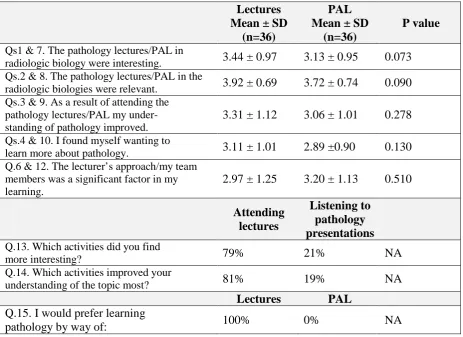
Second year radiography students undertaking the Radiologic Biology 4 unit in the second half of 2008 were aged between 19 and 22 years of age. Sixty percent were female and 40% were male. All students had previously studied pathology as part of the Radiologic Biology 2 and 3 units. Thirty-six students from the class of 48 (75%) completed the questionnaire about the PAL program. Students rated each teaching mode similarly in several domains. There was no significant difference in the ratings by students, between didactic academic led lectures and PAL (Table 1) in terms of interest (questions 1 & 7), relevance (questions 2 & 8), improving understanding of the topics (questions 3 & 9,) or in motivation to learn more (question 4 & 10). Students rated lecturers and their team members equally as factors in their learning (questions 6 & 12, mean ± SDev, scores 2.97±1.25 versus 3.20 ± 1.13 respectively, (p = 0.51).
When asked to compare lectures directly with listening to their peers pathology presentation, 27 out of 34 (79%) students said that the lectures were more interesting while only seven out 34 (21%) said that learning from their peers was more interesting (Table 1). A similar result was seen when students were asked “Which improved your understanding of the topic most?” Eighty-one percent of students identified lectures as improving their understanding of the topic while only 19% said that learning from their peers improved their understanding. All students stated that they would prefer to learn pathology by way of lectures rather than PAL (Table 1).
22
In contrast, relatively low mean ratings were given for items that measured student learning. Questions relating to “improving understanding” (questions 17 & 29, Table 3) and “wanting to learn more” (questions 20 & 31) received mean ratings of less than 3.00. These items can be broken down into ratings with respect to preparing the presentation and in listening to peers deliver presentations. There was a significant difference between these, with listening to the presentations being significantly lower (Table 3). A mean of 2.75 ± 1.13 and 2.08 ± 1.00 (p<0.039) was observed for questions relating to improving understanding. Ratings for wanting to learn more were 2.61 ± 1.15 and 1.83± 0.97 (p<0.001), respectively (questions 20 & 31, Table 3).
Table 1: Comparing Learning Pathology from Lectures and PAL Lectures
Mean ± SD (n=36)
PAL Mean ± SD
(n=36)
P value
Qs1 & 7. The pathology lectures/PAL in
radiologic biology were interesting. 3.44 ± 0.97 3.13 ± 0.95 0.073 Qs.2 & 8. The pathology lectures/PAL in the
radiologic biologies were relevant. 3.92 ± 0.69 3.72 ± 0.74 0.090 Qs.3 & 9. As a result of attending the
pathology lectures/PAL my under- standing of pathology improved.
3.31 ± 1.12 3.06 ± 1.01 0.278
Qs.4 & 10. I found myself wanting to
learn more about pathology. 3.11 ± 1.01 2.89 ±0.90 0.130
Q.6 & 12. The lecturer’s approach/my team members was a significant factor in my learning.
2.97 ± 1.25 3.20 ± 1.13 0.510
Attending lectures
Listening to pathology presentations
Q.13. Which activities did you find
more interesting? 79% 21% NA
Q.14. Which activities improved your
understanding of the topic most? 81% 19% NA
Lectures PAL
Q.15. I would prefer learning
23
Table 2: Student experience in preparing and presenting the pathology presentations
Mean ± SD (n=36)
Strongly agree &agree
(%) Q.21. In preparing my presentation I integrated material from
other areas of the unit (anatomy, physiology and imaging): 3.28 ± 1.06 56% Q.22. In preparing my presentation, I made judgments regarding
the validity of the information I used: 3.47 ± 1.03 64% Q.23. Preparation of the presentation required me to use/develop
interpretive skills: 3.36 ± 1.07 58%
Q.25. When I was working in my PAL team, I appreciated the
benefits of teamwork to carry out complex tasks. 3.25 ± 1.11 56% Q.27. I used the assessment forms in the unit manual when
planning the oral presentation: 3.47 ± 1.23 53%
Q.28. I used a range of resources to research my pathology presentation, e.g. textbooks, journal articles, web-sites, human resources, television, radio:
3.72 ±1.06 72%
Table 3: Comparing student experience in preparing the pathology presentations and in listening to peer presentations
Preparing presentations
Mean ± SD (n=36)
Listening to presentations
Mean ± SD (n=36)
Wilcoxon signed rank test
p-value
Qs. 17 & 29. As a result of attending student presentations, my understanding of the topics improved:
2.75 ± 1.13 2.08 ± 1.00 0.039
Qs. 20 & 31. I wanted to learn more about the topics, or to develop further ideas relating to them:
2.61 ± 1.15 1.83 ± 0.97 0.001
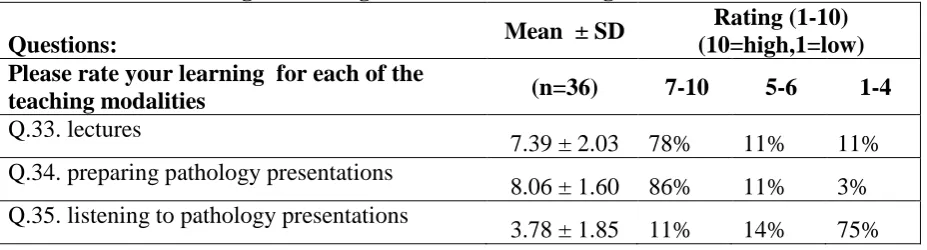
In the final section of the survey, students were asked to rate their level of learning from the different teaching modalities, using a scale of 1-10, with 1 being low learning and 10 being highest learning. Eighty-six percent of students gave a high rating (7-10) to their learning achieved while preparing the pathology presentations (mean of 8.06 ± 1.06, Table 4). Learning from lectures was also rated highly by 78% of students. In contrast, 75% of students gave a very low rating (3.78 ± 1.85) to learning from their peers via listening to the pathology presentations (Table 4).
Table 4: Student rating of learning from different teaching modalities Questions: Mean ± SD
Rating (1-10) (10=high,1=low) Please rate your learning for each of the
teaching modalities (n=36) 7-10 5-6 1-4
Q.33. lectures
7.39 ± 2.03 78% 11% 11% Q.34. preparing pathology presentations
8.06 ± 1.60 86% 11% 3% Q.35. listening to pathology presentations
24
Quantitative analysis 1– Exam results
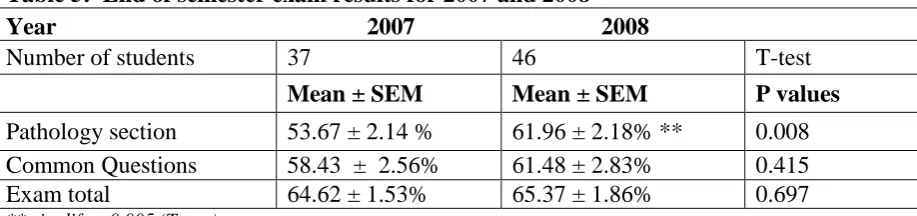
The end of semester exam consisted of two sections, a section of multiple choice questions (MCQ’s) and a short answer section. Pathology was examined using 14 questions in the MCQ section. In 2008 nine of these questions were identical to those used in 2007. Statistical analysis by t-test showed that overall, the students in 2008 scored significantly higher on the 14 pathology MCQ’s (p=0.008). However, there was no significant difference between the two year cohorts in scores on the common nine MCQ’s, nor on the total exam scores (Table 5).
Table 5: End of semester exam results for 2007 and 2008
Year 2007 2008
Number of students 37 46 T-test
Mean ± SEM Mean ± SEM P values
Pathology section 53.67 ± 2.14 % 61.96 ± 2.18% ** 0.008 Common Questions 58.43 ± 2.56% 61.48 ± 2.83% 0.415
Exam total 64.62 ± 1.53% 65.37 ± 1.86% 0.697
** sig dif p<0.005 (T-test)
Quantitative analysis 2– University Unit Evaluation
The standard University unit evaluation data for 2008 demonstrated a reduced overall satisfaction with the unit compared to 2007; on a 5 point Likert scale, a mean score of 2.97 was obtained in 2008 compared with 4.00 in 2007. This was particularly evident for the total aggregate score of all evaluation questions, being 62.25 in 2008 and 71.02 in 2007. It was not possible to perform any statistical analysis of these, as the raw data is not made available to staff.
The written comments from the unit evaluation data generally indicated that students perceived the PAL program as driven by financial motivations. For example, one student wrote:
“[it’s unreasonable to incur tuition fee] debt to have unqualified radiography students teach me and then be expected to regurgitate this information on the exam. Very poor effort.”
Qualitative methods – Focus group
Six students participated in the focus group discussion. The focus group discussion revealed that the main concern regarding the PAL program from a student’s perspective was related to the assessment of pathology in the unit. The students felt that preparing their pathology presentations increased their confidence and independent learning skills but they did not feel that they learned much from listening to their peers’ presentations.
“It gave me more confidence, because I had to get up and give a presentation.” (student 2)
“It develops your independent learning skills, I guess – you don’t always need to rely on the lecturer to learn.” (student 4)
25
better able to describe the key points for exam preparation, which was why they would prefer to learn pathology from a lecturer rather than from their peers.
“We were supposed to learn a whole topic from students who were unexperienced in giving lectures, therefore it’s a bit hard to concentrate, like I am not criticising anyone’s work or anything,…like it’s not a real lecture. So it’s a bit hard to learn problems that you can take out of it.” (student 2)
“some people missed the main idea about the topic and went on and on about a lot of things
whereas a lecturer will focus on points.” (student 5)
“for me I thought that the whole problem was the students presenting it. For a lecturer they
are knowledgeable and expert in their field. And so for a student to get up there they don’t have the same focus … Problem was about the students teaching it.” (student 6)
“lecturer needs to write the key points – like if the students do it they might miss some of the key points. The pathology lecturer writes this is the key point that I want you all to know. If students write the key points they might miss some so it’s better to get the pathology lecturer to do it.” (student 4)
Discussion
This study has demonstrated that implementing new teaching modalities such as peer learning in higher education is not always a straightforward process. Academic staff need to be explicit with students about the reasons for introducing teaching and learning innovations and must provide support for students when doing so. One of the major drivers behind the introduction of the peer learning program was a staffing issue, not an uncommon reason for the introduction of peer teaching (Ten Cate & Durning, 2007b). However, the PAL program was deliberately structured around principles of peer teaching and student-centred learning. It also offered the rare opportunity to compare the same student cohort directly between two modalities of learning and teaching in essentially the same subject area.
This study reveals that students perceived the active component of the peer learning program as most valuable, with participants rating highly those items relating to preparing their pathology presentations. They must analyse, evaluate and integrate information, all high order thinking tasks. That is, the ‘teaching’ role provided the benefits of ‘active learning’ (Tang, Hernandez, & Adams, 2004; Topping, 1996,) and encouraged deeper knowledge acquisition associated with peer learning. Likewise the focus group data indicated that preparation of the pathology presentations increased confidence. These are positive outcomes posited to be associated with peer learning (Ten Cate & Durning, 2007a; Higgins-Opitz & Tufts, 2010).
26
2010). Ten Cate and Durning (2007a) state that a high formality of the peer teaching process, such as that used in the present study, may not assist the learning of the receiving peers. Our study has certainly confirmed this. Steele et al. (2000) found that in highly structured learning activities, such as Problem Based Learning (PBL), students in groups led by fellow students were concerned that they may not master the material or that they may make errors of judgment or interpretation. Raidal and Volet (2009) found that veterinary students preferred teacher led sessions and individual forms of learning to social collaborative forms of learning, which they related to strategies for coping with large amounts of complex information. In our study students believed that the difference between having a lecturer present the material compared to students was the ability of the lecturer to define the key points of the topic. Students noted that they used these key points as a study tool in preparation for the end of semester exam. The focus group discussions revealed that students were comfortable with being assessed on their oral presentation by staff, but they were not comfortable with having to base their study for the exam on the theoretical content delivered by and taught to them by their peers. The main cause of the dissatisfaction with the PAL program was the anxiety this caused. Despite the dissatisfaction with the PAL program, the academic performance of the student cohort was not statistically different to the previous year, indicating that students achieved the required learning outcomes. The anxiety expressed by students is consistent with other studies (Steele et al., 2000).
The level of anxiety about the peer learning of pathology in the unit was reflected in the relatively low evaluation of the unit in the standard University evaluation (SUE) process. Institutions use the SUE as a measure of teaching quality; however, recent research has shown that student satisfaction is a complex measure that is influenced by contextual factors which may not be related to the quality of teaching (Schuck, Gordon, & Buchanan, 2008, Darwin, 2010). Our data supports the notion that context plays an important role in determining the SUE responses. In the SUE students were asked to evaluate their overall satisfaction with the whole unit. We can only conclude that most students must have rated this question in the SUE based on their satisfaction with the teaching of pathology, that is the PAL program, because this was the only aspect of the unit that changed in 2008. The teaching of all other components of the unit (anatomy, physiology and imaging) was identical to the previous year. Student written comments from the 2008 SUE indicated that some students saw the PAL program as a deliberate attempt by staff to alleviate teaching loads. This finding is consistent with those of Ten Cate and Durning (2007b). Hill (1995) found that in order to obtain good student satisfaction ratings, the student experience needs to be aligned with their perception of service. In the study presented here the poor overall unit satisfaction could result from a misalignment of student expectations. Students believed that they would receive lectures from specialised academic staff but instead were asked to teach and learn from their peers. Lectures, delivered by “experts in the field” are a distinguishing feature of the traditional university education. If students do not receive this, they may feel let down by the system and a level of dissatisfaction may ensue. This “customer view of education” is an obstacle that will need to be addressed if peer teaching modalities are to be pursued. One way to overcome this customer view, is to explicitly inform students about the pedagogical benefits of PAL and the reasons why it is being implemented for the unit of study in question. We did not explicitly inform students about this in the first iteration of the PAL program.
27
have also been reported to be important considerations in PAL (Ladyshewsky & Gardner, 2008). Our group size of two to three students was considered to be too small by students who participated in the focus group. A study of PAL and blogging by Ladyshewsky and Gardner (2008) found that students preferred a group size of 6-8 students. Our findings indicate that adjusting the PAL program to accommodate a larger group size and increased support for teaching could lead to an improved student experience of PAL.
Key lessons learnt
There were several lessons that we learnt from this first implementation of PAL. Students did not appreciate the reasons for the implementation of the PAL program and there was a misalignment of the expectations of students and staff. As the semester wore on the students began to see the PAL program as a substitution for formal lectures and therefore lost confidence in PAL as a learning activity. This does raise several questions:
•How do we adequately involve our students in the decision making process about the teaching and learning activities that they will engage in as part of their studies?
•Was covering the entire pathology curriculum too much to ask of this group of students?
•How much support for the peer teaching role did the students need in order to increase their confidence in undertaking this role and in learning from their peers?
Clearly the PAL program did not achieve one of its main aims, which was to increase student engagement in the unit of study. A large part of student dissatisfaction resided with listening to their peers presentations and with the assessment of the theory covered by the peer presentations. Asking students to listen to their peers’ presentations does not guarantee that they will learn from these. Processes need to be installed to foster this. Peer assessment and feedback are important factors in engaging students with learning (Taras, 2010) which has a particular significance in PAL. Assessment drives learning, meaning that students will take a task more seriously and engage more meaningfully with it if it is assessed. Assessment of the PAL presentations by end of semester exam was not aligned with the social nature of the learning that took place in the PAL program.
Modifications that have generated a positive result
The PAL program has continued to run since 2008. In each iteration of the program student feedback has informed the modifications that have been made. In 2009 the student experience of the PAL program was much more favourable. The changes made in this year included increasing the group size, support for peer teaching and introducing peer assessment of the peer presentations. We were also more explicit about the reason for using PAL, presenting the pedagogical research that demonstrates the benefits of PAL to these students and explaining that PAL developed high order thinking and skills, was not a substitute for lectures and did not save staff time.
28
inclusion of peer assessment increased student engagement with the peer presentations at two levels, preparing and listening.
Questions for PAL research
This research provides evidence of the complexity of the peer learning domain. The data suggested that in using PAL in a lecture/ large group setting, the most positive experiences of peer learning programs is in the teaching experience; and that the benefits to ‘receiving peers’ are less apparent to participants unless support and procedures are put in place to rectify this. This may be because the lecture format does not lend itself to cognitive congruence as the students cannot negotiate questions and answers as easily as they do in a small group setting or because of inadequate preparation and support for students. Evidence for the later is provided by the work of Edwards and Bone (2012) who used PAL successfully to replace lectures in an early childhood education unit. These authors provided substantial support for their students to peer teach by including weekly tutorials and web based activities that directly related to the lecture content students were to teach.
This study has raised a number of questions worthy of further research. Firstly, are the advantages of peer learning for the ‘receivers’ only maximized in active learning settings such as small group tutorials? Secondly, how can the value of the ‘expert’ be integrated into the peer learning experience? Finally, there is the issue of assuring students about the value of a mode of learning which contrasts with their strong expectations of the tertiary sector.
Conclusion
The final, and in some ways, simple take-home message of this experience is that negative data was critical in shaping improvement. The value of both qualitative and quantitative data in achieving this cannot be understated. Providing students with an in-depth understanding of the purpose of innovations such as PAL is an important part of ‘stepping forward’.
Acknowledgements
We would like to acknowledge the support of Dr Richard Davey in the trial of the peer learning program and Dr Robyn Benson for her advice in the preparation of the manuscript.
References
Boud, D., Cohen, R., & Sampson, J. (1999). Peer learning and assessment, Assessment & Evaluation in Higher Education, 24(4), 413-426.
Darwin, S. (2010). Exploring critical conceptions of student-led evaluation in Australian higher education.
Research and Development in Higher Education, 33, 203-212.
Edwards, S., & Bone, J. (2012). Integrating peer assisted learning and elearning: Using innovative pedagogies to support learning and teaching in higher education settings. Australian Journal of teacher Education, 37(5), article 1.
Falchikov, N. (2001). Learning Together: Peer tutoring in higher education. London and New York: Routeledge Falmer.
Farrell, B. J., & Farrell, H. M. (2008). Student satisfaction with cooperative learning in an accounting curriculum. Journal of University Teaching and Learning Practice, 5(2), article 4.
Hammond, J. A., Bithell, C. P., Jones, L., & Bidgood, P. (2010). A first year experience of student-directed peer assisted learning. Active Learning in Higher Education,11(3), 201-212.
29
Hill, F.M. (1995). Managing service quality in higher education: the role of the student as primary customer,
Quality Assurance in Education, 3, 10-21.
Ladyshewsky, R. K., Barrie, S. C., & Drake, V. M. (1998). A comparison of productivity and learning outcome in individual and cooperative physical therapy clinical education models. Physical Therapy, 78, 1288-1391. Ladyshewsky, R. K. & Gardner, P. (2008). Peer assisted learning and blogging: A strategy to promote reflective
practice during clinical fieldwork. Australasian Journal of Educational Technology,24(3), 241-257.
Lockspeiser, T.M, O’Sullivan, P., Teherani, A., & Muller, J. (2008). Understanding the experience of being taught by peers: the value of social and cognitive congruence. Advances in Health Science Education, 13, 361-372.
Longfellow, E., May, S., Burke, L., & Marks-Maran, D. (2008). “They had a way of helping that actually helped”: a case study of a peer-assisted learning scheme. Teaching in Higher Education, 13, 93-105.
Macaulay, J. O., & Nagley, P. (2008). Student project cases: a learner-centred team activity broadly integrated across the undergraduate medical curriculum. Medical Teacher, 30, e23-e33.
McKenna, L., & French, J. (2011). A step ahead: Teaching undergraduate student to be peer teachers. Nurse Education in Practice, 11, 141-145.
Morrison, K. (2007). Peer Assisted Study Sessions supporting quality learning & student engagement in Economics & Business. Synergy, 25, 3-6.
Nestel, D., & Kidd, K. (2005). Peer assisted learning in patient-centred interviewing: The impact on student tutors. Medical Teacher, 27, 439-44.
Raidal, S.L., & Volet, S. E. (2009). Preclinical students’ predispositions towards social forms of instruction and self-directed learning: a challenge for the development of autonomous and collaborative learners. Higher Education, 57, 577-596.
Ross, M.T., & Cameron, H.S. (2007). Peer assisted learning: a planning and implementation framework: AMEE Guide no. 30. Medical Teacher,29, 527–545.
Schmidt, H., Arend, A.V.D., Kokx, I., & Boon, L. (1994). Peer versus staff tutoring in problem-based learning , Instructional Science,22, 279–285.
Schuck, S., Gordon, S., & Buchanan, J. (2008). What are we missing? Problematising wisdoms on teaching quality and professionalism in higher education. Teaching in Higher Education, 13(5), 537-547.
Steele, D. J., Medder, J. D., & Turner, P. (2000). A comparison of learning outcomes and attitudes in student-versus faculty-led problem-based learning an experimental study. Medical Education.34, 23-29.
Tang, T. S., Hernandez, E., & Adams, B. S. (2004). Learning by teaching: A peer teaching model for diversity training in medical school. Teaching and Learning in Medicine, 16(1), 60-63.
Taras, M. (2010). Student self assessment: processes and consequences. Teaching in Higher Education,15(2), 199-209.
Ten Cate, O. and Durning, S. (2007a). Dimensions and psychology of peer teaching in medical education.
Medical Teacher, 29, 546-552.
Ten Cate, O. and Durning, S (2007b). Peer teaching in medical education: Twelve reasons to move from theory to practice. Medical Teacher, 29, 591-599.
Topping, K. J. (1996). The effectiveness of peer tutoring in further and higher education: A typology and review of the literature. Higher Education, 32, 321-345.
Topping, K. J. (2005). Trends in peer learning. Educational Psychology, 25, 623-645.
Vygotsky, L. S. (1978). Mind in Society: the Development of Higher Psychological Processes. Cambridge, MA: Harvard University Press.