International Journal of Innovation in Science and Mathematics Education, 21(3), 60-74, 2013
Facilitating Timely Feedback in the
Biomedical Sciences
Kay Colthorpea, Shaohong Liangb and Kirsten Zimbardia
Corresponding author: Kay Colthorpe ([email protected]) a
School of Biomedical Sciences, The University of Queensland, Brisbane QLD 4072, Australia bSchool of Population Health, The University of Queensland, Brisbane QLD 4006, Australia
Keywords: feedback; allied health science; biomedical science
International Journal of Innovation in Science and Mathematics Education, 21(3), 60-74, 2013
Abstract
Feedback is one of the most influential factors on student learning gains (Hattie & Timperley 2007). However, studies also show that when students do receive feedback it is often too brief, too broadly stated, and is often misinterpreted by students (Nicol & Macfarlane-Dick, 2006; Stern & Solomon, 2006). Furthermore, evaluating the actual extent to which students engage with and utilise feedback is difficult.
This study evaluated a method of providing detailed, specific and timely feedback to allied health science students studying biomedical sciences in large class settings at a higher education institution in Australia. We investigated the extent and quality of feedback provided through analysis of annotated drafts, and examined how students interpreted and used the feedback received, by identifying how student work was modified in response to each item of feedback. This study has demonstrated that for feedback to elicit positive changes in student writing it must be specific, detailed and directed. The results indicate that the majority of the feedback given in the assignments analysed had a positive effect on subsequent student work, but also highlights that student responses to feedback can differ based on the type of feedback that is given.
Introduction
Assessment reforms in higher education recognise the need for effective feedback that is timely, informative, and encourages positive attitudes towards future learning amongst students (Boud et al, 2010). It is well established that feedback to students is one of the educational practices with some of the largest positive impacts on student learning (Hattie & Timperley, 2007), However, studies also show that when students do receive feedback it is often too brief, and too broadly stated, and is often misinterpreted by students (Nicol & Macfarlane-Dick, 2006; Stern & Solomon, 2006). Furthermore, evaluating the actual extent to which students engage with and utilise feedback is difficult.
International Journal of Innovation in Science and Mathematics Education, 21(3), 60-74, 2013
! 61
Although research has extensively characterised the types of feedback academics provide on student papers (Connors & Lunsford, 1993, Stern & Solomon, 2006, Turnitin, 2012), much of this work has been limited to categorising and analysing feedback provided on summative assessment items, and does not determine the impact of formative feedback on subsequent student work. The study reported here investigated the relationship between the types of individual items of feedback provided by academics on formative submissions and the type and quality of changes students made to the subsequent summative submission in response to that feedback. This analysis involved modifying the original simple category system of Stern and Solomon (2006) into a more complex multi-level system which enabled a more detailed analysis of the impact of feedback, both in terms of the extent and the effect of change elicited by the feedback. The implications of these findings for the development of key criteria for effective feedback practice are then discussed.
Methods
Undergraduate students (n=220) in the Bachelor of Physiotherapy (n= 112), Bachelor of Speech Pathology (n=95) or Masters of Speech Pathology (n=13) studying a second level Physiology course at the University of Queensland in Australia, were given the option to submit a draft of their major written assignment of semester 1, 2012. Assignments consisted of a 1500 word scientific literature review covering one of four available topics drawn from the lecture modules. Topics included rehydration strategy; the effect of Botulinum toxin; the impact of mould on respiratory function; and mechanisms, treatment and prevention of deep vein thrombosis. Students had access to both a guideline for the assessment task and a marking criteria sheet prior to submission of the draft assignment. Of these students, approximately 69% chose to submit a draft. Each draft was provided with individualised handwritten feedback, placed in situ on a hard copy of each student’s work by the four academics who lectured within the course, as part of their normal contribution to this course. No marks were provided for the drafts. Two weeks after draft submission, the drafts were collected by the students, who were then required to submit their final assignment a further two weeks later. Marking of the final assignments was criteria-based, and all students received a marked criteria sheet, with a final grade. No feedback was given on any of the final assignments, regardless of whether or not that student had submitted a draft.
Four complete drafts from each of the four topics (16 in total) were randomly selected for extensive in-depth analysis of the feedback given, and the corresponding final assignment was examined to determine the impact of that feedback using the method described below. As each topic was the responsibility of a different contributing academic, there was variation in the type and extent feedback represented within this selection. In addition, the final assignment grade achieved by these students ranged from 57% to 97%, so they were representative of a broad academic standard.
International Journal of Innovation in Science and Mathematics Education, 21(3), 60-74, 2013
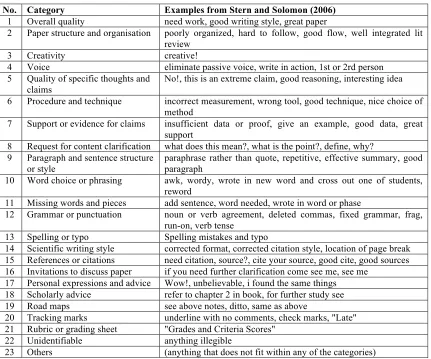
Table 1: Categories of feedback: Details of the full list of possible categories against which
feedback annotations were coded, with descriptors and examples of each category (Adapted from Stern & Solomon, 2006), and designated numbers. Category 21 was considered not applicable in this study, and category 14 was modified from ‘technical’ to ‘scientific’ writing style.
No. Category Examples from Stern and Solomon (2006)
1 Overall quality need work, good writing style, great paper
2 Paper structure and organisation poorly organized, hard to follow, good flow, well integrated lit review
3 Creativity creative!
4 Voice eliminate passive voice, write in action, 1st or 2rd person 5 Quality of specific thoughts and
claims
No!, this is an extreme claim, good reasoning, interesting idea
6 Procedure and technique incorrect measurement, wrong tool, good technique, nice choice of method
7 Support or evidence for claims insufficient data or proof, give an example, good data, great support
8 Request for content clarification what does this mean?, what is the point?, define, why? 9 Paragraph and sentence structure
or style
paraphrase rather than quote, repetitive, effective summary, good paragraph
10 Word choice or phrasing awk, wordy, wrote in new word and cross out one of students, reword
11 Missing words and pieces add sentence, word needed, wrote in word or phase
12 Grammar or punctuation noun or verb agreement, deleted commas, fixed grammar, frag, run-on, verb tense
13 Spelling or typo Spelling mistakes and typo
14 Scientific writing style corrected format, corrected citation style, location of page break 15 References or citations need citation, source?, cite your source, good cite, good sources 16 Invitations to discuss paper if you need further clarification come see me, see me
17 Personal expressions and advice Wow!, unbelievable, i found the same things 18 Scholarly advice refer to chapter 2 in book, for further study see 19 Road maps see above notes, ditto, same as above
20 Tracking marks underline with no comments, check marks, "Late" 21 Rubric or grading sheet "Grades and Criteria Scores"
22 Unidentifiable anything illegible
23 Others (anything that does not fit within any of the categories)
The change(s) made in the final assignment in response to each annotation were scored by determining the extent to which the student changed their work on a scale ranging from none to major (Table 2). Change(s) were then further qualified by identifying the effect of change, which ranged from positive to negative, with positive representing a substantive improvement in the academic standard, negative representing a substantive reduction in academic standard, and neutral representing either no change or a change which neither improved nor worsened the quality of that section of the student’s assignment (Table 2). In addition, the final assignments were examined for correlations between the final grades awarded and both the amount of feedback provided, and the extent and effect of changes in response to that feedback, using the statistical analysis software PrismTM (GraphPad Software, Inc, CA, USA).
International Journal of Innovation in Science and Mathematics Education, 21(3), 60-74, 2013
! 63
Table 2: Multi-level analysis: Feedback annotations from the draft submissions were
individually categorised using the 23 categories of Stern and Solomon (2006; Level A), then the response to each annotation in the corresponding final assignment was quantified (Level B) and qualified (Level C).
Level A 23 Categories of Feedback (Table 1)
Developed by Stern and Solomon (2006), items of feedback on draft assignments are classified into 23 categories.
Level B Scale of change
Extent of change made in the final assignment in response to each feedback annotation, classified into Major, Moderate, Minor and None.
Level C Effect of change
Classification of the quality of change made in the final assignment in response to each feedback annotation, ranging from Positive, Slightly positive, Neutral, Slightly Negative or Negative.
Student performance on summative assessment was collated for both the final assignment submission and the end of semester examination, which contributed 25% and 60% toward the course grade respectively. Summative results for students who did, and those who did not, submit a draft of their assignment were compared using a t-test (Microsoft Excel, Microsoft Corporation, WA, USA). Results were considered significant in p<0.05. This study has been approved by the University of Queensland Human Experimentation Ethical Review Committee.
Results
Approximately 69% (n=156) of the student cohort chose to submit a draft of their assignment for feedback. The vast majority of the drafts were close to full length, with a small number being partial drafts or outlines. After receiving feedback, 100% of the submitted drafts were collected by the students.
Impact of feedback
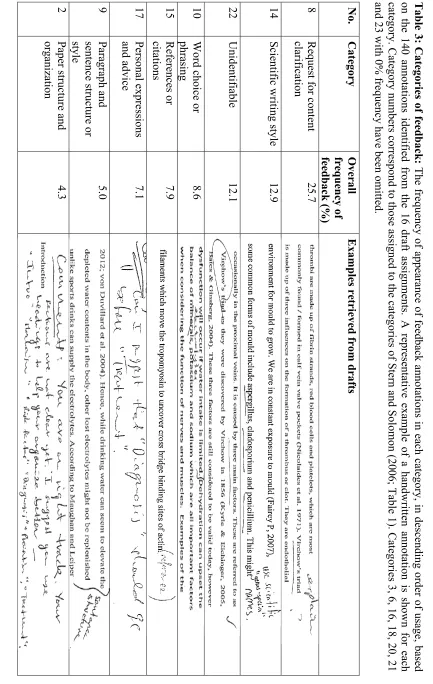
A total of 140 feedback annotations were provided on the 16 draft assignments that had been randomly selected for in-depth analysis. Examples from 16 of the 22 applicable categories described by Stern and Solomon (2006) were present, with the vast majority (90.8%) falling within 10 categories (Table 3). Feedback ranged from simple symbols or single words to specific, detailed paragraphs of advice and expectations (Table 3). Some feedback annotations were a combination of categories, the most common example of this was where parentheses were used to indicate the area to which a comment referred (such as the examples in Table 3, Categories 4, 5, and 9), in these cases the annotation was only categorised once, based on the associated comment. There were no significant correlations identified between the amount of feedback students received and their final assignment grade, nor were there any correlations found between the extent or effect of the changes the students made in response to feedback and their final grade.
International Journal of Innovation in Science and Mathematics Education, 21(3), 60-74, 2013
positive effect on student work (Table 4). Annotations which were categorised as ‘Unidentifiable’ represented 12.1% of the feedback provided (Table 3), but had only moderate effect if any, and majority of student responses were of little or no academic benefit, or were detrimental (Table 4).
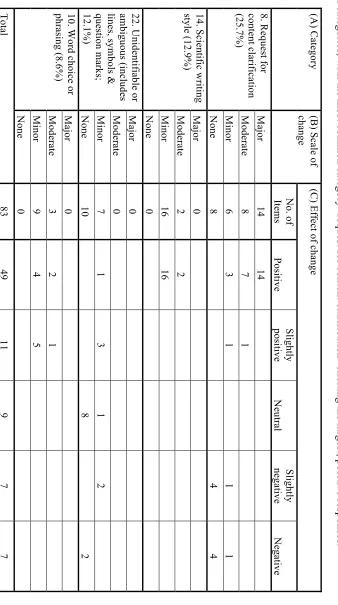
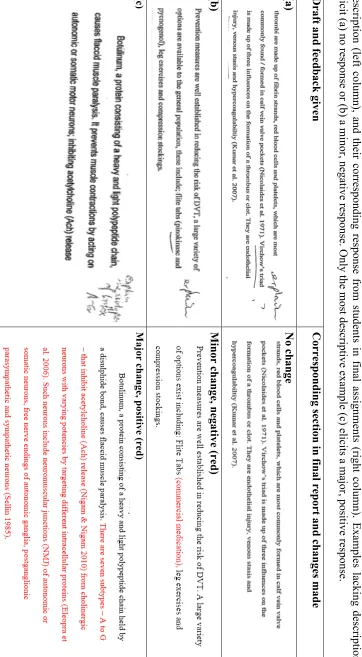
The extent of student responses to feedback varied from none to major, and the effect varied from positive to negative (Tables 5-7). Variations in extent and/or effect of responses were apparent within all individual categories of feedback present, for example in category 8 ‘Request for content clarification’ (Table 5). Overall, 77.9% of all the feedback provided elicited positive or slightly positive effects in student work.
Summative performance
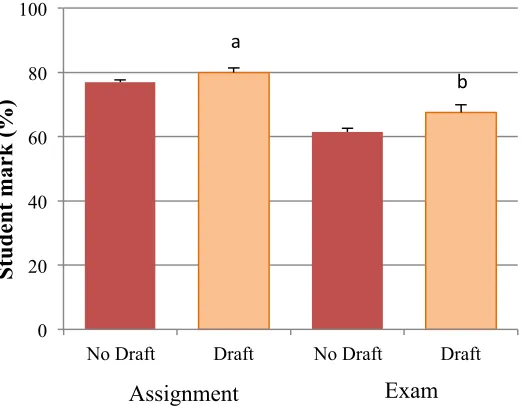
Student performance on the final submission of the assignment was significantly higher for students who submitted a draft assignment (79.9+0.82; mean+SEM) compared to those who had not (76.85+1.40; p<0.05). However, students who had submitted a draft assignment also had significantly higher scores on the end of semester examination (67.5+1.10) than those who had not (61.4+2.46; p<0.05; Figure 1). Within the subset of students whose work was subjected to detailed analysis, there were no significant correlations between the number or type of feedback items students received and their final assignment mark, nor were there any correlations found between either the extent or effect of the changes the students made in response to feedback and their final mark.
Figure 1: Student summative performance on final assignment submission and end of
semester examination for those who did not submit a draft (n=64) or those who did (n=156) as percentage of available marks (Mean +/- SEM). A, significantly higher assignment mark than students who did not submit a draft; b, significantly higher examination mark than students who did not submit a draft, p<0.05
0 20 40 60 80 100
No Draft Draft No Draft Draft
S
tu
d
en
t mar
k
(%)
Exam Assignment
a!
In
te
rn
ati
on
al
Jo
urn
al
of
In
no
va
tio
n i
n S
cie
nc
e a
nd
M
ath
em
ati
cs
E
du
ca
tio
n,
21
(3)
, 60
-74
, 2
01
3
!
66
12
G
ra
m
m
ar or
punc
tua
tion
3.6
1
O
ve
ra
ll qua
lit
y
3.6
19
Roa
d m
aps
2.9
13
S
pe
lli
ng or t
ypo
2.1
7
S
upport
or e
vi
de
nc
e
for c
la
im
s
1.4
11
M
iss
ing w
ords
a
nd
pi
ec
es
1.4
5
Q
ua
lit
y of
s
pe
cif
ic
thought
s a
nd c
la
im
s
0.7
4
V
oi
ce
In te rn ati on al Jo urn al of In no va tio n i n S cie nc e a nd M ath em ati cs E du ca tio n, 21 (3) , 60 -74 , 2 01 3 ! 67 Tab le 4: Q u an ti ty an d q u al
ity of s
tu d en t r es p on se
s to fe
ed b ac k : 60% of the 140 f ee dba ck a nnot ati ons provi de
d by m
arke rs a cros s t he 16 stude nt a ss ignm ent s f ell w ithi n f our c ate gori es
. T
In te rn ati on al Jo urn al of In no va tio n i n S cie nc e a nd M ath em ati cs E du ca tio n, 21 (3) , 60 -74 , 2 01 3 ! 68 Tab le 5: C on te n t clar ifi cati on an d th e i mp ac t of d es cr ip ti ve fe ed b ac k : S im ila r ite m s of fe edba ck on dra fts a ss ignm ent s w ith va ryi ng le ve ls of de sc ri pt ion (l ef t c ol um n), and the ir corre spondi ng re spons e from s tude nt s in fina l a ss ignm ent s (ri ght c ol um n). E xa m pl es la cki ng de sc ri pt ion eli cit (a
) no re
spons
e or (b) a
In te rn ati on al Jo urn al of In no va tio n i n S cie nc e a nd M ath em ati cs E du ca tio n, 21 (3) , 60 -74 , 2 01 3 ! 69 Tab le 6. Ex amp le
s of fe
ed b ac k th at fai le d to e lic it stu d en t r es p on se s: F ee dba
ck on dra
ft a ss ignm ent s f rom c ate
gory 22 ‘U
ni de nt ifi abl e’ (a ) & (b) a nd c ate
gory 9 ‘Re
International Journal of Innovation in Science and Mathematics Education, 21(3), 60-74, 2013
! 71
Discussion
This study has demonstrated that for feedback to elicit positive changes in student writing it must be specific, detailed and directed. The results indicate that the majority of the feedback given in the assignments analysed had a positive effect on subsequent student work, but also highlights that student responses to feedback can differ based on the type of feedback that is given (Table 4). Furthermore, these results provide empirical evidence for the types of feedback which elicit both positive and negative changes in student writing. The assessment design used in this study conformed to a number of the conditions which support student learning, as outlined by Gibbs and Simpson (2004). These conditions included that the feedback was timely, it was received by the students, as all students collected their drafts, and it was appropriate to the purpose of the task, particularly for these allied health science students who were writing in a genre that was relatively unfamiliar to them.
A clear example of the importance of description to elicit positive student responses can be seen where requests for content clarification occur. This category of feedback was the one most frequently found in this study, but examples of it ranged from detailed, lengthy annotations, to just single words. For example, in Table 5a and 5b, where “explain” or “explain?” were used (with associated underlining of relevant text), students responded with either no change or a small but negative change, whereas when more detail was included in “explain the subtypes of botox A-G”, the student responded with a major, positive change (Table 5c). Despite these items of feedback being very similar, as all are requests for content clarification, only the more descriptive annotation elicited a desirable response. Dinneen (2010) suggests that descriptive feedback is necessary to help students gain better perceptions of a given task, the examples given here highlight the value of even a small addition to description for guiding the student to respond to the specific task in the appropriate way.
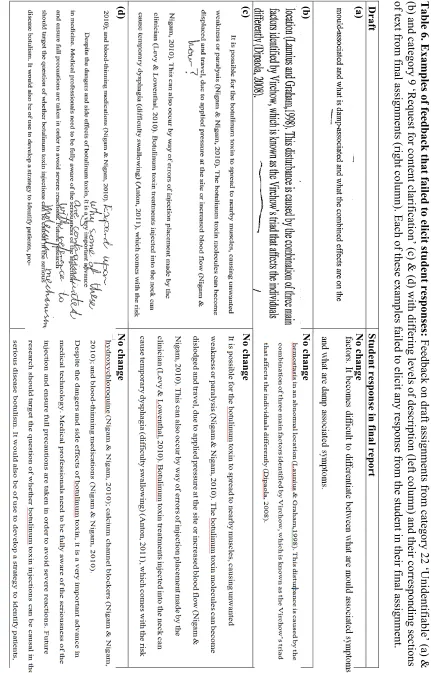
The third most common category of feedback found in this study was ‘Unidentifiable’ representing 12.1% of all feedback given (Table 3). These indicative marks, such as question marks or underlined or circled sections, where not associated with comments, did not elicit as strong positive responses. Indeed such feedback caused only minor or no responses from the students, the majority of which were of either neutral or negative effect (Table 4). The combination of the common usage of these types of indicative marks, and the finding that they are of little value as feedback, has important implications for the provision of effective feedback, and suggests that, while these types of annotations are quick and easy to add to student work, they are essentially worthless. The exception to this is where these types of marks are used in combination with comments, for example the use of parentheses or arrows, to direct the comment to a specific area of student work (Table 3, category 5; Table 3, category 9). In these cases, they add value by enabling the feedback providers to highlight the area of student work to which a comment specifically refers.
International Journal of Innovation in Science and Mathematics Education, 21(3), 60-74, 2013
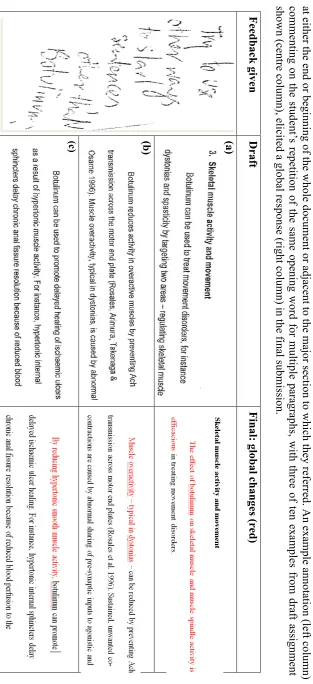
should be positioned at the beginning or end of the page, section or report. The value of this is demonstrated by the example of a well-positioned feedback annotation (Table 7, left column), that led to global changes in the final report (Table 7, right column).
There were, however, examples within this study of feedback that, despite meeting the requirements of being specific, detailed and directed, failed to elicit responses from the students. For example, the feedback “Expand upon why some of these are contraindicated with reference to molecular mechanisms” (Table 6d) failed to elicit any response from the student. Clearly, in this case, an appropriate response to this feedback would have required considerable further reading and editing on behalf of the student. While there is insufficient evidence available from this study to fully elucidate the cause of this failure, it may reflect that the complexity of task required to respond to feedback plays a part in the extent and nature of the students’ response. It is feasible that in such cases, the task may have been either beyond the capabilities of the student, or required more than the available time to complete, and consequently the student failed to respond. Perhaps in these cases, the onus is on the feedback giver to either have realistic expectations of student capabilities, or to provide further guidance to encourage students to tackle these more complex issues. Ideally, further information should be sought to elucidate why feedback failed to elicit student responses on these occasions, despite meeting the desirable characteristics, and this should be a focus of future research in this field.
This study was designed as an extension of the earlier work of Stern and Solomon (2006), who developed their category system from the much simpler version of Connors and Lunsford (1993). However, this study differs from those earlier studies in both sample size and selection strategy, and was a more detailed study, with the direct comparison of draft and final versions of the assignment allowing detailed analysis of the direct impact of feedback on subsequent student work. While direct comparison to results from Connors and Lunsford (1993) is difficult, as feedback was categorised somewhat differently, direct comparisons can be made with all categories from Stern and Solomon (2006). The findings from this study show similarities and some notable differences in feedback category distribution when compared to that study.
International Journal of Innovation in Science and Mathematics Education, 21(3), 60-74, 2013
! 73
While a large proportion of the feedback given was associated with positive improvements in the quality of student work, the higher marks achieved by students who submitted drafts and received feedback cannot be solely attributed to that feedback. Students who submitted drafts also performed significantly better on the end of semester exam (Figure 1). It is unlikely that
performance on the assignment per se influenced examination performance, as the material
covered within the assignment topics was of considerably greater depth and far less breadth than the examination material. Therefore, it is likely that students who took the option to submit a draft are those with the stronger academic focus and commitment and, consequently, would be expected to perform better. Given the optional nature of draft submission, and the lack of grading of the drafts, we cannot definitively conclude that the feedback improved overall student marks. However, the design of this study was such that we were able to identify the impact of individual items of feedback, in both the extent and quality of the student responses to each item, demonstrating that the majority of the feedback provided elicited positive responses, and allowing us to draw important conclusions on the nature and type of feedback that elicits the largest, most positive responses. Therefore, the important implications to take from this study are not that all instructors should provide feedback on drafts, but rather that in any instance of providing feedback, feedback which is specific, detailed and directed is more likely to produce improvements in student writing.
Conclusion
As shown in our examples, feedback with more description elicited stronger positive responses than those with no description, and indicative marks such as underlined or circled sections, or question marks, when not associated with comments, did not elicit strong positive responses. In addition, our examples show that positioning of feedback is important, both to link feedback to specific areas of work, or to create global responses. With these findings in mind, we have identified four key criteria to giving effective feedback:
• Students respond more positively to feedback with words than symbols alone.
• Annotations should be simple yet descriptive to achieve the desired responses.
• Feedback should be specific and directed at the region of work it refers to.
• In order to address global issues, feedback should be placed separately at the end or
beginning of either the section or the document.
References
Boud, D. (2010) Assessment 2020: Seven propositions for assessment reform in higher education. Sydney:
Australian Learning and Teaching Council. Viewed 20th February, 2013.
Connors, S. J., & Lunsford, A. A. (1993). Teachers’ rhetorical comments on student papers. College
Composition and Communication, 44, 200-223.
Dinneen, C. D. (2010). Using Descriptive Feedback in an Assessment as Learning Context for Constructing the
Way Forward. (Doctoral dissertation, University of Melbourne, Department of Learning and Educational
Development, Australia). Retrieved from http://repository.unimelb.edu.au/10187/9569
Gibbs, G., & Simpson, C. (2004). Conditions under which assessment supports students’ learning. Learning and
teaching in higher education, 1(1), 3-31.
Hattie, J., & Timperley H. (2007). The Power of Feedback. Review of Educational Research, 77(1), 81-112. Nicol, D. J. & Macfarlane-Dick, D. (2006) Formative assessment and self-regulated learning: A model and
seven principles of good feedback practice. Studies in Higher Education 31(2): 199-218.
International Journal of Innovation in Science and Mathematics Education, 21(3), 60-74, 2013
Turnitin. (2012) From the Margins: What Instructors Say on Student Papers - 30 Million Insights into Improving Instructor Feedback. Turnitin White Paper. Retrieved from
http://www.turnitin.com/en_us/resources/white-papers