The Use of Gamification at Different Levels of E-Recruitment
Jacek WOŹNIAK
University of Finance and Management 55 Pawia St.,01-030, Warsaw, Poland
Abstract. E-recruitment is a field of human resources where ICT tools are frequently used. We popularly assume that the scope with which they are used differs between countries, and that technical structure is the main reason for these differences. However, we lack the tools to explain why e-recruitment is considered more common in the US than in Poland, for instance, despite similar access to the Internet among employees and employers in both countries. The article presents a typology of four levels of e-recruitment methods, as a tool for explaining the differences in the maturity of using e-recruitment methods in these two countries. Additionally, for each of the four groups of e-recruitment methods, strong and weak points are shown, and the keys to their successful use are described. It has been also shown that a positive image of a company’s brand is a necessary condition for higher levels of e-recruitment to be successful. A special analysis is conducted of the use of gamification and games for recruitment purposes, and examples are given of their use on each of the four e-recruitment levels.
Keywords recruitment, recruitment methods, recruitment in Poland, e-recruitment in the US, gamification.
Introduction
E-recruitment (also called: online or Internet recruitment) is one of the fastest growing areas in contemporary recruitment (Armstrong, 2011; Listwan, 2010; Vătămănescu & Constantin, 2015). It is being increasingly used by various groups of potential employees and employers, who experience fewer barriers related to Internet access. However, its understanding by science and the development of scientifically based recommendations for management are hindered by the variability of its methods.
particularly in human resources (HR), but its utility for the proposed typology of e-recruitment tools has not yet been discussed.
A second goal of the text is to illustrate the classification-related problems in e-recruitment, and to show the real incidence of the four e-recruitment tools described. The proposed classification is also used to show that although access to the Internet is similar in Poland and the US, higher level e-recruitment is decidedly less widespread in Poland.
The text is organized as follows: The first part describes e-recruitment and its potential scope in Poland. The following section distinguishes the four stages in the development of e-recruitment methods. The next part briefly presents the possibility of using games and gamification in each of the four e-recruitment methods. The empirical part of the text briefly describes the use of the four levels of e-recruitment methods in Poland and the USA. Readers who are interested may find a broader survey of the subject in another work (Woźniak, 2013). The final section contains brief conclusions. Previous versions of this text were delivered at the 8th International Conference “Business and Management” in Vilnius, Lituania and The International Conference of Global Economics and Governance 2014, Bucharest, Romania. Discussions at these conferences helped develop an understanding of the main theses, and the reasoning supporting them. Some of the theses and phrasing are similar to the older versions (Woźniak, 2014b, 2014c). One of the consequences of these discussions was using the typology of four recruitment tools to evaluate the maturity of e-recruitment markets (Woźniak, 2014d). The present text develops a different aspect of the conference discussions – the use of gamification and games in the four types of e-recruitment.
Online recruitment – its definition and scope
Poland is not a leader in the use of new technologies (Runiewicz-Wardyn, 2008; Woźniak, 2009) but organizations (similarly to other Central European organizations) are among the most advanced users of ICT for HR in Europe (Strohmeier & Kabst, 2009). For employers, Internet access has ceased to be a restriction on the use of online recruitment tools: according to the Polish Main Statistical Office, by 2011 over 95% of businesses had such access (further data in this area is to be found in Woźniak, 2013, 2014a). The situation is worse for potential employees: lack of Internet access excludes 1/3 of Poles from taking advantage of online recruitment. In the remaining age groups, lack of Internet access is fairly similar and affects a little under 1/3 of each group (Woźniak, 2013, 2014b, c, d).
Almost everyone with a higher education degree has access to the Internet; for those with a secondary school education, Internet access is slightly lower (ca. 85%); for those with a vocational education lower still (46%); and for those with a primary education it is considerably lower (23%) (Woźniak, 2013, 2014a). Although these statistics suggest that online recruitment is better suited for hiring persons with higher education, employers do not limit its use to university graduates or to persons aspiring to work in high-tech professions (considered a leader in this type of recruitment method). Proof of this may be that the most frequently published advertisements on recruitment websites are for employees without higher education (ca. 600,000 advertisements in 2011 were for cashiers, salespersons, and drivers – Zając, 2012), and an analysis of the terms of the positions offered shows that the most frequently sought employees are drivers and construction workers (Zając, 2012; Woźniak, 2013).
human resource activities, but for core recruitment tasks. In the case of recruitment, this signifies a web-based implementation of recruitment procedures, which includes locating potential candidates (labor market segmentation), contacting them and collecting information necessary for the selection process.
Four generations of e-recruitment methods
The changing use of Internet resources and growing numbers of ICT tools that can be used in the recruitment process have been two of the barriers for giving e-recruitment a precise definition. Some researchers have attempted to systematize the successive stages of the growing collection of web-based recruitment instruments, and propose differentiating the various kinds of e-recruitment by giving them a 'Web' prefix and successive numbers (Jeffrey, 2012; Woźniak, 2013), analogously to the terminology used to refer to the successive stages of communication modes developed by the Internet.
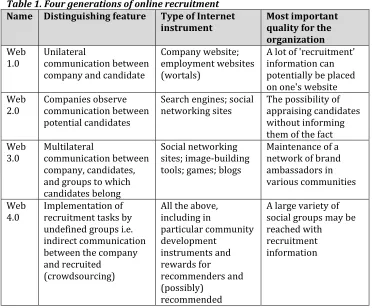
Table 1. Four generations of online recruitment
Name Distinguishing feature Type of Internet
instrument Most important quality for the organization Web
1.0 Unilateral communication between company and candidate
Company website; employment websites (wortals)
A lot of 'recruitment' information can potentially be placed on one's website Web
2.0 Companies observe communication between potential candidates
Search engines; social
networking sites The possibility of appraising candidates without informing them of the fact Web
3.0 Multilateral communication between company, candidates, and groups to which candidates belong
Social networking sites; image-building tools; games; blogs
Maintenance of a network of brand ambassadors in various communities
Web
4.0 Implementation of recruitment tasks by undefined groups i.e. indirect communication between the company and recruited
(crowdsourcing)
All the above, including in
particular community development
instruments and rewards for recommenders and (possibly)
recommended
A large variety of social groups may be reached with recruitment information
As illustrated in the table 1, initially the Internet served for the placement of recruitment ads analogous to those in the printed press, stating that a company was seeking employees (Web 1.0). In this period of online recruitment, the only real difference in comparison with newspaper ads was the opportunity for employees to search websites serving as employment agencies (such as Monster.com, the Polish Jobpilot.pl, or pracuj.pl). These services were analogous to a traditional search through the classified advertisements in the press.
However, e-recruitment has brought about changes not only in how recruitment tasks are implemented, but also in the nature of these tasks (Woźniak, 2014a). This had already been happening in Web 1.0; currently larger traffic on company websites and more capacious Internet connections have meant that companies can put more information on their websites and use a richer set of methods for transmitting it – films, testimonials, blogs, or games. As traditional recruitment had confirmed, more information, richer means of transmitting it, and greater individualization increase the attractiveness of job offers for candidates (Yüce & Highhouse, 1998).
Web 2.0 recruitment is connected (like everything termed Web 2.0 in the language used to speak of the Internet) with the use of material created spontaneously by participants in online communities. The plural in the term 'communities' is important here, as – along with the emergence of the possibility of creating social networking sites and other forums where participants can express themselves and place material they have created themselves – the range of such sites is continually growing. By definition, the Web 2.0 model differs from Web 1.0 in its eradication of the difference between a privileged broadcaster of information and a recipient, and the use of content created by Internet users for the purpose of communicating with one another.
In this sense, we speak of Web 2.0 recruitment when a potential employer actively seeks material – other than job-wanted advertisements – placed by other users of the Internet. Characteristic Internet tools used in Web 2.0 recruitment are: social networking sites of a private (such as Facebook) or professional type (LinkedIn), video platforms such as Youtube.com, virtual worlds of the Second-Life type, and search engines analyzing data in various areas of the Internet (Google). Such an understanding of Web 2.0 recruitment therefore emphasizes sifting through material – generally unconnected with a search for employment – generated by potential job candidates (and other persons – about potential job candidates and their qualities), for the purpose of acquiring preselection information about them (allowing potentially interesting candidates to be distinguished) and possibly making contact. It is sometimes pointed out that, though use of the social media is widespread, apart from Facebook-like social sites a relatively low percentage of users actively create comments. It should be emphasized that – with the rise in popularity of social media and the maturing of age groups which have been brought up with them – individual input is on the increase: in the US 38% of 18-24 years-olds with Internet access have shared something created by themselves in the social media, compared to 15% of the 65+ group (Brake, 2013).
If the definition of Web 2.0 recruitment stresses the unilateral nature of communication (recruiters search through the communication of various persons for the purpose of finding potential candidates), then the natural differentiator of Web 3.0 recruitment is a creation of an Internet community of potential employees and employer (Jeffrey, 2012, p.9). Entering into dialogue with Internet users – either for the explicit purpose of encouraging them to apply, or to create groups associated with the company so that these connections can be used for recruitment purposes – becomes the characteristic trait of a third type of communication environment, based on the bilateral (or multilateral) communication principles of Web 3.0.
Recommendations as to the manner of creating a company's employer brand go beyond using the new forms of communicating with the social environment – such as through Internet games, competitions, or emotionally loaded events. It is sometimes suggested that the content of communications should be fairly specific (Allen, Mahto, & Otondo, 2007) and that activities intended to establish the veracity of these communications should be included (Banerjee & Tiwari, 2013).
Management of a company's employer brand means creating value for potential employees by using the fact that a brand has value beyond practical benefits and the value of an employer brand can partially be influenced by the company's consumer brand (Keller, 2003; Cable & Turban, 2003). To transfer conclusions from the field of consumer marketing to the 'product' of being an employer, we should note that creating an Employee Value Proposition requires distinguishing the practical traits of the offered job, such as remuneration, logistics (location, length, flexibility, hours, amenities, and material benefits), development potential and prospects for promotion, from symbolic benefits, which include the prestige of working for a given employer (the employer's image in particular groups), and the employee's sense of fit with his/her employer. The significance of the symbolic information needs to be stressed as, in comparison with functional benefits, the potential employer has greater latitude in shaping this part of the employer brand.
It has been emphasized (Woźniak, 2014a, c) that a prerequisite for successful crowdsourcing of recruitment is that the company should have a positive image in the eyes of the group to which the recruitment information will be addressed (that is, the potential recommenders and referrals)1. This entails the increased importance of maintaining contact with the social environment, including in particular the routine work of creating the company's image in the target group – from maintaining blogs, through discussions on online forums, to activity in communities of practitioners.
It should also be noted that crowdsourcing-based recruitment does not solve the problem of how to reach those people who are not currently searching for a job, if the competencies sought for are not of a purely formal nature (i.e, qualifications). Research into crowdsourcing shows that tasks suitable for crowdsourcing (that is, those that have a significant probability of being outsourced to indeterminate performers) have the following traits: the problem is easily defined and presented; the knowledge needed for its solution is not very accessible in the decision-makers' environment; the crowd is large and part of it is motivated and possesses the knowledge necessary to resolve the problem; the solution is easy to appraise as to quality; and communications technologies are cheap (Afuah & Tucci, 2012, p.356). From the recruitment viewpoint, it can be observed that the search for persons having specialized, but formally defined, qualifications (for instance, the ability to use IT tools, certified by course, work or participation in a project of the appropriate type), is easier for crowdsourcing than the search for persons with specific character profiles or competences (Woźniak, 2014a, c).
The table below illustrates the pros and cons of the four generations of e-recruitment tools.
Table 2. Four generations of e-recruitment tools and their conditions of use
Name Advantages Disadvantages When to use
Web 1.0 – own
website A wealth of information about the company may be presented on one’s own website
The need to attract visitors and keep the site updated
When traffic on the company website is abundant
Web 1.0 – portals for candidates seeking jobs
Simpler to search through candidates’ CVs collected in one
Most of the cvs are no longer applicable; they are limited in scope
For ease in recruiting young people
1 This is why some authors use the term “friends of the company referrals” for Web 4.0
(vertical or domain-specific portals)
place (mainly from students)
Web 2.0 – scanning with the use of search engines
Quick access to information about a given candidate
Breach of privacy; information specially prepared by the candidate may be taken for real; identification hindered in the case of common surnames
Always when gathering initial information for further verification
Web 2.0 – scanning communities to find potential candidates
Completely new (unknown) people may be identified; places in the web where desired candidates gather may be identified
Labor intensive Always when there are no good ideas about where to find desirable candidates
Web 3.0 An occasion to strengthen company image and surround oneself with different kinds of supportive communities
Labor intensive; the need to develop new and innovative ways of attracting communities
Always to develop company image; as a recruitment tool when trying to reach chosen (narrow) segments of the work market Web 4.0 Reaches a wide and
varied audience The need to develop company image in various target groups and maintain relations with brand ambassadors
For companies with recognizable brands or with a good reputation, needing to find
candidates with specific qualifications
Source: classification developed by the author, based on literature from Woźniak (2013)
Gamification and its uses in recruitment
Popular views associate gamification with collecting points, winning badges for missions accomplished and developing a community of players who compare their own achievements and those of others in contests proposed by the organizer (Wozniak, 2015). From the perspective of the latter’s goals, however, if game mechanisms are used, both their chosen elements (i.e., gamification de facto or narrowly comprehended gamification) (Detering et al., 2011; Hamari, Koivisto & Sarsa, 2014), as the whole game (gamification in its broader sense) (Niewęgłowski, 2012; Tkaczyk, 2012; Herger, 2014) may be used. The structure of these goals differs, although the overt goal is usually encouraging potential players to participate in the game. A further goal for the creator of the game may be accruing benefits from increased sales or – as in the case of gamification systems used in recruitment – presenting a warmer company image, or stimulating interest in its job offer. From the perspective of its utility for recruitment purposes, it is worth differentiating between gamification in its narrower sense and entertainment games. The latter in a natural manner provokes players’ activity, as the game itself is assumed to stimulate their interest. The underlying assumption is that the game is of a high quality (i.e. it absorbs the player through its structure), independently of its content, which is an obvious oversimplification. However, it is easier to find absorbing games, than absorbing gamification structures, as experience with creating games is by now rich enough for it to be relatively simple to reach a minimal level of quality (a significant component of which is creating players’ involvement).
It is worth differentiating between games based on their content. Where the content requires a player to take on the role of an employee in a particular company, participation in the game may develop knowledge about the work context and give a more realistic job preview2. If playing this role requires the player to carry out tasks analogous to those an employee carries out3, not only the actor learns more about his or her fit with the employee role, but the HR department may also benefit from this information.
We need to remember, however, that playing a game is not equivalent to taking a part in an Assessment Center – even if events or tasks in the game
2 Delivering realistic job previews (RJP) are an important group of HR recruitment activities,
aimed at changing applicants’ inaccurate expectations about the job. “The basic premise upon which the use of an RJP is based is that many job applicants have inaccurate perceptions of positions for which they are applying. Given that many employers try to make themselves appear to be a good place to work, these applicant expectations generally are inflated” (Breugh, 2008, p.105), and the risk for voluntary turn-over is high.
3 As we can see, this description encompasses a wider category of games than those which are
reflect those that are critical for the job; the actor’s behavior in the game is not necessarily indicative of how s/he would behave in everyday life (Woźniak, 2015). Playing the game has its own dynamics, and how players carry out their roles is only a (weak) approximation of how they would perform their professional roles. Players frequently apply a “game logic” when personifying a character, rather than an “everyday logic” and realize goals they would not normally choose in normal life. Hence information about behavior during a game may be unreliable and burdened with error, i.e., if the player can perform in a given way in the game, s/he will probably be able to do so in real life, but not the other way round. It also stress that not carrying out some task in the game does not mean it will not be carried out in real life, when both motivation and thoroughness may be higher. As we can see, a hidden assumption of this reasoning is that there is no control over the player’s complete dedication to playing the game. If the player’s identification with the role played were complete, then his or her behavior (though not necessarily goals) during the game would be similar to his or her behavior in real life. This argument is stronger still in the case of gamification, where actors – as a general rule – identify more weakly with roles played than in games.
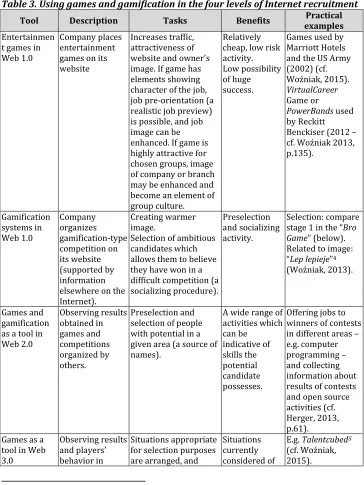
Table 3. Using games and gamification in the four levels of Internet recruitment
Tool Description Tasks Benefits examples Practical
Entertainmen t games in Web 1.0
Company places entertainment games on its website
Increases traffic, attractiveness of website and owner’s image. If game has elements showing character of the job, job pre-orientation (a realistic job preview) is possible, and job image can be enhanced. If game is highly attractive for chosen groups, image of company or branch may be enhanced and become an element of group culture.
Relatively cheap, low risk activity. Low possibility of huge success.
Games used by Marriott Hotels and the US Army (2002) (cf. Woźniak, 2015).
VirtualCareer
Game or
PowerBands used by Reckitt Benckiser (2012 – cf. Woźniak 2013, p.135). Gamification systems in Web 1.0 Company organizes gamification-type competition on its website (supported by information elsewhere on the Internet).
Creating warmer image.
Selection of ambitious candidates which allows them to believe they have won in a difficult competition (a socializing procedure).
Preselection and socializing activity.
Selection: compare stage 1 in the “Bro Game” (below). Related to image: “Lep lepieje”4
(Woźniak, 2013).
Games and gamification as a tool in Web 2.0 Observing results obtained in games and competitions organized by others. Preselection and selection of people with potential in a given area (a source of names).
A wide range of activities which can be indicative of skills the potential candidate possesses.
Offering jobs to winners of contests in different areas – e.g. computer programming – and collecting information about results of contests and open source activities (cf. Herger, 2013, p.61). Games as a
tool in Web 3.0
Observing results and players’ behavior in
Situations appropriate for selection purposes are arranged, and
Situations currently considered of
E.g. Talentcubed5
(cf. Woźniak, 2015).
4 The 2012-2013 Żywiec Breweries “Lep lepieje” campaign: Over a period of 56 days, Internet
games containing tasks analogous to those tested using AC (indicative of competencies sought), or to significant challenges in everyday work. more comprehensive information concerning motivation behind behavior in such situations is gathered.
critical significance for the success of the
organization can be tested. Hypotheses can be verified by repeating the test situation several times. Gamified contests and communicatio n activities as a tool in Web 3.0
Gamification is used in classic employer branding activities – such as the exchange of points for a trophy (e.g. tickets to a sponsored concert) – to encourage the development of fan clubs.
Increasing readiness to participate in an image-warming activity.
Real-life activities are part of the contest and can be taken into consideration.
Stimulating activity through organizational forms that are adjusted to young people.
The Bro Game, recruiting candidates for the Beerlovers.pl portal.6
Games as a tool in Web 4.0
Entertainment type game in which additional resources are obtained when a correct command is given.
If the task is relatively simple for players, the group of candidates increases.
Increased number of referrals in chosen
segments of the work market.
None.
Gamified forms of activities as a tool in Web 4.0
Points are collected for tasks, leading to valuable prizes.
Recommenders may become interested in cooperation on a permanent basis.
Increase in attractiveness of
recommending, with the costs of individual referrals
Points are collected as a reward for referrals according to the value of the position7
5 Start-up in Great Britain offering employer games which may be used for preorientation of
candidates (similar to the Marriot Hotel and the US Army games), which however also create a report on player competencies as secondary data for selection (Weeks, 2013).
6 The game has 3 stages: 1. A quiz that checks editing knowledge and skills, organized as a
journey of avatars, which are created by candidates on the website. Typical recruitment questions are also asked (alongside the knowledge test). 2. Traditional AC and trips to the brewery. 3. Interview (after: http://nowymarketing.pl/a/2062,gra-o-bro-socialowa-rekrutacja-do-portalu-dla-milosnikow-piwa-beerlovers-pl-wystartowala) (1.07.2014).
7 The system used in Hay Polska, where employee referrals are rewarded in points
retained on a low level.
Source: classification developed by the author, based on literature cited in Woźniak (2015, 2013)
Four generations of e-recruitment in the US and Poland
This part of the text is devoted to checking if the four types of e-recruitment tools are less common in Poland than in the US. We would like to verify the following hypotheses:
H1. Higher than first level e-recruitment tools are less common in Poland then in the US.
H2. The largest companies in Poland use higher levels of e-recruitment tools no less frequently than is common in the US.
The second hypothesis based on the assumption that HR processes in big enterprises are on an equal level, and thus implement the US standards of management. As discussed above, competencies required in higher levels of e-recruitment are available on the Polish business market, so there is no clear reason why big companies do not utilize them, at least for mimetic and employer brand reasons. We will verify this hypothesis by referring to two types of data – the State Main Statistical Office reports on information society in Poland (GUS, 2014) and observations of 300 www sites of the largest Polish enterprises (Wołodźko, 2014).
An obvious method of verifying the first hypothesis should be checking statistical data. As official statistical data does not present such detailed information, a main source of data can be the business sector, and in particular – consultancy reports. However, this source is not objective, as consultants have their own interests in presenting new tools as ones in common use, to create a bigger market demand for them. The second shortcoming of this source is usually the non-representative character of the survey and inadequate generalizations. Additionally, empirical data from branch reports on e-recruitment practices is very diverse, and much easier to obtain for the US than for Poland. Web searches yield several reports (the most important being Bullhorn and Jobvite for the US, and for Poland – Agora 2010, Pracuj.pl 2012 and interaktywnie.com 2011, as well as some scientific research on e-recruitment). We chose periods where some comparisons between Poland and the US were possible.
published by the firm Bullhorn shows that HR directors and recruiters from the US and all other Anglophone countries declare that they put recruitment advertisements on the LinkedIn site (the US – around 85%, the rest of the world – 75%), on Facebook (the US – around 25%, the rest of the world – 17%) and Twitter (the US – around 50%, the rest of the world - 28%) (Bullhorn, 2012). Only 9% of employers in the US stated that they did not use social media for recruitment (Jobvite, 2010).
We do not have representative data on e-recruitment use for Poland. The report cited below is based on Internet users only, and the samples are incidental and relatively small (ca. 100 representatives of employers). But by and large, job seekers in Poland declare that they use the Internet for every job search. Already in 2010 almost 100% of respondents stated that they had gone to websites and portals with employment offers in looking for work, and they ascribed the greatest effectiveness in obtaining it to such sites (at the level of personal recommendations, i.e., more than 2/3 chose them as being effective – report from Agora research on a test sample of 1200 Internet users, see the description in Woźniak, 2013).
According to data found in Polish branch reports, higher level e-recruitment may soon be standard in Poland, at least for large enterprises (interaktywnie.com 2011). However, even from these reports it is obvious that personnel departments in Poland use social networking communities to gather information about a specific candidate who was earlier identified as potentially interesting through Google-type searches. In research by the portal pracuj.pl, as many as 46% of the representatives of personnel departments indicated that verifying information contained in a CV on the basis of information that can be found about a candidate on the Internet is the recruitment practice that has the most chance of becoming universal in the next two years. For comparison, according to the American data published in the years 2006-2008, around 20-25% of employers surveyed declared that they had used social networking sites to verify information about candidates, while 40% stated that such a use would probably be introduced in the coming year (see the bibliographic references in Woźniak, 2013). The only trend that was more often mentioned by the respondents was the introduction of first-stage e-recruitment (62%): this may be interpreted as announcing job offers online and preselection on the basis of tests and automatic methods of appraising applications.
Facebook, and only 17% had conducted branding activity there, publishing their profiles as employers. Recruitment actions using Facebook were conducted by 5% of employers, although it is not known whether respondents, in choosing such an answer, were thinking of collecting information about candidates or only promoting recruitment or internship offers on the site. Only 2% of respondents stated that they obtained candidates thanks to contextual advertising (Pracuj.pl, 2012, p.14)8.
An even more optimistic approximation can be found in the scientific literature. Wawer and Muryjas (2011, p.116), for example, based on a questionnaire with 105 employers from the poor regions of Poland (Lubelskie), stated that 56% employers put job offers on their websites, 49% on recruitment sites (wortals) and 27% on social networking websites. However, representative research based on 19,000 companies (18% of all companies in Poland with over 10 employees) conducted by the Polish Main Statistical Office in 2014 shows that only 2/3 of enterprises have their own website (no increase from 2010) – 91% large companies, 85% medium and only 61% small ones. Only in the group of medium companies is the increase is larger than 3%9. A company website is used primary for offering information about the company’s products (product catalogues – 60%). For recruitment purposes (“Advertisement of open job positions or online job application”), only 16% companies use their own websites (no change from 2013). There are big differences in this respect between large and small companies, and between sectors – 63% of the large companies offer openings on their websites, 30% - medium companies and 12% - small companies. An increase since 2013 is only in the group of large enterprises (by 5%). Sector-wise, companies using their own website for recruitment purposes are: ICT (47%), professional, scientific and technical activities (26%), financial and insurance activities (30%), construction and accommodation/catering are among the smallest in this respect (respectively – 11% and 14%) (GUS, 2014, p.65-67). The websites created by companies are relatively simple – in 2013, research on websites of the 300 biggest enterprises in Poland showed that Internet applications were possible in only 49% cases (44% ask for email applications, which do not make automatic preselection possible), testimonials were present on 15% of websites but information about the CEO on 1/3 (the CEO’s photo on 28% and his/her name on 37%) (Wołodźko, 2014).
This data shows that a fundamental tool – the company’s website – is standard only for large enterprises. Nothing strange that usage of social
8 E-survey among 510 HR workers – client of one of biggest Polish wortals pracuj.pl.
9 This survey is a part of Eurostat research – average for EU is 73%, highest in Finland (94%),
media – the base for e-recruitment of higher levels – is so infrequent. 19% of all companies declare usage of social media (40% of large ones, 25% of medium ones and 17% of small ones). The increase between 2013 and 2014 is 10%, 5% and 2% respectively. The survey analyses some other social media, such as blogs (used by 3% in total, 12% in large companies), multimedia content-sharing websites (9% for total, 24% for large), Wiki tools (3,5% for total, 10,5 for large) (GUS, 2014, p.69), but low percentage and imprecise definitions of terms in question in everyday speech suggests that this data shows only that their usage is low. It should be stressed that the increase in the scope of e-recruitment methods in Poland is very slow. The spread of recruitment with the help of a company's own employees or crowdsourcing is still at an early stage in both countries (i.e. Poland and the US). It should be clearly noted that the use of higher e-recruitment tools depends not only on actual access to technical instruments and personnel departments' competence in their use, but above all on the needs created by the local labor market. India has a difficult labor market in the IT segment, and thus constitutes a good testing ground for new recruitment practices. Apparently, as many as 57% of the employers studied there used recruitment practices based on crowdsourcing (Woźniak, 2013).
The use of gamification on the Polish market started around 2010, when the first start-ups offering products for marketing purposes were established10. In 2013, at least 5 companies offering gamification products were active on the Polish market, but no recruitment project is known. On the US market, several dozen companies are active (among them: Badgeville, Bunchball, Gygia czy Bigdoor), and some of them already have a capitalisation of 50 million US$ (Cybulski, 2014). The reader may find a long list of examples in Herger’s book (2014).
However, some data gives different estimates of the universality of e-recruitment even in the United States. For instance, CareerXroads SOH 2/2012 notes that only 20% of persons hired in the course of the last year by the companies it studied came from recruitment company websites, and 10% came from the companies' own websites. Such statistics testify that the spread of e-recruitment is occurring gradually in the United States as well.
10 “In the US, gamification started to be popular in 2010, with the launching of such companies as
Conclusions
Online recruitment is the fastest developing area in the application of Internet technology to managing human resources. The continual variability of the instruments used in this field hinders a theoretical understanding of its specifics. The aim of this paper was to propose a typology to narrow this gap in the scientific understanding of e-recruitment.
This text has presented the differences in online recruitment methods by distinguishing four stages of e-recruitment development, together with an indication of the conditions that safeguard success in the use of a given type. An assessment of the application of e-recruitment methods in Poland and the US was proposed, using this typology. The proposed classification allows us to show – based on statistical data from consultancy reports and the Polish Main Statistical Office – that although access to the Internet is similar in Poland as in the US, higher level e-recruitment is decidedly less widespread in Poland.
The scientific contributions of this paper are as follows: 1. Proposing a typology of recruitment methods.
2. Describing determinants of the successful use of each of the four generations of tools.
3. Showing the utility of the proposed typology by assessing the scope of e-recruitment practices in Poland and the US.
4. Analyzing the possibility of using gamification and games at each of the four levels of e-recruitment.
5. Opening a new field of research based on the proposed typology and level of e-recruitment maturity.
It should be emphasized that the author’s conclusions in this article are based on a specific kind of data on Internet users in Poland and in the US, namely consultancy reports. Despite how increasingly widespread access to the Internet is in both Poland and the US, studies based on Internet users’ opinions do not take into account large social groups or the companies who work mainly with these groups.
new technologies is an important status factor, so the opinions are under the stress of social pressure. Data cited in the last paragraph of section 5 may prove this suspicion – at least partially – true. It would be a strong limitation of presented data as a description of actual practice, however – not as the description of potential usefulness of the different e-recruitment tool.
This last remark shows the most important new avenue for further research. Assuming that we know how to apply e-recruitment tools, what are the factors – taking into account organization, labor market segment and country – that favor their use, and what factors hinder it. This type of research needs more data from different markets, which would allow large enough groups of variables to be compared and conclusions concerning interrelationships to be drawn.
A second avenue for further research is getting a better understanding of factors which facilitate the use of each e-tool. The text stresses the role of company websites as the place where almost all activity takes place, but this is not enough by far. Low competency of HR departments and the lack of need for better recruitment procedures are obvious obstacles for the application of any new tool, even if its usage is technically already possible. But why are some tools in use earlier than others? Is this purely incidental, or is it based on ease of usage? A better understanding of the psychological, social and economic factors which are important for develop introduction of some of the e-recruitment tools will support our knowledge about the dynamics of new technology usage, which is still based on the old and simplistic Technology Acceptance Model (Davis, Bagozzi & Warshaw, 1989).
References
Afuah, A., and Tucci, C.L. (2012). Crowdsourcing as a Solution to Distant Search. Academy of Management Review, 37(3), 355–375.
Allen, D.G., Mahto, R.V., and Otondo, R.F. (2007). Web-based recruitment: Effects of information, organizational brand, and attitudes toward a Web site on applicant attraction. Journal of Applied Psychology, 92(6),1696–1708. Armstrong, M. (2011). Zarządzanie zasobami ludzkimi[Human Resource
Management]. Warszawa: Wolters Kluwer.
Banerjee, P., and Tiwari,A.K. (2013).Factors Affecting Job-seekers’ Perceived Credibility of Online Job Advertisements: A Review. Asia Pacific Journal of Research in Business Management, 4(8-9), 1-17.
Brake, D.R. (2013). Are We All Online Content Creators Now? Web 2.0 and Digital Divides. Journal of Computer-Mediated Communication. doi:10.1111
Breaugh, J.A. (2008). Employee Recruitment: Current Knowledge and Important Areas for Future Research. Human Resource Management Review, 18(3), 103-118.
Bullhorn (2012). Country Report 2012. Retrieved from http://www.bullhorn.com. Cable, D.M., and Turban, D.B. (2003). The Value of Organizational Reputation in the
Recruitment Context: A Brand-Equity Perspective. Journal of Applied Social Psychology, 33(11), 2244–2266.
Crispin, G., and Mehler, M. (2012). Sources of Hire: Channels that Influence. CareerXroads SOH 2/2012 Retrieved from:http://www. Slideshare.com. Cybulski A. (2014). Grywalizacja to następny krok w marketingu (wywiad)
[Gamification – Next Step in Marketing - Interview]. Retrieved from
http://troyann.pl/grywalizacja-nastepny-krok-marketingu-wywiad-arkiem-cybulskim-gamfi.html.
Davis, F.D., Bagozzi, R.P., and Warshaw, P.R. (1989). User Acceptance of Computer Technology: A Comparison of Two Theoretical Models. Management Science, 35(8), 982-1003.
Deterding, S., Dixon, D., Khaled R., and Nacke, L. (2011). From game design elements to gamefulness: defining gamification. In Proceedings of the 15th International Academic MindTrek Conference:Envisioning Future Media Environments (pp. 9-15). New York: ACM.
GUS [the Polish State Main Statistical Office]. (2014). Społeczeństwo informacyjne w Polsce. Wyniki badań statystycznych 2010-2014 [Information society in Poland – statistical data 2010-2014]. GUS: Warszawa.
Girard, A., and Fallery, B. (2010). Human Resource Management on Internet: New Perspectives. The Journal Contemporary Management Research,4(2), 1-14. Hamari, J., Koivisto, J., and Sarsa, H. (2014). Does gamification work?--a literature
review of empirical studies on gamification. In Proceedings of 47th Hawaii International Conference on System Sciences (HICSS) (pp. 3025-3034). doi>10.1109/HICSS.2014.6.
Herger, M. (2014). Gamification in Human Resources. Engaging people by letting them have fun. CreateSpace Independent Publishing Platform.
Hoye v.G. (2013). Recruiting Through Employee Referrals: An Examination of Employees’ Motives. Human Performance, 26(5), 451-464.
Interaktywnie.com (2011). Rekrutacja w internecie – raport [Recruitment in Internet – raport]. Retrieved from
http://www.interaktywnie.com/index/index/?file=raport_rynek_pracy...inter necie.
Jeffery M. (2012). Rekrutacja 4.0, czyli spojrzenie w przyszłość [Recruitmrent 4.0 - a Glimpse into Future]. In Rekrutacja 2012. Retrieved from
http://hrstandard.pl/raport-rekrutacja-2012.
Jobvite Social Recruiting Survey (2010). Retrieved from http://www.jovvite.com. Kapp K. (2014). Gamification: Separating Fact from Fictio. Chief Learning Officer,
March. Retrieved from www.CL)media.com .
Keller, K.L. (2003). Brand Synthesis: The Multidimensionality of Brand Knowledge. Journal of Consumer Research, 29(4), 595 - 600.
Listwan, T. (Ed.) (2010). Zarządzanie kadrami[People management]. Warszawa: Beck.
Niewęgłowski, M. (2012). Gamification: na zdrowie, dla społeczeństwa i lepszej pracy [Gamification for health society and work]. Raport Game Industry Trends 2012, Nowy Marketing 2012, 68–69.
Pracuj.pl (2011). Wyzwania HR w 2012 [Challenges for HR in 2012]. Retrieved from http://www.hrtrendy.pl/dokument-hr/118.
Runiewicz-Wardyn, H. (2008). Towards building e-learning environment in Poland. Warszawa: WaiP.
Selden, S., and Orenstein, J. (2011). Government e-Recruiting Web Sites: The Influence of e-Recruitment Content and Usability on Recruiting and Hiring Outcomes in US State Governments. International Journal of Selection and Assessment, 19(1), 31 - 40.
Strohmeier, S., and Kabst, R. (2009). Organisational adoption of e-HRM in Europe: An empirical exploration of major adoption factors. Journal of Managerial Psychology, 24(6), 482 - 501.
Stone, D.L., Lukaszewski, K.L., Stone-Romero, E.-F., and Johnson, T.L. (2013). Factors Affecting the Effectiveness and Acceptance of Electronic Selection Systems. Human Resource Management Review, 23(1), 50-70.
Sullivan, J. (2014). ‘Friends of the Firm’ Referrals – Expand Referals to
Non-Employees. Retrieved from http://www.ere.net/2014/02/10/friends-of-the-firm-referrals-expand-referrals-to-non-employees/.
Tkaczyk, P. (2012). Grywalizacja. Jak zastosować mechanizmy gier w działaniach marketingowych [Gamification in marketing]. Gliwice: Helion.
Vătămănescu, E.-M., and Constantin, F.I. (2015). Facebook Usage as Social
Screening. Exploring the Approach of Admissions Officers from Management Colleges. Management Dynamics in the Knowledge Economy, 3(1), 61-77. Wołodźko, K. (2014). Ocena wpływu wybranych wartości osobistych jako czynników
zwiększających atrakcyjność organizacji w procesie rekrutacji internetowej [Assessment of CSR values and information as a tool for employer branding in e-recruitment]. Unpublished MA thesis, Wyższa Szkoła Finansów i Zarządzania w Warszawie.
Wawer, M., and Muryjas, P. (2011). E-rekrutacja w realizacji strategii biznesu w Polsce [E-Recruitment as a Strategy Tool for Business in Poland]. Uniwersytet Szczeciński Zeszyty Naukowe, 651(68), 112-120.
Woźniak, J. (2006). Zarządzanie wiedza w firmie szkoleniowej [Knowledge Management in Training Company]. Olsztyn: OWSIiZ.
Woźniak, J. (2009). Model zarządzania efektywnością procesu szkoleniowego. Olsztyn: OWSIiZ.
Woźniak, J. (2013). Rekrutacja – teoria i praktyka [Recruitment and selection - theory and praxis]. Warszawa: WP PWN.
Woźniak, J. (2014a). Crowdsourcing jako czwarty etap rekrutacji internetowej [Crowdsourcing as the forth stage of e-recruitment]. Zarządzanie Zasobami Ludzkimi, 1(96), 27-40.
Woźniak, J. (2014c). On a typology of e-recruitment methods and its’ consequences, Proceedings of The International Conference Global Economics and
Governance 2014, Bucharest, Romania.
Woźniak, J. (2014d). On Evaluating e-Recruitment Maturity with a Typology of Its Methods, International Journal of Engineering Science and Innovative
Technology (IJESIT), 3(6), 223-232.
Woźniak, J. (2015). Grywalizacja w zarządzaniu ludźmi [Gamification in HR]. Zarządzanie Zasobami Ludzkimi, 2(103), 11-34.
Yüce, P., and Highhouse, S. (1998). Effects of Attribute Set Size and Pay Ambiguity on Reactions to ‘‘help wanted’’. Advertisements. Journal of Organizational Behavior, 19(4), 337–352.