A Practical Approach to Testing Calibration Strategies
∗Yongquan Cao† Grey Gordon‡
January 3, 2018
Abstract
A calibration strategy tries to match target moments using a model’s parameters. We propose
tests for determining whether this is possible. The tests use moments at random parameter draws to assess whether the target moments are similar to the computed ones (evidence of existence) or
appear to be outliers (evidence of non-existence). Our experiments show the tests are effective at
detecting both existence and non-existence in a non-linear model. Multiple calibration strategies
can be quickly tested using just one set of simulated data. Applying our approach to indirect inference allows for the testing of many auxiliary model specifications simultaneously. Code is
provided.
JEL Codes:C13, C51, C52, C80, F34
Keywords:Calibration, GMM, Indirect Inference, Existence, Misspecification, Outlier Detection, Data Mining
∗
We thank Juan Carlos Escanciano, Pablo Guerron-Quintana, Amanda Michaud, Stefan Weiergraeber and two ref-erees for helpful comments. All codes for this paper are available athttps://sites.google.com/site/greygordon/research.
†
Indiana University,[email protected].
‡
1
Introduction
Most calibration approaches are, in effect, generalized method of moments (GMM).1GMM assumes
the existence of parametersθ∗ such that a model’s momentsm(θ) match target momentsm∗, i.e., m(θ∗) =m∗. The parametersθ∗ are identified if m(θ)6=m∗ for all θ6=θ∗. If these conditions are satisfied,θ∗ can be found as the solution of
min
θ∈Θ(m(θ)−m
∗)0W(m(θ)−m∗) (1)
where Θ is the parameter space andW is a positive definite weighting matrix (often diagonal). In this paper, our objective is to test whether a θ∗ satisfying m(θ∗) = m∗ exists without explicitly solving (1), a computationally costly and error-fraught process for many economic models. We use
the term calibration strategy to reflect the particular choice of moments used for identification, noting that a researcher typically has multiple choices available to them.2
Our approach generates i.i.d. random draws of θ from a distribution G (chosen by the user).
In many cases, Θ is a hypercube and G is the uniform distribution over it. Using the draws {θi}
and associated moments {m(θi)} as data, we test whetherm∗ is an “outlier” with respect to the
distribution of moments induced by G. If so, we take it as evidence that θ∗ does not exist. For
simplicity, we treat the moments as being without sampling error, but practically speaking this
makes no difference for our proposed techniques.
We employ three tests, two straightforward statistical methods and one from the data-mining literature. The first uses regressions to determine the relationship between one component ofmand
all the other components. We then assess whether them∗ observation is an outlier using standard-ized residuals, leverage, and Cook’s distance. The second test measuresm∗’s Mahalanobis distance, a measure closely related to the log-density of the multivariate normal. Under an assumption that
the moments are normally distributed, the probability of encountering a moment with a worse
Ma-halanobis distance is easily calculated. A low probability suggests thatm∗ is an outlier. The third
test computes m∗’s local outlier factor (LOF), a measure proposed by Breunig, Kriegel, Ng, and
Sander (2000). The LOF is closely related to a ratio of densities estimated non-parametrically via
a k-Nearest Neighbor (kNN) algorithm. A high LOF form∗ suggests it has a small density relative to its neighbors’ and hence is an outlier.
We assess our proposed tests using a real-life example of challenging existence issues given in
Chatterjee and Eyigungor (2012). There, three parameters (the discount factor and two default
cost parameters) are used to target three moments (average interest rate spreads, their standard
deviation, and the debt-output ratio). This model provides a useful test case for four reasons.
First, the moments are tightly connected to one another, which illustrates some of the difficulties
1Hansen and Heckman(1996) provide an overview of the relationship between calibration as proposed byKydland
and Prescott(1982) and estimation.
2For concreteness, imagine there are 2 moment statistics {a, b} known from the data and model but only 1
frequently encountered in calibration. Second,Chatterjee and Eyigungor(2012) show the long-term
debt case gives existence for their calibration strategy, and our tests confirm this. Third, our results show the short-term debt case does not give existence, indicating our tests can accept or reject
calibration strategies. Last, default decisions and a discrete state space create many local minima
in (1). Consequently, solving directly for θ∗ requires a thorough and time-consuming search of the parameter space, which highlights the usefulness of applying our low-cost tests before calibrating.
We also show how to quickly test multiple calibration strategies. This is particularly useful
because researchers often use only a few moments as targets, reserving the rest for testing the
model’s non-targeted predictions (a procedure Hansen and Heckman, 1996, call calibration and
verification).3 Hence, a researcher need not pick moments, run a costly minimization routine, and
then see whether it found aθ∗ such thatm(θ∗) =m∗. Rather, they can solve a model for multiple parameter values, check many different moment combinations all at once, and then attempt to solve
(1) only for combinations that seem to give existence (or modify the model to better fit the data).
While we have motivated our approach in terms of GMM, it can also be useful in indirect
inference as developed by Smith (1993); Gourieroux, Monfort, and Renault (1993); Gallant and
Tauchen (1996); and others. With indirect inference, the moments to be matched are determined
by an auxiliary model and may be parameters of the auxiliary model (like in Smith, 1993) or its
score (like inGallant and Tauchen,1996). Given them, our method applies in straightforward way,
and we explicitly show how in an example using vector autoregressions (VARs) and their score.4
We test for non-existence—an indication that the deep (non-auxiliary) model is misspecified—and
find the long-term debt specification can give existence or not depending on which variables are
included in the VAR. In contrast, the short-term debt does not give existence for any of the seven VAR specifications we consider.
Our approach is designed to test existence, i.e., whether there is a θ∗ such that m(θ∗) = m∗. However, it can also aid in identification. For concreteness, suppose existence holds for an “over-identified” calibration strategy m in the sense that dim(m) >dim(θ). In that case, existence also
holds for any calibration strategy ˜mthat requires only a subset ofm’s moment conditions. However,
the parameters identified bym, namely{θ|m(θ) =m∗}, are a subset of the parameters identified by ˜
m, namely{θ|m(θ) = ˜˜ m∗}.5 Hence,mshould be preferred over ˜mon the grounds of identification.
In our Chatterjee and Eyigungor (2012) application with long-term debt, we found a calibration
strategy with 6 moments for which, according to our tests, existence holds. If existence does hold,
then since there are only three parameters, there would be 41 (= 63
+ 64
+ 65
) calibration
strategies consisting of three or more moments that also give existence but are dominated in terms
of identification (and one of these is the strategyChatterjee and Eyigungor,2012, use).6This shows
3E.g., this is done inKydland and Prescott (1982), where the correlations are non-targeted, andChristiano and
Eichenbaum (1992), where labor market moments are left non-targeted. Christiano and Eichenbaum (1992) and Hansen(2008) discuss how to formally test the fit of the non-targeted moments.
4Feldman and Sun(2011) also validate econometric specifications by using simulated model data. 5
If the model is identified undermand ˜m, then both sets will be a singleton, but in general the parameters are only set-identified. The ˜m∗appearing in the{θ|m˜(θ) = ˜m∗}is the appropriate subset of moments inm∗.
6
that in addition to reducing the cost of calibration, testing multiple calibration strategies should
also aid in identification.
To ease adoption of our proposed approach, we provide two types of code. The first is a Fortran
subroutine that uses MPI to compute the {(θi, m(θi))} draws in parallel. This allows for efficient
testing even if the routine for computingm(·) is single-threaded (but it may be multiply-threaded with OpenMP). Optionally, it will also use these draws as part of a global optimization algorithm
that can be used to solve (1). The second type of code is a Stata do-file that imports the Fortran
results, runs all our tests, and produces reports and graphs indicating potential problems with the calibration strategy (or strategies in the case where testing multiple combinations is desired).7
1.1 Related literature
We test existence by asking whether the target moments are outliers. While we have considered three tests, there are in fact many others, all of which could be useful. A number of traditional statistical
methods and references are described inBollen and Jackman(1990) andBen-Gal(2005). The
data-mining literature also contains many other methods. Examples include Kriegel, Kr¨oger, Schubert,
and Zimek(2009)’s “Local Outlier Probabilities,”Zhang, Hutter, and Jin(2009)’s “Local
Distance-based Outlier Factor,” Ramaswamy, Rastogi, and Shim (2000)’s selection of outliers according to
kNN-distance ranking, andAngiulli and Pizzuti (2002)’s weighted kNN distance method.
Our focus on existence is complementary to an extensive literature on identification dating
back to at least Koopmans and Reiersol (1950). Several tests have been proposed for checking
identification problems, including those discussed in the surveyStock, Wright, and Yogo(2002) and
proposed byCanova and Sala(2009). While our approach can eliminate some calibration strategies
on the grounds of identification, once that has been done it has nothing else to say regarding
identification. Consequently, tests like the ones discussed in these papers are indispensable. A smaller literature examines the consequences of favoring certain observables over others in
estimation, analogous to our examining combinations of moments that give existence. Building
on Sargan (1958, 1959), Hansen (1982) characterizes GMM’s consistency and efficiency for many
different types of weighting matrices. As a special case, these index all the moment combinations
we consider.8 Guerron-Quintana(2010) considers how selection of observables impacts DSGE
esti-mation, and Canova, Ferroni, and Matthes (2014) propose and analyze selection procedures.
rate spread, the mean debt-output ratio, and the relative standard deviation of net exports and of consumption. For these, the LOF is 0.99 and 1.02 when taking k = 20 and 40, respectively. Moreover, assuming normality, the probability of encountering a moment with Mahalanobis distance worse than the target moment’s distance is 72%. As we discuss later, these measures strongly suggest existence.Chatterjee and Eyigungor(2012) use the mean and standard deviation of the spread and the mean debt-output ratio.
7The tests we propose are simple enough to implement in other languages like Matlab or Fortran. We chose Stata
because it is well-known, cross platform, and has built-in functions that are helpful in the statistical analysis.
8Specifically,Hansen(1982) considers whatHansen(2008) calls selection matricesA, having dimensionsr×dim(m)
Hansen (1982),Stock and Wright(2000), and Kleibergen(2005) all derive asymptotic
distribu-tions of funcdistribu-tions of the optimal estimator that can be used to conduct hypothesis tests in finite
samples. E.g., Hansen’s shows that, with the optimal GMM estimator, the GMM objective (1)
times the sample size is distributedχ2 atθ∗. With lack of existence, the same statistic explodes as the sample size grows.9 The key distinction between these tests of existence and ours is that they require finding a θ∗ first—a procedure that is often costly and error-prone—and then using it to
form a null hypothesis. Our approach circumvents this by looking at the distribution of m(θ) to
infer whether aθ∗ giving m(θ∗) =m∗ is likely to exist.
2
Checking existence for a given strategy
In this section, we develop a multi-pronged approach to testing existence. We evaluate the
per-formance of our tests using the sovereign default model of Chatterjee and Eyigungor (2012). We
mention just a few aspects of it here in order to define the parameter space; a thorough description is
given in AppendixB. In the model, a sovereign with stochastic endowment streamydiscounts future utility at rateβ. If he defaults, the endowment is exogenously reduced byφ(y) = max{0, d0y+d1y2}
(where d1 ≥0). For long-term debt,Chatterjee and Eyigungor(2012) findβ = 0.954, d0 =−0.188
and d1 = 0.246 deliver the targeted moments (the model period taken to be a quarter). We set
the parameter space to be (β, d0, d1) ∈[0.94,0.98]×[−0.5,0]×[0,0.5] and take G as the uniform
distribution over it. Our methods only test the existence of θ∗ ∈ Θ. For example, if m(θ∗) = m∗ only for θ∗ = (0.5,−0.2,0.2), the tests should indicate non-existence since θ∗∈/ Θ.10 Our sample is 1000 draws.
2.1 Joint-moment restrictions
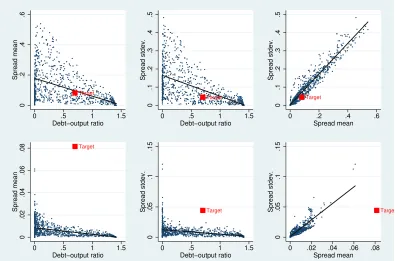
Figure 1 shows pairwise plots of the three moments for long-term debt (the top panel) and
short-term debt (the bottom panel). The figure reveals clear connections between moments, which we refer
to as “joint-moment restrictions.” For long-term debt, the graphs visually reveal that the target
moments appear to satisfy the joint-moment restrictions in that the target moments (indicated by the red squares) fall within the clouds of simulated data. However, because the moment conditions
are only pairwise, this may be misleading in that matching 2 of the moments simultaneously does
not imply matching 3 simultaneously will be possible.11 What cannot be misleading is the
short-term debt case where the target moments are far away from the pairwise joint-moment conditions
in each case. Note that, for short-term debt, the target spread standard deviation and debt-output
9
As we have assumed there is no sampling error in the moments, these hypothesis tests in our context have an infinite sample size and, with lack of existence, the test statistic is “infinite.”
10
Chatterjee and Eyigungor(2012) do not estimate the short-term debt case. However, in a similar modelGordon and Guerron-Quintana(2017) find it is possible to match the same moments as they do when usingβ= 0.44. We consider this value implausibly low, and so restrict the parameter space to more conventional values.
11
ratio can likely be matched individually: The support of the debt-output ratio covers the target
debt-output ratio, and likewise for the spread standard deviation. However, the two statistics cannot be matched simultaneously. While graphing all the pairwise cases is helpful here, as the number of
moments grows, this becomes increasingly costly from a user’s perspective.
Target 0 .2 .4 .6 Spread mean
0 .5 1 1.5
Debt−output ratio Target 0 .1 .2 .3 .4 .5 Spread stdev.
0 .5 1 1.5
Debt−output ratio Target 0 .1 .2 .3 .4 .5 Spread stdev.
0 .2 .4 .6
Spread mean Target 0 .02 .04 .06 .08 Spread mean
0 .5 1 1.5
Debt−output ratio Target 0 .05 .1 .15 Spread stdev.
0 .5 1 1.5
Debt−output ratio Target 0 .05 .1 .15 Spread stdev.
0 .02 .04 .06 .08 Spread mean
Long−term (short−term) debt is in the top (bottom) panel. Black lines give best linear fits.
Figure 1: Joint-moment restrictions
2.2 Leverage, error, and Cook’s distance
To handle these failures of a purely graphical approach, we attempt to capture the link between
a moment mj (a superscript here and throughout denotes a vector component) and all the other
moments using a flexible OLS specification. Specifically, we regress a single component of mj on
interactions of the all other componentsm1, . . . , mj−1, mj+1, . . . , mdim(m)and a constant. Our code lets the user specify the order of interactions desired, and in our example we use a second order,
i.e., the regressors are 1, mk, mkml for k, l6=j. However, in this regression, we include one “fake”
data point, the components ofm∗. We then formally test whether the target moments are an outlier
from the viewpoint of the regression model. If so, we consider it evidence that θ∗ ∈ Θ does not
exist.
We employ three measures—standardized residuals, leverage, and a combination of the two called Cook’s distance—to determine whetherm∗ is an outlier. First, we consider where the targets fall in terms of standardized residuals. That is, we take the error termeji (where a subscript denotes
roughly normally distributed, the familiar rules of thumb may be used to interpret ε∗j (the error form the target moment observation). A large value, say greater than 4 or 5 (in absolute terms), would occur with low probability and so suggestm∗ is an outlier; a value less than 1 would suggest the opposite.
Figure2presents this measure for our example. For the long-term debt version, the standardized residuals for the target moments are within ±1 standard deviations. This suggests that given the
underlying joint-moment restrictions, the targets are not unreasonable. However, for the
short-term debt version, the targets are unreasonable. E.g., the spread mean is 17 standard deviations too high. This indicates that the model, conditional on matching the target debt-output ratio and
target spread standard deviation, would require an absurdly high error to match the target spread
mean. Target 0 .05 .1 .15 Leverage
−4 −2 0 2
Standardized residuals Target’s Cook’s distance: 0.00058
Debt−output ratio Target 0 .02 .04 .06 .08 .1 Leverage
−5 0 5
Standardized residuals Target’s Cook’s distance: 0.00028
Spread mean Target 0 .02 .04 .06 .08 Leverage
−4 −2 0 2 4 6
Standardized residuals Target’s Cook’s distance: 0.00022
Spread stdev. Target 0 .2 .4 .6 .8 1 Leverage
−2 −1 0 1 2 3
Standardized residuals Target’s Cook’s distance: 9.16897
Debt−output ratio Target 0 .1 .2 .3 .4 .5 Leverage
−5 0 5 10 15
Standardized residuals Target’s Cook’s distance: 7.97746
Spread mean Target 0 .2 .4 .6 .8 Leverage
−15 −10 −5 0 5
Standardized residuals Target’s Cook’s distance: 231.41241
Spread stdev.
Long−term (short−term) debt is in the top (bottom) panel. Black lines give a leverage rule of thumb.
Figure 2: Outlier tests
Our second measure is leverage. Leverage is always between 0 and 1 and indicates how much
influence a particular datapoint has on the regression coefficients (Bollen and Jackman, 1990, p.
262). Formally, the leverage of an observation i is defined as the i-th diagonal of the matrix H
such that ˆmj =Hmj where ˆmj are the predicted values and mj the actual (Bollen and Jackman,
1990, p. 262).12 If the observation corresponding to the target moments has large leverage and a
large error, it means that it does not fit into the pattern implied by the other moments. If the
target moments have high leverage and low error, this may indicate that the moments fit into the
12
underlying pattern, but theθdeliveringm(θ)≈m∗ are unusual in some way. For instance, it could indicate the solution θ may not be in the interior of the parameter space. Alternatively, it could
be that G(θ) places very low probability on θnear θ∗. Bollen and Jackman(1990) summarize the
rules of thumb for when an observation has high leverage. For p the number of regressors, these
range fromp/n (the mean leverage value) to 3p/n(p. 262).
Figure 2 reports leverage on the vertical axis. In the example,p= 6 and n= 1000 so the rules
of thumb range from 0.006 to 0.018, and the larger of these is displayed as a black, horizontal
line. For the long-term debt moments, all the leverage values fall well below this cutoff. Hence, the target moments seem to satisfy the joint-moment restrictions. For the short-term debt version, the
leverage exceeds the cutoff for all the statistics indicating the target moments do not satisfy them.
Our last regression-based measure is Cook’s distance. Cook’s distance combines leverage and the standardized residual into a single number. Formally, lettinghji andeji denote the leverage and
(non-standardized) error of observationiand componentj, Cook’s distance is (1/p)hji(1−hij)−2(eji)2/s2 wheres2 is the regression’s mean squared error (Bollen and Jackman,1990, p. 266). There are two rules of thumb for this measure. One says a Cook’s distance greater than 1 is suspicious, and the
other uses a cutoff of 4/n instead (Bollen and Jackman, 1990, p. 268). For long-term debt, the
largest value is 0.0006, and so the target moments seem to satisfy the joint-moment restrictions according to both cutoffs. The opposite is true for short-term debt where the smallest Cook’s
distance is 8.0 and the largest is 231.
2.3 Mahalanobis distance
A conceptually simple parametric multivariate outlier detection method is given by considering the
Mahalanobis distance. The Mahalanobis distance dis defined as
d(m) = (m−µ)0Σ−1(m−µ)1/2
where µ is the sample mean and Σ is the sample variance-covariance matrix.13 Assuming that
m∼N(µ,Σ),d(m)2 is distributed χ2dim(m).14Consequently, the probability ofd(m)2 being greater thand(m∗)2 is given by
P r(d(m)2 ≥d(m∗)2) = 1−χ2dim(m)(m∗),
which also equals P r(d(m) ≥d(m∗)). Hence, the probability of encountering an observation with greater Mahalanobis distance than the target moments’ distance is 1−χ2dim(m)(m∗). We refer to this statistic as the M-test value. For our example, long-term (short-term) debt has a M-test value
13Penny and Jolliffe(2001) andBen-Gal(2005) provide examples of using the Mahalanobis distance for detecting
outliers.Gnanadesikan(1997) callsd2 the squared generalized distance (p. 48).
14Gnanadesikan(1997, p. 48) makes a general claim of this. Formally, the result may be had by convertingmto a
standard normalzviaz=A−1(m−µ) forAA0the Cholesky decomposition of Σ. Thend2(m) = (m−µ)0Σ−1(m−µ) = (m−µ)0(A−1)0A−1(m−µ) =z(m)0z(m) =Pdim(m)
j=1 z
j
of 0.59 (6×10−63). This suggests the long-term debt target moments could plausibly be generated by aθ∈Θ but clearly not for short-term debt.
2.4 Local Outlier Factors
The main drawback of the Mahalanobis distance test in the preceding section is the assumption of
normality.Breunig et al.(2000)’s local outlier factor (LOF) improves on this by non-parametrically
estimating something akin to a density. Formally, consider some set X and some metric d(., .).
Let Nk(x) denote the k-nearest neighbors of x ∈ X. Here, we assume Nk(x) is unique for each
x to simplify exposition (Breunig et al., 2000, handle the general case). Define the “k-distance” as k(x) = maxo∈Nk(x)d(x, o), which is the radius of the smallest closed ball containing the
k-nearest neighbors of x. A “reachability distance” from x to some point p is defined as rk(x, p) =
max{k(p), d(x, p)} (note that generally rk(x, p)6=rk(p, x)).
Only one more definition is needed before defining the LOF. The “local reachability density” is
defined as
lrdk(x) =
1 k
X
p∈Nk(x)
rk(x, p)
−1
,
the inverse of the average reachability distance. A relatively high value means x can be easily
reached (rk(x, p) is low) fromx’sk-nearest neighbors (and hence in some sense has a large density). The LOF is defined as
LOFk(x) =
1 k
X
p∈Nk(x)
lrdk(p) lrdk(x) ,
which is the mean of the local reachability densities of x’s k-nearest neighbors relative to that of
pointx. Hence, ifLOFk is large,xis further from its neighbors (lrdk(x) is small) thanx’s neighbors are from their neighbors. An LOFk value close to or less than 1 indicates that x is not an outlier
while a value much greater than 1 suggests xis an outlier.
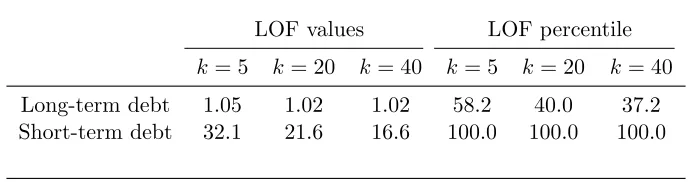
Table 1 reports LOF values for the long and short-term debt cases. There is no consensus on
the best value ofk, but there is some evidence to suggests kbetweenn1/4 ton1/2 are reasonable.15
Because LOF values greater but not much greater than 1 are hard to interpret, we also computed
the target moments’ LOF percentile among all the moments.16 The percentile is computed as
100×(rank −1)/(n−1) where rank = n means the observation had the highest LOF in the
sample.
15
Loftsgaarden and Quesenberry(1965) propose a consistent non-parametric density function estimator that uses the distance from a point to its kNN. They suggestk=n1/2 gives “good results” empirically (p. 1051). Enas and Choi(1986) quantitively investigate optimal values of kin the context of kNN classification (assigning observations to groups based on their kNN distance) and conclude values ofn2/8 ton3/8 are best (p. 244). The results inKriegel et al.(2009) can be sensitive to the value ofk, but for the range we consider (5 to 40) they seem to be robust.
16
An advantage of LOF is that one need not compute the lrdk or rk for all points, only for the neighbors of a
For long-term debt, the LOF values and percentiles suggest the target moments are not outliers
as the largest LOF value is 1.05 (and hence the “density” is only 5% percent lower at the target moments) and the percentiles are not large. However, for short-term debt, all the LOF values are
greater than 16 and the percentiles are all 100% (the latter implying that the target moments
have the largest LOF of all the moments). This forcefully suggests that m∗ is an outlier for the short-term debt model.
LOF values LOF percentile
k= 5 k= 20 k= 40 k= 5 k= 20 k= 40
Long-term debt 1.05 1.02 1.02 58.2 40.0 37.2
Short-term debt 32.1 21.6 16.6 100.0 100.0 100.0
Note: A percentile ofx means in it is thex% largest LOF value.
Table 1: Target moments’ Local Outlier Factor (LOF) values
While the results here are intuitive and agree with the other tests, the claim that the LOF
is non-parametrically estimating ratios of densities may seem suspicious. Based on the work of
Loftsgaarden and Quesenberry(1965), we can formalize the connection as follows. Assume that the
distributionF induced by G, i.e.,F(M) =G({θ∈Θ|m(θ)∈M}), is absolutely continuous. Given
a sequence k(n) such that limk(n) =∞ and limk(n)/n= 0, a consistent estimator of the density
f at a given pointm is
ˆ
f(m) = k(n)−1
n
1 Ak(n)(m)
whereAk(n)(m) is the volume of a closed ball with radiusk(n)(m) (thek-distance from above). The volume is 2rpπp/2p−1Γ(p/2) where p = dim(m) (Loftsgaarden and Quesenberry, 1965, p. 1049). Consequently, for two points m1 and m2,
ˆ f(m2)
ˆ f(m1)
!1/dim(m)
= k(n)(m2)
−1
k(n)(m1)−1
.
Hence, the ratio of the densities (raised to 1/dim(m)) is equal to the ratio of inverse distances of
thek-th nearest neighbor. This expression is analogous to the LOF, the average ratio of the inverse
of the average distances rk= max{k, d}.
3
Checking existence for many strategies
In this section, we consider one of the first problems encountered in calibration: Which moments
should be targeted? Suppose a researcher knowsq moments in the model and data with the model
having p parameters. If exact identification is desired, there are a total of qp
mo-ment combinations (i.e., calibration strategies) that could be used in estimation. Similarly, if
over-identification using l > p moments is desired, there are ql possible calibration strategies. (In the next section we will consider indirect inference, which provides an alternative approach to
mo-ment selection.) We propose using the M-test values and LOFs to determine which of these many
strategies are likely to give existence.17
To generate a large, but not overly large, list of pairs, we consider two methods of generation.
In our code, the user specifies anl. Then, ql combinations of moments are generated. Ifl=p, this
exhausts all the moments giving exact identification, but a user-selectable l prevents there from being too many combinations.18The second method of generation is by taking the list ofqmoments
and removingl, which also gives qlpairs. This exhausts all the moments giving exact identification
ifq−l=psince ql= qq−l= qp. Note that the two methods typically produce different moments. For instance, if the moments are {a, b, c} and l = 1, then the first method produces {a},{b},{c}
while the second produces {a, b},{a, c},{b, c}.
In our example, we add to the three moments already used five additional moments (the volatili-ties of consumption and net exports and the cyclicalivolatili-ties of consumption, net exports, and spreads).
Since there are only three parameters, we set l = 3 (alternatively, we could set l = 5 implying
q −l = p) and enumerate all possible moment combinations giving exact identification. Since
there are 56 combinations, we do not present them all, but just list in table 2 the best and worst
three ranked according to the M-test value. Our code takes around 1.7 seconds to evaluate each combination.19
According to the M-test values, both models have some target moment combinations that are
not outliers and some combinations that definitely are. While the LOF values correlate somewhat well with the M-test values, there are notable exceptions. For instance, long-term debt’s best
combi-nation as measured by the M-test has a high LOF percentile at 84%. Hence, a researcher choosing
moments to calibrate to (and indifferent over which moments should be used) might favor the second or third best combination as a calibration strategy rather than the first.
The discrepancy for the best short-term debt combination (the debt-output ratioµb, the
volatil-17
Having determined which calibration strategies give existence, we do not take a stand on how one should select a particular strategy. Many times, some moments are more essential for research questions than other ones, and so the best choice will be obvious. Of course, one should avoid any strategies that might result in weak or under-identification; Stock et al.(2002) andCanova and Sala(2009) provide ways to check for identification problems.
18To see why, note that for a givenlthere will be q l
moment combination, which is bounded byq!/l!. While this bound grows extremely quickly (faster than exponential) inq, it also shrinks extremely quickly inl. So the approach can still handle an arbitrarily large number of momentsq, but it may requirel close toq to prevent the generation of too many moment combinations. E.g., ifl=q(l=q−1), so that of theq moments available in the dataq(q−1) of them should be selected, there is only 1 (q) possible moment combination(s).
An alternative way to reduce the number of moments is to redefine theq moments into groups. For concreteness, suppose the moments consist of the mean µ and standard deviation σ for spreads r, consumption c, and output y (so thatq = 6). Then one could require that the mean and standard deviation must both be included if either one of them is: E.g., if µr is included, then σr must be as well. This essentially reduces the choice space from
q= 6—{µr, σr, µc, σc, µy, σy}—toq= 3—{(µr, σr),(µc, σc),(µy, σy)}. The next section does essentially this, selecting
observables and then generating moments from those observables.
19The times are fork= 20 running in Stata SE (and hence not parallel) on a quad core 2.7 GHz processor. If the
Long-term debt, best Long-term debt, worst
Moments M-test LOF value (pctile) Moments M-test LOF value (pctile)
µb,µr,ρr 0.89 1.14 (83.7) σnx,ρc,ρr 3×10⁻⁴ 2.03 (98.8)
µr,σc,σnx 0.86 1.05 (52.1) σr,σnx,ρc 3×10⁻⁴ 1.94 (99.4)
µb,σr,ρr 0.85 1.08 (74.2) σnx,ρc,ρnx 7×10⁻⁵ 2.92 (100)
Short-term debt, best Short-term debt, worst
Moments M-test LOF value (pctile) Moments M-test LOF value (pctile)
µb,σnx,ρc 0.95 2.30 (100) µr,σr,σc 1×10−57 19.1 (100)
µb,σc,σnx 0.21 2.42 (99.9) µb,µr,σr 6×10−63 21.6 (100)
µb,σc,ρr 0.18 3.01 (99.9) µr,σr,ρnx 2×10−63 21.3 (100)
Note: M-test is the Mahalanobis test value discussed in section2.3; LOF is fork= 20; µ, σ, and ρ denote mean, standard deviation, and correlation with log output, respec-tively; and b, c, nx, and r are debt-output, log consumption, net exports-output, and spreads, respectively. The volatilities forc and nxare relative to log output volatility.
Table 2: Best and worst moment combinations
ity of net exports relative to output σnx, and the cyclicality of consumption ρc) is perhaps more
interesting. There, the M-test value is close to 1 but the LOF percentile indicates that the target moments have the highest LOF. To see why this is, consider figure3that plotsρc againstσnx. The
data exhibit clear joint-moment restrictions, which the target moments do not appear to satisfy.
However, the target moments lie almost on top of the best fit line. The M-test value, which as-sumes a normal distribution, is fooled because of this as the target is not an outlier with respect
to N(µ,Σ). However, the LOF correctly detects that the target is relatively far from its nearest
neighbors.
Because we setl= 3, our code also produces the 5-moment combinations constructed by taking
8 moments and removing 3 at a time. For short-term debt, these have a maximum M-test value of
2×10⁻⁵, a minimum LOF of 1.5, and a minimum percentile of 98%. Hence, all 56 combinations
are likely outliers. However, for long-term debt, the best six moment combinations (ranked by the
M-test value) have an M-test value of 0.8 or more, an LOF of 1.06 or less, and percentiles between
30% and 63%. Hence, it is likely that the long-term debt model has multiple calibration strategies that give existence, even in the over-identified case.
4
Application to indirect inference
In testing existence for calibration strategies, our method connects to the literature on indirect
inference (including Smith, 1993; Gourieroux et al., 1993; Gallant and Tauchen, 1996, and many
Target
0
.2
.4
.6
.8
NX/Y relative stdev.
.9 .92 .94 .96 .98 1
C corr. with Y
Figure 3: Short-term debt’s best moment calibration
of interest. Typically, the likelihood for this model is not easy to derive or compute. The other model
is an “auxiliary” model with parametersγ, which may capture some properties of the deep model,
but typically has a likelihood function that is easier to compute. The basic principle of indirect
inference is that the model’s deep parameters θ are adjusted until the auxiliary model estimates
using simulated model data resemble the auxiliary model estimates using actual data. The most
straightforward way to do this is by choosingθso that parameter estimates from simulated data—
call themγ(θ)—match parameter estimates on the actual data—call them γ∗. In our setup, this is equivalent to having “moments”m(θ) :=γ(θ) and target momentsm∗ :=γ∗. A less straightforward way, but one which can be very efficient both computationally and econometrically, is the approach
of Gallant and Tauchen (1996). There, the auxiliary model’s score—i.e., the derivative of the log
likelihood with respect to γ (the gradient)—determines the moment conditions. Specifically, the
score using simulated model data givesm(θ) and the score using actual data givesm∗.
If the deep model is properly specified in that the data is generated from the deep model using
some parameter θ∗, then indirect inference always gives existence: Simulated model data from θ∗ has exactly the same distribution as the actual data and som(θ∗) must, under mild conditions, be m∗. However, it is also the case that existence doesnot necessarily hold if the model is misspecified.
We provide an example showing this in Appendix A. In terms of matching parameters γ(θ) and
γ∗, a lack of existence means the model cannot replicate the data’s properties as summarized by
the auxiliary model parameters. With the Gallant and Tauchen (1996) approach, it means the
model cannot replicate the data’s properties as summarized by the auxiliary model’s likelihood. In
either case, lack of existence is economically important as it implies the deep model is not the data
To illustrate how our approach can be useful for testing existence, we again consider the
Chat-terjee and Eyigungor (2012) model while focusing on a VAR specification of the auxiliary model
like inSmith(1993). In particular, we consider VAR(1) specifications of the form
x=µ+Ax−1+e (2)
with e∼N(0, SS0) andS lower triangular. Letting n denote the dimensionality ofx, there are a
total of n+n2+n(n+ 1)/2 auxiliary model parameters γ = (µ, A, S).20 We define our moments
using the auxiliary model scores as proposed inGallant and Tauchen(1996).
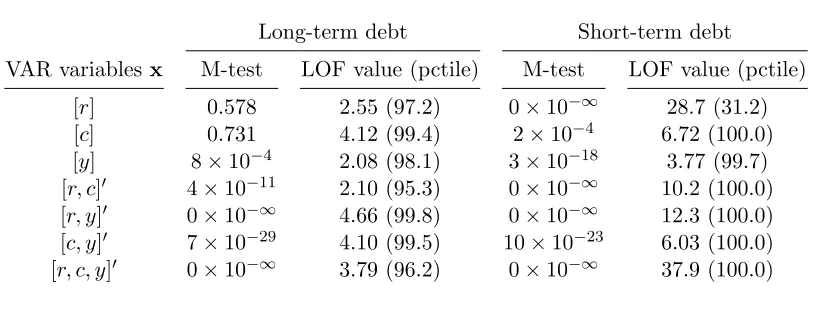
We consider seven total auxiliary models / calibration strategies corresponding to seven different definitions of the observablesx, namely, [r],[c],[y],[r, c]0,[r, y]0,[c, y]0,and [r, c, y]0 whereris spreads, cis log consumption, andy is log output (the latter two linearly detrended in the data). Using one set of simulated data, we test existence for all of these auxiliary model specifications. Like in the
previous section, we do so by looking at the M-test and LOF values, which are presented for
long-and short-term debt in table3.
Long-term debt Short-term debt
VAR variablesx M-test LOF value (pctile) M-test LOF value (pctile)
[r] 0.578 2.55 (97.2) 0×10−∞ 28.7 (31.2)
[c] 0.731 4.12 (99.4) 2×10⁻⁴ 6.72 (100.0)
[y] 8×10⁻⁴ 2.08 (98.1) 3×10⁻¹⁸ 3.77 (99.7)
[r, c]0 4×10⁻¹¹ 2.10 (95.3) 0×10−∞ 10.2 (100.0)
[r, y]0 0×10−∞ 4.66 (99.8) 0×10−∞ 12.3 (100.0)
[c, y]0 7×10⁻²⁹ 4.10 (99.5) 10×10−23 6.03 (100.0)
[r, c, y]0 0×10−∞ 3.79 (96.2) 0×10−∞ 37.9 (100.0)
Note: the LOF value is computed fork= 20; 0×10−∞means the value is zero to
numerical precision.
Table 3: Existence in indirect inference
For long-term debt, VARs with [r] or [c] (i.e., ARs) both seem to give existence according to
the M-test while the LOF values and percentiles are high and seem to indicate nonexistence. For [y], the M-test and LOF agree that there is probably non-existence.21The VAR specifications with
more than one variable all indicate lack of existence. As discussed above, this is an indication that
20Note that for indirect inference one must always have the order condition dim(γ)≥dim(θ) satisfied (Gallant and
Tauchen,1996, p. 664). Here, since dim(θ) = 3, this is satisfied even withn= 1 (in which case the VAR is an AR).
21
(1) the model could be the data generating process forror forc, but not both; and (2) the model is
not the data generating process foryand not for combinations ofr, c,andy, either. For short-term debt, each specification is soundly rejected.22 Consequently, the short-term debt model seems to
not be the data generating process for r,c, ory.
5
Conclusion
We developed a battery of tests for evaluating calibration strategies. In our quantitative
experi-ments, the methods unanimously suggested existence holds for long-term debt and does not hold for
short-term debt. We also showed how multiple calibration strategies can be quickly evaluated. Addi-tionally, we showed how our techniques can be applied to test existence in indirect inference. While
no single test is fool proof, our multi-pronged approach should help researchers avoid unnecessary
and costly attempts to match target moments that simply cannot be matched.
References
F. Angiulli and C. Pizzuti. Fast Outlier Detection in High Dimensional Spaces, pages 15–27.
Springer Berlin Heidelberg, Berlin, Heidelberg, 2002.
C. Arellano. Default risk and income fluctuations in emerging economies. American Economic
Review, 98(3):690–712, 2008.
I. Ben-Gal. Outlier detection. In Data mining and knowledge discovery handbook, pages 131–146.
Springer, 2005.
P. Billingsley. Probability and Measure (Third Edition). John Wiley & Sons, Inc., Hoboken, NJ,
1995.
K. A. Bollen and R. W. Jackman. Modern Methods of Data Analysis, chapter Regression
Diag-nostics: An Expository Treatment of Outliers and Influential Cases. Sage, Newbury Park, CA,
1990.
M. M. Breunig, H.-P. Kriegel, R. T. Ng, and J. Sander. LOF: Identifying density-based local
outliers. Proceedings of the ACM SIGMOD 2000 International Conference on Management of
Data, pages 93–104, 2000.
F. Canova and L. Sala. Back to square one: Identification issues in DSGE models. Journal of
Monetary Economics, 56(4):431–449, 2009.
F. Canova, F. Ferroni, and C. Matthes. Choosing the variables to estimate singular DSGE models.
Journal of Applied Econometrics, 29(7):1099–1117, 2014.
22
S. Chatterjee and B. Eyigungor. Maturity, indebtedness, and default risk. American Economic
Review, 102(6):2674–2699, 2012.
L. J. Christiano and M. Eichenbaum. Current real-business-cycle theories and aggregate
labor-market fluctuations. American Economic Review, 82(3):430–450, 1992.
G. G. Enas and S. C. Choi. Choice of the smoothing parameter and efficiency of the k-nearest neighbor classification. Computers & Mathematics with Applications, 12A(2):235–244, 1986.
T. Feldman and Y. Sun. Econometrics and computational economics: an exercise in compatibility.
International Journal of Computational Economics and Econometrics, 2(2):105–114, 2011.
A. R. Gallant and G. Tauchen. Which moments to match? Econometric Theory, 12(4):657–681,
1996.
R. Gnanadesikan. Methods for statistical data analysis of multivariate observations. John Wiley &
Sons, Inc., New York, NY, 1997.
G. Gordon and P. Guerron-Quintana. Dynamics of investment, debt, and default. Review of
Economic Dynamics, Forthcoming, 2017.
G. Gordon and S. Qiu. A divide and conquer algorithm for exploiting policy function monotonicity.
Quantitative Economics, Forthcoming, 2017.
C. Gourieroux, A. Monfort, and E. Renault. Indirect inference. Journal of Applied Econometrics,
8:S85–S118, 1993.
P. A. Guerron-Quintana. What you match does matter: The effects of data on DSGE estimation.
Journal of Applied Econometrics, 25(5):774–804, 2010.
L. P. Hansen. Large sample properties of generalized method of moments estimators.Econometrica, 50(4):1029–1054, 1982.
L. P. Hansen. Generalized method of moments estimation. In S. N. Durlauf and L. E. Blume,
editors, The New Palgrave Dictionary of Economics. Palgrave Macmillan, Basingstoke, 2008.
L. P. Hansen and J. J. Heckman. The empirical foundations of calibration. Journal of Economic
Perspectives, 10(1):87–104, 1996.
F. Kleibergen. Testing parameters in GMM without assuming that they are identified.
Economet-rica, 73(4):1103–1123, 2005.
T. C. Koopmans and O. Reiersol. The identification of structural characteristics. The Annals of
H.-P. Kriegel, P. Kr¨oger, E. Schubert, and A. Zimek. LoOP: Local outlier probabilities. In
Pro-ceedings of the 18th ACM Conference on Information and Knowledge Management, CIKM ’09, pages 1649–1652, New York, NY, USA, 2009. ACM. ISBN 978-1-60558-512-3.
F. E. Kydland and E. C. Prescott. Time to build and aggregate fluctuations. Econometrica, 50(6): 1345–70, 1982.
D. O. Loftsgaarden and C. P. Quesenberry. A nonparametric estimate of a multivariate density function. Annals of Mathematical Statistics, 36:1049–1051, 1965.
K. I. Penny and I. T. Jolliffe. A comparison of multivariate outlier detection methods for clinical laboratory safety data. The Statistician, 50(3):295–308, 2001.
S. Ramaswamy, R. Rastogi, and K. Shim. Efficient algorithms for mining outliers from large data
sets. In Proceedings of the 2000 ACM SIGMOD International Conference on Management of
Data, SIGMOD ’00, pages 427–438, New York, NY, USA, 2000. ACM.
J. D. Sargan. The estimation of economic relationships using instrumental variables.Econometrica,
pages 393–415, 1958.
J. D. Sargan. The estimation of relationships with autocorrelated residuals by the use of
instrumen-tal variables. Journal of the Royal Statistical Society. Series B (Methodological), 21(1):91–105,
1959.
A. A. Smith, Jr. Estimating nonlinear time-series models using simulated vector autoregressions.
Journal of Applied Econometrics, 8:S63–S84, 1993.
J. H. Stock and J. H. Wright. GMM with weak identification. Econometrica, 68(5):1055–1096,
2000.
J. H. Stock, J. H. Wright, and M. Yogo. A survey of weak instruments and weak identification
in generalized method of moments. Journal of Business Economics & Statistics, 20(4):518–529, 2002.
K. Zhang, M. Hutter, and H. Jin. A New Local Distance-Based Outlier Detection Approach for
Scattered Real-World Data, pages 813–822. Springer Berlin Heidelberg, Berlin, Heidelberg, 2009.
A
Lack of existence in indirect inference with misspecification
In this appendix, we show indirect inference does not guarantee existence for misspecified models.
Consider the following indirect inference setup. Let the auxiliary model be y =γ1+γ2 with
∼N(0,1). Then the maximum likelihood estimates (MLE) forγ1 andγ2 are the mean and square
infinite amount of both simulated and actual data. Then γ1∗, γ1(θ) are the population mean from
the data and model, respectively, andγ2∗, γ2(θ) are the population standard deviation from the data
and model.
If indirect inference is done by trying to find aθ∗ such thatγi(θ∗) =γi∗, then evidently the deep model must be able to simultaneously match the data’s mean and variance. Under misspecification,
this is not always possible. E.g., suppose the data generating process (DGP) is ˜y = 1 + 2 with
∼N(0,1)—so the auxiliary model in fact nests the DGP. Then if the deep model is an exponential
with parameterθ, existence will not hold because the mean isθ−1 (which requiresθ∗ = 1) and the variance is θ−2 (which does not equal 4 at θ∗ = 1). Hence, indirect inference does not guarantee existence when the model is misspecified.
Unsurprisingly then, this is also true with the Gallant and Tauchen (1996) approach. For
in-stance, lettingφ(y;γ1, γ2) denote the normal density with meanγ1 and standard deviationγ2, the
expected score of the auxiliary model is
E
"∂log(φ(y;γ
1,γ2))
∂γ1
∂log(φ(y;γ1,γ2))
∂γ2
#
=E
" y−γ1
γ2
−γ1
2 +
(y−γ1)2
γ3
2
#
=
" E(y)−γ1
γ2
−1
γ2 +
1
γ3
2E
(y−γ1)2
#
. (3)
For existence, there must be a θ such that this expectation—taken with respect to model data—
equals zero when evaluated atγ1∗, γ2∗. From the first component of the vector, this requiresE(y) =γ1,
i.e., the deep model must be able to reproduce the mean in the data. Supposingθis chosen to make this hold, the second component then requires that the variance of deep-model-generated data at
θ equals γ2∗2.23 So if the deep model cannot simultaneously reproduce the mean and variance in the data, existence will not hold. The example DGP and deep model discussed above provide an
example where this is the case.
B
The Chatterjee and Eyigungor (2012) model
In this appendix, we more thoroughly describe the Chatterjee and Eyigungor(2012) model.
A sovereign seeks to maximize E0P∞t=0βtu(ct) whereu is the period utility function andβ the
time discount factor. The sovereign’s “output” is a stochastic endowment consisting of a persistent
component y that evolves according to a Markov chain plus an i.i.d. shock m ∼ U[−m, m]. As
Chatterjee and Eyigungor (2012) discuss, the m shock’s role is simply to aid convergence.24 A
default triggers an entry to autarky, which entails (1) a direct loss in output φ(y) = max{0, d0y+
d1y2}; (2) exclusion from borrowing; and (3) m being replaced with −m. The sovereign returns
from autarky with probability ξ.
23The second component requires−1/γ∗
2+E(y−γ∗1)2/γ
∗3
2 = 0 orE(y−γ1∗)2=γ
∗2
2 . Ifθis chosen to haveE(y) =γ1∗,
thenE(y−γ1∗)2 is the variance, which must equalγ2∗2.
24Chatterjee and Eyigungor(2012) use a 250 point grid for debt and findmhelps in obtaining convergence of the
Every unit of debt matures probabilistically at rate λ∈(0,1] so that λ= 1 is short-term debt
and λ∈ (0,1) is long-term debt. In keeping with the literature, let b denote assets so that −b is
debt. The total stock of assets evolves according to b0 = x+ (1−λ)b with −x being new debt
issuance. The price paid on debt issuance is q(b0, y), which depends only on b0 and y as they are sufficient statistics for determining future repayment rates. For each unit of debt that does not
mature, the sovereign must pay a couponz. The sovereign’s budget constraint when not in autarky
isc=y+m+ (λ+ (1−λ)z)b+q(b0, y)(b0−(1−λ)b). In autarky, the sovereign’s budget constraint isc=y−φ(y) + (−m).
When the sovereign is not in autarky, he compares the value of repaying debt with the value
of default and optimally chooses to default, d= 1, or not, d= 0. Let the default policy function
be denotedd(b, y, m) and the next-period asset policy be denoted a(b, y, m). With rf the risk-free world interest rate and risk-neutral (foreign) purchasers of sovereign debt, bond prices must satisfy
q(b0, y) =Ey0,m0|y
(1−d(b0, y0, m0))λ+ (1−λ)(z+q(a(b
0, y0, m0), y0))
1 +rf
. (4)
Equilibrium is a fixed point in which (1) q satisfies the above functional equation givend and a;
and (2)dand aare optimal givenq.
The mapping of the model to data for consumption and output is the obvious one. Less obvious is the definition of spreads and net exports. Following Chatterjee and Eyigungor(2012), we define
spreads for a given (b0, y) pair as the difference between “internal rate of return”r and the risk-free rate r. Specifically,r is defined as the solution to25
q(b0, y) = λ+ (1−λ)(z+q(b
0, y))
1 +r(b0, y) (5)
and spreads are (1 +r)4−(1 +rf)4 since the model is calibrated to quarterly time periods. Net
exports is more simply defined as output less consumption, which isy+m−cwhen not in autarky and y−φ(y) + (−m)−c in autarky.
25Chatterjee and Eyigungor(2012) define it implicitly asq(b0