11
An Investigation of the Relationship between
Mathematics Performance of Students in a
Non-Routine Problem, according to Grade
and Gender
Razieh Heidaria and Fahime Rajabib
Corresponding author: Fahime Rajabi ([email protected])
aDepartment of Mathematics, Payame Noor University, PO BOX 19395-3697, Tehran, Iran
bDepartment of Educational Sciences, Payame Noor University, PO BOX 19395-3697, Tehran, Iran.
Keywords: gender differences, problem solving, proportional reasoning, strategy, school grade.
International Journal of Innovation in Science and Mathematics Education, 25(3), 11–19, 2017
Abstract
This study aims to investigate the relationship between performance of students in solving a proportional reasoning problem and the variables of gender and grade level, respectively. The participants in the study included 540 students (320 girls and 220 boys) in the first, second, and third grades of junior high school in Isfahan's schools. Students were asked to respond to non-routine problems in a special sheet that had been prepared in advance. The strategies used by students in the answer sheets were then analysed by using a theoretical framework from the research literature in mathematics education, and classified into seven categories as follows: no answer, sheer collective, non-real, procedural, transition, novice and professional strategies. Kruskal-Wallis and Mann and Whitney statistics were used to evaluate the significance of the effects of each grade and gender factors on the student performance. The results showed that the overall performance of boys was better than that of girls. Also performance of the first grade students was significantly higher than the second and third grade students' performance. Other differences were not significant.
Introduction
Mathematics is one of the subjects in which a proficient level of functioning has always been important for students and their parents. Perhaps this importance has an historical aspect, because mathematics has been recognised as a basic and applied science in everyday life in the history of human civilization. The importance of this scientific discipline (including at the level of teaching) and issues related to its learning, have led to substantial research into many aspects of mathematics education, including research into problem solving ability (Rowlanda, 2016). Problem solving is a type of complicated learning. Understanding a problem and attempting to solve it is a part of each person's life. Problem solving is fruitful in itself, because it can lead to a decision that will undoubtedly cause changes in an individual’s thoughts. A problem solver is often a person who asks, searches, and finds solutions. That is, the solver shows their understanding of the problem by finding a solution. As a result of this process, a problem solver can use the solutions in various conditions.
12
According to Piaget's theory, proportional reasoning is one of the symptoms of the formal operational stage which is the last level of Piaget's cognitive development stages. The subject of proportion has not been without its challenges in the teaching-learning process (Verissimo, Lopes, Garcia, & González, 2017). Therefore, in the present study, mathematical performance of first-year high school students in solving a non-routine problem related to proportion has been evaluated.
In line with various studies which have been conducted in mathematics (maths) teaching which report gender difference, this study also examined the performance of males and females. Therefore this study reports the results of the survey in three sections and draws on the relevant literature as outlined below.
Literature
Proportional Reasoning
According to Silvestre (2009), proportional reasoning is the basis for solving many routine issues in the real world, and is a prerequisite of many advanced subjects of mathematics. However, the ability of students in proportional reasoning is very limited. In his study, Silvestre reviewed the difficulties of the sixth-grade students in solving proportional problems before formal teaching. They have reported the misdiagnosis of the multiplicative nature of proportional reasoning as the main problem of students.
Recent studies have shown that although students develop the proportional reasoning skill, they tend to use it where it is not applicable (Modestou & Gagatsis, 2007). Specifically, students tend to utilise collective reasoning in proportional situations. For instance, by repeating an adding strategy, students calculate the price of three pineapples as follows: if one pineapple is 3 thousand toman, three pineapples will be: 3+3+3=9 thousand toman. According to Hino (2011), in the maths curriculum in Japan, proportional reasoning is taught in the sixth grade using tables, and in the seventh grade using algebraic equations. In the maths curriculum of Iran, teaching proportional reasoning starts from the primary school, where students practice proportional reasoning skills by finding an unknown amount in problems based on proportional reasoning. For example: to make sour cherry juice, per 2 tablespoons of sugar, 6 tablespoons of sour cherry extract are required. If in a sour cherry juice, 6 spoons of sugar have been used, how much extract is needed?
One of the common mistakes of students is using an additive strategy instead of proportional reasoning. In such cases, students consider the difference between things as constant, while they are variable. For example, in the above problem, a student might reason that for 2 spoons of sugar, 10 spoons of sour cherry extract are needed, so, for 4+2=6 spoons of sugar, 6+4=10 spoons of extract are needed. Such mistakes have been observed among younger students, and in situations where students have not been taught formally (Van Dooren et al., 2009). Nevertheless, in some cases, students mistakenly use an additive procedure instead of a proportional procedure. It occurs most commonly when a more difficult problem is raised. One factor that makes the problem more difficult is that the ratio of numbers in the problem is not in integer form.
Gender
13
(National Council of Mathematics Teachers of America, 2000). In addition, one of the examples of educational equality is the consideration of gender differences. Therefore, it is essential to examine gender differences, the intention being, that by taking these differences into account, richer and more productive learning environments, tailored to the capabilities of all students, can be provided. The subject of equality in mathematics education in particular has attracted much attention recently. Indeed the National Council of Mathematics Teachers of America has emphasised the importance of equality in maths education with a specific issue of the Journal of
Research in Mathematics Education devoted to the subject of equity. Gender and especially gender
equity has been the focus of studies in mathematics education for decades, with increased attention in more recent years (Damarin & Erchick, 2010; Lindstrøma & Sharma, 2011). Sadker and Zittleman (2005) mention that males might be encouraged by their teachers to continue to work through their solution during problem-solving activities, while females just think about the final answer.
In the bulk of research on gender differences in mathematical education, mathematical performance of boys and girls has been compared using standardised tests. In the United States, the National Assessment of Educational Progress has been applied to compare the maths performance of boys and girls (Che, Wiegert, & Threlkeld, 2012). Some researchers state that the variation in the problem-solving strategies of boys and girls is due to the differences between them. Perhaps, lack of stability (being emotional) in girls has an effect on their problem solving. Gurian (2010) contends that boys have a better ability than girls, regarding logical mathematical intelligence. In addition, they rely on this intelligence more than females do. However, attempts made in the past twenty years to strengthen mathematical intelligence of girls have had desirable results, so that we are now witnessing the development of girls in mathematics.
In their study about gender differences in mathematics lessons in Denmark, Meelissen and Luyten (2008) concluded that the difference is slight in the level of educational attainment, but it is evident in the system of beliefs and attitudes of the students toward maths. Hyde et al. (1990) argue that as the maths at primary level deals with calculations more, and as girls' performance in calculation is better, so they perform better than males in primary school maths. However, in the maths lessons at higher levels, mathematics concepts and problem solving become more significant, therefore, the progression of girls in mathematics will decrease. Sadker and Klein (1991) reported the presence of two gender biases in their studies. According to them, teachers allocate more attention and time in class to the girls, while in dealing with boys they use praise and criticism feedback. According to them, such a difference in the type of dealing with students could lead to a change in the mathematical attitude and function of students.
14
The Role of Grade in Mathematics Performance of Students
It is expected that in higher grades, the maths performance of students will be enhanced. Of course, in the literature relating to maths education, some research studies have reported a drop in mathematics achievement of students in higher grades (Anderton, Hine, & Joyce, 2017). For instance, the study of Rafipour and Gooya (2005) found that students in the second and third grade of junior high school were equally capable of answering shared questions in maths. The results obtained from Rafipour and Gooya (2005) indicated that the performance of students in the second grade of junior high school was better than that of students in the third grade, because students of the second grade used their right mind more, and were more willing to use mathematical formulas to respond to the problems. Such a phenomenon was predicted beforehand by Howson (1996) during the study of eight textbooks of the countries participating in the Thames in 1995.
It seems that the two factors of gender and grade are the factors that play a role in maths performance of students during problem solving, and the present study sought to survey and determine the role of each of these factors. Specifically, the present study was guided by the following three questions:
1. What strategies used by boys and girls in solving non-routine maths problems in the field of appropriateness?
2. What are the similarities and differences in the boys and girls solutions? 3. What is the impact of students' school grade on maths performance?
Method
Participants
The participants in the study included 540 students (320 girls and 220 boys) in the first, second, and third grades of junior high school in Isfahan's schools.
Data Collection
To collect data, the papers, containing the problem, which were prepared and duplicated beforehand, were handed to the students. Although there was not any time limit to answer the question, the recorded time for responding showed that the students took a minimum of six minutes and maximum of 21 minutes to solve the problem. The students responded individually to the following maths problem involving the concept of proportional reasoning. This problem was retrieved from the book of problem-solving strategies quoted in Che et al. (2012).
A lift capacity is 20 children or 15 adults. If there are 12 children in the lift right now, how many adults can enter to the lift?
15
Data Analysis
The answers to the lift problem were reviewed and were sorted into the seven categories of: no answer, sheer collective strategy, non-real solutions, procedural strategy, transition strategy, novice proportional strategy and professional proportional strategy which are outlined in Table 1.
Table 1: Types of strategies and description of each
Strategy Code Description
1 No answer [0] Student is reluctant to think and there is not any response to be discussed
2 Sheer collective [1] The solution is provided ,but it does not have any relation with the proportionate
3 Non-real [2] In such cases, student represents a non-real and meaningless answer for the problem by performing arithmetic operations on numbers in question and without any reflection on obtained answer
4 Procedural [3] After doing wrong operation, student finally understands that the problem is related to proportionate, but he does not apply the proportionate correctly
5 Transition [4] Proportionate is correct, but doing its procedures is quite traditional. Student does not pay attention to the unknown of the problem
6 Novice [5] Proportionate is correct. Doing the procedures is more professional than procedural strategy, but the last step is incomplete
7 Professional [6] Answer is completely correct
Findings
The first question of the study sought to determine the types of strategies applied by female and male students in solving the problem related to proportionate scope. The information in Table 1 identifies the strategy used, while the frequency and percentage of different applied strategies by the male and female students are represented in Table 2.
16
Table 2: Table descriptive study of gender differences
Categories replies Rate Gender
Boy Girl
No answer Frequency 28 27 Percentage 6.6 6.5 Sheer collective Frequency 63 71 Percentage 14.9 17.1 Non-real Frequency 47 86
Percentage 11.1 20.8 Procedural Frequency 146 150 Percentage 34.6 36.2 Transition Frequency 23 20
Percentage 5.5 4.8 Novice Frequency 84 34 Percentage 19.9 8.2 Professional Frequency 31 26 Percentage 7.3 6.3
Total -- 722 414
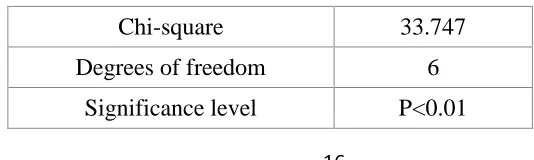
The data in Table 2 also addresses the second question of the study which sought to determine the similarities and differences in the strategies of female and male students in solving the problem related to proportionate scope. As mentioned earlier, the performance of male and female students is significantly different within the two categories of non-real answers and novice. Table 2 shows that in other categories, male and female students' performance is more or less the same. In fact, the rate of non-real answers provided by female students is almost twice as high as the males' responses. In addition, the frequency of using a novice proportionate strategy by males is more than twice the rate of using the same strategy by females. In total, male students' performance in non-routine problem solving for the proportionate field is better than females' performance. The result is obtained using Chi-square tests. As the calculated values for Chi-square tests in Table 3 indicate, gender difference is significant at the 0.01 level.
Table 3: Inferential table for gender differences
Chi-square 33.747 Degrees of freedom 6
17
Although the study conducted by Che et al. (2011) is somewhat different from the present study regarding the theoretical framework, and the result of their study is descriptive, in total, their finding is aligned with that of the present study in concluding that the performance of male students was better than that of female students. In the study of Che et al., more than half of the responses of female students belonged to the sheer collective and procedural strategy categories, and the percentage of male students was half of the females' in the two categories. In addition, 55 percent of responses of male students were in transition and novice categories, while almost one third of the responses of female students were in these two groups. Moreover, the percentage of female and male students was same in the professional group.
To respond to the third question of the present study about the role of grade in the math performance of students to solve proportionate problems, Kruskal-Wallis, and Mann and Whitney statistics were used. The performance of student according to the grade is presented in Table 4.
Table 4: Students’ performance according to grade level
Grade Answers
First grade of middle school
Second grade of middle school
Third grade middle school
No answer 10 28 16
Sheer collective 45 58 31
Non-real 47 35 50
Procedural 112 98 86
Transition 23 12 8
Novice 48 41 29
Professional 21 19 17
Total 207 291 236
Table 5: Inferential table for grade differences
Chi-square 6.747 Degrees of freedom 2
Significance level P<0.05
18
difference of students in the first and second grades of junior high school is significant at level of 0.05, but the difference between the frequency of the second and third levels of junior high school and also between frequencies of the first and third grades of junior high school, is not significant at level of 0.05.
Discussion and Conclusion
The present study focuses on the problem solving performance of male and female students of junior high school to solve a non-routine problem based on the mathematical concept of proportion. In the present study, the role of the two factors of gender and grade in the maths performance of junior high school students was studied. The study is a part of a broader research study where differences and similarities of problem-solving performance of both male and female students of junior high school have been surveyed considering other factors such as types of schools including public, non-profit, and special.
The results obtained from the answers of male and female students show that there is a gender difference in the maths performance of students. In fact, male students' performance was better in solving a proportionate problem compared with the performance of female students. In addition, the strategy most frequently adopted was related to the procedural strategy. It seems that adopting a special teaching-learning approach can lead to such a response and, that observation-based studies of classes can be effective in the decryption of the reason for this. Also the rate of responses in the category of ‘non-real’ for male students is much lower than the rate of female students' responses. In novice and professional proportionate strategies, the performance of male students is significantly better than females.
The results of the present study regarding the role of grade in problem solving performance of students showed that the performance of first grade students of junior high school in solving the proportionate problem about the lift is significantly better than the performance of the second and third grade students of junior high school. Nevertheless, the difference between the performance of the first and second grade students as well as the performance of the second and third grade students of junior high school was not statistically significant. It seems slightly strange that the performance of students in the first grade of junior high school is significantly better than the performance of students in the second grade of junior high school. However, in the maths education literature, there are numerous cases of this kind. For example, the study of Rafipour and Gooya (2005) has shown cases of reverse function of students by increasing grade. In fact, by increasing their knowledge reserves, students do not obtain the ability to make efficient use of their new knowledge stocks. This phenomenon suggests that with increasing educational grades, some students' performance will be weaker in solving some kinds of problems. Of course, to identify all the factors causing such a phenomenon, more data-based in-depth qualitative researches is required. This could be the focus for the future studies.
19
In addition, the restriction of time meant that it was not possible to interview the students individually about the process of their problem solving. Consequently, only the written responses were analysed.
References
Anderton, R., Hine, G., & Joyce, C. (2017). Secondary school mathematics and science matters: Academic performance for secondary students transitioning into university Allied Health and Science Courses. International Journal of Innovation in Science and Mathematics Education, 25(1), 34–47.
Che, M., Wiegert, K., & Threlkeld, K. (2012). Problem solving strategies of girls and boys in single-sex mathematics classrooms. Educational Studies in Mathematics,79(2), 311–326.
Damarin, S., & Erchick, D. B. (2010). Toward clarifying the meanings of gender in mathematics education research.
Journal for Research in Mathematics Education, 41(1), 310–323.
Hino, K. (2011). Students’ uses of tables in learning equations of proportion: A case study of a seventh grade class. In B. Ubuz (Ed.), Proceedings of the 35th Conference of the International Group for the Psychology of Mathematics Education, (Vol. 3 pp: 25–32). Ankara, Turkey: PME.
Howson, G. (1996). Mathematics and common sense. In C. Alsina, J. M. Alvarez, B. Hodgson, C. Llaborde & A. Perez (Eds.), 8th International Congress on Mathematical Education Selected Lectures (pp. 257–269). Sevilla: S.A.E.M. ‘THALES’.
Hyde, J. S., Fennema, E., Ryan, M., Frost, L. A., & Hopp, C. (1990). Gender comparisons of mathematics attitudes and affect, a met analysis. Psychology of Women Quarterly, 14, 299–324.
Gurian, M. (2010). Boys and girls learn differently! A guide for teachers and parents. CA: Jossey-Bass.
Hejazi, A., & Naghsh, Z. (2008). Structural model of the relationship between perceptions of classroom, achievement goals, self-efficacy, and self-regulation in mathematics. News in Cognitive Sciences, 104, 27–38.
Lindstrøma, C., & Sharma, M. D. (2011). Self-efficacy of first year university physics students: Do gender and prior formal instruction in physics matter? International Journal of Innovation in Science and Mathematics Education,
19(2), 1–19.
Meelissen, M., & Luyten, H. (2008). The Dutch gender gap in mathematics: Small for achievement substantial for beliefs and attitudes. Studies in Educational Evaluation, 34, 82–93.
Modestou, M., & Gagatsis, A. (2007). Students’ improper proportional reasoning: A result of the epistemological obstacle of “linearity”. Educational Psychology, 27(1), 75–92.
National Council of Teachers of Mathematics (NCTM). (2000). Principals and standards for school mathematics.
Reston, Va: National Council of Teachers of Mathematics Pub.
Rafipour, A., & Gooya, Z. (2005). Why the mathematics performance of Iranian students' in TIMSS was unique? Available at: https://www.emis.de/proceedings/PME28/SO/SO075_Gooya.pdf
Rowlanda, S. L. (2016). Lessons to educators from recent studies about employability for research-trained graduates.
International Journal of Innovation in Science and Mathematics Education, 24(3), 84–93.
Sadker, D., & Klein, S. (1991). The issue of gender in elementary and secondary education. Review of Research in Education, 17, 269–334.
Sadker, D., & Zittleman, K. (2005). Closing the gender gap–again! Just when educators thought it was no longer an issue, gender bias is back in a new context. Principal, 84(4), 18–22.
Silvestre, A. I. (2009). Teaching for the development of proportional reasoning. In M. Tzekaki, M. Kaldrimidou & H. Sakonidis, Proceedingsof the 33rd Conferenceof the International Group for the Psychology of Mathematics Education (Vol. 5, p. 492).Thessaloniki, Greece: PME.
Van Dooren, W., De Bock, D., Gillard, E., & Verschaffel, L. (2009). Add? Or Multiply? A Study on the Development of Primary School Students’ Proportional Reasoning Skills. In M. Tzekaki, M. Kaldrimidou & H. Sakonidis, H. (Eds.), Proceedings of the 33rd Conference of the International Group for the Psychology of Mathematics Education, (Vol. 5, pp. 281–288). Thessaloniki, Greece: PME.