Wine production using high nutritious
value fruits as substrates
Vanka Kanth Swaroop, Aparna Mukherjee, W. Jabez Osborne
Department of Bio-Sciences, School of Bio-sciences and Technology, VIT University, Vellore, Tamil Nadu, India
Abstract
Aim: The study was aimed to understand the correlation between the production of ethanol with carbohydrate utilization using various combinations of high nutritious substrates such as West Indian cherry, strawberry, grape, amla, and honey. Materials and Methods: High nutritious tropical fruits were selected as substrates and were taken in different combinations based on available sugar content. Individual combinations were allowed to ferment in a laboratory scale fermenter in presence of Saccharomyces cerevisiae (aerobic fermentation followed by anaerobic phase). On completion of fermentation, the wine samples were filtered, pasteurized and were analyzed for ethanol content using High-Performance Liquid Chromatography. Further, the antibacterial activity of the produced wine samples was assayed against human pathogen Escherichia coli. Results and Discussion: Among the tested combinations, Combination 1 (grape, West Indian cherry, and honey) was found to produce 16% of ethanol which is appropriate for wine production at industrial scale. The study depicts that production of ethanol is directly proportional to the rate of fermentation, similarly, the combination one was very effective in producing ethanol. In contrast, the other combinations were also found to produce significant concentrations of ethanol and showed antibacterial activity. Conclusion: We conclude that the combination of fruits like grape and West Indian cherry supplemented with honey can be employed in developing a high nutritious and healthy beverage.
Key words: Antibacterial activity, ethanol, High-Performance Liquid Chromatography (HPCL), tropical fruits, wine
Address for correspondence:
Dr. W. Jabez Osborne,
School of Bio-Sciences and Technology, VIT University, Vellore - 632 014, Tamil Nadu, India.
Fax: 91-416-2243092. Tel.: +91-9894204309. E-mail: [email protected]
Received: 22-03-2017
Revised: 14-04-2017
Accepted: 25-04-2017
INTRODUCTION
T
ropical fruits as a substrate for wine production have remained significant since ancient days (Muccillo et al., 2013).[1] The beverages play a key role as asupplement in the human diet and also found to lower the mortality rate in people suffering from coronary heart diseases.[2] Grapes are one
of the largely cultivated fruit crops from which huge proportions are used for wine production every year (International Organization of Vine and Wine, 2012, Toscano et al., 2013).[3] For
the production of wine, the European species of grapes Vitis vinifera has been widely used across the world.[4] They contain several
compounds which harbor numerous traits such as antibacterial, and anticancerous activity, an especially phenolic compound like resveratrol in grapes has proven to show effective antimicrobial activity.[5]
Wine can be produced from a variety of substrates (fruits) such as strawberry, cherries, apple, and pomegranate and the produced wine is popularly known as fruit wine. Among all the fruit wines strawberry have a unique desirable flavor
which makes it one of the most popular summer fruit. Sugar and acids provide sweetness and tartness, whereas volatiles compounds give the fruity characteristic aroma (Sun et al., 2014).[6] Strawberry wine is rich in anthocyanin, and the major
anthocyanins includes cyanidin and pelargonidin glucosides.[7]
Amla (Emblica officinalis) is another euphorbiaceous plant which has vitamin C at higher concentrations. It is reported to have antioxidant activity, hypoglycemic, and hypolipidemic activity (Anila and Vijayalakshmi, 2000, Liu et al, 2008).[8,9]
Amla has a characteristic sour taste it provides the bitterness to the wine. Honey is often added to wine as a supplement, and it contains sugar such as fructose, sucrose and carbohydrates, and minerals. All these compounds suppress the growth of bacteria and provide stability to the honey. Honey has a
ORIGINAL
AR
healing property and can reduce inflammation it can stimulate angiogenesis and avoid various infections.[10] Natural unheated
honey has a broad spectrum antibacterial activity.[11]
In this study, we have used various tropical fruits in various combinations for the production of nutrient-rich wine. The substrates used in this study are amla, grapes, West Indian cherries, strawberries, and honey. Further, the utilization of available sugar to the production of ethanol was correlated. The produced wine was also tested for their antibacterial activity against human pathogens like Escherichia coli.
MATERIALS AND METHODS
Collection of Substrates
The freshly harvested fruits such as strawberries (Fragaria ananassa), amla (E. officinalis), and grapes (V. vinifera) were procured from nearby fruit market. The unprocessed honey and West Indian cherries (Malpighia emarginata) were acquired from the field station of Tamil Nadu Agricultural University, Thadiyankudisai, Dindigul, Tamil Nadu, India. The substrates except honey were surface sterilized using 70% ethanol followed by repeated washing with sterile deionized water and were allowed to air dry.
Culture Conditions
Commercially available lyophilized Saccharomyces cerevisiae (baker’s yeast) was procured. 1 g of lyophilized powder was added in 100 ml of autoclaved distilled water containing 2% of glucose. The mixture was incubated at 35°C in a temperature controlled orbital shaker operated at 120 rpm for 4 h to activate the yeast cells. Thus, obtained metabolically active cells were used as an inoculum.
Combination of Substrates
The substrates were initially sorted and taken in various combinations based on their nutrition and sugar levels. The Combination 1 included grapes, West Indian cherries, and honey (2:1:1), Combination 2 included West Indian cherries, amla, and honey (2:1:1), Combination 3 included West Indian cherries, grapes, amla, and honey (1:1:1:1), Combination 4 included strawberries, amla, and honey (2:1:1), Combination 5 and 6 containing grapes alone served as positive and negative control.
Detection of Sugar Concentration
The substrates were taken in various combinations and manually crushed and pressed to extract the sugar and other organic acids which were followed by homogenization. The available concentration of the sugar was determined using Brix meter. The sugar concentrations were recorded before and after the fermentation to monitor the utilization rate.
Fermentation Process
The batch fermentation process was opted for the production of wine, where 400 g of the homogenized substrate was taken in a sterile Erlenmeyer flask which acted as a fermenter to carry out the fermentation process. 2% of the metabolically active yeast culture was added to all the combinations expect Combination 6 to study the effect of indigenous bacteria on fermentation.
Aerobic Fermentation
On addition of the inoculum, the mouth of the conical flask was sealed with cotton plug allowing the free passage of the air. The conical flasks were allowed to incubate at 25°C in a temperature controlled incubator in a static condition for 3 days to carry out the aerobic phase of fermentation.
Anaerobic Fermentation
After the aerobic fermentation, the cotton plugs of the conical flasks were replaced with center holed rubber stoppers to restrict the entry of air thus creating the anaerobic condition. One end of a hollow tube was fixed into the rubber stopper and another end into a beaker containing sterile distilled water to facilitate the escape of carbon dioxide produced as a by-product during the fermentation process. The anaerobic fermentation was carried out for 12 days at 25°C in a temperature controlled orbital shaker operated at static condition. All the fermentation processes were conducted in triplicates, and the mean value was taken for statistical analysis.
Clarification Process
On completion of the fermentation process, the slurry was filtered using sterile Whatman filter paper aseptically. The filtrate was collected in screw capped tubes and stored at 4°C until further processing.
Pasteurization
To inactivate and arrest the further fermentation by yeast or other lactic acid producing bacteria, the samples were pasteurized with slight modification as given by Marangon et al., 2012.[12] The screw-capped tubes containing wine
samples were exposed to 72°C in hot water bath for 15 s. The process was repeated thrice to achieve the maximum result.
Detection of Ethanol Using High-Performance Liquid Chromatography (HPLC)
reference.[13] The conditions used were: Flow rate: 1.2 ml/
min; detector: Ultraviolet 220 nm; mobile phase:acetonitrile and water (4:1 ratio) and sample injection volume: 20 µl. Further, the quantitative analysis of the ethanol was performed by peak height and peak area measurements. The formula for calculating the concentration is as follows:
% Area under peak
Sum of the total area of the peaks
= ×100
Antibacterial Activity
The effective samples were analyzed for their antibacterial activity against known human pathogen E. coli using well diffusion method, where streptomycin and distilled water served as positive and negative control, respectively.[14]
RESULTS
Utilization of Available Sugar
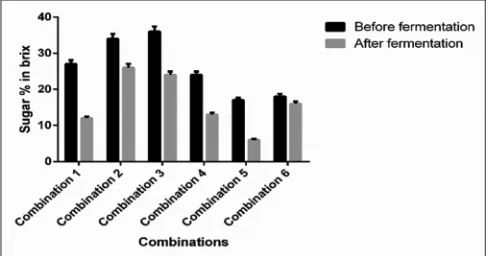
Figure 1 depicts that the supplemented yeast culture was metabolically active and have utilized the available sugar in all the tested combinations. However, the major variance in the sugar level was observed in combination 1 where 15 brix sugar was fermented within 12 days of the fermentation period. Although other combinations such as 2, 3, 4, and 5 showed a considerable amount of utilization. In contrast, the
Combination 6 without yeast showed a negligible utilization of sugar (2 brix), which adds to the importance of the yeast cells in the fermentation process. Preliminary observations like aroma, color indicated the presence of ethanol and different flavoring compounds.
Detection of Ethanol Using HPLC
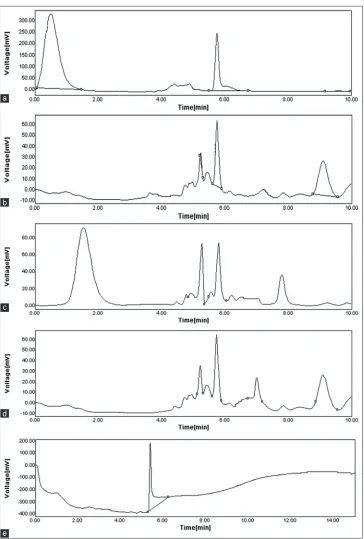
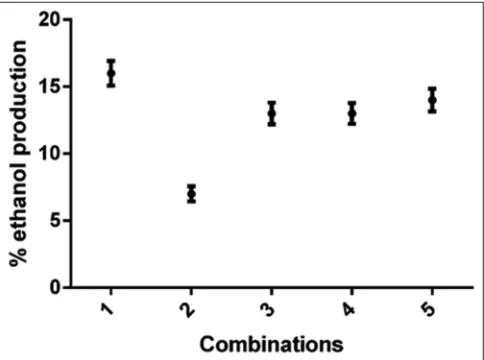
The ethanol standard on injection gave a single sharp peak at a retention time of 6 min as shown in Figure 2. The fermented samples from all the fermenters (Combination 1, 2, 3, 4, and 5) on injecting into HPLC operating in similar conditions showed a sharp peak at retention time 6 min as shown in Figure 3a-e were identical to the standard peak. Thus, confirming the production of ethanol in all the combinations. Further, the quantification of ethanol revealed that Combination 1 was an effective combination with 16% ethanol production, whereas Combinations 3 and 4 were found to produce 13% of ethanol. The Combination 5 (only grapes) showed 14% of ethanol production as shown in Figure 4.
Antibacterial Assay
Among all the tested samples, the Combination 1 was found to have high antibacterial activity showing a 0.4 mm zone of inhibition as shown in Table 1. The positive control streptomycin (antibiotic) showed a zone of inhibition around 1.1 cm whereas the negative control failed to restrict the growth of E. coli.
Table 1: The zone of inhibition of wine samples from various combinations (in mm)
Sample Zone of inhibition (in mm)
Positive control 1.1 cm
Sterile distilled water 0.0 mm
Combination 1 0.4 mm
Combination 2 0.1 mm
Combination 3 0.2 mm
Combination 4 0.1 mm
Combination 5 0.3 mm
Figure 1: The utilization of available sugar before and after fermentation
DISCUSSION
Usage of beverages across the world is increasing significantly in which wine is one of the oldest and largely consumed beverage. A variety of substrates is being employed for the production of wine to meet this requirement. Several substrates were previously reported,
however, this study is the first of its kind where combinations of one or more substrates were used for the production of wine. A report by Sun et al., 2014[6] showed that sugar and
acids aids in sweetness of wine, similarly the wine produced from the combination of grapes, West Indian cherries and honey showed increased sweetness, tartness, and aroma. Further, the choice of different combinations of the fruits
Figure 3: (a) Chromatogram showing the peaks of Combination 1 (grapes, west Indian cherries, and honey), (b) chromatogram showing the peaks of Combination 2 (west Indian cherries, amla, and honey), (c) chromatogram showing the peaks of Combination 3 (west Indian cherries, grapes, amla, and honey), (d) chromatogram showing the peaks of Combination 4 (strawberries, amla, and honey), (e)chromatogram showing the peaks of Combination 5 (grapes alone)
d c b a
was deliberately selected based on their nutritional and bioactive properties.
The usage of amla as substrate was reported by Anila and Vijayalakshmi,[8] 2000 to have high antioxidant, hypoglycemic,
and hypolipidemic activity. A similar study by Oliveira et al., 2013[5] unveiled the application of grapes which contains
phenolic compound like resveratrol capable of showing antibacterial and anticancerous activity, whereas strawberries and honey were selected for their sweet texture and aroma.[7,11]
The combination one (grape, West Indian cherries, and honey) was found to show enhanced antibacterial activity over the other combinations can be related to the presence of phenolic compounds such as resveratrol, gallic acid, (+)-catechin, epicatechin, dimeric procyanidin, proanthocyanidins commonly found in grapes, and West Indian cherries.[2]
The study also revealed the simultaneous production of ethanol during the fermentation process, among all the tested combinations, the combination one was found to utilize high concentrations of available sugar and produce 16% of ethanol. The observed pattern can be related to the observations by Chilaka et al., 2011.[15] The study depicts that production of
ethanol is directly proportional to the rate of fermentation, similarly, the combination one was very effective in producing ethanol. In contrast, the other combinations were also found to produce significant concentrations of ethanol and showed antibacterial activity.
Thus from this study, it is evident that the combination one consisting of grape, West Indian cherries, and honey could be effectively used for the production of wine with high nutritive value to meet this requirement.
CONCLUSION
From this study, we conclude that the combination of fruits like grape and West Indian cherries supplemented with honey
can be employed in developing a nutritious beverage like wine which can replace the existing expensive substrates.
ACKNOWLEDGMENT
Authors express their sincere gratitude to TBI facility of VIT and VIT University management for providing the instruments and other infrastructure to carry out the present work. This research did not receive any specific grant from funding.
REFERENCES
1. Muccillo L, Gambuti A, Frusciante L, Iorizzo M, Moio L, Raieta K, et al. Biochemical features of native red wines and genetic diversity of the corresponding grape varieties from Campania region. Food Chem 2014;143:506-13. 2. Xia EQ, Deng GF, Guo YJ, Li HB. Biological activities of
polyphenols from grapes. Int J Mol Sci 2010;11:622-46 3. Toscano G, Riva G, Duca D, Pedretti EF, Corinaldesi F,
Rossini G. Analysis of the characteristics of the residues of the wine production chain finalized to their industrial and energy recovery. Biomass Bioenergy 2013;55:260-7. 4. Kim SK. The Present State of Grape Cultivation in
Korea. Symposium on Development of Yeongdong Grape Cluster Regional Innovation. Yeongdong, Korea: Yeongdong Grape Cluster Organization; 2005. p. 4-10. 5. Oliveira DA, Salvador AA, Smânia A Jr, Smânia EF,
Maraschin M, Ferreira SR. Antimicrobial activity and composition profile of grape (Vitis vinifera) pomace extracts obtained by supercritical fluids. J Biotechnol 2013;164:423-32.
6. Sun SY, Gong HS, Jiang XM, Zhao YP. Selected non-Saccharomyces wine yeasts in controlled multistarter fermentations with Saccharomyces cerevisiae on alcoholic fermentation behaviour and wine aroma of cherry wines. Food Microbiol 2014;31;44:15-23.
7. Crecente-Campo J, Nunes-Damaceno M, Romero-Rodríguez MA, Vázquez-Odériz ML. Color, anthocyanin pigment, ascorbic acid and total phenolic compound determination in organic versus conventional strawberries (Fragaria ananassa Duch, cv Selva). J Food Compost Anal 2012;28:23-30.
8. Anila L, Vijayalakshmi NR. Beneficial effects of flavonoids from Sesamum indicum, Emblica officinalis and Momordica charantia. Phytotherapy Research. 2000; 1;14(8):592-5.
9. Liu X, Zhao M, Wang J, Yang B, Jiang Y. Antioxidant activity of methanolic extract of Emblica fruit (Phyllanthus emblica L.) From six regions in China. J Food Compost Anal 2008;21:219-28.
10. Voidarou C, Alexopoulos A, Plessas S, Karapanou A, Mantzourani I, Stavropoulou E, et al. Antibacterial activity of different honeys against pathogenic bacteria. Anaerobe 2011;17:375-9.
11. Mandal MD, Mandal S. Honey: Its medicinal property and antibacterial activity. Asian Pac J Trop Biomed 2011;1:154-60.
12. Marangon M, Van Sluyter SC, Robinson EM, Muhlack RA, Holt HE, Haynes PA, et al. Degradation of white wine haze proteins by Aspergillopepsin I and II during juice flash pasteurization. Food Chem 2012;135:1157-65.
13. Brabcová I, Hlavácková M, Satínský D, Solich P. A rapid HPLC column switching method for sample preparation and determination of ß-carotene in food supplements.
Food Chem 2013;141:1433-7.
14. Dhanya KI, Swati VI, Vanka KS, Osborne WJ. Antimicrobial activity of Ulva reticulate and its endophytes. J Ocean Univ China 2016;15:363-9.
15. Chilaka CA, Uchechukwu N, Obidiegwu JE, Akpor OB. Evaluation of the efficiency of yeast isolates from palm wine in diverse fruit wine production. Afr J Food Sci 2010;4:764-74.