RESEARCH
Integrated experimental
and technoeconomic evaluation of two-stage
Cu-catalyzed alkaline–oxidative pretreatment
of hybrid poplar
Aditya Bhalla
1,2, Peyman Fasahati
1,3,7, Chrislyn A. Particka
1, Aline E. Assad
1,6, Ryan J. Stoklosa
1,4,8,
Namita Bansal
1,2, Rachel Semaan
2, Christopher M. Saffron
1,3,4*, David B. Hodge
1,3,4,5,9*and Eric L. Hegg
1,2*Abstract
Background: When applied to recalcitrant lignocellulosic feedstocks, multi-stage pretreatments can provide more processing flexibility to optimize or balance process outcomes such as increasing delignification, preserving hemicel-lulose, and maximizing enzymatic hydrolysis yields. We previously reported that adding an alkaline pre-extraction step to a copper-catalyzed alkaline hydrogen peroxide (Cu-AHP) pretreatment process resulted in improved sugar yields, but the process still utilized relatively high chemical inputs (catalyst and H2O2) and enzyme loadings. We hypoth-esized that by increasing the temperature of the alkaline pre-extraction step in water or ethanol, we could reduce the inputs required during Cu-AHP pretreatment and enzymatic hydrolysis without significant loss in sugar yield. We also performed technoeconomic analysis to determine if ethanol or water was the more cost-effective solvent during alka-line pre-extraction and if the expense associated with increasing the temperature was economically justified.
Results: After Cu-AHP pretreatment of 120 °C NaOH-H2O pre-extracted and 120 °C NaOH-EtOH pre-extracted biomass, approximately 1.4-fold more total lignin was solubilized (78% and 74%, respectively) compared to the 30 °C NaOH-H2O pre-extraction (55%) carried out in a previous study. Consequently, increasing the temperature of the alkaline pre-extraction step to 120 °C in both ethanol and water allowed us to decrease bipyridine and H2O2 during Cu-AHP and enzymes during hydrolysis with only a small reduction in sugar yields compared to 30 °C alkaline pre-extraction. Technoeconomic analysis indicated that 120 °C NaOH-H2O pre-extraction has the lowest installed ($246 million) and raw material ($175 million) costs compared to the other process configurations.
Conclusions: We found that by increasing the temperature of the alkaline pre-extraction step, we could success-fully lower the inputs for pretreatment and enzymatic hydrolysis. Based on sugar yields as well as capital, feedstock, and operating costs, 120 °C NaOH-H2O pre-extraction was superior to both 120 °C NaOH-EtOH and 30 °C NaOH-H2O pre-extraction.
Keywords: Alkaline hydrogen peroxide (AHP), Biofuels, Copper, Hybrid poplar, Lignin, Lignocellulosic biomass, Oxidative delignification, Technoeconomic analysis (TEA)
© The Author(s) 2018. This article is distributed under the terms of the Creative Commons Attribution 4.0 International License (http://creat iveco mmons .org/licen ses/by/4.0/), which permits unrestricted use, distribution, and reproduction in any medium, provided you give appropriate credit to the original author(s) and the source, provide a link to the Creative Commons license, and indicate if changes were made. The Creative Commons Public Domain Dedication waiver (http://creat iveco mmons .org/ publi cdoma in/zero/1.0/) applies to the data made available in this article, unless otherwise stated.
Open Access
*Correspondence: [email protected]; [email protected]; [email protected]
1 DOE Great Lakes Bioenergy Research Center, Michigan State University, 1129 Farm Lane, East Lansing, MI 48824, USA
Background
Increasing energy demands, the desire for energy inde-pendence, and growing concern over greenhouse gas emissions and global warming have encouraged the search for renewable, eco-friendly sources of energy, including biofuels produced from lignocellulosic biomass [1]. Lignocellulose, the structural biopolymer found in plant cell walls, is comprised of lignin, cellulose, hemicel-luloses, and to a minor extent, pectins. Due to contribu-tions from the composition, the higher order structure of the plant cell wall, and the cellular organization of higher plants, lignocellulosic biomass is recalcitrant to many deconstruction processes that are used to release the fer-mentable sugars found in cellulose and hemicellulose [2,
3].
A diverse range of pretreatment technologies have been investigated that are capable of overcoming this recalcitrance, and several studies have used aqueous or organic solvents to effectively pretreat the lignocellulosic biomass for its improved conversion [4–10]. Relevant to this manuscript, significant research efforts have focused on developing pretreatments using water or ethanol as solvents in the presence of alkali [11–15]. Addition of ethanol during alkaline delignification has been found to result in more rapid delignification relative to alkaline only [16] and has been developed as a process to yield low-lignin pulps [17].
Multi-stage pretreatments offer the potential to pro-vide a synergistic interaction in order to improve and/ or generate high-yield, high-purity fractions of cell wall biopolymers and are commonly used in the forest prod-ucts industry. For example, an acidic “pre-hydrolysis” coupled to an alkaline delignification is employed in the production of viscose pulps and is capable of yielding acetate and hemicellulose-derived compounds (e.g., fur-fural) in the first stage and a high-purity cellulose pulp suitable for the production of cellulose derivatives [18]. Comparable to these processes, autohydrolysis and dilute acid pretreatment have been coupled to a range of del-ignifying post-treatments in order to improve the subse-quent enzymatic hydrolysis of woody biomass including
hybrid poplar [19–21]. Multi-stage mild alkaline and
alkaline–oxidative pretreatments have been proposed in our prior work as a method of preserving hemicellulose and maximizing enzymatic hydrolysis yields [13, 22].
We previously demonstrated that a copper-catalyzed alkaline hydrogen peroxide (Cu-AHP) pretreatment process resulted in a substantial improvement of sugar yields following enzymatic hydrolysis compared to AHP-only pretreatment [23, 24]. Further, we recently reported that the addition of an alkaline pre-extraction step prior to Cu-AHP pretreatment increased lignin and hemicel-lulose solubilization under mild process conditions (i.e.,
low temperature and pressure), improving the glucose yields by 1.4-fold (63% to 86%) and xylose yields by 1.3-fold (74% to 95%) [13]. While these data were promising, the process still utilized relatively high chemical inputs (copper, the ligand 2,2’-bipyridine (bpy) and H2O2) dur-ing pretreatment and enzyme loaddur-ings durdur-ing hydrolysis to achieve the reported yields. We hypothesized that by increasing the severity of the alkaline pre-extraction step, we could increase delignification while still retaining most of the xylan, thereby allowing us to reduce both the chemical inputs required during Cu-AHP pretreatment and the enzyme loadings utilized during hydrolysis.
Although increasing the severity of alkaline pre-extrac-tion condipre-extrac-tions would almost certainly improve glucose yields following Cu-AHP pretreatment and enzymatic hydrolysis, an economic evaluation of pretreatment process economics is needed, as increasing the severity would also increase the processing costs. Technoeco-nomic analysis (TEA) evaluates both the ecoTechnoeco-nomic and technological aspects of pretreatment technologies. In addition to understanding the total costs associated with producing ethanol from lignocellulosic feedstocks, TEA also analyzes the effects of changes in chemical input or feedstock costs, evaluates process design to maximize energy usage and recovery, and identifies process bottle-necks that might inhibit industrial-scale feasibility. As a process development tool, TEA has been applied to many pretreatment technologies including, but not limited to, dilute acid [25, 26], AFEX™ [27, 28], ionic liquid [29, 30], and γ-valerolactone (GVL) [31, 32]. Recently, TEA was applied to a two-stage alkaline hydrogen peroxide (AHP) pretreatment of corn stover, revealing a favorable mini-mum ethanol selling price (MESP) [33]; however, TEA on the two-stage Cu-AHP pretreatment of woody biomass has not been performed.
In this manuscript, we compare the impact that water and ethanol alkaline pre-extraction steps have on the effectiveness of Cu-AHP pretreatment of hybrid poplar. Importantly, we report that by increasing the tempera-ture of the alkaline pre-extraction step to 120 °C, we can improve the process performance while simultaneously reducing the chemical and enzyme inputs in the second stage that are required to achieve high sugar yields fol-lowing enzymatic hydrolysis. Finally, we perform eco-nomic analysis to identify areas of the pretreatment process to target for further improvements.
Methods Biomass
Eighteen-year-old hybrid poplar (Populus nigra var.
hybrid poplar logs were split to approximately 1.5″× 2″
x 12″ wedges, chipped by an Earthwise 15-Amp Electric
Garden Chipper/Shredder (Model GS70015), and sieved by shaking for 15 min in a LABTECH Chip Classifier with round-hole screens. Chips that passed through the 7-mm round-hole screen but were retained on the 3-mm round-hole screen were shipped to Michigan State Uni-versity for use in this study.
Compositional analysis
Prior to compositional analysis, wood chips were ground to pass through a 1-mm screen on a Christy Turner lab mill (Christy Turner LTD, Ipswich, Suffolk, UK). A two-stage acidolysis method from the National
Renew-able Energy Laboratory [34] was used to determine the
composition of the structural carbohydrates and the acid-insoluble lignin (Klason lignin). The structural car-bohydrates were separated and quantified on an Agilent 1260 series high-performance liquid chromatography (HPLC) system equipped with an Infinity II refractive index detector and an Aminex HPX-87H column. The
mobile phase was 5.0 mM H2SO4 (0.6 mL/min) and the
operating temperature was 65 °C. The xylose measured from the samples were reported as a cumulative percent-age of xylose, mannose, and galactose as the HPX-87H column is unable to resolve these sugars.
Alkaline pre‑extraction of wood chips
For the pre-extraction step, a 5 g sample (1–2% mois-ture content) of 3–7 mm of hybrid poplar wood chips was heated without mixing at 120 °C for 1 h (plus a 15 min heat-up time and a 10-min cool-down time) with 250 mM NaOH (100 mg/g biomass) and either 50 mL (~ 10% wt/vol solids loadings) of 95% (vol/vol) etha-nol (120 °C NaOH-EtOH pre-extraction (PE)) or water
(120 °C NaOH-H2O PE) in a 100 mL volume capacity
Parr reactor (4560 Mini Benchtop reactor). After incu-bation, the remaining insoluble biomass was thoroughly washed with deionized water and air dried. Prior to Cu-AHP pretreatment, the alkaline pre-extracted wood chips were milled to 1 mm using a Christy Turner lab mill (Christy Turner LTD, Ipswich, Suffolk, UK).
Cu‑AHP pretreatment
Following ethanol or water alkaline pre-extraction, the milled hybrid poplar biomass was subjected to Cu-AHP pretreatment with fed-batch addition of H2O2 [13]. The pretreatment was performed in 2.5 mL of reaction vol-ume at 10% solids loading for 23 h at 30 °C. Unless oth-erwise noted, the following concentrations of reactants were utilized during pretreatment. Catalyst loadings were set at 1 mM for Cu2+ (added as CuSO
4·5H2O) and 2 mM for 2,2′-bipyridine (bpy), respectively. (Although
the precise function of the bpy ligand is unknown, the N heteroatom donor and the aromaticity of the biden-tate ligand are important.) The H2O2 and NaOH load-ings were both set at 100 mg/g of hybrid poplar biomass. Fed-batch addition of H2O2 was performed over a 10-h period to achieve a final oxidant loading of 100 mg/g pre-extracted biomass.
Enzymatic hydrolysis
Following 23 h of Cu-AHP pretreatment, the pH of the pretreatment mixture was adjusted to 5.0 with 72% (w/w) H2SO4 followed by the addition of 0.25 mL of 1 M citric acid buffer (pH 5.0). To complete enzymatic hydrolysis, Cellic CTec3 (197.3 mg/g) and HTec3 (170.5 mg/g), pro-vided by Novozymes A/S (Bagsværd, DK), were added into the reaction mixture, each at a loading of 15 mg protein/g glucan from pre-extracted biomass, for a total protein loading of 30 mg/g. The enzyme content was sup-plied by the manufacturer. The total aqueous volume of the reaction was then adjusted to 5 mL by adding deion-ized water to attain solids loading of 5% (wt/vol). The samples were incubated at 50 °C for 72 h with orbital shaking at 210 rpm. The sugars obtained following enzy-matic hydrolysis were quantified by high-performance liquid chromatography following a procedure described
previously [13]. The sugar yields (glucose and xylose)
were calculated by dividing the amount of released sugar by the total sugar content of the biomass (dry weight basis) prior to pretreatment.
Technoeconomic analysis
A technoeconomic analysis (TEA) based on nth plant
assumptions was performed to assess economic improve-ments resulting from the two-stage Cu-AHP pretreat-ment conditions that were evaluated experipretreat-mentally. Three processes were considered to precede Cu-AHP pretreatment: 1) 30 °C NaOH-H2O PE [13], 2) 120 °C
NaOH-H2O PE (as described above), and 3) 120 °C
reactors. The bottoms of ethanol recovery column are routed to the integrated Kraft paper mill as a means of handling the waste that contains NaOH. Further infor-mation on operating conditions and conversions are provided as supplementary data (see Additional file 1: TableS2, Additional file 1: Figures S1, S2). Aspen Plus Version 8.8 was used to simulate material and energy bal-ances for the three process configurations.
The 2011 NREL biorefinery model [35], designed
for bioethanol production from corn stover, served as the basis scenario for each simulation. The model was updated to utilize poplar at 20% moisture content and produce 60 million (MM) gal/year of ethanol. The bench-scale experiments performed in this study provided the processing conditions and yields that were implemented by the biorefinery model. Capital costs for each area of the biorefinery model were primarily scaled from the
NREL equipment cost estimates in the 2011 [35], 2013
[36], and 2015 reports [37]. These were then adjusted to 2011 dollars using the Chemical Engineering Plant Cost Index, the primary source of which is Chemical Engi-neering Magazine, to allow for comparison with recent NREL reports [35–37]. The operating hours of the biore-finery were changed to 7880 h per year. Raw material prices are also updated to 2011 dollars using the
Indus-trial Inorganic Chemical Index (see Additional file 1
Table S1) [38]. A unit production cost (UPC) was calcu-lated for each process based on the capital and operating costs (Eqs. 1–3) [39]. The calculated UPC represents the minimum selling price of ethanol to compensate for the annual production cost of the biorefinery,
where ACC, TOC, and APR are annualized capital cost, total operating costs, and annual ethanol production rate (60 MMgal/year), respectively. CP is the total capital cost and CCF is the capital charge factor calculated to be 0.1061 for an interest rate (r) of 10% and a plant life of 30 years. OC is calculated as the summation of raw mate-rial and fixed operating costs minus revenues from selling byproducts. Annual fixed operating costs are assumed to be 5.1% of total capital costs [39].
Results and discussion
We have previously demonstrated the improved hydroly-sis yields of the Cu-AHP pretreatment process in treat-ing hybrid poplar compared to both alkaline-only and alkaline hydrogen peroxide-only treatments when all pretreatments were conducted at 30 °C [12, 23, 24].
(1)
UPC=(ACC+TOC)/APR,
(2)
ACC=CCF×CP,
(3)
CCF= [r(1+r)n/[(1+r)n−1],
Additionally, we demonstrated that adding an alkaline pre-extraction step at 30 °C to the Cu-AHP pretreatment resulted in an increase in glucose and xylose yields by 23 and 21%, respectively [13].
Based on this promising yield increase, we hypoth-esized that by increasing severity of the alkaline pre-extraction, we could further reduce the chemical costs during Cu-AHP while still maintaining high sugar yields. Therefore, the current study focused on further improve-ments to Cu-AHP pretreatment by performing alkaline pre-extraction at high temperature in two different sol-vent systems, i.e., ethanol and water. Additionally, we performed the alkaline pre-extraction step on larger sized poplar wood chips (3–7 mm) that were then milled to 20 mesh (0.85 mm) screen size using a Wiley mill prior to Cu-AHP pretreatment. Studies have shown that pre-treating wood chips prior to milling to a size appropriate for enzymatic hydrolysis can reduce energy consumption compared to milling prior to pretreatment [40, 41].
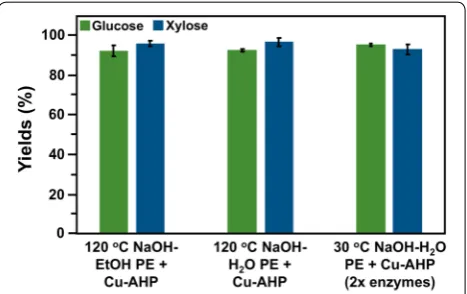
To test the hypothesis that increasing the temperature of the alkaline pre-extraction would allow us to reduce inputs during Cu-AHP, hybrid poplar biomass was mixed with the solvent (ethanol or water) in the presence of alkali and incubated at 120 °C for 1 h instead of at 30 °C, as in our previous studies. After completing Cu-AHP pretreatment and enzymatic hydrolysis, we observed between 93 and 98% conversion of glucan and xylan of pre-extracted biomass to glucose and xylose (Fig. 1).
Compositional analysis of the pretreated biomass was performed to determine the changes associated with the pre-extraction treatments relative to untreated biomass. A larger amount of mass was solubilized during 120 °C
NaOH-H2O PE (~ 21%) compared to 120 °C
NaOH-EtOH PE (~ 16%). Compositional analysis of treated biomass demonstrated that ~ 27% of the original xylan and ~ 28% of the original lignin was solubilized during
120 °C NaOH-H2O PE compared to ~ 20% xylan and 19%
lignin solubilization for 120 °C NaOH-EtOH PE-treated biomass (see Additional file 1: Table S2). In comparison, only ~ 5% of both the lignin and xylan were solubilized during 30 °C NaOH-H2O PE [13].
While both 120 °C pre-extraction steps resulted in some lignin removal, the majority of the delignification occurred when the pre-extracted biomass was further subjected to Cu-AHP pretreatment. After Cu-AHP
pre-treatment of 120 °C NaOH-H2O PE and 120 °C
NaOH-EtOH PE biomass, 78% and 74%, respectively, of the original lignin content was removed from a combination of pre-extraction and pretreatment. This is an approxi-mate 1.4-fold increase in lignin solubilization compared to the 30 °C NaOH-H2O PE (55%) [13].
high-temperature alkaline pre-extraction would allow chemical and enzyme loadings to be reduced without negatively impacting final sugar yields. A preliminary cost analysis indicated that bpy, H2O2, enzymes, and NaOH are the major raw material costs (other than feed-stocks) in the overall conversion process. Therefore, the first set of experiments were carried out at reduced bpy loadings while Cu2+ concentrations were maintained at 1 mM. High glucose yields (~ 90%) were still observed when the bpy concentration was reduced to 0.75 mM
with 120 °C NaOH-H2O PE/Cu-AHP, but slightly lower
yields (~ 80%) were noted for 120 °C NaOH-EtOH PE/ Cu-AHP (Fig. 2). Further, when pre-extraction was car-ried out at 120 °C, the glucose yields obtained when etha-nol was used with 0.75 mM bpy were the same as when water was used with just 0.5 mM bpy. Interestingly, when no bpy was added during the Cu-AHP treatment, glu-cose yields were 76% when water was used during pre-extraction and~ 70% when ethanol was used. Overall, the results showed significant improvements in sugar yields
over 30 °C NaOH-H2O PE/Cu-AHP [13] where glucose
yields dropped to~ 70% when bpy was reduced to 0.5 mM concentration.
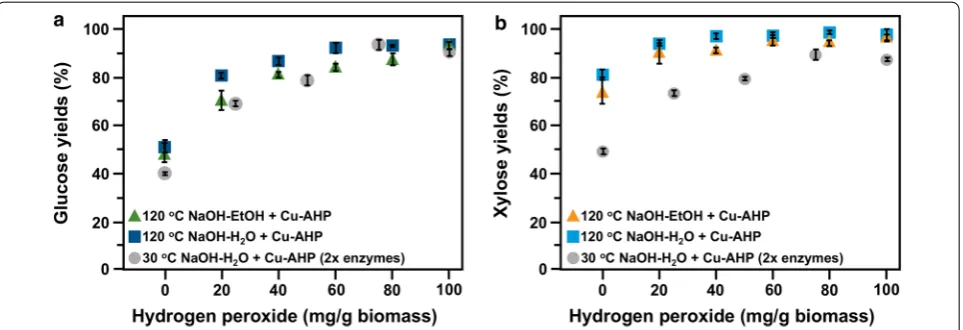
In the second set of experiments, we reduced H2O2
loadings while bpy (2 mM), Cu2+ (1 mM) and enzymes
loadings (30 mg/g original glucan) were kept constant
(Fig. 3). The results demonstrated that 120 °C
NaOH-H2O PE/Cu-AHP resulted in slightly higher glucose
yields (3–10% increase) and xylose yields (2–6% increase)
Fig. 1 Glucose and xylose yields following enzymatic hydrolysis of alkaline pre-extracted (in water or ethanol) and fed-batch Cu-AHP pretreated hybrid poplar (yields based on composition of alkaline pre-extracted biomass). All pretreatment reactions were performed for 24 h at 10% (w/v) solids. For the two 120 °C pre-extractions completed as part of this study, particle size was 3–7 mm for pre-extraction and 1 mm for Cu-AHP pretreatment. The temperature for
pretreatment was 30 °C, with final concentrations of 1 mM Cu2+ and
2 mM bpy, and a H2O loading of 100 mg/g biomass. Enzyme loadings
for enzymatic hydrolysis were 30 mg total protein per g glucan. The
30 °C pre-extraction was from a previous study [13]. Experimental
conditions were largely the same as above, except that samples were milled to pass through a 20-mesh screen (0.85 mm) prior to pre-extraction, and enzyme loadings of 60 mg total protein per g glucan. The data points are the averages of three independent experiments,
and the error bars represent ± standard deviations of the means
Fig. 2 Glucose (a) and xylose (b) yields following enzymatic hydrolysis of alkaline pre-extracted and fed-batch Cu-AHP pretreated hybrid poplar at different bpy loadings (yields based on composition of alkaline pre-extracted biomass). Triangles represent 120 °C NaOH-EtOH pre-extraction and
squares represent 120 °C NaOH-H2O pre-extraction. Pretreatment reactions were performed at 30 °C for 24 h at 10% (w/v) solids. Particle size was
3–7 mm for pre-extraction and 1 mm for Cu-AHP pretreatment. The final concentrations in the reaction were 1 mM Cu2+ and 100 mg/g biomass for
the H2O2. Enzyme loadings for enzymatic hydrolysis were 30 mg total protein per g glucan. The data points are the averages of three independent
experiments, and the error bars represent ± standard deviations of the means. Circles represent 30 °C NaOH-H2O pre-extraction from a previous
study [13]. Experimental conditions were largely the same as above, except that samples were milled to pass through a 20-mesh screen (0.85 mm)
prior to pre-extraction, and a temperature of 30 °C during both pre-extraction and pretreatment. The data points are the averages of three
compared to 120 °C NaOH-EtOH PE/Cu-AHP at all peroxide loadings. Further, H2O2 could be reduced to 40 mg/g biomass while still maintaining high glucose
yields for both 120 °C NaOH-H2O PE/Cu-AHP (86%)
and 120 °C NaOH-EtOH PE/Cu-AHP (81%). The biomass treated with just 20 mg H2O2/g biomass and subjected to
120 °C NaOH-H2O PE/Cu-AHP still resulted in just over
80% glucose yields. The complete elimination of H2O2, however, resulted in only ~ 50% glucose yields for both
120 °C NaOH-H2O PE and 120 °C NaOH-EtOH PE.
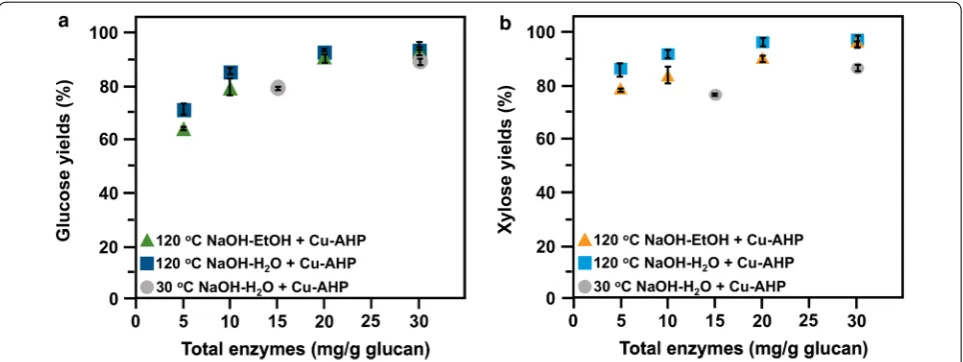
We performed a third set of experiments where total enzyme loadings were reduced, although the ratio of Cel-lic CTec3:HTec3 remained 1:1, while H2O2 (100 mg/g glucan), Cu2+ (1 mM) and bpy loadings (2 mM) were held constant (Fig. 4). At a total enzyme loading of 20 mg/g glucan (10 mg/g each protein), glucose yields of > 90%
were still achieved for both 120 °C NaOH-H2O PE and
120 °C NaOH-EtOH PE. The results also revealed that at lower total enzyme loadings of 10 and 5 mg/g glucan, the
glucose yields were higher for 120 °C NaOH-H2O
PE/Cu-AHP compared to the 120 °C NaOH-EtOH PE/Cu-PE/Cu-AHP.
Technoeconomic analysis results
Increasing the temperature of the alkaline PE step to 120 °C allowed for a decrease in bpy, H2O2, and enzymes with a small variation in glucose and xylose yields com-pared to 30 °C alkaline PE. However, 120 °C alkaline PE requires heat input at an economic cost. Therefore, this
preliminary TEA was performed to gauge how process changes improve the biorefinery economics.
Simulation results were used to calculate the raw material and variable operating cost of each process. A detailed list of the annual raw material cost for the
three processes, i.e., 30 °C NaOH-H2O water
PE/Cu-AHP [13], 120 °C NaOH-H2O PE/Cu-AHP, and 120 °C
NaOH-EtOH PE/Cu-AHP, is provided in Table S3 (see Additional file 1: Table S3). Total raw material costs
for 30 °C NaOH-H2O PE, 120 °C NaOH-H2O PE, and
120 °C NaOH-EtOH PE were calculated to be $197.6, $175.3, and $191.8 MM/year, respectively. Other than
feedstocks, H2O2, bpy, enzymes, and NaOH comprise
the main raw material costs in the pretreatment unit in all cases. Smaller carbohydrate losses in 30 °C
NaOH-H2O PE translate to less biomass required for
mak-ing 60 MMgal/year ethanol, which reduces biomass
cost by about $3 MM/year. Further, 30 °C NaOH-H2O
PE and 120 °C NaOH-H2O PE produce electricity as a
by-product by burning lignin and have an annual rev-enue of $2.82 and $3.63 MM/year from selling
elec-tricity to the grid. Additionally, 30 °C NaOH-H2O PE
consumes more power for aeration and agitation in cellulase enzyme production vessels as the enzyme
requirement of 30 °C NaOH-H2O PE is twice that of
120 °C NaOH-H2O PE and 120 °C NaOH-EtOH PE
(60 vs 30 mg/g glucan). Increased enzymes also lead to increased sugar costs for onsite enzyme production,
Fig. 3 Glucose (a) and xylose (b) yields following enzymatic hydrolysis of alkaline pre-extracted and fed-batch Cu-AHP pretreated hybrid poplar
at different H2O2 loadings (yields based on composition of alkaline pre-extracted biomass). Triangles represent 120 °C NaOH-EtOH pre-extraction
and squares represent 120 °C NaOH-H2O pre-extraction. Pretreatment reactions were performed at 30 °C for 24 h at 10% (w/v) solids. Particle size
was 3–7 mm for pre-extraction and 1 mm for Cu-AHP pretreatment. The final Cu2+ and bpy concentrations in the reaction were 1 mM and 2 mM,
respectively. Enzyme loadings for enzymatic hydrolysis were 30 mg total protein per g glucan. The data points are the averages of three
independ-ent experimindepend-ents, and the error bars represindepend-ent ± standard deviations of the means. Circles represent 30 °C NaOH-H2O pre-extraction from a previous
study [13]. Experimental conditions were largely the same as above, except that samples were milled to pass through a 20-mesh screen (0.85 mm)
prior to pre-extraction, and a temperature of 30 °C during both pre-extraction and pretreatment, and enzyme loadings of 60 mg total protein per g
as 30 °C NaOH-H2O PE sugar cost ($48.2 MM/year)
is about double that of 120 °C NaOH-H2O PE ($27.1
MM/year) and 120 °C NaOH-EtOH PE ($26.1 MM/ year). Finally, 120 °C NaOH-EtOH PE requires a larger amount of heat to recover ethanol used in the pre-extraction reactors. More troubling, the heat obtained from combusting the solid residues of fermentation and the biogas from wastewater treatment is insufficient to meet the heat demands, requiring that purchased natu-ral gas be burned (about $1.84 MM/year) to provide the necessary process heat. Consequently, 120 °C NaOH-EtOH PE does not produce excess steam for power production and must purchase grid electricity costing $12.3 MM/year.
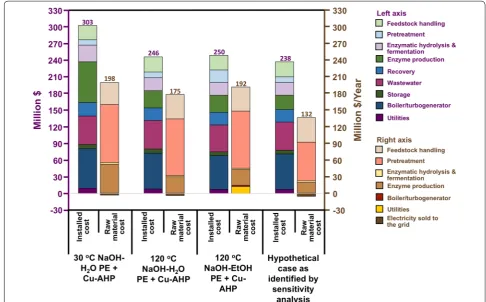
A detailed itemization of the total capital investment (TCI) for each process is shown in Table S4 (see Addi-tional file 1 Table S4). The installed cost of the pretreat-ment unit in 120 °C NaOH-EtOH PE is about $13 MM
more expensive than 30 °C NaOH-H2O PE and 120 °C
NaOH-H2O PE because of the capital costs attributed to ethanol recovery, the reboiler, and air-cooled
condens-ers. Overall, 30 °C NaOH-H2O PE resulted in $100 MM
higher capital costs than the other processes, primarily because of higher capital costs for enzyme production.
Consequently, UPC for 30 °C NaOH-H2O PE/Cu-AHP,
120 °C NaOH-H2O PE/Cu-AHP, and 120 °C
NaOH-EtOH PE/Cu-AHP was calculated as 4.09, 3.57, and 3.85 $/gal, respectively. This indicates that compared to the
other process, 120 °C NaOH-H2O PE has the better
eco-nomics because of its lower operating and investment cost (Fig. 5).
Using the 120 °C NaOH-H2O PE model, a sensitivity
analysis, based on the actual bench-scale data obtained by this work, was performed to assess the potential for further cost reduction. Experimental data show that
H2O2, enzyme, and bpy loadings can be reduced from
their base value of 100 mg/g dry biomass (to 60 mg/g dry biomass), 30 mg/g glucan (to 20 mg/g glucan), and 2 mM (to 1 mM), respectively, without meaningfully low-ering the glucose and xylose yields. To gauge the impact of altering these three variables on process economics, a hypothetical case was formulated by assuming no inter-action effects. If H2O2, enzyme, and bpy loadings can be reduced in concert without lowering the ferment-able sugar yield, then the overall impact of these changes reduced the total raw material cost of the process and capital costs of the enzyme production unit by about 25% and 16% to $131.7 MM/year and $25.6 MM, respectively. The excess electricity sold to the grid also increased from $3.6 to $5.2 MM/year, a 44% increase. Overall, these changes reduced UPC from $3.57 to $2.82/gal, which is a 21% decrease. Figure 5 compares the three cases exam-ined in this study to a 120 °C NaOH-H2O PE hypothetical case that benefits from lowering H2O2, enzyme, and bpy loadings in concert. As expected, reductions in raw mate-rials used by 120 °C NaOH-H2O PE results in significant
Fig. 4 Glucose (a) and xylose (b) yields following enzymatic hydrolysis of alkaline pre-extracted and fed-batch Cu-AHP pretreated hybrid poplar at different total enzyme loadings (yields based on composition of alkaline extracted biomass). Triangles represent 120 °C NaOH-EtOH
pre-extraction and squares represent 120 °C NaOH-H2O pre-extraction. Pretreatment reactions were performed at 30 °C for 24 h at 10% (w/v) solids.
Particle size was 3–7 mm for pre-extraction and 1 mm for Cu-AHP pretreatment. The final Cu2+ and bpy concentrations in the reaction were 1 mM
and 2 mM, respectively. The final H2O2 concentration was 100 mg/g biomass. The data points are the averages of three independent experiments,
and the error bars represent ± standard deviations of the means. Circles represent 30 °C NaOH-H2O pre-extraction from a previous study [13].
Experimental conditions were largely the same as above, except that samples were milled to pass through a 20-mesh screen (0.85 mm) prior to pre-extraction and a temperature of 30 °C during both pre-extraction and pretreatment. The data points are the averages of three independent
reductions in operating costs, and to a lesser degree, cap-ital costs. Of course, interaction effects could alter these predictions positively or negatively; future experiments should be designed to simultaneously vary multiple fac-tors and measure the influence of interaction on costs.
Another possible option to further reduce the raw material cost would be lowering the current bpy price ($59/kg) by mass production. A five- and ten-fold reduc-tion in bpy cost will reduce the annual raw material cost for high-temperature water PE by about $22.7 and $25.5 MM/year, respectively, which is a significant decrease. However, this option assumes future economies of scale for the production of bpy. Therefore, scenarios that include bpy recycling or onsite production should be considered in future studies.
A complete life cycle analysis, which would provide a more detailed picture of the environmental impact of the three process configurations, was not performed. How-ever, several observations can be made based solely on the mass and energy balances. For example, as a conse-quence of the higher electricity and natural gas inputs, the process utilizing 120 °C NaOH-EtOH PE would result
in higher fossil fuel input and greenhouse gas emissions per unit of biofuel generated than either of the other two process configurations. On the other hand, the 120 °C NaOH-EtOH PE process requires less process water per unit of biofuel produced. Further analysis is needed to fully understand these tradeoffs.
Conclusion
In conclusion, we found that increasing the temperature of the alkaline pre-extraction step to 120 °C prior to Cu-AHP pretreatment allowed bpy, H2O2, and enzyme loadings to be decreased without causing as large of a reduction in glucose and xylose yields as was seen with a 30 °C
NaOH-H2O PE. Additionally, sugar yields with 120 °C
NaOH-H2O PE were greater than those for 120 °C NaOH-EtOH
PE. TEA revealed that 30 °C NaOH-H2O PE was the most
expensive of the three pre-extraction methods, and that
120 °C NaOH-H2O PE had the lowest investment and
operating costs. Further experimental work, coupled with TEA, will be required to identify the optimal severity of the alkaline pre-extraction step relative to the Cu-AHP extraction and the reduction of non-feedstock inputs.
Fig. 5 Comparison of installed costs and raw material costs between the three process scenarios considered by TEA. These scenarios are then
compared to a “hypothetical case” 120 °C NaOH-H2O pre-extraction process that reduces H2O2, enzyme, and bpy loadings in concert. Note that raw
Abbreviations
30 °C NaOH-H2O PE: alkaline pre-extraction step conducted in water at 30 °C; 120 °C NaOH-EtOH PE: alkaline pre-extraction step conducted in ethanol at 120 °C; 120 °C NaOH-H2O PE: alkaline pre-extraction step conducted in water at 120 °C; ACC : annualized capital cost; APR: annual ethanol production rate; bpy: 2,2′-bipyridine; CCF: capital charge factor; CP: total capital cost; Cu-AHP: copper-catalyzed alkaline hydrogen peroxide; GVL: γ-valerolactone; HPLC: high-performance liquid chromatography; PE: pre-extraction; TEA: technoeco-nomic analysis; TOC: total operating costs; UPC: unit production cost.
Authors’ contributions
AB performed experiments in all areas of pre-extraction, pretreatment, and enzymatic hydrolysis, and helped write the manuscript. PF performed process simulations, technoeconomic analysis, and helped write the manuscript. CAP led the writing and editing of the manuscript. AEA performed ethanol pre-extractions and studied the impact of chemical inputs. RJS performed technoeconomic analysis. NB performed ethanol pre-extractions, studied the impact of chemical inputs, and performed enzymatic hydrolysis at different enzyme and peroxide loadings. RS performed compositional analysis on pre-extracted biomass. CMS helped design TEA experiments, interpret the results, and edit the manuscript. DBH and ELH helped design pretreatment experiments, interpret the results, and edit the manuscript. All authors read and approved the final manuscript.
Author details
1 DOE Great Lakes Bioenergy Research Center, Michigan State University, 1129 Farm Lane, East Lansing, MI 48824, USA. 2 Department of Biochemistry & Molecular Biology, Michigan State University, 603 Wilson Road, East Lansing, MI 48824, USA. 3 Department of Biosystems & Agricultural Engineering, Michi-gan State University, 216 Farrall Hall, East Lansing, MI 48824, USA. 4 Depart-ment of Chemical Engineering & Materials Science, Michigan State University, 428 S. Shaw Lane, East Lansing, MI 48824, USA. 5 Division of Sustainable Process Engineering, Luleå University of Technology, 98187 Luleå, Sweden. 6 Present Address: Faculdade de Engenharia Agrícola, UNICAMP, Cândido Rondon, 501, Cidade Universitária, Campinas, São Paulo 13083-875, Brasil. 7 Present Address: Department of Chemical and Biological Engineering, 3111 Engineering Hall, 1415 Engineering Drive, Madison, WI 53706, USA. 8 Present Address: Sustainable Biofuels and Co-Products Research Unit, Eastern Regional Research Center, USDA, ARS, 600 E. Mermaid Lane, Wyndmoor, PA 19038, USA. 9 Present Address: Chemical and Biological Engineering Department, Montana State University, PO Box 173920, Bozeman, MT 59717, USA.
Acknowledgements Not applicable.
Competing interests
The authors declare the following competing financial interest: D. B. Hodge, E. L. Hegg, A. Bhalla, and N. Bansal (Multi-Ligand Metal Complexes and Methods of Using Same to Perform Oxidative Catalytic Pretreatment of Lignocellulosic
Additional file
Additional file 1: Table S1. Raw material prices considered in the technoeconomic analysis. Table S2. Operating conditions considered for technoeconomic assessment of industrial scale bioethanol plant utilizing two stage Cu-AHP preteatments. The first three columns use data that were collected during this investigation. Entries in the fourth column, for the best-case, assume that glucose and xylose yields from the “120 °C NaOH-H2O PE + Cu-AHP case” remain unchanged when hydrogen per-oxide, 2,2ʹ-bipyridine (bpy), and enzyme loadings are reduced. Table S3. Comparison of raw material costs (MM $/year) for 60 MM gal/year bioethanol plant utilizing two-stage Cu-AHP pretreatments. Table S4. Total capital investments of 60 MM gal/year bioethanol plant utilizing two-stage Cu-AHP pretreatments. Figure S1. Block flow diagram of the biorefinery. Figure S2. Process flow diagram of pretreatment unit includ-ing first stage (a) 30 °C NaOH-H2O PE, (b) 120 °C NaOH-H2O PE, and (c) 120 °C NaOH-EtOH PE followed by second stage Cu-AHP pretreatment.
Biomass—2015/0352540 A1). As a holder of this patent, we may benefit finan-cially from advances in the technology discussed in this manuscript.
Availability of data and materials
The datasets used and/or analyzed during the current study are available from the corresponding authors on reasonable request.
Consent for publication Not applicable.
Ethics approval and consent to participate Not applicable.
Funding
This material is based upon work supported by the U. S. Department of Energy, Office of Science, Office of Biological and Environmental Research under Award Number DE-SC0018409 and work funded by the DOE Great Lakes Bioenergy Research Center (DOE BER Office of Science DE-FC02-07ER64494). Dr. Saffron’s contribution was supported in part by the USDA National Institute of Food and Agriculture (Hatch project MICL02289) and Michigan State University AgBioResearch.
Publisher’s Note
Springer Nature remains neutral with regard to jurisdictional claims in pub-lished maps and institutional affiliations.
Received: 23 February 2018 Accepted: 19 April 2018
References
1. Lange JP. Lignocellulose conversion: an introduction to chemistry, pro-cess and economics. Biofuel Bioprod Biorefining. 2007;1:39–48. 2. Ong RG, Chundawat SPS, Hodge DB, Keskar S, Dale BE. Linking plant
biology and pretreatment: understanding the structure and organization of the plant cell wall and interactions with cellulosic biofuel production. In: McCann MC, Buckeridge MS, Carpita NC, editors. Plants and BioEnergy. New York: Springer; 2014. p. 231–53.
3. Menon V, Rao M. Trends in bioconversion of lignocellulose: biofuels, platform chemicals & biorefinery concept. Prog Energy Combust Sci. 2012;38:522–50.
4. Diner BA, Fan J. Organic solvent pretreatment of biomass to enhance enzymatic saccharification. US Patent. 2012.
5. Zhang K, Pei ZJ, Wang DH. Organic solvent pretreatment of lignocellu-losic biomass for biofuels and biochemicals: a review. Bioresour Technol. 2016;199:21–33.
6. Zhang ZY, Harrison MD, Rackemann DW, Doherty WOS, O’Hara IM. Organosolv pretreatment of plant biomass for enhanced enzymatic sac-charification. Green Chem. 2016;18:360–81.
7. Meng XZ, Wells T, Sun QN, Huang F, Ragauskas A. Insights into the effect of dilute acid, hot water or alkaline pretreatment on the cellulose accessible surface area and the overall porosity of Populus. Green Chem. 2015;17:4239–46.
8. Hallac BB, Sannigrahi P, Pu YQ, Ray M, Murphy RJ, Ragauskas AJ. Effect of ethanol organosolv pretreatment on enzymatic hydrolysis of Buddleja davidii stem biomass. Ind Eng Chem Res. 2010;49:1467–72.
9. Agbor VB, Cicek N, Sparling R, Berlin A, Levin DB. Biomass pretreatment: fundamentals toward application. Biotechnol Adv. 2011;29:675–85. 10. Kumar P, Barrett DM, Delwiche MJ, Stroeve P. Methods for pretreatment
of lignocellulosic biomass for efficient hydrolysis and biofuel production. Ind Eng Chem Res. 2009;48:3713–29.
11. Guragain YN, Bastola KP, Madl RL, Vadlani PV. Novel biomass pretreatment using alkaline organic solvents: a green approach for biomass fractiona-tion and 2,3-butanediol producfractiona-tion. Bioenergy Res. 2016;9:643–55. 12. Li Z, Bansal N, Azarpira A, Bhalla A, Chen CH, Ralph J, Hegg EL, Hodge DB.
•fast, convenient online submission •
thorough peer review by experienced researchers in your field • rapid publication on acceptance
• support for research data, including large and complex data types •
gold Open Access which fosters wider collaboration and increased citations maximum visibility for your research: over 100M website views per year •
At BMC, research is always in progress.
Learn more biomedcentral.com/submissions
Ready to submit your research? Choose BMC and benefit from: 13. Bhalla A, Bansal N, Stoklosa RJ, Fountain M, Ralph J, Hodge DB, Hegg
EL. Effective alkaline metal-catalyzed oxidative delignification of hybrid poplar. Biotechnol Biofuels. 2016;9:34.
14. Karp EM, Donohoe BS, O’Brien MH, Ciesielski PN, Mittal A, Biddy MJ, Beck-ham GT. Alkaline pretreatment of corn stover: bench-scale fractionation and stream characterization. ACS Sustain Chem Eng. 2014;2:1481–91. 15. Xiao LP, Bai YY, Shi HJ, Lu Q, Sun RC. Influence of alkaline hydrothermal
pretreatment on shrub wood Tamarix ramosissima: characteristics of degraded lignin. Biomass Bioenergy. 2014;68:82–94.
16. Marton R, Granzow SG. Use of ethanol in alkaline pulping. In: Google Patents. 1982.
17. Marton R, Granzow S. Ethanol-alkali pulping. Tappi. 1982;65:103–6. 18. Sixta H, Iakovlev M, Testova L, Roselli A, Hummel M, Borrega M, van
Hei-ningen A, Froschauer C, Schottenberger H. Novel concepts of dissolving pulp production. Cellulose. 2013;20:1547–61.
19. Chen X, Li H, Sun S, Cao X, Sun R. Effect of hydrothermal pretreatment on the structural changes of alkaline ethanol lignin from wheat straw. Sci Rep. 2016;6:39354.
20. Panagiotopoulos IA, Chandra RP, Saddler JN. A two-stage pretreatment approach to maximise sugar yield and enhance reactive lignin recovery from poplar wood chips. Bioresour Technol. 2013;130:570–7.
21. Tian D, Chandra RP, Lee J-S, Lu C, Saddler JN. A comparison of various lignin-extraction methods to enhance the accessibility and ease of enzy-matic hydrolysis of the cellulosic component of steam-pretreated poplar. Biotechnol Biofuels. 2017;10:157.
22. Liu T, Williams DL, Pattathil S, Li M, Hahn MG, Hodge DB. Coupling alkaline pre-extraction with alkaline-oxidative post-treatment of corn stover to enhance enzymatic hydrolysis and fermentability. Biotechnol Biofuels. 2014;7:48.
23. Li Z, Chen CH, Liu T, Mathrubootham V, Hegg EL, Hodge DB. Catalysis with Cu(II) (bpy) improves alkaline hydrogen peroxide pretreatment. Biotechnol Bioeng. 2013;110:1078–86.
24. Li Z, Chen C, Hegg E, Hodge DB. Rapid and effective oxidative pretreat-ment of woody biomass at mild reaction conditions and low oxidant loadings. Biotechnol Biofuel. 2013;6:119.
25. Tao L, Chen XW, Aden A, Kuhn E, Himmel ME, Tucker M, Franden MAA, Zhang M, Johnson DK, Dowe N, et al. Improved ethanol yield and reduced minimum ethanol selling price (MESP) by modifying low sever-ity dilute acid pretreatment with deacetylation and mechanical refining: 2) Techno-economic analysis. Biotechnol Biofuels. 2012;5:69.
26. Aden A, Foust T. Technoeconomic analysis of the dilute sulfuric acid and enzymatic hydrolysis process for the conversion of corn stover to ethanol. Cellulose. 2009;16:535–45.
27. Sendich E, Laser M, Kim S, Alizadeh H, Laureano-Perez L, Dale B, Lynd L. Recent process improvements for the ammonia fiber expansion (AFEX) process and resulting reductions in minimum ethanol selling price. Bioresour Technol. 2008;99:8429–35.
28. Bals B, Wedding C, Balan V, Sendich E, Dale B. Evaluating the impact of ammonia fiber expansion (AFEX) pretreatment conditions on the cost of ethanol production. Bioresour Technol. 2011;102:1277–83.
29. Konda NVSNM, Shi J, Singh S, Blanch HW, Simmons BA, Klein-Marcus-chamer D. Understanding cost drivers and economic potential of two variants of ionic liquid pretreatment for cellulosic biofuel production. Biotechnol Biofuels. 2014;7:86.
30. Oleskowicz-Popiel P, Klein-Marcuschamer D, Simmons BA, Blanch HW. Lignocellulosic ethanol production without enzymes—Technoeconomic analysis of ionic liquid pretreatment followed by acidolysis. Bioresour Technol. 2014;158:294–9.
31. Sen SM, Henao CA, Drew J, Braden DJ, Dumesic JA, Maravelias CT. Cata-lytic conversion of lignocellulosic biomass to fuels: process development and technoeconomic evaluation. Chem Eng Sci. 2012;67:57–67. 32. Luterbacher JS, Rand JM, Alonso DM, Han J, Youngquist JT, Maravelias CT,
Pfleger BF, Dumesic JA. Nonenzymatic sugar production from biomass using biomass-derived gamma-valerolactone. Science. 2014;343:277–80. 33. Stoklosa RJ, Del Pilar Orjuela A, da Costa Sousa L, Uppugundla N, Williams
DL, Dale BE, Hodge DB, Balan V. Techno-economic comparison of central-ized versus decentralcentral-ized biorefineries for two alkaline pretreatment processes. Bioresour Technol. 2017;226:9–17.
34. Sluiter A, Hames B, Ruiz R, Scarlata C, Sluiter J, Templeton D, Crocker D. Determination of structural carbohydrates and lignin in biomass. Tech Rep NREL TP. 2011;10:42618.
35. Humbird DDR, Tao L, Kinchin C, Hsu D, Aden A, Schoen P, Lukas J, Olthof B, Worley M, Sexton D, Dudgeon D. Process design and economics for biochemical conversion of lignocellulosic biomass to ethanol. Golden: NREL; 2011. p. TP-5100–47764.
36. Davis R, Tao L, Tan ECD, Biddy MJ, Beckham GT, Scarlata C, Jacobson J, Cafferty K, Ross J, Lukas J, et al. Process design and economics for the conversion of lignocellulosic biomass to hydrocarbons: dilute-acid and enzymatic deconstruction of biomass to sugars and biological conver-sion of sugars to hydrocarbons. Golden: NREL; 2013. p. TP-5100–60223. 37. Davis R, Tao L, Scarlata C, Tan ECD, Ross J, Lukas J, Sexton D. Process
design and economics for the conversion of lignocellulosic biomass to hydrocarbons: dilute-acid and enzymatic deconstruction of biomass to sugars and catalytic conversion of sugars to hydrocarbons. Golden: NREL; 2015. p. TP-5100–62498.
38. Consulting S. U.S. producer price indexes - chemicals and allied products/ industrial inorganic chemicals index. Menlo Park: Chemical Economics Handbook; 2008.
39. Kim J, Sen SM, Maravelias C. An optimization-based assessment framework for biomass-to-fuel conversion strategies. Energy Environ Sci. 2013;6:1093–104.
40. Zhu JY, Pan XJ, Wang GS, Gleisner R. Sulfite pretreatment (SPORL) for robust enzymatic saccharification of spruce and red pine. Bioresour Technol. 2009;100:2411–8.