1 Instructor of Department of Occupational Health Engineering, Sirjan University of Medical Sciences, Sirjan, Iran•2 Instructor, Department of Occupational Health Engineering, School of Health, Larestan University of Medical Sciences, Larestan, Iran•3 Department of Occupational Medicine and Industrial Diseases Research Center, Professor, Shahid Sadoughi University of Medical Sciences, Yazd, Iran•4 Department of Occupational Health, Instructor, School of Paramedicine Abarkouh, Genetic and Enviormental Advantures Research Center Shahid Sadoughi University of Medical Sciences, Yazd, Iran •*Corresponding Author: Hamideh Mihanpour,Email: [email protected], Tel: +98-913-2513816
Abstract
Introduction:Method:
Results:
Conclusion:
Keywords:
Introduction
226
Methods
Phase I - Initial evaluation of the work
environment
Phase II - Training intervention
Phase III - Evaluating the effectiveness of
the intervention
Results
The
effect
of
intervention
on
the
participants' working condition:
The effect of intervention on the seating
status:
228
Table 1. Comparison of working condition results in performing computer tasks before and after the intervention
Questions Before the intervention
One month after intervention X2 P Number Percentages Number Percentages
1. Your head and neck should be straight and in a line with the body (avoid bending forward or backward). 13 13 81 81 92.81 0.0
2.Head, neck, and body should be in a straight line (not rotated)
87 87 93 93 2 0.23
3. The body should be perpendicular to the ground (one may rely slightly on the back of the chair).
18 18 85 85 89.86 0.00
4.The shoulders and upper arms should be in a single line with the body, generally perpendicular to the ground (they should not be raised or extended to the front).
4 4 87 87 138.90 0.00
5.The upper part of the arms and elbows should be close to the body (they should not be stretched out). 3 3 91 91 155.44 0.00
6. Forearms, wrists, and hands should be straight and in one line (forearms should have an angle of about 90 degrees with the arm). 4 4 97 97 172.99 0.00
7. The hands and wrists should be straight (not bending upwards, downwards, or towards the little finger). 3 3 94 94 165.76 0.00
8. The thighs should be parallel to the ground and the forelegs should be perpendicular to the ground (the thighs may be placed slightly above the knees).
93 97 93 97 0.00 1
9 .The feet soles should be on the ground or on a footrest.
97 97 99 99 1.02 0.62
Table 2.Evaluation of the seat before and after the intervention
Questions Before the intervention
One month after intervention X2 P Number Percentages Number Percentages
10. The backrest should support the back.
14 14 96 96 135.83 0.00
11. The width and depth of seat should be suitable for the user (the seating space should not be very large or very small). 94 94 94 94 0.00 1
12.The seat front should not press against the back of the knees and legs (the sitting space width and length should not be large). 93 93 93 93 0.00 1
13. The seat should have a cushion with round edges and should be in a cascade mode (without sharp edges). 99 99 99 99 0.00 1
14. If the seat has arms, they should support both forearms during working and should not interfere with the movement. 49 49 92 92 44.52 0.00
Table 3.Evaluation of keyboard and other data entry devices before and after the intervention
Questions Before the intervention
One month after intervention X2 P Number Percentages Number Percentages
15. The placement site of the data entry devices is fixed and is large enough to put the keyboard or other data entry devices on it. 95 95 97 97 0.52 0.72
16. The data entry devices such as mouse are located close to the keyboard and there is no need to lift the hands. 74 74 88 88 6.36 0.18
17. Application of the data entry devices is convenient and their size and shape are proportional to the user's hand size(not too large or very small) 85 85 96 96 132.87 0.00
18. The hands and wrists should not lean with sharp edges.
1 1 1 1 0.00 1
The effect of intervention on the status of
keyboard and other data entry devices:
Table 4.Evaluation of the monitor before and after the intervention
Questions Before the intervention
One month after intervention X2 P Number Percentages Number Percentages
19. The monitor screen should be in the same level with or lower than the eye. In order to look at the screen, you should not bend down or backward. 64 64 97 97 34.68 0.00
20. The monitor distance should allow you to see it without bending the head, neck, or body backward or forward. 78 78 78 78 0.00 0.00
21. The monitor should be right in front of you, so that you can see it without turning your head and neck. 45 45 99 99 72.32 0.00
22. There should be no stunning reflection (for example, due to the light from windows, lamps, etc.) on the screen that forces you to change your body position inappropriately to see the information.
90 90 100 100 10.52 0.00
Intervention Effect on monitor status:
The Effect of intervention on the table and
workstation status:
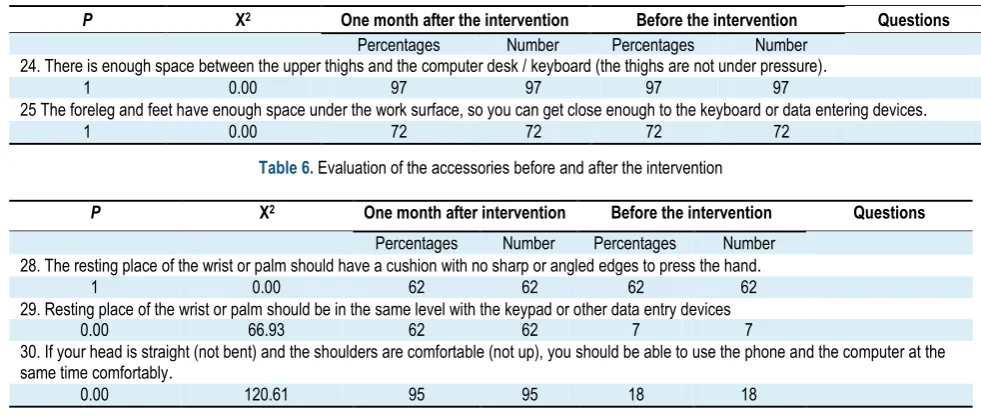
The effect of intervention on accessories:
Table 5.Evaluation of the desk and workstation before and after the intervention
Questions Before the intervention
One month after the intervention X2 P Number Percentages Number Percentages
24. There is enough space between the upper thighs and the computer desk / keyboard (the thighs are not under pressure). 97 97 97 97 0.00 1
25 The foreleg and feet have enough space under the work surface, so you can get close enough to the keyboard or data entering devices. 72 72 72 72 0.00 1
Table 6. Evaluation of the accessories before and after the intervention
Questions Before the intervention
One month after intervention X2 P Number Percentages Number Percentages
28.The resting place of the wrist or palm should have a cushion with no sharp or angled edges to press the hand. 62 62 62 62 0.00 1
29. Resting place of the wrist or palm should be in the same level with the keypad or other data entry devices 7 7 62 62 66.93 0.00
30. If your head is straight (not bent) and the shoulders are comfortable (not up), you should be able to use the phone and the computer at the same time comfortably.
18 18 95 95 120.61 0.00
230
Table 7.Evaluation of the general status of the workstation before and after the intervention
Questions Before the intervention
One month after intervention X2
P
Number Percentages
Number Percentages
31 The workstation and devices are configurable so that you can work in a safe working condition and make occasional changes while working.
34 34
34 34
0.00 1
32. The computer, workstation, and accessories are kept in a good condition and work properly.
10 10
87 87
118.68 0.00
33.The computer device, its accessories, and workstation let you to change your body position and have small breaks or stops to rebuild your strength. 96
96 100
100 4.08
0.12
Changing the general status of the
workstation
before
and
after
the
intervention:
Discussion
Conclusion
References
1. Bernaards CM, Ariëns GAM, Hildebrandt VH. The (cost-) effectiveness of a lifestyle physical activity intervention in addition to a work style intervention on the recovery from neck and upper limb symptoms in computer workers. BMC musculoskeletal disorders. 2006;7(1):80.
2. Organization WH. WHO global plan of action on workers' health (2008-2017): Baseline for implementation. Geneva: WHO. 2013. 3. Stupar M, Shearer H, Cote P, Van der Velde G, Cassidy JD,
Carroll LJ, editors. Prevalence and factors associated with neck pain in office workers. Proceedings of the world congress on neck pain; 2008.P:20-2.
4. Stevens JC, Witt JC, Smith BE, Weaver AL. The frequency of carpal tunnel syndrome in computer users at a medical facility. Neurology. 2001;56(11):1568-70.
5. IJmker S, Huysmans MA, Blatter BM, van der Beek AJ, van Mechelen W, Bongers PM. Should office workers spend fewer hours at their computer? A systematic review of the literature. Occupational and environmental medicine. 2007;64(4):211-22. 6. poorghsemi A, editor. Summary of Computer Applications in
Ergonomics and introduction to some modeling software. [POSTER] at: Proceeding of the National Ergonomics Conference in Tehran manufacturing; 2002 Oct 29-30; Association of Ergonomics and Human Factors Engineering, Iran. Iran: Tehran; 2002.
7. Gerr F, Marcus M, Monteilh C. Epidemiology of musculoskeletal disorders among computer users: lesson learned from the role of posture and keyboard use. Electromyography and kinesiology. 2004;14(1):25-31.
8. Sauter SL, Schleifer LM, Knutson SJ. Work posture, workstation design, and musculoskeletal discomfort in a VDT data entry task. Human factors. 1991;33(2):151-67.
9. Hagberg M, Wegman DH. Prevalence rates and odds ratios of shoulder-neck diseases in different occupational groups. Occupational and environmental medicine. 1987;44(9):602-10. 10. Gerr F, Marcus M, Ortiz D. Musculoskeletal disorders among
VDT operators. NIOSH, Bethesda (GA). 2001;82.
11. Choobineh A, Tabatabaei SH, Mokhtarzadeh A, Salehi M. Musculoskeletal problems among workers of an Iranian rubber factory. occupational health. 2007;49(5):418-23.
232
13. Brewer S, Van Eerd D, Amick Iii BC, Irvin E, Daum KM, Gerr F, et al. Workplace interventions to prevent musculoskeletal and visual symptoms and disorders among computer users: a systematic review. occupational rehabilitation. 2006;16(3):317.
14. McLaney MA, Hurrell Jr JJ. Control, stress, and job satisfaction in Canadian nurses. Work & Stress. 1988;2(3):217-24.
15. O'Neill MJ. Work space adjustability, storage, and enclosure as predictors of employee reactions and performance. Environment and behavior. 1994;26(4):504-26.
16. Robertson MM, O'Neill M, editors. Effects of environmental control on stress, performance and group effectiveness. Proceedings of the Human Factors and Ergonomics Society Annual Meeting. 1999 ;43(8):552-6.
17. OSHA ergonomic checklists. Available at: URL: WWW.osha.gove.
18. Afra A, Abedi HA, Taheri N. Ocular Symptoms of Computer Users in an Administrative Workplace. Iran journal of nursing. 2013;26(82):42-50. [Persian]
19. Côté J, Ngomo S, Stock S, Messing K, Vézina N, Antle D, et al. Quebec research on work-related musculoskeletal disorders: deeper understanding for better prevention. Relations industrielles/industrial relations. 2013;68(4):643-60.
20. Jamjumrus N, Nanthavanij S. Ergonomic intervention for improving work postures during notebook computer operation. Journal of human ergology. 2008;37(1):23-33.
21. Ramalingam KP, Karthikeyan P, van Lieshout J, Akiro C, Wohemani R, Girey M. Effects of exercise intervention on work-related musculoskeletal discomforts among computer users. Contemporary PNG Studies. 2010;13:49.
22. Robertson MM, editor. Health and performance consequences of office ergonomic interventions among computer workers. International Conference on Ergonomics and Health Aspects of Work with Computers. Springer; 2007.
23. Taieb-Maimon M, Cwikel J, Shapira B, Orenstein I. The effectiveness of a training method using self-modeling webcam photos for reducing musculoskeletal risk among office workers using computers. Applied ergonomics. 2012;43(2):376-85. 24. Ugbebor JN, Adaramola SS. Evaluating the effectiveness of
ergonomics application. Work. 2012;41(Supplement 1):484-6. 25. Denis D, St-Vincent M, Imbeau D, Jette C, Nastasia I.
Intervention practices in musculoskeletal disorder prevention: a critical literature review. Applied ergonomics. 2008;39(1):1-14. 26. Leyshon R, Chalova K, Gerson L, Savtchenko A, Zakrzewski R,
Howie A, et al. Ergonomic interventions for office workers with
musculoskeletal disorders: a systematic review. Work. 2010;35(3):335-48.
27. Robertson M, Amick III BC, DeRango K, Rooney T, Bazzani L, Harrist R, et al. The effects of an office ergonomics training and chair intervention on worker knowledge, behavior and musculoskeletal risk. Applied ergonomics. 2009;40(1):124-35. 28. da Costa BR, Vieira ER. Stretching to reduce work-related
musculoskeletal disorders: a systematic review. Rehabilitation medicine. 2008;40(5):321-8.
29. Yue P, Xu G, Li L, Wang S. Prevalence of musculoskeletal symptoms in relation to psychosocial factors. Occupational medicine. 2014;64(3):211-6.
30. Robertson MM, Ciriello VM, Garabet AM. Office ergonomics training and a sit-stand workstation: Effects on musculoskeletal and visual symptoms and performance of office workers. Applied ergonomics. 2013;44(1):73-85.
31. Yu W, Ignatius T, Wang X, Li Z, Wan S, Qiu H, et al. Effectiveness of participatory training for prevention of musculoskeletal disorders: a randomized controlled trial. International archives of occupational and environmental health. 2013;86(4):431-40.
32. Mahmud N, Kenny DT, Md Zein R, Hassan SN. The effects of office ergonomic training on musculoskeletal complaints, sickness absence, and psychological well-being: a cluster randomized control trial. Asia pacific journal of public health. 2015;27(2):NP1652-NP68.
33. Sundstrup E, Jakobsen MD, Andersen CH, Jay K, Persson R, Aagaard P, et al. Effect of two contrasting interventions on upper limb chronic pain and disability: a randomized controlled trial. Pain Physician. 2014;17(2):145-54.
34. Amick III BC, Robertson MM, DeRango K, Bazzani L, Moore A, Rooney T, et al. Effect of office ergonomics intervention on reducing musculoskeletal symptoms. Spine. 2003;28(24):2706-11. 35. Ketola R, Toivonen R, Häkkänen M, Luukkonen R, Takala EP, Viikari-Juntura E, et al. Effects of ergonomic intervention in work with video display units. Scandinavian journal of work, environment & health. 2002;28(1):18-24.
36. Nasiri I. The survey of musculoskeletal disorders risk factors among office workers and the implementation of an ergonomic training program. Mil med. 2015;16(4):211-6. [Pesian]
37. Habibi E, Soury S. The effect of three ergonomics interventions on body posture and musculoskeletal disorders among stuff of Isfahan Province Gas Company. education and health promotion. 2015;4:65.