Soil Model: Tool to Demonstrate the Effect of Different Cropping Systems on Soil
Conservation
Author’s Details:
Rafael Goulart Machado1; Romeu Cezar Deon2; Geiseana Pohlmann3; Douglas Zilli4; Guilherme Brandelero4 1
Engineer agronomist, Doctor in soil science, Emater-RS / ASCAR-Municipal Office of Coxilha, Brazil. Email: [email protected] 2Agricultural technician, Emater-RS / ASCAR-Municipal Office of Nova Alvorada,
Brazil and Academic of the course of Agronomy, Faculdades IDEAU, Passo Fundo, Brazil. E-mail: [email protected] 3 Academic of the course of Law, Faculties João Paulo II, Passo Fundo, Brazil. Email: [email protected] 4Academic of the course of Agronomy, Faculdades IDEAU, Passo Fundo, Brazil.
E-mail: [email protected]; [email protected]
ABSTRACT: The use of soil models is applied to disseminate the importance of soil cover in mitigating erosive processes. The objective of the present study was to compare the effect of different systems of soil cover on the losses of soil and water. For this, an experiment was carried out on soil models containing soil classified as Cambisol, at a slope of 7%. The treatments were maize cultivation more canola straw; canola straw; and uncovered soil. In the treatments that received canola straw, there was used 40 g of straw.pot-1, equivalent to approximately 7 t.ha-1. For the measurement of the soil and water loss, the infiltrated water and the surface water were collected, and the lost water and soil were quantified. It was possible to verify differences between the treatments in terms of soil losses due to surface erosion, being the treatment without soil cover with the highest soil loss, equivalent to approximately 60 kg soil.ha-1, while in the treatment of canola straw with maize crop there were no soil losses. There was a superficial loss of water in all treatments, and there was no difference between them.
KEYWORD: Soil erosion, Vegetation cover, Rain water runoff, rain simulation.
INTRODUCTION
The soil is a natural, slowly renewable and fundamental resource for the production of food, fiber, and fuel to meet the need of a growing global population. Despite its great importance, the soil is a fragile and potentially degradable natural resource if handled improperly.
According to UNU estimates, about 33% of global soils are already degraded by urbanization (UNU, 2014). Soil erosion, nutrient depletion, salinity, aridification, and contamination are additional threats (UNU, 2014). In this sense, given the demands of humanity and given the great fragility of soils, it is fundamental that conservation practices are recommended for soil protection and conservation so that it will serve as a foundation for the prosperity of future generations.
In the state of Rio Grande do Sul in Brazil, in the 1990s, given the importance of conservation practices, the METAS project was implemented, a public-private partnership that had the objective of disseminating the techniques and mechanisms applicable to the cultivation of annual crops in a no-tillage system. The application of the principles of conservation agriculture, among them the diversification of crops for the contribution of 8 to 12 t of straw and root.ha-1.ano-1, help to the success of the no-tillage system, allowing the conservation of soil structure and the water storage in the crop (DENARDIN; LEMAINSKI, 2017). In addition, the conservation practices of the no-tillage system promote a better distribution of nutrients in the soil, better porosity for root growth and stimulation of soil microbial population responsible for nutrient cycling.
winter, at which time the soil is susceptible to erosive processes, with the no-tillage system in its fullness. In this sense, in order to resume dissemination of conservation practices and their consequent economic, environmental and social benefits, Decree number 52.751, dated December 4, 2015, in the state of Rio Grande do Sul, published in the Official State Gazette, was Established the Policy for Soil and Water Conservation, coordinated by the Secretariat of Agriculture, Livestock, and Irrigation. The purpose of this Decree is to encourage, and coordinate actions for the conservation of soil and water. In this program, it is recommended the dissemination of conservation practices to farmers, agricultural technicians who provide assistance to rural producers, technical schools and students of elementary and secondary education.
With the use of the soil model, it is possible to contribute to this public policy by demonstrating to farmers, students, and technicians the importance of cover crops and straw in soil protection and in mitigating the effects of the impact of rain. In a study aimed at elementary school students, Yoshioka and Lima (2005) visually demonstrate the reduction of soil loss in soil covered with vegetation compared to the uncovered soil when submitted to erosive rainfall. The soil model is applied to promote public awareness of soil and nutrient losses that occur when intensive rainfall reaches portions of soil without straw.
The objective of the present study was to compare the effect of soil cover on the loss of soil and water by erosion. Three different systems were compared for soil and water loss due to erosion: soil exposed; canola (Brassica napus L.) straw maintenance on the surface, and the combination of canola (Brassica napus L.) straw and maize (Zea mays) cultivation on the losses of soil and water.
MATERIAL AND METHODS
The experiment was installed on October 31, 2016, in a greenhouse in the municipality of Nova
Alvorada, in the mesoregion northeast of Rio Grande do Sul, Brazil, georeferenced at latitude 28o 40' 29.83'',
longitude 52o 09' 54, 82'' and altitude of 431 m above sea level. During the study, the average, maximum
and minimum temperatures were measured daily, for which the averages were observed 23.5 o C, 32 o C, and
15 o C, respectively.
CHARACTERIZATION OF SOIL MODELS
To evaluate the effect of vegetation cover on soil and water loss, three models were installed, composed of different systems of use and soil cover. Each model was composed of a rectangular plastic vessel, containing 16 liters of soil classified as typical Eutrophic Haplic Cambisol, according to Streck et al. (2008). The mockups were maintained at 7% inclination, to simulate the effect of cultivations conducted on sloping terrain and to induce the flow of water, as it happens in many slopes of Nova Alvorada and region, where the cultivation of grain crops is conducted.
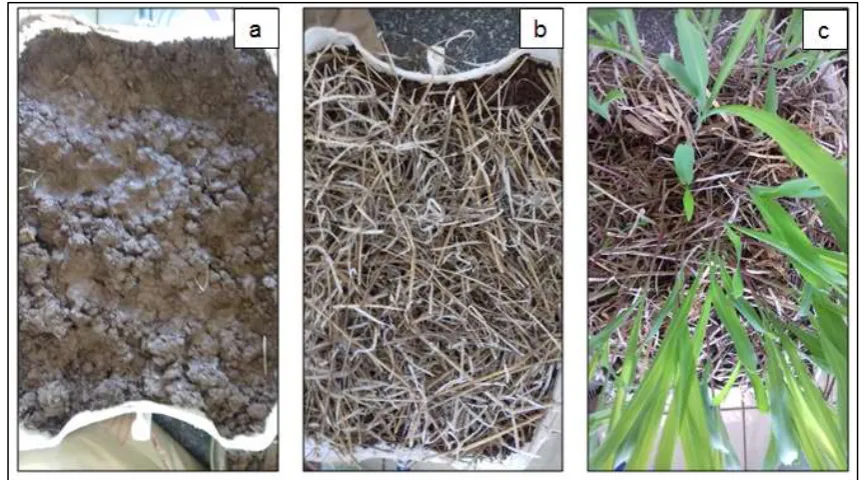
To evaluate the effect of the treatments, these were organized as follows: 1) living cover with corn sowing + canola straw on the surface; 2) canola straw on the surface; 3) only discovered (Figure 1). In the treatment that received corn plants, the cultivar used was Syngenta Impacto, with a density of 12 plants per
pot. In the treatments that received canola straw, was maintained the mass of 40 g of straw.plastic vessel-1,
equivalent to approximately 7 t.ha-1.
The soil used in the present study is of high fertility, and the report of chemical analysis is presented in table 1. In the three models, maintenance fertilization was carried out for the corn crop with the fertilizer 5-20-20, recommending the exportation of the nutrients by the crop, according to fertilization and liming manual for the Rio Grande do Sul and Santa Catarina states (SBCS, 2016). To complement nitrogen
Table 1 - Report of a chemical analysis of soil.
pH in
water SMP Al Ca Mg H + Al
CEC (pH 7,0)
Effective
CEC K Cu Zn Mn
index . . . cmolc/dm3 . . . . . . . . . . . . . mg/dm3. . .
5,78 6,18 0,00 15,86 4,21 3,55 24,36 20,81 289 6,19 > 10,0 41
EBS (%) . . . Saturation index (%) . . .
. . . % (m/v) . . .
. . . . mg/dm3 . . .
Al Ca Mg K OM Clay P S B
85,48 0 65,11 17,28 3,03 2,8 35 > 50 16,0 0,31
* CEC: Cations Exchange capacity; EBS: exchangeable base saturation; Al: exchangeable aluminum; Ca: exchangeable calcium; Mg: exchangeable magnesium; H + Al: active acidity; K: exchangeable potassium; Cu: exchangeable copper; Zn: exchangeable zinc; exchangeable manganese; MO: organic matter; S: exchangeable sulfur; P: labile phosphor; B: exchangeable boron.
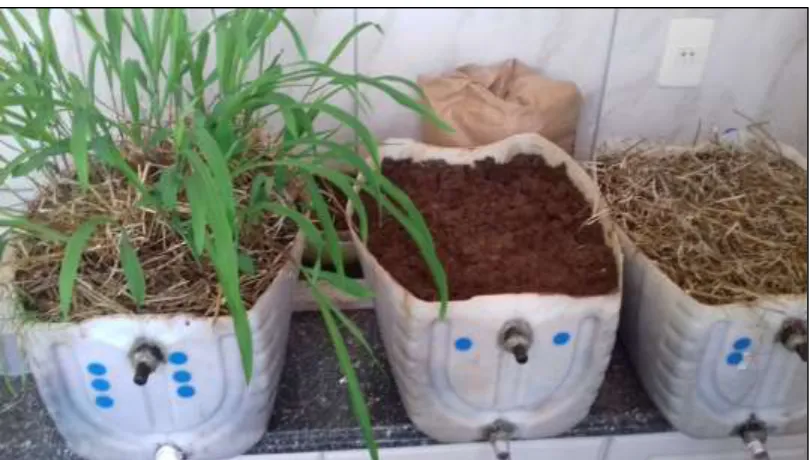
In each of the models, two holes 1.2 cm in diameter were opened, one upper and one lower. The upper hole was positioned at the soil surface to collect the water drained surface, while the lower hole was positioned two fingers above the base, in order to collect the infiltrated water (Figure 2). To induce soil saturation, which naturally occurs during erosive rains, the lower hole was kept closed with a sealing tape, and it was opened 24 hours after the application of rain, to measure the infiltrated water.
In each of the holes made for the collection of water, transparent polyethylene tubes were attached to drainage of the water drained surface and water infiltrated in each of the models. The water was collected in plastic buckets for later gauging in graduated test tubes.
Figure 2 - Front view of the soil models, showing upper and lower holes for collecting the drained and infiltrated water, respectively.
RAIN SIMULATION
In order to verify the effect of vegetation cover on soil and water loss through erosive rainfall, evaluations were carried out 15 days after maize sowing, when maize plants were in stage V3, according to Ciampitti et al. (2016). For this, erosive rains were simulated on each of the models, with a total volume of 5
liters of water distilled by rain, with the intensity of 600 mL.min-1. Each simulation was equivalent to a rain
of 88 mm at an intensity of 11 mm. min-1. In order to obtain this effect, the use of 600 mL pissettes was done, which was manually pressed, simulating rainfall on the soil surface. Seven spots of rain were simulated, with an interval of 10 days between them, and after each rain simulation, the soil and water loss parameters were measured.
EXPERIMENT CONDUCTION AND EVALUATIONS
The experiment was composed of three treatments and seven simulated spots of rain. The experiment was arranged in a completely randomized design, given the homogeneity of soil conditions, temperature, and luminosity incident on the models. The evaluated parameters were the water drained superficially in each model, the infiltrated water and the dry mass of suspended soil carried by the water drained superficially. After each simulated rainfall, the volume of water drained and infiltrated in each of the systems was measured in 500 mL graduated beakers.
For the determination of the dry mass of the soil particles carried in each of said systems, the samples were kept in test tubes for sedimentation for a period of 48 hours. Subsequent to the sedimentation of the solid particles, the water was drained. After flow, the solid particles were collected in microwave drying flasks, according to the methodology described by Tavares et al. (2008).
condition of an erosive process in the field. This study reinforces the hypothesis of soil erosion equations, in which the soil slope and the space that the water travels horizontally since it reaches the surface of the ground, known as ramp length, are preponderant factors for erosive processes. In other words, without the existence of a considerable ramp length, it was not possible to verify the effect of straw and crop in mitigating the water runoff. In a study conducted in the field, several authors describe the vegetation cover as an important mitigating agent of erosive processes (SANTOS et al., 2000; ANDREOLA et al., 2000; SOUSA et al., 2012).
Table 2 - Volumes of water drained and infiltrated in the models of soil conducted under different treatments.
Treatment
Water drained superficially (mL)
Infiltrated water (mL)
Eroded soil (mg)
Without coverage 1405,0 * 2679,3 a 333,3 a
Canola straw 1525,0 2839,7 a 166,7 b
Canola straw and maize 1330,0 2326,3 b 0,0 b
CV (%) 33,25 5,85 89,33
* Means accompanied by an asterisk in the column did not differ statistically according to the Scott Knott test, at 5% probability of error. Means with different letters in the column differ statistically from one another according to the Scott Knott test, at 5% probability of error.
Table 2 also shows the data regarding the amount of soil lost in each of the systems. In the treatment without cover, the greatest loss of soil was observed, with a mean of 333.3 mg of soil eroded by rainfall. In the treatment covered by canola straw, the soil loss was 166.7 mg of soil per rainfall, which did not differ from treatment covered by canola straw and maize crop, in which soil loss was zero. Due to the high coefficient of variation for the eroded soil parameter (89.3%), there was no difference between treatments of canola straw and canola straw + corn.
24 hours after the simulation of each rain, the bottom holes of each model of soil were uncovered to collect the water infiltrated in each culture system. It was possible to verify differences in the infiltration of water, and the treatment straw on the surface and cultivation of corn had less infiltration of water than the others. This is due to the consumption of water by the maize crop since this was the only treatment with a live plant. At the end of the study, which lasted for 75 days, the plants were at the stage of the tassel emission, having covered the entire vegetative period throughout the study, which caused considerable water consumption and interfered with the results of infiltrated water, being the canola straw treatment + Less infiltration of water. There were no differences in the infiltration of water between the canola straw treatments and the uncovered treatment.
Based on the results obtained in the soil models, soil loss per hectare was estimated in each of the cropping systems (Table 3).
statistically from one another according to the Scott Knott test, at 5% probability of error.
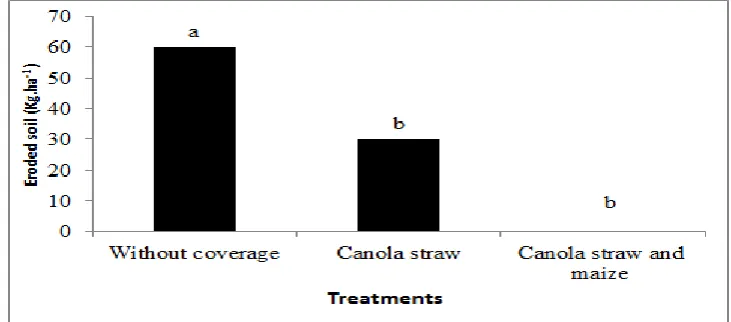
Although there was no significant difference between treatments straw and straw + maize cultivation,
due to the simple presence of 7 t.ha-1 of canola straw, without the maize crop, the equivalent of
approximately 30 kg.ha-1 of soil would be lost, whereas in the presence of canola straw associated with
maize cultivation, soil loss would be zero (Figure 3). Under uncovered soil conditions the losses would be
equivalent to 60 kg of soil.ha-1, representing significant losses in the cropping system (Figure 3). Under field
conditions, soil losses through erosive rains are much more dramatic than those observed in the present
study. According to Amado et al. (2002), soil losses of up to 37 tons of soil.ha-1 were verified under field
conditions by erosive rainfall occurring in the year of occurrence of the El Niño climatic phenomenon. These soil losses occurring in the field represent significant economic losses to farmers since part of their investments are taken out of the crop together with the colloidal particles of eroded soil. Sousa et al. (2012) observed a decrease in eroded nutrient concentrations when the percentage coverage by sugar cane straw was greater than 50% (0.7 kg straw). This reduction in coverage of 100% was quite significant ( 1.4 kg straw.m2).
Soil losses can also induce manhole clogging, road degradation, fish mortality due to the accumulation of fertilizers and organic materials in water sources and contamination of food webs due to the transfer of waste from soil to water.
Thus, in the present study, it was possible to verify that the maintenance of straw on the surface, especially when associated with crops such as corn, is a practice of soil conservation. It preserves the structure of the cultivated soils, since it provides greater protection of the soil against the impact of the rain drop, reduces the velocity of the laminar flow of the water on the surface of the soil and thus induces greater preservation of the soil aggregates, drastically reducing its withdrawal by erosive processes. In addition to preserving the farmers' investments in farming, these conservation principles advocated by the no-tillage system are also of great environmental importance, since avoiding the loss of soil due to surface runoff also prevents the contamination of dams, streams, and rivers against contamination by nutrients and pesticides adsorbed to colloidal soil particles.
Due to the restrictions in greenhouse conditions, it is impossible to faithfully represent all the factors that induce erosive processes in field cultivation systems. An important restriction of the present study is the impossibility of representing the effect of the flood, which consists of the erosive force gain that the rainwater acquires under crops, especially under conditions of great slope and great distances covered by water without finding any obstacle. In this sense, the results obtained in the present study are underestimated due to the conditions that occur in the field, but they serve to demonstrate the erosive effects of rain to farmers, technicians, and students, especially with regard to soil losses. In this way, the soil models consist of important tools for the dissemination of the importance of the vegetation cover for the mitigation of soil erosion.
CONCLUSIONS
With the use of the soil model, it was possible to demonstrate that the coverage with canola straw or canola straw associated with maize crop is efficient to mitigate the loss of soil compared to the uncovered soil.
Ciência do Solo, Viçosa, v. 24, n. 4, p. 867-874, 2000. Disponível em: http://www.scielo.br/pdf/rbcs/v24n4/18.pdf
iii. CIANPITTI, I. A.; ELMORE, R. W.; LAUER, J. Fases de desenvolvimento da cultura do milho.
Manhattan: Kansas State University Agricultural Experiment Station and Cooperative Extension
Service, 2016. Disponível em:
http://brasil.ipni.net/ipniweb/region/brasil.nsf/0/84A346AA07195E74832580490042FB4D/$FILE/M F3305BP-CornGrowth-portuguese_FINAL.pdf
iv. DENARDIN, J. E.; LEMAINSKI, J. Agricultura conservacionista e disponibilidade de água. Passo Fundo: Embrapa Trigo, 2017. 4p.
v. FEDERAÇÃO BRASILEIRA DE PLANTIO DIRETO E IRRIGAÇÃO (FEBRAPDP). Evolução da área cultivada no sistema plantio direto na palha – Brasil. 2012. 1 p. Federação Brasileira de Plantio Direto e Irrigação, Foz do Iguaçu. Disponível em: http://febrapdp.org.br/download/PD_Brasil_2013.I.pdf
vi. INSTITUTO BRASILEIRO DE GEOGRAFIA E ESTATÍSTICA (IBGE). Estados, Rio Grande do Sul, Lavoura Temporária, 2015. Instituto Brasileiro de Geografia e Estatística, Rio de Janeiro. Disponível em http://www.ibge.gov.br/estadosat/temas.php?sigla=rs&tema=lavouratemporaria2015
vii. ORGANIZAÇÃO DAS NAÇÕES UNIDAS (ONU). The secretary-general message on world soil day and the launch of the international year of soils. 2014. Organização das Nações Unidas, Nova Iorque. Disponível em https://onuci.unmissions.org/en/secretary-general-message-world-soil-day-and-launch-international-year-soils.
viii. SANTOS, C. A. G.; SUZUKI, K.; WATANABE, M.; SRINIVASAN, V. S. Influência do tipo de cobertura vegetal sobre a erosão no semiárido paraibano. Revista Brasileira de Engenharia Agrícola e Ambiental, v. 4, n. 1, p. 92-96, 2000. Disponível em: http://www.agriambi.com.br/revista/v4n1/092.pdf.
ix. SOCIEDADE BRASILEIRA DE CIÊNCIA DO SOLO (SBCS). Manual de calagem e adubação para os Estados do Rio Grande do Sul e de Santa Catarina. Xanxerê: Sociedade Brasileira de Ciência do Solo – Núcleo Regional Sul: Comissão de Química e Fertilidade do Solo – RS/SC, 2016. 376 p. x. SOUSA, G. B.; FILHO, M. V. M.; MATIAS, S. S. R. Perdas de solo, matéria orgânica e nutrientes
por erosão hídrica em uma vertente coberta com diferentes quantidades de palha de cana de açúcar em Guariba-SP. Engenharia Agrícola, v. 32, n. 3, p. 490-500, 2012. Disponível em: http://www.scielo.br/pdf/eagri/v32n3/08.pdf
xi. TAVARES, M. H. F.; CARDOSO, D. L.; GENTELINI, D. P.; FILHO, A.G.; KONOPATSKI, E. A. Uso de forno de micro-ondas na determinação da umidade em diferentes tipos de solo. Semina: Ciências Agrárias, v. 29, n. 3, p.529-538, 2008. Disponível em: http://webcache.googleusercontent.com/search?q=cache:gbh1y9DGhkYJ:www.uel.br/revistas/uel/in dex.php/semagrarias/article/download/2764/2365+&cd=3&hl=pt-BR&ct=clnk&gl=br
xii. YOSHIOKA, M. H.; LIMA, M. R. Experimentoteca de solos. Erosão eólica e hídrica do solo.