Croat. j. for. eng. 38(2017)1 55
1. Introduction
The volume of timber harvested in Poland has sig-nificantly increased in the recent years: from 27 mil. m3 in 2000 to nearly 38 mil. m3 in 2013 (Central Statistical Office 2014), though no more than 10% of wood (ca. 4 mil. m3) had been extracted using technologies based on innovative multi-operational forest machines (Karaszewski et al. 2013). In Poland, skidding of tim-ber is mainly performed with the use of agricultural tractors, 3000 of which operate in Polish forests, and properly equipped forest tractors (skidder type) – ca. 1500 machines (Kocel 2013). With regard to skidders, cable models are predominant, although grapple skid-ders have proved to be considerably more efficient (Bembenek et al. 2011, Mousavi et al. 2013). Having knowledge of productivity of particular skidding
means, operating under diversified conditions, is es-sential for an appropriate selection and respective matching of these machines with a certain type of for-est stand to assure satisfactory financial results (Acar and Yoshimura 1997, Gallis and Spyroglou 2012, Gief-ing et al. 2012, Marčeta et al. 2014). One of the ways to achieve this goal is to describe the relations between the productivity of skidding operations and properties of the terrain where skidding works were performed (Horvat 2007), selected characteristics of stands under treatments (Ghaffariyan et al. 2013), skidding means employed (Kluender and Stokes 1994), and skidding distance (Naghdi 2005, Maesano et al. 2013).
In respect to Europe, semi-suspended skidding of timber is the most popular method, commonly en-gaged in the central and southern part of the continent
Productivity and Time Consumption
of Timber Extraction with a Grapple
Skidder in Selected Pine Stands
Dariusz Kulak, Arkadiusz Stańczykiewicz, Grzegorz Szewczyk
Abstract
This paper presents the results of the study on work time and productivity of the John Deere
548G-III grapple skidder operating in pine stands on flat terrain. The research covered three types of treatment: late thinning, removal cutting in openings and clear cutting in openings. The average skidding distance was between 120 and 250 m. In the clear-cut stands, a mean
duration of a skidding cycle accounted for 12 minutes, while in the thinned ones it was longer,
lasting ca. 16 minutes. The investigators performed an estimate of parameters of multiple
regression models, which revealed dependences between:
Þ duration of skidding cycles and stand conditions, number of logs per load and skidding distance, and
Þ productivity achieved in specific skidding cycles and the above-mentioned variables, as well as wood volume per load.
The highest productivity within the productive work time of a skidder was recorded in the
stand where removal cutting in openings was performed; it exceeded 14 m3×h-1. In other stands, the efficiency was lower, not greater than 9 m3×h-1. However, differences between the produc
-tivity achieved within the productive work time and that recorded for the work place time did
not exceed 20%, which indicated that skidding operations in the stands under scrutiny were organised properly.
(Gil 2000, Kocel 2013). Results of studies on productiv-ity of skidding operations performed under these con-ditions have been published in many publications, referring to various felling treatments, such as: thin-ning (Kluender et al. 2007, Spinelli and Magagnotti 2012, Vusić et al. 2013), clear cutting (Zečić 2005, Klu-ender et al. 2008), or selective cutting (Sabo and Poršinsky 2005, Behjou et al. 2008). However, there are only few papers dealing with the efficiency of skid-ding operations performed in stands in various man-ners by one type of skidder. A better recognition of this issue would enable an identification of conditions, un-der which the skidun-der achieves the highest productiv-ity level, and consequently, provides the most profit-able economic outcomes.
This paper aimed to characterise the duration of a skidding cycle and the productivity achieved by a grapple skidder, the John Deere 548G-III in particular, operating in pine stands in various manners. To be more specific, the research goals covered:
Þ characteristics of timber loads and skidding dis-tance
Þ characteristics of work time structure
Þ characteristics of a skidding cycle duration, in-cluding the determination whether the impact of the manner of use of a forest stand on this variable is statistically significant
Þ constructing a mathematical model that would enable an estimate of a skidding cycle duration
Þ determining the productivity of a skidder op-erating in the stands under investigation and developing a mathematical model for work ef-ficiency.
2. Materials and methods
2.1 Research areaThe research was carried out in southern Poland, in forest stands where various types of treatments were performed: late thinning (stand A), removal cut-ting in beech undergrowth (stand B), and clear cutcut-ting in openings (stand C).
All the trial plots were located on flat terrain, 200– 300 m a.s.l. The major features of the stands studied are listed in table 1.
2.2 Machines and technology engaged in logging operations
In the stands under analysis, timber was extracted in the long length system (LLS) (Pulkki 2004). Cutting Table 1 Characteristics of the stands under investigation
Stand A B C
Studied area, ha 14.8 2.6 4.7
Location – geographical coordinates 50°03’21“N 19°35’29“E 50°03’29“N 19°30’47“E 50°03’57“N 19°35’41“E
Type of habitat Fresh upland deciduous forest Fresh upland deciduous forest Fresh mixed coniferous forest
Tree species composition 10 Pine (Pinus sylvestris L.) 10 Pine (Pinus sylvestris L.) 10 Pine (Pinus sylvestris L.)
Age, years 77 77 102
Stocking index 0.9 0.9 0.7
Crown closure Broken crown Open crown Broken crown
Average diameter at breast height, cm / Average height, m 36/27 31/26 37/25
Large timber, m3×ha–1 430 188 225
Mean volume of harvested trees ± SD, m3 0.65±0.23 0.63±0.14 0.81±0.19
Croat. j. for. eng. 38(2017)1 57 down and delimbing of trees, which were felled in the
direction opposite to the direction of skidding, were performed with the use of chainsaws. Longwood was extracted in the long tree system (LTS), using the semi-suspended skidding method. This method of skidding employed the John Deere 548G-III grapple skidder, equipped with a cable winch remotely controlled, as displayed in Fig. 1.
The major parameters of the skidder used for ex-traction in the studied stands are listed in Table 2.
The skidder was operated by one person. The op-erator approached the logs as close as possible to mini-mise the distance of hauling wood with a winch and facilitate forming loads using a grapple. The skidding operations were performed in autumn and winter, when the soil was dry or frozen, not covered with snow.
2.3 Measurements and calculations
During the skidding operations, a time study was carried out by means of a digital stopwatch, with the accuracy of 1 sec. The work time measurements cov-ered durations of all operations that were recorded at the felling site, including:
Þ travel without a load – relocation of a vehicle without a load from the landing to the felling site. The time measurement started at the mo-ment when the skidder left the landing and en-tered the operational track. The time measure-ment ended when the skidder stopped at the first log designated for loading and hauling
Þ forming a load – lifting logs with the use of a grapple (possibly, dragging a log to the skidder using a cable) and relocating between particular logs. The time measurement started at the mo-ment when the skidder stopped at the first log, and ended when the entire load was lifted
Þ skidding – travel with a load to the landing. The time measurement started when the skidder, fully loaded, set on its way to the landing, and ended when the entire load was deposited at the landing
Þ log stacking – relocating logs deposited at the landing, with the use of a log stacker, to align the stacks. The time measurement started at the mo-ment when the entire load was laid at the land-ing, and ended when the last log was aligned properly
Þ aligning ground beams – placing ground beams at the landing in an appropriate manner to cre-ate a stack foundation for skidded logs
Þ daily maintenance – activities connected with the preparation of the skidder for work before its launching, and refilling the fuel
Þ delays – unblocking the cable on a winch drum;
Þ breaks – time for meal consumption, physiolog-ical needs and rest for the skidder operator. The work efficiency was calculated for the produc-tive work time and the work place time, based on the Classification of Time in forest work study (Acuna et al. 2012).
Upon completing every skidding cycle, the load was registered to compute the wood volume and mass. A hauling distance of every load was deter-mined with the use of the Garmin 64S GPS device. In the course of the indoor research, the volume and mass of timber extracted during every skidding cycle were calculated, as well as the basic descriptive statis-tics referring to volumes of individual loads, work times and productivity. For determining the mass of skidded timber in kilograms, the authors assumed, ac-cording to Tomczak and Jelonek (2014), that one cubic meter of freshly felled pine wood weighed 750 kg. The significance of differences in duration of skidding cycles in specific stands was determined using the variance analysis (Fisher’s test), followed by the post-hoc LSD test. The multiple regression analysis was used to estimate parameters of the equations that de-scribed dependences between the duration of skid-ding cycles and the work efficiency, and the stand conditions under which the skidding operations were performed, selected features of loads and the skidding distance. Afterwards, the above-mentioned parame-ters were computed. The significance of particular independent variables was assessed by means of the Student’s t-test, while the Fisher’s test was used for the entire model. For determining the relative significance of certain properties of the model, standardised (nor-malised) ß (beta) coefficients of regression were as-sumed as a measure of weights, which enabled the Table 2 General technical specifications of the John Deere 548G-III
grapple skidder
Unit Value
Weight kg 10,750
Length mm 6330
Width mm 2640
Height mm 3010
Engine – type, power kW Diesel, 98
Grapple – gripping area in closed position m2 0.7
authors to compare factors with various units (Stanisz 2007). All the statistical analyses were performed us-ing the Statistica 10 software.
3. Results
The time studies performed in the stands under scrutiny covered in total 80 h 2 min 9 s, of which 24 h 49 min 5 s in stand A, 33 h 0 min 58 s in stand B, and
28 h 12 min 46 s in stand C. Within this time, the skid-der completed 326 skidding cycles and hauled 1074 logs with a total volume of about 770 m3 and mass of about 577,500 kg. Detailed characteristics of loads of the skidder and skidding distances are gathered in Table 3.
The logs were transported to upper landings, situ-ated close to the stands under investigation; therefore, in all the cases, the minimum skidding distance was Table 3 Characteristics of skidder loads, skidding distances and work times within skidding cycles
Stand Number of cycles Mean Sum Minimum Maximum Standard deviation
A 78
Number of logs per load, pcs. 3.28 256 1 7 1.38
Load volume, m3 2.20 171.82 0.27 6.28 1.12
Skidding distance, m 197 15,378 18 581 127.59
Work times within skidding cycles, min. 16.1 1254 1.6 40.5 9.2
B 127
Number of logs per load, pcs. 3.66 465 1 5 0.60
Load volume, m3 2.95 374.50 1.55 4.61 0.65
Skidding distance, m 246 31,350 53 456 98.43
Work times within skidding cycles, min. 12.0 1532 3.4 19.1 2.3
C 121
Number of logs per load, pcs. 2.94 353 1 5 0.63
Load volume, m3 1.86 223.27 0.72 3.17 0.45
Skidding distance, m 124 15,082 27 246 46.16
Work times within skidding cycles, min. 11.5 1389 1.8 18.9 2.9
Croat. j. for. eng. 38(2017)1 59 not excessive. The longest mean skidding distance was
recorded in stand B, whereas, the shortest in stand C. In stands A and C, the mean volume of an individual load amounted to ca. 2 m3, while in stand B this value accounted for nearly 3 m3.
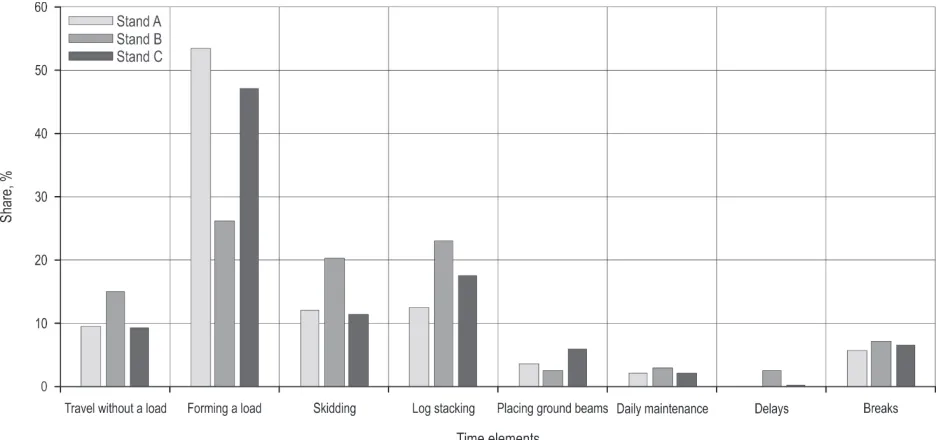
Fig. 2 shows the shares of particular elements of times within the work time. The diagram revealed leg-ible differences between the stand B and the other two stands in terms of duration of most of the operations under analysis. Forming a load on this trial plot took slightly over 25% of the work place time and the times of skidding, travels without a load and log stacking had higher shares. In stands A and C, the time of form-ing a load was predominant, takform-ing nearly 50% of the work place time. What is noteworthy is the surpris-ingly low, not exceeding 8%, share of times of breaks. Delays that occurred during the logging operations were not serious and they were fixed by the skidder operator as they emerged, due to which their impact on the course of works was insignificant. The share of the time of repairs was low, ranging from 0.16% in stand C to 2.5% in stand B.
Table 3 also contains characteristics of skidding cycles, enclosing the times of forming a load, skidding, log stacking and travels without a load (returns).
Variance analysis revealed statistically significant differences in mean duration of a skidding cycle be-tween the stands under investigation (p=0.00; F=21.34). The LSD test proved that the differences between stand A and the other two stands (B and C) were significant. Dependences between the skidding cycle duration and the type of a felling site (stand), the skidding distance and the number of logs per load were displayed by means of the multiple regression model (Eq. 1), the pa-rameters of which are presented in Table 4.
Skidding cycle duration = 1.23 – 6.63× – 1.39× + 2.60× + 0.03× ± 2.82 (min.)a b c d
Skidding cycle duration = 1.23 – 6.63× – 1.39× + 2.60× + 0.03× ± 2.82 (min.)a b c d (1)
Where:
a zero-one variable of the stand category, taking the value »1« for stand B, and »0« for the other two stands
b zero-one variable of the stand category, taking the value »1« for stand C, and »0« for the other two stands
c number of logs per load (pcs.)
d skidding distance (m).
The model of multiple regression function pre-sented above explained the variability in duration of skidding cycles well, which was reflected by the value of coefficient of determination R2, accounting for 73%. The values of β coefficients obtained in the analysis indicated that the skidding distance had the greatest impact on the skidding cycle duration, followed by the stand-related factors – the conditions encountered in stand B and the number of logs per load. The factors with the weakest influence on the skidding cycle dura-tion in the above-mendura-tioned model were the condi-tions under which the wood was hauled in stand C, where the mean duration of a cycle was the lowest.
The values of productivity per hour achieved by the skidder studied, operating in particular stands, are displayed in Fig. 3.
Table 4 Regression analysis – duration of a skidding cycle
Equation parameters: R=0.86; R2=0.73; R2
revised=0.73;
F=221.82; p<0.001; Estimation error = 2.82 Parameters of independent variables:
b Standard
deviation
Coefficients of
regression t p
Absolute term 0.68 1.23 1.79 0.04
a –0.59 0.41 –6.63 –15.90 <0.001
b –0.12 0.42 –1.39 –3.25 0.01
c 0.43 0.19 2.60 13.43 <0.001
The skidder achieved the highest productivity in stand B; it exceeded 14 m3×h-1 when calculated within the productive work time. On the other two trial plots, the productivity of skidding ranged from 8 to 9 m3×h–1. The differences in productivity achieved within the productive work time and the work place time of a working shift were not large, which might indicate that the logging operations were well organised and executed.
The model of multiple regression (Eq. 2), describ-ing the efficiency of skidddescrib-ing cycles within the produc-tive work time, took the form presented below:
3 -1
Productivity of a skidding cycle = 14.79+3.72× -1.79× -2.73× -0.03× +5.08× ±4.53 (m ×h )a b c d e
3 -1
Productivity of a skidding cycle = 14.79+3.72× -1.79× -2.73× -0.03× +5.08× ±4.53 (m ×h )a b c d e (2)
Where:
e wood volume per single load (m3) other symbols as in equation 1 above.
Characteristics of the above mentioned model are presented in Table 5.
Table 5 Regression analysis – productivity of a skidding cycle
Equation parameters: R=0.73; R2=0.53; R2
revised=0.52;
F=71.47; p<0.001; estimation error = 4.53 Parameters of independent variables:
b Standard
deviation
Coefficients of
regression t p
Absolute term 1.03 14.79 14.36 <0.001
a 0.30 0.65 3.72 5.66 <0.001
b –0.14 0.64 –1.79 –2.79 0.01
c –0.41 0.38 –2.73 –7.22 <0.001
d 0.73 0.01 –0.03 –11.77 <0.001
e –0.57 0.44 5.08 11.47 <0.001
The model in question explained the variability in productivity of skidding cycles in slightly over 50%. The F test revealed that the model was statistically sig-nificant, though there must have been other indepen-dent variables that affected the productivity of skid-ding in its successive cycles. The values of standardised β coefficients of regression indicated that the skidding distance had the strongest impact on productivity, fol-lowed by the wood volume per load and the number of logs per load. Stand-related factors affected the pro-ductivity of skidding less significantly.
4. Discussion
Productivity of skidding means used for semi-suspended skidding of timber is highly diversified (Mederski et al. 2010). It depends on many factors, among which the most important are the following: the volume of extracted trees, number of logs per load, skidding distance, landform and atmospheric condi-tions, experience of an operator (Gil 2000, Ozturk and Senturk 2010, Sowa and Szewczyk 2013). Therefore, in the existing literature there are publications reporting both, the higher and the lower levels of skidding effi-ciency when compared with those presented in this paper; the latter did not exceed 14.2 m3×h-1, when cal-culated within the productive work time. For instance, Bembenek et al. (2011) stated that in a 140 year old clear-cut beech stand, the productivity of skidding performed by the HSM 904D grapple skidder, over a distance of 200–300 meters, was very high, accounting for 18 m3×h-1 within the productive work time. How-ever, transport operations took place in a finely acces-sible area, the landform of which was only slightly inclined, with a dense network of skid roads. In com-parison, the HSM 94 grapple skidder operating in the poplar and pine plantations, though on gently de-scending slopes, and hauling logs over the similar distance (220–285 m), achieved the productivity hard-ly exceeding 7 m3×h-1 (Mousavi et al. 2013). Whereas in higher mountainous locations, the MB Trac 900 skidder, operating on steep slopes in winter, reached the productivity of merely ca. 6 m3×h-1 (Acar and Dinc 2001). Nevertheless, logging operations in the moun-tains do not necessarily have to be less efficient as proved by other authors. According to Behjou et al. (2008), who analysed skidding of hardwood (beech and alder), performed down the slope with a 30% angle of inclination, over a distance of 300 meters, using the Timbejack 450C skidder, recorded that the machine managed to achieve the productivity of 22 m3×h–1. A skidder of the same type, operating under very similar conditions (in beech and alder stands, down the slope with a mean inclination accounting for 30%), over a distance of 900 meters, achieved only slightly lower productivity of 20.1 m3×h-1 (Lotfalian et al. 2011).
Croat. j. for. eng. 38(2017)1 61 only by ca. 5%. Thus, it may be assumed that hauling
operations in the stands studied were performed with-in optimal distances, which allowed the skidder to achieve a satisfactory level of productivity.
One of the factors that might have influenced the productivity recorded was the volume of individual loads. The operator of the John Deere skidder under analysis did not make a full use of the available capac-ity of the machine. The volumes of loads quoted in this paper ranged from 1.8–2.9 m3 and they were closer to those recorded in young plantations, where volumes of loads oscillated around 2.2 m3, at a mean volume of a single tree smaller than 0.4 m3 (Mosuavi et al. 2012), rather than to clear-cut stands, where an average load contained nearly 6 m3 wood (Mederski et al. 2010). Nev-ertheless, it is difficult to forecast how the efficiency of skidding would change if the skidder operator formed larger loads, as this operation took the most of time (up to 50%) on all the trial plots under investigation. Adding more logs to a single load would even increase the share of this work time elements. The stands where skidding took place were not optimal in terms of employing a grapple skidder, which proved to be much more effec-tive while operating on large clear-cut sites. With regard to the latter, the time of forming loads would also be the shortest. However, the studies presented in this paper were carried out in pine stands under thinning and com-plex felling system, which are typical of Polish forest management. The share of time of forming loads was similar to the data reported in the existing literature only in stand B. Mosuavi et al. (2013) stated that this time element was prevalent in a semi-suspended skidding cycle, and constituted 27% of work time for a grapple skidder, while its share for a cable skidder reached 36%. Sabo and Poršinsky (2005), having analysed skidding performed in the mountains, on slopes of various angles of inclination, estimated that depending on the particu-lar stand, the share of time of forming loads ranged from 30 to 32% within the total time of work.
In the clear-cut stands (B and C), the mean duration of a skidding cycle was the same (the differences de-tected appeared to be statistically insignificant), and accounted for ca. 12 minutes, which corresponded to similar values quoted in the existing literature. Ac-cording to Mederski et al. (2010), who conducted stud-ies in a clear-cut beech stand, the mean duration of a skidding cycle accounted for 10.9 minutes. In the thinned stand A, this time was longer (ca. 16 minutes), though it was within the range given in the related literature. Admittedly, Brinker et al. (1996) reported that the mean duration of a skidding cycle performed in pine plantations, with the use of the Timberjack 240C grapple skidder, over a distance of 300 meters, amounted to 5 minutes. On the other hand, according
to Zečić et al. (2010), the mean duration of a skidding cycle over the same distance, employing the Timber-jack 240C skidder, though performed in fir and beech stands in the mountains, lasted 35 minutes.
Due to a great number of variables determining the duration of skidding and its productivity, a multiple regression analysis is often used for modelling these properties. This research covered an elaboration of mod-els that described the duration and the productivity of skidding cycles within the productive work time, based on a skidding distance, number of logs per load, and wood volume per load. Those variables were used for developing an efficiency model. The models also in-cluded other variables defining the treatment performed and stand conditions encountered on a certain felling site. The latter is a variable hardly ever used for model-ling of work time and productivity, which is mainly due to the fact that studies on productivity of skidding are usually conducted in stands managed within only one category of felling system. Nevertheless, the field re-search discussed in this paper was carried out in three stands managed within different felling systems, which enabled the authors to include the variable in question into modelling. A similar approach was taken by Nur-minen et al. (2006), whose model of skidding efficiency included, among others, a variable describing the type of cutting. The variables most commonly used in models published in the existing literature referred to the num-ber of extracted logs or load volume and skidding dis-tance (Bolding et al. 2009, Borz et al. 2013, Vusić et al. 2013), in some cases complemented with the inclination of the terrain (Zečić and Marenče 2005, Gholami and Majnounian 2008, Ozturk and Senturk 2010), the num-ber of loads (Ozturk 2010), type of skidder (wheeled, crawler) (Maesano et al. 2013) or temperature and soil conditions at which logging operations took place (Hor-vat et al. 2007). Borz et al. (2014), apart from the variables mentioned above, developed their models of duration of skidding operations, which included the skidding direction, down or up slope. Upon modelling produc-tivity of logging operations based on wide-spread re-search conducted in North America, Goychuk et al. (2011) suggested to complement these models addition-ally with a few variables, such as: season of the year, technological system and human factor related to the manner of work performance and experience of a par-ticular operator of the skidder.
5. Conclusions
for skidding under conditions in question, in particu-lar, in clear-cut pine stands. Logging operations in thinned stands, where a skidder is forced to maneuver among trees remaining in the stand, are expected to be less efficient. Therefore, an essential role in forest stands within younger age classes is played by a prop-erly designed and, what is even more important, suit-ably utilised network of forest tracks.
The models of multiple regression obtained in this studies, defining the productivity and the time con-sumption of skidding, may appear very useful in prac-tice since they enable relatively reliable estimate of productivity of logging works, performed not only in stands like those studied, but also in stands with vary-ing conditions, partly similar to those discussed in this paper (Papyrakis and Gerlagh 2007). Taking into ac-count an extremely vast incidence of pine species in Europe and Asia (Sinclair et al. 1999), the aspect of studies presented here appears to be very significant.
6. References
Acar, H.H., Dinc, B., 2001: An investigation of winter harvest -ing on steep terrain in forestry. Turkish Journal of Agriculture and Forestry 25(2): 139–147.
Acar, H.H, Yoshimura, T., 1997: A study on the productivity and cost of cable logging in Turkey. Journal of Forest Research 2(4): 199–202.
Acuna, M., Bigot, M., Guerra, S., Hartsough, B., Kanzian, C., Kärhä, K., Lindroos, O., Magagnotti, N., Roux, S., Spinelli, R., Talbot, B., Tolosana, E., Zormaier, F., 2012. Good practice guidelines for biomass production studies. In: Magagnotti, N., Spinelli, R. (eds.), CNR IVALSA, Sesto Fiorentino, 51 p. Behjou, F.K, Majnounian, B., Namiranian, M., Dvořák, J., 2008: Time study and skidding capacity of wheeled skidder Tim -berjack 450C in Caspian forests. Journal of Forest Science 54(4): 183–188.
Bembenek, M., Mederski, P.S., Erler, J., Giefing, D.F., 2011: Results of large-size timber extracting with a grapple skidder. Acta Scientarum Polonorum Silvarum Colendarum Ratio et Industria Lignaria10(3): 5–14.
Bolding, M.C., Kellogg, L.D., Davis, C.T., 2009: Productivity and costs of an integrated mechanical forest fuel reduction operation in southwest Oregon. Forest Products Journal 59(3): 35–46.
Borz, S.A., Ignea, G., Popa, B., 2014: Modelling and comparing timber winching performance in windthrow and uniform selective cuttings for two Romanian skidders. Journal of For -est Research 19(6): 473–482.
Borz, S., Dinulică, F., Birda, M., Ignea, G., Ciobanu, V., Popa, B., 2013: Time consumption and productivity of skidding Sil -ver fir (Abies alba Mill.) round wood in reduced accessibility conditions: a case study in windthrow salvage logging form Romanian Carpathians. Annals of Forest Research 56(2): 363–375.
Brinker, R.W., Klepac, J.F., Stokes, B.J., Roberson, J.D., 1996: Effect of tire size on skidder productivity. In Proceedings of a Joint Conference of the Canadian Woodlands Forum, the Ca -nadian Pulp and Paper Association, and the International Union of Forest Research Organizations, 9–11 p.
Central Statistical Office, 2014: Forestry. Statistical information and elaborations, Warszawa, 324 p.
Di Gironimo, G., Balsamo, A., Esposito, G., Lanzotti, A., Me -lemez, K., Spinelli, R., 2015: Simulation of forest harvesting alternative processes and concept design of an innovative skidding winch focused on productivity improvement. Turk -ish Journal of Agriculture and Forestry 39(2): 350–359. Gallis, C., Spyroglou, G., 2012: Productivity linear regression models of tree-length harvesting system in natural coastal Aleppo pine (Pinus halepensis l.) forests in the Chalkidiki area of Greece. Croatian Journal of Forest Engineering 33(1): 115– 123.
Ghaffariyan, M.R., Naghdi, R., Ghajar, I., Nikooy, M., 2013: Time prediction models and cost evaluation of cut-to-length (CTL) harvesting method in a mountainous forest. Small-scale Forestry 12(2): 181–192.
Gholami, M.J., Majnounian, B., 2008: Productivity and cost of wheeled skidder in Hyrcanian Forest. International Journal of Engineering Science 2(3):99–103.
Giefing, D.F., Bembenek, M., Gackowski, M., Grzywiński, W., Karaszewski, Z., Klentak, I., Kosak, J., Mederski, P.S., Siewert, S., 2012: Evaluation of thinning operations in older pine stands. Research methods. Nauka Przyroda Technologie 6(3): 1–23. Gil, W., 2000: Ground extraction of wood by skidders from the aspect of the logging code of practice. Sylwan 144(1): 59–74. Goychuk, D., Kilgore, M.A., Blinn, C.R., Coggins, J., Kolka, R.K., 2011: The effect of timber harvesting guidelines on fell -ing and skidd-ing productivity in Northern Minnesota. Forest Science 57(5): 393–407.
Horvat, D., Zečić, Ž., Šušnjar, M., 2007: Morphological char -acteristics and productivity of skidder ECOTRAC 120V. Cro -atian Journal of Forest Engineering 28(1): 11–25.
Karaszewski, Z., Giefing, D.F., Mederski, P.S., Bembenek, M., Dobek, A., Stergiadou, A., 2013. Stand damage when harvest -ing timber us-ing a tractor for extraction. Leśne Prace Badaw -cze 74(1): 27–34.
Kluender, R.A., Stokes, B.J., 1994: Productivity and costs of three harvesting methods. Southern Journal of Applied For -estry 18(4): 168–174.
Kluender, R., Lortz, D., McCoy, W., Stokes, B., Klepac, J., 1997: Productivity of rubber-tired skidders in southern pine forests. Journal of Forest Products 47(11/12): 53–58.
Kluender, R., Lortz, D., McCoy, W., Stokes, B., Klepac, J., 1998: Removal intensity and tree size effects on harvesting cost and profitability. Forest Products Journal 48(1) :54–59.
Kocel, J., 2013: Firmy leśne w Polsce. CILP. DGLP Warszawa, 333 p.
Croat. j. for. eng. 38(2017)1 63 Maesano, M., Picchio, R., Monaco, A.L., Neri, F., Lasserre, B.,
Marchetti, M., 2013: Productivity and energy consumption in logging operation in a Cameroonian tropical forest. Ecological Engineering 57: 149–153.
Marčeta, D., Petković, V., Košir, B., 2014: Comparison of two skidding methods in beech forests in mountainous condi -tions. Nova mehanizacija šumarstva 35(1): 51–62.
Mederski, P.S., Bembenek, M., Jörn, E., Dieter, D.F., Karasze -wsk, Z., 2010: The enhancement of skidding productivity re -sulting from changes in construction: grapple skidder vs. rope skidder. In: Cavalli, R., Grigolato, S., (eds) Proceeding of FOR -MEC 2010, Forest Engineering: Meeting the Needs of the So -ciety and the Environment, July 11–14, Padova, Italy, 7 p. Mousavi, R., Nikooy, M., Esmailinezhad, A., Ershadfar, M., 2012: Evaluation of full tree skidding by HSM-904 skidder in patch cutting of aspen plantation in Northern Iran. Journal of Forest Science 58(2): 79–87.
Mousavi, R., Nikoye Seyahkal, M., Naghdi, R., 2013: Com -parison of timber skidding using two ground-based skidding systems: grapple skidding vs. cable skidding.International Journal of Forest, Soil and Erosion 3(3): 79–86.
Naghdi, R., Rafatnia, N., Jalali, G.H.S., 2005: A survey of the efficiency of Timberjack 450C Wheeled skidder in Shafaroud forests in Guilan province. Iranian Journal of Natural Re -sources 57(4): 675–687.
Nurminen, T., Korpunen, H., Uusitalo, J., 2006: Time con -sumption analysis of the mechanized cut-to-length harvesting system. Silva Fennica 40(2): 335–363.
Ozturk, T., 2010: Productivity of MB Trac 900 tractor at beech stands on mountainous areas in Blacksea region. African Jour -nal of Agricultural Research 5(1): 028–033.
Ozturk, T., Senturk, N., 2010: Productivity and Time Studies of MB Trac 900 Tractor at Beech Stands on Mountainous Ar -eas in Turkey. Baltic Forestry 16(1): 132–138.
Papyrakis, E., Gerlagh, R., 2007: Resource abundance and eco -nomic growth in the United States. European Eco-nomic Re -view 51(4): 1011–1039.
Pulkki R.E., 2004. Glossary of forest harvesting terminology. [online], www.flash.lakeheadu.ca.
Sabo, A., Poršinsky, T., 2005: Skidding of fir roundwood by Timberjack 240C from selective forests of Gorski Kotar. Croatian Journal of Forest Engineering 26(1): 13–27.
Sinclair, W.T., Morman, T.J.D., Ennos, R.A., 1999: The postgla -cial history of Scots pine (Pinus sylvestris L.) in western Eu -rope: evidence from mitochondrial DNA variation. Molecular Ecology 8(1):83–88.
Sowa, J.M., Szewczyk, G., 2013: Time consumption of skid -ding in mature stands performed by winches powered by farm tractor. Croatian Journal of Forest Engineering 34(2): 255–265.
Spinelli, R., Magagnotti, N., 2012: Wood extraction with farm tractor and sulky. Estimating productivity, cost and energy consumption. Small-scale Forestry 11(1): 73–85.
Stanisz, A., 2007: Przystępny kurs statystyki z zastosowaniem STATISTICA PL na przykładach z medycyny. Tom 2. Modele liniowe i nieliniowe. Kraków: StatSoft Polska, 868 p.
Tomczak, A., Jelonek, T., 2014: Green density of Scots pine (Pinus sylvestris L.) sapwood coming from selected stands north-western Poland. Forestry Letters 107(6): 5–9.
Vusić, D., Šušnjar, M., Marchi, E., Spina, R., Zečić, Ž., Picchio, R., 2013: Skidding operations in thinning and shelterwood cut of mixed stands–Work productivity, energy inputs and emis -sions. Ecological Engineering 61: 216–223.
Zečić, Ž., Marenče, J., 2005: Mathematical models for optimi -zation of group work in harvesting operation. Croatian Jour -nal of Forest Engineering 26(1): 29–37.
Zečić, Z., Krpan, A.P.B., Vukušić, S., 2005: Productivity of C Holder 870 F tractor with double drum winch Ingland 4002 in thinning beech stands. Croatian Journal of Forest Engineer -ing 26(1): 49–57.
Zečić, Ž., Vusić, D., Prka, M., Klepac, S., 2010: Uticaj nagiba traktorskog puta na proizvodnost traktora Timberjack 240C pri privlačenju drvnih sortimenata u prebornim šumama. Šumarski list 134(3/4): 103–114.
Received: February 22, 2016 Accepted: July 22, 2016
Authors’ address: Dariusz Kulak, PhD. * e-mail: [email protected] Arkadiusz Stańczykiewicz, PhD. e-mail: [email protected] Grzegorz Szewczyk, DSc. e-mail: [email protected] University of Agriculture in Krakow Faculty of Forestry
Institute of Forest Utilization and Forest Technology Department of Forest and Wood Utilization
Al. 29 Listopada 46 31–425 Krakow POLAND