ORIGINAL PAPER
Evaluation of US/S2O8-2
compilative process performance in the
removal of Erythrosine B dye from aqueous solution
Reza Shokoohi, Abdollah Dargahi, Raheleh Amiri, Zhila GhavamiDepartment of Environmental Health Engineering, School of Public Health, Hamadan University of Medical Sciences, Hamadan, Iran
Date of submission:16 Aug 2017,Date of acceptance:28 Nov 2017
ABSTRACT
Erythrosine B is widely used for dyeing in various applications, especially in the food industry, despite its already proved toxicity and carcinogenicity. Therefore, the purpose of this study is to evaluate the efficiency of the synthesis process of US/S2O8-2 in removing erythrosine B dye from aqueous solution. In this experimental study, the removal of erythrosine B dye using combined persulfate and 40 kHz ultrasound process was studied. All reactions was conducted in a beaker of 1,000 mL in an ultrasonic bath. The effects of operational parameters such as pH of the solution (3-7), initial concentration of erythrosine B dye (10–100 mg/L), and amount of persulfate concentration (0.001–0.005 mol/L) in different contact time were investigated. The results showed that the removal efficiency increased significantly by increasing the oxidant concentration, then a steady trend was observed in the removal of erythrosine B dye. The process used US/S2O8-2at pH:3, concentration of persulfate at 0.003 mol/L, and the time of 60 min for achieving the highest removal efficiency (98.91%). Ultrasonic device alone had little effect in the removal of this dye. The effects of ion changes from calcium chloride on the performance of the US/S2O8- process were ineffective for erythrosine B dye. The results of the US/S2O8-2process application in the removal of erythrosine B dye indicated that this process has a suitably proper ability for erythrosine B dye removal and could be used as an effective method for industrial wastewater treatment.
Keywords:US/S2O8-2process; Erythrosine B dye; Ultrasonic; Aqueous solutions
Introduction
The increasing expansion of industries and the consequent discharge of industrial wastewater into the environment have created a great deal of concern about the pollution of surface water and groundwater and environmental pollution. Industrial wastewater is important because of the variety of pollutants of variable quality and quantity contained therein.1,2 Currently, there are about 10,000 different types of synthetic dyes, and annually more than 7×10⁵tons are produced worldwide.3 Existence of high levels of dyes with high concentrations of Chemical Oxygen Demand (COD) and low biodegradability of textile wastewater in receiving water sources, as well as increasing demand and consumption of dye
Zhila Ghavami [email protected]
Citation: Shokoohi R, Dargahi A, Amiri R, Ghavami Zh. Evaluation of US/S2O8-2compilative process performance in the removal of Erythrosine B dye from aqueous solution. J Adv
devoted to the assessment of the acute toxicity of erythrosine B.8The major efforts around this were initiated in the 1970s, while the US FDA instituted a partial ban on erythrosine in 1990, based on studies which indicated that high doses can cause cancer in rats, in particular thyroid tumor formation.8,9Other effects are associated with bronchoconstriction, sequential vascular response, elevation of protein-bound iodide, and chromosomal damage.9 In spite of these concerns, the consequences of erythrosine B in the environment are less investigated, and there is inadequate documentation on its removal from aqueous effluents containing dissolved erythrosine, which is difficult to be eliminated by conventional wastewater treatments.8-12 While almost every industrial dyeing process involves a solution of dye, water-soluble reactive and acid dyes are the most problematic pollutants as they tend to pass unaffected through conventional treatment systems.13,14 The treatment of colored wastewater is difficult and complex due to the presence of stable and non-biodegradable aromatic compounds in the structure of dyes.15-18 The methods used to remove dyes from these industrial wastewaters are mainly biological, chemical and physical processes.17-19 Conventional treatment processes such as chemical treatment, reverse osmosis and adsorption of adsorbent substrates also produce secondary pollutants of this dye, and chemical oxidation methods are not cost-effective and efficient.20Physical methods often do not have the power to destroy the dyes, and the remaining sludge treatment is costly in physical methods.19,20Chemical methods, using strong oxidants such as ozone and chlorine, are capable of breaking up dye compounds but, due to the requirement for high doses of these materials, the use of this method is uneconomical.21 In recent years, advanced oxidation processes (AOPs) have been extensively considered in order to overcome the problem of dye in aquatic systems. Removal of contaminants in the advanced oxidation process is performed based on the production of free hydroxyl radicals (•OH) with high oxidation potential, which convert many organic chemical compounds into minerals.22 These radicals are unstable and highly active, and are produced by chemical or photochemical reactions in situ.23,24
Free radicals are strong oxidizing agents and quickly attack organic molecules, separating a hydrogen atom from the organic material structure.23-26
Nowadays, the use of oxidizing agents, such as hydrogen peroxide, persulfate, and periodontium, has been considered by the researchers to enhance the function of oxidation processes with the aim of eliminating more organic pollutants.27The persulfate ion (S2O82-) with 2.01 oxidation-reduction potential has been used as an oxidation agent of resistant compounds in chemical removal processes.28 Persulfates, as a non-selective anion, soluble and stable, have unique properties including high kinetic velocity, more stability at environmental temperatures and less dependence on organic matter.28 Ultraviolet waves, ultrasound waves, heat, and bivalent metals are among the most important active ingredients of persulfate, which ultimately converts persulfate into free radicals of sulfate and hydroxyl.28,29Despite the great merits of the US waves, results of numerous studies have shown that the use of US waves individually due to low efficiency and the need for long time and limited energy, is not possible on a large scale. Because of increasing efficiency of ultrasound waves and overcoming the disadvantages of them mentioned above, the use of these ultrasound waves due to their ease of use and non-production of toxic by-products, in combination with other methods, has been considered. Due to the thermal decomposition of persulfate during the use of ultrasound in the activation of persulfate, several highly reactive radicals such as H, O and SO4are
produced.26
In the study by Seidmohammadi et al. on 4-chlorophenol oxidation from chemical wastewaters using US/Fenton in an aqueous environment, the results showed that 4-chlorophenol oxidation using the combined advanced oxidation process of ultrasound and Fenton, is much better than the separate use of each method. The decomposition rate of this pollutant depends on several factors, such as pH, concentration of hydrogen peroxide as oxidizing agent, contact time, iron concentration and initial concentration of organic matter.26
dye from colored textile industrial wastewaters, and as seen through studying previous researches conducted by others, there has as yet been no study on erythrosine B dye removal from aqueous solutions using the combined process. Therefore, this study was conducted to evaluate US/S2O8-2 compilative process performance on erythrosine B dye removal from aqueous solution.
Materials and Methods
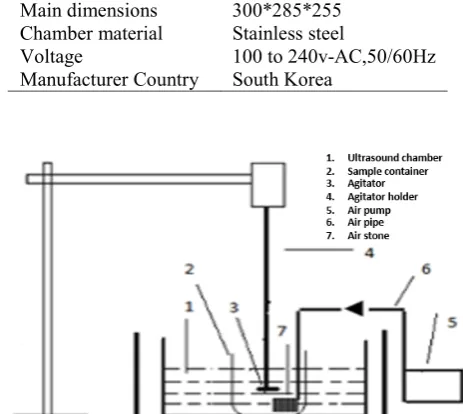
This experimental study was performed on a laboratory scale in a steel reactor with dimensions of 25×13×15 cm and a volume of 2.5 L, equipped with a turbulent reservoir, a transformer, and an ultrasonic wave generator with the LUC-405 model. The samples were synthetic effluents made in the laboratory with different concentrations of erythrosine B dye. Table 1 shows the specifications of the ultrasonic device used in this research. Also, the schematic design of the reactor is presented in Fig.1. All experiments were repeated three times and the final results were reported as mean values. Hydrochloric acid (HCl) 0.1 M and sodium hydroxide (NaOH) 0.1 M were used to adjust the pH of the solutions while being controlled by a pH meter (HACH-Ha-USA). For analysis of data, the EXCEL software was used.
Table 1. Ultrasonic device specifications
Parameter Property
Model LUC-405
Time range 0-99 min
Temperature range 0-50 ºC
Frequency 40 KHZ
Capacity dimensions 300*55*150
Main dimensions 300*285*255
Chamber material Stainless steel
Voltage 100 to 240v-AC,50/60Hz
Manufacturer Country South Korea
The acidic dye used in this study was erythrosine B dye (Ery B, CI 45,430), which was purchased from Merck Company (Germany). Its chemical structure is presented in Fig. 2. To measure the erythrosine B dye, a UV/Vis-DR 5000 spectrophotometer was used at 527 nm wavelength.30
Fig. 2. Chemical structure of erythrosine B
To investigate the effect of the environmental initial pH on the process efficiency, 1,000 mL of sample with initial pH (3, 5 and 7) was entered into the reactor. Sodium hydroxide and normal sulfuric acid were used to adjust pH. Other parameters, including the initial concentration of the dye (50 mg/L), the persulfate concentration (0.003 mol/L) and the reaction time (60 min), were set. Finally, the effect of the initial pH on the specific process efficiency and on the highest efficiency was determined.
To investigate the effect of persulfate concentration on the process efficiency in removing erythrosine B dye, samples of 1,000 mL volume placed in the reactor with the optimum pH obtained in the previous step were investigated, and the concentrations of 0.001, 0.002, 0.003, 0.004 and 0.005 mol/L were analyzed. At this stage of the study, the reaction time was 60 min and the dye initial concentration was 50 mg/L. Then, at the end of the set time, sampling and measuring the residual concentration of the dye were investigated. Finally, the effect of persulfate concentration on the process efficiency was determined, and the optimal concentration was selected. Also, to determine the effect of ion intensity in the process of US/S2O8-2 on the removal of erythrosine B dye, CaCl2(0.13, 0.52 and 1.03 g/L) was added to the reactor inlet flow and the removal rate of the dye in optimum conditions of operation was measured.
stages was investigated. For this purpose, the concentration ranges of erythrosine B dye, 10– 100 mg/L (10, 25, 50, 75 and 100 mg/L) were considered. Also, to determine the effect of
reaction time on the efficiency of the US/S2O8-2
process, sampling was done at all stages of the studying the time range of 2.5–60 min.
Results and Discussion
Speed of chemical reactions is dependent on the pH of the environment, and the pH affects directly and indirectly the oxidation of organic matter. In advanced oxidation processes, pH changes through the production of various radicals affect the oxidation of organic
matter.2,31 Since the pH of the solution has a
direct effect on the production of hydroxyl radicals and thus can affect the efficiency of the oxidation process, the first parameter examined
by the process is pH.32,33 In this study, in order
to verify the effect of pH in the US/S2O8-2
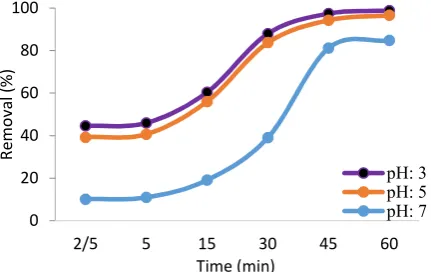
process, pH values of 3, 5, and 7 were evaluated, and the results are presented in Fig. 3. The results show that the maximum removal rate of erythrosine B was at pH:3 and contact time 60 min (98.91%), and the lowest removal rate was at pH:7 and contact time 2.5 min (10.2%). Comparison of the changes made in the first 30 min of the reaction shows that the removal efficiency at pH 3, 5, and 7 was 88.66, 81.83, and 39.41%, respectively. According to the results obtained in this study, it was found that the process efficiency in acidic pH was higher
than in neutral pH. In the US/S2O8-2 process in
acidic pH (pH:3), radical sulfate production from anion persulfate was higher in acid pH than other pHs. These findings correspond with those
of the study by Apostol et al.30As the results of
the study by Apostol et al. showed, the highest erythrosine B removal rate was found in acidic pH. Also, the results of the study by Okoye et al. showed that the highest erythrosine B removal
rate was in the lowest pH value.34 As the
reduction of pH from 10 to 2, the erythrosine B removal rate increased from 41% to 95.75%. Anion persulfate are one of the anions in persulfate coupled systems. Anion degradation of persulfates can lead to a decrease in the pH of the system and high pH changes in one process result in the removal of a high percentage of a
pollutant.35 Therefore, pH directly affects the
activation process of persulfate and can produce different radicals and anions, all of which affect the activation of persulfate and pollutant
removal.35,36
Fig. 3. Changes in the efficiency of erythrombin B dye removal at different pH and contact time in the US/S2O8
2-process (concentration of erythrysine B, 50 mg/L and persulfate, 0.003 mol/L)
In order to determine the effect of changes in the concentration of persulfate on the removal of erythrosine B dye, the optimum pH was 3 and the concentration of erythrosine B was considered to be equal to 50 mg/L. The results of changes in the persulfate concentration in the
US/S2O82- process at different contact times
showed that, by adding 0.001, 0.002, 0.003, 0.004, 0.005 mol/L persulfate at 60 min, erythrosine B with an initial concentration of 50 mg/L was obtained in 69.63%, 82.08%, 98.28%, 98.48%, 99.76%, respectively (Fig. 4).
Considering that the radical hydroxyl of the combined system is greater than the differential ultrasonic system, the combined oxidation velocity will be higher than the ultrasonic
separation system.37 According to the results,
the optimum persulfate content was chosen as 0.003 mol/L. Radical sulfate is a result of the decomposition of persulfate anions (an extremely powerful single oxidizing agent with high oxidation and reduction potential), and is likely to be competitive with radical hydroxyl and reacts rapidly with many organic materials. In the ultrasonic/ persulfate process, the increase in the oxidizing agent concentration up to 0.003 mol/L increased the reaction speed, and with increasing concentrations of persulfate to 0.005 mol/L, the increasing trend remained constant and no change was observed. This result corresponds with results of the study by
Seidmohammadi et al.26, which showed that by
0 20 40 60 80 100
2/5 5 15 30 45 60
Re
m
ov
al
(%
)
Time (min)
0 20 40 60 80 100
Re
m
ov
al
(%
)
US S2O8 US/S2O8
increasing the oxidizing matter spike to a certain extent, the reaction rate was increased, and with the increase of persulfate concentration to more than 0.02 mol/L, there was a reverse trend in removal of organic matter. Persulfates are able to produce two radicals and an hydroxyl, and these two radicals may have synergistic effects. But studies have shown that radical hydroxyl plays most of the role of the radical sulfate radicals, and does not have much effect on
persulfate-derived processes.26 In a study by
Azadbakht et al. using a persulfate-based advanced oxidation process to remove metronidazole from aqueous solutions, the results showed that with increasing persulfate concentration, the efficiency of metronidazole
elimination increased,38which corresponds with
the findings of the present study. In the study of Wu et al. regarding removal of acid orange 7 by activated persulfate with electric methods, the results showed that with increased persulfate concentration from 2 to 12 mmol/ L, efficiency
increased.39
Fig. 4. Changes in the removal efficiency of erythrombin B dye in different concentrations of persulfate in the US/S2O82-process (pH:3; concentration of erythrosine B
dye, 50 mg/L)
In the next step, the effect of different concentrations of erythrosine B (10, 25, 50, 75 and 100 mg/L) on the efficiency of the
US/S2O82-process was investigated. According
to the results, by increasing the initial concentration of erythrosine B, the removal
efficiency decreased. As the initial
concentration of erythrosine B increased from 25 to 100 mg/L, the removal rate decreased from 99.29% to 69.65% after 60 min (Fig. 5). This was in agreement with the results of the study by
Jain et al.40, which showed that by reducing the
erythrosine B dye concentration, the adsorbent
efficiency in the removal of erythrosine B dye was increased.
Fig. 5. Changes in the efficiency of removal of erythrosine B dye in different dye concentrations in the US/S2O8
2-process (pH:3; concentration of persulfate, 0.003 mol/L)
In order to effect the separation of processes in the removal of erythrosine B dye under optimal conditions, which is the
US/S2O82-process, persulfate was studied under
optimal conditions of operation and US waves alone. As the results showed, the highest
removal rate of erythrosine B dye by US/S2O8
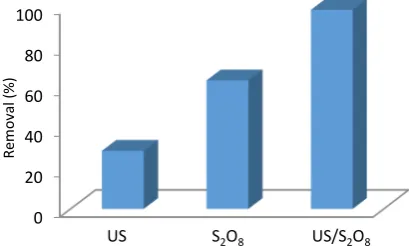
2-process (98.28%) and the lowest removal rate by the US process (28.61%) were obtained (Fig. 6). Also, the effect of persulfate alone on the removal of erythrosine B dye under optimal conditions of 63% of erythrosine B was
destructured. In the case of using the US/S2O8
2-process, for 60 min, the removal efficiency increased to 99%. Thus, it can be concluded that
using the US/S2O82-process was 1.5 times faster
than persulfate and 4.5 times faster than ultrasonic waves in eliminating erythrosine B dye.
Fig. 6. Comparative removal efficiency of erythrosine B dye in the US/S2O82-process, with persulfate in optimal
conditions of operation, and US waves alone (pH:3; initial concentration of dye, 50 mg/L, and concentration of persulfate, 0.003 mol/L)
0 20 40 60 80 100
0 10 20 30 40 50 60
R
em
ov
al
(%
)
Time (min)
ps=0.238 ps=0.476 ps=0.714 ps=0.952 ps=1.1905
0 20 40 60 80 100
0 10 20 30 40 50 60
R
em
ov
al
(%
)
Time (min)
C=10 C=25 C=50
In order to influence the changes in calcium
chloride concentration in the US/S2O82-process,
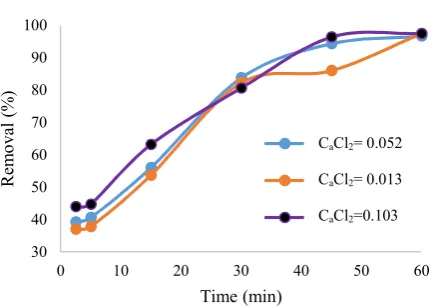
to remove the erythrosine B dye, the concentration of calcium chloride in the range of 0.13 to 1.3 mg/L was investigated. The results showed that increased concentration of calcium chloride did not have a significant effect on dye removal. In the concentration of calcium chloride equal to 0.13, 0.52 and 1.03 g/L, the removal rate of erythrosine B dye was 96.71%, 97.5% and 97.81%, respectively, for 60 min (Fig. 7). Therefore, according to Fig. 6, it can be concluded that the variations in ionic intensity
have been slightly reduced in the US/S2O8
2-process. Probably this phenomenon can be due to the activation of persulfates and other active radical species that were formed in high concentrations of persulfate and caused ion interference. This finding is similar to those of the study by Seidmohammadi et al., where, with increasing calcium chloride ion intensity, the
efficiency of metronidazole removal
increased.41
Fig. 7. Changes in the efficiency of removal of erythrosine B dye in different concentrations of sodium chloride in the US/S2O82-process (pH: 3; initial concentration of dye, 50
mg/L and concentration of persulfate, 0.003 mol/L) Conclusion
The US/S2O82- process is a very effective
process for the destruction of erythrosine B dye from aqueous solutions. The performance of the
US/S2O82- process in optimal conditions for
erythrosine B dye indicates high removal efficiency, so that at least 60 min of the
US/S2O82-process eliminated more than 90% of
the erythrosine B dye. This process can also be used as an effective method to remove this dye from industrial wastewater.
Acknowledgement
Present study extracted from research project No. 9411136366 was approved by the Hamadan University of Medical Sciences. So, the authors acknowledge the university research deputy for financial support of the research project.
References
1. Awual MR. A novel facial composite adsorbent for enhanced copper(II) detection and removal from wastewater. Chem Eng J 2015;266:368-75. 2. Seidmohammadi A, Asgari G, Dargahi A, Mobarakian S A. Equilibrium and synthetic equations for index removal of methylene blue using activated carbon from oak fruit bark. J Mazandaran Univ Med Sci 2015;24(121):172-187.
3. Koprivanac N, Hazardous HK. Organic Pollutants in Colored Wastewaters. New York: New Science Publishers; 2008.
4. Pirsaheb M, Zinatizadeh AK, Dargahi A. Performance evaluation of coagulation process in removal of low turbidity and color from water using different inorganic coagulants. Water & wastewater 2011;23(181):111-118.
5. Gong JL, Wang B, Zeng GM, Yang CP, Niu CG, Niu QY. Removal of cationic dyes from aqueous solution using magnetic multi-wall carbon nanotube nanocomposite as adsorbent. J Hazard Mater 2009;164(2-3):1517-522.
6. AL I, Zhou Y, Jiang J. Removal of methylene blue from aqueous solution by montmorillonite/ CoFe2O4 composite with magnetic separation performance. Desalination. 2011;266(1-3):72-77.
7. Qadri SH, Ganoe A, Haiks Y. Removal and recovery of acridine orange from solution by use of magnetic nanoparticles. J Hazard Mater 2009;169(1-3):318-323.
8. Apostol LC, Smaranda C, Diaconu M, Gavrilescu M. Preliminary ecotoxicological evaluation of Erythrosin B and its photocatalytic degradation products. Environ Eng Manage J 2015;14:465–71.
9. Jesus GJ, Corso CR, Campos A, Franchetti SMM. Biodegradation of erythrosin B dye by paramorphicNeurosporacrassa 74A. Braz Arch Biol Technol 2010;53(2):473–80.
10. Caliman FC, Apostol LC, Bulgariu L, Bulgariu D, Gavrilescu M. Study regarding the sorption of erythrosine from aqueous solution onto soil. Environ Eng Manage J 2009;8(6):1339–46. 30
40 50 60 70 80 90 100
0 10 20 30 40 50 60
Re
m
ov
al
(%
)
Time (min)
CaCl2=0.052 CaCl2=0.013 CaCl2=0.103
CaCl2= 0.052
CaCl2= 0.013
11. Caliman FC, Apostol LC, Bulgariu L, Bulgariu D, Gavrilescu M. Influence of soil particle size onto sorption of tartrazine from aqueous solutions. Environ Eng Manage J 2009;8(5):1081–7.
12. Pereira L, Pereira R, Oliveira CS, Apostol LC, Gavrilescu M, Pons MN, et al. UV/TiO2 photocatalytic degradation of xanthene dyes. Photochem Photobiol 2013;89(1):33–9.
13. Motoc S, Manea F, Pop A, Baciu A, Burtica˘ G, Pode R. Electrochemical mineralization of Reactive Red147 Dye on boron-doped diamond electrodes. Environ Eng Manage J 2013;12(3): 509–16.
14. Suteu D, Biliuta G, Rusu L, Coseri S, Nacu G. Cellulose cellets as new type of adsorbent for the removal of dyes from aqueous media. Environ Eng Manage J 2015;14(3):525–32.
15. Royer B, Cardoso NF, Lima EC, Macedo TR, Airoldi C. A useful organofunctionalized layered silicate for textile dye removal. J Hazard Mater 2010;181(1–3):366-74.
16. Dotto GL, Lima EC, Pinto LAA. Biosorption of food dyes onto Spirulina platensis nanoparticles: Equilibrium isotherm and thermodynamic analysis. Bioresource Technol 2012;103(1):123-30.
17. Asadi F, Dargahi A, Almasi A, Moghofe E. Red Reactive 2 Dye Removal from Aqueous Solutions by Pumice as a Low-Cost and Available Adsorbent. Arch Hyg Sci 2016;5(3):145-152.
18. Forgacs E, Cserháti T, Oros G. Removal of synthetic dyes from wastewaters: a review. Environ Int 2004;30(7):953-71.
19. Mondal S. Methods of dye removal from dye house effluent—an overview. Environ Eng Sci 2008;25(3):383–96.
20. Shuang S, Lejin Xu, Zhiqiao H, Haiping Y, JianmengCh, Xiuzhen X, et al. Photocatalytic degradation of C.I. Direct Red 23 in aqueous solutions under UV irradiation using SrTiO3/CeO2composite as the catalyst. J Hazard Mater 2008;152(3):1301–1308.
21. Kansal S, Hassan Ali A, Kapoor S. Photocatalytic decolorization of biebrich scarlet dye inaqueous phase using different nanophotocatalysts. Desalination 2010;259(1-3):147–155.
22. Al-Momani F, Touraud E, Degorce-Dumas JR, Roussy J, Thomas O. Biodegradability enhancement of textile dyes and textile wastewater by VUV photolysis.J Photochem Photobiol A: Chemistry 2002;153(1-3):191-197. 23. Ledakowicz S, Solecka M, Zylla R. Biodegradation, decolourisation and detoxification of textile wastewater enhanced by
advanced oxidation processes. J Biotechnol 2001;89(2-3):175-184.
24. Zahraa O, MaireS, Evenou F, Pons MN, Alinsafi A, Bouchy M. Treatment of wastewater dyeing agent by photocatalytic process in solar reactor. Inter J Photoene 2006;2006(3):1-7.
25. Asadi A, Mehrvar M. Degradation of aqueous methyl tert-butyl ether by photochemical, biological, and their combined processes. Inter J Photoene 2006;2006:1-9.
26. Seid Mohammadi A, Movahedian H. p-Chlorophenol Oxidation in Industrial Effluent by Ultrasonic/Fenton Technology. Water and wastewater 2011;22(4):43-9.
27. LeeY-Ch, Lo S-L, Kuo J, Lin Y-L. Persulfate oxidation of perflorooctanoic acid under the temperature of 20-40 ºC. Chem Eng J 2012;198-199:27-32.
28. Hussain I, Zhang Y, Huang Sh, Du X. Degradation of p-chloroaniline by persulfate activated with zero-valent iron. Chem Eng J 2012;234:269-276.
29. Kang J, Duan X, Zhou L, Sun H, Tade MO, Wang Sh. Carbocatalytic activation of persulfate for removal of antibiotics in water solutions. Chem Eng J 2016; 288: 399-405.
30. Apostol LC, Ghinea C, Alves M, Gavrilescu M. Removal of Erythrosine B dye from water effluents using crop waste pumpkin seed hulls as adsorbent. Desalination Water Treatt 2016;57(47):22585-608.
31. Moussavi G, Mahmoudi M. Removal of azo and anthraquinone reactive dyes from industrial wastewaters using MgO nanoparticles. J Hazard Mater 2009;168(2-3):806-12.
32. Asgari Gh, Chavoshani A, Seidmohammadi A, Rahmani A. Removal of Pentachlorophenol Using Microwave Assisted Persulfate from Synthetic Wastewater. J Water Wastewater 2013;25 (4):1-10.
33. Arslan G, Yazici B, Erbil M. The effect of pH, temperature and concentration on electrooxidation of phenol. J Hazard Mater 2005;124(1–3):37-43.
34. Okoye CC, Onukwuli OD, Okey-Onyesolu CF, Nwokedi IC. Adsorptive Removal of Erythrosin B Dye onto Terminalia Catappa Endocarp Prepared Activated Carbon: Kinetics, Isotherm and Thermodynamics Studies. Chem Process Eng Res 2016;43:26-43.
35. Liang C, Wang ZS, Bruell CJ. Influence of pH on persulfate oxidation of TCE at ambient temperatures. Chemosphere 2007;66(1):106-13. 36. Miraglio MA. Base-activatedpersulfate treatment
to circumneutral. Washington State University; 2009.
37. Hou L, Zhang H, Xue X. Ultrasound enhanced heterogeneous activation of peroxydisulfate by magnetite catalyst for the degradation of tetracycline in water. Sepa Puri Technol 2012; (84):147-152.
38. Azadbakht F, Esrafili A, Sajedifar J, Yeganeh Badi M, Amiri M, Gholami M. Efficiency of Persulfate-based Advanced Oxidation Process (UV/Na2S2O8) in Removal of Metronidazole from Aqueous Solutions. J Mazandaran Univ Med Sci 2017;27(154):119-29.
39. Wu J, Zhang H, Qiu J. Degradation of Acid Orange 7 in aqueous solution by a novel electro/ Fe2+/peroxydisulfate process. J Hazard Mater 2012;215:138-45.
40. Jain R, Sikarwar S. Adsorptive removal of Erythrosine dye onto activated low cost de-oiled mustard. J Hazard Mater 2009;164:627–33. 41. Seidmohammadi A, Asgari G, Torabi L.