Vol. 48, No. 1, Spring 2016, pp. 11- 17 )AIJ-EEE)
Corresponding Author, Email: [email protected] ٭
Electrostatic Analysis of the Charged Surface in a
Solution via the Finite Element Method: The
Poisson-Boltzmann Theory
S. Nikzad
1and H. Noshad
2*1- PhD. Student, Department of Energy Engineering and Physics, Amirkabir University of Technology, Tehran, Iran. 2- Professor, Department of Energy Engineering and Physics, Amirkabir University of Technology, Tehran, Iran.
Received September 29, 2015, Accepted October 28, 2015
ABSTRACT
Electrostatic potential as well as the local volume charge density are computed for a macromolecule by
solving the Poisson-Boltzmann equation (PBE) using the finite element method (FEM). As a verification,
our numerical results for a one dimensional PBE, which corresponds to an infinite-length macromolecule,
are compared with the existing analytical solution and good agreement is found. As a macromolecule has a
rod-like shape with a finite length, a much more real case is considered, which leads to a two dimensional
PBE. Furthermore, it is demonstrated that the potential and charge density decrease as the distance from the
axis of the macromolecule increases. Moreover, it is concluded that the absolute value of the electrostatic
field obtained from the nonlinear PBE subject to the boundary condition with a fixed charge differs from that
of the linear PBE at fixed potential by an order of magnitude in the vicinity of the finite rod-like
macromolecule. On the other hand, excellent agreement is observed between the electric fields calculated
from the aforementioned equations at far distances.
KEYWORDS
1. INTRODUCTION
Electric charges and electrostatic interactions are ubiquitous in soft matter and biological systems [1,2], referred to as muscle, membrane, and protoplasm, which are generally regarded as organized polyelectrolytes. Polyelectrolytes exhibit various interesting phenomena due to their dual character as highly charged electrolytes and flexible chain molecules. Polyelectrolytes are macromolecules having many ionizable groups, which often acquire surface charges when dissolved in a polar solvent like water. This is usually due to dissociation of surface chemical groups, which leaves permanent charges on macromolecular surfaces and releases oppositely charged microscopic counter ions into the solution [3,4]. The counter ions, which in accordance with the Boltzmann distribution are attracted into the region of highest mean potential, are more or less trapped and form the fraction of „the bound‟ ions. Although radially fixed upon the polymer framework, these ions still have a certain freedom to move in the longitudinal direction of the molecule[5].
Soft materials are easily deformed or rearranged by interaction potentials in comparison with the thermal energy. Thus, it becomes clear that electrostatic interactions, which are typically long-ranged and strong, constitute a prominent factor in determining the behavior and properties of soft materials. This makes charged materials to be considered as appropriate candidates for many technological applications and on the other hand, a challenging subject for fundamental research in interdisciplinary sciences [6]. For instance, polyelectrolytes have been identified as good candidates for resistive type humidity sensors due to their high sensitivity, quick response and low cost [7]. Absorption of water into the insulating polymer film changes its dielectric constant, and hence, modulating its capacitance. As dielectric constant of the absorbed water is high, the capacitance of these materials increases with humidity. Capacitive-type sensors are in general more expensive than the resistive-type ones, but on the other hand, they reveal more attractive characteristics [8]. These properties and applications of soft materials, can motivate the analysis regarding this field.
Electrostatic interactions between biological molecules in solutions have generally been evaluated using the PBE, which gives the static equilibrium electric fields with reasonable accuracy [9-11]. One can find in the literature that the PBE has been linearized to eliminate the exponential terms in order to make the equation more convenient to solve [12]. The Debye length [13] appears as one of the coefficients in the linearized PBE, the so-called Debye-Huckel equation [10,12]. Both the linear and non-linear forms of the PBE give adequate descriptions regarding the steady-state electrostatic solutions. On the other hand, the effects of external electric fields on polyelectrolytes have been extensively investigated by various experimental and theoretical procedures. The effects of the interaction of
radio frequency and microwave radiations with biological tissues can be considered as the result of various phenomena. The physical laws of electromagnetic field theory, reflection, diffraction, dispersion, interference, optics, and quantum effects, should be applied in order to investigate and explain the observed phenomena. This is true in general for the whole spectrum of electromagnetic radiation [14].
The nonlinear PBE was solved using the Newton– Krylov iterations coupled with pseudo-transient continuation [15]. The potential was used to compute the electrostatic energy and evaluate the force on a user-specified contour. Potentials and energies of charged spheres and plates were computed and the data were compared with the results of the analysis. Chapot et al. [16] have written the nonlinear PBE as a self consistent equation for a highly charged finite size cylinder. The solution has been obtained by solving this self-consistent equation iteratively using the Green‟s function formalism.
The purpose of the present work is to solve the PBE numerically for a rod-like macromolecule having a finite length in the salt-free case via the FEM. This method can be described as an adaptation of the variational method to the problems with complex geometries and inhomogeneous media. Its variational property implies that the solution is accurate to, for example, the second order even if the modeling is accurate to the first order. This translates to coarse discretization for the same accuracy and reduces the computational load. The systematic generality of the method makes it possible to construct general-purpose computer programs for solving a wide range of problems. Hence, in recent years, with the rapid development of applied mathematics and computer science, the FEM is widely used in the fields of mathematics, engineering, and so on. The finite element analysis of any problem involves basically four steps [17]: discretizing the solution region into a finite number of sub regions or elements, deriving governing equations for a typical element, assembling of all elements in the solution region, and solving the system of equations obtained.
The numerical results are represented in section 3. Finally, the paper is ended by a conclusion in section 4.
2. MATHEMATICAL FORMALISM AND MODEL
Although in this paper the model is constructed in analogy to DNA double helices, modeling the DNA double helix is not carried out in details. Without loss of generality, it is assumed that the charged polyelectrolyte is situated in the axis of a coaxial electro-neutral cylinder containing counter ions equivalent to the charges on the polyion. As a consequence, the cylinder containing the polyion and its counter ions is considered to be an uncharged entity in an electrically neutral environment i.e., the solvent. The model considers the macroion to be a rod with a finite length. The common symmetry axes of the macromolecule and the unit cell are assumed to be placed along the z-axis.
The local potential is given through the Poisson equation:
2 ,
, r z ,
r z
(1)
where
r z, is the charge density distribution. The quantity
is permittivity of the medium. The localcharge density distribution
r z, is given by the Boltzmann equation
r z, en r z
, , (2)
where e denotes the electron charge and n r z
, stands for the counter ion distribution, which is related to the electrostatic potential
r z, by the Boltzmann factor in the form [19]:
0( , )
, exp ,
B
e r z n r z n R
k T
(3)where n R( 0) is the average counter ion concentration. As the mutual repulsion among the bound ions was neglected in the Schwarz‟s model, the distribution of the bound ions is Gaussian around the center of polyion in the absence of an external electric field [20]. It should be noted that, it is not quite simple to obtain the potential due to the nonlinearity nature of the equation.
In order to solve the PBE, the screening constant K , Bjerrum length lB, the charge parameter and the reduced electrostatic potential y r z( , )should be defined. The screening potential K is defined as follows:
2
0
8 B ( ),
K l n R (4)
where
l
B denotes the Bjerrum length and is given by:2 4
.
B B e l k T (5)The charge parameter also known as the Manning parameter is a measure of the charges on the surface of the macro ions:
,
B
l b
(6)
where b is the distance between the two ionic groups. Using the aforementioned parameters the reduced electrostatic potential y r z( , ) is determined by the following normalized relation
,,
.
B
e r z y r z
k T
(7)
Therefore, it is a dimensionless quantity Combining the Poisson equation with the Boltzmann factor, the PBE can be written as
2 2
2
2 2
1
, exp ,
.
y r z K y r z r r r z
(8)Eq. (8) is a non-linear partial differential equation of the second order. The solution of this equation has been obtained using the Neumann boundary conditions in radial direction as well as the continuity conditions in the longitudinal direction. At large distances from the macromolecule, i.e. the distances typically larger than the Debye length, the electrostatic potential becomes small and the nonlinear PBE, namely eq. (8), reduces to the linear PBE. This can be justified for surface potentials which are smaller than 25 mV at room temperature. By expanding the right hand side of eq. (8) to the first order in y r z( , )the following equation is obtained:
2 2
2
2 2
1
, 1 ( , )
y r z K y r z r r r z
(9)3. NUMERICAL RESULTS
In the numerical calculations, 16 negative charges were considered with equal separation of 0.715 nm along the symmetry axis of the cylinder. The radius and length of the cylinder were selected as 0.5 nm and 12 nm, respectively. In our analysis, the radius of the unit cell of the system was chosen as 6 nm, whereas its length was considered to be as 24 nm. The diameter of the counter ions was taken equal to b0.3 nm. The solvent was treated as a dielectric continuum with the relative
permittivity of pure water, namely r 78.3 at 298K
T , and dielectric discontinuity between the solvent and DNA cylinder was neglected. The average counter ion concentration was considered as
4
76.8 10 M[20,21].
It is worth noting that, by solving the exact solution of the PBE for the two boundary conditions, a set of two
coupled differential equations for and RM has been obtained in the literature [18,22]. In the equations, the
parameters and RM denote the integration constant and the Manning radius, respectively [18,22]. These equations were solved using the Newton‟s iteration method with high accuracy. Subsequently, by substituting the parameters in the exact solution [18,23,24], two peaks were appeared around r1nm and r3nm. It is notable that, it is not expected to see the peaks in the plot conceptually. It is concluded that, the values of and
M
R obtained from the aforementioned analysis are not quite correct. Afterwards, the correct value of was calculated using the screening potential which can be written as
2 2 0
4(1 )
.
K R
(10)
To calculateRM, as the second parameter, the quantity was substituted in the corresponding equation for RM as follows [18,22]
M
1 1
exp arctan
.
R a
(11)In the aforementioned equation,
a
and denote the radius of the macromolecule and the charge parameter, respectively. It should be noted that, thecorrect values of and RM are obtained as i 1, and 1.2915 10 202.0043i1010 from our computations, respectively. Whereas, their corresponding values are computed from the equations reported in Ref. [18], to be as 2.6727 and 8.1062, respectively. As mentioned, the main objective of this work is to solve the
this purpose, eq. (8) has been solved by using the FEM. In Fig. 1, the reduced electrostatic potential has been illustrated for a macromolecule with a finite length. As a result shown in the figure, potential is maximum at the center and decreases by increasing distance from the axis of the macromolecule.
x [nanometer]
-8 -6 -4 -2 0 2 4 6 8
Redu
ced el
ectrostati
c potent
ial
6.5 7.0 7.5 8.0 8.5 9.0
z = 7 [nm] z = 8 [nm] z = 9 [nm]
Fig. 1. The dimensionless reduced electrostatic potential versus distance from axis of the macromolecule in the planes z = 7,
8 and 9 nm for a finite rod-like macromolecule, which corresponds to two variable PBE
x [nanometer]
1 2 3 4 5 6 7
Vo
lum
e c
harge density [
C/m
3 ]
*10
6
0 1 2 3 4 5
z = 7 nanometer [nm] z = 8 [nm] z = 9 [nm]
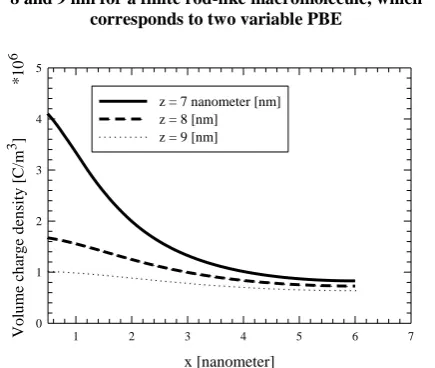
Fig. 2. Local volume charge density as a function of distance from axis of the macromolecule in the planes z = 7, 8 and 9 nm for a finite rod-like macromolecule, which corresponds to two variable PBE
Afterwards, by substituting y r z( , ) in eqs. (2) and
solution for a PBE with one variable [18], which corresponds to an infinite charged rod and good agreement was found.
In Fig. 5, the nonlinear PBE has been solved with defined surface charge density, and our data have been compared with those obtained from the linear PBE having a fixed potential on the surface of the cylinder. It is important to note that the agreement between these two solutions is not obvious a priori.
r = 0.5 nanometer [nm]
Reduce
d e
lec
trostatic
pote
ntial
6 7 8 9 10 11 12 13 14
r = 6 [nm]
z [nanometer]
-15 -10 -5 0 5 10 15
Reduce
d e
lec
trostatic
pote
ntial
6.4 6.6 6.8 7.0 7.2 7.4 7.6
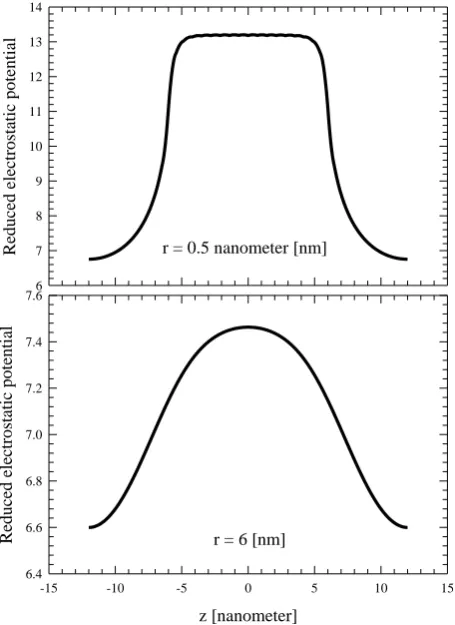
Fig. 3. The dimensionless reduced electrostatic potential as a function of z at: (a) r = 0.5 nm and (b) r = 6 nm for a finite rod-like macromolecule, which corresponds to two variable PBE
Indeed for finite rod-like cylinders, the solution of the linear (or nonlinear) PBEs is quite different depending on the boundary condition under consideration, namely fixed surface charge, or fixed surface potential (at the macromolecule surface). This difference originates in particular in the so-called edge effects associated with the constant potential boundary condition. The fact that an agreement may be found between the nonlinear PB with fixed charge and the linear PB with fixed surface potential is a non trivial point [25,26].
x [nanometer]
0 1 2 3 4 5 6 7
Redu
ced el
ectrostati
c potent
ial
0 3 6 9 12 15
Analytical solution
Numerical solution (The present work)
Fig. 4 The dimensionless reduced electrostatic potential obtained from the analytical solution [18] compared with our numerical method for an infinite charged rod, which corresponds to one variable PBE
x [micrometer]
-0.1 0.0 0.1 0.2 0.3 0.4 0.5 0.6
Redu
ced el
ectrostati
c potent
ial
-3 0 3 6 9 12 15
linear PBE nonlinear PBE
Fig. 5. The dimensionless reduced electrostatic potential as a function of distance from axis of the macromolecule in the plane z = 7 nm for the nonlinear PBE with the fixed surface charge density as well as the linear PBE with the fixed potential on the surface of the finite cylinder, which corresponds to two variable PBE
x [micrometer]
-0.1 0.0 0.1 0.2 0.3 0.4 0.5 0.6
Electric
fie
ld [
V
/m
]
*1
0
7
0.0 0.5 1.0 1.5 2.0 2.5 3.0 3.5
linear PBE nonlinear PBE
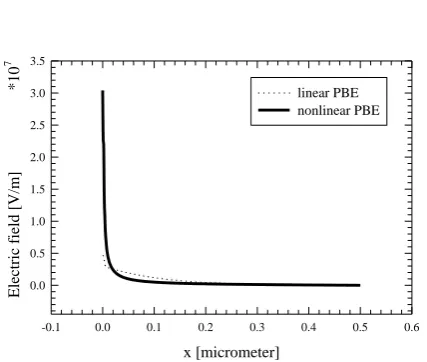
Fig. 6. Electric field as a function of distance from axis of the macromolecule in the plane z = 7 nm obtained from the nonlinear PBE with the fixed surface charge density as well as the linear PBE with the fixed potential on the surface of the finite cylinder, which corresponds to two variable PBE
4. CONCLUSION
In this work, the electrostatic potential and the local charge density have been calculated by solving a two dimensional PBE for a macromolecule with a finite length based on the FEM. For more details, the plot of the reduced electrostatic potential has been presented as a function of z for r = 0.5 nm and r = 6 nm. As shown, the reduced electrostatic potential is maximum at the center of the macromolecule (z0). Moreover, our results are in agreement with the analytical solution for a one dimensional PBE with radial variable. As expected, in the particular case of an infinitely long charged rod, in the salt-free case, a decrease of mean electric potential was observed around the macromolecule in the radial direction. Furthermore, the solution of the nonlinear PBE for the electric field associated to a fixed charge boundary condition was compared with its linear counterpart at a fixed potential boundary condition. It is concluded that, the nonlinear PBE solution at fixed charge for the electric field coincides with the linear PBE one at fixed potential at large distances from the macromolecule. However, DNA is a polyelectrolyte with a rigid rod-like shape, and the obtained results are of particular importance in the field of bioelectromagnetism. Furthermore, the obtained solutions allow us to compute important thermodynamic quantities such as osmotic coefficient of polyelectrolytes.
REFERENCES
[1] Holm, C., Kekicheff, P., Podgornik, R., “Electrostatic Effects in Soft Matter and Biophysics”, Kluwer Academic, Dordrecht, 2001. [2] Poon, W.C.K., Andelman, D., “Soft condensed
matter physics in molecular and cell biology”, Taylor & Francis, New York: London, 2006.
[3] Oosawa, F., “Polyelectrolytes”, Marcel Dekker, New York, 1971.
[4] Naji, A., Kanduc, M., Netz, R.R., Podgornik, R., “Exotic Electrostatics: Unusual Features of Electrostatic Interactions between Macroions. In: Andelman D and Reiter G (eds) Understanding Soft Condensed Matter via Modeling and Computation”, World Scientific, Singapore, 2010.
[5] Mandel, M., “The electric polarization of rod-like, charged Macromolecules”, J. Mol. Phys, 4: pp 489-496, 1961.
[6] French, R.H et al., “Long range interactions in nanoscale science”, Rev. Mod. Phys, 82: pp 1887-1944, 2010.
[7] Li, Y., Yang, M.J., She, Y., “Humidity sensitive properties of crosslinked and quaternized Poly (4-vinylpyridine-co-butyl methacrylate)”, Sensors and Actuators B, 107: pp 252–257, 2005.
[8] Harrey, P.M., Ramsey, B.J., Evans, P.S.A., Harrison, D.J., “Capacitive-type humidity sensors fabricated using the offset lithographic printing process”, Sensors and Actuators B, 87: pp 226–232, 2002. [9] Hossain, R., Adamiak, K., “Dynamic properties of
the electric double layer in electrolytes”, J. Electrost, 71: pp 829-838, 2010.
[10] Honig, B., Nicholls, A., “Classical electrostatics in biology and chemistry”, Science, 268: pp 1144- 1149, 1995.
[11] Rocchia, W., Alexov, E., Honig, B., “Extending the Applicability of the Nonlinear Poisson−Boltzmann Equation: Multiple Dielectric Constants and Multivalent Ions”, J. Phys. Chem, 105: pp 6507- 6514, 2001.
[12] Butt, H-J., Graf, K., Kappl, M., “Physics and Chemistry of Interfaces”, Weinheim: Wiley-VCH, 2003.
[13] Israelachvili, J.N., “Intermolecular and Surface Forces: With Applications to Colloidal and Biological Systems”, Academic Press, London, 1985.
[14] Vander Vorst, A., Rosen, A., Kotsuka, Y., “RF/Microwave Interaction with Biological Tissues”, IEEE Press, 2006.
[15] Shestakov, A. I., Milovich, J. L., Noy, A., “Solution of the nonlinear Poisson–Boltzmann equation using pseudo-transient continuation and the finite element method”, J. Colloid Interface Sci, 247: pp 62–79, 2002.
theory”, J. Colloid Interface Sci, 285: pp 609-618, 2005.
[17] Sadiku, M.N.O., “A simple introduction to finite element analysis of electromagnetic problems,” IEEE Trans. Educ, 32: pp 85–93, 1989.
[18] Le Bret, M., Zimm, B.H., “Distribution of counter ions around a cylindrical polyelectrolyte and Manning‟s condensation theory”, Biopolymers, 23: pp 287-312, 1984.
[19] Zangwill, A., “Modern electrodynamics”, Cambridge University Press, 2012.
[20] Yoshida, M., Kikuchi, K., Maekawa, T., Watanabe, H., “Electric polarization of rod-like polyions investigated by Monte Carlo simulations”, J. Phys. Chem, 96: pp 2365-2371, 1992.
[21] Washizu, H., Kikuchi, K., “Electric polarizability of DNA in aqueous salt solution”, J. Phys. Chem. B, 110: pp 2855-2861, 2006.
[22] Deserno, M., Holm, C., May, S., “The fraction of condensed counter ions around a charged rod: Comparison of Poisson-Boltzmann theory and computer simulations”, Macromolecules,33: pp 199-206, 2000.
[23] Fuoss, R., Katchalsky, A., Lifson, S., “The potential of an infinite rod-like molecule and the distribution of the counter ions”, Proc Natl Acad Sci (Wash), 37: pp 579-589, 1951.
[24] Alfrey, T., Berg, P., Morawetz, H., “The Counter ion Distribution in Solutions of Rod-Shaped Polyelectrolytes”, J. Polym. Sci, 7: pp 543-547, 1951.
[25] Bocquet, L., Trizac, E., Aubouy, M., “Effective charge saturation in colloidal suspensions”, J. Chem. Phys, 117: pp 8138-8152, 2002.