Please cite this article as: H. Bypour, M. Farhadi, R. Mortazavi, An Efficient Secret Sharing-based Storage System for Cloud-based Internet of Things, International Journal of Engineering (IJE), IJE TRANSACTIONS B: Applications Vol. 32, No. 8, (August 2019) 1117-1125
International Journal of Engineering
J o u r n a l H o m e p a g e : w w w . i j e . i r
An Efficient Secret Sharing-based Storage System for Cloud-based Internet of Things
H. Bypoura, M. Farhadi*a, R. Mortazavib
a School of Mathematics and Computer Science, Damghan University, Damghan, Iran b School of Engineering, Damghan University, Damghan, Iran
P A P E R I N F O
Paper history:
Received 23December 2018 Received in revised form 15 May 2019 Accepted 05 July 2019
Keywords: Internet of Things Cloud Storage Secret Sharing Scheme Aggregate Data
A B S T R A C T
Internet of things (IoTs) is the newfound information architecture based on the internet that develops interactions between objects and services in a secure and reliable environment. As the availability of many smart devices rises, secure and scalable mass storage systems for aggregate data is required in IoTs applications. In this paper, we propose a new method for storing aggregate data in IoTs by the use of ( , )-threshold secret sharing scheme in the cloud storage. In this method, original data is divided into blocks that each block is considered as a share. The edge server does not send these shares (blocks) directly (through the secure channel) to cloud service providers ( s). Rather, the edge server hides the shares (blocks) with XORing two secret values and publishes the result. Indeed, with this method, none of s has an amount of block information.This scheme is also verifiable, i.e., in the verification phase, each can verify its quasi-share. Moreover, before data retrieval, the edge server checks the correctness of provided quasi-share from s of an authorized group. Also, the proposed scheme is scalable, since new data can be inserted or part of the original data can be deleted, without changing shares. It is worth noting that the proposed scheme is more efficient compared with the other scheme since heavy and complex computation is not required.
doi: 10.5829/ije.2019.32.08b.07
1. INTRODUCTION
The concept of the internet of things was first introduced by Ashton [1] in 1999. He describes a world in which everything has its own digital identity and allows computers to manage them. The most important feature of IoTs is the ability to connect various types of objects to the virtual world.
The model of IoTs and its standards have been reviewed and surveyed in several literature studies [2-8]. Miraz et al. [5] discussed the the Internet of Things (IoTs), Internet of Everything (IoE), and Internet of Nano Things (IoNTs). They have distinguished the difference between IoTs and IoE which are wrongly considered to be the same by many people. Moreover, Lin et al. [4], first explore the relationship between Cyber-Physical Systems (CPS) and IoTs. Then they present existing architectures, enabling technologies, and security and privacy issues in IoTs to enhance the understanding of the state of the art IoTs development.
*Corresponding Author Email: [email protected] (M. Farhadi)
The challenges in IoTs have been addressed in several studies. Andra et al. [9]presented security vulnerabilities and challenges in IoTs and explored the security requirements for IoTs and provided a classification of the security challenges in IoTs systems using a new unique classification method consisting of four classes of attacks: physical, network, software, and encryption attacks. Moreover, Botta et al. [10] presented the integration of cloud computing and IoTs. In addition, Samuel [6] reviewed connectivity challenges in the IoTs-smart home. Also Wei et al. [11]presented survey work on the challenges issues and opportunities in IoTs. Generally, the IoTs system requires confidentiality, integrity, authentication and access control. Privacy and access control are also the major challenges of IoTs [12].
As the availability of many smart devices rises, fast and easy access to data as well as sharing more information is felt. Moreover, secure and scalable mass storage systems for aggregate data are required in IoTs applications [4]. Mollah et al. [13] proposed a new
cryptographic scheme that smart devices can share data securely with others at the edge of cloud-assisted IoTs with checking the integrity of decrypted data in data sharing and downloading phase. Furthermore, they proposed data-searching scheme to search desired data/shared data by authorized users on storage where all data are in encrypted form.
One of the methods used in the IoTs is to employ the secret sharing scheme [14]. A secret sharing scheme is designed to safeguard a secret by splitting it into shares and distributing them among a group of participants. In 1979, ( , ) -threshold secret sharing schemes were proposed by Blackley [15] and Shamir [16], independently. In a ( , ) -threshold secret sharing scheme, a secret can be shared among participants such that or more participants can reconstruct the secret, but
− 1 or fewer participants can not share it.
To adapt the IoTs applications, a cloud service provider offers rapid access to flexible, low-cost resources. Cloud computing is the most cost-effective method for utilization, protection, and upgrading the program and data. The advantage of using cloud computing is the almost unlimited storage space. Therefore, there is no need to concern about possible space shortages and to increase storage space. Also, since the information is stored in the cloud, preparing a backup version and restoring the information is much easier than storing the same information on a physical device. Therefore, most cloud service providers compete for data retrieval.
Asadi and Hamidi [17] point to the privacy issues of big data distributed in the cloud computing and analyze the privacy issue with the Petri model. Chen et al. [18] and Shen et al. [19] used the revised Blakley's and Shamir's secret sharing schemes, respectively, in a secure distributed file system. Then, Jiang et al. [14] proposed a secure and scalable storage system for aggregate data in IoTs, using the method proposed by Shen et al. [19]. Jiang et al. [14] introduced big data with bytes which was divided into blocks with − 1 bytes for storage. Then, for each block, a polynomial of degree − 1 is generated, and each byte of each block is considered as a coefficient of a polynomial. Moreover, in this scheme, new data can be inserted, or part of the original data can be deleted, without changing shares.
In this paper, we proposed a new scheme based on the method Jiang et al. [14] for storing aggregate data in IoTs in cloud storage. In this scheme, we use a ( , ) -threshold secret sharing scheme. Our proposed scheme has the following properties:
1. The edge server divides the data into blocks, and each block is considered as a share. However, the edge server does not send these shares (blocks) directly (through the secure channel) to s, but the shares are generated by published
information.
2. The correctness of published information about s can be verified by s in the verification phase. 3. In the data retrieval phase, before the data retrieval,
the correctness of provided information by s checked by the edge server. Thus, the edge server can prevent the cheating of some malicious s. 4. The edge server is responsible for receiving, sharing
and retrieving data. However, if the security of the edge server is compromised, then s can retrieve the data in collaboration with each other and with the information, they had.
5. The new data can be inserted or part of original data can be deleted, without changing shares.
6. We have only simple and easy calculations of the hash function, and we only use “⨁” (bitwise exclusive OR) and “||” (concatenation) operators in the calculations. These operators make our scheme less costly and more efficient than other schemes [13, 14].
The rest of the paper is structured in the following sections: in section 2 we provide some definitions. In section 3, we propose the new method for storing aggregate data of IoTs applications in cloud storage. Section 4 involves analyzing the proposed method. In this section, we will describe some of the features and performance of the proposed scheme. Finally, section 5
concludes our paper.
2. PRELIMINARIES
2. 1.Overall System Architecture Data owner The data owner is the possessor of the sensitive data that he/she wants to store his/her data in the cloud storage environment. He/she registers in the cloud account and uploads his/her data by PC or laptop or smart devices. Then, whenever necessary, he/she will be able to access the data by requesting the data in his/her cloud account.
Edge server This part of the cloud receives data from the data owner and, for storing it, divides the data into shares by the secret sharing scheme. We do not have absolute trust in this party, which means that the edge server may be misled in generating and publishing values.
Cloud Service Provider ( ) This party receives a share from the edge server. The s of an authorized subset send their shares to the edge server for retrieving the data. We do not have trust in this party, which means that this party maybe sends an invalid share to the edge server in the data retrieval phase.
on the bulletin board, and the other ( s) can only view the published values.
2. 2. Security Properties Correctness If edge server and s act honestly, the data retrieve by shares of any authorized subset of s.
Verifiability Each must be able to check the accuracy of its share. Furthermore, before retrieving data, the edge server must be able to verify the accuracy of the shares received by the s in order to prevent the cheating of s.
Secrecy The basic requirement is that an adversary cannot learn any information about the data, or it is impossible for any collusion of less than s to obtain any information about the data.
2. 3. Cryptographic Method We say that hash function is cryptographically secure if satisfies the following conditions:
• The hash function should be preimage resistant, i.e., for a given output of , it should be difficult to find a message such that = ( ).
• The hash function should be second preimage resistant, i.e., for a given , it should be difficult to
find a message ≠ such that ( ) = ( ).
• The hash function should be collision resistant, i.e., it should be difficult to find two different messages
and such that ( ) = ( ).
The difficulty of finding a collision depends on the size of the hash value.
2. 4. Threat Model Insider threats Malicious insiders such as s that want to access/disclose/modify the stored data.
Outsider threats Outside intruders are those who want to access the data, alone or with the collaboration of some unauthorized subsets of s.
3. THE PROPOSED SCHEME
In this section, we describe our proposed scheme. We need some notations and values in Table 1.
In the proposed scheme, we assume that each has , which receives them with 2′ !"#= ( 2)
from CA (certificate authority). Also, CA sends to the
edge server.
The steps of the proposed scheme are as follows:
• Submitting the data
- Registration
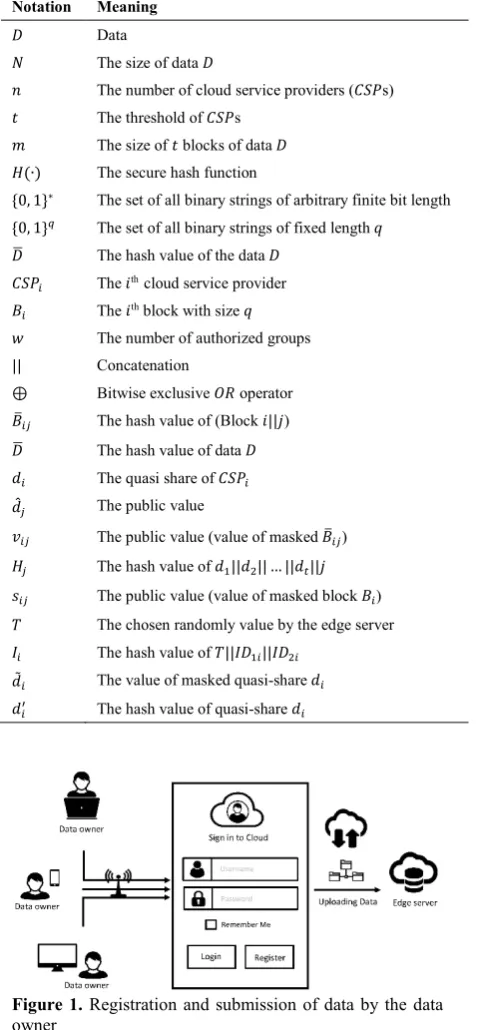
As shown in Figure 1, the data owner selects a username and registers her/his information. Then, he/she receives a password (note that the data owner can change the password).
TABLE 1. The notations used in the proposed scheme
Notation Meaning
Data
$ The size of data
The number of cloud service providers ( s)
The threshold of s
The size of blocks of data
(∙) The secure hash function
{0, 1}∗ The set of all binary strings of arbitrary finite bit length
{0, 1}* The set of all binary strings of fixed length +
, The hash value of the data The th cloud service provider
- The th block with size +
. The number of authorized groups
|| Concatenation
⊕ Bitwise exclusive 01 operator
-23 The hash value of (Block ||4)
, The hash value of data
5 The quasi share of
563 The public value
73 The public value (value of masked -23) 3 The hash value of 5 ||5 || … ||59||4
:3 The public value (value of masked block -) The chosen randomly value by the edge server
The hash value of || ||
5; The value of masked quasi-share 5 5< The hash value of quasi-share 5
Figure 1. Registration and submission of data by the data
owner
- Login and submitting
1. The data owner logs into a nearby edge server from a smart device using the username and password and submits the data
.
data owner can introduce some users to access data. There are two cases when users of the group want to access the data using keywords:
- Users of the group are authorized to access the data. In this case, authorized users request the data by providing keywords. Then, the edge server provides the data to them.
- The data owner revokes access of some users to the data in the group. In this case, the data owner revokes access of some users (=) by providing ( , keywords, $>?) to the edge server (note that we assume $>? is a sign of revocation of access to the data). Once, when the user = requests the data by providing the keyword, the edge server checks the user = access to the data. In this case, the edge server will display “unauthorized access” to the user
=.
• Construction
1. After submitting the data by the data owner, the edge server first publishes an access structure @ =
{A , A , … , AB} on the BB, where A3 (4 =
1, 2, … , .) is an authorized group. Then, the edge
server splits the data into blocks with size . If
∤
|Data| , then the edge server appends therandomly generated padding strings to the end of the data such that
|
|Data || padding|.2. Suppose | | = |Data| = $ or | | =
|Data || padding| = $ and | $ .So
= L LOPPPPPPPPPPPPPPQPPPPPPPPPPPPPPR. . . L N||L L . . . L N||. . . ||L9 L9 . . . L9N S
-TUVW 1: L L … L N
-TUVW 2: L L … L N
⋮
-TUVW : L9 L9 … L9N
3. The edge server chooses a secure hash function
: {0,1}∗⟶ {0, 1}*and computes
, = ( ) (1)
4. Now, the edge server acts based on the following cases:
- If |Block [|\ ]
1. The edge server appends the randomly generated padding strings to the end of each block such that the length of the block equals to +.
- = Block || padding , = 1, 2, … , (2)
⟹ |- | = +
-23= (Block ||4) (3)
2. Each sendsℐ` = ⨁ , { < }
Ato the edge server. The edge server first obtains =
ℐ` ⨁ , << = ( ) and then compares <<
with{ < }
"#. If two hash values are equal, then the edge server accepts , otherwise rejects it. After this, the edge server obtains for every in an authorized group A3
∀5 , 5 , … , 5b∈ {0, 1}*, ∃ 563∈ {0, 1}* s.t.
, =⊕efgh∈#i5 ⨁ 563
(4)
73= -23 ⨁ , (5)
3= (5 ||5 || … ||59||4) (6)
:3= - ⨁-23 ⨁ 3 (7)
= ( || || ), ∈j{0, 1}* (8)
5; = 5 ⨁ (9)
5<= (5 ) (10)
where = 1, 2, … , , 4 = 1, 2, … , ..
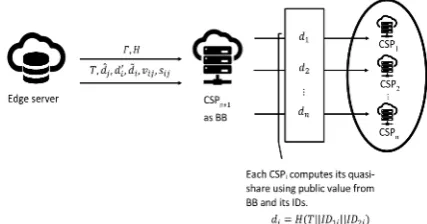
3. The edge server sends 5; to and publishes , 563,5′, 74, :4, and Hash function on the BB
( , 563,5′for and73, :3for itself). Indeed, each just gets 5 as quasi-share and in the Verification phase, it just needs to verify the validity of5. Then, the edge server stores the size of paddings.
Figure 2 shows the construction phase of the proposed scheme.
- If |Block[|= ] or |Block [|= k]
1. In case |Block |= +, it is not necessary to perform the padding for Block in Eq. (2).
2. In case |Block |= W+, the edge server considers
W-23= -2OPPPPQPPPPR3||-23||. . . ||-23 l
. (11)
Similar to Equation (11), the edge server considers
W ,, W 3 instead of ,, 3. Then, the edge server performs
the rest of the calculation in the same way as the case |Block |\ +.
- If |Block [|m ]
Suppose
(W − 1)+ \|Block | \ W+.
Note that the size of the block here is greater than + and is not divisible by +. In this case, the edge server performs as follows:
∀ = 1, 2, … , - = Block ||padding
s.t. |- | = W+
(12)
Then, the edge server performs the rest of the calculation in the same way as case |Block |= W+.
• Verification
Each computes
= ( || || ),
5 = 5; ⨁
5<<= (5 )
and then checks
5<<≟ 5<. (13)
If Equality (13) holds, the published hash value5<is valid. Otherwise5<is invalid.
After successful verification, the edge server deletes , = 1, 2, … , .
• Data requesting and retrieval
We only show data retrieval for the first case where |Block |\ +, and the two remaining cases are similarly obtained.
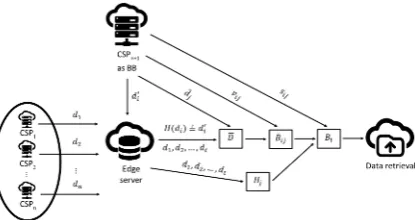
1. If data owner requests the data (or an authorized user requests the data by searching keywords), then s of an authorized group 4 provide their quasi-shares to edge server.
2. After sending quasi-shares 5 by ( =
1, 2, … , ), the edge server obtains and checks
5<<= (5 ) (14)
5<<≟ 5<. (15)
The edge server accepts quasi-share5, if Equality (15) holds, and rejects it otherwise.
Figure 3. Data retrieval phase of proposed scheme
3. After accepting quasi-shares, the edge server computes
, =⊕efgh∈#i5 ⨁ 563 (16)
-23= 73 ⨁ , (17)
3= (5 ||5 || … ||59||4) (18)
- = :3⨁-23 ⨁ 3. (19)
Then, the edge server appends the obtained blocks together for retrieval.
Figure 3 shows the Data retrieval phase of the proposed scheme.
• Inserting new data
Suppose that there is new data to be added to the original data. So, there are four cases:
1. Inserting new data before Block 1
The new discrete block(s) is/are generated. There are three cases:
- If
|new data| \ |Block 1|,
then the edge server randomly appends a new padding to the new data block such that
|new data || padding|= .
- If
|new data|= |Block 1|,
then the edge server considers the new data as the new block of size .
- If
|new data| m |Block 1|,
then the edge server splits the new data into blocks of size . If
|last generated new block| \ |Block 1|,
then the edge server randomly appends a new padding in the same way as the first instance.
In general, in this case, there are more than blocks. Therefore, at least o 1 s can retrieve data.
2. Inserting new data between Block [ data
The edge server splits the Block with inserted data into new blocks of size . If
|last generated new block| \ |Block |,
then the edge server randomly appends a new padding in the same way as the first instance of the previous case.
3. Inserting new data between Block [ and Block [ o p
4. Inserting new data after the last Block
The new discrete block(s) is/are generated similar to case 1.
• Deleting part of the data
Suppose that part of data is deleted. So, there will be three cases.
1. Deleted data is just part of Block [; |deleted data| \ |Block [|
In this case, the edge server performs the padding again only for the block that part of its data has been deleted.
2. Deleted data is part of Block [ and Block [ o p; |deleted data| \ |Block [, Block [ o p|
In this case, the edge server performs the padding again only for Block and Block o 1.
3. |deleted data| m |Block [|
In this case, less than blocks remain. So, the deleted block(s) should be generated. If the number of deleted Blocks \ |Block |, then the edge server selects an adjacent block of deleted data and splits it into blocks of size 1. Note that
1 ≤ |last generated new Block \ .
Then, edge server appends padding to the newly generated blocks. Now, if
the number of deleted Blocks m |Block |,
then the edge server selects several adjacent blocks of deleted data for splitting and generates new blocks instead of deleted blocks similar before.
4. ANALYSIS OF OUR PROPOSAL
4. 1. Security Analysis In this section, we will analyze the features of our proposal.
Theorem 4.1.Any collusion of less than s cannot obtain any information about the data.
Proof. Without loss of generality, suppose , , …,
9r (malicious insiders) with quasi-shares5 , 5 , …, 59r , respectively, intend to retrieve the data without 9. To do this, malicious insiders should obtain blocks
- , - , …, -9. However, to obtain these blocks, they need
values -23, 3, which values -23, 3 are derived from Equations (5) and (6), respectively. That is, they must first obtain the quasi-share 59. Malicious insiders can try to derive quasi-share of 9by published value5<in the construction phase. Since the hash function is one-way, they cannot obtain the quasi-share 59 from public information 5<.
Theorem 4.2. The edge server cannot cheat by publishing invalid values in the Construction phase. Indeed, its cheating is detectable.
Proof According to the verification phase, if the edge server publishes invalid 5<, then Equality (13) does not hold. Indeed, since the hash function is second preimage resistant, the edge server cannot find the second preimage 5̅ such that 5<= t5̅ u = (5 ). Moreover, since values 73, :3 are required for data retrieval, so the edge server must publish valid values of 73, :3 in the construction phase. Otherwise, in the data retrieval phase, the original data will not be restored, and this will be the edge server error. ∎
Theorem 4.3. If some malicious s provide fake shares to prevent retrieval of the main data, then their cheating is detectable.
Proof According to the data retrieval phase, if
provides invalid quasi-share 5, similar to proof of
Theorem 4.2, Equality (15) does not hold. ∎
Theorem 4.4. Under the secure hash function, outside intruders cannot get any information about the data.
Proof Suppose outside intruders want to achieve blocks of data by public information , 563,5′, 7
4, :4. But, according to proof of Theorem 4.1, outside intruders need to get a quasi-shares of s to get blocks and retrieve the original data. But since is a one-way function, they can not get quasi-shares and retrieve data using public values5<. ∎
Remark Our proposal is scalable because we can add new data or delete part of the original data without changing all the shares. When inserting new data, previous shares don’t change and only some new shares are generated. Also, when part of the original data is deleted, only some of the blocks are affected by the deletion of the data that are subject to change.
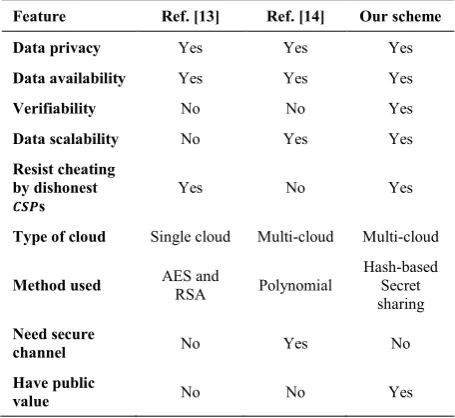
4. 2. Performance Analysis In this section, in Tables 2 and 3, we consider two schemes for comparison with our scheme. One of the reported schemes [13] is based on the cryptographic mechanisms and the other
[14] is based on the secret sharing scheme.
The scheme introduced by Mollah [13] used RSA and AES cryptosystems. Since the computational complexity of the RSA encryption is 0( w), the computational complexity of the scheme becomes 0( w) (It is notable that the symmetric cryptosystem AES has a much lower computational complexity, so we ignore it).
there are T blocks, then we have T polynomials. To retrieve data, each shares together retrieves these T
blocks and the scheme requires 0(T ) computations. The proposed scheme is established based on the x01
operator, concatenation, and hash functions. The construction phase requires 0( ) computations since it consistsof (5. o 9) o 3x01 operators, concatenations and hashfunction calls. The verification phase comprises of ( )x01 operators, (2 ) concatenations and calls the hash function( ) times. Therefore, it is accomplished in
0( ). Similarly, the data retrieval phase comprises of (2 ) x01 operators, ( ) concatenations and calls the hash function( ) times. Therefore it is accomplished in 0( ).
4. 3. Experimental Evaluations We implemented and compared the runtime of the proposed method and the technique introduced by Jiang et al. [14]. In both experiments, the same 10000 secret messages each of length 70 bytes are sent to participants ( s) and reconstructed using shares. Each experiment is repeated 10 times and the average required time per message is measured. Figure 4 shows the results of the methods for
= 3, 4, 5, 6, 7, 8, 9. The methods are implemented in
C#.Net on a regular PC with an Intel G3220 3.0 GHz CPU and Windows 10 operating system. The results
TABLE 2. Comparisons between the proposed scheme with
other related schemes
Feature Ref. [13] Ref. [14] Our scheme
Data privacy Yes Yes Yes
Data availability Yes Yes Yes
Verifiability No No Yes
Data scalability No Yes Yes
Resist cheating by dishonest
s
Yes No Yes
Type of cloud Single cloud Multi-cloud Multi-cloud
Method used AES and RSA Polynomial
Hash-based Secret sharing
Need secure
channel No Yes No
Have public
value No No Yes
TABLE 3.Comparison of computational complexity
Feature Ref. [13] Ref. [14] Our scheme
Construction 0( w) 0(T ) 0( )
Verification ___ ___ 0( )
Retrieval 0( w) 0(T ) 0( )
confirm the effectiveness of the proposed method in all cases. This performance gain is the result of using hash functions and simple operators such as XOR and concatenation instead of heavy matrix or polynomial computations in finite fields. It is notable that the proposed method also includes the verification step that is not part of the technique defined by Jiang et al. [14].
5. CONCLUSION AND FUTURE WORK
In this paper, we proposed a new verifiable and scalable cloud storage for aggregate data in IoTs. In this scheme, the edge server divided the data into blocks and each block was considered as a share. But these blocks were hidden for each . Indeed, the edge server obtained a quasi-share for each and published the hash value of it. Then in the data retrieval phase, the edge server retrieved the blocks of data by quasi-share of s of an authorized group. In the verification phase, each obtained the hash value of its quasi-share and compared it with published hash value by the edge server to observe whether the valid hash value has been published to it by the edge server. Moreover, before data retrieval, the edge server checked the correctness of provided quasi-shares by s. Therefore, the fault of s in providing invalid quasi-shares was detectable. Since blocks of data are hidden using the quasi-shares, the confidentiality of data is maintained. Thus, this scheme is safe against attacks of malicious insiders and outsiders. Also, in our scheme, new data can be inserted or part of the original data can be deleted, without changing all shares. Furthermore, we showed that our scheme is more efficient than some other schemes because, in this scheme, we had only simple and easy calculations of the hash function, and we only used “⨁” (bitwise exclusive OR) and “||” (concatenation) operators in the calculations.
Figure 4. The execution time of our scheme compared to the
In this paper, we proposed a scheme in which the edge server is trusted. But in the real world, the server may not be absolutely reliable. In this way, it can exploit user information and documents. So, we are looking to propose a scheme in which the edge server and s are not reliable, and the user's file and information in cloud environments are stored in such a way that the servers and s do not access its content in any way.
6. REFERENCES
1. Ashton, K., "That ‘internet of things’ thing", RFID Journal, Vol. 22, No. 7, (2009), 97-114.
2. Belkeziz, R. and Jarir, Z., "A survey on internet of things coordination", in International Conference on Systems of Collaboration., (2016), 1-6.
3. Darshan, K. and Anandakumar, K., "A comprehensive review on usage of internet of things (iot) in healthcare system", in 2015 International Conference on Emerging Research in Electronics, Computer Science and Technology (ICERECT), IEEE., (2015), 132-136.
4. Lin, J., Yu, W., Zhang, N., Yang, X., Zhang, H. and Zhao, W., "A survey on internet of things: Architecture, enabling technologies, security and privacy, and applications", IEEE Internet of Things Journal, Vol. 4, No. 5, (2017), 1125-1142.
5. Miraz, M.H., Ali, M., Excell, P.S. and Picking, R., "A review on internet of things (iot), internet of everything (ioe) and internet of nano things (iont)", in 2015 Internet Technologies and Applications (ITA), IEEE., (2015), 219-224.
6. Samuel, S.S.I., "A review of connectivity challenges in iot-smart home", in 2016 3rd MEC International conference on big data and smart city (ICBDSC), IEEE. Vol., No. Issue, (2016), 1-4. 7. Suresh, P., Daniel, J.V., Parthasarathy, V. and Aswathy, R., "A
state of the art review on the internet of things (iot) history, technology and fields of deployment", in 2014 International conference on science engineering and management research (ICSEMR), IEEE., (2014), 1-8.
8. Tayeb, S., Latifi, S. and Kim, Y., "A survey on iot communication and computation frameworks: An industrial perspective", in 2017
IEEE 7th Annual Computing and Communication Workshop and Conference (CCWC), IEEE., (2017), 1-6.
9. Andrea, I., Chrysostomou, C. and Hadjichristofi, G., "Internet of things: Security vulnerabilities and challenges", in 2015 IEEE Symposium on Computers and Communication (ISCC), IEEE., (2015), 180-187.
10. Botta, A., De Donato, W., Persico, V. and Pescapé, A., "On the integration of cloud computing and internet of things", in 2014 International Conference on Future Internet of Things and Cloud, IEEE., (2014), 23-30.
11. Wei, W., Yang, A.T. and Shi, W., "Security in internet of things: Opportunities and challenges", in 2016 International Conference on Identification, Information and Knowledge in the Internet of Things (IIKI), IEEE., (2016), 512-518.
12. Roman, R., Zhou, J. and Lopez, J., "On the features and challenges of security and privacy in distributed internet of things", Computer Networks, Vol. 57, No. 10, (2013), 2266-2279.
13. Mollah, M.B., Azad, M.A.K. and Vasilakos, A., "Secure data sharing and searching at the edge of cloud-assisted internet of things", IEEE Cloud Computing, Vol. 4, No. 1, (2017), 34-42.
14. Jiang, H., Shen, F., Chen, S., Li, K.-C. and Jeong, Y.-S., "A secure and scalable storage system for aggregate data in iot", Future Generation Computer Systems, Vol. 49, (2015), 133-141. 15. Blakley, G.R., "Safeguarding cryptographic keys", in
Proceedings of the national computer conference. Vol. 48, (1979), 313-317.
16. Shamir, A., "How to share a secret", Communications of the ACM, Vol. 22, No. 11, (1979), 612-613.
17. Asadi, F. and Hamidi, H., "An architecture for security and protection of big data", International Journal of Engineering, Vol. 30, No. 10, (2017), 1479-1486.
18. Chen, S., Chen, Y., Jiang, H., Yang, L.T. and Li, K.-C., "A secure distributed file system based on revised blakley's secret sharing scheme", in 2012 IEEE 11th International Conference on Trust, Security and Privacy in Computing and Communications, IEEE., (2012), 310-317.
An Efficient Secret Sharing-based Storage System for Cloud-based Internet of Things
H. Bypoura, M. Farhadia, R. Mortazavib
a School of Mathematics and Computer Science, Damghan University, Damghan, Iran b School of Engineering, Damghan University, Damghan, Iran
P A P E R I N F O
Paper history:
Received 23December 2018 Received in revised form 15 May 2019 Accepted 05 July 2019
Keywords: Internet of Things Cloud Storage Secret Sharing Scheme Aggregate Data
! " #
$ % ( '() *
+ " , - . /
0 1 % % 2 % + 3 .'*%
5 6 # 7 89 ' " * ! *
! *
0 (: ; < 0 !2 0% % ! =>
"? ! * % 0' @ ! *
IoTs
. 2 %
A $ # B < %
0 (: ! ' '? 0% % !2
@"? ! * % 0' IoTs C 2 5 6 2 0% D !
( , )
0 (: % !2 % E >
FG 0% % #A % .5 5 6< H F
! % H F * 9 I J % 5 $ +
.%
5 B H F ) *
( * ( G K( L M 2 ) 5 < 6 !
N ! *
) '( 0' *%
( *
" L '
5 B OF .
H F ) * ( *
x01
+% + > # DP '< % ' '< '
0' C
E 2 $ Q * #A @- % .'
H F 0 % *
. =>' R S"* T .% ' *
* #! =>' R FU % #
% '
2 , - #0 .' ' R % ( 5
B #0% % 2
% 5
. 0' N ! *
*
; < !% E > T S"* .'
+ 3 # =>
V + ' #
#W +% % % X=U FG 0% % 2 EP 9 Y ' '? 0% % +
.
6 < % !% E > T ? ,
-T % ! *
. 6 2 % 0' S > 1 / 2 # ' C 1