
www.astesj.com 171
Complexity Drivers in Digitalized Work Systems: Implications for Cooperative Forms of Work
Benedikt Andrew Latos*, Markus Harlacher*, Florens Burgert, Verena Nitsch, Philipp Przybysz, Susanne Mütze-Niewöhner
Institute of Industrial Engineering and Ergonomics, Work Organization Department, RWTH Aachen University,
52062 Aachen, Germany
A R T I C L E I N F O A B S T R A C T Article history:
Received: 01 August, 2018 Accepted: 16 September, 2018 Online: 27 September, 2018
Digitalization changes the way people work to a considerable extent. It alters business models and process organizations of whole industries. The ensuing market dynamics and faster innovation cycles cause an increase in complexity. In this article, the interconnection of digitalization and complexity in work systems is analyzed. For this purpose, a framework for comparing relevant complexity definitions is developed. Moreover, complexity drivers in digitalized labor systems in six different organizational dimensions (process organization, organizational structure, technology, working conditions, product and personnel) are explored. 23 experts from the academic and industrial sector were interviewed using semi-structured interviews. The results of a qualitative content analysis show that the consideration of complexity and digitalization has extensive impact what becomes evident in interdependent relations amongst the organizational dimensions. Furthermore, complexity drivers in digitalized work systems are determined as a result of the analysis procedure. Finally, the implications of the expert interviews for cooperative forms of work are discussed. The concept of a “task complexity mountain range” is presented to explain the effect of task complexity on performance and motivation in the context of work groups.
Keywords: complexity digitalization work organization cooperative forms of work
1. Introduction
This article is an extension of work originally presented on the IEEE International Conference on Industrial Engineering & Engineering Management in Singapore (December 2017) [1].
Digitalization considerably affects work systems through diverse and quicker communication media as well as through the networking of manufacturing facilities and information systems. Industry 4.0, or the concept of advanced manufacturing, is used to manufacture individualized consumer goods or machines that are progressively equipped with mechatronic components [2]. Also, developments towards dynamic customer requirements change production planning for these products, since personalized customer requirements necessitate real-time and flexible reactions within a company [3]. This causes an increase in complexity in the process organization. According to [4], [5], though, the use of digital systems is able to reduce complexity in production planning, as they enable a more efficient and flexible control and management of company processes. However, the
use of digital systems may cause interface problems or media discontinuities due to missing IT standards, since different IT systems are used for data acquisition that are not compatible with each other [6].Yet, digitalization also enables the introduction of internal and external company network structures so that distributed and global cooperation across company boundaries is feasible [7]. Another significant change in the course of digitalization, which is discussed in literature, is the increase in the decision-making powers for employees that also partly results from flatter hierarchies [8], [9].There is a general trend towards decentralized forms of management and control [10]. This implies that team and group work or interaction between individuals (in this article the term “cooperative forms of work” is employed) is relevant – especially in the course of digitalization. The changes result in an increase in the demands on employees. On the one hand, social competences are required. On the other hand, IT-related knowledge and skills in particular are becoming more important because digital technologies are used in almost all areas of companies and therefore must be handled by the employees [6], [9], [11], [12].
ASTESJ
ISSN: 2415-6698
*Benedikt Andrew Latos, Markus Harlacher; Bergdriesch 27, 52062 Aachen, Germany, [email protected]; [email protected]
www.astesj.com
Special Issue on Multidisciplinary Sciences and Engineering
As all these facets might cause levels of higher complexity, it is important to install appropriate complexity management procedures in highly digitalized labor environments [13]. In order to manage complexity, it is necessary to understand the causes of complexity and its relationships, and to keep in mind that complexity may have both positive and negative effects.
This article investigates how the digital transformation relates to complexity in work environments. It examines work systems that use information and communication technologies which are interconnected to a large extent and are increasingly mobile as well as systems that process and supply significant proportions of information in digital forms (cf. [14]). Current complexity definitions from relevant research fields do not entirely incorporate important complexity characteristics with respect to a work system. Therefore, a framework for work systems is employed to systematize and analyze existing complexity definitions (section 2). Moreover, there is a lack of suitable classification systems for complexity drivers in digitalized work systems. In order to systematize complexity drivers that are explored with 23 semi-structured expert interviews (section 3), six organizational dimensions are chosen as a framework to present the results (section 4). Subsequently, complexity management approaches in digitalized work systems are outlined and digitalization-related effects on cooperative forms of work are discussed (section 5). The individual task complexity concept of Dalhöfer and Prieß [15] is extended to consider a work group. The article concludes with a critical discussion of the findings and outlines future research steps (section 6).
2. Complexity definitions from different research disciplines
The expression complex is widely employed in everyday language to express the difficulty of comprehending, investigating and forecasting relationships or systems’ behavior that is not easy to understand. In research, the use and understanding of complexity depend on the specific research discipline [13], [16], [17], [18]. In order to conceptualize actions to handle complexity in digitalized work systems, it is vital to develop a theoretically grounded approach. Therefore, it is necessary to systematize existing definitions of complexity from relevant research disciplines in a framework that is suitable to represent a work system. As a basis for this framework the general model of a work system according to Schlick et al. [19] was chosen. This model describes the transformation process of input variables inside the work system into outputs. The working person that executes this transformation with work equipment is an essential part of the work system. Relevant research disciplines from the pluri- and interdisciplinary research field of industrial engineering and ergonomics that consider work system design are in particular: engineering, economics, sociology, and industrial and organizational psychology (see e.g. [19]). In order to develop an understanding of complexity for this framework, the understanding of complexity within these research disciplines is examined below:
Although diverse scientific disciplines employ the expression complexity in different manners, general system theory is widely used to define the phenomenon of complexity [16]. Since a work system can be regarded as a general system, the characteristics of
complex systems are outlined: systems that are meant to be complex have lots of system elements as well as they exhibit many interactions simultaneously [20][21]. Relevant literature on system theory indicates that certain characteristics of complex systems are the number and type of elements and interactions, rate of change of the system structure and uncertainty of the current and future system status (various complexity definitions can be found e.g. in [16][22]). In fact, von Bertalanffy [23] states that the characteristics of a system are due to the properties of its elements and the connections amongst them. The construct of emergence is special for complex systems. This phenomenon means that the system’s behavior is not entirely explainable with the properties of the single system elements [24]. Schuh and Schwenk [25] distinguish between simple, complicated, relatively complex and extremely complex systems, based on their number and diversity of the elements and relations as well as their variability and dynamic (see Figure 1). Whilst simple systems are characterized by few elements, interrelations and behavioral possibilities, extremely complex systems have a multitude of elements with a great variety of interrelations and possible system behaviors with variable impacts of the elements [26].
Figure 1: System states according to Schuh and Schwenk [25], Ulrich and Probst [26]
System theory is also frequently used in engineering disciplines to explain the phenomenon of complexity. Therefore, the complexity properties from general system theory also apply to considerations of complexity in an engineering context [27], [28], [29]. For example, system elements in a labor system are produced goods, tools, assignments or personnel. The system’s interrelations are, for instance, relationships of the elements during production or communication procedures. Because digitalization in work systems could have an impact on the elements or relationships in the system, this could also change the level of complexity in it.
In the literature, researchers distinguish static or structural complexity from dynamic or operational complexity when manufacturing systems are regarded [27]. The two facets are often generalized as objective complexity, whereas Blockus [22] describes complexity in the field of business administration with reference to system theory and includes perception as a subjective complexity characteristic. This aspect is crucial for a work system framework, since workers operate in these systems. For production systems, subjective complexity reflects how
high
M
u
lt
ip
li
ci
ty
/
D
iv
er
si
ty
Variability/ Dynamics
lo
w
low
h
ig
h
Complicated system Extremely complex
system
Simple system Relatively complex
individual persons experience complexity, e.g. with respect to the design of single work stations in assembly [30]. Zeltzer et al. [31] state that complexity perception in assembly is largely determined by the operator and therefore define complexity as subjectively negative perceived effects of the assembly system on the operator.
Persons in work systems have to make numerous decisions whilst performing their jobs. This is why the complexity understanding in psychology is important for the framework. Within the discipline of psychology, complex situations and problems are described by interrelated variables, a considerable level of dynamics, a lack of transparency concerning a situation and multiple goals that are conflicting (polytely) [32][33][34]. Willke [35] provides a sociological definition that considers the degree of multidimensionality, interconnectedness and relevance of the consequences of a decision problem. Complex systems have diverse options that can be chosen so that operators have to select an alternative [36].
The aforementioned complexity definitions contain central characteristics, which are relevant for a complexity definition with regard to a work system. For a systematic comparative analysis of existing complexity definitions, which relate to the chosen framework, relevant criteria are required:
In this article, work systems are considered with regard to the transformation of work through digitalization. Therefore, a system-theoretic criterion “system size” should be defined that considers the type and number of elements, as well as interactions between them. As second criterion, “dynamics and uncertainty” should be included. This criterion considers the non-static and emergent behavior of complex systems. Concerning the work system framework, the system-theoretical concept should be expanded to consider humans and effects of working conditions on humans. Decision behavior of human operators in complex situations within their work systems should be taken into account. Therefore, “polytely” is defined as a criterion for complex situations with conflicting goals. In addition, complexity may arise due to human information processing and differing semantic perceptions. Following the stress-strain-concept [37][38] and the individual perception of complexity according to Blockus [22], it has to be stated that human perception of complexity is subjective. Thus, the criterion “subjectivity” is introduced. With respect to the transformation of work through digitalization, the aspect “digitalization” is explicitly included. Figure 2 presents a selection of complexity definitions from relevant research disciplines with regard to the derived criteria.
Figure 2: Evaluation of a selection of complexity definitions within relevant research disciplines
Author(s) Research Discipline
Definition of Complexity/ Complexity Characteristics
S
y
st
e
m
S
iz
e
D
y
n
a
m
ic
s
a
n
d
U
n
c
e
r
ta
in
ty
Po
ly
te
ly
S
u
b
je
c
ti
v
it
y
D
ig
it
a
li
z
a
ti
o
n
von Bertalanffy
(1972) System theory Number of elements, variety of elements, number of interrelations
Ulrich and Probst
(1988) System theory
Complex systems are characterized by a high number and diversity of the elements and relations as well as high variability and dynamics. This allows complex systems to be distinguished from simple and complicated systems.
Deshmukh et al.
(1998) Engineering
Static complexity of a production system is characterized by its structure, variety of subsystems and strength of the interactions.
Sivadasan et al.
(2006) Engineering
The dynamic or operational complexity is defined as uncertainty regarding the temporal change of the system.
Blockus (2010) Business Administration
The main characteristics are the number and type of elements and connections and the variability over time. Beside these objective complexity characteristics, perception is considered as a subjective component.
Zeltzer et al. (2013)
Engineering (assembly system design)
Complexity of a workstation is the sum of all technical and ergonomical aspects and factors that make the set of tasks to be performed within it by an operator mentally difficult, error-prone, requiring thinking and vigilance, and inducing stress.
Dörner et al. (1983), Dörner (2011),
Kluge (2004)
Psychology
A complex problem is described by four characteristics: dependencies between variables, internal dynamics, non-transparency of the situation, multiple conflicting goals (polytely).
Willke (1996) Sociology Complexity is described by three characteristics: multidimensionality, interconnectedness and relevance of the consequences of a decision problem.
Luhmann (1991) Sociology
A system is complicated with a large number of elements and connections, whereby a complex system simultaneously contains many alternative options and forces selection.
The results illustrate that none of the considered definitions fully covers all defined criteria. Striving towards a definition containing all criteria, a synthesis of the discipline-specific definitions is required. Additionally, none of the definitions includes the aspect of digitalization. As a conclusion, the findings can be used to derive an integrated comprehension of complexity characteristics in the context of digitalized work systems:
Complexity in a system refers to a construct of higher order that is composed of single system elements.
A complex system, as sum of its elements, has the properties of high dynamics caused by multidimensional interactions, unpredictability of the system state and polytely, inducing self-generated characteristics of the system.
Concerning the digitalization of work systems, objective complexity has to be distinguished from subjective complexity. While subjective complexity is induced by information processing and perception of the individual, objective complexity arises from interactions of internal system relations and external environmental impacts. Especially from a work design point of view, it is crucial to develop a deep comprehension of variables that induce complexity in a digitalized work environment. On the one hand, labor systems with a too high degree of complexity are avoidable. On the other hand, operators may be qualified to manage complexity, if they are provided with sufficient information via support systems within work procedures. Moreover, complexity is also mentioned in terms of knowledge management as a basis for developing flexible and self-learning organizational structures [39]. All these aspects can only be considered, if there is a fundamental knowledge of complexity drivers in a work system. In this article, the understanding of the term “complexity driver” is based on the general definition of Vogel and Lasch [40], which they developed from the use of the term in the literature:
“Complexity drivers are factors, which influence a system’s complexity and company’s target achievement. They are responsible for increasing system’s [sic] complexity level and help to define the characteristics or the phenomenon of a system’s complexity. Complexity drivers are influenced by one another, that is by internal or external drivers, and cannot be reduced completely to another one” ([40], p. 18).
As another result of their systematic literature research, Vogel and Lasch [40] show that there is a multitude of different approaches to identify and classify complexity drivers. They identify complexity drivers with a systematic literature research procedure and employ a quantitative frequency analysis of mentioned complexity drivers. They present a general complexity driver classification system, based on existing classification systems, which is shown in Figure 3.
External complexity drivers are distinguished from internal and general complexity. The internal complexity can be actively influenced by the company. It is further divided into correlated complexity drivers, which are directly related to external complexity impacts, and autonomous complexity drivers, which are not directly influenced by external impacts. The general complexity category includes all drivers that cannot directly be
assigned to other specific categories (e.g. uncertainty). The rectangles in Figure 3 represent one complexity driver category that is further subdivided into numerous complexity drivers. Detailed descriptions of the assigned complexity drivers are presented in [40].
However, it can be seen that digitalization is not explicitly included as a complexity driving factor. This also applies to alternative complexity driver systematizations (see e.g. [41][42][43][44]). Furthermore, diverse methods exist in order to assess the level of complexity in work systems (see e.g. [41][42][45]). However, these approaches also do not explicitly take changes into account that are caused through digitalization.
Above all, these classification systems regard complexity on a general or company-wide level. They do not focus on complexity drivers that directly relate to work of the persons in a company and their specific work systems. This necessitates that a suitable framework has to be used to explore drivers of complexity in digitalized work systems. This framework is presented in the next section.
Figure 3: Complexity driver classification system in the style of Vogel and Lasch (2016) [40]
3. Methodology
As a framework to systematize drivers of complexity in digitalized work systems, six organizational dimensions were chosen. The organizational dimensions were the process organization, organizational structure, technology, working conditions, product and personnel. The authors have employed this framework already in diverse transformation projects in different industry sectors. In these projects, the dimensions have proven to be applicable for holistic organizational transformation projects regardless of industry settings.
To identify drivers of complexity for every organizational dimension in digitalized work systems, semi-structured expert interviews were performed. This methodology was selected, because it provides valuable qualitative insights at an initial exploration stage. Moreover, it can be used to complement ongoing quantitative research steps. The questions consisted of a constant number of open questions. This procedure guaranteed
Society complexity
External complexity
Market complexity
General market-related
complexity
Competitive complexity
Supply complexity
Technological complexity
(external) Demand
complexity
Internal correlated complexity
Target complexity
Product & product portfolio
complexity
Technological complexity
(internal) Customer
complexity
Product development complexity
Service complexity
Remanufacturing complexity Supply process
complexity
Internal autonomous complexity
Organizational complexity
Production complexity
Planning, control & information complexity Process
complexity
Resource complexity
Sales & distribution complexity Logistics
complexity
General complexity
Internal
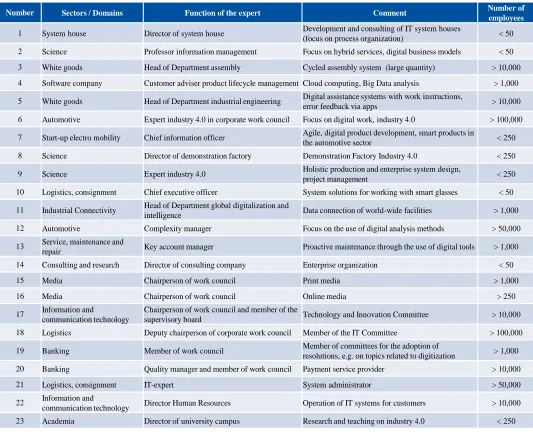
that all important questions were treated in all interview sessions. However, the interview design made it possible to stress on aspects that are especially important for an individual interviewee at the same time. Also, the aspects could be discussed according to the individual reference framework. The duration of the interviews was about 45 minutes. The interviews were transcribed according to Mayring [46] by using the audio recordings with permission of the interviewees. In one case, no recording was available so that interview notes were used. The interview transcription time took up to 8 hours for one interview. In total, 23 interviews were performed. 22 interviews were conducted via phone. One was a personal interview. The majority was conducted as phone interviews because of interview economics reasons: the interviewees worked in companies that are spread throughout Germany. Figure 4 gives an overview on the experts and their backgrounds that were included in the study. The interviewees were acquired via using the databases and business networks of the research institute. They were requested via e-mail. In total, about 30 interview requests were sent, whereof 23 interviewees accepted
the invitation. For being taken into account as an expert, two requirements had to be fulfilled: the experts needed to have privileged access to information and must have been responsible for conceptualizing, implementing or controlling problem solutions with regard to digital strategies [47].
The 23 interviewees held positions in German academia or industry and were requested because of their positions and knowledge of digitalization and complexity management or their expertise of work organization. Moreover, the experts belonged to industries from both production and service. Most worked in the fields of engineering, the management of projects, consignment and logistics, information and communication technology, banking or within the media industry.
Also, the experts were representatives of entrepreneurs or belonged to committees that represent employees. To prevent biased analysis results, the expert acquisition procedure was conducted in a manner to obtain interviewees that cover several domains and stakeholder groups.
Figure 4: Overview of the experts that were included in the study
Number Sectors / Domains Function of the expert Comment Number of
employees
1 System house Director of system house Development and consulting of IT system houses
(focus on process organization) < 50
2 Science Professor information management Focus on hybrid services, digital business models < 50
3 White goods Head of Department assembly Cycled assembly system (large quantity) > 10,000
4 Software company Customer adviser product lifecycle management Cloud computing, Big Data analysis > 1,000
5 White goods Head of Department industrial engineering Digital assistance systems with work instructions,
error feedback via apps > 10,000
6 Automotive Expert industry 4.0 in corporate work council Focus on digital work, industry 4.0 > 100,000
7 Start-up electro mobility Chief information officer Agile, digital product development, smart products in
the automotive sector < 250
8 Science Director of demonstration factory Demonstration Factory Industry 4.0 < 250
9 Science Expert industry 4.0 Holistic production and enterprise system design,
project management < 250
10 Logistics, consignment Chief executive officer System solutions for working with smart glasses < 50
11 Industrial Connectivity Head of Department global digitalization and
intelligence Data connection of world-wide facilities > 1,000
12 Automotive Complexity manager Focus on the use of digital analysis methods > 50,000
13 Service, maintenance and
repair Key account manager Proactive maintenance through the use of digital tools > 1,000
14 Consulting and research Director of consulting company Enterprise organization < 50
15 Media Chairperson of work council Print media > 1,000
16 Media Chairperson of work council Online media > 250
17 Information and communication technology
Chairperson of work council and member of the
supervisory board Technology and Innovation Committee > 10,000
18 Logistics Deputy chairperson of corporate work council Member of the IT Committee > 100,000
19 Banking Member of work council Member of committees for the adoption of
resolutions, e.g. on topics related to digitization > 1,000
20 Banking Quality manager and member of work council Payment service provider > 10,000
21 Logistics, consignment IT-expert System administrator > 50,000
22 Information and
communication technology Director Human Resources Operation of IT systems for customers > 10,000
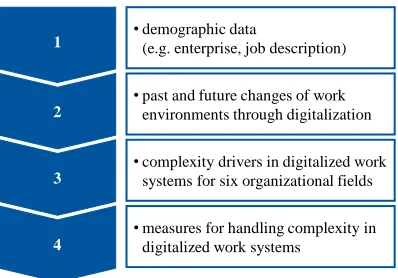
The questionnaire guide was divided into four parts. In a first step, demographic information on the interviewees was documented. The second questions asked for aspects that change companies and labor through digitalization; e.g. question were: what are the main digitalization-related changes in your company within the last 10 years? Which important changes do you anticipate for the next 10 years? The third question part focused on whether and how digitalized labor systems result in higher complexity levels. Therefore, the experts should name complexity drivers which are caused by digitalization for the six organizational dimensions respectively. In the final part of the interview, the experts were asked to identify measures to manage complexity in digitalized labor environments. Figure 5 summarizes the content of the interviews. The detailed questionnaire guide is included in Appendix 1.
Figure 5: Structure of the interview template
The analysis process initially incorporated a verification of the transcription documents. This was conducted with the available sound recordings of the interviews. Then, the single interviews were qualitatively analyzed via employing the methodology of qualitative content analysis [48][49][50].
A qualitative content analysis is a systematic and intersubjective verifiable text analysis procedure that meets the needs of interpretation and semantic meanings of a linguistical research basis [51]. In contrast to quantitative content analyses, the main purpose is not to discover quantitative connections, but rather to reduce a large amount of analysis material and to extract the main contents. This makes the method especially useful for explorative studies. Mayring [48] describes a systematic and rule-based analysis approach. The structured and transparent procedure enhances the reliability and validity of the analysis. In this case, the general procedure was adapted to the specific research aim.
In a first step, a qualitative-interpretative analysis of every interview was conducted. As code unit, a single word was chosen and a whole sentence structure was defined as context unit. Furthermore, the analysis unit was structured according to the interview template. Within the analysis procedure, the statements of the experts were generalized, paraphrased and reduced to elementary categories. The categories were derived by using a hybrid approach of deductive and inductive category formation. The inductive approach was chosen, since the research did not aim at confirming existing theories. The aim was rather to extract general statements from the interview material. However,
deductive analysis elements were included, as statements were assigned to expressions that are well established in literature. For example, the expression “polytely” (cf. section 2) was chosen as category name for expressions that contained phrases such as “conflicting goals” or “different goals that cannot all be reached at the same time”. This simplified a purposeful assignment of the interview phrases.
In a second step, the single analysis results were combined and aggregated with a quantitative analysis of mentioned categories. This made it possible to describe how often a certain category was mentioned by the interviewed persons. By doing so, complexity drivers were extracted via counting the number of mentions for single driver categories within all 6 organizational dimensions. Figure 6 summarizes the whole analysis procedure.
Figure 6: Procedure of qualitative content analysis according to Petz et al. [52], Duckwitz et al. [53]
According to Mayring [48], a qualitative analysis should meet two major quality criteria. On the one hand, intra-code-reliability requires that a repeated analysis procedure of the same coder after a certain time should lead to similar results. On the other hand, inter-code-reliability means that different persons will achieve similar analysis results. As the method is an interpretative approach, there will always be slight differences in the results, e.g. concerning the wording of categories between different coders (see e.g. [48]). With this analysis procedure, one repeated analysis by the initial coder as well as one further analysis with an additional coder was conducted. In both cases, similar results were extracted from the interviews which can be seen as indication for meeting the reliability criteria.
4. Results
In this section, the results of the aforementioned qualitative content analysis procedure are presented. In the first subsection, past and future changes of work environments through digitalization that were extracted from the interviews are outlined. Subsequently, the derived complexity drivers are presented for every organizational dimension, respectively. In the third subsection, the results for measures to handle complexity in digitalized labor systems are displayed.
4.1.Past and future changes of work environments through digitalization
Concerning the last 10 years, the experts pointed out diverse changes within their companies that have been caused through digitalization. The main changes are due to the new opportunities 4
3 2
1 •demographic data (e.g. enterprise, job description)
•past and future changes of work environments through digitalization
•complexity drivers in digitalized work systems for six organizational fields
•measures for handling complexity in
digitalized work systems interview
outcome
selection, paraphrasing
generalizing
category derivation
interview outcome
categories frequencies
quantitative analysis Interview
… Interview
2 Interview
1
selection, paraphrasing,
generalizing
Interview … Interview
2 Interview
1
categories
of manufacturing customized products. In addition, a development towards hybrid products in production industry was named. This means that the product is enhanced with further service options for the customer.
Also, the experts stated that former manually documented procedures have been changed into digital processes. These workflows incorporate several companies so that the dynamics and speed of these procedures have considerably increased as well as the duration for reactions has become shorter. Enterprise software, information and communication tools and cheaper sensor technologies offer the opportunity for companies to track and process big amounts of data. However, the operators within the companies very often have a problem to interpret and mentally capture these masses of information. As a solution for this problem, the use of big data algorithms was proposed.
Employing information and communication technology remarkably altered every day work procedures, since the amounts of interpersonal face-to-face communication are reduced. Nowadays, (digital) work forms of collaboration can be observed increasingly. Portable devices such as mobile phones, tablet computers and netbooks make it possible to perform the job in flexible work forms in terms of location and time. This gives employees more flexibility and enhances family friendliness of enterprises, whereas the persons at the same time have the drawback of possibly being always available. The interviewees concluded that these changes rather relate to administrative departments and service sectors than to manufacturing. Within the service sector, value creation networks have a higher level of digitalization than in manufacturing.
With respect to the next 10 years, the interviewees predicted increasing and quicker rates of process changes. Consequently, data will not be documented manually any more. Planning procedures will be complemented with digital support tools as well as data in real-time will be provided. Concerning manufacturing steps, the interviewees pointed out that planning and controlling would change from an internal enterprise-focused view towards an approach that considers whole value-chains. Furthermore, business models will more and more tend to include services. Therefore, products will include more software and will be a medium to offer services to the users of the products. For instance, a car manufacturer will no longer be only selling cars but rather mobility, since the car offers supplemental services to the customer.
Although experts that represented employees feared big job losses because of digitalization, the majority of the interviewees agreed that operators would not be replaced in labor systems. However, different tasks and qualification requirements will develop so that there will be new job types.
4.2.Complexity drivers in digitalized work systems
Although the interviewees did not all have the same occupational backgrounds, the overall analysis indicates that similar points can be generalized from the single interviews. In total, the analysis results show that a considerable development towards very adaptive procedural and structural organizations is required for meeting the environmental demands and to evolve to customer-focused production procedures. This development is
made possible through digitalization of manufacturing and service procedures. Nevertheless, this causes a higher complexity level.
Regarding the organizational dimension of process organization, the experts answered that complexity increases due to more customer involvement into faster work procedures. This calls for reactive and adaptive planning processes. Since digitalization can be used to initiate reactions in a company in real-time via using novel technology, this remarkably raises the dynamics of the whole organization. The change towards worldwide active value creation networks with several levels also increases the overall complexity. Since labor systems are more digitalized, the amount of human machine interfaces and diverse system solution rises. In this context, parallel IT-systems may increase the complexity level because of several maintenance and data processing steps. This may in turn cause data redundancies and problems of lacking data hygiene. Furthermore, media changes during work processes were mentioned as roots of complexity, which is digitally solvable via solutions for integrated systems. Figure 7 summarizes the drivers in the dimension of process organization and their number of mentions. Since every expert could mention several or no complexity drivers for every organizational dimension, the number of mentions does not necessarily have to sum up to the number of experts.
Figure 7: Complexity drivers in digitalized work environments concerning process organization, including their number of mentions
To develop such adaptive enterprise organizations, a shift of traditional hierarchic organizations towards the direction of flatter hierarchies is necessary. Almost all interviewees agreed on the point that agile work methods and project work would be most frequently found in the course of digitalization. In this context, complexity with respect to the organization increases, when a development towards trans-disciplinary work in (worldwide) structures is needed. This causes more coordination procedures. To work in smaller and agile cooperative structures also causes that employees need to be given more autonomy. The targeted final state may make it easier to fulfill market demands. However, the procedure of changing the culture in an organization was seen as raising the complexity level in a first step. If work persons are not empowered and qualified in diverse dimensions, occurrences with conflicting goals (polytely) can imply complexity for single operators. Complexity drivers and
Process Organization
Media disruption, increasing number of interfaces
Highly flexible and reactive planning operations
Increasing number of (parallel) systems
Data redundancies, lack of data hygiene
Customer integration into processes
Global, multistage value creation networks
Increased process speed
9
6
5
4
3
3
3
their number of mentions regarding the dimension of structural organization are illustrated in Figure 8.
Figure 8: Complexity drivers in digitalized work environments concerning structural organization, including their number of mentions
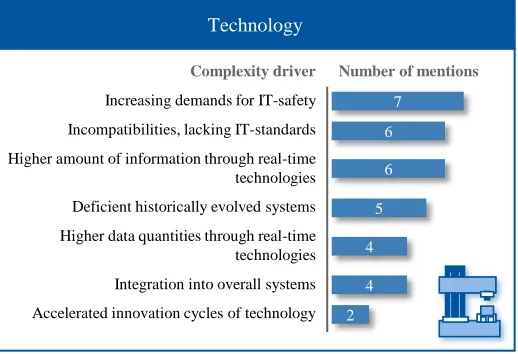
For the organizational dimension of technology, the experts named rising requirements for IT security as most important aspect in digitalized labor systems. Systems that are not compatible, missing technological standards and lacking common sets of protocols increase complexity during digitalization. These aspects gain importance, since harmonization problems happen because of systems that have evolved over a long time span. Furthermore, much higher information amounts need to be captured in real-time with software to analyze the data. Faster innovation cycles with respect to software and hardware cause more dynamics of introducing novel systems. Figure 9 summarizes the drivers concerning technological aspects and their number of mentions.
Figure 9: Complexity drivers in digitalized work environments concerning the technology, including their number of mentions
Digitalization will also have an effect on the conditions of work and will make new methods of digital communication possible. However, mentioned by the interviewees, only communicating digitally could not totally replace interpersonal communication and cause communicational complexity, because the semantic meaning of expressed phrases is mainly strengthened with face expressions or gestures. For this reason, hybrid communication ways should be considered. The majority
of the interviewees stated that the digital transformation in general changed jobs into the direction of tasks that have to manage more complexity. Although monotonous tasks are likely to be replaced by automation, jobs that demand analytical information processing, creative thinking and the capability of solving problems combined with specialist skills are more and more required. This causes that employees need transdisciplinary abilities (for instance, qualifications such as self-organization or multidimensional work with respect to diverse disciplines). Task complexity occurs as well, if novel digital systems are used and if more digitalized information has to be captured mentally in a shorter time. Lots of interviewees stressed on the point that this facet already produced trouble for employees in many cases. If the rising amount of operator machine interfaces was not created in a way that they can be used easily, a higher level of complexity would be a consequence for the employees. Nevertheless, single interviewees mentioned that the use of digitalization could at the same time be employed to make work easier. For example, work instructions can be provided during the task fulfillment. A further point is that the digital transformation could cause more task quantities. In this context, scan devices facilitate to introduce inventory documentation jobs into work procedures. All in all, a major complexity cause in digitalized labor systems was identified in the point that digitalization frequently is not very well established in management hierarchies. Particularly for worldwide operating organizations, the significance of different laws and agreements for data protection in diverse nations has extensive consequences. Figure 10 illustrates complexity drivers in the dimension of working conditions.
Figure 10: Complexity drivers in digitalized work environments concerning working conditions, including their number of mentions
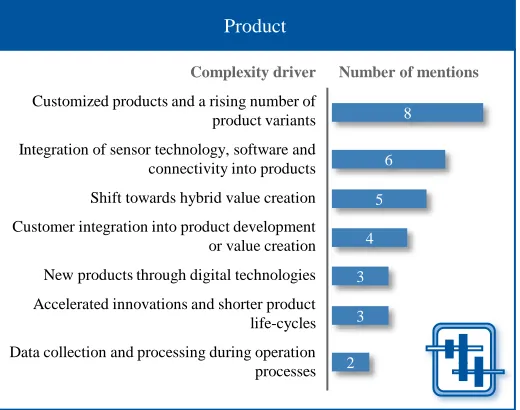
With respect to the organizational dimension of products, the interviewees named individualized products and more product variants as main complexity drivers. In general, digitalization causes product and service portfolio complexity because sensor devices, software and connecting elements are important parts of a product. This implies that designers of goods and machines will have to take into account that the final product is going to be used in a web-based context. These changes remarkably enhance feasible functions of the product but also cause more software dependency. The radical development from typical products towards hybrid production necessitates that the whole life-cycle Structural Organization
Small, agile teams working in networks with a higher degree of autonomy
Conflicting, multiple goals and situations (polytely)
Higher degree of autonomy for working persons
Working in cross-disciplinary (global) networks leads to higher coordination effort
Transformation towards delegation and participative leadership
4
2
Number of mentions Complexity driver
6
5
2
Technology
Increasing demands for IT-safety
Incompatibilities, lacking IT-standards
Higher amount of information through real-time technologies
Deficient historically evolved systems
Higher data quantities through real-time technologies
Integration into overall systems
Accelerated innovation cycles of technology
7
6
6
5
4
4
2
Number of mentions Complexity driver
Working Conditions
Loss of information within digital communication
Insufficient presence of digitalization in management levels
Multidimensional qualification requirements
Higher task quantities
Higher, accelerated input of digital information
Use of new digital technologies
Globally differing data protection laws
Increasing number of human machine interfaces
8
5
4
3
3
Number of mentions Complexity driver
9
12
3
2
2
of a produced good will need be regarded during the development of the product. Since producers and customers will not only interact once when selling a smart product, they will likely be in close contact during the whole life-cycle when processing data packages are transferred. This provides numerous novel options and makes a product more complex. For instance, individualized services or upgrades may be suggested as well as novel business models that are based on data analyses will come into focus.
In addition, very iterative and accelerated product development procedures in which clients work with the contractor together were mentioned as complexity drivers. This process of co-development between companies is essential, since a considerable gain in IT-skills and system thinking develops on the client side. In particular within the service sector, digital opportunities are employed to integrate the customer (business-to-customer relation) into the development of new services and into the service delivery. In the context of self-service, digital procedures make it possible to outsource tasks to the customers and to let them directly take part in the service fulfillment. In analogy to the organizational dimension of technology, the interviewees mentioned that digitalization fastens the release cycles for new innovations or products so that the complexity level of the products increases. Figure 11 summarizes the complexity drivers concerning the product.
Figure 11: Complexity drivers in digitalized work environments concerning the product, including their number of mentions
Concerning the organizational dimension of personnel, the interviewees said that qualification requirements for more digital understanding and skills are the most important aspect for handling the complexity in digitalized labor systems. However, the operators very frequently do not have the needed competencies. Moreover, a major gap of IT understanding between employees can be detected. Also, digitalization offers the possibility to work in mobile and flexible work conditions. This allows for balancing the private life and the job. Nevertheless, this also can cause very complex situations for the staff, because contrary requirements could evolve from the trend that makes the separation between the job and free time more difficult. The employment of mobile gadgets also implies that an employee is always available. This can be the cause of a
dependency on technology to some extent. Additionally, severe problems were mentioned that concern the aspects measuring and controlling the performance of the personnel in labor environments. If new places of work are conceptualized for digital work systems, the complexity of planning increases due to missing approaches for strain measurement. Furthermore, there is a lack of rules and relief concepts for digital work. Ultimately, many experts stated that digitalization offers novel job forms, such as crowdworking. This may have major implications for single persons or whole organizations. In addition, this can also imply complex problems for societies. These could be related to topics of social exclusion or regulatory problems for whole systems due to lacking contributions to social insurances. Figure 12 summarizes the complexity drivers concerning the personnel.
Figure 12: Complexity drivers in digitalized work environments concerning the personnel, including their number of mentions
4.3.Measures to handle complexity in digitalized work systems
The interviews were also used to explore measures to manage complexity in digitalized work systems. Adequate training of employees was most frequently mentioned by the experts. On the one hand, this implies qualifications for imparting methodical and expert knowledge on new technologies, processes and work equipment. On the other hand, training includes enhancement of social and communicative competences, which are targeted e.g. at avoiding or solving communication problems and conflicts in cooperative decision-making processes. Training was also considered as necessary to support employees coping with mental and physical strain as a consequence of changing or increasing job requirements.
The second most frequently mentioned measure was participation. Employees that are affected by digitalization-induced change should not only receive adequate training, but also should be involved in change-related development and decision-making processes at an early stage. Participation in pilot projects for implementation of new technologies and communication tools was mentioned as an example in order to enhance acceptance for digitalization-related innovations and to Product
Customized products and a rising number of product variants
Integration of sensor technology, software and connectivity into products
Shift towards hybrid value creation
Customer integration into product development or value creation
New products through digital technologies
Accelerated innovations and shorter product life-cycles
Data collection and processing during operation processes
8
6
5
4
3
3
2
Number of mentions Complexity driver
Personnel
Qualification needs for digital competence
Conflicting interests in the context of mobile and flexible work
Differences concerning digital competence
Problems of performance measurement and control
Increased flexibility requirements in personnel deployment planning
Use of mobile devices connotes permanent availability
Missing strain measurement methods, regulations and relief concepts for digital forms of work
Individual, company-wide and societal consequences of new forms of employment
9
7
6
3
3
2
2
Number of mentions Complexity driver
ensure economic efficiency. Additionally, participation-oriented pilot projects were recommended to design user-centered support systems and identify policies or required formalities on the following aspects: workload, working time, occupational safety and data protection. In this context, work in agile teams was, for example, seen as form of work that especially requires policies concerning these aspects.
Development and use of algorithms for automatic data analyses were proposed as further measures to handle complexity. Thus, increasing data volume and diversity in the course of digitalization could be limited to the information and key figures required for the specific application. These and similar measures aim to relieve employees from analyzing and processing large amounts of data. The resources saved can be used for the accurate interpretations of data, which still need to be carried out by employees.
To harmonize different systems and their interfaces, the development and introduction of reference architectures for IT systems were mentioned. A modular structure of IT systems enables further development and easier linking of new technologies to the overall IT system. The definition of IT standards and the standardization of the IT structure help to avoid interface problems and to ensure the interoperability of the systems used. According to the experts, simple operation of products and systems is an equally important measure, e.g. through intuitive user guidance and ergonomic interface design. While this results in potentially more demanding programming, there are various benefits: avoidance of handling problems and errors, reduction of operating effort, and reduction of qualification effort during introduction and application of newly introduced technologies and systems.
The experts also mentioned the development of more transparent business processes to clarify responsibilities and avoid misunderstandings in work instructions due to inaccurate communication or misleading information. This also aims at a solid understanding of processes of all employees and managers as well as better overall communication.
Figure 13: Measures to handle complexity in digitalized work environments including their number of mentions
Finally, the introduction of motivation drivers includes measures that can or should contribute indirectly to mastering the resulting complexity by promoting the willingness of employees to change. Motivation drivers could be e.g. suitable break concepts, more varied activities or "gamification" approaches combined with monetary incentives. Figure 13 illustrates the categorized measures to manage complexity in digitalized work systems as a result of the interview analysis.
5. Implications for cooperative forms of work
The results of the expert interviews have far-reaching implications for cooperative forms of work. In this context, the term cooperative form of work is employed to express that people work in a team or group structure and thus exhibit interaction amongst each other whilst performing their job. This includes a project team as well as a work group in a production environment.
In the literature, there is already extensive research on team or group work that describes the interrelations of relevant variables, e.g. in team models (e.g. [54][55][56][57]; overviews can be found in [19][58][59]). These models often focus on teamwork in the context of innovation and do not consider complexity parameters. Only a few conceptual and non-empirically validated models (e.g. [60]) contain "task complexity" in the context of cooperative forms of work as a single complexity-related variable. The expert interviews revealed that the ratio of cooperative forms of work is expected to grow in the field of production. A literature review of existing models for cooperative forms of work shows that currently there is no interrelated and empirically assessed model for group work in production and thus no consideration of complexity in a superordinate model (see e.g. [59]). Therefore, further research is necessary in this field. Such a model could be developed conceptually as an input-process-output model (see e.g. [19]). This approach enables to investigate the effects of digitalization and complexity as input factors on process and output dimensions. The interview results offer diverse aspects that directly refer to cooperative work. These aspects could be integrated into the development of such a new model. By doing so, the explorative results of the interviews, which originally did not aim at confirming existing theories, could be used to develop hypotheses, new theories and an overall framework for analyzing cooperative forms of work.
When regarding the dimension of structural organization in the interviews, a transformation towards cooperative forms of work was the most frequently mentioned complexity driver for digitalized work environments. Small and agile teams working in network structures with a high degree of autonomy were considered by the experts as a predominant form of work in the late stage of digital transformation processes. This can be seen as a continuation of the trend observed by the experts, which already describes a change towards cooperative forms of work over the past 10 years. These results strengthen that team and group research will increasingly come into focus – particularly in the course of digitalization. This conclusion is also reached by Trompisch [61].
Hence, there is a need for further research on group processes on the one hand and to explicitly focus on the effects of digitalization on cooperative forms of work on the other hand. In Measures to handle complexity in digitalized work systems
Adequate training for employees implying expert and interdisciplinary knowledge
Participation of employees in change-related development and decision-making processes
Use of algorithms for automatic data analysis
Reference architecture with modular structure for IT systems
Simplify operation of products and systems
Transparency of all business processes
Introduction of motivation drivers
14
12
10
7
7
6
5
Number of mentions Measure
addition, the results of the expert interviews showed that digitalization does effectively imply complexity-driving aspects that have an impact on working persons. For this reason, it is also necessary to apply complexity considerations to cooperative forms of work and to investigate complexity in greater depth in this context.
Assuming that humans do not have a stable input-output relationship [62] supports the consideration of human behavior and perception in complexity studies, e.g. with regard to emergent events [63]. For example, a user of a new digital system could use the system for a completely different purpose compared to the original goal of the system. If this individual view was transferred to a work group consisting of several individuals, it seems trivial that the interaction of several people can especially be classified as complex. From a system theory point of view, a work group, e.g. a team of workers in production, can be seen as a complex structure or subsystem within the complex company system. In this context, the characteristics of complexity from system theory that were derived in the first section of this article can be considered and transferred to the system "work group".
On the whole, it is essential to consider factors such as digitalization and complexity in a differentiated manner. Complexity may contain positive and negative aspects concerning both organizational levels (e.g. [17] [64]) and individual levels. On the company level for instance, a larger variety within a product portfolio – and thus greater complexity – can be used to respond to changing market requirements and thereby to achieve competitive advantages. However, an excessive broad product range also bears the risk of strong cross-subsidization effects and thus economic losses (see e.g. [65] [66]). As the focus of this article lies on work design, the individual level concerning work persons will be discussed in more detail.
For an individual person and in analogy to the Yerkes-Dodson law, Dalhöfer and Prieß [15] conceptually describe the influence of task complexity on the individual performance and motivation in the context of indirect business processes with an inverted u-shape parabola. The decline in performance for tasks that are less complex than the optimum task complexity is explained with demotivation due to highly monotonous activities. The area near the parabola's apex describes an optimum of task complexity in which the worker is challenged in a positive sense by the work task and thereby is highly motivated. The decline in performance to the right of the complexity optimum is caused by the employee being overloaded by the work task. Regarding the individual skills of the working person, the task becomes too complex so that work performance and motivation decrease. Since complexity is not clearly measurable due to the subjectivity of its perception, and a slight change in complexity does not necessarily lead to immense changes in performance, an interval for acceptable task complexity should be defined. Dalhöfer and Prieß [15] use the term "Eu-Stress" (good stress) to define the term "Eu-complexity" (good complexity). This term describes the range around the complexity optimum in which a high performance is achieved. In analogy, they describe the area of overload as "Dys-complexity". Figure 14 illustrates these conceptual considerations.
It is important to note that the curve trace of the parabola and therefore also the interval boundaries vary in analogy to the stress-strain concept [37][38] between different persons.
In general, the individual parabolic curve can be explained either by constitutional characteristics, disposition characteristics, qualification and competence characteristics or by adaptation characteristics of a worker [19]. Constitutional characteristics (e.g. gender, body type, nationality etc.) are invariable in a person's life-cycle so that it is difficult to change a person’s ability to cope with the required task complexity. This also applies to disposition characteristics (e.g. personality, age, intelligence, body weight etc.) which can be changed over time – even though not directly by the employee. However, qualification and competence characteristics (e.g. experience, knowledge, skills, education, competence etc.) can be varied through long, medium and short-term work structuring processes. For instance, dedicated training can help to ensure that a work task is no longer perceived as too complex, i.e. more complex than the complexity optimum of the parabolic curve, by the individual worker. In this context, Dalhöfer and Prieß [15] regard the line manager as key figure in complexity management, as the complexity optimum could individually be designed for every employee. Finally, short-term work structuring measures may lead to a variation of adaptation characteristics (reaction to energetic-effector, informational-mental or emotional stress; e.g. strain, fatigue, satisfaction etc.) and to a reduction of subjectively perceived task complexity, e.g. through supporting information systems.
Figure 14: Performance, motivation and task complexity according to Dalhöfer and Prieß [15]
This article makes the first attempt to extend these conceptual considerations towards cooperative forms of work and hence further developing the concept of Dalhöfer and Prieß [15]. For the example of a work group, it is assumed that the original concept for the individual worker still is valid. Thus, each work group has individual complexity parabolas for each person in this group. The individual complexity parabolas are now transferred into a three-dimensional diagram, which contains the individual persons of the work group as a third axis. This creates a three-dimensional graph that can be covered with an envelope curve. In this article, the concept of a "task complexity mountain range" of a work group is introduced as a metaphor. This concept is illustrated in Figure 15.
It is evident that although the task complexity mountain range is composed of the individual graphs, the interval of a complexity optimum also exists for the work group as a whole. The interval appears through the envelope curve, which covers the individual
mo
ti
v
a
ti
o
n
/
p
e
rf
o
rma
n
c
e
task complexity de-motivation
caused by underload
motivation caused by Eu-stress
de-motivation / stress caused by
overload
![Figure 1: System states according to Schuh and Schwenk [25], Ulrich and Probst [26]](https://thumb-us.123doks.com/thumbv2/123dok_us/10082307.1994746/2.612.316.572.304.473/figure-states-according-schuh-schwenk-ulrich-probst.webp)

![Figure 3: Complexity driver classification system in the style of Vogel and Lasch (2016) [40]](https://thumb-us.123doks.com/thumbv2/123dok_us/10082307.1994746/4.612.316.576.289.493/figure-complexity-driver-classification-style-vogel-lasch.webp)


![Figure 14: Performance, motivation and task complexity according to Dalhöfer and Prieß [15]](https://thumb-us.123doks.com/thumbv2/123dok_us/10082307.1994746/11.612.316.575.380.496/figure-performance-motivation-task-complexity-according-dalhofer-priess.webp)
