for Solving Locating-Routing Problem in Transportation of
Hazardous Material
Abbas Mahmoudabadi
1, Seyed Mohammad Seyedhosseini
25HFHLYHG$FFHSWHG
Abstract
$OORFDWLQJDQGURXWLQJSUREOHPVLQWKH¿HOGRIWUDQVSRUWDWLRQHQJLQHHULQJDUHJHQHUDOO\VROYHGXVLQJWKHREMHFWLYH
function of minimizing transport cost. Transport risk is a main concern in hazardous material transportation, mainly
GHSHQGHQWRQWKHYLVLRQRIGHFLVLRQPDNHUVQDWLRQDODQGRUORFDODXWKRULWLHV,QWKLVUHVHDUFKZRUNDWUDGHRIIDS -proach has been proposed to determine the safest paths and the best locations of distribution centers for carrying
WKHWKLUGW\SHRIKD]DUGRXVPDWHULDOVFDWHJRUL]HGDVÀDPPDEOHOLTXLGV7UDGHRIIKDVEHHQGH¿QHGEHWZHHQULVNDQG
cost, whereas a bi-level objective function has been developed to determine the best routes for hazardous material
WUDQVSRUWDWLRQDQGDOVRWRGHWHUPLQHWKHEHVWORFDWLRQVIRUHVWDEOLVKLQJWKHPDLQGLVWULEXWLRQFHQWHUV$WWKH¿UVWOHYHO
obtaining the best locations for distribution centers are obtained then determining the safest paths of origin-destination
LVGHYHORSHGDWWKHVHFRQGOHYHO([SHULPHQWDOGDWDLQWKHVHFRQGODUJHVW,UDQLDQSURYLQFHRI)DUVZKLFKFRQVLVWVRI ¿IW\QLQHQRGHVDQGHLJKW\HGJHVKDVEHHQXVHGIRUDSSO\LQJDQDO\WLFDOSURFHVV5HVXOWVVKRZWKDWGHFLVLRQPDNHUV VKRXOGEHDZDUHLQWKHSURFHVVRIDOORFDWLQJDQGURXWLQJSUREOHPVDVZHOODVLQÀXHQFLQJDWWULEXWHVEHIRUHWRPDNH GHFLVLRQVEHFDXVHWKHSULRULWLHVRIULVNDQGWLPHDQGWKHQXPEHURIGLVWULEXWLRQFHQWHUVSOD\VLJQL¿FDQWUROHVLQURXWLQJ
and allocating hazardous materials.
Keywords:
Hazardous materials transportation, location-routing problem, risk-cost trade-off, Risk analysisѨѨѨѨѨѨѨѨ
Corresponding Author: Email: [email protected]
3K''HSDUWPHQWRI,QGXVWULDO(QJLQHHULQJ3D\DPH1RRU8QLYHUVLW\7HKUDQ,UDQ
1. Introduction
1.1 Hazmat Routing Problem
+D]DUGRXVPDWHULDOV+D]PDWIRUVKRUWDUHFODVVL¿HG LQWR QLQH FODVVHV RI H[SORVLYHV JDVHV ÀDPPDEOH OLTXLGV ÀDPPDEOH VROLGV R[LGL]LQJ VXEVWDQFHV
toxic substances, radioactive materials, corrosive substances, and miscellaneous dangerous goods
>(QYLURQPHQWDO+HDOWK 6DIHW\@7UDQVSRUWDWLRQ
of hazardous materials covers a large part of economic activities in industrialized countries [Zografos and Androutsopoulos, 2004], therefore management of hazardous material is an extremely complex issue involving a multitude of environmental, engineering,
HFRQRPLF VRFLDO DQG SROLWLFDO FRQFHUQV >'ÕD]
Banez et al. 2005]. One of the most important issues
LQ PDQDJHPHQW RI KD]DUGRXV PDWHULDO LV ¿QGLQJ
the best path for transportation. Determining the route for carrying hazardous materials, known as Hazmat Routing Problem, is usually a double-sided consideration problem, in which the local authorities are interested in minimizing public risk and carriers are concerned about minimizing transport cost [Erkuta and Alpb, 2007]. Therefore, the combination of risk and cost is usually observed in mathematical models
WR¿QGWKHEHVWSDWK2EYLRXVO\WKHEHVWSDWKRXWOLQHG
using the above consideration is not necessarily as the shortest path. Different combination of risk and cost leads researchers to use different methods of problem solving [Bonvicini and Spadoni, 2008] and [Shariat and Khodadadian, 2008].
1.2 Location Allocation Problem
/RFDWLRQDOORFDWLRQSUREOHP¿UVWO\SURSRVHGLQ
by Cooper [Cooper, 1963], is a well-known problem
LQWKH¿HOGRILQGXVWULDOHQJLQHHULQJ7KHSUREOHPLVWR
locate a set of new facilities such that the transportation cost from facilities to customers is minimized [Zhou
DQG /LX @ 7KH PDLQ FRQFHSW LV WR ¿QG WKH EHVW ORFDWLRQV LQ WHUPV RI HIIHFWLYH DWWULEXWHV GH¿QHG E\ GHFLVLRQPDNHUV,GHQWL¿FDWLRQRIHIIHFWLYHDWWULEXWHVDV
well as developing mathematical models or proposing proper methodologies are often observed as the main points in the literature, accordingly. Capacitated and interval parameters [Shavandi, 2009] and [Escobar et al. 2013], stochastic parameters [Zhou and Liu, 2003],
]RQHGH¿QLWLRQ>)RWKHULQJKDPHWDO@RUFRQJHVWLQJ
situations within stochastic queuing frameworks [Ghambari et al., 2011] are considered as effective attributes in the problem formulation. Uncertainty is also observed in the process of modeling developed for location allocation problems. Probabilistic variables are also utilized in developing location problems mainly solved by heuristic methods [Amiri-Aref et al. 2013]. Using fuzzy variables [Mousavi and Akhavan Niaki,
@ GH¿QLQJ IX]]\ GHPDQGV XQGHU WKH +XUZLF] FULWHULRQ>:HQDQG,ZDPXUD@DQGUDQGRPIX]]\ GHPDQGV>:HQDQG.DQJ@DUHVWXGLHGLQWKLV¿HOG
and observed in the literature.
1.3 Locating-Routing Problem
,I URXWLQJ DQG ORFDWLRQ DOORFDWLRQ SUREOHPV DUH
combined, a locating routing problem should be formulated. The locating-routing problem (LRP) includes two types of fundamental problems of supply
FKDLQ PDQDJHPHQW DQG YHKLFOH URXWLQJ SUREOHP ,Q
supply chain management, the location of facilities are obtained, and in the vehicle routing problem, the best path for carrying materials are outlined [Escobar
HWDO@,QJHQHUDOLWLVH[SODLQHGWKDWWKHORFDWLRQ
problem is a strategic decision which is made for a long time frame, while the routing problem is an operational aspect which can be considered in a short time frame. The locating depots for materials or freights are
VWURQJO\ LQÀXHQFHG E\ WUDQVSRUW FRVW >5DQG @
On the contrary, the term of locating-routing problem is used for introducing a problem in which location and routing are both considered simultaneously to
PLQLPL]HFRVWLQORJLVWLFV\VWHPV>-DUERXLHWDO@ ,W KDV EHHQ UHFHQWO\ GHYHORSHG FRQVLGHULQJ FURVV
docking concept and new solution techniques such as hybrid simulated annealing [Mousavi and
Tavakkoli-0RJKDGGDP@,QDGGLWLRQPRUHDWWULEXWHVKDYH
been considered to satisfy decision makers in order to
GH¿QHORFDWLQJURXWLQJSUREOHPXQGHUG\QDPLFYLVLRQ
[Gebennini, et al. 2009] in which the locations of facilities are dynamically changed based on production
ÀRZ DQG HQYLURQPHQWDO FRQFHUQV
1.4 Vision
¿QGLQJURXWHVIRUWUDQVSRUWDWLRQRIKD]DUGRXVPDWHULDO
where a trade-off between effective attributes play
VLJQL¿FDQWUROHORFDWLQJWKHEHVWSODFHVIRUHVWDEOLVKLQJ
distribution centers should also been highlighted in hazmat transportation. Therefore, the main concern of decision makers in hazmat transportation may lie on
¿QGLQJVSHFL¿FURXWHVDQGORFDWLQJGLVWULEXWLRQFHQWHUV
simultaneously. This concern is leading to be more serious when a huge portion of goods categorized as
KD]PDWDUHFDUULHGDQQXDOO\LQ,5,UDQ7KHUHIRUHWKH
vision followed in this paper is to achieve a solution in which a combination of risk and cost should be
PLQLPL]HG ZKLOH ¿QGLQJ WKH URXWHV DQG ORFDWLQJ
distribution centers are simultaneously considered in
GH¿QLQJWKHSUREOHP7KH¿UVWDQGPDLQFRQVLGHUDWLRQ
or focal point of this research work lies in answering the question that whether the locations of distribution centers for hazmat are affected by the strategies imposed by national/local authorities in terms of considering risk and cost of hazmat transportation or not. To achieve this aim, a bi-level objective function is required and mathematical model should be developed
LQWZROHYHOV7KH¿UVWOHYHOLVUHJDUGLQJWKHPLQLPL]LQJ
of the total amount of transportation cost and risk over the network, while the second level is corresponded
WR PLQLPL]LQJ RI WKH DERYH FULWHULRQ IRU ¿QGLQJ WKH
best path for each origin-destination pair. The second consideration of this research work is to apply a way to solve a bi-level objective function, therefore a two-stage procedure has been introduced to solve a bi-level objective function which is solved by several methods, observed in the literature [Bianco, 2009].
3UREOHP'H¿QLWLRQ
Fuel, the third type of hazardous materials recognized
DV ÀDPPDEOH OLTXLGV LV RQH RI WKH PRVW LPSRUWDQW VXEVWDQFHV ZKLFK LV FDUULHG WR IXO¿OO WKH SXUSRVHV RI
home-warming, industries, private cars and agricultural activities. The usual way of transportation is to carry
IXHOV IURP UH¿QHULHV WR WKH PDLQ GLVWULEXWLRQ FHQWHUV
through pipelines, then carry them from distribution centers to demand points by trucks. According to whatever is mentioned in our introduction, the main concern of local or national authorities is to determine suitable paths in terms of risk and cost for transportation
RI KD]DUGRXV PDWHULDO ,Q WKH FDVH RI SUHGH¿QHG SRLQWV RI GHPDQGV ZKLFK DUH LGHQWL¿HG DFFRUGLQJ
to population and geographical characteristics of inhabited points, location of distribution centers should be determined to minimize the transport risk and cost, simultaneously. On the other hand, decision makers have different viewpoints on priorities of transport risk and cost. Transportation risk of hazardous materials is mainly associated with accidents in road networks as
ZHOODVWKHSRSXODWLRQLQKDELWHGQHDUWKHURDGV,WDOVR
includes the environmental concerns, represents effects on natural resources such as rivers, lakes, trees, …, and heavy damages to vital infrastructures of tunnels and bridges [Mahmoudabadi and Seyedhosseini, 2013]. Following the above mentioned issues, the main question is “which points should be selected as distribution
FHQWHUV IRU KD]DUGRXV PDWHULDO WR WKH SUHGH¿QHG
demands points while risk and cost are minimized
VLPXOWDQHRXVO\´" ,Q WKLV FDVH WKH PDLQ GLVWULEXWLRQ
centers will be located regarding to combined priorities of risk and cost which are dictated by national or local authorities. Decision makers are able to check a wide range of priorities and sensitivity analysis utilizing the proposed methodology to ensure making a proper decision in terms of locating distribution centers and routing for transportation of hazardous material.
'H¿QLQJ0HWKRGRORJ\
$FFRUGLQJ WR WKH SUREOHP GH¿QLWLRQ WKH SURSRVHG
methodology is a two-stage procedure based on the developing mathematical model for routing and
DOORFDWLQJ ULVNFRVW WUDGHRII DSSURDFK $W WKH ¿UVW
level of objective function in mathematical model, the total combination of risk and cost should be minimized, while in the second level, the best path for each origin-destination pairs is determined regarding to risk and
FRVW SULRULWLHV LPSRVHG E\ GHFLVLRQ PDNHUV ,Q RWKHU
words, the best locations for distribution centers are
LGHQWL¿HG LQ WKH ¿UVW OHYHO DQG WKH VDIHVW URXWHV DUH LGHQWL¿HG IRU KD]PDW WUDQVSRUWDWLRQ DW WKH VHFRQG
level. The procedure is being run until the whole
GLIIHUHQWSULRULWLHVRIULVNDQGFRVWFKHFNHG$V¿JXUH
short sentences :
'H¿QLQJ WKH VSHFL¿HG QHWZRUN QRGHV HGJHV DQG
their attributes.
2- Setting demand nodes and nominated distribution centers to build the matrix of O-D pairs.
3- Setting risk and cost priorities imposed by national or local authorities.
4- Solving the proposed mathematical model to determine risk-cost combination factors of the best path for O-D pairs and to determine the locations of distribution centers.
5- Keep results regarding to the total combination of risk and cost for each priority set.
,I DOO DPRXQWV RI SULRULWLHV IRU ULVN DQG FRVW DUH
checked go to step 7, otherwise go back to step 3. 7- Analyze results and select the best locations for establishing distribution centers.
4. Developing Mathematical Model
$VVXPH WKDW WKH URDG QHWZRUN LV GH¿QHG E\ JUDSK * Q H LQFOXGLQJ SUHGH¿QHG QRGHV DQG HGJHV 1RGHV
are categorized into three main sets corresponding to demand nodes, origin nodes nominated as distribution centers, and connecting nodes. Demand and distribution centers are known as connecting nodes and distribution centers may be known as demand nodes
EXWQRWYLFHYHUVD)ROORZLQJWKHFRQFHSWGH¿QHGLQWKH
previous section, mathematical model should be able to minimize the total combination of risk and cost over
WKHQHWZRUN,WZRXOGEHREWDLQHGE\GHWHUPLQLQJWKH
best path in terms of combined risk and cost priorities followed by determining the amount of hazmat should be carried from each distribution center to demand points (destinations). Therefore, a bi-level objective function is required to satisfy the above mentioned purposes.
7KH ¿UVW OHYHO RI PRGHO REMHFWLYH IXQFWLRQ LV WR
minimize the total prioritized combination of risk and
FRVWIRUKD]PDWWUDQVSRUWDWLRQ,WLVFDOFXODWHGE\VXP
product risk-cost combination and the amount of hazmat
WUDQVSRUWHGIURPDOORULJLQVWRSUHGH¿QHGGHVWLQDWLRQV
According to the above mentioned, objective function
DWWKH¿UVWOHYHOLVGH¿QHGE\HTXDWLRQ
(1) Where:
CRod is the best combination factor of risk and cost obtained by running the second objective function will be discussed later. Qod is the amount of hazmat thath should be transported from origin node “o” to destination node “d”, which are represented by origin set “O”, and destination set “D”, respectively. Satisfying demands and supplies can be formulated
DVFRQVWUDLQWVLQWKH¿UVWOHYHORIPDWKHPDWLFDOPRGHO
Min Z
1= CR
od×Q
odOD
(TXDWLRQV DQG GH¿QH FRQVWUDLQWV WR PHHW
supplies and demands corresponding to origin nodes and destinations, respectively.
(2)
(3)
UoLVWKHXSSHUERXQGRIKD]PDWZKLFKFDQEHVDWLV¿HG by origin “o”, and Fd is the required amount of hazmat should be transported to destination “d”. The other
FRQVWUDLQW RI WKH ¿UVW OHYHO LV WKH QXPEHU RI VWDWLRQV PDLQO\ UHVWULFWHG E\ EXGJHW OLPLWDWLRQ GH¿QHG E\ HTXDWLRQ ,W VKRXOG EH PHQWLRQHG WKDW WKH XSSHU
bound for supply is calculated based on the number of stations because demand of destinations should be met.
(4)
where: Y
o is assigned by 1 if distribution center is established in origin “o”, otherwise it is assigned by 0. Because Y
o is a binary variable depends on the amount of hazmat transported from “o”, two equations (5) and (6) are necessary to formulate the binary variable Yo. The well-known technique of big M is utilized to apply this
DSSURDFK,WLVREYLRXVWKDW¿[LQJGLVWULEXWLRQFHQWHUV
would be possible, if variable Yo is pre-assigned 1 by decision makers.
(5)
(6)
As mentioned before, CRod is the best combination of risk and cost obtained by determining the safest path between origin node "o" and destination node "d" while the total combination of risk and cost for selected path is considered as criterion. Therefore, the second level
RIREMHFWLYHIXQFWLRQVKRXOGEHGHYHORSHGWR¿QGWKH
best path in which the combination of risk and cost will
EHPLQLPL]HGVLPXOWDQHRXVO\,QWKLVFDVHWKHVHFRQG OHYHORIREMHFWLYHIXQFWLRQLVGH¿QHGE\HTXDWLRQ
(7)
P
r and Pc are the priorities of risk and cost, respectively. Rij is the uniformed risk for edge (i, j) and Cij is uniformed transportation cost for edge (i, j). Xij is a binary variable which will be set as 1 if edge (i, j) is located in determined path, otherwise it will be assigned by 0. The uniformed amount of variables corresponding to risk and cost are used due to the existing different dimensions for risk and cost [Seyedhosseini and Mahmoudabadi, 2012] and they are converted into
FORVHLQWHUYDO>@,QRUGHUWRNHHSFRQWLQXRXVSDWK
equation (8) is inserted in the model [Erkuta and Alpb, 2007].
(8)
,Q LQWHUFLW\ WUDQVSRUWDWLRQ PRGH WZRZD\ HGJHV
are usually available, so equation (9) is inserted in mathematical model to provide the above characteristics.
(9)
To summarize the above descriptions, mathematical model is formulated as follow:
(10) (11) (12) (13) (14) (15) (16) (17) (18) (19) D
Q
od
U
o
o O
o
Q
od
F
D
d D
o
Y
o
n(Number of stations)
MY
O
DQ
od
o O
M(Y
o
DQ
od
o O
CR
od=
Min Z
2=
G[P
r×R
ij+ P
C×C
ij]×X
ij
GX
ij-
X
ji=
G
{
-1 if j=origin
1 if j=destination
0 otherwise
(i,j),(j,i) G
Min Z
1=
ODCR
od×Q
odS.T.
DQ
od
U
o
o O
OQ
od
F
D
d
D
OY
oQ1XPEHURIVWDWLRQV
MY
o
Q
od
o O
First Le
ve
l of Objecti
ve
F
unction
M(Y
o-1) <
D
Q
odo O
Second Le
vel of Objecti
ve F
unction
CRod=Min Z2
G
[P
r×R
ij+P
c×C
ij]×X
ij=
S.T.
GX
ij-
X
ji=
G
{
-1 if j = origin 1 if j = destination
0 otherwise
(i,j),(j,i) G
5. Case Study
)DUVWKHVHFRQGODUJHVWSURYLQFHLQ,UDQLVVHOHFWHGDV
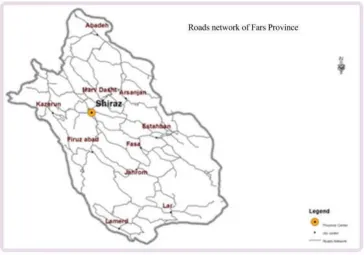
case study. Figure 2 shows an overall view of Fars road
QHWZRUN,WFRQVLVWVRIPDLQQRGHVDQGWZRZD\
edges. Some of nodes are border nodes, which connect research area to other provinces [Mahmoudabadi and Seyedhosseini, 2013].
,W LV DOVR DVVXPHG WKDW IXHOV FDUULHG IURP UH¿QHULHV
to distribution centers, are not within the scope of this research work, but transporting fuels from distribution centers to destinations should be determined. Therefore, some of nominated points will be determined as distribution centers utilizing the proposed model. For each link, risk has been calculated based on four components of accident, environment, population and infrastructure issues [Mahmoudabadi and Seyedhosseini, 2013]. Cost is corresponding to length and travel time obtained by conducting a library study using geographical maps.
6. Running Model and Discussion
'HWDLOVRQ3UREOHP'H¿QLWLRQ
A number of sets of origins and destinations have been selected to solve the proposed model. Distribution centers will be constructed by three different capacities.
The sum of demands and supplies should not necessarily
EHHTXDOEXWGHPDQGVPXVWEHIXOO\VDWLV¿HG,WLVDOVR
assumed that transporting hazmat from an origin node to itself is not considered as inter-city transportation, so combination of cost and risk will be set as 0 when a destination node is a distribution center. According to
WKH FDVH VWXG\ QRGHV DUH LGHQWL¿HG DV GHVWLQDWLRQ
nodes, shown in table (1), whose names are explained
LQDSSHQGL[,,QDGGLWLRQWKHUHDUHHLJKWRULJLQQRGHV
nominated as distribution centers. Some of them are destination nodes shown in table 1. Upper bounds for origin capacities depend on the number of distribution centers may be set as 3000, 2000 and 1500 thousands M3 per year.
6.2 Scenarios
$FFRUGLQJ WR WKH SUREOHP GH¿QLWLRQ DQG SURSRVHG PDWKHPDWLFDO PRGHO WZR IDFWRUV KDYH VLJQL¿FDQW LQÀXHQFHVRQVROYLQJSUREOHPDQGFRQVHTXHQWUHVXOWV 7KH¿UVWLVWKHSULRULW\RIULVNDQGFRVWDQGWKHVHFRQG
is the limitation of the number of distribution centers. Assuming three different sets of risk and cost priorities together with three different distribution centers nine scenarios would be made and shown in table 2. Due
WRHVWDEOLVKLQJVRPHSUHGH¿QHGFHQWHUVXSSHUERXQGV
for their capacities are also set in the last row of table 2.
Table 1. List of destination nodes (Dimension = Thousands M3 per year)
Table 2. Proposed scenarios in terms of distribution centers and (risk, cost) priorities
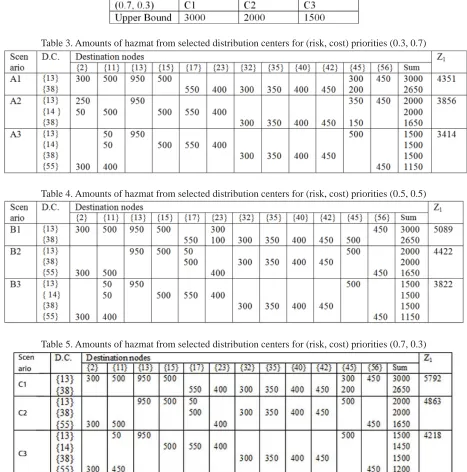
Table 3. Amounts of hazmat from selected distribution centers for (risk, cost) priorities (0.3, 0.7)
Table 4. Amounts of hazmat from selected distribution centers for (risk, cost) priorities (0.5, 0.5)
6.3 Numerical Results
The proposed mathematical model has been performed using nine different scenarios, discussed in the previous section. Results have been tabulated in tables 3 to 5. The results are categorized in to three tables regarding to different priorities of risk and cost including (0.3, 0.7), (0.5, 0.5) and (0.7, 0.3). For each table, origin and destination nodes presented in bracket i.e. symbol
^`VKRZVWKHQRGHQXPEHUUHIHUUHGWRDSSHQGL[,
Three scenarios in each table are different based on the number of distribution centers imposed by budget limitation or decision makers. The second column shows the nodes selected for establishing distribution centers. The amount of hazardous material should be carried from distribution centers to destination points
DUH LGHQWL¿HG LQ WKH DERYH WDEOHV )RU H[DPSOH LQ
scenario A1 (table 3), 500 thousands M3 are annually required to transport from distribution center 13 to destination node 11. Total combination of risk and cost
ZKLFK KDV EHHQ XVHG DV FULWHULRQ LQ WKH ¿UVW OHYHO RI PDWKHPDWLFDOPRGHOLGHQWL¿HGDV=LVDOVRSUHVHQWHG
in the last columns of tables.
The numerical analysis shows that there is no limitation for solving the proposed mathematical model using the network selected as the case study, if the number of nodes getting to be raised, the existing binary variable model may be a NP Hard problem. The above consideration should be checked using another (large) network, but there was no network available to do that.
6.4 Discussion
,Q RUGHU WR JLYH D JRRG HVWLPDWH UHVXOWV VKRZQ LQ
tables 3-5 have been summarized and shown in table 6. Results revealed that risk and cost priorities
KDYH VLJQL¿FDQW HIIHFWV RQ VHOHFWLQJ RULJLQ QRGHV DV
distribution centers. For example, if risk and cost priorities considered by (0.3, 0.7) and the number of distribution centers set by 3, the selected nodes for establishing distribution centers will be {13}, {14}
DQG^`EXWLIWKHULVNDQGFRVWSULRULWLHVGH¿QHGE\
(0.7, 0.3), the selected points will be obtained as {13}, {38}, {55}. The total combination of risk and cost
WKHREWDLQHGYDOXHFRUUHVSRQGLQJWRWKH¿UVWOHYHORI
objective function, Z1) is getting to be decreased when the number of distribution centers moves forward to
ULVH,WPHDQVWKDWWKHLQYHVWPHQWYDOXHIRUWKHLQLWLDO
progress should be considered carefully according to economic engineering. Therefore, decision makers should be aware not only the risk and cost priorities but also the number of distribution centers is main criterion in routing and allocating approach for hazardous
PDWHULDOWUDQVSRUWDWLRQ,WLVYHU\LPSRUWDQWIRUGHFLVLRQ
makers to be aware that a trade-off between total cost of transportation and establishing distribution centers should be considered as a main concern in hazmat transportation. Based on the above issues, it can be concluded that, in the real world, when some concerns such as green transportation may impose limitation or constraint for developing industrial aspects, decision makers should be careful to look at all the aspects
LQÀXHQFLQJRQWUDQVSRUWDWLRQDQGLQWKLVFDVHKD]DUGRXV
material transportation and locating related industries.
7. Summary and Conclusion
,Q JHQHUDO KD]PDW URXWLQJ SUREOHPV DUH VROYHG UHJDUGLQJWRPLQLPL]LQJWKHULVNDQGFRVWIRUVSHFL¿HG RULJLQV DQG GHVWLQDWLRQV ,W PLJKW EH D JRRG LGHD LI
decision makers locate sources of hazmat, mainly distribution centers, based on minimizing the above
IDFWRUV VLPXOWDQHRXVO\ ,Q WKLV SDSHU D PDWKHPDWLFDO
model considering risk and cost minimization has been developed, where the total combination of risk and cost is minimized. For this aim, a bi-level objective function in a mathematical model has been developed.
$W WKH ¿UVW OHYHO WKH DPRXQW RI KD]PDW VKRXOG EH
carried to destination nodes minimizing the total combination of risk and cost, while risk and cost are prioritized by national or local authorities. Following that the locations for installing distribution centers are obtained. At the second level, the best route for each
RULJLQGHVWLQDWLRQSDLULVRXWOLQHGWREHXVHGLQWKH¿UVW
level. A two-stage process has also been applied to solve a bi-level objective function model where in the
¿UVWVWDJHVDIHVWSDWKVDUHREWDLQHGDQGLQWKHVHFRQG
stage the best locations for establishing distribution centers are selected. Fars Province, the second largest
SURYLQFH RI ,UDQ KDV EHHQ VHOHFWHG DV WKH FDVH VWXG\
cost while there is an ability to set some distribution
FHQWHUV DV ¿[HG RQHV 5HVXOWV KDYH EHHQ GLVFXVVHG
and it is concluded that the priorities of risk and cost
KDYHVLJQL¿FDQWHIIHFWVRQORFDWLQJGLVWULEXWLRQFHQWHUV
Results also revealed that the number of distribution
FHQWHUVSOD\DVLJQL¿FDQWUROHRQWRWDOFRPELQDWLRQRI
risk and cost which would be a main concern for those who are dealing with investment and budgeting in real projects.
For further studies, researchers interested in this topic are recommended to focus on the other kinds of hazmat
ZKLFKKDYHLQÀXHQFHVRQURXWLQJSUREOHPV,QDGGLWLRQ
considering more real constraints such as installing budget, other transport modes for carrying hazmat from
UH¿QHU\WRGLVWULEXWLRQFHQWHUVDUHDOVRUHFRPPHQGHG
for future studies.
8. References
$PLUL$UHI0-DYDGLDQ17DYDNNROL0RJKDGGDP
R., Baboli, A. and Shiripour, S. (2013) "The center location-dependent relocation problem with a probabilistic line barrier", Applied Soft Computing, Vol. 13, No. 7, pp. 3380-3391.
- Bianco, L., Caramia, M. and Giordani, S. (2009) "A
ELOHYHOÀRZPRGHOIRUKD]PDWWUDQVSRUWDWLRQQHWZRUN
design", Transportation Research, Part C: Emerging Technologies, Vol. 17, No. 2, pp. 175-196 .
- Bonvicini, S. and Spadoni, G. (2008) “A hazmat multi-commodity routing model satisfying risk criteria:
$FDVHVWXG\´-RXUQDORI/RVV3UHYHQWLRQLQWKH3URFHVV ,QGXVWULHV9ROSS±
- Chambari, A., Rahmaty, S.H., Hajipour, V. and Karimi, A. (2011) "A bi-objective model for location-allocation problem within queuing framework", World
Academy of Science, Engineering and Technology, Vol. 54, pp. 138-145.
- Cooper, L. (1963) "Location-allocation problems", Operation Research, Vol. 11, pp. 331-344.
'ÕD]%DQH] - 0 *RPH] ) DQG 7RXVVDLQ *7
(2005) “Computing shortest paths for transportation of
KD]DUGRXVPDWHULDOVLQFRQWLQXRXVVSDFHV´-RXUQDORI
Food Engineering, Vol. 70, pp. 293–298.
- Environmental Health and Safety (2011) "Hazardous
PDWHULDOFODVVL¿FDWLRQ1&6WDWH8QLYHUVLW\DYDLODEOH DW KWWSZZZQFVXHGXHKVGRWFODVVL¿FDWLRQKWPO
- Erkuta, E. and Alpb, O. (2007) “Designing a road network for hazardous materials shipments”,
&RPSXWHUV 2SHUDWLRQV5HVHDUFK9ROSS±
1405.
(VFREDU-:/LQIDWL5DQG7RWK3$WZR
phase hybrid heuristic algorithm for the capacitated
ORFDWLRQURXWLQJ SUREOHP &RPSXWHUV 2SHUDWLRQV
Research, Vol. 40, pp. 70–79.
)RWKHULQJKDP $ 6 'HQVKDP 3 - DQG &XUWLV $ 7KH ]RQH GH¿QLWLRQ SUREOHP LQ ORFDWLRQ
allocation modeling", Geographical Analysis, Vol. 27, No. 1, pp. 60-77.
- Gebennini, E., Gamberini, R. and Manzini, R. (2009) "An integrated production–distribution model for the dynamic location and allocation problem with safety
VWRFNRSWLPL]DWLRQ,QWHUQDWLRQDO-RXUQDORI3URGXFWLRQ
Economics, Vol. 122, No. 1, pp. 286-304.
-DUERXL%'HUEHO++DQD¿6DQG0ODGHQRYLF
N. (2013) "Variable neighborhood search for location
URXWLQJ&RPSXWHUV 2SHUDWLRQV5HVHDUFK9RO
pp. 47–57.
- Mahmoudabadi, A. and Seyedhosseini, S. M. (2012) "Application of chaos theory in hazardous material
WUDQVSRUWDWLRQ,QWHUQDWLRQDO-RXUQDORI7UDQVSRUWDWLRQ
Engineering, Vol. 1, No. 1, pp. 15-23.
- Mahmoudabadi, A. and Seyedhosseini, S. M. (2013) "Time-risk trade-off of hazmat routing problem under emergency environment by using linguistic variables",
,QWHUQDWLRQDO -RXUQDO RI $GYDQFHG 2SHUDWLRQV 0DQDJHPHQW,QWHUVFLHQFH3XEOLFDWLRQ$UWLFOHLQ3UHVV
- Mousavi, S. M. and Akhavan Niaki S.T. (2013) "Capacitated location allocation problem with stochastic location and fuzzy demand: A hybrid algorithm", Applied Mathematical Modelling, Vol. 37, No. 7, pp. 5109-5119.
- Mousavi, S. M. and Tavakkoli-Moghaddam, R. (2013) "A hybrid simulated annealing algorithm for location and routing scheduling problems with cross-docking in
WKHVXSSO\FKDLQ-RXUQDORI0DQXIDFWXULQJ6\VWHPV
Vol. 32, No. 2, pp. 335-347.
- Shariat Mohaymany, A. and Khodadadian, M. (2008) “A routing methodology for hazardous material transportation to reduce the risk of road network”,
,QWHUQDWLRQDO-RXUQDORI(QJLQHHULQJ6FLHQFH9RO
No. 3, pp. 57-65.
- Shavandi, H. (2009) "The capacitated
location-DOORFDWLRQ SUREOHP ZLWK LQWHUYDO SDUDPHWHUV -RXUQDO RI ,QGXVWULDO (QJLQHHULQJ 9RO SS
- Rand, G. K. (1976) "Methodological choices in depot location studies", Operational Research Quarterly, Vol. 27, No. 1, pp. 241–249.
:HQ 0 DQG ,ZDPXUD . )X]]\ IDFLOLW\
location-allocation problem under the Hurwicz
FULWHULRQ(XURSHDQ-RXUQDORI2SHUDWLRQDO5HVHDUFK
Vol. 184, No. 2, pp. 627-635.
- Wen, M. and Kang, R. (2011) "Some optimal models for facility location–allocation problem with random fuzzy demands", Applied Soft Computing, Vol. 11, No. 1, pp. 1202-1207.
=KRX-DQG/LX%1HZVWRFKDVWLFPRGHOVIRU FDSDFLWDWHGORFDWLRQDOORFDWLRQSUREOHP&RPSXWHUV ,QGXVWULDO(QJLQHHULQJ9ROSS
- Zografos, K. G. and Androutsopoulos, K. N. (2004) “A heuristic algorithm for solving hazardous
PDWHULDOVGLVWULEXWLRQSUREOHPV´(XURSHDQ-RXUQDORI
Operational Research, Vol. 152, pp. 507–519.
$SSHQGL[,/LVWRIQRGHVDQGWKHLUQDPHVFRUUHVSRQGLQJWRFDVHVWXG\