The State Again
PhD Research Thesis of
- Samuele Bibi -
Trento, 30th of April 2019
University of Trento
University of Florence
“And today we see how utterly mistaken was the Milton Friedman notion that a market system can regulate itself. We see how silly the Ronald Reagan slogan was that government is the problem, not the solution. This prevailing ideology of the last few decades has now been reversed.
Everyone understands now, on the contrary, that there can be no solution without government. The Keynesian idea is once again accepted that fiscal policy and deficit spending has a major role to play in guiding a market economy. I wish Friedman were still alive so he could witness how his extremism led to the defeat of his own ideas.”
- Paul Samuelson -
(Samuelson, 2009)
Supervisor: Malcolm Sawyer
- University of Leeds
Gratitude
To my parents, to my brothers and to my sisters,
because thanks to them and to their different spirits, I have always heard different bells,
and despite they were often different to mine, I have always had their support.
To the critical thinking teachers of my life,
because thanks to them I came across to a broader way of approaching reality and life
and I had their example in fighting for a more social equitable world.
To the State,
because directly and indirectly it has always supported my education path,
Index
Cover ... i
Gratitude ... ii
Index ... iii
- Chapter I - The State Again, an overview ... 1
- Chapter II - Keynes, Kalecki and Metzler in a Dynamic Distribution Model ... 7
2.1 Introduction ... 7
2.2 The canonical Short Run and the Long Run Post-Keynesian Kaleckian models ... 8
2.2.1 Retracing the canonical Short Run Kaleckian model ... 9
2.2.2 Questioning the canonical Kaleckian short run and long run models ... 11
2.3 The ultra-short run reconsidered: an alternative dynamic analysis ... 13
2.3.1 The core assumptions of the model and national identities ... 14
2.3.2 Consumption and Production relations ... 15
2.3.3 Wages and Profits relations ... 15
2.4 Preliminary Simulations ... 18
2.4.1 Exogenous increase of the Private Investments ... 23
2.4.2 The effect of a higher workers’ claims and wages ... 24
2.4.3 Decrease in marginal propensity of consumption of workers and capitalists ... 24
2.4.4 Increase in productivity ... 29
2.4.5 Simultaneous increase in productivity, in real wages and in expenditure ... 30
2.5 Concluding remarks ... 30
Bibliography ... 32
- Chapter II - Appendix- Keynes, Kalecki and Metzler in a Dynamic Distribution Model ... 34
2.1.A An alternative dynamic analysis ... 34
2.2.A Analysis of Initial Equilibrium State, Shocks and Parameters ... 36
2.3.A Analysis of Shocks ... 37
2.4.A Analysis of the causal relations (Example: higher EPL and workers’ claims) ... 38
2.5.A Scenario with Fixed Expectations: 𝜼𝒕 ... 39
2.6.A Scenario with Variable Expectations: 𝜼′𝒕 ... 40
- Chapter III - The stabilising role of the Government in a Dynamic Distribution Growth Model 43
3.1 Introduction ... 44
3.2 “Keynes, Kalecki and Metzler model”: summary, conclusions and some limits ... 45
3.3 The basic Structure of the model ... 46
3.3.1 National Identities ... 46
3.3.2 Consumption and households relations ... 47
3.3.3 Production and firms relations ... 48
3.3.4 Employment, Labour Force and Wages-Profits relations ... 49
3.4 Kaleckian Investment function and firms’ driving force ... 51
3.5 The Government into the Scene: goals and fiscal policies ... 55
3.6 Simulation results ... 58
3.6.1 Exogenous drop in Private Investments with a Government committed to 0 Budget Deficit policy ... 59
3.6.2 Who controls the (broad or tight) expectations boundaries? ... 61
3.6.3 Exogenous drop in Private Investments with a moderate Government intervention ... 62
3.6.4 Exogenous drop in Private Investments with a Proactive Government ... 63
3.6.5 Exogenous increase in productivity and real wages under different fiscal policies ... ... 65
3.6.6 Exogenous increase in productivity and real wages with proactive fiscal policies ... ... 66
3.7 Policy implications ... 68
Conclusions ... 69
Bibliography ... 70
- Chapter III - Appendix - The stabilising role of the Government in a Dynamic Distribution Growth Model 71 3.1.A System of Equations ... 71
3.2.A Kaleckian Investment function and firms’ driving force ... 73
3.3.A The Government into the Scene: goals and fiscal policies ... 74
3.4.A BOX 1. Production and utilization function ... 75
3.5.A Eta (𝜼) Analysis: Figures 5.0.a - 5.0.n ... 77
3.6.A Analysis of Initial Equilibrium State and Parameters ... 78
3.7.A Analysis of Key Parameters: ... 79
- Chapter IV- The distributive monetary analysis of a sustainable ecological economy... 81
4.1 Introduction ... 82
4.2 Balance Sheet and transactions-flow matrix ... 84
4.3 A sketch of the economy ... 86
4.3.1 The endogenous money framework ... 86
4.3.2 The ecological framework of the society ... 87
4.3.3 Firms’ production and investment relations ... 89
4.3.4 Employment, Costs and Wage-Profit determination ... 91
4.3.5 Consumption and households’ relations ... 93
4.3.6 Public Sector relations ... 97
4.3.7 The banking sector relations ... 100
4.4 The effects of a crises on socio economic and ecological distribution ... 101
4.4.1 A passive government scenario ... 102
4.4.2 A 0BD government policy scenario ... 103
4.4.3 A proactive government scenario ... 109
4.5 Policy recommendations and conclusions ... 112
Bibliography ... 115
- Chapter V - Concluding remarks ... 117
- Chapter I -
The State again, an overview
February 14, 2019
The overall goal of this work is to study the effect of a crisis on the distribution and employment
and the space of manoeuvre of the government for supporting and reverting the negative shock
produced by such a crisis. Every chapter of this work and the related models are supported by
both a theoretical background analysis and by numerical dynamic simulations.
Stylized facts show that the income and wealth inequality in all the OECD countries has been
constantly increasing after the 1960s. Piketty has been one of the most important authors that
highlighted the rising inequality issue, mainly in the OECD countries. For example, Piketty (2014)
shows that the income share held by the top percentile in countries such as US, Canada and UK
increased from 8%-10% in the 1960s up to 14%-18% in the current decade. Similar figures are
now provided by the World Inequality Lab1 that has updated data for almost every country up to
2016. At the same time, the wage share for the majority of the OECD countries substantially
decreased. For example, countries such as Italy and Spain experienced a decrease in wage share
from about 73% in the 1970s to about 63% in the current decade (Hein, 2014).
Taking into account such a stylized fact, we will consider a model with two social classes,
workers and capitalists. These social classes differ in terms of their initial endowment, their
consumption behaviour, the different loans repayment conditions required to them by the banks
and in terms of the ways in which they can use their financeable wealth. This is a very important
departure hypothesis from the mainstream point of view models that generally consider a
population made up of “a representative agent” of the whole society.
Considering the inequality levels that the OECD countries are experiencing, we took the
Post-Keynesians school of thought as a very good reference point since it always focused its attention
on the relation between the level of employment, the aggregate demand and the distribution
between social classes. In line with the post-Keynesians tradition, we believe that a theory cannot
be correct unless it starts from realist or realistic hypotheses, although it is recognized that
assumptions are always abstractions and simplifications (Lavoie, 2014).
Therefore, we developed a step by step model with the analysis of an economy based on some
well-known stylized facts. Beyond the social classes distinction, we take into consideration the
temporal lag between production and sales of products by firms and the one between income
received by the social classes and their expenditure. Those two temporal lags are the very key
aspects we focus our attention on in the model presented in Chapter II named “Keynes, Kalecki
and Metzler in a Dynamic Distribution Model”.
In that chapter, we merge the hints of Keynes and Kalecki about the distribution of social
classes and the intervention of the government in supporting the aggregate demand together with
Metzler’s hint about the mismatching process between aggregate demand and aggregate production. Metzler’s mismatching process would finally generate inventories of consumption
goods. More specifically, it is argued that even if Post-Keynesians models focused their attention
on output growth, employment and income distribution relating those issues with a stronger
intervention of the state, they all (even the canonical Kaleckian model) overlooked the adjustment
- or non-adjustment - dynamics from the ultra-short run to the short run period upon which the
short run and long run models are then constructed.
In fact, even if the Kaleckian models completely reject the standard neoclassical production
function (rejecting diminishing returns and rejecting the substitution between capital and labour)
they also very strongly rely on a final equilibrium between aggregate demand and aggregate
production. The canonical Kaleckian short run models are constructed upon the consideration of
the effective labour demand curve defined as “the locus of combinations between real wages and
levels of employment which ensure that all produced goods are sold at the price set by firms”
(Lavoie, 2014). As argued by Lavoie (2014), this construction assures that an increase of real
wage leads to an increase in the employment level. That has been and still is definitely one of the
cornerstones for the Post-Keynesian authors.
We argue that the equilibrium assumption between the aggregate demand and the aggregate
production plays a key role in obtaining the standard Kaleckian conclusions regarding the relation
between effective demand, employment levels and the distribution of surplus product between
the social classes. The main question arising from the previous enquiring exercise about
adjustment dynamics in the Kaleckian framework is that, because of the overlooking on that
adjustment process between aggregate production and aggregate demand, also its conclusions
might be consequentially affected. More precisely the main Post-Keynesian Kaleckian
conclusions to assess are the following: would it still be true that higher real wages lead to a higher
level of employment? Would it still be true that a decrease in the propensity to save will lead to
from falling, whenever there is an increase in productivity there must be some increase in real
wages? And finally, most importantly in terms of policies, would it still be true that in order to
keep employment from falling, even when the economy faces a pari passu increase of real wage
and productivity level, it would be necessary an increase in real autonomous expenditure such as
a strong government one?
In this way, our model analyses under which conditions the standard Kaleckian conclusions
are still valid considering a disequilibrium situation. Two scenarios are simulated: one with fixed
expectations as in Metzler (1941) and another new one based on adaptive expectations and
asymmetric behaviour of the wages-unemployment relation. The model questions the effective
demand labour curve and suggests that an increase in real autonomous expenditures, mainly by
the Government, might be even more essential than what is generally considered in the Kaleckian
literature, to avoid increasing unemployment in an increasing wage world.
The model presented in Chapter III named “The stabilising role of the Government in a
Dynamic Distribution Growth Model” builds upon the model presented in Chapter II and
considers once again the effect of a crises on the relation between aggregated demand,
employment and distribution between social classes adding important characteristics of realism
that were absent in the previous chapter. Here, we consider the gestation period of the investments
and the presence of the government investigating its margin of manoeuvre in such an economy.
The first aspect takes inspiration by Kalecki (1971) himself who considers the three different
Investment stages: investment order or Demand (𝐼𝐷), investment Production (𝐼𝑃) and investment
delivery or Completion (𝐼𝐶). In line with a post-Kaleckian perspective, we consider the expected
profitability and the capacity utilisation as the two main variables as driving forces for the
investment decisions. The second new aspect of this model compared to the one presented in
Chapter II is the explicit presence of the government. In fact, even if chapter II suggested the
Government as the emblematic autonomous figure able to foster expenditure in times of recession,
its actual role in the economy was not analysed. Many post-Keynesian scholars have underlined
how recent decades have been characterised by a strong downgrading of the fiscal policy role as
a stabilisation instrument of macroeconomic policy (Arestis and Sawyer, 2003). In this way, this
chapter analyses exactly the space of manoeuvre of the government and the role of the fiscal
policies into a “functional finance” framework where the government "can and should be called
upon as a key part of the remedy" (Fazzari, 1994) to ensure a high level of economic activity
In the light of such a functional finance framework, the government actions should be inspired
to achieve a more stable and sustainable growth path. More specifically, we here investigate the
possibilities that the Government has to boost and support the economic activity with its two main
tools, public investments spending and a taxation system in two scenarios. The first scenario
simulates an exogenous fall of private investments while the second one relates to an exogenous
increase in labour productivity and real wages. In particular, here we test the canonical Kaleckian
model conclusion according to which even when the economy faces a pari passu increase of real
wages and productivity level it would be necessary an increase in real autonomous expenditures
- such as the one implemented by the government - in order to keep employment from falling.
At the same time, the aim of this chapter is also to explore the role of the Government in
stabilising the economy exactly thanks to the previous tools. In fact, Chapter II underlined the
possibility of an arising unstable path from a mismatching dynamic between aggregate demand
and aggregate production. It was argued that such an unstable path might develop because of
“wrong” oversensitive expectations of firms regarding the production of consumption goods.
Therefore, chapter III focuses exactly on the space of manoeuvre of the government in stabilizing
an unstable economic scenario caused by a crisis.
The model built in Chapter IV named “The distributive monetary analysis of a sustainable
ecological economy” is the natural evolution of the models developed in Chapters II and III. In
such a model all the previous stylized facts are contained, namely the temporal lag between
production and sales of products by firms, the temporal lag between income received by the social
classes and their expenditure, the gestation period of the investments and, finally, the intervention
of the government. The most important difference with respect to the models presented in the
previous chapters is its overall monetary and ecological framework. In fact, for simplification
purposes the previous models were assuming that, in line with a horizontalist approach,
commercial banks were providing funds on demand to firms for financing their investments.
However, the explicit relations among all the sectors of our economy were not fully exposed. In
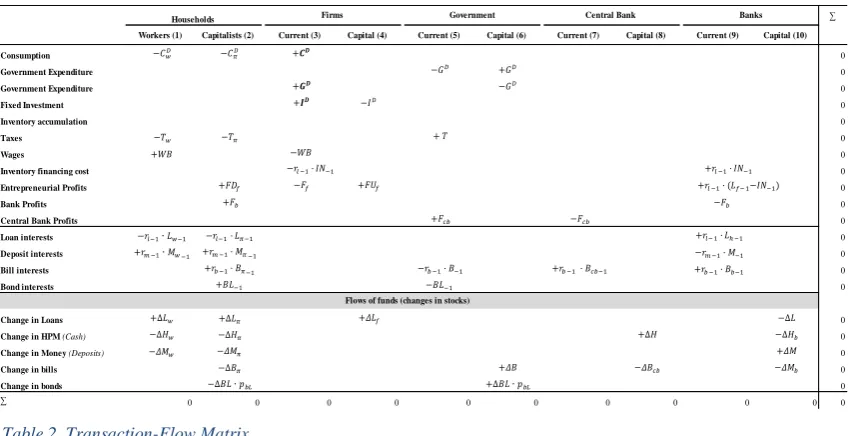
this chapter Graziani’s endogenous money theory is used and we are developing a Post-Keynesian
Stock Flow Consistent (SFC) model to track all the economic relations, both the real and monetary
ones. At the same time, the use of a SFC model ensures that “there are no black holes - every flow comes from somewhere and goes somewhere” (Godley W. , 1996) through a rigorous accounting
framework, which guarantees a correct and comprehensive integration of all the flows and the
stocks of an economy.
Such as Kalecki, Graziani and the circuitists economists introduce a preliminary distinction
by firms’ decision to activate production and, in order to do so, they take up loans by commercial
banks. In this sense, commercial banks are able to create deposits ex nihilo, granting them loans
and, at the same time, creating deposits. In this way, the starting logical cause of the expansion of
money is exactly the firms’ willingness of contracting a liability to activate production.
In the second step, firms use those loans to pay workers and in this way to obtain the amount
of consumption goods desired through the production process. When such funds are transferred
by firms to households they instantaneously become income paid for the work provided to firms
by workers.
Finally, the last step of the Monetary Circuit is characterized by the households’ spending
decision to use the money balances previously obtained as income. In this step, while households
use their funds to buy consumption goods, firms obtain back those money balances they initially
paid to households for their work.
In this way, the previous Monetary Circuit analysis is not in contrast with the one made by
Kalecki upon the way workers obtain their wages and use all of them to buy consumption goods
while capitalists are able to spend just a proportion of their income.
Finally, together with its social and monetary framework, our economy is also characterized
by an environmental one since we here study the impacts that the economic consumption has in
terms of ecological erosion of natural resources.
In this way, the model of chapter IV questions the expenditure margins of the Government –
in particular after a crisis - and uses the suggestions of the monetary circuit theory to analyse the
space for fiscal policies to reduce unemployment boosting the economic activity, to obtain a more
equitable distribution between social classes in a sustainable ecological way. Our understanding
is that despite many contributions focused on the topics of recovery, distribution and ecological
sustainability, few of them tried to tackle them all in a comprehensive way considering the
rediscovery of the endogenous money phenomena as one of the most important breakthroughs in
the last decades. Here we argue that exactly the endogenous money feature is the essential fil
rouge to better understand and connect the three previous important aspects. It is so when we
analyse the sectors connections and the policies ones devoted to recovery, and also if we consider
how the different incomes and wealth are captured and distributed by the different social classes
and finally when we point out the ways of financing long term ecological path to preserve a
sustainable environment.
Indeed, our overall work in Chapter II, Chapter III and Chapter IV is a step by step construction
of an organic and consistent model. It starts with a more theoretical and simplified approach
suggesting the presence of an autonomous figure such as the government one. Chapter III adds
more real base features through endogenous investments and government presence while Chapter
IV finally concludes considering all the real and monetary links of the sectors into a social and
- Chapter II -
Keynes, Kalecki and Metzler
in a Dynamic Distribution Model
Samuele Bibi
November 21, 2018*
This paper focuses on the dynamics analysis from the ultra-short to the short period from a Post-Keynesian perspective. It is argued that the construction of both the short run and the long run models are based on the critical assumption of an equilibrium between aggregate demand and aggregate supply. Starting from the work by Metzler (1941), the issue of equilibrium and stability is investigated inside a Keynesian-Kaleckian perspective. The suggested model analyses under which conditions the standard Kaleckian conclusions are still valid considering a disequilibrium situation. Two scenarios are simulated: one with fixed expectations as in Metzler (1941) and another based on adaptive expectations and asymmetric behaviour of the wages-unemployment relation. The model questions the effective demand labour curve and suggests that an increase in real autonomous expenditures, mainly by the Government, might be even more essential than what is generally considered in the Kaleckian literature, to avoid increasing unemployment a world with increasing wages.
Key words: Kalecki, Post-Keynesian Economics, Disequilibrium, Adjustment dynamics
JEL classifications: B5, E11, E12, E32
“It is necessary to “think dynamically”. The static system of equations is set not only for its own beauty, but also to enable the economist to train his mind upon special problems when they arise. A new method of approach – indeed, a mental revolution - is needed.”
(Harrod, R.F., 1939: 15)
2.1 Introduction
The Post-Keynesians have always focused on issues such as output growth, employment and
income distribution and, in the last decade, Kaleckian models were developed to show the
* This paper has been submitted to the Cambridge Journal of Economics in the date indicated and accepted.
relevance of the previous issues in justifying a stronger intervention of the state and stronger
public policies. It is argued that while those models reject Say’s law, even the canonical Kaleckian
one overlooked the adjustment - or non-adjustment - dynamics from the ultra-short run to the
short run period upon which the short run and long run models are constructed. Lavoie (1996) is
one of the most audacious attempts to focus on the traverse from one equilibrium position to
another, tackling the adjustment dynamics and considering the effect of hysteresis. However, in
general, all disequilibrium ultra-short-period states are left aside, assuming that “the period under
consideration is long enough for firms to adjust their production to actual demand, and hence that
the economy always operates on the effective labour demand curve” (Lavoie, 2014).
The main question arising from the previous exercise about adjustment dynamics in the
Kaleckian framework is that, because of overlooking that adjustment process, conclusions are
affected consequentially. More precisely, would it still be true that higher real wages lead to a
higher level of employment? Would it still be true that a decrease in the propensity to save will
lead to an increase in output and employment? Would it still be true that in order to keep
employment from falling, whenever there is an increase in productivity there must be some
increase in real wages? And finally, most importantly in terms of policies, would it still be true
that in order to keep employment from falling, even when the economy faces a pari passu increase
of real wage and productivity level, it would be necessary an increase in real autonomous
expenditures such as a strong government one?
This paper proceeds as follows. Section 2 retraces the Post-Keynesians models of short run
and long run focusing on the Kaleckian one. Section 3 suggests a reconsideration of the dynamics
process including some of Metzler’s suggestions in a Keynesian-Kaleckian framework. Section
4 develops a set of preliminary simulations to assess the robustness of the standard Kaleckian
conclusions. Section 5 draws together the conclusions.
2.2 The canonical Short Run and the Long Run Post-Keynesian Kaleckian models
To analyse the relation among the level of employment, the aggregate demand and the distribution
between classes of an economy within a Post-Keynesian framework Kaleckian models are
generally proposed. These are based on the analysis of the effective demand constraint – the
consideration that aggregate supply needs to be equal to aggregate demand.
Kaleckian models reject standard neoclassical production function. They reject diminishing
returns (assuming constant marginal costs -up to full capacity - and therefore constant or
brilliantly the labour peculiarities with respect to capital and the consequent need to reject the
neoclassical production function.
We will focus our attention on retracing the canonical Kaleckian model of short period and
after that on the related adjustment process from the short to the long period as presented “by
textbook” up to this day. We will briefly go back over the previous path as it is presented by
Lavoie (2014) - one of the most important as well as accurate and widely used Post-Keynesian
economics textbooks.
2.2.1 Retracing the canonical Short Run Kaleckian model
The Kaleckian model is generally presented considering a closed economy without any
Government presence where, therefore, the components of the aggregate demand are
consumption and investment. From the consideration of GDP on the expenditure and distribution
side, at the end of each economic period, we can rely on the following identity:
𝑌 = 𝐶𝑜𝑛𝑠𝑢𝑚𝑝𝑡𝑖𝑜𝑛 + 𝐼𝑛𝑣𝑒𝑠𝑡𝑚𝑒𝑛𝑡 = 𝑊𝑎𝑔𝑒𝑠 + 𝑃𝑟𝑜𝑓𝑖𝑡𝑠 (1)
In a Keynesian and Kaleckian view, some of the components of the aggregate demand are
autonomous and some of them are induced. Consumption is made of consumption from wages
𝐶𝑤 - and consumption from profits - 𝐶𝜋.
Taking the basic version of the model (and the original assumption by Kalecki), it is assumed
for simplicity that workers consume entirely their wages with a marginal propensity to consume
equal to one (𝑐𝑤 = 1) not being able to save. The aggregate demand is then composed of an
endogenous component related to the wages obtained by workers and an autonomous component
made of consumption out of capitalists and of investment expenditure.
𝐴𝐷 = 𝑤𝐿 + 𝐴 = 𝑤𝐿 + 𝑎𝑝 (2)
being w the nominal wage rate, 𝐿 the amount of employment, 𝑎 the real autonomous expenditure,
𝑝 the price level (and therefore 𝐴 being the nominal autonomous expenditure).
On the supply side, the Kaleckian model does not have a proper production function. It is
replaced by a “utilization function”. Assuming only direct labour use (the labour proportional to
production), the aggregate supply equation would be the following one:
𝐴𝑆 = 𝑝𝑞𝑠= 𝑝𝐿𝑦 (3)
In (3) the quantity obtained in the production process is a direct function of the labour employed
(L) and of the labour productivity (y, here assumed constant). Here production and supply periods
are implicitly considered overlapping, meaning that what is supplied in a certain period is
takes time and a mismatch of the production-supply periods might occur. An implicit
simplification is therefore used making them exactly overlap.
Equating aggregate demand and aggregate supply – (2) and (3) – into (4), we find the effective
demand constraint - equation (5) -, or the effective labour demand curve. That is defined as “the
locus of combinations between the real wage and the level of employment that ensure that
whatever is being produced is sold… such that the goods market is in equilibrium” (Lavoie, 2014).
𝐴𝐷 = 𝐴𝑆 (4)
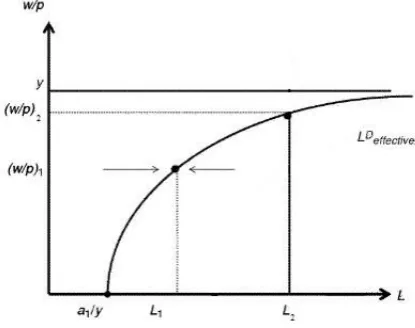
(𝑤 𝑝⁄ )𝑒𝑓𝑓 = 𝑦 − 𝑎
𝐿 (5)
Equation (5) can be reversed and written as an employment function (6):
𝐿𝐷𝑒𝑓𝑓 = 𝑎
𝑦 − (𝑤𝑝) (6)
Obviously, equations (5) and (6) describe the same scenario. As figure 2.1 shows, the Kaleckian
labour demand curve is reflecting an upward sloping labour demand curve - until full capacity
utilization.
Figure 2.1. The Kaleckian post-Keynesian model of employment. Source: Adapted from Lavoie, 2014, p. 293
Once the Kaleckian model structure has been presented, the adjustment process of production to
demand is explained as follows:
As long as firms react to a situation of excess supply (demand) on the goods market by reducing (increasing) production, rather than changing the mark-up and hence prices, the economy will move horizontally towards the locus of equilibria, that is, towards the effective labour demand curve. In other words, the model exhibits stability under these conditions. Henceforth we will presume when doing comparative analysis, that the period under consideration is long enough for firms to adjust their production to actual demand, and hence that the economy always operates on the effective labour demand curve (emphasis added).
As a consequence of the previous argument, some fundamental conclusions have been proposed
(Lavoie, 2014, p.295-297):
1) “Higher real wages will generate more employment”. This could be so for different
reasons such as a higher nominal wage claim by workers not followed by the same
increase in prices. In a different way, the increase of real wages could be due to a
decreasing mark-up applied by the firms (due, for example, to higher competition in the
market) not followed by the same speed in the reduction of prices. Whatever the trigger
of the real wage increase, that would lead to a higher level of employment thanks to the
employment multiplier effect, as explained in Lavoie (2014).
2) An increase in the propensity to save out of profit will lead to a reduction in output and
employment.
3) In order to keep employment from falling, whenever there is an increase in productivity
there must be some increase in real wages.
4) In order to keep employment from falling and avoid technological unemployment, even
when the economy faces a pari passu increase of real wage and productivity level, there
should be an increase in real autonomous expenditure such as a strong government
expenditure.
“The canonical Kaleckian model of growth and distribution” is then presented by considering the dynamic version of the principle of effective demand that is the “equilibrium locus on the goods market, by equating aggregate supply with aggregate demand” (Lavoie, 2014). Exactly equating
aggregate supply with aggregate demand will imply investments are equal to savings.
𝐼 = 𝑆 (7)
The canonical Kaleckian long run model is then based on the dynamic version of equation (7):
𝑔𝑖 = 𝑔𝑠
(8)
where 𝑔𝑖 is the rate of growth of investment and 𝑔𝑠 is the rate of growth of savings.
It is therefore evident how both the canonical short run as well as the long run Kaleckian
models are constructed on the equalization between aggregate demand and aggregate supply. That,
in turn, is based on an adjustment mechanism that leads the economy exactly on its effective
demand curve. In short, everything must ultimately converge.
Although this convergence process could possibly and eventually take place, to assume that is
far from obvious, straightforward and innocuous. In this sense, if even Kaleckians have often
the stability and adjustment analysis by studying under which circumstances some of the usual
corollaries may be nuanced.
2.2.2 Questioning the canonical Kaleckian short run and long run models
The last part of Lavoie (2014) sentence quoted in Section 2.1 shows how, in general,
Post-Keynesian economists leave aside a computational analysis of the adjustment process in the
ultra-short period. Lavoie (1996) is one of the most audacious attempt to focus on the traverse from
one equilibrium position to another, tackling the adjustment dynamics and considering the effect
of hysteresis. However, in general, the assumption of the economy being already in the short
period in the Kaleckian model explanation is made. Lavoie (2014) suggests that “ideally, a formal
model would take into account changes in inventories” and the aim of Section 3 will be exactly
to build a computational model analysing the adjustment (or non-adjustment) process in a
Kaleckian framework by considering the time lags in more detail.
Our analysis starts with the equilibrium condition between the aggregate actual demand and
the aggregate supply (4). Now, simply by substitution, from (4), equation (6) can be easily derived
through the following steps:
If and When AD = AS (4)
𝑤𝐿 + 𝑎𝑝 = 𝑝𝐿𝑦 (9)
𝑤
𝑝𝐿 + 𝑎 = 𝐿𝑦 (10)
𝐿 (𝑦 −𝑤
𝑝) = 𝑎 (11)
Then 𝐿𝑒𝑓𝑓
𝐷 = 𝑎
𝑦 −𝑤𝑝 (6)
Following the previous steps, it could be argued that iff aggregate demand is equal to
aggregate supply (4) we would obtain the effective labour demand curve as described in figure 1.
In fact, when (4) is not assured, the economy could be oscillating with stability around it (in a sort
of mismatching situation between aggregate supply and aggregate demand), fluctuating with an
implosive or explosive behaviour, or even without an increasing curve at all. The potential
indeterminability of such an effective labour demand curve could undermine not only the
example, not having an effective demand curve with the shape of figure 1 could mean
undermining the conclusion 1 previously cited according to which higher real wages will generate
more employment.
Although we consider the presentation of the canonical Kaleckian model extremely important
in the Post-Keynesian literature, further helpful insights could be gained by using an algorithmic
procedure. Our first research question concerns the main canonical Kaleckian model conclusions
explained excellently in Lavoie, 2014, p. 295-298. More specifically such research questions are
linked to the following issues:
1) Can we be sure and assume that (already in the short run and then more in general) the
economy reaches and stays on the effective labour demand curve?
2) Would it still be true that higher real wages lead to a higher employment? This point is
linked to the paradox of costs.
3) Would it still be true that an increase in the propensity to save will lead to a reduction in
output and employment? This point directly refers to the paradox of thrift.
4) Would it still be true that in order to keep employment from falling, whenever there is an
increase in productivity, there should be some increase in real wages?
5) Would it still be true that in order to keep employment from falling, even when the
economy faces a pari passu increase of real wages and productivity level, it would be
necessary an increase in real autonomous expenditures such as one implemented by the
government?
2.3 The ultra-short run reconsidered: an alternative dynamic analysis
To tackle the fulfilment of the effective demand constraint, we have to consider what this implies:
the equality between aggregate demand and aggregate supply. The effective demand is generally
defined as “the locus of combinations between real wages and levels of employment which ensure
that whatever is being produced is sold at the price set by firms” (Lavoie 2014, p. 282).
As discussed above, to suppose that we already are on the effective demand curve or that “the period under consideration is long enough for firms to adjust their production to actual demand”
is like considering we have hit directly upon the effective demand curve without truly computing
a real reaction (and not necessarily adjustment) mechanism. Once we believe we are on the
effective demand labour curve, moving along that is like considering we got stuck in a
not allowing the possibility for the economic system to constantly be off that path or to deviate
once we are on it.
The keystone of inventories analysis is the work done by Metzler (1941). Metzler himself
considers two types of time relations: a “Robertson or Receipt-Expenditure lag” and a “Lundberg
or Sales–Output lag”. The former refers to “the lag in the expenditure of income behind its receipt”
(Metzler, 1941). The latter “Lundberg S-O” lag refers instead to the existing lag between the
change in revenue from sales and the output of consumer goods. “In other words, businessmen
were assumed to base their production in period t upon sales in period t-1” (Metzler, 1941). This
lag is the one that generally produces an impact on inventories. Although Metzler himself stresses
the relevance of both lags, he finally prefers to focus only on the Lundberg S-O lag.
2.3.1 The core assumptions of the model and national identities
In contrast to Metzler, we will try to merge the two types of lags, since we consider both lags are
more representative of the current real world situation.
Before considering the reaction (and not necessarily adjustment) mechanisms implicit in the
described lags, we will try here to disentangle the forces that lie behind the aggregate production
by firms and the ones tied to aggregate demand. This would not necessarily imply that everything
produced by firms is actually sold, thus giving rise to inventories through time.
Most precisely, and in the spirit of Metzler analysis too, we claim that at least three main forces
might lead aggregate production to diverge from aggregate demand: the multiplier mechanism,
the accelerator mechanism and the role of expectations.
Beyond the simulation itself related to the suggestions within the framework proposed by
Metzler, the features merged in a Kalecki-Metzler framework are the following ones:
a. the presence of different social classes, more specifically workers and firms;
b. the fact that collective bargaining (instead of the market) forces are the ones behind the
wage-profit distribution between workers and firms;
c. different marginal propensity of consumption between the two predominant social
classes–workers and capitalists.
d. Finally, in accordance with both Kalecki and Metzler, we will suppose that firms react to
the demand side stimulus through quantity variation and not through the price one. This
adequate inventories so that any discrepancy between output and consumer demand may
be met by inventory fluctuations rather than price changes” (Metzler, 1941).
That is why, in accepting this hypothesis made both by Kalecki and Metzler, we will assume that
prices are constant. Constant prices means that a definite price level is the one at which firms are
ready to sell their product in a certain period.
We will now propose the main structural and behavioural equations that represent the main
relations and reaction mechanisms in this framework both in real and in nominal terms. Since the
price level is here considered constant and we can assume p=1, the price variable will not appear
in the following equations.
𝑌𝑡𝑃= 𝐶𝑡𝑃+ 𝐼𝑡𝑃 (12)
The total production in a given period is mainly composed by the production of Consumption
goods - 𝐶𝑡𝑃- and production of Investment goods - 𝐼𝑡𝑃 – in a certain period. The production
process is carried out by the firms that hire and pay the workers. Here the superscripts P stand for
the produced side of the previous aggregate values.
𝑌𝑡𝑁𝐼 = 𝑊
𝑡+ 𝛱𝑡 (13)
The National Income of a country in a period - 𝑌𝑡𝑁𝐼 - is shared by the aggregate level of wages -
𝑊𝑡 - and the aggregate level of profits - 𝛱𝑡. 𝑌𝑡𝐷= 𝐶
𝑡𝐷+ 𝐼𝑡𝐷 (14)
The total amount of product demanded in a period - 𝑌𝑡𝐷- is composed by the aggregate demand
for Consumption goods - 𝐶𝑡𝐷- and by the aggregate demand for Investment goods - 𝐼𝑡𝐷. Here the
superscripts D stand for the demanded side of the previous aggregate values. For the moment, we
will consider the investment component as fixed.
𝑌𝑡𝑃= 𝑌
𝑡𝑁𝐼 (15)
The total income produced in a certain period - 𝑌𝑡𝑃 - is paid out to the social classes - 𝑌𝑡𝑁𝐼
considered aggregated into workers and capitalists or firms. Here, it is important to underline that
we are no longer supposing that the Production obtained in one year is totally sold absorbed by
the aggregate Demand. In this way, firms production - 𝑌𝑡𝑃- might well be different from goods
demanded in a period - 𝑌𝑡𝐷 - thus possibly giving rise to the inventories issue.
2.3.2 Consumption and Production relations
𝐶𝑡𝐷= 𝐶
𝑡 𝑤𝐷 + 𝐶𝑡 𝜋𝐷 (16)
The aggregate Demand of Consumption goods - 𝐶𝑡𝐷 - is made up of two parts: the Demand of
Consumption goods by workers- 𝐶𝑡 𝑤𝐷 - and the Demand of Consumption goods by capitalists -
𝐶𝑡 𝜋𝐷 . In line with Hansen and Samuelson, we will firstly assume that the Demand of Consumption
goods for a certain period is related to the receipts obtained in the previous one. We will assume
that for both consumers and for capitalists.
𝐶𝑡 𝜋𝐷 = 𝐶
0𝜋+ 𝑐𝜋 𝛱𝑡−1 (17)
Hence, the Demand of Consumption goods by capitalists includes an exogenous component - 𝐶0𝜋
- and a part - 𝑐𝜋 𝛱𝑡−1 - linked to the profits obtained in the previous period by the capitalists
through their specific marginal propensity (𝑐𝜋).
𝐶𝑡 𝑤𝐷 = 𝐶
0𝑤+ 𝑐𝑤 𝑊𝑡−1 (18)
In turn, the Demand of Consumption goods by workers is also partly composed by an exogenous
component - 𝐶0𝑤 - and a part - 𝑐𝑤 𝑊𝑡−1 - linked to the wages obtained by the workers in the
previous period through their specific marginal propensity (𝑐𝑤).
𝐶𝑡 𝑃= 𝐸
𝑡−1(𝐶𝑡 𝐷) + 𝑠𝑡∗ (19)
Equation (19) represents the basic Lundberg S-O hypothesis according to which businessmen
base their production in period t upon sales in period t-1. This is done through the role of
expectations (𝐸𝑡−1) upon the demand for consumption goods to be produced for the following
period (𝐶𝑡 𝐷), the functional form of which will be underlined in equation (20). In addition, it is
then assumed that, more than producing for what they expect to sell in the following period, firms
also produce a certain desired level of inventories, 𝑠∗(𝑡). This hypothesis is in line with many
post-Keynesians authors who have tackled the issue of inventories. Godley and Lavoie (2007a),
for example, argue that firms do want to produce a target level of inventories because of
uncertainty.
The functional form of the desired inventories (24) plays an important role in the determination
of production.
𝐸𝑡−1(𝐶𝑡 𝐷) = 𝐶𝑡−1 𝐷 + 𝜂(𝐶𝑡−1𝐷 − 𝐶𝑡−2𝐷 ) (20)
𝜂𝑡 =
𝐶𝑡𝐷− 𝐶 𝑡−1𝐷 𝐶𝑡−1𝐷 − 𝐶
𝑡−2 𝐷
(21)
𝐸𝑡−1(𝐶𝑡 𝐷) = 𝐶𝑡−1 𝐷 + 𝜂′(𝐶𝑡−1𝐷 − 𝐶𝑡−2𝐷 ) (22)
𝜂′𝑡=𝐶𝑡−1
𝐷 − 𝐶
𝑡−2 𝐷 𝐶𝑡−2𝐷 − 𝐶
𝑡−3 𝐷
The specification of the expectation equation (20) is derived from the latest model proposed
by Metzler himself. In that model, instead of considering the expected sales of the next period to
be simply equal to the consumption goods demanded in the previous one, another component is
added. As he says: “expectations of future sales may depend not only upon the past level of sales, but also upon the direction of change of such sales” (Metzler, 1941). We should therefore consider another component in the expectation, a “trend cycle projection” according to which firms will
take into account the trend of the last two – for instance - production periods, perceiving that the
same demand trend will be maintained or instead – guessing that the end phase of a cycle is
arriving – reversed. Following Metzler, we called this coefficient of expectations “𝜂”. In Metzler
(1941), it represents “the ratio between the expected change of sales between periods t and t-1
and the observed change of sale between period t-1 and t-2” (Metzler, 1941). It is represented by
equation (23). Following the Metzler explanation, we will consider the value of 𝜂 lying between
-1 and 1.
Later, we will slightly change the composition of 𝜂, suggesting that it embodies the same ratio
but lagged one period back, that is to say “the ratio between the observed change of sales between
periods t-1 and t-2 and the observed change of sale between period t-2 and t-3”. We will call “η′”
(equation (23)) that modified version of η. Taking η′ into account it will produce equation (22)
that will then replace equation (20). In this behavioural equation, the production of demanded
goods is therefore partly related to the demand of the previous year and partly assumed to be a
linear function of the rate of change of the demanded goods in the last two (or further on, three)
periods - this is related to the Hansen-Samuelson acceleration principle.
𝑠𝑡∗= 𝛼 𝐸
𝑡−1(𝐶𝑡 𝐷) − 𝑄𝑡−1 (24)
Equation (24) represents the desired level of inventories that firms intend to produce or the
desired change in inventories. Instead of considering their attempt in maintaining a certain level
of constant inventories, it is assumed that the latter is related to the expected level of sales. More
specifically, as to inventories, we suppose that entrepreneurs try to maintain those at a constant
proportion of the expected sales of the next year’s demand. Following Metzler’s suggestion, we
will call 𝛼 that proportion. The idea of a targeted or desired proportion of inventories is widely
accepted in the Kaleckian literature that tackles the inventories issue and it could be associated
with the Godley-Lavoie target inventories to sales ratio, 𝜎𝑇 (Godley & Lavoie, 2007a).
𝑄𝑡 = 𝑠𝑡+ 𝑄𝑡−1= 𝐶𝑡 𝑃− 𝐶𝑡 𝐷+ 𝑄𝑡−1 (25)
Finally, the total amount of inventories stocked at the end of a certain period - 𝑄𝑡 - is simply
existing in the previous one 𝑄𝑡−1. In turn, the former is the discrepancy between the Production
of Consumption goods and the Demand of Consumption goods, 𝐶𝑡 𝑃− 𝐶𝑡 𝐷. It is important to
underline that the actual inventories level - 𝑠𝑡 - in a certain period might well be different from
the desired one - 𝑠𝑡∗.
The following equations are based upon Blanchard et al. (2010) but they are different in many
ways, the most important of which is that the following ones are expressed in a dynamical sense
explicitly considering the timing issue. The other relevant difference refers to the exogeneity or
endogeneity of some variables. Thirdly, almost all of the following equations do explicitly take
into consideration both the real and the monetary aspects. This is done in line with the
Post-Keynesian literature that considers monetary influences having a role in determining the level of
aggregate demand and through that of the employment and economic activity. When we deal with
the monetary issue, it will appear how that is true not only in the “short run” as the mainstream
literature claims.
𝐶𝑡 𝑃= 𝐴
𝑡𝑁𝑡 𝐶 (26)
The total production in a certain period is given by the total number of workers employed in
the production process 𝑁𝑡 𝐶 multiplied by their productivity 𝐴𝑡.The first really important
distinction with respect to the exogenous variable considered by Blanchard et al (2010) is the one
regarding productivity (𝐴𝑡). In fact, in that model, the productivity is considered exogenously
given, while we claim that is not the case. We will focus on the productivity aspect later on in
equations (33).
𝑁𝑡 𝐶 =𝐶𝑡 𝑃
𝐴𝑡 (27)
Equation (26) can obviously be converted into (27) that shows how employment in an
economy is positively related to its total production.
2.3.3 Wages and Profits relations
In this subsection, the relations at the base of wages and profits determination will be presented.
The following equation is also based on Blanchard et al. (2010).
However, there are important differences between (29) and the one proposed by Blanchard
such as the assumption of constant prices (for the reasons given in subsection 3.1) and the fact
that it is the individual (not the collective) nominal wage to be function of the expected prices,
unemployment and z (workers’ protection laws). For now, anyway, we are supposing fixed prices
𝑤𝑡 = 𝑤𝑡−1+ 𝛾𝑧
𝑧𝑡− 𝑧𝑡−1
𝑧𝑡−1 𝑤𝑡−1− 𝛾𝑢(𝑢𝑡−1− 𝑢𝑡−2)𝑤𝑡−1 (28)
𝑊𝑡 = 𝑤𝑡 𝑁𝑡 𝑇 (29)
Equation (28) assumes individual real wage claimed by workers in a certain period based on the
previous one. Workers will then adjust that taking into account the variables previously
considered. The parameters 𝛾𝑧 and 𝛾𝑢 reflect the sensitivity of the wage claim with respect to the
protection of the workers.
It is assumed that the demanded wage is negatively related to the unemployment rate of a certain
period and context, 𝑢𝑡
𝑁𝑡 𝑇 = 𝑁
𝑡 𝐶+ 𝑁𝑡 𝐼 (30)
Equation (30) represents the total number of workers employed in a certain period in the economy.
This is the sum of the workers employed to produce consumption goods, 𝑁𝑡 𝐶, and producing
Investment goods, 𝑁𝑡 𝐼.
𝑁𝑡 𝐼 = 𝐼𝑡 𝑃
𝐴𝑡 (31)
As well as equation (27), equation (31) represents the number of workers employed in producing
the private Investments goods.
𝑢𝑡=𝑈𝑡 𝐿 =
𝐿 − 𝑁𝑡
𝐿 = 1 −
𝑁𝑡 𝑇 𝐿 = 1 −
𝑌𝑡 𝑃
𝐴𝑡 𝐿 (32)
The rate of unemployment of a certain period, 𝑢𝑡, is simply given by the ratio between the total
amount of unemployed people, 𝑈𝑡, and the total labour force, L, that we start considering as fixed.
It is important to point out that labour productivity (𝐴𝑡) should not be considered an exogenous
value determined outside the economic system. In truth, many studies suggest that labour
productivity is related to different features. For example, Schor (1987) found that work effort is
influenced by the wage rates level, by the rate of unemployment or the average duration of
unemployment, and by the presence of social security benefits. We could also recall the Webb
effect that relates real wages and labour productivity. In this line, Marquetti (2004)
econometrically shows the existence of a unidirectionality relation from the former to the latter.
Also social influences such as work satisfaction should be taken into account. Akerlof (1982)
suggests that higher wages or higher wages compared to other groups of workers stimulate
satisfaction and, through that, a better work environment and higher productivity. Recent works
established and documented a positive relation between wage claims and labour productivity the
former being the determinant of the latter.
By the same token, Kleinknecht et al. (2016) argue that the positive incidence of wage protection
upon labour productivity works in different ways.
Invoking the Webb effect supported by Marquetti (2004), labour productivity is then considered
as a positive function of real wage, as described by equation (33):
𝐴𝑡 = 𝐴𝑡−1+ 𝛾𝜔(
𝜔𝑡− 𝜔𝑡−1
𝜔𝑡−1 ) 𝐴𝑡−1, (33)
Finally, it is important to analyse the concept of profits more fully to underline a crucial aspect:
the difference between the profit in its accountability terms and in the cash flow one. Appendix
3.3 sets out details on the inventories analysis and on its consideration in the accountability profit.
According to the accountability profits aspect, the inventories from a certain period are included
in the profits obtained by capitalists. This is so because the inventories will be sold in future
periods and since we are considering a model where prices are fixed, the evaluation of the
inventories problem should not arise: their value would not change. In this way the production
obtained at the end of each period will be completely shared among the social classes – wages to
workers and profits to capitalists. However, in accounting terms, the latter now includes the
inventories produced. This is the way profits are considered in equation (34).
𝛱𝑡 = 𝑌𝑡𝑃− 𝑊𝑡 (34)
In terms of the cash flow profit, we can clearly separate the effective amount of profits obtained
and spendable by capitalists from the residual inventories at the end of the process. According to
this frame and since the unsold production will give rise to the inventories, the production
obtained at the end of each period will not be completely shared among the social classes. The
national income actually distributed will be therefore the net production value of the inventories
(the term between parenthesis in equation (35)), producing the following equation.
𝑌𝑡𝑁𝐼= 𝑌
𝑡𝑃− (𝑌𝑡𝑃− 𝑌𝑡𝐷) (35)
that obviously reduces to the following (36):
𝑌𝑡𝑁𝐼= 𝑌
𝑡𝐷 (36)
Putting equation (36) into (13), we finally obtain the profits received by capitalists in terms of
cash flow (37), П𝑐𝑓, underling the actual amount of resources they dispose of.
2.4 Preliminary Simulations
From now on, because of the issues proposed in section 3 and discussed in details in appendix
3.3, we will consider the Profits in the Cash Flow Profits meaning as defined in equation (37)2.
In this model, the investments are not explained but they are simply considered as exogenously
given. Furthermore, it is assumed that there is no Government presence in the economy and that,
in line with a horizontalist approach, commercial banks provide funds on demand to firms for
financing their investments. Prices are considered constant. We will consider a modified version
of Metzler expectations (1941).
In fact, Metzler (1941) offered some strong implicit simplifications as to expectations
regarding the constancy of the respective parameter and the boundaries the parameter itself
assumed. In particular, despite producers’ expectations being taken into account, 𝜂 was finally
considered as a constant value along with the traverse and dynamics, in this way attributing the
same weight to the expectation of the demand in the different periods. In light of that, a slightly
different coefficient of expectation - 𝜂′ - will be considered, the value of which should be left free
to vary between reasonable boundaries levels. The value of 𝜂′ still embodies the same ratio of 𝜂
but now lagged one period back, to allow the expectation parameter to vary. In this way, producers
will still have expectations according to the recent past (we considered the past three periods)
having 𝜂′ the form considered in (23). We would allow 𝜂′ to vary freely within acceptable
boundaries (𝜂′𝐿 𝑎𝑛𝑑 𝜂′𝑈) described by equations (23𝐿) - (23𝑈).
The second change we allow to our expectations with respect to Metzler (1941) regards the
boundaries values the related parameter might take. In fact, the analysis of figures (4.0.a-4.0.n)
allows us to appreciate that considering only the values proposed by Metzler (-1:1) would
implicitly constrain our analysis avoiding those values that exactly describe booms and busts (for
values of 𝜂 higher than 1, figures 4.0.c and 4.0.f) and those ones describing strong reversing
behaviours in the economic cycle (for values of 𝜂 lower than -1, figures 4.0.i and 4.0).
In this sense, our model allows us to include a broader spectrum of values for the expectations
by tackling the previous two aspects. We will then consider our 𝜂′ free to vary between a broader
range (-1,5 and 1,5), where not differently established.
2 It can be noted that in case we considered the accounting profit (34) as a main driver of the firms, an increasing level of inventories
Eta (𝜼) Analysis: Figures 4.0.a - 4.0.n
Figure 4.0.a: Soft increase Figure 4.0.b: Straight increase Figure 4.0.c: Strong increase 𝐶𝑡−2 𝐷 − 𝐶𝑡−3 𝐷 > 0 𝐶𝑡−2 𝐷 − 𝐶𝑡−3 𝐷 > 0 𝐶𝑡−2 𝐷 − 𝐶𝑡−3 𝐷 > 0
𝐶𝑡−1 𝐷 − 𝐶𝑡−2 𝐷 > 0 𝐶𝑡−1 𝐷 − 𝐶𝑡−2 𝐷 > 0 𝐶𝑡−1 𝐷 − 𝐶𝑡−2 𝐷 > 0 𝐶𝑡−1 𝐷 − 𝐶𝑡−2 𝐷 < 𝐶𝑡−2 𝐷 − 𝐶𝑡−3 𝐷 𝐶𝑡−1 𝐷 − 𝐶𝑡−2 𝐷 = 𝐶𝑡−2 𝐷 − 𝐶𝑡−3 𝐷 𝐶𝑡−1 𝐷 − 𝐶𝑡−2 𝐷 > 𝐶𝑡−2 𝐷 − 𝐶𝑡−3 𝐷
Figure 4.0.d: Soft decrease Figure 4.0.e: Straight decrease Figure 4.0.f: Strong decrease 𝐶𝑡−2 𝐷 − 𝐶𝑡−3 𝐷 < 0 𝐶𝑡−2 𝐷 − 𝐶𝑡−3 𝐷 < 0 𝐶𝑡−2 𝐷 − 𝐶𝑡−3 𝐷 < 0
𝐶𝑡−1 𝐷 − 𝐶𝑡−2 𝐷 < 0 𝐶𝑡−1 𝐷 − 𝐶𝑡−2 𝐷 < 0 𝐶𝑡−1 𝐷 − 𝐶𝑡−2 𝐷 < 0 𝐶𝑡−1 𝐷 − 𝐶𝑡−2 𝐷 > 𝐶𝑡−2 𝐷 − 𝐶𝑡−3 𝐷 𝐶𝑡−1 𝐷 − 𝐶𝑡−2 𝐷 = 𝐶𝑡−2 𝐷 − 𝐶𝑡−3 𝐷 𝐶𝑡−1 𝐷 − 𝐶𝑡−2 𝐷 < 𝐶𝑡−2 𝐷 − 𝐶𝑡−3 𝐷
Figure 4.0.g: Soft upward switch Figure 4.0.h: Prop. upward switch Figure 4.0.i: Strong upward switch 𝐶𝑡−2 𝐷 − 𝐶𝑡−3 𝐷 < 0 𝐶𝑡−2 𝐷 − 𝐶𝑡−3 𝐷 < 0 𝐶𝑡−2 𝐷 − 𝐶𝑡−3 𝐷 < 0
𝐶𝑡−1 𝐷 − 𝐶𝑡−2 𝐷 > 0 𝐶𝑡−1 𝐷 − 𝐶𝑡−2 𝐷 > 0 𝐶𝑡−1 𝐷 − 𝐶𝑡−2 𝐷 > 0
𝐶𝑡−1 𝐷 − 𝐶𝑡−2 𝐷 < |𝐶𝑡−2 𝐷 − 𝐶𝑡−3 𝐷 | 𝐶𝑡−1 𝐷 − 𝐶𝑡−2 𝐷 = |𝐶𝑡−2 𝐷 − 𝐶𝑡−3 𝐷 | 𝐶𝑡−1 𝐷 − 𝐶𝑡−2 𝐷 > |𝐶𝑡−2 𝐷 − 𝐶𝑡−3 𝐷 |
Figure 4.0.l: Soft downward switch Figure 4.0.m: Prop downward switch Figure 4.0.n: Strong downward switch 𝐶𝑡−2 𝐷 − 𝐶𝑡−3 𝐷 > 0 𝐶𝑡−2 𝐷 − 𝐶𝑡−3 𝐷 0 𝐶𝑡−2 𝐷 − 𝐶𝑡−3 𝐷 > 0
𝐶𝑡−1 𝐷 − 𝐶𝑡−2 𝐷 < 0 𝐶𝑡−1 𝐷 − 𝐶𝑡−2 𝐷 < 0 𝐶𝑡−1 𝐷 − 𝐶𝑡−2 𝐷 < 0
|𝐶𝑡−1 𝐷 − 𝐶𝑡−2 𝐷 | < 𝐶𝑡−2 𝐷 − 𝐶𝑡−3 𝐷 |𝐶𝑡−1 𝐷 − 𝐶𝑡−2 𝐷 | = 𝐶𝑡−2 𝐷 − 𝐶𝑡−3 𝐷 |𝐶𝑡−1 𝐷 − 𝐶𝑡−2 𝐷 | > 𝐶𝑡−2 𝐷 − 𝐶𝑡−3 𝐷
Cd(t-3) Cd(t-2) Cd(t-1)
0 < 𝜂< 1
soft increase
Cd(t-3) Cd(t-2) Cd(t-1)
𝜂= 1
straight increase
Cd(t-3) Cd(t-2) Cd(t-1)
𝜂> 1 Strong increase
Cd(t-3) Cd(t-2) Cd(t-1)
0 < 𝜂< 1
soft decrease
Cd(t-3) Cd(t-2) Cd(t-1)
𝜂= 1
straight decrease
Cd(t-3) Cd(t-2) Cd(t-1)
𝜂> 1 Strong decrease
Cd(t-3) Cd(t-2) Cd(t-1)
-1 < η < 0
soft upward switch
Cd(t-3) Cd(t-2) Cd(t-1)
η = - 1
prop. upward switch
Cd(t-3) Cd(t-2) Cd(t-1) η < - 1 Strong upward
switch
Cd(t-3) Cd(t-2) Cd(t-1)
-1 < η < 0
soft downward switch
Cd(t-3) Cd(t-2) Cd(t-1)
η = - 1
prop. downward switch
Cd(t-3) Cd(t-2) Cd(t-1) η < -1 Strong downward
𝐸𝑡−1(𝐶𝑡 𝐷) = 𝐶𝑡−1 𝐷 + 𝜂′(𝐶𝑡−1𝐷 − 𝐶𝑡−2𝐷 ) (22)
𝜂′𝑡=𝐶𝑡−1 𝐷 − 𝐶
𝑡−2 𝐷 𝐶𝑡−2𝐷 − 𝐶𝑡−3 𝐷
(23)
𝜂′𝑡= 𝜂′𝐿 𝑖𝑓 𝜂′𝑡> 𝜂′𝐿
(23L)
𝜂′𝑡= 0 𝑖𝑓 𝐶𝑡−2𝐷 = 𝐶
𝑡−3 𝐷 (230)
𝜂′𝑡= 𝜂′𝑈 𝑖𝑓 𝜂′𝑡< 𝜂′𝑈 (23U)
2.4.1 Exogenous increase of the Private Investments
A scenario in which the investments exogenously increase is set out. In this case, after the shock
has been introduced, the aggregate demand and production, after a brief and moderate
mismatching between them, tend to come back to an equal (and stable) level again. In fact, such
a positive shock in one component of the aggregate demand (𝐶𝑡 𝐷) pushes up the expectations of
firms, thus increasing their production (𝐶𝑡 𝑃) through (19). However, since the push in the
component of 𝐶𝑡 𝐷 is just an una tantum increase, the multiplier effect loses its strength and allows
𝐶𝑡 𝐷 to finally stabilize at a higher level. So, the reduced 𝐶
𝑡 𝐷 increases lead to an oscillation
reduction of the expectation and of 𝐶𝑡 𝑃 the value of which starts to implode until it stabilizes itself
adjusting to the new 𝐶𝑡 𝐷 level.
4.1.a. Aggregate Production and Aggregate Demand 4.1.b. Wages and Profits 4.1.c. Wages and Employment level
Figures 4.1.a-4.1.c The effects of an increase of the Private Investments
In the same way, Profits, Wages and Employment levels tend to stabilize again at higher levels
compared to the initial ones after a brief increase in the first periods. Considering the wage-profits
differential level, it is shown that an exogenous increase of investment leads to a faster increase
2.4.2 The effect of a higher workers’ claims and wages
According to the Post-Keynesian literature, an exogenous increase in real wages (for example due
to higher wage claims by the workers) will increase the level of activity and employment. This is
linked to the famous paradox of costs, mentioned in section 2.2. It is generally claimed that such
a conclusion is still valid when we consider the presence of the Webb effect and also that “the
positive relationship between real wages and the level of employment will persist as long as the
reaction parameter (of productivity with respect to wages - our 𝛾𝜔 -) is smaller than unity” (Lavoie,
2014).The results here presented are actually not completely in line with that scenario and the
paradox of costs now happens in some constellation of parameters and not in others.
In fact, despite a 𝛾𝜔 lower than 1 (𝛾𝜔 = 0.5), the employment level slightly decreases as a
consequence of an increase of wages level caused by a higher EPL (see figure 4.2.c). Here, a first
and “una tantum” rise in z level, the residual variable summarizing the workers’ protection, causes
increasing wages level claimed by workers. Such an increase has, in turn, two effects: on one side,
it increases workers’ productivity (through the Webb effect we reached with (33)) and as a
consequence, it makes firms hire fewer employees to produce the same amount of consumption
goods. The wage increase also boosts workers’ consumption. If we consider the higher share of
wages as a part of national income and the higher marginal propensity of consumption by workers
with respect to capitalists, all that makes the total demand for consumption goods rise together
with production allowing a partial employment recovery that nevertheless remains lower than the
pre-shock level (figure 4.2.c).
4.2.a. Aggregate Production and Aggregate Demand 4.2.b. Wages and Profits 4.2.c. Wages and Employment level Figures 4.2.a-4.2.c The effects of an increase of EPL (from 80 points in period t=3 to 120 points in t=4) with 𝜸𝝎= 𝟎. 𝟓𝟎 and 𝜼𝒕= 𝟏. 𝟓𝟎
However, once a proper analysis of the interaction of the inventories and the mismatching
between the demand and the production is considered, the causal mechanisms are not as
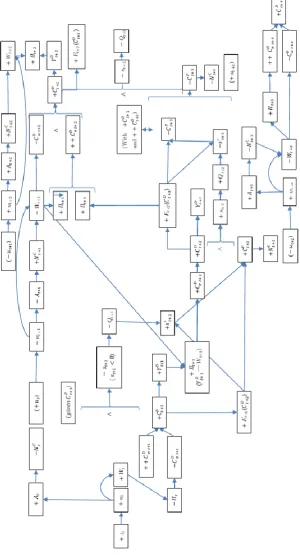
straightforward as presented. A deeper analysis of the causal relations is presented in appendix
figure 4.2.0. The conclusions of the figure presented generally do vary with respect to several
factors such as the sensitivity of wages to the variation of EPL or workers’ protections (𝛾𝑧), the
sensitivity of wages to the variation of the unemployment level (𝛾𝑢), the sensitivity of workers’
productivity to variations in wages (𝛾𝜔) and the expectations of firms (𝜂′𝑡). For example, with a
wages and economic activity suggesting that in such a case the paradox of costs still holds (not
reported). The complexity involved in the model allows us to appreciate how the final impact of
employment level depends on the constellation values of the parameters previously mentioned.
The previous scenario presented in figures 4.2.a-c takes into consideration the case in which
there is an “una tantum” increase of the EPL. We could do the same exercise with a “continuous”
increase in z, as if the EPL was going to increase constantly over time due to higher workers’
claims. The result would not be different: in any case, we would obtain the same decreased level
of employment (figures 4.2 d-f, in Appendix) even in cases of a present low Webb effect (𝛾𝜔=
0,5 as before) and an increase in employment levels -where the paradox of costs would still hold-
in a case of a no Webb effect (𝛾𝜔 = 0)(figures 4.2.g-i, in the Appendix).
What is more, in order to show the different impact on the economic and employment levels
due to the different parameters’ values, figures 4.2.l-q’ consider the situation of a constant high
value of the expectation parameter (𝜂′𝑡 = 4) without any Webb effect. In such a case, the high
and constant value of 𝜂′𝑡 makes expectations take the shape and explosive dynamic that figures
(4.0.c-4.0.f) suggest. Such dynamics produce growing oscillatory movements in all the other
economic variables too (4.2 l-n). The key equations for grasping the following dynamics are
reported below.
As long as the overall demand for consumption goods (𝐶𝑡 𝐷) keeps constantly increasing, ev