HRD Strategies: A Good Predictor of the Medical Professionals’
Performance
*Dr. G.D.Gidwani, Ms. Preeti Naik,
Mr. N.K. Totala.
Reader, Institute of mgmt studies Davv Indore
Introduction:
Human Resources in Health Sector
Human resources in health sector reform also seek to improve the quality of services and patients' satisfaction. Health care quality is generally defined in two ways: technical quality and socio-cultural quality. Technical quality refers to the impact that the health services available can have on the health conditions of a population. Socio-cultural quality measures the degree of acceptability of services and the ability to satisfy patients' expectations.
Hospitals are the social systems, which combine science, people and technology and are form on the basis of mutual interests. Human resources have been described as “The heart of the health system in any country”. Human resource development in the hospital is directed by various physical and psychological factors. Modern researches have proved that not only fine materials, sophisticated technology, good working conditions make for progress and effectiveness of an organization but employees motivation, performance, abilities and skills plays a crucial role in determining the effectiveness of organization.
In modern hospitals, different categories of staff work in different capacities. The doctors, the nursing staff, different types of technicians, management personnel contribute substantially to the smooth functioning of the hospital. Hospital employees are supposed to work with the single motto of making available to the patients, the services upto their expectations. In hospital, employees have to work in different conditions and make use of different type of technology.
Medical professionals face many obstacles in their attempt to deliver high quality health care to citizens. Some of these constraints include budgets, lack of congruence between different stakeholders' values, absenteeism rates, high rates of turnover and low morale of health personnel. Better use of the spectrum of health care providers and better coordination of patient services through interdisciplinary teamwork have been recommended as part of health sector reform. An examination of the main human resources issues and questions, along with the analysis of the impact of human resource development strategies or practices on the medical professionals, as well as the identification of the HRD Practices in hospitals in the Indore Metropolitan area has been a key area of focus of this study. These trends include efficiency, equity and quality objectives. Since all health care is ultimately delivered by people, effective human resources management will play a vital role in the success of health sector reform. Though it has been observed the adoption of HRD practices in the health care sector especially in the Hospitals, where lack of HRD practices could lead to a life or death question has yet to fully adopt them.
Current Scenario of Government Hr Policies
Undoubtedly well planned health research plays pivotal role in impressive health outcomes. In India, health research activities do not match with public health priorities, which is necessary for better health
Abstract:
Proper management of human resources is critical in providing a high quality of health care. A refocus on human resources management in health care and more research are needed to develop new policies. Effective human resources management strategies are greatly needed to achieve better outcomes from and access to health care in Hospital Organizations. Human resources, when pertaining to health care, can be defined as the different kinds of clinical and non-clinical staff responsible for public and individual health intervention. As arguably the most important of the health system inputs, the performance and the benefits the system can deliver depend largely upon the knowledge, skills and motivation of those individuals responsible for delivering health services.outcomes. Without accurate data, it will not be able to allocate resources appropriately. All the major public health programmes and policies need to be rigorously evaluated to improve health outcomes and equity. With the help of Department of Health Research (DHR) and Indian Council of Medical Research (ICMR), the government should enable an environment for collaborating major research institutes for preparing a plan of action and methods and generating knowledge based health information system to achieve healthcare for all in India. It should make research initiatives more interactive with policies and implementation of health programmes for making health research more relevant to health system and policy. The government should focus on research capacity building and institutional strengthening for research.
The fundamental reason for poor functioning of health system and ill health indicators is the low level of investment on healthcare. Due to this India is saddled with a high burden of preventable illnesses that traps households in poverty. Public health financing is pivotal to provide financial entitlement in terms of purchase of services so that the out-of-pocket expenditure is taken care of. It is also needed for creating better infrastructure, expansion of health workforce and provision of essential drugs free of cost. In India the public spending on health is around 1.2 per cent of its GDP which is among the lowest in the world. Development of standard treatment guidelines, prescription audit and quality assurance methods are also needed to improve performance, efficiency, and accountability in the public and private sectors.
Health Sector at State Level: The state of Madhya Pradesh does not have a formal mechanism in place to undertake manpower planning on a continuous basis. Planning exercise in the department of health is primarily focused on creation of new infrastructure. In spite of having such a large staffing the directorate does not have a specialized HR department nor do they have HR specialist to guide them on various HR functions. The recruitment and other service conditions for staff in health services of the state government are regulated by the respective Civil Services recruitment rules. Although the rules and its interpretation have undergone modifications from time to time based on amendments and court ruling, there has not been any concerted effort to analyse and modify the existing criteria in the light of changing job requirements. There exist large vacancies in certain categories of staff. The delay on the part of institutions such as Public services commission, subordinate services selection board etc has been cited as the reason for large backlog of vacancies. However the requirement is even larger as the number of sanctioned post of staff have not been revised over the years where as the load of patients and utilization of health facilities have gone up significantly.
Government of Madhya Pradesh has a transfer policy issued by the department of general administration which applies to all categories of staff in the state. The current practices of transfers and posting in Madhya Pradesh are seen as non-systematic. Attempts have been made by both states to impart management training to the managerial staff. However these practices have not been institutionalized due to lack of clear cut policy and the mechanism to ensure the implementation of the training policy. The global forces have opened up the public domain health services to the private investment and introduction of high users‟ charges, but these measures have failed to increase health services for the poor or to bring about greater efficiency in the delivery of health services in the state. In fact, these measures have led to a rise in the cost of public health care in such a way that the poor patients are deprived of accessing the low or subsidized but quality care supposed to be provided by the publicly-owned health services.
Effectiveness & Efficient Management of Human Resources for Medical Professionals
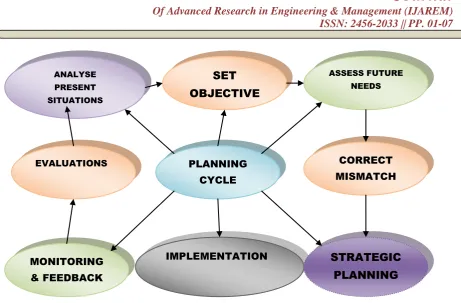
Human resources have been recognized as an indispensable input for the organizational effectiveness and efficient management of this resource has assumed a critical role to play in the performance and success of the organizations. The effectiveness of management depends upon optimum utilization of different resources such as men, money, material, machines, methods, marketing etc. From the many factors listed above, Human Resource is an important factor because they can think, plan & arrange the work successfully towards the predetermined goals & objectives. Human resources are not only an important factor of management but they also play an important role in executing different functions such as planning, organizing, staffing, directing, coordinating & controlling. In total, these functions represent the management process.There are four important steps of Manpower (Medical Professionals) :
Steps in Manpower Planning
Set the Goal
Set the Timeframe
Figure 1.2: Bridging The Gap of HRP
The above figure reflects the role of HRD Practices in the whole procedures and bridge the gap between present and future aspects. Motivated human resources play key role in the success of an organization. Optimum utilization of this valuable resource becomes specialized branch of Management i.e. Human Resource Management. The simplest definition of management is to get the work done from others.
That means for completion of work one has to get positive response from the work force. Motivated work force cans produce wonders for the organization. Human Resource is the common factor for any kind of industry. A hospital industry is a service industry. Human resource is an important factor in helping the hospital industry to be successful. In the hospital organization human resources is in force front of service sector & cannot be replaced by machine or electronic gadgets. e.g. caring of patients.
Hospital organization presents a number of unique human resources management challenges. Managing human resources is the real challenge of hospital managers. The hospital is an institution dedicated to the attention of human suffering, the treatment of human ailments and the promotion of general health of the community, has to take care of the welfare of those who run it, i.e. its personnel.
Human resource management is staff function through which managers recruit, select, train, and develop their employees and develop the organization as well. So it totally depends the way in which the personnel are recruited, selected, trained , developed and utilized by management largely determines whether the organization achieve its objectives or not. S. M. Jha (2001) stated that to bring efficiency in the function of a hospital by proper employee selection, training and control is very important. Employee selection, training and control require special skills, time and effort which cannot, usually be provided by the person charged with the general administration work of the hospital. The increasing size of hospitals has made impossible the continuance of the employee-employer relationship in which employee and employer worked side by side, knew each other as individuals and understood mutual problems. In small hospitals such a relationship is still possible. In big hospitals, supervisors have been introduced to function as links between administration and employees; but in most cases, these supervisors are only interested in getting the work done and are in need of training in the human relationships which are involved in their own work situation.
During the last quarter-century, numerous labour legislations, imposing legal restrictions on employment in hospitals, have been passed. It is, therefore, essential that a human resource manager well versed in the labour laws can be of immense service. The increasing complexity of the various problems in dealing with
ANALYSE PRESENT SITUATIONS
SET
OBJECTIVE
S
ASSESS FUTURE NEEDS
EVALUATIONS PLANNING
CYCLE
CORRECT MISMATCH
MONITORING & FEEDBACK
IMPLEMENTATION
STRATEGIC
employee relations demands a specially trained individual who can give these problems continued attention so that desirable working relationships may be established among all employees of the hospital.
Rationale of The Study
Hospitals need to deal with improving the patient experience as a long term strategic goal that leads to continued growth. Improvement in patient experience and satisfaction in healthcare organizations is important for future survival. The speed at which change is occurring, the availability of technology needed to deliver quality care, and the expertise and style of health care resource management available may also influence quality. In the relationship between human resource development strategies and performance, Guest et al. (2000b) modeled that the HR strategy, HR practices and HR effectiveness are interrelated and it impacts on quality of goods and services, productivity and performance. Entry-level knowledge, skills and understandings of medical professionals are affected by the quality of the basic educational system, the links between the health education and hospital industry and the extent to which the educational system promotes continuing learning skills. The ability of the existing employees to acquire new skills may also be limited as they need support from management to carry out further education and training.
Review of Literature
Samart Plangpramool (2016) in his study entitled „Human Resource Development in Hospitality Industry: A Case Study Of Training Need Analysis for Hotel Sector‟ determined the importance of human resource development and the training need analysis of leading five star hotels in Thailand. The findings show that training need analysis is a foundational effort of employees‟ success in their career paths and growths. Moreover, everyone at these five star hotels have the ability to be heard. Every effort is made to keep its employees fully developed on their tasks via training. In other words, employees have accessed to all their needs and expectations on the process of training need analysis. In addition, most employees are satisfied with the training need analysis activity of their hotel properties. In concluding remarks, the practice of training need analysis of the hotel sector is considered to be a crucial part to be considered for the hospitality industry.
Devi, Rama V. & Naga, Bhaska (2014) This paper examines the growth, geographic distribution, and quality concerns of medical education in India, particularly in the private sector. It is observed that an important feature of the considerable growth of medical education experienced in India, especially after the 1990s, is the significant growth of private medical education. The paper suggests policy actions for correcting geographical imbalances in the production and distribution of medical graduates and increasing the density of quality doctors in India.
Through this paper Ningombam Reagan Singh & Arabinda Debnath (2015) have attempted to discuss as how Hospital Management plays various roles for human resource development. With a view to systematizing the study, the entire paper is divided into three parts. It is a comprehensive study where it is discussed as how the hospital management can contribute a lot to the human resource development.
V. Rama Devi and P. Lakshmi Narayanamma (2014) pointed out that People are considered to be the valuable assets of the organization as the source of ideas for innovation, quality and continuous improvement and other important inputs needed to compete in the modern, highly competitive world, comes from people and not from inanimate machines. They can change the fortune of the organization. Acknowledging the importance of human resources and their competencies, organizations are making attempts to create healthy HRD climate irrespective of the nature of organization. The present study aims to determine the effectiveness of HRD climate prevailing in healthcare and banking sectors.
Rosman Md. Y., Shah F.A. , Hussain J. and Hussain (2013) focussed on the role of Human Resource Management in healthcare sector and challenges it faces has always been an important area of research both in developed and developing countries. The objective of this study is to evaluate the role of HR department in private healthcare sector in the province of Khyber Pakhtunkhwa (KPK), Pakistan and to analyze the challenges/factors affecting the role of HR department. Being the largest private sector hospital in KPK the researchers have selected RMI as a case for this study.
Objectives of The Study:
1. To analyze the HRD strategies in terms of performance of medical professionals.
2. To suugest some measures to make an effective of health care services through the implementation of HRD strategies.
METHODOLOGY:
The study is primarily a descriptive and analytical. The study is undertaken on the Hospitals in Indore Region.
Sample Size:
Total 400 Medical Professionals were selected in Indore Area. Source of Data:
Primary data are collected from the sample through questionnaire. Secondary data are collected from National & International Journals, collecting information from websites, consulting with expert and Medical Practitioners.
Analysis of Data
The collected data has been analyzed with the help of five point scale from strongly agree to strongly disagree and hypothesis is tested by applying correlation & regression.
TESTING OF HYPOTHESIS
Correlation & Regression
H01: There is no significant impact of HRD Strategies on the Performance of Medical Professionals.
H11: There is a significant impact of HRD Strategies on the Performance of Medical Professionals.
Descriptive Statistics on HRD Strategies& Performance of Medical Professionals
Mean Std. Deviation
N
Performance of Medical Professionals 25.2050 4.88032 400 HRD Strategies 18.4975 17.42826 400
Correlationson HRD Strategies& Performance of Medical Professionals
Performance of Medical Professionals
HRD Strategies
Pearson Correlation
Performance of Medical
Professionals 1.000 .412
HRD Strategies .412 1.000
Sig. (1-tailed)
Performance of Medical
Professionals . .000
HRD Strategies .000 .
N
Performance of Medical
Professionals 400 400
HRD Strategies 400 400
association between HRD Strategies and Performance of Medical Professionals. Furthermore, since the value of correlation coefficient r suggests a strong positive correlation, we can use a regression analysis to Model the relationship between the variables.
Model Summarybon HRD Strategies& Performance of Medical Professionals
Mod el
R R
Square
Adjusted R Square
Std. Error of the Estimate
Change Statistics
R Square Change
F Change
df1 df2 Sig. F Change 1 .412a .170 .168 4.45199 .170 81.470 1 398 .000
a. Predictors: (Constant), HRD Strategies
b. Dependent Variable: Performance of Medical Professionals
Coefficientsaon HRD Strategies& Performance of Medical Professionals
Model Unstandardized Coefficients
Standardi zed Coefficie
nts
t Sig. 95.0% Confidence Interval for B
B Std. Error
Beta Lower
Bound
Upper Bound
1 (Constant) 17.298 .904 19.140 .000 15.522 19.075 HRD Strategies .115 .013 .412 9.026 .000 .090 .141 a. Dependent Variable: Performance of Medical Professionals
Over all model summary shows the value of multiple correlation coefficient R=0.412, it is the linear correlation coefficient between observed and model predicted values of the dependent variable, Its large value indicates a strong relationship. R2, the coefficient of determination is the squared value of the multiple correlation coefficients. Adjusted R2=0.168, R2 change is also 0.170 and these values are significant which shows that overall strength of association is noteworthy. The coefficient of determination R2 is 0.170; therefore, 17% of the variation in Performance of Medical Professionals is explained by HRD Strategies.
ANOVA is used to exhibit model‟s ability to explain any variation in the dependent variable. ANOVA table exhibits that the hypothesis that all model coefficients are 0 is rejected at 1% as well as 5% level of significance which means that the model coefficients differ significantly from zero. In other words we can say that there exists enough evidence to conclude that slope of population regression line is not zero and hence, HRD Strategies s is useful as predictor of Performance of Medical Professionals. From the table of ANOVA, it has been revealed that the calculated F value (81.470) is greater than the tabulated value at .000 significant levels; it means that null hypothesis is not supported.
Conclusion:
Human centered development thus must be carried out through a holistic approach which encompasses all physical, psychological and social dimensions. At present, we can only mobilize one-third of our personnel potential. The truly effective development is “internal development of the individual”. Most HRD activities focus only on the technical capabilities and behavior of personnel, omitting the holistic human aspect. In order to motivate personnel to dedicate their hands, heads and hearts for the organization, an atmosphere of a learning organization needs to be developed. Wisdom will be developed through team activities ; creating a community of practices, with sharing of knowledge, skills and ideas leading to development of standard practices and skills. Some personnel are skillful enough to become experts, coaches or trainers for other hospitals.
management concerned. Of course, decision thereafter will have to be that of the management concerned. All the same the essential first step of diagnosis would have risen up for their decision-making. The effectiveness of hospital services (HRD) is reflected in the several dimensions of quality of patient care such as- availability of physical infrastructure, adequacy of equipments & supplies, services & amenities provided, prescription practices, referrals, record maintenance, prices of services, maintenance & upkeep, adequacy & competence of staff, the level of staff‟s motivation & dedication, their approach towards work, behaviour of staff, interpersonal relations, work environment, work relationship, professional satisfaction, personal losses & gain, main bottlenecks & effectively of treatment. These dimensions provided a useful framework to analyze the extent a quality of care provided in the hospitals.
Recommendations
Atmospheres promoting HRD should be developed, e.g., decentralization, recruitment of hospital directors through their achievements in management rather than through achievements in medical services, merit system for career development.
Development of the hospital can be a learning model for HRD in the public organization. Technical support from central HRD and research institutes are required for further development and application of the model.
References:
[1]. Agarwala, Tanuja (2002) “Innovative Human Resource Practices and HRD Climate: A Comparison of Automobile and IT Industries”. In: Pareek, U, Osman-Gani, Ramnarayan and T.V. Rao (eds.) Human Resource Development in Asia. New Delhi: Oxford & IBH, 3-10.
[2]. Agarwal, M., & Gupta, S. (2007). Effects of perceived procedural fairness of organizational Human Resource practices on the relationship between facets of the performance appraisal system and its effectiveness. Indian Journal of Training and Development, XXXVII: 2, April-June 2007, 53-67. [3]. Beduk, A., Altan, M., & Sarsenova, K. (2011). Performance management in the health care industry:
an application on the assessment of public-private sector hospitals. The 2011 Barcelona Academic Conference, Barcelona, Spain 2011, 1181-1188.
[4]. Ningombam Reagan Singh & Arabinda Debnath (2015) The Role of Hospital management in Human Resource Development. Management Business Review. Vol.3 (5), pp.56-62.
[5]. Rosman Md. Y., Shah F.A. , Hussain J. and Hussain (2013) Factors Affecting the Role of Human Resource Department in Private Healthcare Sector in Pakistan: A Case Study of Rehman Medical Institute (RMI). Research Journal of Recent Sciences. Vol. 2(1), 84-90, January.
[6]. Shaghayegh Vahdat, Somayeh Hessam, Elham Ghazanchaei and Beheshteh Jebelli,(2013) Determining Variables of Implementing Human Resource Development in Iranian Social Security Organization‟s Hospitals Middle-East Journal of Scientific Research 13 (1): 09-13, IDOSI Publications.
[7]. V. Rama Devi and P. Lakshmi Narayanamma (2014) Human Resource Development Climate in Healthcare and Banking Sector. Middle-East Journal of Scientific Research 21 (7): 1055-1060.