AbstrAct
Objectives To investigate whether an authorship effect is found that leads to better performance in studies conducted by the original developers of the Patient Health Questionnaire (PHQ-9) (allegiant studies).
Design Systematic review with random effects bivariate diagnostic meta-analysis. Search strategies included electronic databases, examination of reference lists and forward citation searches.
Inclusion criteria Included studies provided sufficient data to calculate the diagnostic accuracy of the PHQ-9 against a gold standard diagnosis of major depression using the algorithm or the summed item scoring method at cut-off point 10.
Data extraction Descriptive information, methodological quality criteria and 2×2 contingency tables.
results Seven allegiant and 20 independent studies reported the diagnostic performance of the PHQ-9 using the algorithm scoring method. Pooled diagnostic OR (DOR) for the allegiant group was 64.40, and 15.05 for non-allegiant studies group. The allegiance status was a significant predictor of DOR variation (p<0.0001). Five allegiant studies and 26 non-allegiant studies reported the performance of the PHQ-9 at recommended cut-off point of 10. Pooled DOR for the allegiant group was 49.31, and 24.96 for the non-allegiant studies. The allegiance status was a significant predictor of DOR variation (p=0.015). Some potential alternative explanations for the observed authorship effect including differences in study characteristics and quality were found, although it is not clear how some of them account for the observed differences.
conclusions Allegiant studies reported better performance of the PHQ-9. Allegiance status was predictive of variation in the DOR. Based on the observed differences between independent and non-independent studies, we were unable to conclude or exclude that allegiance effects are present in studies examining the diagnostic performance of the PHQ-9. This study highlights the need for future meta-analyses of diagnostic validation studies of psychological measures to evaluate the impact of researcher allegiance in the primary studies.
Research on allegiance effects has a long tradition in psychotherapy research. In this
context, allegiance describes the phenomenon that researchers and clinicians who devel-oped a treatment approach or are for other reasons invested in it tend to find larger effect sizes in favour of their treatment than for comparison groups.1 This finding has been extensively replicated2 3 and is also robust when the quality of research is controlled for. Researcher allegiance is subject of ongoing debates about the design of efficacy studies as well as implications for policy.2 4 5 Researcher allegiance is also discussed widely in the liter-ature on experimental as well as evaluation research.6 Since the motivational underpin-nings of allegiance effects are potentially far more ingrained into human behaviour and decision making than previously thought,7 they may occur commonly in clinical research in general.
Although it has been suggested that alle-giance effects may play a role in the validation of psychological screening and case-finding tools (eg, O'Shea et al., in press), systematic
Are there researcher allegiance effects in
diagnostic validation studies of the
PHQ-9? A systematic review and
meta-analysis
Laura Manea,1,2 Jan Rasmus Boehnke,3 Simon Gilbody,1,2 Andrew S Moriarty,2
Dean McMillan1,2
To cite: Manea L, Boehnke JR,
Gilbody S, et al. Are there
researcher allegiance effects in diagnostic validation studies of the PHQ-9? A systematic review
and meta-analysis. BMJ Open
2017;7:e015247. doi:10.1136/ bmjopen-2016-015247
►Prepublication history and
additional material for this paper are available online. To view, please visit the journal (http:// dx. doi. org/ 10. 1136/ bmjopen- 2016- 015247).
Received 23 November 2016 Revised 21 July 2017 Accepted 25 July 2017
1Deparment of Health Sciences,
University of York, York, UK
2Hull York Medical School,
University of York, York, United Kingdom
3Dundee Centre for Health And
Related Research, University of Dundee, Dundee, United Kingdom
correspondence to Dr Laura Manea; laura. manea@ york. ac. uk
strengths and limitations of this study
► An original study—the first meta-analysis of diagnostic validation studies of psychological measures to evaluate the impact of researcher allegiance.
► Using rigorous methodology—strict inclusion/ exclusion and quality assessment criteria.
► We found that the allegiance effect was a significant predictor of the variation of the diagnostic OR in the meta-regression analysis.
► Substantial variability observed in methodological quality of included studies.
► Based on the observed methodological differences between the independent and non-independent studies, we were unable to conclude or exclude that allegiance effects are present in studies examining the diagnostic performance of the Patient Health Questionnaire (PHQ-9).
on September 22, 2020 by guest. Protected by copyright.
evaluations of this hypothesis are rare and studies that acknowledge potential allegiance effects in such studies mainly come from forensic psychology and psychiatry backgrounds.8–11 Diagnostic validation studies are geared at establishing the sensitivity and specificity of a screening or case-finding tool, which is used in practice to differ-entiate cases from non-cases or to decide about whether further assessment or treatment is indicated or will be offered. An allegiance effect in such studies would be seen in systematically higher sensitivities or specificities if the original author(s) is (are) part of the team of such a study. Such a bias would have a deleterious affect on practice through promising overoptimistic accuracy of the screening or case-finding tool or in evaluating the cost-effectiveness of the measure in a screening or case-finding context.
The depression module of the Patient Health Ques-tionnaire (PHQ-9) is a widely used depression-screening instrument in non-psychiatric settings. The PHQ-9 was developed by a team of researchers, with its development underwritten by an educational grant from Pfizer US Phar-maceuticals.12 The PHQ-9 can be scored using different methods, including an algorithm based on Diagnostic and Statistical Manual of Mental Disorders (DSM)-IV criteria and a cut-off based on summed-item scores. The psycho-metric properties of these two approaches have been summarised in two recently published meta-analyses.13 14 The goal of the current review is to investigate, based on an established database of PHQ-9 diagnostic validation studies,13 14 whether an allegiance effect is found that leads to an increased sensitivity and specificity in studies that were conducted by researchers closely connected to the original developers of the instrument.
MethODs study selection
Similar search strategies were used in both systematic reviews (for full details, please see Manea et al and Mori-arty et al13 14). Embase, Medline and PsycINFO were searched from 1999 (when the PHQ-9 was first devel-oped) to August 2013 and September 2013, respectively, using the terms ‘PHQ-9’, ‘PHQ’, ‘PHQ$’ and ‘patient health questionnaire’. The search strategy is presented in online supplementary appendix 1. The reference lists of studies fitting the inclusion criteria were manually searched and a reverse citation search in Web of Science was performed. The authors of unpublished studies were contacted and conference abstracts were reviewed in an attempt to minimise publication bias.
The following inclusion-exclusion criteria were used:
Population: adult population. Instrument: studies that
used the PHQ-9. Comparison (reference standard): the accu-racy of the PHQ-9 had to be assessed against a recognised gold-standard instrument for the diagnosis of either DSM or International Classification of Disease (ICD) criteria for major depression. Studies were included if the diagnoses were made using a standardised diagnostic structured
interview schedule (eg, Mini International Neuropsychi-atric Interview (MINI), Structured Clinical Interview for DSM Disorders (SCID)). Unguided clinician diagnoses with no reference to a standard structured diagnostic schedule or comparisons of the PHQ-9 with other self-re-port measures were excluded. Studies were also excluded if the target diagnosis was not major depressive disorder (MDD, eg, any depressive disorder). Outcome: studies had to report sufficient information to calculate a 2×2 contin-gency table for the algorithm or the recommended cut-off point 10. Study design: any design. Additional criterion: we avoided double counting of evidence by ensuring that only one study of those that reported overlapping data-sets in different journals were included in the meta-anal-ysis. Citations with overlapping samples were examined to establish whether they contained information relevant to the research question that was not contained in the included report.
Quality assessment
Quality assessment was performed using the Quality Assessment of Diagnostic Accuracy Studies (Revised) (QUADAS-2) tool, a tool for evaluating the risk of bias and applicability of primary diagnostic accuracy studies when conducting diagnostic systematic reviews.15 It covers the areas of patient selection, index test, reference stan-dard and flow and timing.16 This tool was adapted for the two reviews and quality assessments were carried out by two independent reviewers for all studies included in the reviews.
Data synthesis and statistical analysis
We constructed 2×2 tables for cut-off point 1014 and the algorithm scoring method.13 Pooled estimates of sensi-tivity, specificity, positive/negative likelihood ratios and diagnostic ORs (DOR) were calculated using random effects bivariate meta-analysis.17 Heterogeneity was assessed using I2 for the DOR, an estimate of the
propor-tion of study variability that is due to between-study vari-ability rather than sampling error. We considered values of ≥50% to indicate substantial heterogeneity.18 Summary receiver operating characteristic curves (sROC) were constructed using the bivariate model to produce a 95% confidence ellipse within ROC space.19 Each data point in the sROC space represents a separate study, unlike a traditional ROC plot, which explores the effect varying thresholds on sensitivity and specificity in a single study.
We undertook a meta-regression analysis of logit DOR using research allegiance as covariate in the meta-regres-sion model.20 21 Analyses were conducted using STATA V.12, with the metan, metandi and metareg user-written commands.
Allegiance rating
We rated authorship on a paper if any of the developers of the PHQ-9—Kurt Kroenke, MD, Robert L Spitzer, MD and Janet BW Williams—as an indicator of poten-tial allegiance. We also rated as evidence of allegiance as
on September 22, 2020 by guest. Protected by copyright.
acknowledged collaborations with the developers of the PHQ-9, even if they were not listed as coauthors or if the authors acknowledged funding from Pfizer to conduct the study.
results
Overview of included studies
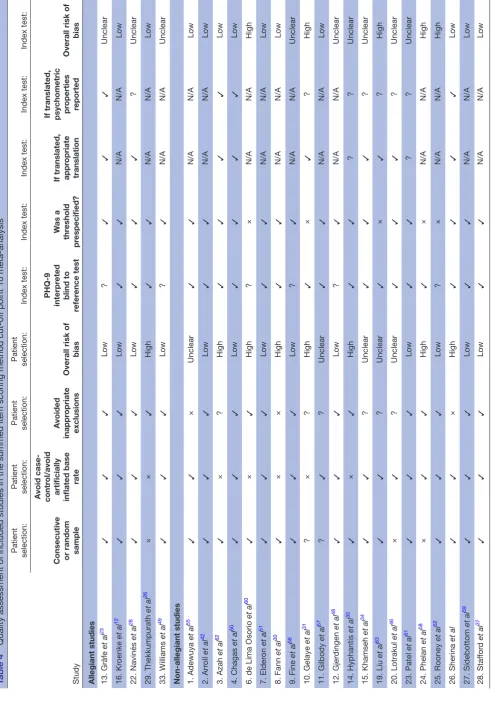
Thirty-one studies reported the diagnostic properties of the PHQ-9 at cut-off point 10 or above and were included in this analysis.14 Twenty-seven studies were included in the algorithm review.13 The study selection flow charts can be found in online supplementary appendix 2 (figures 1 and 2). The characteristics of these studies are reported in tables 1 and 2 and the results of the methodological assessment are presented in tables 3 and 4.
Algorithm scoring method Descriptive characteristics
The descriptive characteristics of the included studies are presented in table 1. Seven individual studies that reported the diagnostic performance of the PHQ-9 using the algorithm scoring method were coauthored by the original developers of the PHQ-9,22–26 specifically acknowledged one of the developers and support by an educational grant from Pfizer USA,27 or were coauthored by the first author of a previous study that had also been coauthored by one of the developers.28 Twenty non-alle-giant studies reported the diagnostic properties of the PHQ-9 using the algorithm scoring method.
Three (43%, 3/7) of the allegiant studies were conducted exclusively in hospital settings.22 26 28 The remaining four studies (67%, 4/7) were conducted in different settings or non-exclusively hospital settings: one in primary care25 and three in mixed settings: psycho-somatic walk in clinics and family practices23,i outpa-tient clinics and family practices24 and primary care and hospital settings.27 In the non-allegiant group, 13 (65%, 13/20) studies were conducted in hospital settings.29–41 Of the remaining seven studies, six were conducted in primary care settings42–47 and one in a community sample.48
In both groups (non-allegiant and allegiant studies), the majority of studies validated a translated version of the PHQ-9. Two of the studies authored by devel-opers (28%, 2/7),25 26 and eight (40%, 8/20) allegiant studies29 30 37–40 42 48 were conducted in English.
The mean prevalence of MDD in the group of allegiant studies was 13.4% (range 6.1%–29.2%); in the non-alle-giant group it was 15.5% (range 3.9%–32.4%). The mean age of patients in the PHQ-9 developers group was 45.7; all but one study had a mean age in the range of 40–50 years. In the non-allegiant group, the mean age was 54.6 (range
i This study provided separate estimates for the two settings in which it was conducted; therefore separate psychometric estimates were gener-ated for each sample for both algorithm scoring method and summed items scoring method at cut-off point 10 (see below).
29.3–75.0), with almost half (8) of the studies reporting a mean age of over 60. The percentage of females in the PHQ-9 developers was 56.8% (range 28.6%–67.8%) and in the non-allegiant group was 59.1 (18%–100%).
All allegiant studies used a self-reported PHQ-9, whereas in seven non-allegiant studies (30%, 6/20) the PHQ-9 was administered by a researcher.30–33 43 48 Apart from Muramatsu et al., all allegiant studies used the SCID as a gold standard27; the non-allegiant studies used a wider range of gold standards including SCAN, CIDI, MINI and C-DIS, although the SCID was also frequently used by the independent studies as well (45%, 9/20 studies).
Four out of the seven allegiant studies (57%) did not include a conflict of interest statement.22 23 25 27 Also, four (57%) of the allegiant studies acknowledged funding from Pfizer.23–25 27 Only one study27 acknowledged the collaboration with one of the developers of the PHQ-9.
Of the non-allegiant studies, 12 (60%) did not include a conflict of interest statement.29–32 35–37 39 44–46 48 It appears that newer studies were more likely to include a conflict of interest statement, which may reflect a recent change in reporting. Funding was acknowledged by most studies (18/20) and most received funding from academic or/ and health research institutions. Two studies received funding from pharmaceutical companies—Lundbeck43 and Pfizer35 and one study acknowledged that Pfizer Italia provided the Italian version of PHQ-9 and gave the authors permission to use it.36
Diagnostic test accuracy
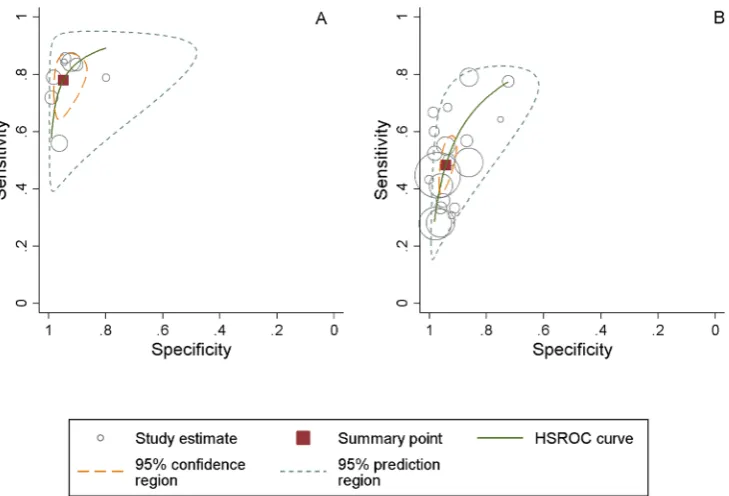
Pooled sensitivity and specificity was calculated separately for the non-allegiant and allegiant studies. Pooled sensi-tivity for the allegiant studies of the PHQ-9 was 0.77 (95% CI 0.70 to 0.84), pooled specificity was 0.94 (95% CI 0.90 to 0.97) and the pooled DOR was 64.40 (95% CI 34.15 to 121.43). Heterogeneity was high (I²=78.9%). Figure 1
represents the sROCs for this set of studies.
Pooled sensitivity for the non-allegiant studies was lower compared with the developer authored studies group at 0.48 (95% CI 0.41 to 0.91), pooled specificity was the same at 0.94 (95% CI 0.91 to 0.95). The pooled DOR was approximately four times lower at 15.05 (95% CI 11.03 to 20.52) (see figure 1). Heterogeneity was substantial at I²=68.1%.
The meta-regression analysis for algorithm studies with non-allegiant status as the predictor of the DOR showed that non-allegiant status was a significant predictor of the DOR (p<0.0001) and explained a substantial amount of the observed heterogeneity (51.5%).
Quality assessment
The results of the quality assessment using QUADAS-2 are given in table 3 for the studies reporting on the diag-nostic performance of the algorithm scoring method. In the patient selection domain, more non-allegiant studies (65%, 13/20) than allegiant (29%, 2/7) met the criterion for consecutive referrals. There were no marked differ-ences on the other two criteria in this domain (avoid
on September 22, 2020 by guest. Protected by copyright.
Table 1
Descriptive characteristics of algorithm studies
13
Study
Sample characteristics
Sample size and % depr
essed
PHQ-9 characteristics Diagnostic standar
d
a) COI declaration b) Funding c) Relationship with original developers
(country
, setting, age, sex)
Diez-Quevedo
et
al
22
Country: Spain Setting: medical and sur
gical tertiary
hospitals Age (years): M=43 (SD=14.2) Female: 45.6% n=1003 Depr
essed: 8.2%
Administration: self- report Language: Spanish DSM-III-R SCID a) No COI declaration b) Funding acknowledged (academic institutions) c) Not acknowledged
Gräfe
et al
23
Country: Germany Setting: psychosomatic walk-in clinics and family practices Age (years): male=41.9 (SD=13.8) Female: 67.8% n=528 Depr
essed: 29.2%
psychosomatic patients; 6.16% medical patients Language: German Administration: self- report DSM-IV SCID a) No COI declaration b) Acknowledged funding fr
om Pfizer
c) Not acknowledged
Lowe
et al
24
Country: Germany Setting: outpatient clinics and family practices Age (years): male=41.7 (SD=13.8) Female: 67.1% n=501 Depr
essed: 13.2%
Administration: self- report Language: German DSM–IV SCID
a) COI declaration ‘This study was supported by unr
estricted
restricted grants fr
om Pfizer Germany and fr
om the medical faculty
of the University of Heidelber
g Germany
, and ther
e ar
e no COI’.
b) Acknowledged funding fr
om Pfizer and academic institution
c) Not acknowledged
Muramatsu
et al
27
Country: Japan Setting: primary car
e and general hospital
Age (years): male=43.3 (SD=16.4) Female: 59.5% n=131 Depr
essed: 28.2%
Administration: self- report Language: Japanese DSM–IV MINI a) No COI declaration b) Acknowledged funding fr
om Pfizer
c) Acknowledged one of the developers of the PHQ-9: ‘The authors acknowledge Dr RL Spitzer’
Navinés
et al
28
Country: Spain Setting: general hospital (patients with chr
onic HCV)
Age (years): male=43.4 (SD=10.2) Female: 28.6% n=500 Depr
essed: 6.4%
Administration: self- report Language: Spanish DSM–IV SCID
a) All authors declar
ed that they had no COI.
b) Role of funding sour
ce declar
ed
c) Not acknowledged
Spitzer
et al
25
Country: USA Setting: primary car
e
Age (years): male=46 (SD=17.2) Female: 66%
n=3000 (585 r
eceived
SCID) Depr
essed: 10%
Administration: self- report Language: English DSM-III-R SCID a) No COI declaration b) Acknowledged funding fr
om Pfizer
. ‘Drs Spitzer and Williams
receive honoraria and consulting money fr
om Pfizer
, which has
supported this work’. c) N/A
Thekkumpurath et al
26
Country: UK Setting: hospital (cancer patients) Age (years): male=61 Female: 63% n=782 Depr
essed: 6.3% (of
the whole sample)
Administration: not stated Language: English DSM-IV SCID
a) COI declaration: ‘Supported by Cancer Resear
ch UK’
b) As in a) c) Not acknowledged
A
yalon
et al
43
Country: Israel Age (years): male=75 (SD=8.1) Female: 40.5% n=153 Depr
essed: 3.9%
Administration: resear
cher
administer
ed
Language: Hebr
ew
DSM-IV SCID
a) COI declaration: ‘The pr
oject was funded by an Investigator’
s
Initiated Resear
ch Grant fr
om Lundbeck Inter
national given to
Dr Liat A
yalon. Lundbeck Inter
national had no other involvement
in the pr
oject concept of design or in this paper
. Per Bech has
occasionally over the past 3
years until August 2008 r
eceived
funding fr
om and has been speaker or member of advisory
boar
ds for pharmaceutical companies with an inter
est in the drug
tr
eatment of af
fective disor
ders (AstraZeneca, Lilly
, H Lundbeck
A/S, Lundbeck Foundation and Or
ganon)'.
b) Acknowledged funding fr
om Lundbeck Inter
national
Continued
on September 22, 2020 by guest. Protected by copyright.
Study
Sample characteristics
Sample size and % depr
essed
PHQ-9 characteristics Diagnostic standar
d
a) COI declaration b) Funding c) Relationship with original developers
(country
, setting, age, sex)
Eack
et al
29
Country: USA Setting: community mental health centr
es
for childr
en
Age (years): male=39.20 (SD 9.63) Female: 100%
n=50 Depr
essed: 28%
Administration: self- report Language: English DSM-IV SCID a) No COI declaration b) Funding acknowledged (academic/health
resear
ch institutions)
Fann
et al
30
Country: USA Setting: trauma hospital (inpatients with traumatic brain injury) Age (years): male=42 (SD=17.9) Female: 29.1% n=135 Depr
essed: 16.3%
Administration: telephone- administer
ed
Language: English
DSM-IV SCID a) No COI declaration b) Funding acknowledged (academic institutions)
Gelaye
et al
31
Country: Ethiopia Setting: general hospital Age (years): 34.9 (SD=11.6) Female: 63.1% n=363 Depr
essed: 12.6%
Administration: resear
cher
-administer
ed
Language: Amharic
DSM-IV SCAN a) No COI declaration b) Funding acknowledged (academic/health
resear
ch institutions)
Gjer
dingen
et al
48
Country: USA Setting: community Age (years): male=29.3 Female: 100% n=438 Depr
essed: 4.6%
Administration: telephone or self- report Language: English DSM-IV SCID a) No COI declaration b) Funding acknowledged (academic/health
resear
ch institutions)
Henkel
et al
44
Country: Germany Setting: primary car
e
Age (years): not r
eported
Female: 74%
n=448 Depr
essed: 10%
Administration: self- report Language: German DSM-IV CIDI a) No COI declaration b) Funding acknowledged (academic/health
resear
ch institutions)
Hyphantis
et al
32
Country: Gr
eece
Setting: hospital – rheumatology patients Age (years): male=54.2 (SD=13.5) Female: 74% n=213 Depr
essed: 32.4%
Administration: resear
cher
administer
ed
Language: Gr
eek
DSM-IV MINI a) No COI declaration b) No funding acknowledgement
Inagaki
et al
33
Country: Japan Setting: general hospital Age whole sample (years): male=73.5 (SD=12.3) Female: 59.3%
n=104
out of 511
received MINI Depr
essed: 7.4%
Administration: resear
cher
administer
ed
Language: Japanese
DSM-IV MINI
a) COI declaration: ‘The authors declar
e that they have no
competing inter
ests’. b) Funding acknowledged (academic/
health
resear
ch
institutions)
Khamseh
et al
34
Country: Iran Setting: diabetes clinic Age (years): male=56.17 (SD=9.60) Female: 51.9% n=185 Depr
essed: 43.2%
Administration:self report Language: Persian DSM-IV SCID
a) COI declaration: the authors declar
ed no competing inter
ests
b) Funding acknowledged (academic/health
resear
ch institutions)
Lamers
et al
45
Country: The Netherlands Setting: primary car
e (elderly)
Age (years): male=71.4 (SD=6.90) Female: 48.2% n=713 Depr
essed: 10.7%
Administration:self report Language: Dutch DSM-IV MINI a) No COI declaration b) Funding acknowledged (academic/health
resear
ch institutions)
Table 1
Continued
Continued
on September 22, 2020 by guest. Protected by copyright.
Study
Sample characteristics
Sample size and % depr
essed
PHQ-9 characteristics Diagnostic standar
d
a) COI declaration b) Funding c) Relationship with original developers
(country
, setting, age, sex)
Lotrakul
et al
46
Country: Thailand Setting: primary car
e
Age (years): male=45.0 (SD=14.30) Female: 73.7% n=279 Depr
essed: 6.8%
Administration:self report Language: Thai DSM-IV MINI a) No COI declaration b) Funding acknowledged (academic/health
resear
ch institutions)
Persoons
et al
35
Country: Belgium Setting: hospital (otolaryngology patients) Age (years): male=48.2 (SD=12.9) Female: 65.6%
n=268 (97 r
eceived
MINI) Depr
essed: 16.5%
Administration: self- report Language: Dutch DSM-IV MINI a) No COI declaration b) Funding acknowledged (academic/health
resear
ch institutions)
and Pfizer Belgium
Picar
di
et al
36
Country: Italy Setting: hospital (dermatology inpatients) Age (years): male=37.5 Female: 56% n=141 Depr
essed: 8.5%
Administration: self- report Language: Italian DSM-IV SCID a) No COI declaration b) Funding acknowledged (academic/health
resear
ch institutions)
Acknowledged Pfizer Italia SRL for pr
oviding the Italian version of
the PHQ-9 and for permission to use it.
Staf
for
d
et al
37
Country: Australia Setting: hospital (car
diology patients)
Age (years): male=64.1 (SD=10.3) Female: 66% n=193 Depr
essed: 18%
Administration: self- report Language: English DSM-IV MINI a) No COI declaration b) Funding acknowledged (academic/health r
esear
ch institutions)
Thombs
et al
38
Country: USA Setting: hospital (outpatients with cor
onary
heart disease) Age (years): male=67 (SD=11) Female: 18% n=1024 Depr
essed: 22%
Administration: not stated Language: English
DSM C-DIS
a) COI declaration ‘None disclosed’ b) Funding acknowledged (academic/health r
esear
ch institutions)
Thompson
et al
39
Country: USA Setting: patients with Parkinson's disease Age (years): 72.5 (SD=9.6) Female: 42% n=214 Depr
essed: 14%
Administration:self administer
ed
Language: English
DSM-IV SCID a) No COI declaration b) Funding acknowledged (academic/health r
esear
ch institutions)
Tur
ner
et al
40
Country: Australia Setting: str
oke patients
Age (years): 66.7 (SD=13.1) Female: 47.2%
n=72 Depr
essed: 18%
Administration:self administer
ed
Language: English
DSM-IV SCID
a) COI declaration: disclosur
es ‘none’.
b) Funding acknowledged (academic/health r
esear
ch institutions)
van Steenber
gen-W
eijenbur
g
et al
41
Country: The Netherlands Setting: patients with diabetes Age (years): male=61.8 (SD=13.6) Female: 48.7% n=197 Depr
essed: 18.8%
Administration: self administer
ed
Language: Dutch
DSM-IV SCID
a) COI declaration: ‘The authors declar
e that they have no
competing inter
ests’.
b) Funding acknowledged (academic/health r
esear
ch
institutions)—‘this had no influence on the content of this article’.
Zuitthof
f
et al
47
Country: The Netherlands Setting: primary car
e
Age (years): male=51 (SD=16.7) Female: 63% n=1338 Depr
essed: 13%
Administration: self- report Language: Dutch DSM-IV CIDI
a) COI declaration ‘The authors declar
e that they have no
competing inter
ests’.
b) Funding acknowledged (academic/health r
esear
ch institutions)
CIDI, Composite Inter
national Diagnostic Interview
,CIS-R, Clinical Interview Schedule;COI, conflict of inter
est; DSM, Diagnostic and Statistical Manual of Mental Disor
ders; MINI,
Mini-Inter
national Neur
opsychiatric Interview; N/A, not available; SCAN, Schedules for Clinical Assessments in Neur
opsychiatry; SCID, Structur
ed Clinical Interview for DSM Disor
ders.
Table 1
Continued
on September 22, 2020 by guest. Protected by copyright.
Table 2
Descriptive characteristics of the summed items scoring method studies cut-of
f point 10
14
Study
Sample characteristics
Sample size and % MDD
PHQ-9 characteristics
Diagnostic standar
d
a) COI declaration b) Funding c) Relationship with original developers
13. Gräfe
et al
23
Country: Germany Setting: psychosomatic walk-in clinics and family practices Mean age: 41.9 (SD=13.8) Female: 67.8% n=528 Depr
essed: 29.2%
psychosomatic patients; 6.16% medical patients
Administration: self-r
eport
Language: German Cut-of
fs: 10–14
DSM-IV SCID a) No COI declaration b) Acknowledged funding fr
om Pfizer
c) Not acknowledged
16. Kr
oenke
et al
12
Country: USA Setting: primary car
e
Mean age: 46 (SD=17) Female: 66% n=580 7.1% MDD
Administration: self-r
eport
Language: English Cut-of
fs: 9–15
DSM-IV SCID a) No COI declaration b) Acknowledged funding fr
om Pfizer
c) N/A
22. Navinés
et al
28
Country: Spain Setting: general hospital (patients with chr
onic HCV)
Mean age: 43.4 (SD=10.2) Female: 28.6% n=500 6.4% MDD
Administration: self-r
eport
Language: Spanish Cut-of
fs: 10
DSM–IV SCID
a) All authors declar
ed that they had no COI
b) Role of funding sour
ce declar
ed
c) Not acknowledged
29. Thekkumpurath et al
26
Country: UK Setting: hospital (cancer patients) Mean age: 61 Female: 63% n=782 6.3% MDD (of the whole sample) Administration: not stated Language: English Cut-of
fs: 5–10
DSM-IV SCID
a) COI declaration: ‘Supported by Cancer Resear
ch UK’
b) As in a) c) Not acknowledged
33. Williams
et al
49
Country: USA Setting: secondary car
e (poststr
oke)
Mean age: unclear Female: unclear n=316 33.5% MDD Administration: unclear Language: English Cut-of
fs: 10
DSM-IV SCID a) No COI declaration b) Funding acknowledged (academic institutions) c) Not acknowledged
1. Adewuya
et al
55
Country: Nigeria Setting: community (students) Mean age: 24.8 (15–40) Female: 41.2% n=512 2.5% MDD
Administration: Self-r
eport
Language: English Cut-of
fs: 8–12
DSM-IV MINI
a) No COI declaration b) No funding declaration
2. Arr
oll
et al
42
Country: New Zealand Setting: primary car
e
Mean age: 49 (17–99) Female: 61% n=2642 6.2% MDD Administration: not stated Language: English Cut-of
fs: 8, 10, 12, 15
DSM-IV SCID a) No COI declaration b) Funding acknowledged (academic/health
resear
ch
institutions)
3. Azah
et al
62
Country: Malaysia Setting: primary car
e
Mean age: 38.7 (18–79) Female: 61.7% n=180 16.6% MDD
Administration: self-r
eport
Language: Malay Cut-of
fs: 5–12
DSM-IV CIDI b) No COI declaration c) Funding acknowledged (academic/health
resear
ch
institutions)
4. Chagas
et al
50
Country: Brazil Setting: secondary car
e
Mean age: not stated Female: 52.7% n=84 25.5% MDD
Administration: self-r
eport
Language: Brazilian Cut-of
fs: 7–10
DSM-IV SCID
a) COI declaration ‘None declar
ed’
b) Funding acknowledged (academic/health r
esear
ch
institutions)
Continued
on September 22, 2020 by guest. Protected by copyright.
Study
Sample characteristics
Sample size and % MDD
PHQ-9 characteristics
Diagnostic standar
d
a) COI declaration b) Funding c) Relationship with original developers
6. de Lima Osorio et al
60
Country: Brazil Setting: primary car
e
Mean age: unclear Female: 100% n=177 34% MDD
Administration: r
esear
ch
assistants Language: Brazilian Portuguese Cut-of
fs: 10–15
DSM-IV SCID a) No COI declaration b) Funding acknowledged (academic institutions)
7. Elder
on
et al
51
Country: USA Setting: secondary car
e
Mean age: unclear Female: 18% n=1022 18.3% MDD
Administration: self-r
eport
Language: English Cut-of
fs: 10
C-DIS
a) COI declaration—‘No disclosur
es’
b) Funding acknowledged (academic institutions and industry—AHA Pharmaceuticals Roundtable)— ‘The funding or
ganisations had no r
ole in the design or
conduct of the study
, collection, management, analysis or
interpr
etation of data; or pr
eparation, r
eview or appr
oval of
the manuscript’.
8. Fann
et al
30
Country: USA Setting: trauma hospital (inpatients with traumatic brain injury) Mean age: 42 (SD=17.9) Female: 29.1% n=135 16.3% MDD Administration: telephone- administer
ed
Language: English Cut-of
fs: 10
DSM-IV SCID a) No COI declaration b) Funding acknowledged (academic institutions)
9. Fine
et al
56
Country: USA Setting: primary car
e (Ohio Army National
Guar
d)
Mean age: 31 (17-60) Female: 12% n=498 21.5% MDD Administration: telephone- administer
ed
Language: English Cut-of
fs: 10, 15
DSM-IV SCID-I a) COI—last author disclosed financial and consulting inter
ests (Pfizer not one of them). All other authors
declar
ed that they have no COI.
b) Funding acknowledged—DoD Medical Resear
ch. ‘The
sponsor had no r
ole in study design, data collection,
analysis, interpr
etation of r
esults, r
eport writing or
manuscript submission'.
10. Gelaye
et al
31
Country: Ethiopia Setting: general hospital Mean age: 34.9 (SD=11.6) Female: 63.1% n=363 12.6% MDD
Administration: r
esear
cher
-administer
ed
Language: Amharic Cut-of
fs: 9–11
DSM-IV SCAN a) No COI declaration b) Funding acknowledged (academic/health
resear
ch
institutions)
11. Gilbody
et al
57
Country: UK Setting: primary car
e
Mean age: 42.5 (SD 13.6) Female: 77% n=96 37.5 MDD Administration: not stated Language: English Cut-of
fs: 9–13
DSM-IV SCID a) COI declaration—last author involved in the development of one of the instruments (CORE-OM), ‘but does not gain financially fr
om its use.
b) Funding acknowledged (academic/health
resear
ch
institutions)
12. Gjer
dingen
et al
48
Country: USA Setting: community Mean age: 29.3 Female: 100% n=438 4.6% MDD Administration: telephone or self-r
eport
Language: English Cut-of
fs: 10
DSM-IV SCID c) No COI declaration d) Funding acknowledged (academic/health
resear
ch
institutions)
14. Hyphantis
et
al
32
Country: Gr
eece
Setting: hospital— rheumatology patients Mean age: 54.2 (SD=13.5) Female: 74% n=213 32.4% MDD
Administration: r
esear
cher
administer
ed
Language: Gr
eek
Cut-of
fs: 4–16
DSM-IV MINI a) No COI declaration b) No funding acknowledgement
Table 2
Continued
Continued
on September 22, 2020 by guest. Protected by copyright.
Study
Sample characteristics
Sample size and % MDD
PHQ-9 characteristics
Diagnostic standar
d
a) COI declaration b) Funding c) Relationship with original developers
15. Khamseh
et
al
34
Country: Iran Setting: outpatient diabetic clinic Mean age: 56.1 (SD=9.6) Female: 51.8% n=185 43.2% MDD
Administration: self-r
eport
Language: Persian Cut-of
fs: 10, 13
DSM-IV SCID
a) COI declaration: the authors declar
ed no competing
inter
ests.
d) Funding acknowledged (academic/health
resear
ch
institutions)
19. Liu
et al
63
Country: T
aiwan
Setting: primary car
e
Mean age: not specified Female: 60.9% n=1532 3.3% MDD
Administration: self-r
eport
Language: Chinese version Cut-of
fs: 9–11
SCAN
a) No COI declaration b) Funding acknowledged (academic/health
resear
ch
institutions)
20. Lotrakul
et al
46
Country: Thailand Setting: primary car
e
Mean age: 45.0 (SD=14.30) Female: 73.7% n=279 6.8% MDD
Administration: self r
eport
Language: Thai Cut-of
fs: 7–15
DSM-IV MINI a) No COI declaration d) Funding acknowledged (academic/health
resear
ch
institutions)
23. Patel
et al
61
Country: India Setting: primary car
e
Mean age: 37.5 (18–83) Female: 56.4% n=299 4.3% MDD Administration: face-to-face interview Language: not specified Cut-of
fs: 7–15
CIS-R
a) COI declaration—No declaration of Inter
est
b) Funding acknowledged (academic/health
resear
ch
institutions)
24. Phelan
et al
58
Country: USA Setting: primary car
e (elderly)
Mean age: 78 (SD=7) Female: 62% n=71 12% MDD
Administration: r
esear
ch
assistant Language: English Cut-of
fs: 8–12
DSM-IV SCID
a) COI declaration—no competing inter
ests
b) Funding acknowledged (academic/health
resear
ch
institutions). ‘The funder had no r
ole in the study design,
methods, data collection, analysis or interpr
etation of
data, nor any r
ole in the pr
eparation of the manuscript or
decision to submit the manuscript for publication'.
25. Rooney
et al
52
Country: UK Setting: secondary car
e (glioma)
Mean age: 54.2 (SD=12.3) Female: 42.6% n=129 13.5% MDD
Administration: self-r
eport
Language: English Cut-of
fs: 8–11
DSM-IV SCID
a) COI declaration ‘The authors declar
e that they have no
COI’. b) Funding acknowledged (academic/health r
esear
ch
institutions)
26. Sherina
et al
Country: Malaysia Setting: primary car
e
Mean age: 30.9 (18–81) Female: 100% n=146 21.2% MDD
Administration: self-r
eport
Language: Malay Cut-of
fs: 10
CIDI
a) COI declaration ‘The authors declar
e that they have no
competing inter
ests’.
b) Funding acknowledged (academic/health r
esear
ch
institutions)
27. Sidebottom et al
59
Country: USA Setting: community (pr
enatal)
Mean age: 23 (SD=5.5) Female: 100% n=745 3.6% MDD Administration: interview Language: English Cut-of
fs: 10
DSM-IV SCID
b) COI declaration ‘The authors declar
e that they have no
financial COI’. b) Funding acknowledged (academic/health r
esear
ch
institutions)
28. Staf
for
d
et al
37
Country: Australia Setting: secondary car
e (car
diac
pr
ocedur
es)
Mean age: 64.14 (38–91) Female: 19.2% n=193 18.1% MDD
Administration: self-r
eport
Language: English Cut-of
fs: 10
DSM-IV MINI
a) No COI declaration b) Funding acknowledged (academic/health r
esear
ch
institutions)
Table 2
Continued
Continued
on September 22, 2020 by guest. Protected by copyright.
Study
Sample characteristics
Sample size and % MDD
PHQ-9 characteristics
Diagnostic standar
d
a) COI declaration b) Funding c) Relationship with original developers
30. Thombs
et al
38
Country: USA Setting: hospital (outpatients with cor
onary
heart disease) Mean age: 67 (SD=11) Female: 18% n=1024 22% MDD Administration: not stated Language: English Cut-of
fs: 7–10
DSM C-DIS
a) COI declaration ‘None disclosed’ b) Funding acknowledged (academic/health r
esear
ch
institutions)
32. W
atnick
et al
53
Country: USA Setting: secondary car
e (dialysis)
Mean age: 63 (SD=15) Female: 32.3% n=62 19% MDD
Administration: self-r
eport
Language: English Cut-of
fs: 10
DSM-IV SCID a) No COI declaration b) Funding acknowledged (academic/health r
esear
ch
institutions)
34. Wittkampf
et
al
64
Country: The Netherlands Setting: primary car
e
Mean age: 49.8 Female: 66.7% n=664 12.3% MDD
Administration: self-r
eport
Language: not specified Cut-of
fs: 10 and 15
DSM-IV SCIDI a) No COI declaration b) Funding acknowledged (academic/health r
esear
ch
institutions)
35. Zhang
et al
54
Country: Hong Kong Setting: secondary car
e (diabetic
outpatients) Mean age: 55.1 (SD=9.5) Female: 40.8% n=99 23.2% MDD
Administration: self-r
eport
Language: Chinese version Cut-of
fs: 15
DSM-IV MINI
a) COI declaration—last author acknowledged financial COI. The other authors declar
e that they have no
competing inter
ests.
b) Funding acknowledged (academic/health r
esear
ch
institutions)
36. Zuithof
f
et al
47
Country: The Netherlands Setting: primary car
e
Age (years): male=51 (SD=16.7) Female: 63% n=1338 Depr
essed: 13%
Administration: self-r
eport
Language: Dutch
DSM-IV CIDI
a) COI declaration 'The authors declar
e that they have no
competing inter
ests'.
b) Funding acknowledged (academic/health r
esear
ch
institutions)
COI, conflict of inter
est; DSM, Diagnostic and Statistical Manual of Mental Disor
ders; MDD, major depr
essive disor
der; N/A, not available; SCID, Structur
ed Clinical Interview for DSM
Disor
ders.
Table 2
Continued
on September 22, 2020 by guest. Protected by copyright.
Table 3
Quality assessment of included studies in the algorithm meta-analysis
13
Study
Patient selection:
Patient selection:
Patient selection: Patient selection: Index test: Index test: Index test: Index test:
Consecutive or random sample
A
void case- contr
ol/ avoid artificially inflated base rate A voided inappr opriate exclusions
Overall risk of
bias PHQ-9 interpr eted blind to r efer ence test
If translated, appr
opriate
translation
If translated, psychometric pr operties reported
Overall risk of
bias
Allegiant studies Diez-Quevedo
et al 22 ✗ ✓ ✗ High ? ✓ ✓ Unclear Gräfe et al 23 ✓ ✓ ✓ Low ? ✓ ✓ Unclear Lowe et al 24 ✗ ✓ ✓ High ✓ ✓ ✓ Low Muramatsu et al 27 ? ✓ ? Unclear ✓ ✓ ? Unclear Navines et al 28 ✓ ✓ ✓ Low ✓ ✓ ? Unclear Spitzer et al 25 ✗ ✓ ✓ High ✓ N/A N/A Low Thekkumpurath et al 26 ✗ ✗ ✓ High ✓ N/A N/A Low
Non-allegiant studies Arr
oll et al 42 ✓ ✓ ✓ Low ✓ N/A N/A Low A yalon et al 43 ? ✓ ✓ Unclear ? ✓ ? Unclear Eack et al 29 ? ✓ ? Unclear ? N/A N/A Unclear Fann et al 30 ✓ ✗ ✗ High ✓ N/A N/A Low Gelaye et al 31 ? ✗ ? High ✓ ✓ ? Unclear Gjer dingen et al 48 ✓ ✓ ✓ Low ? N/A N/A Unclear Henkel et al 44 ✓ ✓ ✓ Low ? N/A N/A Unclear Hyphantis et al 32 ✓ ✓ ✗ High ✓ ? ? Unclear Inagaki et al 33 ✓ ✗ ✓ High ✓ ? ? Unclear Khamseh et al 34 ✓ ✓ ? Unclear ✓ ✓ ? Unclear Lamers et al 45 ✓ ✗ ✗ High ✓ ? ? Unclear Lotrakul et al 46 ✗ ✓ ? High ✓ ✓ ? Unclear Persoons et al 35 ✓ ✓ ✓ Low ✓ ✓ N/A Low Picar di et al 36 ✓ ✓ ✓ Low ✓ ? ? Unclear Staf for d et al 37 ✓ ✓ ✓ Low ✓ N/A N/A Low Thombs et al 38 ✗ ✓ ? Unclear ? N/A N/A Unclear Thomspon et al 39 ? ✓ ✓ Unclear ? N/A N/A Unclear Tur ner et al 40 ✓ ✓ ✓ Low ✓ N/A N/A Low Continued
on September 22, 2020 by guest. Protected by copyright.
Study
Patient selection:
Patient selection:
Patient selection: Patient selection: Index test: Index test: Index test: Index test:
Consecutive or random sample
A
void case- contr
ol/ avoid artificially inflated base rate A voided inappr opriate exclusions
Overall risk of
bias PHQ-9 interpr eted blind to r efer ence test
If translated, appr
opriate
translation
If translated, psychometric pr operties reported
Overall risk of
bias van Steenber gen-Wijenbur g et al 41 ? ✓ ✓ Unclear ? ? ? Unclear Zuithof f et al 47 ✓ ✓ ✓ Low ✓ ✓ ? Unclear Study Refer ence test: Refer ence test: Refer ence test: Refer ence test: Refer ence test: Flow/timing: Flow/timing: Flow/timing: Flow/timing: Refer ence test corr ectly
classifies target condition
Refer
ence test
interpr
eted
blind to PHQ-9
If translated, appr
opriate
translation
If translated, psychometric pr operties reported
Overall risk of
bias
Interval of
2
weeks or less
All participants receive same refer
ence test
All participants included in
analysis?
Overall risk of
bias
Allegiant studies Diez-Quevedo
et al 22 ✓ ✓ ✓ ? Unclear ✓ ✓ ✓ Low Gräfe et al 23 ✓ ? N/A N/A Unclear ✓ ✓ ✓ Low Lowe et al 24 ✓ ✓ N/A N/A Low ✓ ✓ ✓ Low Muramatsu et al 27 ✓ ✓ ✓ ✓ Low ✓ ✓ ? Unclear Navines et al 28 ✓ ✓ ? ? Unclear ✓ ✓ ✓ Low Spitzer et al 25 ✓ ✓ N/A N/A Low ✓ ✓ ✗ High Thekkumpurath et al 26 ✓ ✓ N/A N/A Low ? ✓ ✗ High
Non-allegiant studies Arr
oll et al 42 ✓ ✓ N/A N/A Low ✓ ✓ ✓ Low A yalon et al 43 ✓ ? ✓ ? Unclear ? ✓ ✓ Unclear Eack et al 29 ✓ ? N/A N/A Unclear ? ✓ ? Unclear Fann et al 30 ✓ ? N/A N/A Unclear ✓ ✓ ✗ High Gelaye et al 31 ✓ ✓ ✓ ✓ Low ✓ ✓ ✗ High Gjer dingen et al 48 ✓ ? N/A N/A Unclear ✓ ✓ ✗ High Henkel et al 44 ✓ ? N/A N/A Unclear ✓ ✓ ✗ High Hyphantis et al 32 ✓ ✓ ? ? Unclear ✓ ✓ ✗ High Inagaki et al 33 ✓ ✓ ✓ ? Unclear ✓ ✓ ✗ High Khamseh et al 34 ✓ ✓ ✓ ? Unclear ✓ ✓ ? Unclear Lamers et al 45 ✓ ✓ ? ? Unclear ? ✓ ✗ High Table 3 Continued Continued
on September 22, 2020 by guest. Protected by copyright.
Study
Refer
ence
test:
Refer
ence
test:
Refer
ence
test:
Refer
ence
test:
Refer
ence
test:
Flow/timing:
Flow/timing:
Flow/timing:
Flow/timing:
Refer
ence
test corr
ectly
classifies target condition
Refer
ence test
interpr
eted
blind to PHQ-9
If translated, appr
opriate
translation
If translated, psychometric pr operties reported
Overall risk of
bias
Interval of
2
weeks or less
All participants receive same refer
ence test
All participants included in
analysis?
Overall risk of
bias
Lotrakul
et al
46
✓
✓
✓
✓
Low
?
✓
✗
High
Persoons
et al
35
✓
✓
?
?
Unclear
✓
✓
✓
Low
Picar
di
et al
36
✓
✓
✓
?
Unclear
✓
✓
✗
High
Staf
for
d
et al
37
✓
✓
N/A
N/A
Low
✓
✓
✗
High
Thombs
et al
38
?
✓
N/A
N/A
Unclear
✓
✓
✓
Low
Thompson
et al
39
✓
?
N/A
N/A
Unclear
✓
✓
✗
High
Tur
ner
et al
40
✓
?
N/A
N/A
Unclear
?
✓
✗
High
van Steenber
gen-Wijenbur
g
et al
41
✓
✗
?
?
High
✓
✓
✗
High
Zuithof
f et al
47
✓
✓
?
?
Unclear
?
✓
✓
Unclear
✓
, criterion met;
✗
, criterion
not met; ?, insuf
ficient
information to code whether criterion met; N/A, not applicable; PHQ-9, Patient Health Questionnair
e-9.
Table 3
Continued
on September 22, 2020 by guest. Protected by copyright.
Table 4
Quality assessment of included studies in the summed item scoring method cut-of
f point 10 meta-analysis
14
Study
Patient selection: Patient selection: Patient selection: Patient selection:
Index test:
Index test:
Index test:
Index test:
Index test:
Consecutive or random
sample A void case-contr ol/avoid artificially inflated base rate A voided inappr opriate exclusions
Overall risk of
bias PHQ-9 interpr eted blind to refer ence test W as a thr eshold pr especified?
If translated, appr
opriate
translation
If translated, psychometric pr operties reported
Overall risk of
bias
Allegiant studies 13. Gräfe
et al 23 ✓ ✓ ✓ Low ? ✓ ✓ ✓ Unclear 16. Kr oenke et al 12 ✓ ✓ ✓ Low ✓ ✓ N/A N/A Low 22. Navinés et al 28 ✓ ✓ ✓ Low ✓ ✓ ✓ ? Unclear 29. Thekkumpurath et al 26 × × ✓ High ✓ ✓ N/A N/A Low 33. Williams et al 49 ✓ ✓ ✓ Low ? ✓ N/A N/A Unclear
Non-allegiant studies 1. Adewuya
et al 55 ✓ ✓ × Unclear ✓ ✓ N/A N/A Low 2. Arr oll et al 42 ✓ ✓ ✓ Low ✓ ✓ N/A N/A Low 3. Azah et al 62 ✓ × ? High ✓ ✓ ✓ ✓ Low 4. Chagas et al 50 ✓ ✓ ✓ Low ✓ ✓ ✓ ✓ Low
6. de Lima Osorio
et al 60 ✓ × ✓ High ? × N/A N/A High 7. Elder on et al 51 ✓ ✓ ✓ Low ✓ ✓ N/A N/A Low 8. Fann et al 30 ✓ × × High ✓ ✓ N/A N/A Low 9. Fine et al 56 ✓ ✓ ✓ Low ? ✓ N/A N/A Unclear 10. Gelaye et al 31 ? × ? High ✓ × ✓ ? High 11. Gilbody et al 57 ? ✓ ? Unclear ✓ ✓ N/A N/A Low 12. Gjer dingen et al 48 ✓ ✓ ✓ Low ? ✓ N/A N/A Unclear 14. Hyphantis et al 32 ✓ × ✓ High ✓ ✓ ? ? Unclear 15. Khamseh et al 34 ✓ ✓ ? Unclear ✓ ✓ ✓ ? Unclear 19. Liu et al 63 ✓ ✓ ? Unclear ✓ × ✓ ? High 20. Lotrakul et al 46 × ✓ ? Unclear ✓ ✓ ✓ ? Unclear 23. Patel et al 61 ✓ ✓ ✓ Low ✓ ✓ ? ? Unclear 24. Phelan et al 58 × ✓ ✓ High ✓ × N/A N/A High 25. Rooney et al 52 ✓ ✓ ✓ Low ? × N/A N/A High 26. Sherina et al ✓ ✓ × High ✓ ✓ ✓ ✓ Low 27. Sidebottom et al 59 ✓ ✓ ✓ Low ✓ ✓ N/A N/A Low 28. Staf for d et al 37 ✓ ✓ ✓ Low ✓ ✓ N/A N/A Low Continued
on September 22, 2020 by guest. Protected by copyright.
Study Patient selection:
Patient selection: Patient selection: Patient selection:
Index test:
Index test:
Index test:
Index test:
Index test:
Consecutive or random
sample A void case-contr ol/avoid artificially inflated base rate A voided inappr opriate exclusions
Overall risk of
bias PHQ-9 interpr eted blind to refer ence test W as a thr eshold pr especified?
If translated, appr
opriate
translation
If translated, psychometric pr operties reported
Overall risk of
bias 30. Thombs et al 38 × ✓ ? High ✓ ? N/A N/A Unclear 32. W atnick et al 53 ? × ✓ High ✓ ✓ N/A N/A Low 34. Wittkampf et al 64 ✓ ✓ ✓ Low ✓ ? N/A N/A Unclear 35. Zhang et al 54 ✓ ✓ ? Unclear ? ✓ ? ? Unclear 36. Zuithof f et al 47 ✓ ✓ ✓ Low ✓ ✓ ✓ ? Unclear Study Refer ence test: Refer ence test: Refer ence test: Refer ence test: Refer ence test:
Flow / timing:
Flow / timing:
Flow / timing:
Flow / timing:
Refer ence test corr ectly classifies tar get condition Refer ence test interpr eted
blind to PHQ-9
If translated, appr
opriate
translation
If translated, psychometric pr operties reported
Overall risk of
bias
Interval of 2 weeks or less All participants receive same refer
ence test
All participants included in
analysis?
Overall risk of
bias
Allegiant studies 13. Gräfe
et al 23 ✓ ? N/A N/A Unclear ✓ ✓ ✓ Low 16. Kr oenke et al 12 ✓ ✓ N/A N/A Low ✓ ✓ ✓ Low 22. Navinés et al 28 ✓ ✓ ? ? Unclear ✓ ✓ ✓ Low 29. Thekkumpurath et al 26 ✓ ✓ N/A N/A Low ? ✓ ✓ Unclear 33. Williams et al 49 ✓ ? N/A N/A Unclear ? ✓ ✓ Unclear
Non-allegiant studies 1. Adewuya
et al 55 ✓ ✓ N/A N/A Low ✓ ✓ ✓ Low 2. Arr oll et al 42 ✓ ✓ N/A N/A Low ? ✓ ✓ Unclear 3. Azah et al 62 ✓ ✓ ✓ ✓ Low ✓ ✓ × High 4. Chagas et al 50 ✓ ✓ ? ? Unclear ✓ ✓ × High
6. de Lima Osorio
et al 60 ✓ ? N/A N/A Unclear ? ✓ ✓ Unclear 7. Elder on et al 51 ✓ ✓ N/A N/A Low ✓ ✓ ✓ Low 8. Fann et al 30 ✓ ? N/A N/A Unclear ✓ ✓ × High 9. Fine et al 56 ✓ ? N/A N/A Unclear ? ✓ ✓ Unclear 10. Gelaye et al 31 ✓ ✓ ✓ ✓ Low ✓ ✓ × High 11. Gilbody et al 57 ✓ ✓ N/A N/A Low ? ✓ ✓ Unclear 12. Gjer dingen et al 48 ✓ ? N/A N/A Unclear ✓ ✓ × High Table 4 Continued Continued
on September 22, 2020 by guest. Protected by copyright.
Study
Refer
ence test:
Refer
ence test:
Refer
ence test:
Refer
ence test:
Refer
ence
test:
Flow / timing:
Flow / timing:
Flow / timing:
Flow / timing:
Refer
ence
test corr
ectly
classifies tar
get
condition
Refer
ence test
interpr
eted
blind to PHQ-9
If translated, appr
opriate
translation
If translated, psychometric pr operties reported
Overall risk of
bias
Interval of 2 weeks or less All participants receive same refer
ence test
All participants included in
analysis?
Overall risk of
bias
14. Hyphantis
et al
32
✓
✓
?
?
Unclear
✓
✓
×
High
15. Khamseh
et al
34
✓
✓
✓
?
Unclear
✓
✓
?
Unclear
19. Liu
et al
63
✓
✓
✓
✓
Low
✓
✓
?
Unclear
20. Lotrakul
et al
46
✓
✓
✓
✓
Low
?
✓
×
High
23. Patel
et al
61
✓
✓
✓
?
Unclear
?
✓
×
High
24. Phelan
et al
58
✓
✓
N/A
N/A
Low
✓
✓
✓
Low
25. Rooney
et al
52
✓
?
N/A
N/A
Unclear
?
✓
×
High
26. Sherina
et al
✓
✓
✓
✓
Low
✓
✓
✓
Low
27. Sidebottom
et al
59
✓
✓
N/A
N/A
Low
✓
✓
×
High
28. Staf
for
d
et al
37
✓
✓
N/A
N/A
Low
✓
✓
×
High
30. Thombs
et al
38
?
✓
N/A
N/A
Unclear
✓
✓
✓
Low
32. W
atnick
et al
53
✓
✓
N/A
N/A
Low
✓
✓
✓
Low
34. Wittkampf
et al
64
✓
✓
N/A
N/A
Low
?
✓
×
High
35. Zhang
et al
54
✓
?
✓
✓
Unclear
×
✓
×
High
36. Zuithof
f
et al
47
✓
✓
?
?
Unclear
?
✓
✓
Unclear
N/A, not applicable; PHQ-9, Patient Health Questionnair
e-9.
✓
,criterion met;
✗
, criterion not met; ? ,insuf
ficient information to code whether criterion met.
Table 4
Continued
on September 22, 2020 by guest. Protected by copyright.
Figure 1 Patient Health Questionnaire-9 algorithm scoring method summary receiver operating characteristic plot for the diagnosis of major depressive disorder in allegiant studies (panel A) and non-allegiant studies (panel B). Pooled sensitivity and specificity estimates using a bivariate meta-analysis. HSROC, hierarchical receiver operating characteristic.
case-control design, avoid inappropriate exclusions). In the index test domain, the proportion of studies reporting that the PHQ-9 was conducted blind to the reference test was comparable between the two groups. There were differences in this domain for those studies using a translated version of the test. All non-English allegiant studies (5/5) used an appropriately translated version of the PHQ-9, whereas just over a half of the non-allegiant studies reported this (55%, 6/11). However, the majority of both sets of studies did not report details of psycho-metric properties of the translated version. For the refer-ence test domain, nearly all studies in both groups were rated as using a reference test that would correctly clas-sify the condition. While most allegiant studies reported that the reference test was interpreted blind to the PHQ-9 score (86%, 6/7), this was reported in only 60% (12/20) of the non-allegiant studies.
The two sets of studies that used translated versions of the reference test were broadly comparable. There was a slight indication that the allegiant studies were more likely to use an appropriately translated version of the reference test and report data on the psycho-metric properties of the translated version, although the numbers for the translated comparison are very low. There were, however, some more notable differ-ences on the flow and timing domain. Most allegiant studies ensured that the time between the index and reference test was under 2 weeks (86%, 6/7) in compar-ison to 70% (14/20) of the non-allegiant studies. More allegiant studies met the criterion for ‘all participants included in the analysis’ (57%, 4/7) than non-allegiant studies (25%).
summed items scoring method (cut-off point 10 or above) Descriptive characteristics
Table 2 presents the sample characteristics of the 31 PHQ-9 validation studies that reported the psychometric properties of the PHQ-9 at cut-off point 10 or above. Five of these studies were coauthored by the original developers of the instrument or acknowledged collabo-ration12 23 26 49 or were coauthored by the first author of a previous study that had also been coauthored by one of the developers.28 Twenty-six studies were conducted by independent researchers.
Three (60%, 3/5) allegiant studies26 28 49 and 11 non-allegiant studies (42%, 11/26)30–32 34 37 38 50–54 were conducted in hospital settings.
Three (60%, 3/5) allegiant studies12 26 49 and 13 non-al-legiant studies (13/26)30 37 38 42 48 51–53 55–59 were conducted in English.
The mean prevalence of MDD in the allegiant group was 13.2% (range 6.1%–33.5%) and in the non-alle-giant group was 16.1% (range 2.5%–43.2%). The mean age of patients in the allegiant group studies was 48.1 (range 41.9–61.0) and in the 26 non-allegiant studies that reported these data was 49.1 (range 23.0–78.0). The percentage of females in the allegiant studies that reported these data12 23 26 28 was 56.3% (range 28.6%– 67.8%) and in the non-allegiant group was 64.9% (range 12%–100%).
Three allegiant studies used the self-reported mode of administration and two of them did not specify how the PHQ-9 was administered. In nine non-allegiant studies (34%, 9/26), the PHQ-9 was administered by the researcher.30–32 48 56 58–61 All allegiant studies used SCID as
on September 22, 2020 by guest. Protected by copyright.
Table 5
Pooled estimates of diagnostic pr
operties of the Patient Health Questionnair
e-9 at cut-of
f point 10 and using algorithm scoring method in the non-independent
vs independent studies gr
oups
Settings
No. of studies No. of patients Sensitivity (95%
CI)
Specificity (95%
CI)
Pooled positive likelihood ratio (95%
CI)
Pooled negative likelihood ratio (95%
CI)
Diagnostic OR (95%
CI)
Heter
ogeneity: I²
Manea
et al
, 2014 SR–RA gr
oup
7
4065
0.77 (0.70 to 0.84)
0.94 (0.90 to 0.97)
14.97 (8.39 to 26.71)
0.23 (0.17 to 0.31)
64.40 (34.15 to 121.43)
78.9%
Manea
et al
, 2014 SR
Independent studies
21
9900
0.48 (0.41 to 0.91)
0.94 (0.91 to 0.95)
8.26 (6.15 to 11.09)
0.54 (0.48 to 0.62)
15.05 (11.03 to 20.52)
68.1%
Moriarty
et al
, 2015 SR–RA gr
oup
5
6188
0.87 (0.77 to 0.93)
0.87 (0.76 to 0.94)
7.24 (3.74 to 14.03)
0.14 (0.08 to 0.25)
49.31 (25.74 to 94.48)
55.1%
Moriarty
et al
, 2015 SR Independent
studies
26
13
164
0.76 (0.67 to 0.83)
0.88 (0.85 to 0.91)
6.72 (5.06 to 8.92)
0.26 (0.19 to 0.37)
24.96 (14.81 to 42.08)
81.5%
SR, Systematic r
eview; RA,r
esear
cher allegiance.
a gold standard; the non-allegiant studies used a wider range of gold standards including SCAN, CIDI, MINI, CIS-R, C-DIS, although the SCID was used in half of the studies (50%, 13/26 studies).
Three allegiant studies (60%) did not include a conflict of interest statement.12 23 49 Two of these studies12 23 acknowledged funding from Pfizer. None of the allegiant studies acknowledged collaboration or authorship of one of the developers of the PHQ-9.
Of the non-allegiant studies, 13 (42%) did not include a conflict of interest statement.30–32 37 42 46 48 53 55 60 62–64 Similar to the algorithm studies, the newer studies were more likely to include a conflict of interest statement. Funding was acknowledged by most studies (27/31) and most received funding from academic and/or health research institutions. One study57 acknowledged that the last author involved in the development of one of the instruments (CORE-OM), ‘but does not gain financially from its use’. One study51 acknowledged funding from industry, AHA Pharmaceuticals Roundtable, but stated that ‘the funding organisations had no role in the design or conduct of the study, collection, management, anal-ysis or interpretation of data; or preparation, review or approval of the manuscript. Fine et al. disclosed that the last author had financial and consulting interests (Pfizer was not cited as one of them).56
Diagnostic test accuracy
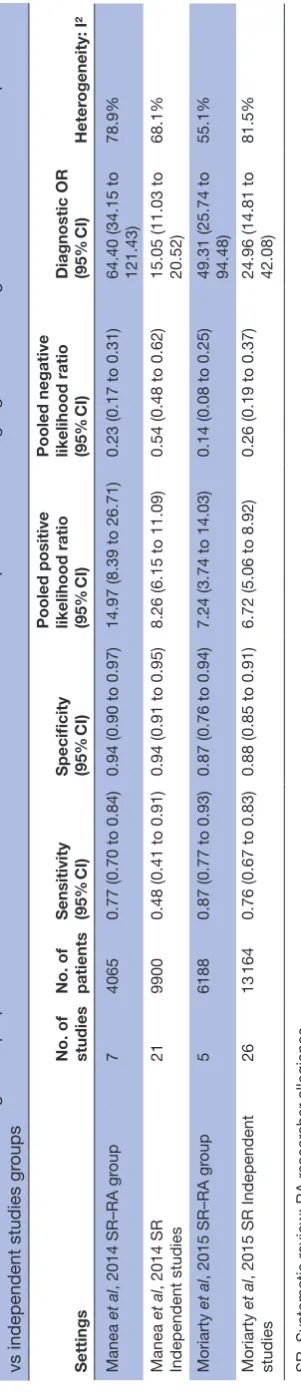
Pooled sensitivity of allegiant studies was 0.87 (95% CI 0.77 to 0.93), pooled specificity was 0.87 (95% CI 0.76 to 0.94) and the pooled DOR was 49.31 (95% CI 25.74 to 94.48)—see table 5. Heterogeneity was moderate (I²=55.1%). Figure 2 represents the sROCs for this group.
Pooled sensitivity of non-allegiant studies was 0.76 (95% CI 0.67 to 0.83), pooled specificity was 0.88 (95% CI 0.85 to 0.91) and the pooled DOR was 24.96 (95% CI 14.81 to 42.08), approximately half that of the allegiant studies (table 2). Heterogeneity was high at I²=81.5%. Figure 2
represents the sROCs for this group.
The meta-regression for the studies using a cut-off point of 10 or above with allegiance status of the predictor showed that allegiance status was a significant predictor of the DOR (p=0.015) and explained 19.0% of observed heterogeneity.
Quality assessment
The results of the quality assessment using the QUADAS-2 are given in table 4. For the patient selection domain, the two groups of studies were broadly comparable on two items (consecutive or random sample, avoid case-con-trol design). However, all allegiant studies were rated as avoiding inappropriate exclusions (5/5) in contrast to 58% (15/26) of the non-allegiant studies.
On the index test domain, there were a number of differences between the two groups of studies. More of the non-allegiant studies (81%, 21/26) reported that the PHQ-9 was interpreted blind to the reference test compared with 60% (3/5) of the allegiant studies. All
on September 22, 2020 by guest. Protected by copyright.