Optimization of Multi objective Economic Load Dispatch with
Emission Constraint Using New PSO
Ravi shankar1, Hemant Mahala2 Department of Electrical Engineering 1, 2
OIST, Bhopal, India 1, 2
1
[email protected], [email protected]
Abstract—Economic load dispatch (ELD) is an
important optimization task in electrical system.
Economic load dispatch is a way to find out the
available generating units and distribute the load
demand between them in such a way fulfills the
load demand and satisfied the constraints in such
way to minimize the fuel cost. In this paper we
considered ELD problem as a multi objective
problem. Here not only solve the ELD problem but
also minimize the SO2 emission. Particle swarm
optimization is one of the most popular
optimization techniques used for the solving ELD
problem. PSO is a population based optimization
techniques inspired by sociological behavior of fish
schooling. PSO can be applied to solve
multi-objective ELD problem. This paper used a novel
PSO with constriction factor for solving ELD
problem, which enhances the ability of particles to
explore the solution spaces more effectively and
increases their convergence rates. In this work the
usefulness and effectiveness of the CPSO algorithm
is demonstrated through its application to three
and six generator systems with emission
constraints.
Keywords:--Economic dispatch, environmental
emission, Particle swarm optimization (PSO),
Particle swarm optimization with constriction
factor (CPSO).
I.
I
NTRODUCTIONElectric utility system is interconnected to achieve the
benefits of minimum the generation prize, improve reliability of the operating conditions. The economic scheduling is the on-line economic load dispatch,
distribute the load among the generating units which are actually paralleled with the system, in such a way
as to minimize the total operating cost of generating units while satisfying system equality and inequality
constraints. For any specified of the demand, economic load dispatch can be identified the power
output of every plant (and each generating unit within the plant) which will minimize the overall cost of fuel
needed to serve the system load [1]. ELD is used in real-time energy management power system control by
most programs to allocate the total generation among the available units. ELD focuses upon coordinating the
production cost at all power plants operating on the system. Conventional as well as modern methods have
been used for solving economic load dispatch problem employing different objective functions. Various conventional methods like lambda iteration method,
[4], dynamic programming [6], linear programming [7], quadratic programming [9], Lagrange relaxation
method [8], Newton-based techniques [10], reported in the literature are used to solve such problems. Conventional methods have many draw back such as
nonlinear programming has complex in nature. Linear programming approach is fast in operation but require
linearization of objective function as well as constraints with non-negative variables. Quadratic
programming is a special form of nonlinear programming which has some disadvantages
associated with piecewise quadratic cost approximation. Newton-based method has a drawback
of the convergence characteristics that are sensitive to initial conditions. The interior point method is
computationally efficient but suffers from bad initial termination and optimality criteria. Recently, different
heuristic approaches have been proved to be effective with promising performance, such as evolutionary programming approach [11], simulated annealing
approach (SA) [12], Tabu search approach (TS) [13], pattern search (PS) [14], Genetic algorithm (GA) [15],
Differential evolution (DE) [16], Ant colony optimization [17], Neural network [18], particle swarm
optimization (PSO) [19], [20], [21], modified particle swarm optimization MPSO [24],SHOPSO [22],
WIPSO [28],MOPSO [29]. Although the heuristic methods do not always guarantee discovering globally
optimal solutions in a limited time, but also provide practical solution. EP is rather slow converging to a
near optimum for some problems. SA is very time consuming, and cannot be utilized easily to tune the
control parameters of the annealing schedule. TS difficult in defining effective memory structures and
strategies. Genetic algorithm lacks a strong ability of producing better offspring and causes slow
convergence near global optimum, sometimes may be trapped into local optimum. DE greedy updating principle and intrinsic differential property usually
lead the computing process to be trapped at local optima. Particle-swarm-optimization (PSO) method is
a population-based Evolutionary technique first introduced in [21], and it is inspired by the emergent
motion of a flock of birds probing for groceries. If it compare with other evolutionary technique like
genetic approach, the PSO has comparable or even superior search performance with faster and more
stable convergence rates. Now, the PSO has been extended to electrical power systems, NN and fuzzy
logic system control. The main objective of this study is to use of new PSO with constriction factor to solve
the power system economic load dispatch as well as reducing the environmental emission. This new development gives particles more opportunity to
explore the solution space than in a standard PSO. The proposed method focuses on solving the economic
load dispatch with emission constraint. The feasibility of the proposed method was demonstrated for three
and 6 generating unit system. The results obtained by the proposed approach are compared with the results
given in the literatures.
II.
PROBLEM
FORMULATION
In this section, we shall formulate the optimization
problems in power system economic load dispatch that have multiple non-commensurable objectives. In what
power system optimization problems will be described.
A. BASIC ECONOMIC DISPATCH FORMULATION TO
MINIMIZE THE FUEL COST
ED is one of the most important problems to be solved
in the operation and planning of a power system the primary concern of an ED problem is the minimization
of its objective function. The total cost generated that meets the demand and satisfies all other constraints
associated is selected as the objective function. The ED problem objective function is formulated
mathematically in (1) and (2),
Where, is the objective function. ai, bi and ci are
the cost coefficients for the nth generating units.
A.1 Minimization of Emission
The emission function can be presented as NOx, SO2,
etc. This work considers only NOx emission. The amount of NOx emission is given as a function of
generator output and it is represented as given below. The Emission equation of the ith generating unit is
usually described as:
Where di, ei and fi are the emission co-efficient of the
ith unit. So our final objective using emission
constrained can be formulated as (4).
Where
B. CONSTRAINTS
In this work following constraints are consider
1). Power balance constraints
Where, PD is the total system demand.
2). Generator Limits: There is a limit on the amount of power which a unit can deliver. The power output
of any unit should not exceed its rating nor should it be below that necessary for stable operation. Generation
output of each unit should lie between maximum and minimum limits.
Where, Pi is the output power of ith generator,
and are the minimum and maximum power
outputs of generator i respectively.
III. OVERVIEWOFSOMEPSOSTRATEGIES
A. Standard particle swarm optimization (PSO)
Particle swarm optimization was first introduced by Kennedy and Eberhart in the year 1995 [21]. It is an
exciting new methodology in evolutionary computation and a population-based optimization tool. PSO is
motivated from the simulation of the behavior of social systems such as fish schooling. PSO is a powerful
optimization approach which scatters particles randomly in the search space. The scatter particles
called swarms. The particles update their positions using the velocity of particles. Position and velocity of
the particles updated in a heuristic manner using guidance from particles’ own experience and the
vectors of the ith particle of a d-dimensional search space can be represented as Pi= (pi1, pi2 …pid) and
velocity of the particles is define as vj= (vj1, vj2,…vjd,).
We can evaluate pbest and gbest from the swarm represented as pbest = (p1best, p2best…, pibest), and
gbest= (g1best, g2best… gibest). Velocity and position of the particles is updates as follows
Where, Vi k
is velocity of individual i at iteration k, k is pointer of iteration, W is the weighing factor, C1, C2
are the acceleration coefficients, Si k
is the current
position of individual i at iteration k, Pbesti is the best
position of individual i and The coefficients c1and c2
pull each particle towards paricle best nad global best positions. The value of c1 and c2 are selected in such a
way so that particle cannot move from the search area. The term c1rand1 () x (pbest, -S
k
1) is called particle
memory influence or cognition part which represents the private thinking of itself and the term c2Rand2 ( ) ×
(gbest – Sk1) is called swarm influence or the social
part which represents the collaboration among the
particles.
Where, Wmax is the initial weight, Wmin is the final
weight, Iter max is the maximum iteration number and
iter is the current iteration position. B. CLASSICAL PSO
In this section, for getting better solution the standard PSO algorithm, used classical PSO
[23],[27],The constriction factor is used in this algorithm given as
Where, Ø is defining as 4.1≤Ø≤4.2 As increases, the factor c decreases and convergence becomes slower
because population diversity is reduced. Now the update its velocity using (14).
ALGORITHMFORELD WITH EMISSION
DISPATCH PROBLEMUSINGMRPSO
The algorithm for ED problem with ramp rate
generation limits employing CPSO for practical power system operationis given in following steps:-
First selects the various constants
Randomly initialize the particles.
Similarly initialize the velocity of the particles
randomly.
Now set counter t=t+1.
Evaluating the fitness function for each particle
according to the objective function.
Compare particles fitness evaluation with its pbest
and gbest.
Updating velocity and position
Apply stopping criteria.
IV.
T
ESTD
ATA ANDR
ESULTSA. TEST DATA
Here we have considered a test case of 6 generating units shown in table 1.The test results obtained for
Emission constraints. The data is tested for the demand of 500MW.
Table 1
Capacity, cost coefficients and Emission Coefficient
of 3 generator systems [28]
To assess the efficiency of the proposed PSO and
CPSO approaches in this paper, considered a case of 6 thermal units for the demand of 500MW, ELD
problems with environmental emission. The CPSO routine in this article is adopted using the Matlab
Optimization Toolbox. All the programs were run on a 1.4-GHz, core-2 solo processor with 2GB DDR of
RAM. In case, 100 time iteration were taken for the optimization.
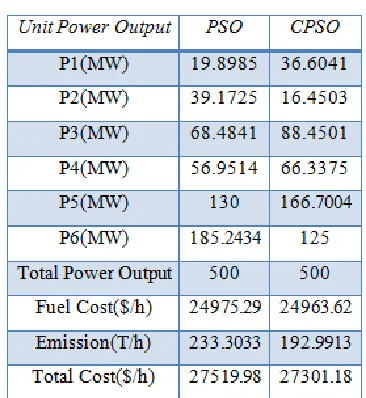
Table II
Results of six generate unit system for the demand
of 500MW
The constant used in this study was, acceleration coefficient used in this study are c1=c 2=2, α=3.1-4.5,
Wmax=0.9 and Wmin=0.4. Fig.1, fig.2 shows the
improvement in iteration for the six generation unit system respectively.
Figure 1. Convergence characteristic of the PSO for
six generator system
Figure 2. Fitness function of the CPSO for six
generator system
V.CONCLUSION
This work presented PSO and CPSO optimization
algorithm to study the power system economic dispatch with ramp rate limit constraints. The proposed method has been applied to test case. The
analysis results have demonstrated that CPSO
outperforms the other methods in terms of a better optimal solution and significant reduction of computational time. However, the much improved
speed of computation allows for additional searches to be made to increase the confidence in the solution.
Overall, the CPSO algorithms have been shown to be
0 5 10 15 20 25 30 35 40 45 50
0 2 4 6 8 10
PSO
iteration
o
b
je
c
ti
v
e
0 5 10 15 20 25 30 35 40 45 50
0 2 4 6 8 10
PSO
iteration
o
b
je
c
ti
v
very helpful in studying optimization problems in power systems.
R
EFERENCES[1] M.E. EI- hawary & G.S. Christensen, “Optimal economic operatiom of Electrical power system,”
New York,Academic,1979.
[2] Mezger Alfredo J & Katia de Almeida C, “Short term hydro thermal scheduling with bilateral traction via bundle method,” International Journal
of Electrical power & Energy system, 29(5),
pp-387-396, 2007.
[3] Martinez Luis Jose, Lora Trancoso Alicia & Santos Riquelme Jesus, “Short term hydrothermal
coordination based on interior point nonlinear programming and genetic Algorithm,”IEEE porto
power Tech Confrence,2001.
[4] M. Gar CW, Aganagic JG,Tony Meding Jose B & Reeves S, “Experience with mixed integer linear
programming based approach on short term hydrothermal scheduling,” IEEE transaction on
power system, 16(4),pp.743-749, 2001.
[5] K.Ng and G.Shelbe, “ Direct load control –a profit-based load management using linear programming,” IEEE transaction on power
system,vol.13,no.2, pp.688-694, 1998.
[6] Shi CC, Chun HC, Fomg IK & Lah PB., “ Hydroelectric generation scheduling with an
effective differential dynamic programming algorithm,” IEEE transaction on power system ,
,5(3),pp.737-743,1990.
[7] Erion Finardi C, silva Edson LD, & Laudia sagastizabal CV., “Solving the unit commitment
problem of hydropower plants via Lagrangian
relaxation and sequential quadratic programming,”
Computaional & Applied Mathematics 2005.
[8] Tkayuki S & Kamu W., “ Lagrangian relaxation method for price based unit commitment problem,” Engineering optimization taylor
Francis, ,pp. 36-41, 2004.
[9] D.I. sun, B.Ashley,B.Brewer,A.Hughes and W.F. Tinney, “ Optimal power flow by Newton Aproach,” IEEE transaction on power system,
vol.103,1984,pp.2864-2880.
[10] A.Santos and G.R. da Costa, “Optimal power flow by Newtons method applied to an augmented Lagrangian function,” IEE proceedings generation,
Transmission & distribution, vol. 142, No.1, pp. 33-36, 1989,.
[11] Nidhul Sinha, R.Chakrabarti & P.K. Chattopadhyay, “ Evolutionary programming techniques for Economic load Dispatch,” IEEE
transactions on Evolutionary Computation, Vol.7 No1,2003, pp.83-94.
[12] K.P. wong & J. yuryevich, “Evolutionary based algorithm for environmentally constraints economic dispatch,” IEEE transaction on power
system , vol.13,no.2,1998,pp.301-306.
[13] K.P. Wong & C.C. Fung, “Simulated annealing based economic dispatch algorithm,” proc. Inst.
Electctircal Engineering C., Genenral, transm., Distribustion,vol.140,no.6,nov.1993.
[14] W.M. Lin,F.S. Cheng & M.T. Tsay, “An improved Tabu search for economic dispatch with multiple minima,” IEEE transaction on power
system , vol.17,no.2,2002,pp.108-112.
system valve point economic load dispatch,” Elect.
Power energy system,
vol.29,no.10,2007,pp.720-730.
[16] Tarek Bouktir, Linda Slimani & M.Belkacemi, “ A genetic algorithm for solving for the optimal power flow problem,” Leonardo journal of
sciences, Issue-4, pp.44-58,2004.
[17] K. Vaisakh & L.R. Srinivas, “Differential Approach for optimal power flow solutions,”
Journals of theoretical and applied information Technology , pp. 261-268, 2005-08.
[18] Boumediene Allaoua & Abedellah Laoufi, “Optimal power flow solution Unsing ant manners for electrical network,” Advance in Electrical & Computer engg.,” Vol.9, , pp.34-4, 20090.
[19] L.L. Lai & Mata Prasad, “Application of ANN to economic load dispatch,” proceeding of 4th
international conference on Advance in power system control, Operation and management, APSCOM-97, Hong-Kong, pp.707-711, 1997,.
[20] J.Kennedy & R.C. Eberhart, “Particle Swarm Optimization,” proceeding of IEEE international
conference on Neural networks , Vol.4, pp. 1942-1948, 1995.
[21] C.H. Chen & S.N. Yeh, “ PSO for Economic power dispatch with valve point effects,” IEEE
PES transmission & Distribution conference and Exposition Latin America, Venezuela,2006.
[22] K.S. Swarup, “ Swarm intelligence Approach to the solution of optimal power flow,” Indian
Institute of science, pp. 439-455, 2006.
[23] K.T. Chaturvedi, Manjaree pandit & Laxmi Srivastava, “Self Organizing Hierachical PSO for nonconvex economic load dispatch,” IEEE
transaction on power system, vol.23, no.3, pp.1079-1087, 2008.
[24] Adel Ali Abou EL-Ela & Ragab Abdel-Aziz EI-Sehiemy, “ Optimized Generation costs using modified particle Swarm optimization version,”
Wseas transactions on power systems, pp.225-232, 2007.
[25] R.C. Eberhart & Y. Shi, “ Comparing inertia weights and constriction factor in PSO,” in proc.
Congr. Evolutionary computation, vol.1,pp.84-88, 2000.
[26] Hao Gao & Wenbo Xu, “ A new particle swarm algorithm and its globally convergent modifications,” 16(4),pp.743-749, 2001.
[27] Phan Tu Vu, Dinhlungle & Joef, “ A Novel weight-Improved Particle swarm optimization algorithm for optimal power flow and economic load dispatch problem,” IEEE Transaction , 2010.
[28] K. Sathish Kumar, V. Tamilselvan, N. Murali, “Economic Load Dispatch with Emission
Constraints using Various PSO Algorithms”, WSEAS TRANSACTIONS on POWER