R E S E A R C H
Open Access
Dual solutions of a boundary layer
problem for MHD nanofluids through a
permeable wedge with variable viscosity
Xiaoqin Xu
1,2and Shumei Chen
1**Correspondence: [email protected]
1School of Mechanical Engineering
and Automation, Fuzhou University, Fuzhou, 350116, China
Full list of author information is available at the end of the article
Abstract
Considering the effect of variable viscosity and the phenomenon of flow separation, the MHD Cu/Ag-Water nanofluids through a permeable wedge are investigated. The governing equations of flow and energy are reduced by similarity transformations and then solved numerically by the shooting method. It is found that dual solutions exist for negative pressure gradient. Compared with the Ag-Water nanofluid, the flow separation occurs later for injection, while it occurs earlier for suction in the Cu-Water nanofluid. The outcomes also specify that suction and small variable viscosity parameters delay the separation for the two nanofluids.
Keywords: flow separation; MHD; nanofluid; permeable wedge; variable viscosity
1 Introduction
Because of the low thermal conductivity, there is a limit to the heat transfer performance of the classical heat transfer fluids such as water, ethylene glycol, and engine oil. The ther-mal conductivity of metals, however, is extremely higher compared with the conventional heat transfer fluids. A nanofluid, which was first proposed by Choi and Eastman [], is a fluid that is created by the distribution of solid particles with dimensions less than nm in base fluid. Choi noticed that the addition of one percent of nanoparticles by volume to the usual fluids increases the thermal conductivity of the fluid up to approximately twice. Comprehensive literature on the applications of nanofluids can be found in papers [–]. Magnetic nanofluid is a magnetic colloidal suspension of carrier liquid and mag-netic nanoparticles. The advantage of the magmag-netic nanofluid is that fluid flow and heat transfer can be controlled by an external source, which makes it applicable to modern metallurgical and metal-working processes such as electronic packing, thermal engineer-ing, and aerospace. Therefore many researchers have been contributing to the study of magneto-hydrodynamic (MHD) nanofluid flow [–].
On the other hand, the study of the flow field in a boundary adjacent to the wedge, an essential part in the area of fluid dynamics and heat transfer, is very important in many thermal engineering applications like geothermal systems, crude oil extraction, thermal insulation heat exchangers, the storage of nuclear waste, etc. Falkner and Skan [] were the first to analyze the steady laminar flow over a wedge, and they proposed a well-known
Falkner-Skan equation to describe the flow over a wedge, which has provided many fruit-ful sources of information about the behavior of incompressible boundary layers. Since then, many researchers have devoted themselves to investigating the same problem and gained lots of valuable results, see [–]. In the past decade, Su and Zheng [] analyzed the Hall effect on MHD flow and heat transfer of nanofluids over a stretching wedge in the presence of velocity slip and Joule heating. Srinivasacharya et al. [] investigated the steady laminar magnetohydrodynamic (MHD) flow, heat and mass transfer characteris-tics in a nanofluid over a wedge in the presence of a variable magnetic field. Khan et al. [] presented the locally similar solutions for the unsteady two-dimensional Falkner-Skan flow of MHD Carreau nanofluid past a static/moving wedge in the presence of convective boundary condition. They found that an increment in the pressure gradient parameter depreciates the heat and mass transfer rate both for shear thinning and shear thickening fluids.
All the above-mentioned literature about MHD nanofluids flowing past a wedge only considered the accelerating or constant flow case, with positive or constant pressure gra-dient. In both cases, there exists no separation point in the velocity profile. However, many early researchers [–] pointed out that for the decelerating flow case, with neg-ative pressure gradient, two solutions occurred in the well-known Falkner-Skan equation. Hence separation may happen in the decelerating flow. As the results pointed out in the reference [], the occurrence of flow separation has several undesirable effects, and it leads to an increase in the drag on a body immersed in the flow. In order to reduce the drag force, injection on the boundary layer flow has been introduced and proved to be an effective way [].
Motivated by the above research, this paper aims to explore the flow and heat transfer of MHD nanofluid past a permeable wedge with suction or injection, considering the occur-rence of flow separation and variable viscosity. The physical properties of the nanofluids may change significantly with temperature [–]. To more accurately depict the flow behavior and heat transfer, it is necessary to take the variation of viscosity with tempera-ture into account. By means of similarity reductions, the nonlinear equations are solved numerically by the shooting method. Besides, the effects of the governing parameters on the separation point, dimensionless velocity, temperature, skin friction coefficient, and local Nusselt number are graphically presented and discussed in detail.
2 Formulation
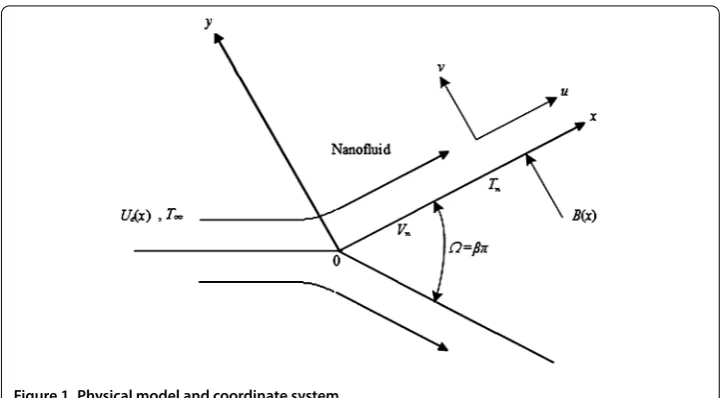
We consider a steady two-dimensional laminar flow and heat transfer of viscous in-compressible MHD Cu/Ag-Water nanofluids past a permeable wedge with temperature-dependent viscosity. The coordinate system is selected in such a way that the x-axis is aligned with the flow on the surface of the wedge and they-axis is taken normal to it, as shown in Figure . The inclined angle of the wedge is taken as=βπ. The free stream velocityUe(x) =Uxm, whereUis constant andmis a pressure gradient parameter re-lated in the inclined angleβπ by m=β/( –β). A variable magnetic field of strength B(x) =Bx(m–)/is applied along they-direction, whereBis constant. It is assumed that the temperature on the wedge surface is a constantTwand the ambient temperature isT∞.
Vwis the velocity of suction (Vw< ) or injection (Vw> ). Further, the magnetic Reynolds
Figure 1 Physical model and coordinate system.
With the above assumptions, using Boussinesq and boundary layer approximations, the governing equations for the continuity, momentum, and energy can be expressed as fol-lows:
∂u
∂x +
∂v
∂y= , ()
u∂u
∂x+v
∂u
∂y=Ue dUe
dx +
ρnf
∂ ∂y
μnf
∂u
∂y
+σB(x)
ρnf
(Ue–u), ()
u∂T
∂x +v
∂T
∂y =αnf
∂T
∂y ()
with the boundary conditions
u= , v=Vw, T=Tw aty= , ()
u=Ue(x), T=T∞ aty→ ∞. ()
Here (u,v) are the velocity components along thexandydirections, respectively,T is the temperature, andσ is the electrical conductivity. The effective dynamic viscosityμnf,
the effective densityρnf, the thermal diffusivityαn, and the heat capacity (ρCp)nf of the
nanofluids are defined as in [, ]
μnf =
μf
( –φ)., ()
ρnf = ( –φ)ρf +φρs, ()
(ρCp)nf = ( –φ)(ρCp)f+φ(ρCp)s, ()
υnf =
μnf
ρnf
, αnf =
knf
(ρCp)nf
, ()
model []:
knf
kf
=(ks+ kf) – φ(kf–ks) (ks+ kf) +φ(kf–ks)
, ()
in which the subscripts nf, f, and s represent the thermophysical properties of the nanofluid, base fluid, and nano solid particles, respectively.
Note that the viscosity of base fluidμfis not constant, but vary as a function of
temper-ature given by the following [, ]:
μf
=
μ∞
+γ(T–T∞)=a(T–Tr), ()
wherea=γ/μ∞ andTr=T∞–γ–,μ∞, a constant, is the cold free stream viscosity,a
andTrare constants related to the reference state, andγ is a thermal property of the fluid.
For nanofluids,a> . To solve Eqs. (), (), and () subjected to the boundary conditions () and (), we introduce the stream functionψ(x,y) (u=∂ψ/∂y,v= –∂ψ/∂x) and the similarity variables as
ψ=
υ∞U∞
m+ x
m+
f(η), η=y
m+
U∞ υ∞x
m–
, θ= T–T∞
Tw–T∞
. ()
Then Eqs. ()-() are reduced to
f+ f
θ
θr( –θθr)
+ mA m+
– θ
θr
–f +A
– θ
θr
ff
+MA m+
– θ
θr
–f = , ()
θ+BPrfθ= , ()
where
A= ( –φ).
( –φ) +φρs ρf
, B=[ks+ kf+φ(kf–ks)] ks+ kf– φ(kf–ks)
( –φ) +φ(ρCp)s
(ρCp)f
,
prime denotes differentiation with respect to η, υ∞ is the cold free stream kinematic
viscosity, the magnetic field parameter M =σB
/U∞ρnf, the Prandtl number Pr =
υ∞(ρCp)f/kf, and the variable viscosity parameterθr= (Tr–T∞)/(Tw–T∞).
According to the definition ofθr, we obtainμf =μ∞/[ –θ(η)/θr]. Since the viscosity of
liquids decreases with increasing temperature,θris negative for nanofluids. Whenθr→
–∞,μf →μ∞, i.e., the viscosity variation in the boundary layer is negligible.
The boundary conditions () and () can be converted into
f =fw, f= , θ= atη= , ()
f= , θ= atη→ ∞, ()
wherefw= –Vw
√
x/[(m+ )υ∞Ue],fw< for injection andfw> for suction, whilefw=
The quantities of physical interest are the skin friction coefficientCf and the local
Nus-selt numberNux, which are defined as []
Cf=
τw
ρ∞Ue
, τw=μnf
∂u ∂y y= , ()
Nux=
xqw
kf(Tw–T∞), qw= –knf
∂T ∂y y= , ()
whereτwis the wall shear stress on the surface andqwis the surface heat flux. Using the
similarity transformation (), we obtain
Cf(Rex)/
=
m+ ( –φ).( – θ
θr)
f(), ()
Nux(Rex)–/= –
knf
kf
m+
θ
(), ()
whereRex=Uex/υ∞is the local Reynolds number. So,f() represents the skin friction
coefficientCf and –θ() represents the local Nusselt numberNux.
3 Results and discussion
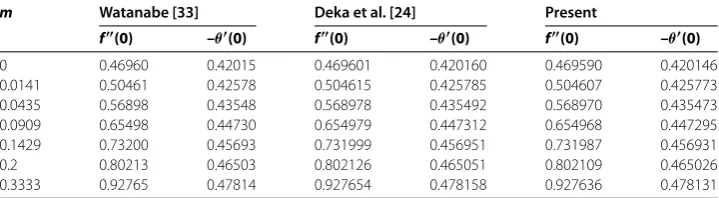
Numerical solutions to the nonlinear ordinary differential Eqs. () and () with the boundary conditions () and () can be obtained by the shooting method. In order to ac-quire the sufficiently accurate numerical solutions, the convergence criterion –is used in the iterative process. To confirm the accuracy of the applied numerical method, values off() and –θ() for different values of the Falkner-Skan exponentmwithPr= . and
fw= were compared with the established results of the research carried out by Watanabe
[] and Deka et al. []. The results were found in good agreement (see Table ). In the present work, MHD mixed convection flow and heat transfer past a perme-able wedge immersed in nanofluids with variperme-able viscosity are conducted. Two different nanoparticles, namely, copper (Cu) and silver (Ag), with water as the base fluid are consid-ered in this study. The Prandtl number of the base fluid was kept at constant asPr= ..
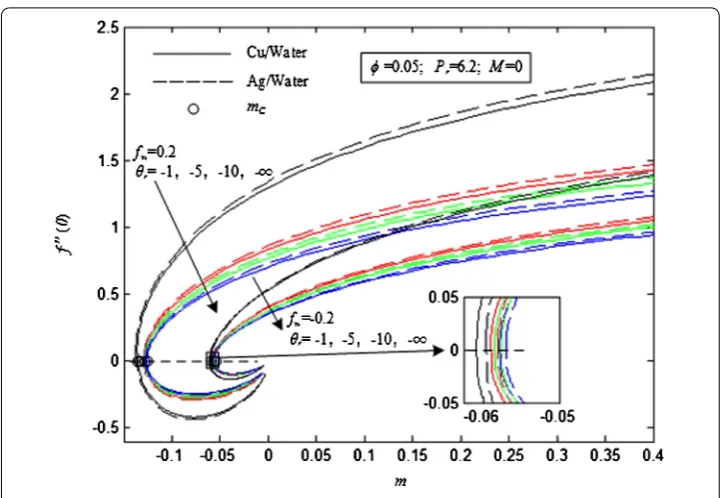
The thermophysical properties of water and Cu/Ag nanoparticles are given in Table . Figure shows the skin frictionf() of Cu/Ag-Water nanofluids as a function ofm for representative values offwwhenθr= –,φ= .,M= . It is seen that there is only
Table 1 Comparison off(0) and –θ(0) for various values ofmwithPr= 0.73 andfw= 0 when
θr→ ∞
m Watanabe [33] Deka et al. [24] Present
f(0) –θ(0) f(0) –θ(0) f(0) –θ(0)
0 0.46960 0.42015 0.469601 0.420160 0.469590 0.420146
0.0141 0.50461 0.42578 0.504615 0.425785 0.504607 0.425773
0.0435 0.56898 0.43548 0.568978 0.435492 0.568970 0.435473
0.0909 0.65498 0.44730 0.654979 0.447312 0.654968 0.447295
0.1429 0.73200 0.45693 0.731999 0.456951 0.731987 0.456931
0.2 0.80213 0.46503 0.802126 0.465051 0.802109 0.465026
Table 2 Thermophysical properties of nanofluids [8]
Cp(J/kgK) ρ(kg/m3) k(W/mK)
Cu 385 8,933 400
Ag 235 10,500 429
Water 4,179 997.1 0.613
Figure 2 Skin friction coefficient as a function ofmfor representative values offw.
one solution whenm≥, two solutions whenmC≤m< , and no solution whenm<
mC. HeremCis the critical value. In addition, the skin friction coefficientf() almost
vanishes whenm<mCfor the two nanofluids. In the rangemC≤m< , there exist two
values off(). One isf()≥ and the other isf() < . Physically,f() > means that the nanofluid exerts a drag force on the wedge, whilef() < means the opposite and f()≈ atmCmeans there is no wall shear stress and the flow will separate completely
at this point. From Figure we can also see that the flow separation is delayed as the value offwincreases. Hence suction delays the separation. Further, compared with the Ag-Water
nanofluid, the flow separation occurs later for injection, while it occurs earlier for suction in the Cu-Water nanofluid.
Figure depicts the skin frictionf() of Cu/Ag-Water nanofluids as a function ofmfor representative values ofθrwithfw=±.,φ= .,M= . From Figure , we can see that
the separation is delayed with smaller value of –θrfor both suction (fw= .) and injection
(fw= –.). Besides, the adverse critical values –mcof Cu-Water are a bit lower than those
of Ag-Water for suction, but we found just the opposite for injection for each fixedθr,
which is consistent with the results of Figure . Critical values mC with representative
values offworθrare shown in Table .
Figure 3 Skin friction coefficient as a function ofmfor representative values ofθr.
Table 3 Critical valuesmCwith representative values offworθrwhenφ= 0.05,Pr= 6.2,M= 0
θr fw mC(Cu-Water nanofluid) mC(Ag-Water nanofluid)
–2 –0.3 –0.0430 –0.0416
–2 –0.2 –0.0601 –0.0591
–2 0 –0.0955 –0.0955
–2 0.5 –0.1875 –0.1904
–2 1 –0.2835 –0.2889
–1 –0.2 –0.0609 –0.0596
–5 –0.2 –0.0590 –0.0581
–10 –0.2 –0.0585 –0.0576
–∞ –0.2 –0.0579 –0.0570
–1 0.2 –0.1361 –0.1375
–5 0.2 –0.1283 –0.1294
–10 0.2 –0.1273 –0.1284
–∞ 0.2 –0.1263 –0.1273
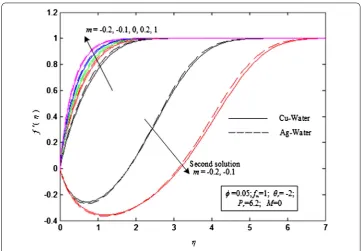
Figure 4 Velocity profile of Cu/Ag-Water nanofluids for representative values ofm.
Figure 5 Temperature profile of Cu/ Ag-Water nanofluids for representative values ofm.
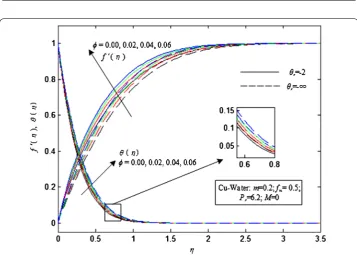
Figure 6 Velocity and temperature profiles of Cu-Water nanofluid for representative values ofφwith differentfw.
Figure 7 Velocity and temperature profiles of Cu-Water nanofluid for representative values ofφwith differentθr.
solid volume fraction of nanoparticlesφ for suction (fw= .). For injection (fw= –.),
however, the temperature profile declines with an increase in the nanoparticle volume fraction for smallerη, but it is just the opposite for largerηwithin the boundary layer. Fig-ure also shows that the velocity profile in the presence of suction (fw= .) is larger than
that in the presence of injection (fw= –.), while the temperature profile is just the
oppo-site. So, suction accelerates the fluid motion and reduces the temperature of the nanofluid along the wall. Figure depicts the temperature profile of Cu-Water nanofluid for vari-ous values ofφwhenθr= –, –∞. Figure tells us that for a fixedφ, the velocity profile
is larger, while the temperature profile is lower forθr= – than that forθr= –∞. This
can be physically explained that the temperature difference of the permeable wedge and the ambient nanofluid within the boundary layer decreases as the value of –θrincreases.
Thus the nanofluid viscosity increases, which results in declining of the velocity profile and thickening of the boundary layer thickness.
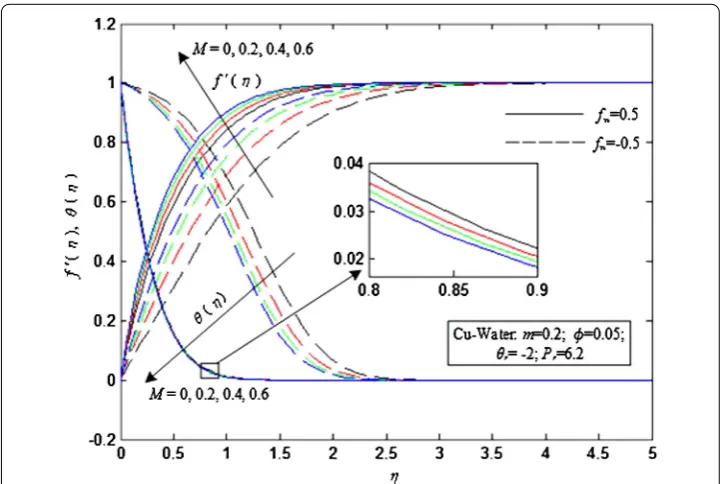
Figure illustrates the effect ofMon the velocity and temperature profiles of Cu-Water nanofluid whenm= .,φ= .,fw=±.,θr= –, andPr= .. The effect ofMon the
two profiles of Ag-Water nanofluid was found to be similar to that of Cu-Water nanofluid, neglected here. It can be seen from Figure that the velocity profile is an increasing func-tion ofM, while the temperature profile is just the opposite. Also, it can be seen that the velocity profile is larger in the presence of suction (fw= .) than that in the presence of
in-jection (fw= –.), while the opposite is true for the temperature profile, which coincides
with the result of Figure .
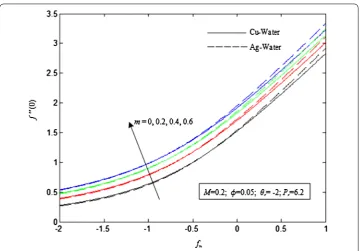
Figures and depict the skin friction and the rate of heat transfer coefficients as a function offwfor various values ofm, respectively. It is observed that both the skin friction
coefficientf() and the rate of heat transfer coefficient –θ() increase with an increase in values offwor pressure gradient parameterm. Hence suction enhances heat transfer and
skin friction, while the effect of injection is just the opposite. The Cu-Water nanofluid has
Figure 9 Skin friction coefficient as a function offwfor representative values ofm.
Figure 10 Rate of heat transfer coefficient as a function offwfor representative values ofm.
a larger skin friction coefficient but a slightly lower rate of heat transfer coefficient than that of Ag-Water nanofluid for deep injection (fw< –.), while the opposite is true for
suction (fw> ). Note that the effect ofmon the rate of heat transfer coefficient is much
4 Conclusions
The boundary layer flow of Cu-Water and Ag-Water nanofluids passing through a perme-able wedge with variperme-able viscosity under the effects of MHD was investigated numerically in present study. Unlike other papers involving a similar problem, this paper takes flow separation into account and compares the effects of several important parameters on two different nanofluids, namely, Cu-Water nanofluid and Ag-Water nanofluid. The main ob-servations of this study are summarized below:
• Dual solutions exist for negative pressure gradient (m< ) for the two nanofluids. • Suction and small variable viscosity parameter delay the flow separation for the two
nanofluids.
• Compared with the Ag-Water nanofluid, the flow separation occurs later for injection, while it occurs earlier for suction in the Cu-Water nanofluid.
• Suction enhances heat transfer and skin friction, while the effect of injection is just the opposite for the two nanofluids.
Acknowledgements
This work was supported by the Science and Technology Major Project of Fujian Province (grant number 2011HZ006-1), Construction of Scientific and Technological Innovation Platform of Fujian Province (grant number 2011H2008), and Special Funds for the University Development from Central Finance of China in 2012 and 2016.
Competing interests
The authors declare that they have no competing interests.
Authors’ contributions
All authors read and approved the final manuscript.
Author details
1School of Mechanical Engineering and Automation, Fuzhou University, Fuzhou, 350116, China.2Department of Automobile Application Engineering, Fujian Chuanzheng Communications College, Fuzhou, 350007, China.
Publisher’s Note
Springer Nature remains neutral with regard to jurisdictional claims in published maps and institutional affiliations.
Received: 16 June 2017 Accepted: 15 September 2017
References
1. Choi, SUS, Eastman, JA: Enhancing thermal conductivity of fluids with nanoparticles. Mater. Sci.231, 99-105 (1995) 2. Hussein, AM, Bakar, RA, Kadirgama, K: Study of forced convection nanofluid heat transfer in the automotive cooling
system. Case Stud. Therm. Eng.2, 50-61 (2014)
3. Frank, M, Drikakis, D, Asproulis, N: Thermal conductivity of nanofluid in nanochannels. Microfluid. Nanofluid.19(5), 1011-1017 (2015)
4. Serna, J: Heat and mass transfer mechanisms in nanofluids boundary layers. Int. J. Heat Mass Transf.92, 173-183 (2016)
5. Hayat, T, Khan, MI, Waqas, M, Alsaedi, A: Newtonian heating effect in nanofluid flow by a permeable cylinder. Results Phys.7, 256-262 (2017)
6. Hatami, M, Sheikholeslami, M, Hosseini, M, Ganji, DD: Analytical investigation of MHD nanofluid flow in non-parallel walls. J. Mol. Liq.194(2), 251-259 (2014)
7. Hayat, T, Imtiaz, M, Alsaedi, A: MHD 3D flow of nanofluid in presence of convective conditions. J. Mol. Liq.212, 203-208 (2015)
8. Mabood, F, Khan, WA: Analytical study for unsteady nanofluid MHD flow impinging on heated stretching sheet. J. Mol. Liq.219, 216-223 (2016)
9. Falkner, VM, Skan, SW: Some approximate solutions of the boundary layer equations. Philos. Mag.12, 865-896 (1931) 10. Yih, KA: MHD forced convection flow adjacent to a non-isothermal wedge. Int. Commun. Heat Mass Transf.26(6),
819-827 (1999)
11. Martin, MJ, Boyd, ID: Falkner-skan flow over a wedge with slip boundary conditions. J. Thermophys. Heat Transf.24(2), 263-270 (2010)
12. Sattar, MA: A local similarity transformation for the unsteady two-dimensional hydrodynamic boundary layer equations of a flow past a wedge. Int. J. Appl. Math. Mech.7(1), 15-28 (2011)
14. Turkyilmazoglu, M: Slip flow and heat transfer over a specific wedge: an exactly solvable Falkner-Skan equation. J. Eng. Math.92(1), 73-81 (2015)
15. Raju, CSK, Sandeep, NA: Comparative study on heat and mass transfer of the Blasius and Falkner-Skan flow of a bio-convective Casson fluid past a wedge. Eur. Phys. J. Plus131(11), 405 (2016)
16. Raju, CSK, Sandeep, N: Nonlinear radiative magnetohydrodynamic Falkner-Skan flow of Casson fluid over a wedge. Alex. Eng. J.55(3), 2045-2054 (2016)
17. Su, X, Zheng, L: Hall effect on MHD flow and heat transfer of nanofluids over a stretching wedge in the presence of velocity slip and Joule heating. Cent. Eur. J. Phys.11(12), 1694-1703 (2013)
18. Srinivasacharya, D, Mendu, U, Venumadhav, K: MHD boundary layer flow of a nanofluid past a wedge. Proc. Eng.127, 1064-1070 (2015)
19. Khan, M, Azam, M, Munir, A: On unsteady Falkner-Skan flow of MHD Carreau nanofluid past a static/moving wedge with convective surface condition. J. Mol. Liq.230, 48-58 (2017)
20. Hartree, DR: On an equation occurring in Falkner and Skan’s approximate treatment of the equations of the boundary layer. Proc. Camb. Philos. Soc.33(2), 223-239 (1937)
21. Stewartson, K: Further solutions of the Falkner-Skan equation. Math. Proc. Camb. Philos. Soc.50(3), 454-465 (1954) 22. Steinheuer, J: Similar solutions for the laminar wall jet in a decelerating outer flow. AIAA J.6(11), 2198-2200 (1968) 23. Cebeci, T, Keller, HB: Shooting and parallel shooting methods for solving the Falkner-Skan boundary-layer equation.
J. Comput. Phys.7(2), 289-300 (1971)
24. Deka, RK, Basumatary, M: Effect of variable viscosity on flow past a porous wedge with suction or injection: new results. Afr. Math.26(7), 1263-1279 (2015)
25. Schlichting, H, Gersten, K: Boundary-Layer Theory. McGraw-Hill, New York (1979)
26. Khamis, S, Makinde, DO, Nkansah-Gyekye, Y: Unsteady flow of variable viscosity Cu-Water and Al2O3-Water nanofluids in a porous pipe with buoyancy force. Int. J. Numer. Methods Heat Fluid Flow25(7), 1638-1657 (2015) 27. Makinde, OD, Iskander, T, Mabood, F, Khan, WA, Tshehla, MS: MHD Couette-Poiseuille flow of variable viscosity
nanofluids in a rotating permeable channel with Hall effects. J. Mol. Liq.221, 778-787 (2016)
28. Huda, AB, Akbar, NS, Beg, OA, Khan, MY: Dynamics of variable-viscosity nanofluid flow with heat transfer in a flexible vertical tube under propagating waves. Results Phys.7, 413-425 (2017)
29. Brinkman, HC: The viscosity of concentrated suspensions and solutions. J. Chem. Phys.20(4), 571 (1952) 30. Sourtiji, E, Gorji-Bandpy, M, Ganji, DD, Hosseinizadeh, SF: Numerical analysis of mixed convection heat transfer of
Al2O3-Water nanofluid in a ventilated cavity considering different positions of the outlet port. Mindfulness5(4), 381-391 (2014)
31. Garnett, JCM: Colours in metal glasses and in metallic films. Philos. Trans. R. Soc. Lond.203, 385-420 (1904) 32. Soundalgekar, VM, Takhar, HS, Das, UN, Deka, RK, Sarmah, A: Effect of variable viscosity on boundary layer flow along
a continuously moving plate with variable surface temperature. Heat Mass Transf.40(5), 421-424 (2004) 33. Watanabe, T: Thermal boundary layer over a wedge with uniform suction or injection in forced flow. Acta Mech.
![Table 2 Thermophysical properties of nanofluids [8]](https://thumb-us.123doks.com/thumbv2/123dok_us/463969.2044821/6.595.117.480.93.408/table-thermophysical-properties-of-nanouids.webp)