Reframing Public Educational Services and
Programs as Tradable Commodities –
A Synthesis and Critique of British Columbia’s Bill 34
Gérald Fallon
University of Western Ontario Sonya Pancucci
Brock University
Abstract
This paper is a critical analysis of British Columbia’s controversial Part 6.1 of the School Amendment Act 2002 (Bill 34) as it relates to the reframing of public
educational services and programs as a tradable commodity. It enables public school districts to incorporate private companies to set up offshore schools and to market educational services and programs locally, nationally, and internationally. Policy-makers introduced this Bill with the assumption that public educational institutions must compete with other “providers,” to sell their services and programs effectively in order to keep revenues at a healthy level to ensure their institutional viability and relevancy. This paper examines the goals, motives, and assumptions behind Bill 34, and, more specifically, the extent to which Part 6.1 of Bill 34 incorporates a market approach to public education as it commodifies public educational services and programs and creates competitive arrangements between public educational institutions.
Introduction
This paper is an attempt to understand some of the multiple and complex effects of globalization on educational policy and policy formation. It stems from our personal concerns about the emergence of a market-oriented approach to educational issues as the dominant paradigm for constructing and implementing public education policy in British Columbia (BC). Despite policy-makers’ claims about the need to prepare individuals for competition in the global economy (The Select Standing Committee Report on Education, 2002), we believe this approach subtly expresses a concealed ideological agenda in which
the social and economic well-being of individuals is subordinated to that of the corporate sector (Jordan & Strahdee, 2001; Scholte, 2000).
Under the governmental reform agenda of Premier Gordon Campbell, the School Amendment Act of 2002, better known as Bill 34, altered British Columbia’s educational landscape. Some observers (Kuehn, 2002; Nelles, 2001) characterize the implementation of Bill 34 as an unprecedented wave of top-down, rapidly implemented educational reform pursuing these explicit goals:
1. increase the fiscal and academic accountability of public education;
2. eliminate the provincial deficit;
3. make the transition toward a market ideology in many aspects of the public education system;
4. mandate the establishment of school planning councils; and 5. expand parental and student choices to attend any schools
and programs anywhere throughout British Columbia.
In order to analyse the ideological assumptions of Part 6.1 of Bill 34 and their potential long-term impacts on public education in BC, this paper is divided into three sections. The first section provides an overview of the context that led to the emergence of Bill 34 and reviews the key policy issues and ideas that prompted a policy development debate and policy response by the BC Liberals. The second part addresses the content of Bill 34 in terms of its key components, general purposes, rights and obligations, and assumptions. The third section discusses more specifically the nature, underlying assumptions and potential long-term impacts of Part 6.1 of Bill 34 on public education. This critical analysis employs policy documents (acts, guidelines, directives), policy review documents (white papers, debates, technical reviews), and relevant research literature drawn from the work of researchers who critique the reconfiguration of public education as a commodity within the context of globalization (Ashton & Green, 1996; Jordan & Strahdee, 2001; Robertson, 2000; Scholte, 2000).
Context of Bill 34
The context in which Bill 34 emerged is characterized by global economic developments and demands that are shaping provincial educational policies into a neo-liberal framework that emphasizes shrinking the state sector while promoting market approaches to school choice and program delivery, rational management of school organizations, performance assessment and
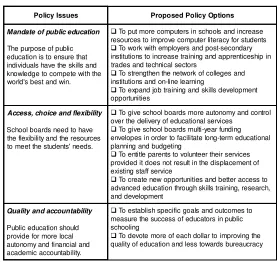
Table 1 - Key Features of the B.C. 2001 Liberal Election Platform on Education Entitled: “A New Era for British Columbia: A Vision for Hope and Prosperity for the Next Decade and Beyond”
main policy documents that form the framework used by the BC Liberals in considering educational matters:
1. The 2001 BC Liberal election document on education entitled: “A New Era for British Columbia: A Vision for Hope and Prosperity for the Next Decade and Beyond” 2. “The Select Standing Committee Report on Education”
published on March 28, 2002
Table 1 summarizes the key education policy issues raised by the BC Liberal platform during the provincial election in 2001: far more variation and choice in the delivery of educational services and programs, greater local community input into how schools are run, transformation of the accountability and professionalism of teachers, and promotion of market approaches to school choice.
Policy Issues Proposed Policy Options
Mandate of public education
The purpose of public education is to ensure that individuals have the skills and knowledge to compete with the world's best and win.
To put more computers in schools and increase resources to improve computer literacy for students To work with employers and post-secondary institutions to increase training and apprenticeship in trades and technical sectors
To strengthen the network of colleges and institutions and on-line learning
To expand job training and skills development opportunities
Access, choice and flexibility
School boards need to have the flexibility and the resources to meet the students' needs.
To give school boards more autonomy and control over the delivery of educational services
To give school boards multi-year funding envelopes in order to facilitate long-term educational planning and budgeting
To entitle parents to volunteer their services provided it does not result in the displacement of existing staff service
To create new opportunities and better access to advanced education through skills training, research, and development
Quality and accountability
Public education should provide for more local autonomy and financial and academic accountability.
To establish specific goals and outcomes to measure the success of educators in public schooling
These broad ideas were subsequently turned into a more detailed scheme in the form of a report presented as the result of consultation with different stakeholders (The Select Standing Committee Report on Education, 2002). The mandate of the Standing Committee was to report on measures to improve access, choice, flexibility and quality in public education, and to strengthen the network of colleges, institutes and on-line learning throughout the province. Table 2 outlines the key policy issues and options proposed in this report.
Table 2 - Features of the Select Standing Committee on Education Report 2002
Key policy Issues Presented in the
Report Proposed Policy Options
Meaning of public education
Public education is the key to a healthy and a prosperous economy. Its value is framed by the need for a highly educated workforce in order to stay competitive in the knowledge-based global economy. The report reflects the societal belief that an educated population has social and economic value for the individual and for society
To link work opportunities and schooling To improve access to further training and education for workers and students by increasing the degree of choice and flexibility within the current system
To offer alternative non-academic post-secondary courses and programs
To develop specialty or magnet schools that offer skills courses and programs
Current initiatives
Attention should be given to social equity programs to enable children to take advantage of the educational opportunities available to them.
To make these non-education programs an integral part of the public education system
Local involvement
The report underlines the value and relevance of local initiatives and choices and the advantage of making educational decisions close to and in consultation with those who are affected by the decisions.
To allow institutions to make decisions reflecting local priorities and needs To provide opportunities for parental input into decisions affecting their children
Access, choice and flexibility
Students should have access to greater choice and variety in schooling in terms of relevant education and training
opportunities.
To increase alternative secondary school programs leading to non-university degree programs
To increase support for independent private institutions
To develop more alternative public schools including funded charter schools
Quality and accountability
The scope and kind of current measurements of achievement do not provide an accurate measurement of the quality of the public education system.
This report promotes a public education system that is fragmented and focused on localized educational projects that promote choice and difference over uniformity. It is also conceptualized within and connected to larger global trends of less redistribution and increased market-based competition between schools and other service providers. It promotes the politics of difference as the justification for an emphasis on devolution and school choice based on free-market principles. This report replicates the major orientations outlined in the BC Liberal election platform on education and was used by the government to frame the political debate that led to the enactment of Bill 34 in May 2002.
Content of Bill 34
Bill 34 promotes four central ideas:
1. Recognition of parental involvement;
2. More choices for students in terms of schools and educational programs;
3. Greater financial flexibility and accountability; and 4. Use of alternate sources of funding by allowing school
boards to set up separate entities to engage in entrepreneurial activities.
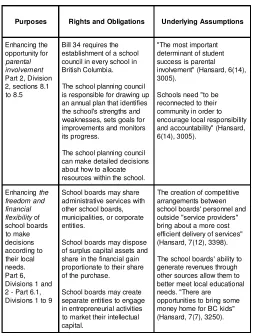
Table 3 synthesizes the main elements of Bill 34 in terms of purposes, rights and obligations, and underlying assumptions.
The main characteristic of Bill 34 is the promotion of various types of school choice, including alternative schools, magnet schools, and voluntary transfer and open enrolment plans. The idea of choice is the precursor to the other dimensions of Bill 34 as they embrace:
1. a sharp distinction between academic and vocational routes, thus reversing the trend in the Western world against streaming and tracking, developed in the name of educational equity (Ashton & Green, 1996);
2. a shift of public education toward competence-based skills at the expense of the more fundamental forms of critical competence for autonomous learning and active democratic citizenship;
4. a form of competition among schools that allows those with the most valued cultural capital to commodify it in the educational marketplace, and leaving those whose cultural capital is less valued with far less market power (Gewirtz, Ball, & Bowe, 1995);
5. an atomized decision-making process as responsibility is shifted to a school-based entity that reduces the scope for collective action to improve education for all (Whitty, Power & Halpin, 1998).
Table 3 - Overview of Bill 34, School Amendment Act, 2002
Purposes Rights and Obligations Underlying Assumptions
Enhancing the opportunity for
parental involvement
Part 2, Division 2, sections 8.1 to 8.5
Bill 34 requires the establishment of a school council in every school in British Columbia.
The school planning council is responsible for drawing up an annual plan that identifies the school's strengths and weaknesses, sets goals for improvements and monitors its progress.
The school planning council can make detailed decisions about how to allocate resources within the school.
"The most important determinant of student success is parental involvement" (Hansard, 6(14), 3005).
Schools need "to be reconnected to their community in order to encourage local responsibility and accountability" (Hansard, 6(14), 3005).
Enhancing the freedom and financial flexibility of school boards to make decisions according to their local needs. Part 6, Divisions 1 and 2 - Part 6.1, Divisions 1 to 9
School boards may share administrative services with other school boards, municipalities, or corporate entities.
School boards may dispose of surplus capital assets and share in the financial gain proportionate to their share of the purchase.
School boards may create separate entities to engage in entrepreneurial activities to market their intellectual capital.
The creation of competitive arrangements between school boards' personnel and outside "service providers" bring about a more cost efficient delivery of services" (Hansard, 7(12), 3398).
The main assumption is that the introduction of market principles and consumer choice into the organisation of schooling will ensure a more efficient delivery of education and enhance its quality. However, some scholars argue that such a policy exacerbates the problems of inequality of educational opportunity, as individuals with cultural and financial capital are able to maximise schooling to their own educational advantage, to the disadvantage of others who cannot (Jonathan, 1989; Ball, 1994; Adler, 1997). The consequence is intensified social segregation as public education becomes a commodified good, one subject to divisibility and excludability (Ball, 1994).
Part 6.1 of Bill 34
In the context of Bill 34 and within its main feature of educational choice, commodification is the crucial structural effect that illustrates how the neo-liberal form of globalization can influence policy making in public education (Scholte, 2000). Part 6.1 of Bill 34 allows public school districts to create legal entities to engage in competitive entrepreneurial activities, such as providing consulting services and educational or administrative expertise and promoting international education through the recruitment of foreign students or the establishment of offshore BC schools designed as profit centres. This part of Bill 34 introduces the institutional dynamics of entrepreneurialism and
Purposes Rights and Obligations Underlying Assumptions
Holding school boards
accountable for financial and academic matters. Part 2, Division 2, sections79.2 and 80
School boards must complete accountability contracts.
A special advisor may be appointed to review the progress of boards where they are not meeting the goals of student achievement.
The school system tends "to focus on the means of education without sufficient attention to the outcomes. The system is driven by the interests of the system or the service provider rather than the interests of the learner and the public" (Hansard, 6(14), 3007 - 3009).
Providing
choices in terms of schools and educational programs. Part 6, Division 2, sections 74.1 to 75.1
Students will be able to attend schools in any catchment area in BC (subject to space availability).
Schools must be more responsive to the needs of their community of learners.
competitiveness in delivering and funding public education. Similar legislation implemented in Australia, New Zealand, the United Kingdom, and the United States has been designed to enable school districts to make up shortfalls in government funding through recruiting foreign fee-paying students, creating offshore private schools, and trading educational expertise and services (Robertson, 2000).
Part 6 of Bill 34 reconceptualizes school districts and their teachers as competitive units within the national and global economies as it is assumed that:
1. school districts should become more “entrepreneurial,” that is, be more responsive to and governed by the preferences of the community of consumers they seek to serve in the marketplace;
2. the creation of more competitive arrangements between school districts will deliver better educational services in terms of efficiency, quality, product differentiation, product management, and the capacity to react quickly to consumer needs; and,
3. trading educational services and programs will augment financial resources for public education.
most powerful symbols win in the educational market (Gewirtz, Ball, & Bowe, 1995).
Conclusion
Academic choices and open enrolment, efficiency through accountability, entrepreneurialism, and competition underpinned Bill 34. Unfortunately, it has set the stage for public education in British Columbia to view knowledge as a commodity and to link, at least partially, the levels of services and of funding of public education to the entrepreneurial success of individual school districts rather than to an equitable distribution of public resources. The logic of the free market is strongly embedded in Bill 34 and market mechanisms are introduced to capitalize upon choice and efficiency the dominant values in British Columbia’s current political culture.
It is too early to fully understand how these new institutional dynamics will shape public education in British Columbia in the long term. Bill 34 is barely two years old and further research is needed to gauge its impact on governance and funding, teachers’ work and identities, conceptualization of teaching and learning, teachers’ identities, organizational structures of school districts, the mandate of public education, and the roles of school. However, we can draw from the experience of countries that have adopted similar policy options and legislation. Studies done in Australia, New Zealand, the United Kingdom, and the United States clearly show that educational policy options based on entrepreneurialism, choice, and competition promote a form of competition between school districts that allow only those with the most valued cultural capital to commodify it in the marketplace, leaving others with limited access to diminishing public and private resources (Delhi, 1996; Kenway & Epstein, 1996; Robertson, 2000; Wells, Lopez, Scott, & Holmes, 1999). A design that turns school districts over to market forces and gives parents more choice does little to alleviate social divisions and promote equity, heterogeneity, pluralism, and local needs (Wells, Lopez, Scott, & Holmes, 1999).
on factors such as product differentiation, product management, economic instrumentalism, and the capacity to react quickly to choice-conscious parents.
Authors’ Note
The authors would like to thank Dr. Greg Dickinson (UWO) for his helpful comments on an earlier draft of this paper.
References
Adler, M. (1997). Looking backward to the future: Parental choice and education, British Educational Research Journal, 23, 297-313. Ashton, D. & Green, F. (1996). Education, training and the global economy.
Chetlham, UK: Edward Elgar.
Ball, S.J. (1994). Education reform. Buckingham, UK: Open University Press. BC Liberals. (2001). A new era for British Columbia: A vision for hope and
prosperity or the next decade and beyond. Retrieved January 7th, 2003, from http://www.bcliberals.com.
British Columbia, Select Standing Committee on Education (2002). A future for learners: A vision for renewal of education in British Columbia. Victoria, BC: Ministry of Education, Governance and Legislative Unit. British Columbia. (2002). Bill 34, School Amendment Act – 2002. Victoria, BC:
Ministry of Education, Governance and Legislation Unit.
British Columbia Hansard Services. (2002). Official report of debates of the Legislative Assembly, 3rd session, 37th Parliament, Hansard, 6(14), 2997-3043.
British Columbia Hansard Services. (2002). Official report of debates of the Legislative Assembly, 3rd session, 37th Parliament, Hansard, 6(16), 3086-3089.
British Columbia Hansard Services. (2002). Official report of debates of the Legislative Assembly, 3rd session, 37th Parliament, Hansard, 7(1), 3099-3121.
British Columbia Hansard Services. (2002). Official report of debates of the Legislative Assembly, 3rd session, 37th Parliament, Hansard, 7(7), 3250-3261.
Delhi, K. (1996). Between market and state? Engendering education change in the 1990s. Discourse: Studies in the Cultural Politics of Education, 17, 363-376.
Gerwirtz, S. Ball, S, & Bowe, R. (1995). Markets, choice and equity. Milton Keynes: Open University Press.
Jonathan, R. (1989). Choice and control in education: Parental rights, individual liberties and social justice, British Journal of Educational Studies, 37, 321-338.
Jordan, S. & Strahdee, R. (2001). The training gospel and the commodification of skills: Some critical reflections on the politics of skills training in
Aoteara/New Zealand. Journal of Vocational Education and Training, 53, 391-403.
Kenway, J. & Epstein, D. (1996). Introduction: The marketization of school education: Feminist studies and perspective. Discourse: Studies in the Cultural Politics of Education, 17, 301-314.
Kuehn, L. (2002). B.C. Liberal push boards to market education. Teacher: NewsMagazine of the BC Teachers’ Federation, 15(2), 1-3. Nelles, W. (2001) The world of education market comes to Canada:
Competition in a trillion dollars global industry. Retrieved January 7th, 2002 from http://www.bctf.ca/Education/NoToWEM/
NellesArticle.html.
Robertson, S.L. (2000). A class act: Changing teachers’ work, globalization and the state. New York, NY: Falmer Press.
Scholte, J.A. (2000). Globalization: A critical introduction. London, UK: Palgrave.
The Select Standing Committee on Education Report. A future for learners: A vision for renewal of education in British Columbia. Retrieved December 12th,2002, from http:// www.legis.gov.bc.ca.
Wells, A.S., Lopez, A., Scott, J. & Holmes, J.J. (1999). Charter schools as postmodern paradox: Rethinking social
stratification in an age of deregulated school choice. Harvard Educational Review, 69, 172-203.