Editorial
Enhancing Education: Attending to the Four Commonplaces
Julian Kitchen p. 1
Articles
Teachers’ Perspectives on Educational Research
Karen Drill, Shazia Miller, and Ellen Behrstock-Sherratt p. 3
Shifting Currents: STSE in Northern Ontario Schools
Astrid Steele p.18
Improving Urban Students’ College Readiness as a Driver of High School Curriculum Enhancement
Marius Boboc, R. D. Nordgren p.43
Pre-service Teachers' Self-Regulated Learning and their Developing Concepts of SRL
Dawn Buzza, Trina Allinotte p.58
Loose Coupling and Inhabited Institutions: Inclusion Policy and Teacher Strategies
Christina DeRoche p.77
Enhancing Conditions for Aboriginal Learners in Higher Education: The Experiences of Nishnawbe Aski Teacher Candidates in a Teacher Education Program
Julian Kitchen, John Hodson p.97
Book Review
The Slow Fix: Solve Problems, Work Smarter and Live Better in a World Addicted to Speed
Stephanie Tukonic p.115
Editorial:
Enhancing Education: Attending to the Four Commonplaces
Julian Kitchen
EditorBrock University
At all levels—elementary, secondary and tertiary—there is a need to constantly improve education. There is no formula, no magic bullet. Instead, educators strive to make a difference through intervention in one or more areas of the educational experience.
Joseph Schwab identified four commonplace of education—teacher, learner, curriculum, and milieu (Schwab, 1970)—that exist in all schools and in other learning contexts. The authors of each article in this issue of Brock Education address one or more commonplaces in their research and their efforts to improve education. Many also give explicit attention to social justice.
As teachers are the professionals who guide the educational experience in classrooms, many efforts to improve schooling focus on improving practice. In “Teachers’ Perspectives on Educational Research,” Karen Drill, Shazia Miller, and Ellen Behrstock-Sherratt address the widely acknowledged disconnect between practitioners and the findings of educational research. They present two related studies conducted with teachers in the Chicago area on how teachers make use of research. As a result of these findings, they identify ways in which research findings can be made more accessible and useful to busy practitioners.
Astrid Steele, in “Shifting Currents: STSE in Northern Ontario Schools,” focuses on the practices of secondary science teachers in rural, resource-extraction-based communities in northern Ontario. She investigates the extent to which science teachers are implementing mandated curriculum on the impacts of science on society and environment. While Steele finds that most teachers are shifting in their attitudes, she notes a range of factors that make it difficult for teachers to effectively address the curriculum and adapt it to local contexts. Like Drill and her associates, Steele offers recommendations to help teachers become more effective in their use of information from experts and policy makers.
Brock Education, Vol. 23, No. 1 Fall 2013. 2 needed for college success. By doing so, they contribute to the improvement of outcomes for learners who are not always well served by schools or society.
At the centre of the learning experience is the student. Each student has particular learning needs. In “Pre-service Teachers' Self-Regulated Learning and their Developing Concepts of SRL,” Dawn Buzza and Trina Allinotte begin with the recognition that each student has different abilities and skills. Of particular significance for Buzza and Allinotte, is the fact that the ability to self-regulate skills, behaviours, and beliefs differs greatly from learner to learner. As well as learning about pedagogy and curriculum, they argue, new teachers also need to become aware strategies for enhancing self-regulated learning in students. Their paper, by investigating teacher candidates’ application of SRL in their field experiences, offers the possibility that teachers can better support students in becoming effective self-regulated learners. Christina DeRoche, in “Loose Coupling and Inhabited Institutions: Inclusion Policy and Teacher Strategies,” is also concerned with improving the student experience by improving their learning skills. Whereas Buzza and Allinotte’s work applies to all students, DeRoche focuses on the particular needs of exceptional learners. Through participant observation and interviews with two teachers and an educational assistant, she studies how the framework of loose coupling and inhabited institution was used by these educators to actively negotiate curriculum and pedagogy by drawing on the personal and social resources of each special needs learner. She concludes with recommendations about employing loose coupling with exceptional learners, and how to support educators in doing this important work.
The final article, “Enhancing Conditions for Aboriginal Learners in Higher Education: The Experiences of Nishnawbe Aski Teacher Candidates in a Teacher Education Program” by Julian Kitchen and John Hodson, focuses on the milieu in which Aboriginal B.Ed. students are prepared. The authors, based on interviews with Aboriginal teacher candidates, identify ways in which a community-based program inadvertently complicated the process of becoming a teacher and making it more difficult. Listening to the voices of minority learners who struggle to succeed in the unfamiliar territory of educational institutions is an important first step in making these institutions more effective in serving the needs of all learners and communities.
Each article in this issue helps us understand one or more of the commonplaces of education. Taken together they offer insights into how to enhance the skills of teachers, adapt curriculum to the needs of students, address the learning skills of students, and improve the contexts in which students learn. By addressing these in our practice, we as educators can make a positive difference for all students, particularly those not well served by contemporary schools or by the societies in which we live.
References
3
Teachers’ Perspectives on Educational Research
Karen Drill
American Institutes for Research, Researcher
Shazia Miller
American Institutes for Research, Managing Director
Ellen Behrstock-Sherratt
American Institutes for Research, Senior Researcher
Abstract
Based on two studies conducted in the Chicago metropolitan area in 2009 and 2010, we found that teachers do, in fact, use research, although they tend to seek it out under very specific conditions and circumstances. Namely, teachers tend to look to research in response to an immediate, pressing concern such as how to best teach fractions to English language learners (ELLs). Teachers also turn to research to address a specific content need, such as gathering information for an upcoming lesson. In terms of broader reviews of research, teachers sometimes review research they have used in the past, such as best practices for a particular topic or method. Finally, teachers may consult educational research when they participate in groups that use research findings to more broadly support their instructional practice (e.g., study groups, committees or courses on using research in the classroom).
Keywords: education research, teachers, best practices
Karen Drill has led and worked on local and national projects, including South Carolina Extended Learning, Striving Readers in the Chicago Public Schools, and the Texas Principal Excellence Program. Her primary focus has been qualitative and quantitative research within education, and has led the evaluation of three mentoring and induction programs in Illinois districts. Previously, Drill worked as the program coordinator for Northwestern University’s Center for Talent Development. She is currently pursuing a doctoral degree in educational psychology from the University of Illinois at Chicago.
Emaill: [email protected]
Shazia Miller has over 20 years of experience in evaluation, with an emphasis on high school transitions and data-based decision-making in schools. She lead or been a senior advisor to many initiatives to improve educational outcomes. Miller is currently the co-primary investigator of the IES sponsored randomized control trial of Indiana’s system of diagnostic assessment.to provide teachers with ongoing feedback on their students.
Ellen Behrstock-Sherratt has authored numerous articles, briefs, and reports on teacher and principal quality and is co-author of Everyone at the Table: Engaging Teachers in Evaluation Reform and Improving Teacher Quality: A Guide for Education Leaders. She led the development of the Educator Talent Management Framework. She has provided technical assistance to state and national educational bodies, and supported teacher effectiveness work at the American Federation of Teachers and the National Education Association.
Brock Education Vol. 23(1), 16-33 4
The sources of educational science are any portions of ascertained knowledge that enter into the heart, head, and hands of educators, and which, by entering in, render the performance of the educational function more enlightened, more humane, more truly educational than it was before.
(Dewey, 1929, p. 76).
How can we improve education? The educational research community constantly aims to produce high-quality research that pushes the boundaries of our knowledge and creates a stronger education system. The volume of literature housed in the Education Resources Information Center (ERIC) database now exceeds one million articles. Linking the vast community of educational researchers is “a deep concern with the condition of children and schools” (Gardner, 2002, p. 72).
However, in spite of the large volume, educational research has sometimes been criticized as neither useful nor influential (Burkhardt and Schoenfeld 2003); some have gone so far as to say the reputation of research is awful (Kaestle, 1993). As described by Bransford, Vye, Stipek, Gomez, & Lam (2009), in 2003 Grover Whitehurst, the then director of the National Institute of Education Sciences, drew widespread attention to these concerns about whether the educational research field was producing useful work for the field. In a presentation at the annual meeting of the American Education Research Association, Whitehurst criticized some of the esoteric paper titles that are inaccessible to those outside a particular research niche, citing a made-up example paper entitled “Episodes of Theory-Building as a Transformative and Decolonizing Process: A Microethnographic Inquiry into a Deeper Awareness of Embodies Knowing.” Whitehurst further cited a survey of state and district leaders, 77 percent of whom believed educational research was overly theoretical and too academic in its orientation (Whitehurst, 2003).
Some researchers note that educational researchers may not be adequately prepared to disseminate research in ways that are useful to practitioners (Schoenfeld, 2009). But we do not know whether there are more fundamental criticisms to how research is being produced and disseminated. For teachers to make effective use of new knowledge being developed by the field, they must be able to identify and access high quality research. But what are the circumstances under which this occurs?
Much of the research on educational research’s usefulness to teachers has emerged from abroad, including Canada (Cooper, 2010; Lysenko, Abrami, & Bernard, 2003), Great Britain (Cordingley, 2000, 2009), Turkey (Beycioglu & Ozer, 2008), and the Netherlands (Bronkhorst, Meijer, Koster, & Vermunt, 2011). Hemsley-Brown and Sharp’s (2003) cross-national review of research on this topic in multiple English-speaking countries over the period 1988-2001 revealed that there were indeed barriers to teachers’ use of educational research, including lack of access to academic journals, the daunting amount of research, jargon and overly theoretical orientations, and distrust of the findings.
Brock Education Vol. 23(1), 16-33 5 engaged in dialogue and collaboration, such as that provided by professional learning communities.
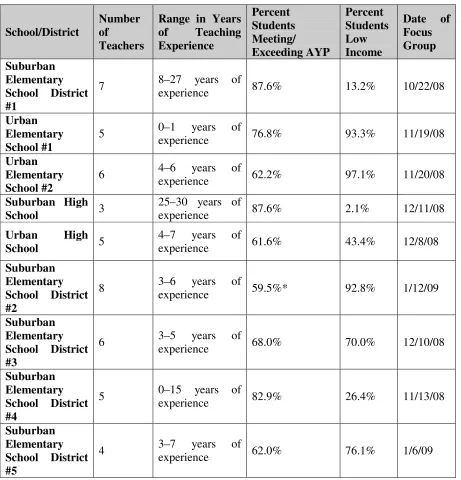
To address the disconnect between researchers and practitioners, we conducted two related studies in the Chicago Metropolitan area. For the first study, we held nine focus groups with 49 public school teachers in 2009. We chose focus groups for the first study because we wanted to explore teachers reactions to research directly through an in depth conversation. We asked teachers about the types of research they are most likely to use and about the resources they consult when looking for research. Based on the findings from the first study, which suggested that teachers are more likely to use research when it is filtered to them by fellow educators, we conducted a follow-up case study in 2010. In the second study, we were interested in whether the information teachers received in a course specifically designed to disseminate research to teachers translated into classroom practice. Here, we found again that if research is tied to a current classroom issue, teachers may use research to address the issue. However, teachers will not spend a lot of time seeking out research. Instead, the information needs to be presented in a way that is convenient and sensitive to their time. In this article, we present each of the studies, the findings, and implications for researchers and schools.
Study 1
Our first study focused on the extent to which the large body of educational research is useful to teachers’ instructional practice and how educational research might be made more appealing to teachers. In other words, is there a demand by teachers for research, and, if so, what, if anything, can the producers of research at universities and elsewhere do to ensure that what they are supplying meets this demand.
To further our understanding of this issue, we conducted nine focus groups with a total of 49 teachers from urban and suburban schools within the Chicago Metropolitan Area. Teachers were asked about:
• Whether they seek out research and why or why not
• What comes to mind when they hear the word “research” in an education context • What sources of research they rely on and how they judge its credibility
• What barriers prevent them from using educational research
• What type of research is useful and what would make using research more appealing • What type of preparation for using research they have received
Methods
Brock Education Vol. 23(1), 16-33 6 Table 1
District and School Sample
School/District
Number of
Teachers
Range in Years of Teaching Experience
Percent Students Meeting/
Exceeding AYP
Percent Students Low Income
Date of Focus Group
Suburban Elementary School District #1
7 8–27 years of
experience 87.6% 13.2% 10/22/08
Urban Elementary School #1
5 0–1 years of
experience 76.8% 93.3% 11/19/08
Urban Elementary School #2
6 4–6 years of
experience 62.2% 97.1% 11/20/08
Suburban High
School 3
25–30 years of
experience 87.6% 2.1% 12/11/08
Urban High
School 5
4–7 years of
experience 61.6% 43.4% 12/8/08
Suburban Elementary School District #2
8 3–6 years of
experience 59.5%* 92.8% 1/12/09
Suburban Elementary School District #3
6 3–5 years of
experience 68.0% 70.0% 12/10/08
Suburban Elementary School District #4
5 0–15 years of
experience 82.9% 26.4% 11/13/08
Suburban Elementary School District #5
4 3–7 years of
experience 62.0% 76.1% 1/6/09
Brock Education Vol. 23(1), 16-33 7 capture the essence of the discussion. The focus group findings should not be interpreted as representative of all teachers, but rather as a useful starting place for future studies.
Findings
Based on data gathered from the focus groups, several key findings emerged about the ways teachers use educational research, the types of research teachers find most useful, and some of the barriers that prevent teachers from accessing and using research.
•Although teachers are not opposed to accessing and using research, research in
general evokes a number of strong yet conflicting responses. The tension between using educational research to support instruction and the perceived gap between what researchers provide and what practitioners need emerged as a common theme in all nine focus groups, regardless of teachers’ years of experience, grade level taught, or school location in the greater Chicago area.
Teachers who held positive reactions to research viewed it as information about “what works” in the classroom. For example, some teachers indicated that research findings are a way to validate that educational practices are “tried and true” and have “proven to be successful.” Research findings, then, can provide an extra level of assurance that teachers are implementing strategies and practices that work.
However, not all teachers view educational research in a positive light. Many focus group participants also suggested that research can seem removed from everyday classroom realities. This sentiment was reinforced when teachers believed that the research environment is not an accurate representation of actual classrooms or of classrooms with similar student compositions to theirs.
•While there was a wide degree of skepticism about researchers and research
findings per se, this skepticism can be reduced when research comes from a source that teachers trust and if the findings work their classroom. In general, focus group participants were more likely to trust research findings that came from a source they deemed credible, such as a colleague, administrator, professor of theirs, or a researcher with experience in the classroom. However, if the research is associated with promoting an educational product, the findings may be disregarded. In the end, teachers have to do what seems to work in the classroom, regardless of official best practices or other research guidance. Teachers also are more likely to trust their own experiences and feedback they receive from their students than suggestions made by a researcher. For some, a strategy that works with their students provides more evidence of success than what research might argue is effective. In addition, teachers may be more likely to accept research that confirms their current instructional pedagogy. Conversely, if applying findings does not work in their classroom, teachers will abandon the effort.
•Teachers turn to research when there is a pressing concern, but often only after they
Brock Education Vol. 23(1), 16-33 8 such as The Reading Teacher, or the Internet, starting with Google. Through these avenues, research and research-based information may be shared. Teachers report that they also will use educational research when they are part of a study group, committee, school initiative, or other work group that uses research findings to support learning more broadly.
•Teachers indicated nearly unanimously that, given competing demands on their
time, both seeking and reading research are low priorities. This explanation was shared by teachers of all experience levels in urban and suburban elementary and high schools serving higher and lower-income students. In light of their limited time, teachers stated that they are less likely to read research when it is presented with overwhelming information and in a manner that is dry and difficult to decipher.
However, even though teachers stated that they often do not have or make time for educational research, some mentioned that they would be more likely to read research if administrators advocated for and provided sanctioned time to discuss research with colleagues. For example, one elementary school received a grant that supported a teacher study group focusing on professional development about instructional strategies. In addition, teachers suggested that they also would be more likely to read research if the massive volumes of research available were screened and filtered by school leaders or administrators.
The desire to receive research findings as a bulleted list, brief synopsis, or audio-visual media also was cited by an overwhelming majority of teacher participants as a way to access the research findings without taking large amounts of time away from students’ more pressing needs.
•Finally, teachers are less likely to use research if they do not see a connection
between the population studied and its applicability to the students in their classroom. Some teachers suggested that the research setting is so controlled that they would be unable to replicate the program or practices in their classroom, while others believed that certain aspects of their own classroom, such as a high concentration of ELLs, make many research-based teaching strategies inappropriate for their students. If teachers believe their classroom does not reflect a study’s students, resources, or context, they will be less likely to try to read or apply the findings.
Summary of Findings
Brock Education Vol. 23(1), 16-33 9 Study 2
A key finding from Study 1 was that teachers are open to using research if it comes from a trustworthy source, is relevant to their classroom context, and is presented in way that respects and values their time. The challenge is ensuring that these trusted sources are also good consumers of research and capable of sifting through documents of varying quality to accurately communicate the findings to teachers. Looking at these criteria, we asked ourselves if there were initiatives that provided teachers with research in ways that would be useful. One vehicle stood out as especially promising -- a professional development program run by the American Federation of Teachers (AFT).
The AFT, one of the two major teachers unions in the country, includes in its mission goals of:
• Strengthening the institutions in which teachers work; • Improving the quality of the services teachers provide; and • Bringing together all members to assist and support one another.
The AFT has addressed its mission in part by creating a number of professional development courses to help teachers improve their practice. Their line of professional development, Educational Research and Dissemination (ER&D), provides professional development in ways that meet the needs of teachers by providing information on research-based practices that have been field tested, with content delivery by their peers.
The AFT’s ER&D program was created in 1981, and in the past five years at least 7,500 teachers nationwide have taken an ER&D course. The ER&D program deliberately trains classroom teachers to create and deliver each course. Instructor training involves two distinct week-long training sessions, with requirements between sessions to practice and reflect on topics taught. The instructor training also involves a mock delivery of the course. Local course instructors are chosen for their content mastery and are often classroom teachers, teacher leaders, or coaches rather than administrators. ER&D offers courses on topics including managing anti-social behavior; reading instruction; reading comprehension; thinking mathematics; school, family, and community; and others. In 2010 the American Education Research Association gave the ER&D program highest honors for bridging the gap between research and practice.
To get a better sense of whether the information provided in an ER&D course translates into classroom practice, and whether it increased teachers use of research we conducted a case study of the ER&D course, Managing Anti-Social Behavior, in a Chicago suburb in Fall 2010.
Managing Anti-Social Behavior encourages classroom teachers to improve their practice and
their students’ performance by:
•Becoming users of research;
•Exposing them to timely research-based principles, practices, and strategies; and •Teaching other teachers to share strong practices.
Brock Education Vol. 23(1), 16-33 10
•Who are these students and what is antisocial behavior? •Effective classroom management techniques
•Behavior analysis
•Building social competence in the classroom •Behavior enhancement and reduction
•The acting-out cycle
•School-wide behavior support practices
In keeping with teachers’ interest in meeting with peers to discuss research and practices, participants meet for three hours, once a week, for seven weeks in the Managing Anti-Social
Behavior course. Each session involves a lecture peppered with numerous opportunities for
participants to ask questions and participate in tabletop and whole group discussions, thereby learning not only from the research, but also from trusted peers.
Teachers are also provided with a binder, assembled by course designers at the AFT headquarters, that consolidates high quality, timely, meaningful research. The course designers included articles with charts and images to help readers connect to the content. The course binder is updated every three years by national AFT experts who seek feedback from other course instructors to ensure that the research is useful to teachers. The course is then field tested for usability. In response to early feedback that the binder felt more like a research journal than a user-friendly resource, previous adjustments have included removing research articles that were not relevant, too dense, wordy, or jargon-filled. In line with principles of adult learning, activities were added to help readers identify with and internalize the content. Each of these efforts aligns with our previous findings that teachers are more likely to use research if it is provided in a clear, straightforward way, and filtered through a trusted source.
Methods
Using a case study approach, we followed two sessions of ER &D’s Managing Anti-Social
Behavior course, presented in a Chicago suburb in the fall of 2010. Through pre- and post-event
surveys, interviews, and focus groups with teachers and ER&D instructors and five course observations, we explored why course participants chose to take the course, the degree to which they use research to inform their practice, and the extent to which course participation influenced their research use. The course was facilitated by a school administrator.
Findings
Our findings suggest that when teachers are presented with research-based information, they use it, particularly when it is related to a specific classroom need. Several themes emerged from our case study on the Managing Anti-Social Behavior course.
•Participation in this targeted professional development course did increase teacher
Brock Education Vol. 23(1), 16-33 11 classroom can have larger ramifications for student behavior later. Another teacher wrote in the post-event survey, “I have been reflecting on the way I address students.”
•Course participants left with increased knowledge about the medical, psychological,
and cultural underpinnings of typical student behavior issues. Teachers told us that they left the course equipped with “techniques to deal with anti-social behavior” and a better understanding of “why students with anti-social behaviors act in certain ways.”
•The course did not influence teachers’ use of research. While participants enjoyed the
course, and felt like they gained new knowledge and strategies for working with challenging students, most did not indicate that the course influenced how often they turn toward research or their intentions to seek out research on their own after the course ended.
Summary of Findings
This feedback from participants suggests that a targeted approach to using research can increase teacher knowledge about the topic at hand, and can have a direct effect on teachers’ use of research-based practices. At the same time for a course focused exclusively on research dissemination, we were surprised that participants and instructors did not emphasize using research regularly to inform practice. For example, little emphasis was placed on seeking out and assessing the quality of research. Neither the participants nor the course instructors received training on seeking out research beyond that which was given to them by the national course designers.
Conclusion
Our findings suggest that teachers use a different set of criteria to evaluate high quality research than researchers. They want research that is worth their time, attention and leads to possible change in practice. Researchers, on the other hand, are trained to judge quality based on key criteria such as internal validity, rigor of analysis, strong methodological design, triangulation of data and appropriate measurement. When forced to use shortcuts, the researcher is taught to rely on peer-reviewed journals as a first cut check of quality, followed by their own review of study methods, which are, not coincidentally, extensively presented in such journals.
Teachers, our study suggests, use an entirely different set of criteria to identify high quality research that they will consider integrating in their classrooms. And, even when presented with research through content-based professional development, teachers are still hesitant to seek out and incorporate research regularly in their practice. Given these findings, we offer several recommendations to educational stakeholders.
Recommendations
Brock Education Vol. 23(1), 16-33 12 Recommendations for Researchers
Teachers genuinely want their students to benefit from the findings of good research. However, there is somewhat of a mismatch between the educational research that currently is supplied and what is demanded by teachers. This mismatch is not necessarily due to researchers’ carelessness or lack of concern; quite on the contrary, it may be largely due to researchers’ extreme care to present their findings as precisely as possible, a process that may lend itself to obscure language and lengthy discussions. In order to bring supply and demand into equilibrium, researchers should:
•Get to the point. Teachers are busy and want to see bulleted lists and brief synopses of
the research findings. Not only does this help ensure that teachers will benefit from findings, but it also demonstrates to teachers that researchers understand and appreciate that teachers’ time is at a premium.
•Provide examples of the applicability of the research to real classroom situations.
This may include illustrations and hands-on examples of how to put the research findings into practice. Also, many teachers consider themselves visual learners and have expressed a desire to access research through audio-visual technology that allows them to see the recommended instructional practices put into action.
•Write in an accessible manner. This does not mean that research findings should be
watered-down; rather it means that unnecessary jargon should be avoided in favor of straightforward language and sentence structure. In addition, complex statistical analyses should be described in laymen’s terms.
•Emphasize how research findings can help teachers solve specific, immediate
classroom problems or address students’ particular learning needs. The demands of teaching tend to prevent teachers from exploring future-oriented or higher order issues than those immediately at-hand; however, there was near consensus that research is consulted in response to pressing needs.
•Highlight the attributes positively associated with research. Teachers already
appreciate that good research represents a trustworthy and solid basis for coming to conclusions about what works in the classroom. Research that reminds readers of these qualities and how they inspired the study is likely to be better received by teachers.
•Be clear about the context of the study and its applicability to other settings.
Teachers are quite skeptical about the relevance of studies conducted in different contexts, especially when there are clear differences in grade level, ability level, socioeconomic level, class size, behavior, and culture. It is important to make clear which population was studied and, if it is believed that the findings are generalizable, to emphasize that point and explain why.
•Be proactive about engaging with teachers and those who directly disseminate
Brock Education Vol. 23(1), 16-33 13 research may make it difficult, spending time in schools and with teachers, being available to present findings and answer questions about the research, and working collaboratively with teachers and teacher educators at each stage of the research process will make research more relevant and useful.
Recommendations for Teacher Preparation Programs
Teacher preparation programs play an important role in building the foundations for a research-oriented teaching career. As the gateway to the profession, they shape teachers’ views and approaches to using research to inform their practice. In some cases, they are also the closest source of access to research and researchers that teachers will receive during their careers.
•Be proactive about bringing teachers and researchers into contact. Bridging the gap
between teachers and researchers requires that the two groups build trust. This can be accomplished through interaction from the early stage of their careers: their preparation. It might take on the form of joint seminars, coffee hours, or project work, for example.
•Prepare teachers to find the research they likely will need. A number of teachers
mentioned difficulty in using search engines effectively, deciding which research is credible, and making decisions about which sources to trust when studies contradict one another. Those preparing teachers should ensure that they learn how to search for research effectively, how to evaluate the quality of research, and how to interpret the findings.
•Encourage and support teachers in accessing research once on the job. Teacher
preparation programs cannot feasibly address all of the potential classroom experiences that teachers might encounter. It is important to make it clear that gaps between the knowledge gained during preparation and that which is needed to address particular needs they will face in their specific classroom contexts can be filled in part through access to research on the job. A few teachers attributed their current use of research to their continued contact with and guidance from former graduate school professors.
Recommendations for School and District Leaders and Policymakers
Leaders and policymakers in schools and government have an important role to play in facilitating teachers’ use of research by taking action to overcoming barriers to teachers’ access to research. This primarily involves the provision of time, encouragement, and resources. Specifically, they can:
•Create a system to filter high-quality research to teachers. Having school
Brock Education Vol. 23(1), 16-33 14
•Ensure that teachers have enough structured time specifically intended for
accessing, collaborating on, and reflecting upon research. The primary barrier to teachers’ use of educational research was simply not having enough time. By providing adequate planning periods and support staff to guide teachers toward high-quality research, this type of professional growth and learning can take place. Teachers should be provided with regular time to work with others in their subject and grade level to discuss research findings and how to coherently apply them to teaching the school’s curriculum. Teachers should receive both support from administrators and sufficient classroom autonomy in their implementation of research-based findings.
•Encourage and provide the time for teachers to access research through district
initiatives or in collaboration with unions. Teachers appreciate time to discuss strategies and best practices that are backed by research and from trusted sources. Providing regular opportunities for teachers to participate in committees, lead departmental meetings, or participate in professional development that include discussions regarding research is likely to enhance teachers’ use of research.
•Provide professional development opportunities that include opportunities to learn
about and reflect upon research. Some teachers cited high-quality, ongoing, job-embedded professional development workshops as among the most useful sources of research that encouraged them to put research to practice in the classroom.
•Encourage more best practices based professional development, similar to the
programs provided under the ER&D model. Based on our findings, teachers enjoyed participating in the ER&D course, and felt equipped with new research-based strategies to apply in their classroom.
•Maintain high-functioning technology for accessing research. The Internet was the
most cited source for accessing educational research. Yet in some cases, broken or slow computers, as well as blocked websites, presented a barrier to teachers who wished to access research.
•Create a library of educational research. Currently, teachers tend not to rely on
libraries as a source of research-based information. Devoting a section of the school library or creating a staffroom library that houses articles, books, and digital media that exhibit the characteristics of research that are useful to teachers is one way to provide busy teachers with easy access to research.
•Support the dissemination of research to teachers. The cost of journal subscriptions,
Brock Education Vol. 23(1), 16-33 15 Future Research
Our findings provide thought-provoking insights into the teachers’ use of research, insights that could be well worth exploring through additional studies. Future work might further explore these ideas in a variety of ways, including obtaining the perspective of educational researchers, exploring the role of social networks in disseminating research-based practices, and investigating the use of research by particularly successful teachers.
The Perspective of Educational Researchers
Although our studies examined teachers’ perspectives on educational research, if the desire truly exists to bridge the gap between researchers and practitioners, one possible next step is to hear directly from educational researchers: Do researchers view their work as a means to improving instructional practice? More specifically, do educational researchers have aspirations to disseminate findings in ways that that are useful to teachers, and, if so, are there barriers that prevent this from happening?
As one half of the researcher–practitioner divide, educational researchers provide a much needed perspective on research, its purpose, and the way findings are disseminated. Once the view of researchers is clarified, the two points of view can be compared for similarities as well as areas of disagreement. By identifying teachers’ and researchers’ perspectives, the two communities can be brought together to discuss ways to make research findings relevant and useful for both parties.
Social Networking
Our study participants indicated that they would be more likely to turn to colleagues for information about how to improve instruction before consulting research findings. Exploring how teachers use social networks to gather information may lead to a better understanding of how to more effectively disseminate research findings. A future study, then, could explore possible connections between group norms, social influence, and use of research. For example, how do group norms or school culture influence the way teachers use research? Do teachers in schools with stronger collegial networks influence whether their colleagues use or access research? Do teachers who are part of an organized cohesive group, such as a professional learning community, access research more frequently?
Effective Teachers and Use of Research
Brock Education Vol. 23(1), 16-33 16 References
Beycioglu, K., & Ozer, N. (2008). Teachers’ views on education research. Poster presented at the European Education Research Association Conference, Göteborg, Sweden.
Bransford, J. D., Vye, N. J., Stipek, D. J., Gomez, L. M., & Lam, D. (2009). Equity, excellence, elephants, and evidence. In J.D. Bransford, N.J., Vye, D.J. Stipek, L.M. Gomez, & D. Lam. The role of research in educational improvement. Cambridge, MA: Harvard Education Press.
Bronkhorst, L., Meijer, P. C., Koster, B., & Vermunt, J. D. H. M. (2011). Collaboration as
Means to Promote Research Use. Paper presented at the annual conference of the
American Education Research Association. New Orleans, LA.
Burkhardt, H., & Schoenfeld, A. H. (2003). Improving educational research: Toward a more useful, more influential, and better funded enterprise. Educational Researcher,32(9), 3–14. Retrieved March 30, 2009, from
http://gse.berkeley.edu/faculty/ahschoenfeld/Schoenfeld_BurkhardtEdResearch.pdf
Cooper, A. (2010). Knowledge Brokers: A Promising Knowledge Mobilization Strategy to
Increase Research Use in Education. Paper presented at the annual conference of the
American Education Research Association. Denver, CO.
Cordingley, P. (2009). Using research and evidence as a lever for change at classroom level.
Paper presented at the annual conference of the American Education Research Association, San Diego, CA.
Cordingley, P. (2000). Teacher perspectives on the accessibility and usability of research
outputs. Presented at the British Education Research Association Annual Conference.
Cardiff, UK. Retrieved March 30, 2009, from
http://www.tda.gov.uk/upload/resources/doc/b/bera.doc
Dewey, J. (1929). The sources of a science of education. New York: Liveright Publishing.
Gardner, H. (2002). The quality and qualities of educational research. Education Week, 22(1), 49, 72. Retrieved March 30, 2009, from
http://www.edweek.org/ew/articles/2002/09/04/01gardner.h22.html
Hargreaves, A. & Stone-Johnson, C. (2009). Evidence-informed change and the practice of teaching. In J.D. Bransford, N.J., Vye, D.J. Stipek, L.M. Gomez, & D. Lam. The role of
Brock Education Vol. 23(1), 16-33 17 Hemsley-Brown, J., & Sharp, C. (2003). The use of research to improve professional practice: a
systematic review of the literature Oxford Review of Education, 29(4), 449–470. Retrieved March 30, 2009, from
http://www.standards.dfes.gov.uk/research/themes/cpd/researchfindingspractice/teachers useresearchfindings.doc
Kaestle, C. F. (1993). The awful reputation of education research. Educational Researcher, 22(1), 23, 26–31.
Laitsch, D. A. (2010). Surveying practitioner use of research. Paper presented at the annual conference of the American Education Research Association. Denver, CO.
Lysenko, L., Abrami, P. C., & Bernard, R. M. (2003). Researching research Use: An online
study of school practitioners in Canada: Quantitative results. Paper presented at the
annual conference of the American Education Research Association. New Orleans, LA.
Miller, S. R., Drill, K., & Behrstock-Sherratt, E. (2011). The bridge between researchers and
teachers: Exploring the pathway to innovation in the classroom. Paper presented at the
annual conference of the American Education Research Association. New Orleans, LA.
Nelson, S. R. (2011). An image of the truth: Exploring the role of research evidence in
educational policy and practice. Paper presented at the annual conference of the
American Education Research Association. New Orleans, LA.
Porter, A. (2007). Making connections between research and practice. Journal of Personnel
Evaluation in Education, 20(3–4), 281–283.
Schoenfeld, A. H. (2009). Instructional research and the improvement of practice. In J. Bransford, N., Vye, D. Stypek, L. Gomez, & D. Lam (Eds.), The Role of Research in
Educational Improvement (pp. 161–188). Cambridge, MA: Harvard Education Press.
Whitehurst, G. (2003). The Institute of Education Sciences: New wine, new bottles. Paper
18
Shifting Currents: Science Technology Society and Environment in
Northern Ontario Schools
Astrid Steele
Nipissing UniversityAbstract
The focus is on the practices of secondary science teachers in rural, resource-extraction-based communities in the boreal region of northern Ontario, Canada. In 2008 the Ontario Ministry of Education mandated that science teaching and learning should bring to the forefront consideration of the impacts of science on society and environment, and include environmental education; topics that are particularly pertinent given the location(s) of the study in logging and mining towns. Three years after the introduction of that curriculum the researcher investigates the extent to which the mandated changes have entered teacher practice. The study consists of a survey, (n= 26), interviews (n=7) and a closer exploration of the collaboration between two teachers who work towards including social and environmental issues in their lessons. Findings provide evidence that secondary science teachers are shifting toward a stronger emphasis issues of society and environment in their practice, however teachers identified a number of concerns including an information gap, developing new lessons, program planning, assessment, and teaching in the North. A theoretical framework developed by Pedretti and Nazir was used in the analysis of the teacher collaboration. Recommendations are for professional development to specifically address the concerns raised by the teachers; as well, changes are suggested to the theoretical framework to include a stronger emphasis on environmental education.
Keywords: environmental education, rural science education, secondary science, STSE, teacher collaboration
Astrid Steele is an Assistant Professor in Education (Science Methods) at Nipissing University. Her research interests focus on the intersection of science and environmental education, especially in secondary education. In her work with teachers she endeavours to empower them to develop rich and meaningful praxes.
E-mail: [email protected]
19
Brock Education, 23(1), 18-42
Introduction
As I drive north the boreal forest slips by, an endless ocean of black spruce, wetlands bordering on muskeg, and groves of trembling aspen. The boreal region covers 58% of northern Canada, it is economically worth $4 billion a year, and it is home to about 14% of Canadians (Canadian Boreal Initiative). I have lived and worked in towns in Canada’s boreal region for several decades and it has left its mark. This landscape elicits environmental sensibilities borne of the harshness of its topography and its seasons, and the result of a northern economy that is predicated on the brutally invasive extraction of timber and minerals. The sense of surviving and thriving in a harsh frontier lingers, and is manifest, in recreational activities that include hunting, trapping, fishing, four-wheeling, and snowmobiling. It seems that for many residents the illusion persists that the boreal is endless, and endlessly capable of absorbing human impacts. Living within close range of nature does not guarantee an environmental ethic of conservation and care. Indeed, living so close to the trees can engender a sort of myopia toward the forest; the big picture of environmental degradation goes unattended.
I believe that environmental education (EE) is a critical factor in ensuring the sustainable use of the boreal region by its inhabitants, and I further believe that formal schooling continues to be one of the powerful platforms for such learning. This research follows, and is informed by, previous action research (Steele, 2011) wherein secondary science teachers in the northern boreal region of Ontario embedded EE in their science lessons, through expectations that are formally titled Science, Technology, Society and Environment (STSE). This study is set apart from other investigations into the nature and implementation of EE/STSE in science curricula by virtue of its location; it gives voice to educators living and working in settings very different from their southern, urban counterparts. While we may have a mutual understanding of the term ‘urban’ as including high-density city living, the term ‘rural’ is not so easily defined. In its simplest terms a rural population is defined as those who live outside commuting distance of a center with more than 10,000 inhabitants (Statistics Canada). However, human interactions are usually more complex than simple numbers; rural populations are also identified through social representations that link people through shared language, symbols, and sensibilities (Halfacree, 1993). For the purpose of this investigation, the term rural will be understood to refer to the people who live and work in Ontario’s boreal north, and who share certain environmental and other subcultural sensibilities.
Understanding EE in the north, particularly as secondary science teachers enact it in formal classrooms, led me to ask the questions: How do secondary science teachers in northern Ontario understand and teach to the STSE expectations? What do the reported lessons in STSE actually look like? and How do teachers understand and implement EE through STSE?
20
Brock Education, 23(1), 18-42
Taking STSE and EE theoretical frameworks as underpinnings, this article examines the practices of secondary science teachers in rural northern Ontario from three vantage points: a multi-participant survey, several interviews, and actual classroom activities of two collaborating teachers.
STSE and Environmental Education Theoretical Frameworks
In Ontario, Canada, the document Acting Today, Shaping Tomorrow (Ontario Curriculum Council, 2009), informed by Shaping Our Schools, Shaping Our Future, (Ontario Ministry of Education, 2007), and supported by the Pan-Canadian Framework of Science Learning Outcomes (CMEC, 1997) directed that EE be incorporated in all school topics and in all grades. In the science curricula, for both the elementary and secondary panels, this was achieved by placing curriculum expectations that contextually examine the impacts of science and technology on issues of society and environment (STSE) at the forefront of all topics in the science curriculum. This represents a significant and profound change to Ontario science curricula, to bring into balance required content knowledge and skills with the scientific literacy of students, to make informed and wise decisions as citizens (Hodson, 2003, 2010; Ontario Ministry of Education, 2008a, 2008b; Pedretti & Little, 2008).
The intentions of the STSE expectations are diverse: to increase student interest; to practice critical thinking and decision-making in the context of social responsibility (Pedretti, 2003); to search for data driven knowledge and act on it (Hodson, 2010); and to introduce elements of morality (Fowler, Zeidler, & Sadler, 2009; Lee et al., 2012; Zeidler, Sadler, Simmons, & Howes, 2004). As Pedretti, (2003) points out:
It would be a mistake to assume that STSE is a single, coherent, well articulated approach to science education, nor should it be. If the spirit of STSE education is to explore the relationships among science, technology, society and environment, then we cannot hope to capture this complexity in a neat unencumbered package. (p. 221)
The Pedretti and Nazir STSE model
More recently the multiple interpretations of STSE have been refined by Pedretti and Nazir (2011) into a coherent and comprehensive framework that allows for the analysis and discussion of different versions of STSE, as they are practiced by educators. Based on an exhaustive review of literature, and particularly Sauvé’s (2005) description of currents in EE, Pedretti and Nazir describe iterations of STSE and propose that these at times overlap or run together in six STSE currents. The currents are identified using four criteria: the focus of the current, the aims of science education, the dominant approaches providing educational emphasis, and examples of strategies that speak to pedagogy and practice of the current. The six currents within STSE identified by Pedretti and Nazir (2011) are summarized below.
21
Brock Education, 23(1), 18-42
The Historical current. The Historical current focuses on the connection between the human enterprises called science, and its historical, social, and cultural dimensions. Its educational aims include valuing the achievements of science and scientists. The dominant approaches are cognitive, reflexive, and affective, and it is most often associated with activities such as case studies and forms of drama.
The Logical Reasoning current. The focus of the Logical Reasoning current is to develop the ability to make decisions regarding socioscientific issues through examination of empirical evidence. The education aims are to develop citizenship, civic responsibility, decision-making, and the transaction of ideas. The Logical Reasoning current is enacted through consideration of socioscientific issues using risk/benefit and stakeholder analyses, and various argumentation and decision-making activities.
The Value Centered current. The Value Centered current focuses on the understanding of socioscientific issues through ethical and moral reasoning. Like the Logical Reasoning current, its aims are to develop citizenship and civic responsibility, however its dominant approaches are affective, moral, logical, and critical. Value Centered current strategies include considering case studies and socioscientific issues through an ethical lens.
The Socio-Cultural current. The focus of the Socio-Cultural current is the understanding that society and culture provide the context for science and technology, therefore, the educational aims of this current focus on cultural and intellectual achievements. The dominant approaches are holistic, reflexive, experiential, and affective. As well as case studies and socio-scientific issues, strategies within this current acknowledge alternate knowledge systems and the integration of curricula.
The Socio-Ecojustice current. The Socio-Ecojustice current focuses on critiquing problems of a social and/or environmental nature and then solving them by taking action. Along with civic responsibility and citizenship, this current’s aims are transformative and emancipatory; its dominant approaches include creative, critical, experiential, and place-based. Strategies used in the Socio-Ecojustice current include community projects and actions plans within both local and global contexts.
Environmental Education within STSE
In the Ontario Science curriculum EE is defined as follows:
Environmental education is education about the environment, for the environment, and in the environment that promotes an understanding of, rich and active experience in, and an appreciation for the dynamic interactions of:
The Earth’s physical and biological systems
The dependency of our social and economic systems on these natural systems
The scientific and human dimensions of environmental issues
The positive and negative consequences, both intended and unintended, of the interactions between human-created and natural systems.
22
Brock Education, 23(1), 18-42
Environmental education in Ontario science curriculum is tasked with teaching about the environment through avenues such as environmental science; in the environment, requiring that students have out-of-classroom and place-based experiences (Greenwood, 2009; Louv, 2005; Smith, 2007) through which they develop affiliation for nature (Tan & Pedretti, 2010); and for
the environment, by learning to make wise consumer and citizenship choices (Hodson, 2003, 2010), engaging in actions of stewardship (Tan & Pedretti, 2010), and socio-political actions on behalf of environment (Hodson, 2003, 2010). This comprehensive definition of EE is consistent with the call for a broader focus for EE (Gough, 2002; Hart, 2002) beyond traditional forms such as nature and conservation studies or environmental science. Environmental education should include considerations of the impacts of science on society and environment (Hart, 2002; Hodson, 2003;). Thus, environmental education finds its strongest expression within the STSE expectations:
(STSE) within this (science) curriculum document provides numerous opportunities for teachers to integrate environmental education effectively into the curriculum. The STSE expectations provide meaningful contexts for applying what has been learned about the environment, for thinking critically about issues related to the environment, and for considering personal action that can be taken to protect the environment. (Ontario Ministry of Education, 2008a, p. 36)
23
Brock Education, 23(1), 18-42
Table 1. Sample STSE expectations for Ontario Secondary Science curricula (Ontario Ministry of Education, 2008a, 2008b)
Grade and Topic STSE Expectation Sample Issues/Questions Provided in the Curriculum Grade 9
Chemistry
Assess social, environmental, and economic impacts of the use of common elements or compounds.
Sample questions: How has the presence of mercury in water bodies in Northern Ontario affected the environment and the lives of Aboriginal people? How does the widespread use of agricultural chemicals in Canada or elsewhere affect the economy, society, and the environment? What are the economic benefits and environmental costs of diamond mining for Northern Canadian
communities? (OME, 2008a, p. 52) Grade 11
Physics: Kinematics
Assess the impact on society and the environment of a technology that applies concepts related to kinematics (e.g., photo radar helps prevent vehicular accidents and reduces fuel consumption associated with excessive speeding).
Sample issue: The use of the global positioning system (GPS) increases accuracy in mapping, surveying, navigation, monitoring earthquakes, and tracking the movement of oil spills and forest fires, among other benefits. However, its extensive use raises concerns about privacy and human rights. Sample questions: How are satellites used to track animal species in remote areas? How can scientists and environmentalists use this information to help protect vulnerable species? What is the impact of the use of speed limiters and tracking devices in the trucking industry? What effect do lower truck speeds have on highway safety and vehicle emissions? (OME, 2008b, p.184)
Grade 12 Earth and Space Science:
Earth Materials
Assess the direct and indirect impact on local, provincial/regional, or national economies of the exploration for and extraction and
refinement/processing of Earth materials (e.g., gold, uranium, sand, gravel, dimension stone, fossil fuels).
Sample issue: Diamonds are prized for industrial and personal uses. The demand contributes to the existence of illegal trade in “blood diamonds”, in which stones mined in war zones are sold and the revenue is used to fund military action by insurgent groups. The protracted wars devastate local and national economies.
Sample questions: What are the effects on local economies of oil extraction in Alberta, transportation by pipeline through the Prairies, and refinement in Ontario? How does the economic benefit of manufacturing items using a mineral resource compare to the economic benefits for the
24
Brock Education, 23(1), 18-42
Educator Agency
Although science studies have traditionally housed education about environment, most specifically through environmental science, the partnership between secondary science education and STSE/EE has been criticized as theoretically and pragmatically incompatible (Gruenewald, 2004; Gruenewald & Manteaw, 2007; Hart, 2002; Pedretti, 2003; Steele, 2011; Stevenson, 2007). Whereas elementary classrooms in Ontario generally support opportunities for integration and cross-disciplinary learning, secondary/high school programs persist in a model that keeps disciplines separate (Gough, 2002; Hodson & Bencze, 1998). Further, traditional science pedagogy has been described as teacher-directed, content-based, and proud of an objective and value-free scientific process (Hodson, 2003). Consequently, the secondary science opportunities for pedagogies often associated with STSE/EE, described with phrases like learner-centered, interdisciplinary, systemic, issue-based, or place-based learning (Smyth, 2006) are difficult to enact. Moreover, there is a documented reluctance by secondary science educators to fully engage in critical studies of how society and environment are impacted by science and technology (Gayford, 2002; Tan & Pedretti, 2010; Wals & Alblas, 1997). Teaching and learning that delves into the realms of cultural and sociopolitical values often elicit between personal beliefs, sociocultural expectations, and peer culture within the science-teaching milieu (Kim, 2005; Pedretti, 2003).
Yet, arguably, the key to enacting any form of EE lies with the determination, knowledge, and agency of the educator tasked with its delivery, placing the onus of meaningful studies in EE directly on their shoulders. The personal conviction of the educator sustains and informs the environmental lessons that they teach (Hart, 2003; Karrow & Fazio, 2010). Therefore, “it is important for each educator to attempt to clarify how he or she views the juncture between education and the environment and coherently translate that into practice” (Sauvé, 2009, p. 325). Taking into account the peculiar and distinct EE/STSE landscape of rural northern Ontario, the study described assists in identifying how STSE is being taught in northern Ontario secondary science classrooms, and locates EE within the enactment of STSE education.
Method for Research
The research study had more than one distinct data collection phase and format, typifying a mixed methods approach (Creswell, 2009). Via an online survey Phase One provided general quantitative information that informed the subsequent qualitative interviews. Phase Two followed the work of two teachers as they collaborated to design and implement STSE lessons with a focus on EE. The study design progressed from multiple-participant survey responses that provided an overview of STSE/EE teaching, through a series of interviews that provided additional and specific concepts and perspectives, to an in-depth case study of two collaborating teachers.
Phase One
25
Brock Education, 23(1), 18-42
STSE curriculum expectations and their focus on those expectations during course delivery. The survey url was sent to secondary science teachers in the northeastern Ontario public school board and the secondary school in Moosonee, Ontario. The response rate was approximately 45 % (n=26); this is an estimate based on the number of secondary schools in the catchment (10) and the estimated number of educators teaching science in each school.
Seven respondents agreed to be interviewed to further discuss their responses on STSE and EE in their classroom practice. The semi-structured interviews each lasted about 30 minutes and were conducted both face to face and through Skype; the anonymity of the interviewees has been preserved through the use of pseudonyms.
Phase Two
The second phase of the study asked the questions: What do the reported lessons in STSE actually look like? and How do teachers understand and implement EE through STSE? In this second phase of the study, research was focused on the collaboration between two secondary science teachers. Data collection took place over the course of a semester and is comprised of several semi-formal meetings and interview transcripts, and observations during classroom and field trip visits. It was anticipated that many of the teachers who had been interviewed in the first phase would agree to participate in the second phase of the study. In addition a number of
teachers who had not been interviewed, but were aware of the study expressed interest in
participating further, so the small number of participants who eventually remained with the study was surprising. Of the 12 who had expressed interest, two were assigned non-science courses, two were affected by maternity leaves and six cited insufficient time in their schedules. Thus, the focus of the study was narrowed to the work of two secondary science teachers as they chose to collaborate to deliver meaningful lessons in EE, through the STSE expectations.
Both teachers, Ned and Tess (pseudonyms), worked in the same secondary school in a town in northern Ontario and from the start of the project they were excited to collaborate. Tess was a teacher with five years of classroom experience who was teaching grade nine science courses and Ned had two years of classroom experience and was teaching grade nine science and grade 11 biology courses. Data collection took the form of interviews with Ned and Tess, and observations that I made as I visited the classes and accompanied them on their field trips. Tess and Ned’s committed collaboration provided not only a gateway into understanding the work of northern educators, but from it there emerged an unexpected synergism. Both Ness and Ted offer compelling narratives as two northern Ontario born-and-raised educators, describing their
trajectories towards becoming science teachers with a passion for EE. Analysis
Phase One
26
Brock Education, 23(1), 18-42
Survey. Of the total number of secondary science teachers who responded to the survey, two-thirds were male; two-two-thirds had teaching assignments that included courses other than science; the undergraduate science degrees held by the respondents were diverse, but most of the women held biology degrees; and one-third of the respondents had been teaching less than six years.
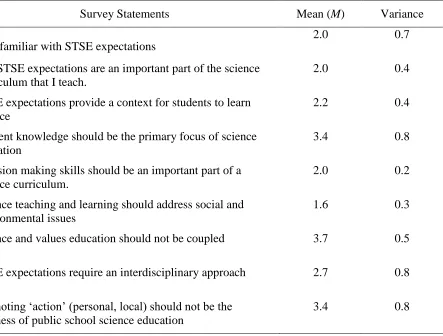
Based on the survey results (Table 2) it appears that respondents feel that: (a) the STSE expectations are important in their science teaching and (b) provide a context for student learning. Further, (c) respondents viewed science teaching as more than the transmission of content; (d) science teaching should include opportunities for decision-making, (e) for consideration of social and environmental issues, (f) for consideration of values, and (g) for taking action to solve problems. This is a general acknowledgement, on the part of the respondents, of the role importance of STSE in science education and a possible (though likely slow) shift in direction away from the traditional science pedagogy described earlier.
Table 2. Survey results showing trends as reported by secondary science teachers
Survey Statements Mean (M) Variance
I am familiar with STSE expectations
2.0 0.7
The STSE expectations are an important part of the science curriculum that I teach.
2.0 0.4
STSE expectations provide a context for students to learn science
2.2 0.4
Content knowledge should be the primary focus of science education
3.4 0.8
Decision making skills should be an important part of a science curriculum.
2.0 0.2
Science teaching and learning should address social and environmental issues
1.6 0.3
Science and values education should not be coupled 3.7 0.5
STSE expectations require an interdisciplinary approach 2.7 0.8
Promoting ‘action’ (personal, local) should not be the business of public school science education
3.4 0.8