Improving continuing medical education by enhancing interactivity:
lessons from Iran
SEYED ALIAKBAR FAGHIHI1, HAMID REZA KHANKEH2,3, SEYED JALIL HOSSEINI4, SEYED
KAMRAN SOLTANI ARABSHAHI5, ZAHRA FAGHIH6, SAGAR V. PARIKH7, MANDANA SHIRAZI3,8*
1Department of Medical Education, Iran University of Medical Sciences, Tehran, Iran; 2Department of Health in Emergency and Disaster, University of Social Welfare and Rehabilitation Sciences, Tehran, Iran; 3Department of Clinical Science and Education, Karolinska Institute, Stockholm, Sweden; 4Infertility & Reproductive Health Research Center, Shahid Beheshti University of Medical Sciences, Tehran, Iran; 5Department of Medical Education, Faculty of Medicine, Iran University of Medical Sciences, Tehran, Iran; 6Shiraz Institute for Cancer Research, School of Medicine, Shiraz University of Medical Sciences, Shiraz, Iran; 7University of Toronto, University Health Network, Canadian Network for Mood and Anxiety Treatments, Toronto Western Hospital, Toronto, ON, Canada; 8Research Deputy of Medical Education Department, Tehran University of Medical Sciences, Tehran, Iran
Introduction: Continuing Medical Education (CME) has been considered as a lifelong commitment for doctors to provide the optimal care for patients. Despite a long history of creating CME programs, outcomes are far from ideal. The present qualitative study aims to clarify the barriers affecting effectiveness of the CME programs in Iran based on the experiences of general practitioners.
Methods: Sixteen general practitioners were recruited to
participate in in-depth interviews and field observations
concerning experiences with CME. The study was performed using a qualitative content analysis method. The codes, categories and themes were explored through an inductive process in which
the researchers moved from specific to general.
Results: The participants’ experiences identified a number of barriers, particularly insufficient interaction with the
instructors; additional problems included the teachers’ use of an undifferentiated approach; unreal and abstract CME; and ignorance of the diverse reasons to participate in CME.
Conclusion: Based on the study results, there are multiple barriers to effective implementation of CME in Iran. The key barriers include
insufficient interaction between the trainees and providers, which
must be considered by other stakeholders and program designers. Such interactions would facilitate improved program design, invite
more specific tailoring of the education to the participants, allow for
more effective educational methods and set the stage for outcome evaluation from the learners actually applying their new knowledge
in practice. Replication of these findings with another sample would improve confidence in these recommendations, but these findings are broadly consistent with findings in the educational literature on improving the efficacy of CME.
*Corresponding author:
Mandana Shirazi,
Research Deputy of Medical Education Department, Tehran University of Medical Sciences, Tehran, Iran
Tel/Fax: +98 21 88955712
Email: mandana.shirazi@ ki.se
Please cite this paper as:
Faghihi SAA, Khankeh HR, Hosseini SJ, Soltani Arabshahi SK, Faghih Z, Parikh SV, Shirazi M. Improving continuing medical education by enhancing interactivity: lessons from Iran. J Adv Med Educ Prof. 2016;4(2):54-63. Received: 19 December 2015 Accepted: 24 January 2016
Keywords: Continuing medical education; General practitioners; Qualitative study
Original Article
Journal of Advances in Medical Education & Professionalism
A
bs
tr
ac
t
Introduction
T
he emergence of new information andtechnologies has necessitated medical
(1, 2). Continuing Medical Education (CME), as a part of a developed system of worldwide health services, has been approved as an approach for changing the behavior of physicians in solving diagnostic and medical problems within health systems (3). Developing both quantity and quality in CME has long been a focus of close attention for academic centers and accreditation institutes (4, 5).
For the individual physician, participating in CME is considered as one of the fundamentals of medical professionalism, requiring a lifelong commitment (6). Despite setting broad goals for CME to bring doctors’ clinical knowledge up to date, numerous medical errors are still observed, which is far from the desired outcomes anticipated from CME in the practice (7). Medical education experts believe that the effectiveness of CME in doctors’ changing behaviors could be achieved through interaction in continuing education activities. Compared with the traditional lecture-based methods, interactive approaches were actually more effective in conveying new information and making changes in doctors’ behavior (5, 8-9). However, because of the ease, lower cost, and familiarity of holding traditional lecture-format CME events, most programs are currently held in the traditional manner where interactivity is limited (10).
CME programs in Iran are compulsory and usually involve traditional approaches (11, 12). Once graduating from medical schools after seven years, general practitioners work in different
fields such as clinics, hospitals, emergency rooms,
and medical health networks. They must gain
125 CME credit points for a period of five years,
25 points per year, to be able to continue their
careers, which can be obtained in different ways
(13). Studies have identified, in a preliminary way,
various problems with Iranian CME activities: lack of coordination between the programs and
the field of activity; insufficient attention to
professional demands and the educational content; inappropriate teaching styles; and ineffective programs (13-17). According to our knowledge, most studies conducted in Iran related to CME have quantitative approaches; a few qualitative studies can be found to report the barriers on the effectiveness of CME programs. In response, the present study was designed to clarify the barriers affecting effectiveness of the CME programs in Iran, based on experiences and perceptions of general practitioners.
Methods
The present study was conducted in Fars province, which is home to one of the major medical educational centers in south of Iran. Educational institutions in Shiraz, the capital of Fars Province, have major responsibility for training expert personnel for health who provide treatment both in Shiraz and neighbor towns including Jahrom. The study participants were selected using the purposive sampling method. The inclusion criteria was participating in CME programs on a permanent basis, with maximum
variety in terms of work fields such as in clinics,
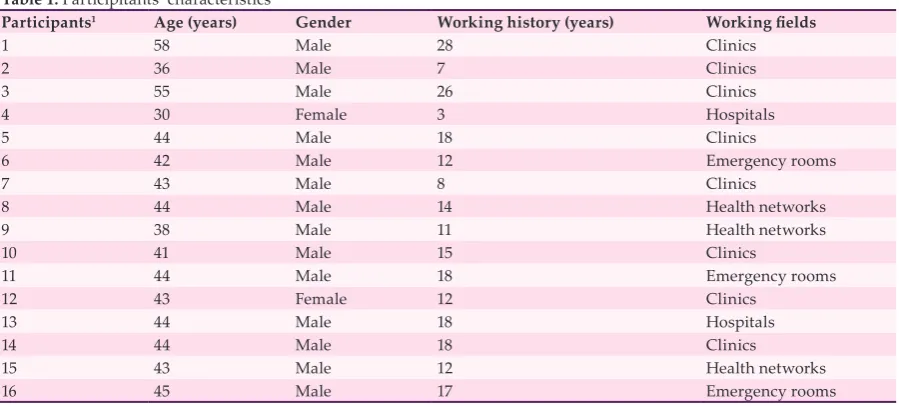
hospitals, Emergency Rooms (ER), and medical health networks. Accordingly, interviews were conducted with14 male and 2 female general practitioners with an age range of 30 to 58 (mean= 43.4 years) and an average of 14.8 years of employment (Table 1).
The data of the study were directly collected
Table 1: Participitants’ characteristics
Participants1 Age (years) Gender Working history (years) Working fields
1 58 Male 28 Clinics
2 36 Male 7 Clinics
3 55 Male 26 Clinics
4 30 Female 3 Hospitals
5 44 Male 18 Clinics
6 42 Male 12 Emergency rooms
7 43 Male 8 Clinics
8 44 Male 14 Health networks
9 38 Male 11 Health networks
10 41 Male 15 Clinics
11 44 Male 18 Emergency rooms
12 43 Female 12 Clinics
13 44 Male 18 Hospitals
14 44 Male 18 Clinics
15 43 Male 12 Health networks
16 45 Male 17 Emergency rooms
from the experiences of the study participants. The codes, categories and themes were explored through an inductive process, in which the
researchers moved from specific to general. The
consequently formulated concepts or categories were representative of the participants’ experiences. The researcher participated in some
traditional CME programs, being a firsthand
witness to the interaction between participants, instructors, and program providers. The data were collected from 2013 to 2014 for two years. In the beginning, semi-structured, in-depth
interviews as well as field notes were used as
the strategy of data gathering. The purposive sampling continued until the saturation was reached, i.e. no further information was obtained for the resulted concept. Each interview took an average time of 45 minutes, which was carried
out by the first author in Persian, and was
literally transcribed. Content analysis was done based on the Persian data prior to translation into English. The interview guide included a short list of general questions e.g. “How do you describe your recent experience of taking part in a CME program?” and “What kind of problems you experienced during CME program?” The questions were followed with respect to the subjects’ experiences in CME; for instance, they were asked to give more examples or clarify their reasons to describe the topic mentioned in the question. The interviews were listened by the principal investigator for several times until an overall idea was obtained and ambiguities were resolved by checking the transcript data with participants soon after the interview or simultaneous at the time of interview. Then, the meaning units and parts of data, which were directly related to the research question, were
identified. Subsequently, the data analysis was
performed based on Graneheim et al. (18). To
find similarities and differences, the preliminary
codes were read for several times and compared. Finally, the categories and subcategories were developed and integrated to the themes. Rigor
The credibility of the data was established by the triangulation strategy, which uses a specialized team combination to examine the
findings. Besides semi-structured interviews,
note taking during interviews and prolonged engagement with data during the past two years were used for data credibility (19). Moreover, the data dependability was assessed, using both peer-and member-checking (20). The primary
findings of the study along with the preliminary
codes and categories were presented to some
of the participants, and their opinions were received (member checking). Some parts of the data were analyzed by other colleagues who were not involved in the study (peer checking) in which the similarities with the current analysis came into view (18). In addition, the
findings were repeatedly assessed and checked
by supervisors (expert checking). The evidence from other studies, ideas by other researchers and documentation of the study helped to
improve the confirmability (21). Finally, by
providing a comprehensive description of the topics, participants, data collection and analysis procedures, and limitations of the study, we hope to have created transferability so that other researchers may clearly follow the research process taken by the researchers (19-20). Ethical approval
This study was approved by the Ethics Committee of Iran University of Medical Sciences (ref. no. 94/d/105/474) and informed consent was taken from all participants. At the beginning of the interview, the participants were acquainted with the purpose of the study, method
of interviewing, privacy, and confidentiality of
the study. The interviews were done individually, all in the places suggested by the interviewees such as a hospital or clinic at an agreed time. The interviewees were allowed to leave the study at any possible time.
Results
In the present study, regarding the barriers
influencing the effectiveness of CME programs,
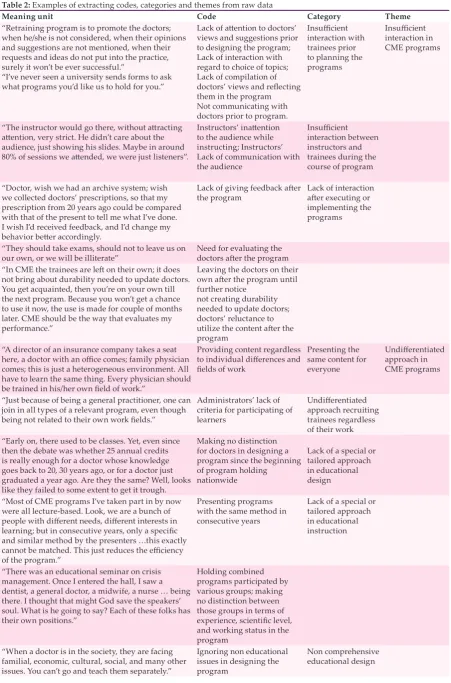
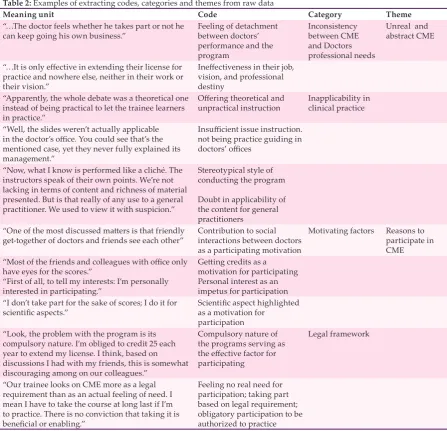
the experiences and perceptions of general practitioners were explored. As presented in Table 2, according to data analysis, four themes containing several major categories and codes
were extracted including insufficient interaction,
undifferentiated approach, unreal and abstract CME, and reasons of participation in CME programs. Each theme is described in more details below.
Insufficient interaction in CME programs The participants’ experiences indicated that there were no enough interactions among the trainers, the trainees, and the providers in CME programs. This concept, which was frequently observed in our results, containing three more related sub-concepts including providers’
insufficient interactions with trainees prior to the program planning, insufficient interactions
Table 2: Examples of extracting codes, categories and themes from raw data
Meaning unit Code Category Theme
“Retraining program is to promote the doctors; when he/she is not considered, when their opinions and suggestions are not mentioned, when their requests and ideas do not put into the practice, surely it won’t be ever successful.”
“I’ve never seen a university sends forms to ask what programs you’d like us to hold for you.”
Lack of attention to doctors’
views and suggestions prior to designing the program; Lack of interaction with regard to choice of topics; Lack of compilation of
doctors’ views and reflecting
them in the program Not communicating with doctors prior to program.
Insufficient
interaction with trainees prior to planning the programs
Insufficient
interaction in CME programs
“The instructor would go there, without attracting attention, very strict. He didn’t care about the
audience, just showing his slides. Maybe in around
80% of sessions we attended, we were just listeners”.
Instructors’ inattention
to the audience while instructing; Instructors’ Lack of communication with the audience
Insufficient
interaction between instructors and trainees during the course of program
“Doctor, wish we had an archive system; wish we collected doctors’ prescriptions, so that my prescription from 20 years ago could be compared with that of the present to tell me what I’ve done. I wish I’d received feedback, and I’d change my
behavior better accordingly.
Lack of giving feedback after
the program Lack of interaction after executing or
implementing the programs
“They should take exams, should not to leave us on
our own, or we will be illiterate” Need for evaluating the doctors after the program “In CME the trainees are left on their own; it does
not bring about durability needed to update doctors. You get acquainted, then you’re on your own till the next program. Because you won’t get a chance to use it now, the use is made for couple of months later. CME should be the way that evaluates my performance.”
Leaving the doctors on their
own after the program until
further notice not creating durability needed to update doctors; doctors’ reluctance to
utilize the content after the
program “A director of an insurance company takes a seat
here, a doctor with an office comes; family physician
comes; this is just a heterogeneous environment. All have to learn the same thing. Every physician should
be trained in his/her own field of work.”
Providing content regardless
to individual differences and fields of work
Presenting the same content for everyone
Undifferentiated
approach in CME programs
“Just because of being a general practitioner, one can join in all types of a relevant program, even though
being not related to their own work fields.”
Administrators’ lack of criteria for participating of learners
Undifferentiated
approach recruiting trainees regardless of their work “Early on, there used to be classes. Yet, even since
then the debate was whether 25 annual credits is really enough for a doctor whose knowledge goes back to 20, 30 years ago, or for a doctor just graduated a year ago. Are they the same? Well, looks like they failed to some extent to get it trough.
Making no distinction for doctors in designing a program since the beginning of program holding
nationwide
Lack of a special or tailored approach in educational design
“Most of CME programs I’ve taken part in by now were all lecture-based. Look, we are a bunch of
people with different needs, different interests in learning; but in consecutive years, only a specific
and similar method by the presenters …this exactly
cannot be matched. This just reduces the efficiency
of the program.”
Presenting programs with the same method in consecutive years
Lack of a special or tailored approach in educational instruction
“There was an educational seminar on crisis management. Once I entered the hall, I saw a dentist, a general doctor, a midwife, a nurse … being there. I thought that might God save the speakers’ soul. What is he going to say? Each of these folks has their own positions.”
Holding combined programs participated by various groups; making no distinction between those groups in terms of
experience, scientific level,
and working status in the program
“When a doctor is in the society, they are facing familial, economic, cultural, social, and many other issues. You can’t go and teach them separately.”
Ignoring non educational issues in designing the program
Insufficient interaction with trainees prior to planning the program
Based on experiences of the participants, the doctors, as major audiences, not only were excluded from CME program development, but also their opinions and suggestions were not considered. In fact, there was no collaboration between the participants and the providers which reduces the effectiveness of the CME program
For instance, participant No. 14 said that
“Retraining program is to promote the doctors;
when he/she is not considered, when their opinions and suggestions are not mentioned, when their requests and ideas won’t be put into the practice, surely it won’t be ever successful.”
Insufficient interaction between instructors and trainees during the course of program
In addition to age and gender, the participants
in the CME programs were very heterogeneous
in terms of professional experiences, work fields, and scientific levels. These disparities result in
a reduced interaction between participants and instructors, leaving a deterrent effect on the former. Participant No. 4 said, “It might be the case that a participant, twenty years older than
me, asks some questions that I might find them
funny, or vice versa, I ask some questions that he
might find them funny because of having more
experience.”
On the other hand, passive methods in teaching such as lecturing and one-sided discussion by the instructors usually leave no rooms for questions and answers or further explanations and laying inadequate ground for involvement of trainees in the discussions.
In line with this, participant No. 9 mentioned,
“Mostly, the workshops and seminars we Table 2: Examples of extracting codes, categories and themes from raw data
Meaning unit Code Category Theme
“…The doctor feels whether he takes part or not he
can keep going his own business.” Feeling of detachment between doctors’ performance and the program
Inconsistency between CME and Doctors professional needs
Unreal and abstract CME
“…It is only effective in extending their license for
practice and nowhere else, neither in their work or their vision.”
Ineffectiveness in their job,
vision, and professional destiny
“Apparently, the whole debate was a theoretical one instead of being practical to let the trainee learners in practice.”
Offering theoretical and
unpractical instruction Inapplicability in clinical practice
“Well, the slides weren’t actually applicable
in the doctor’s office. You could see that’s the
mentioned case, yet they never fully explained its management.”
Insufficient issue instruction.
not being practice guiding in
doctors’ offices
“Now, what I know is performed like a cliché. The instructors speak of their own points. We’re not lacking in terms of content and richness of material presented. But is that really of any use to a general practitioner. We used to view it with suspicion.”
Stereotypical style of conducting the program
Doubt in applicability of the content for general practitioners
“One of the most discussed matters is that friendly
get-together of doctors and friends see each other” Contribution to social interactions between doctors as a participating motivation
Motivating factors Reasons to participate in CME
“Most of the friends and colleagues with office only
have eyes for the scores.”
“First of all, to tell my interests: I’m personally interested in participating.”
Getting credits as a
motivation for participating Personal interest as an impetus for participation “I don’t take part for the sake of scores; I do it for
scientific aspects.” Scientific aspect highlighted as a motivation for
participation “Look, the problem with the program is its
compulsory nature. I’m obliged to credit 25 each year to extend my license. I think, based on discussions I had with my friends, this is somewhat discouraging among on our colleagues.”
Compulsory nature of the programs serving as
the effective factor for
participating
Legal framework
“Our trainee looks on CME more as a legal requirement than as an actual feeling of need. I mean I have to take the course at long last if I’m to practice. There is no conviction that taking it is
beneficial or enabling.”
participated were made up of a group of listeners with just one speaker. At the end, we would ask a couple of questions. It was not like this that someone maneuvered in the middle of the discussion to expand it. That has not been the method up to now.”
Lack of interaction after executing or implementing the CME programs
In the participants’ opinion, carrying out a program without following up and monitoring was not considered as CME. They said that they were left on their own from the end of one program until the next, and no follow up was done by the providers regarding the modifying or revising their clinical performances. They believed that, in the long time, this has led to the outdated knowledge of the more experienced physicians.
Participant No. 1 said that “We wish we had an archive system, collected doctors’ prescriptions, so that my prescription from 20 years ago could be compared with that of the present to tell me what I’ve done. I wish I’d received feedback, and I’d change my behavior better accordingly.”
Some participants emphasized the necessity of examining and monitoring the performance to enhance the clinical practice.
Similarly, participant No. 5 added: “… We’d rather be considered not left on our own. By the end of a seminar, we’d rather not be told to wait until further notice. If they leave us alone, we’ll be illiterate. If you look at veteran doctors, you realize they are well behind the times, knowing
only four or five medication items. Nevertheless,
if we, doctors, are constantly demanded, we will be brought up more knowledgeable. Anyway, if we take a pretest and to be monitored afterwards, we think it will be much better.”
Undifferentiated approach in CME programs An undifferentiated CME program was another major barrier derived from our analysis. Based on the experiences and perceptions of participants, the same program with the similar content and methodology, irrespective
of individual differences such as work fields,
motives, and needs, is designed and conducted to instruct all target groups. This could be described by four relevant sub-concepts: presenting the same content for everyone, undifferentiated approaches in recruiting trainees regardless of
their work fields, unique approach in designing
a program, and a unique approach in instruction. Presenting the same content for everyone
The participants believed that the presented contents did not correspond to items such as
differences in the work fields, scientific level of
the audiences, and professional experiences of the participants, and actually, the same content was presented to everyone in practice.
Participant No. 3 stated that “A director of an insurance company takes a seat here, a doctor
with an office comes; a family physician comes;
this is just a heterogeneous environment. All have to learn the same thing. Every physician should
be trained in his/her own field of work.”
Undifferentiated approaches in recruiting trainees regardless of their work fields
Doctors participate in a program just because of being a doctor. In fact, no rules are proposed by the providers for learners’ participation in the program.
This is evident from what participant No. 15 said: “Just because of being a general practitioner, one can join all types of relevant programs, even though not being related to their
own work fields.”
Lack of a special or tailored approach in educational design
According to participants experiences, another problem was provision of integrated programs in which other health professions such as specialists, nurses, midwives, and so on, were present whilst their work status was not taken into account, so the mentioned program was not
properly efficient for participants which resulted
in their dissatisfaction.
That is why participant No. 13 stated:
“There was an educational seminar on crisis management. Once I entered the hall, I saw a dentist, a general practitioner, a midwife, a nurse … being there. I thought that might God save the speakers’ soul. What is he going to say? Each of these folks has their own positions.”
Lack of a special or tailored approach in educational instruction
Applying a similar methodology to train various types of CME programs was one particular issue at the center of the most participants’ attentions. In their opinions, the fact that everyone receives training through the same methodology led to ineffectiveness of the programs to a large extent.
Participant No. 2 said: “Most of CME programs I’ve taken part in by now were all lecture-based. Look, we are a bunch of people with different needs, different interests in learning, but in
consecutive years, only a specific and similar
method by the presenters … This just reduces
Unreal and abstract CME
It was presumed by the participants in the study that the CME was unreal, which denotes its ineffectiveness in both clinical practice and improvement of doctors’ performances. As
clarified below, it can be illustrated by three
associated sub-concepts: inapplicability in clinical practice; inconsistency between CME and doctor’s professional needs; and non-comprehensive educational design.
Inapplicability in clinical practice
Based on the doctors’ experiences, the materials were specialty-based and limited to general issues or, sometimes, outside the general practitioners’
expertise area, and/or not sufficient to resolve the
doctors’ forthcoming working problems.
In connection with this, participant No. 13 mentioned, “The person who’s come to give a speech, only has given all general and specialized issues, but when it comes to the treatment part, he has not said anything. Forget about the formalities; when a session was over, I said ‘we didn’t get the knack.’”
Inconsistency between CME and doctors’ professional needs
Doctors’ experiences showed that for the time being, CME had no effects on their future work, and they did not believe that it brought any particular capabilities or any improvements in curing the patients. Actually, CME does not go hand in hand with clinical practice, thus remaining detached from their professional needs.
In fact, it is seen in the words of participant no. 6:“Now we know where the problem is. Now the errors in doctors’ prescriptions are brought into their notice. If now we put the previous formulated blocks from ten years ago, this is abstract. The doctor feels whether he takes part or not; he can keep on going his business.”
Non-comprehensive educational design
Based on their experiences, doctors did not live in a vacuum; their practice is affected by external surroundings including livelihood as well as social, political and cultural pressures, whereas CME merely focuses on clinical issues. In their opinions, this type of education is an abstract, and one-dimensional one.
Again, participant No. 3 added, “When a doctor is in the society, they are facing familial, economical, cultural, social, and many other issues. You can’t go and teach them separately.”
Reasons to participate in CME
As mentioned earlier, reasons to participate in
CME constituted another concept derived from the analysis. Doctors’ reasons to participate in CME were composed of a spectrum ranging from mere motivation and performance improvement to simply earning the permit to get the credits to
extend the relicensure in the fulfillment of legal
frameworks. This is delineated by two associated concepts: motivating factors and legal frameworks. Motivating factors
No physician is willing to be in the dark about state of the innovations in the medical sciences. All of them are interested in learning about advances in the area of their expertise.
This brings participant No. 12 to acknowledge that: “At first, to mention my interest; I was
interested to participate. I liked to see what sorts of developments have happened, whether they are new or not. I took part because I was looking forward to this stuff.”
Legal frameworks
One of the issues that the majority of participants laid emphasis on was the compulsory presence in CME to get their licensure, which provoked displeasure and dissatisfaction with the programs and the lack of importance for them.
For instance, participant No. 16 said that “Our trainee’s view towards CME is more a legal requirement rather than a feeling of need; I mean that if I want to practice medicine, I have to go through the course. There is no belief that taking
the course has any benefits for him or provides an
advantage or a capability in any sense.”
Discussion
The present study was conducted to explore, based on the general practitioners’ experiences, the barriers of CME programs effectiveness. Results of the study revealed four main concepts
including insufficient interaction in CME
programs, an undifferentiated approach, unreal and abstract CME, and reasons to participate in CME as the main barriers.
According to the study results, the first and
one of the most important barriers affecting the
effectiveness of CME programs is insufficient
interactions, which has been more explored with
some related sub-concepts including insufficient
interactions between the trainees and providers before planning the program, during the program, and after carrying out the CME programs.
Insufficient interaction refers to inadequate
mutual communication or negotiation during planning the programs. Besides little discussion and/or question and answer in the course of the
the participants are left on their own until the next program.
Gratini, et al. (2011) argue that interaction and applicability are two major factors involved in the effectiveness of CME programs in terms of changing doctors’ behaviors (9). Moreover, Shirazi, et al. (2013) showed that limited interaction as well as inapplicability of the topics with GP’s workplace needs covered in CME programs are the reasons of doctors’ dissatisfaction with the programs (12). Making an effective program begins with involving the target audience in the planning of the CME. Here, we found that the trainees did not have any collaboration with the providers in designing or planning the programs. In addition, Wisenberg, et al. (2002) stated that there was a specialist vision dominancy through the program planning in designing. In short, the program is teacher-focused rather than student-focused. In most CME programs, specialists are involved as trainers; the difference between their views in providing the appropriate educational content and what the general practitioners demand leads to more dissatisfaction of the latter with the programs, particularly when no negotiations or collaborations are between the instructors and the trainees (22). However, more studies are needed to investigate the relationship between doctors’ dissatisfaction and reduced effectiveness of the programs. Beyond being excluded from planning,
our respondents identified problems at the next
level, namely during the CME events themselves,
insufficient interaction during instruction means
less discussion on the issues and less interchange of clinical experience, which resulted in low program effectiveness. This is consistent with the
findings of Davis, et al. (2008) denoting reduced
effectiveness of the programs when they are passively conducted (5).
Another relevant concept is lack of interaction between the trainees and providers after the program termination. It means that there is no place for discussion; the participants are left on their own. No evaluations of the trainer’s performance are done, and the trainees are not given any feedback.
The use of an undifferentiated approach is the second major barrier associated with CME programs. An undifferentiated approach involves several aspects: recruiting trainees irrespective of
their work fields, presentation of similar content
to all trainees, and lack of a special or tailored approach in the educational design and instruction. More explicitly, the participants noted that an undifferentiated approach in CME also refers to ignoring participants’ needs, motivations, and also differences among the individuals as well as
work fields. As a result, everyone will be trained
in the same way and taught the same subjects despite having different needs and learning styles
(1). However, as the present findings indicated, no
criteria is applied by the providers for recruiting the participants, and the same content through the same methodology is presented to all trainees regardless of their professional differences and
scientific levels. Undoubtedly, presence of a
patriarchic approach in the programs planning in the designing of educational materials without inclusion of doctors’ needs and expectations could be a proper explanation for the present
findings (23), which in turn, seems to pave the way for insufficient interest of the audiences
and render CME unimportant in the trainees’ views. A glance at the literature reveals that the dominant teaching methodology in majority of the CME programs is lecture-based; and even the administrators make no distinctions in giving grades to those paid attention to the programs and those who did not (23-24).
Unreal and abstract CME is another major barrier derived from the present study, encompassing several sub-concepts including inapplicability in clinical practice, non-comprehensive educational design, and inconsistency between CME and doctors’ professional needs. It denotes an inapplicable, and non-comprehensive educational design, which has no effects on the professional needs of the doctors. In fact, the predominance of an academic approach and a heavily specialist-oriented presentation in CME precede inconsistency between the presented content and general practitioners’ professional requirements (22). In addition, the educational contents are not useful for general practitioner performances and services, which should be provided for the patients. Therefore, as noted earlier, interaction would be an overriding factor to improve the effectiveness of programs and applicability of the educational content in the practice (9, 12).
Another major concept inferred from the study is the doctors’ reasons to participate in CME programs with two related sub-concepts: motivational factors and legal frameworks.
Participants believed that this finding, in
be still prioritized over professional exchanges. Davis, et al. (2008), believes that acceptance of CME credits as a legal framework to get the relicensure by accreditation institutes has diverted CME from its proposed aims and reduced its level to the plain credit for the doctors (5). This stands
in line with our findings, which demonstrates that
getting the credits is the only reason for some physicians to participate in the programs. Another important role for CME, namely improving the socialization and peer interactions between attendees, is not considered as an educational goal for the programs participants. This lack of attention to the social purposes of CME which in turn facilitates learning by peer-to-peer discussion could to some extent reduce program effectiveness (5).
Conclusion
The present study illustrated the main barriers standing in the way of traditional CME programs’ effectiveness in Iran. One of the leading problems derived from the participants’ experiences was
insufficient interactions between trainees and
providers in the planning, executing, and after implementation of the programs, all of which contribute to reduced effectiveness of the CME program and presumably reduces the chance for trainees to improve their clinical performance. Therefore, it is suggested that participants should be taken into account in the program by the providers not only in planning but also in teaching phases as active partners. We also need to design the programs that consider the differences among
individuals and their work fields. In addition,
identifying and responding to non-educational issues governing the performance of the physician can provide the circumstances to tailor CME to their professional needs. Improving clinical performance in practicing physicians in Iran thus requires many steps including involving the learner in the process, using interactivity at all stages, tailoring programs to meet actual clinical/ professional needs, and providing evaluation of outcomes of the learning to ensure a healthy feedback cycle in the educational process. Strength and Limitation
This is the first qualitative study based on
the perceptions and experiences of general practitioners, reporting more comprehensively the barriers to the CME programs effectiveness in Iranian context. Exploring the experience and perception of the people involved in the phenomenon and looking through the eyes of experienced participants can bring something new, and can help us to understand the
phenomenon under study. However, this kind of study has some limitations. First, the data were gathered through semi-structured interviews, so the results were more comprehensive and subjective. Second, in this study, we just tried to present the barriers of CME, and the process of CME, itself, was not explored; therefore, a grounded theory approach is recommended for further exploring of CME process in Iran. Authors’ Contributions
SAF and MSH designed, developed the concept of the study and analyzed the data in collaboration with HKH. All authors contributed
to critical revising and editing of the final version
of the manuscript and approved it for submission. Acknowledgements
The present study was a part of PhD thesis written by Seyed Aliakbar Faghihi, Department of Medical Education, Iran University of Medical Sciences. The authors would like to thank all general practitioners who participated in this study and spent their time to share their experiences through interviews.
Conflict of Interest: None declared. References
1. Chan KKW. Medical education: From continuing medical education to continuing professional
development. Asia Pacific Family Medicine.
2002;1(2-3):88-90. doi:10.1046/j.1444-1683.2002.00026.x. 2. Shojania KG, Silver I, Levinson W. Continuing
medical education and quality improvement: a match made in heaven? Ann Intern Med. 2012;156(4):305-8. doi:10.7326/0003-4819-156-4-201202210-00008. 3. Grol R. Changing physicians’ competence and
performance: finding the balance between the
individual and the organization. The Journal of continuing education in the health professions. 2002;22(4):244-51. doi:10.1002/chp.1340220409. 4. Yaman H. Continuing medical education in Turkey:
recent developments. BMC Med Educ. 2002;2:6. doi:10.1186/1472-6920-2-6.
5. Davis N, Davis D, Bloch R. Continuing medical education: AMEE Education Guide No 35. Medical Teacher. 2008;30(7):652-66. doi:10.1080/01421590802108323.
6. Pohlmann G. Continuing medical education in Wisconsin: current status and future directions. WMJ. 2007;106(1):20-6.
7. Marinopoulos SS, Dorman T, Ratanawongsa N, Wilson LM, Ashar BH, Magaziner JL, et al. Effectiveness of continuing medical education. Evid Rep Technol Assess (Full Rep). 2007; 149:1-69.
Syst Rev. 2009; 2:1. doi:10.1002/14651858.CD003030. pub2.
9. Garattini L, Gritti S, De Compadri P, Casadei G. Continuing Medical Education in six European countries: a comparative analysis. Health policy. 2010;94(3):246-54. doi:10.1016/j.healthpol.2009.09.017. 10. Stephens MB, McKenna M, Carrington K. Adult
learning models for large-group continuing medical education activities. Fam Med. 2011;43(5):334-7. 11. Wentz DK. Continuing Medical Education: Looking
Back, Planning Ahead. USA: UPNE; 2011.
12. Shirazi M, Parikh SV, Dadgaran I, Silén C. Designing Effective CME—Potential Barriers to Practice Change in the Management of Depression: A Qualitative Study. Psychology. 2013;4:25. doi:10.4236/ psych.2013.411A005. Persian.
13. Shirazi M, Zeinaloo A, Sabouri Kashani A, Alaeddini F. Assessing the gap between current and desirable needs in TUMS CME Unit: participants’ viewpoints. Journal of Medical Education. 2004;5(1):17-23. Persian.
14. Haghani F, Shari`atmadari A, Naderi E, Yousefi A.
Teaching Methods Used by General Practitioners’ Continuing Education Programs in Isfahan University of Medical Sciences. Iranian Journal of Medical Education. 2003;3(2):15-21. Persian.
15. Vahidshahi K, Mahmudi M, Abbaskhanian A,
Shahbaznejhad L, Ranjbar M, Emadi A. Efficacy of
continuing medical education on knowledge of general practitioners. Koomesh. 2008;9(4):255-62. Persian. 16. Kousha A, Khoshnevis P, Sadeghzadeh M, Kazemi
N, Nourian A, Mousavinasab N. General physicians’ viewpoints on continuing education programs in Zanjan province. Iranian Journal of Medical Education. 2011;11(2):165-6. Persian.
17. Amirnia M, Mohammadi F, Vahidi RG, Mohammadzadeh M, Gojazadeh M, Hejazi SA, et al. General Practitioners’ Views toward Quality of Continuing Medical Education Programs in Tabriz. Iranian Journal of Medical Education. 2012;12(4):231-9. Persian.
18. Graneheim UH, Lundman B. Qualitative content analysis in nursing research: concepts, procedures and measures to achieve trustworthiness. Nurse Educ Today. 2004;24(2):105-12. doi:10.1016/j. nedt.2003.10.001.
19. Beck CT. Qualitative research: the evaluation of its
credibility, fittingness, and auditability. West J Nurs
Res. 1993;15(2):263-6.
20. Lincoln YS. Emerging criteria for quality in qualitative and interpretive research. Qualitative inquiry. 1995;1(3):275-89.
21. Guba EG. Criteria for assessing the trustworthiness of naturalistic inquiries. ECTJ. 1981;29(2):75-91. 22. Winzenberg T, Higginbotham N. Factors affecting
the intention of providers to deliver more effective continuing medical education to general practitioners: a pilot study. BMC Med Educ. 2003;3:11. doi:10.1186/1472-6920-3-11.