Bridge to Success: Developing Library Services for Transfer Students
Margaret N. Gregor and Kelly R. McBride, Appalachian State University
A
ppalachian State University (ASU) is a public, compre-hensive, Master’s level institution located in rural North Carolina, with a 2016-17-student enrollment of 18,295 (Appalachian State University Fast Facts). Reflecting na-tional trends, ASU has experienced growth in transfer stu-dent enrollment over the past decade. Between 2006 and 2016, transfer enrollment increased from 768 to 1596 stu-dents and this figure is expected to increase. The majority enroll as sophomores and come to the University from com-munity colleges (Fall 2016 Transfer Student Talking Points). The impact of this transfer student enrollment is important for several reasons. At ASU, 33.2% of the 2015-16 graduation class began as transfers (Fall 20-16 Transfer Student Talking Points). Nationwide, 49% of students who graduated from four-year institutions in 2015-16 had been enrolled at a two-year institution during the previous ten years. About half of these students earned their bachelor’s degree within three years of enrollment at a two-year institu-tion (Nainstitu-tional Student Clearinghouse Research Center Snapshot Report, Spring 2017). In addition, the success of transfer students impacts other measures of institutional ac-countability such as retention, time to degree completion, grade point average (GPA), and job placement (Bailey, 2006).
The University libraries at ASU are recognized as con-tributing to the success of our transfer student population. Our library outreach to this group of students began with a realization that we needed to learn more about this increas-ing population, understand their needs, and collaborate with other units serving them. This awareness did not occur quickly and is still being developed. We are beginning to see that partnerships with campus units are having an impact on our work with this important population.
Factors That Contribute To Transfer Student Success
There are a number of factors influencing transfer stu-dent success at receiving four-year institutions. Among these are GPA upon transfer (Carlan & Byxbe, 2000; Luo, Williams, & Vieweg, 2007; Zhai & Newcomb, 2000), the desire to attain a higher degree (Wang, 2009; Zhai & New-comb, 2000), the number of credit hours that transfer (Luo, et al., 2007), and transfer preparedness in the form of coun-seling, advice from faculty and staff, and an understanding of the academic requirements for upper level college cours-es (Berger & Malaney, 2003). However, none of thcours-ese fac-tors ensures a seamless adjustment to a four-year environ-ment. Transfer students need to feel that they fit at their new college or university. They must integrate into the academic life of the institution, establish positive relationships with
faculty members, and find a place in collegiate social activi-ties to ensure success at their new school (Wang & Whar-ton, 2010). Their level of social and academic integration into a four-year environment plays a major role in their per-sistence (D’Amico, Dika, Elling, Algozzine, & Ginn, 2014; Pascarella, Smart, & Ethington, 1986). Receiving institu-tions can facilitate the transfer process through well-crafted articulation agreements and academic advising. However, other institutional initiatives must be provided to enhance the success of these students (Miller, 2013).
Tinto and Pusser (2006) have studied the institutional initiatives that affect native student persistence and result in degree completion. Their research indicates that student retention, and ultimately graduation rates, are influenced by five factors. These include a commitment to student success on the part of the four-year institution; evidence of academ-ic, social, and financial support for students; and the provi-sion of programs that facilitated academic and social volvement in classes and campus activities. In addition, in-stitutions that help students understand institutional expecta-tions and that provide frequent feedback on academic per-formance tend to retain higher numbers of students. Finally, these researchers have noted that coordinated, integrated efforts developed across college units had the greatest im-pact on student success.
This study, and similar research, has helped administra-tors at four-year institutions understand the importance of designing transition programs with community colleges that facilitate the transfer admissions process. In addition, work has begun across admissions, student affairs, transfer center offices, academic departments, and other campus units to create resources that support and contribute to the retention of transfer students (Archambault, 2016). One unit that has become involved in fostering transfer student success at ASU is the academic library.
Library Support of Transfer Students
LOEX Quarterly Number 4
Staines’ (1996) research shows that there are differences in the ways community college and four-year librarians teach information literacy skills. There is often no formali-zation of information literacy instruction across two and four-year institutions. Nor is there systematic communica-tion between the librarians at these schools. Consequently, librarians at four-year institutions are unaware of the infor-mation literacy skills that transfer students have acquired or of instructional gaps that need to be filled. They may as-sume that transfer students have received some level of in-formation literacy instruction, but this is not always true. Unfortunately, some transfer students have not received instruction that prepares them for upper level research and may not possess the ability to apply information literacy skills to their assignments (Phillips & Atwood, 2010). This can have an impact on their retention and success.
Many university libraries offer formal information liter-acy programs within the first year that contribute to student retention. At ASU we offer a formal program of introducto-ry information literacy instruction targeting students en-rolled in their first year seminar requirement and also their first year writing courses. However, these programs may not offer the same level of instruction to their transfer popula-tion (Heinbach, 2016). At ASU we have found this to be the case. In 2014, librarians hosted a one-day workshop, “Information Literacy for Transfer Students,” and invited librarians from ASU’s top feeder schools, which included both community colleges and selected North Carolina four
-year institutions. The workshop’s goal was to share infor-mation about teaching inforinfor-mation literacy skills to first and second year students. This experience helped ASU librari-ans create relationships with librarilibrari-ans at institutions where our transfer students begin their education, share approaches and strategies for teaching information literacy at our insti-tution, and consider the idea of working together to develop transfer students’ information literacy skills as they move between intuitions.
Although the ASU library does not offer a formal in-struction program for transfers, these students often receive intermediate information literacy instruction in second level required General Education courses. Depending on their major, transfers may receive advanced information literacy instruction in a required Senior Seminar Capstone course. In spite of these opportunities, librarians are concerned that transfer students may not have the basic skills to research effectively or understand the advantage of working with librarians.
Our librarians recognize that informal opportunities for instruction are also important to address the needs of our transfer population. Switzer (2008) has noted that one-on
-one research consultations are helpful to transfer students. We have found this to be the case at ASU and offer individ-ualized research assistance to transfer students at their point of need. This service is promoted in our instruction sessions, on our website, and in our LibGuides.
In addition to working within the University curriculum, librarians network with the Office of Advising and Orienta-tion, participate regularly in transfer orientation events, and serve as Faculty Transfer Mentors. We have designed a Lib-Guide specifically for transfer students and market it as part of our regular interactions through the Office of Transfer Services. Finally, librarians support and participate in social events and services within the library and across campus to promote interaction among transfer students.
Strategies for Library/Campus Unit Collaboration
Our experience working with transfers has shown us that they want services and resources tailored to their needs. In order to achieve this it is useful to collaborate across campus units that have information about these students. This collaboration helps librarians create a meaningful pro-gram of services. It also provides opportunities to explain the correlation between library use and student success to student services personnel and administrators. Our efforts to develop campus partnerships have been effective at ASU. These relationships were developed using the approach out-lined below. We understand the need to take campus culture into account when establishing realistic goals and achieva-ble outcomes for any initiatives that may be undertaken.
Educate Yourself About the Characteristics and Needs of Your Transfer Student Population
Understanding the characteristics of your transfer stu-dent population is necessary in order to assess their need for library support. Examining data published by your Office of Institutional Research and reading journal articles that dis-cuss transfer students will help to identify the characteristics of this population. In addition, talking to staff and faculty who work with these students on your campus and librarians at your institution’s feeder schools will clarify what you glean from the literature.
Work within the Library
Gaining support for new initiatives among library ad-ministrators and colleagues is critical. Share what you have learned about your transfer population. You may find that other librarians have interesting perspectives on service pro-vision and information literacy instruction. Brainstorm ways that you can reach out to your transfer population.
Create Transfer Specific Library Resources such as LibGuides and Brochures, and Use Social Media
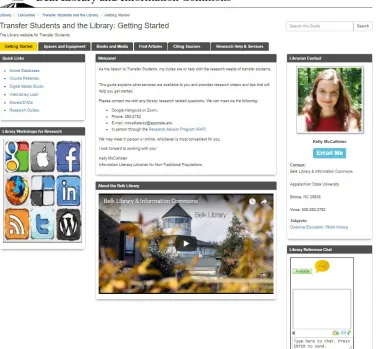
Communicating directly with your transfer students as a specialized population is important. Our work with transfers indicates they respond better to targeted communication about resources and services that recognize their role as a non-traditional population. Using focused LibGuides (see Figure 1), brochures and social media outlets can assist li-brarians in engaging this population.
Liaise with Campus Units Serving Transfer Students
Establishing relationships with personnel in campus units that serve transfer students is a first step in identifying common goals. Personnel in these units are invested in transfer student success and will appreciate your interest and perspective. Building these relationships may lead to oppor-tunities to participate in orientations, library instruction ses-sions, workshops, mentoring programs, and social events.
Market Your Information Literacy Program to Campus Units
Communicating with faculty about ways that your in-formation literacy program can enhance their course assign-ments and their students’ success is a vital contribution that librarians can make. Talk about the instructional needs of
transfer students in their classes. Offer to create LibGuides, help develop assignments, and meet individually with stu-dents needing research assistance.
Conclusion
Librarians at ASU offer services designed for our trans-fer population because we believe that library use and infor-mation literacy instruction contribute to student persistence and success. An important part of our work is our collabora-tive teaching of information literacy skills with faculty in writing-intensive courses, learning communities, and cap-stone courses, and our program of individualized research assistance for transfer students. Librarians also serve as mentors and sponsor social events that promote interaction among transfer students. We work actively with our Office of Transfer Services to market our services and resources to this population, to solicit feedback on the need for new ser-vices, and to conduct research on library services for trans-fer students.
The fact that ASU librarians hold faculty status contrib-utes to our success. We engage in faculty governance and serve on university-wide committees. Participation in these
(Bridge to Success...continued on page 15)
Figure 1: LibGuide – Transfer Students and
venues allows us to discuss the importance of information literacy instruction and library use. In addition, we have found that the relationships developed through committee work and faculty governance activities result in invitations to participate in workshops and conferences that typically do not involve librarians.
We recognize that we have more work to do to develop a comprehensive information literacy program for our trans-fer students, and know that we must evaluate our service provision to this population on a regular basis. We would like to make our outreach to transfer students intentional, deliberate, and purposeful. Our relationships and collabora-tive efforts across campus will help us to do this and will enhance our outreach to this important population.
References
Appalachian State University Facts (2017). Retrieved from
www.appstate.edu/about/facts/
Archambault, K. (2016). Collaborating across campus to support transfer students. In S.J. Handel & E. Strempel (Eds.), Transition and Transformation: Fostering Transfer Student Success (pp. 3-7). Dahlonega, GA: University of North Georgia Press.
Association of College and Research Libraries (2016). Documented library contributions to student learning and success: Building evidence with team-based assessment in action campus projects. Prepared by Karen Brown with contributions by Kara J. Malen-fant. Chicago: Association of College and Research Libraries. Retrieved from www.acrl.ala.org/value.
Bailey, T. R. (2006). Research on institution level practice for post-secondary student success. Washington, D.C.: National Postsec-ondary Education Cooperative (NPEC).
Berger, J.B. & Malaney, G.D. (2003). Assessing the transition of transfer students from community colleges to a university. NASPA Journal, 40(4), 1-23.
Bowles-Terry, M. (2012). Library instruction and academic success: A mixed-methods assessment of a library instruction program. Evi-dence Based Library and Information Practice, 7(1), 82-95.
Carlan, P.E. & Byxbe, F.R. (2000). Community colleges under the microscope: An analysis of performance predictors for native and transfer students. Community College Review, 28(2), 27-42. doi: 10.1177/009155210002800202
D’Amico, M.M., Dika, S.L., Elling, T.W., Algozzine, B., & Ginn, D.J. (2014). Early integration and other outcomes for community college transfer students. Research in Higher Education, 55, 370-399. doi: 10.1007/s11162-013-9316-5
Fall 2016 Transfer Student Talking Points Appalachian State Univer-sity – Main Campus. Retrieved from https://
transfersymposium.appstate.edu/sites/transfersymposium.appstate.edu/ files/Fall%202016%20Talking%20Points.pdf
(Bridge to Success...continued from page 12)
Grallo, J.D., Chalmers, M., & Baker, P.G. (2012). How do I get a campus ID? The other role of the academic library in student retention and success. Reference Librarian, 53(2), 182-193. doi:10.1080/02763877.2011.618787
Heinback, C. (2016). How one-shot library instruction is failing trans-fer students. In A. Hicks (Ed.), Got a minute? Instruction tune -up for time pressed librarians. (Chapter 5). Retrieved from
https://gotaminute.pressbooks.com/
Luo, M., Williams, J.E., & Vieweg, B. (2007). Transitioning transfer students: Interactive factors that influence first- year reten-tion. College and University, 83(2), 8-19.
Miller, A. (Summer 2013). Institutional practices that facilitate bache-lor’s degree completion for transfer students. New Directions for Higher Education, 162, 39-50. doi:10.1002/he.20055
Murray, A., Ireland, A., & Hackathorn, J. (2016). The value of aca-demic libraries: Library services as a predictor of student reten-tion. College & Research Libraries, 77(5), 631-642.
doi:10.5860/crl.77.5.631
National Student Clearinghouse Research Center (March 29, 2017). Snapshot Report-Contributions of Two-Year Public Institutions to Bachelor’s Completions at Four-Year Institutions. Retrieved from https://nscresearchcenter.org/snapshotreport
-twoyearcontributionfouryearcompletions26/
Pascarella, E.T., Smart, J.C., & Ethington, C.A. (1986). Long-term persistence of two-year college students. Research in Higher Education, 24, 47-71. doi:10.1007/BF00973742
Phillips, J.C., & Atwood, T.A. (2010). Transferring skills, transferring students: A call to academic libraries. College and Undergradu-ate Libraries, 17(4), 331-48.
doi:10.1080/10691316.2010.525394
Soria, K.M., Fransen, J., & Nackerud, S. (2013). Library use and un-dergraduate student outcomes: New evidence for students’ re-tention and academic success. Portal: Libraries and the Acade-my, 13(2), 147-164.
Staines, G. (1996). Moving beyond institutional boundaries: Percep-tions toward BI for transfer students. Research Strategies, 14(2), 93-107.
Stemmer, J.K., & Mahan, D.M. (2016). Investigating the relationship of library usage to student outcomes. College & Research Li-braries, 77(3), 359-375. doi:10.5860/crl.77.3.359
Switzer, A. (2008). Redefining diversity: Creating an inclusive aca-demic library through diversity initiatives. College and Under-graduate Libraries, 15(3), 280-200.
Tinto, V. & Pusser, B. (2006). Moving from theory to action: Build-ing a model of institutional action for student success. WashBuild-ing- Washing-ton, D.C.: National postsecondary Education Cooperative (NPEC).
Developed Questions:
The questions below are the original questions developed by the group. Each Librarian adapted and edited the questions to fit their own teaching style.
Using this source: What is it about?
1. The answers to the following questions will help you determine whether this source could be used for your research paper/ project.
a. What is this source about?
b. Is this source relevant for your research paper/project? Why or why not? c. What aspects of this source apply to your topic (You can be broad here)?
2. Where is this source “published?”
a. Is it published in a magazine, an online magazine, a blog, a journal or somewhere else?
b. Investigate this “publication.” What is its mission or purpose? What are the titles of other articles/posts in this “publication?” What is this “publication” about?
3. Who has written this source?
a. Google the author(s). What did you learn about them?
b. From what you found, can you say that this person has a professional background on this topic? Why or why not? c. From what you found, does this person have an official responsibility that is relevant to this topic? How do you
know that they have this responsibility?
d. From what you found, did this person learn about this topic in some other way? How did they learn about it? (Questioning Authority...continued from page 9)
A
PPENDIXWang, X. (2009). Baccalaureate attainment and college persistence of community college transfer students at four-year institutions. Research in Higher Education, 50, 570-588. doi:10.1007/s11162-009-9133-z
Wang, X. & Wharton, B. (2010). The differential patterns of college involvement between transfer and non-native students. Journal of the First Year Experience & Students in Transition, 22(1), 49-66.
Wong, S.H.R. and Cmor, D. (2011). Measuring association between library instruction and graduation GPA. College & Research Libraries, 72(5), 464-73.
Zhai, L., & Newcomb, L.H. (2000). Factors that influence transfer students academic performance and retention. Retrieved from ERIC database. (ED474482)
Zhong, Y., & Alexander, J. (2007). Academic success: how library services make a difference. In H.A. Thompson (Ed.), Sailing into the future: Charting our Destiny. Proceedings from the Associa-tion of College and Research Libraries 13th NaAssocia-tional Conference (pp. 141-157). Chicago: Association of College and Research Libraries.