Vol. 10, 2017, 1-9
ISSN: 2349-0632 (P), 2349-0640 (online) Published 11 December 2017
www.researchmathsci.org
DOI: http://dx.doi.org/10.22457/jmi.v10a1
1
Journal of
On the Hyperbola 2x
2-3y
2=23
Sharadha Kumar1 and M.A.Gopalan21
Deptarment of Mathematics, SIGC, Trichy-620002, Tamilnadu, India. e-mail: [email protected]
2
Department of Mathematics, SIGC, Trichy-620002, Tamilnadu, India. e-mail: [email protected]
Received 15 November 2017; accepted 4 December 2017
Abstract. The hyperbola represented by the binary quadratic equation 2x2−3y2 =23 is
analyzed for finding its non-zero distinct integer solutions. A few interesting relations among its solutions are presented. Also, knowing an integral solution of the given hyperbola, integer solutions for other choices of hyperbolas and parabolas are presented. Also, employing the solutions of the given equation, special Pythagorean triangle is constructed.
Keywords: Binary quadratic, Hyperbola, Parabola, Integral solutions, Pell equation. AMS Mathematics Subject Classification (2010): 11D09
1. Introduction
The binary quadratic Diophantine equations of the form ax2−by2 =N,
(
a,b,N≠0)
are rich in variety and have been analyzed by many mathematicians for their respective integer solutions for particular values of a,bandN . In this context, one may refer [1-13].This communication concerns with the problem of obtaining non-zero distinct integer solutions to the binary quadratic equation given by 2x2 −3y2 =23 representing hyperbola. A few interesting relations among its solutions are presented. Knowing an integral solution of the given hyperbola, integer solutions for other choices of hyperbolas and parabolas are presented. Also, employing the solutions of the given equation, special Pythagorean triangle is constructed.
2. Method of analysis
The binary quadratic equation representing hyperbola is given by 23
3
2x2 − y2 = (1)
Takingx= X +3T,y= X +2T (2) in (1), it simplifies to the equation
23 6 2
2 = −
T
X (3)
2
1
,
2
00
=
X
=
T
To obtain, the other solutions of (3), consider the pellian equation 1
6 2
2 = +
T
X (4)
whose smallest positive integer solution is 5 ~ , 2 ~ 0
0 = X =
T
The general solution (T~n,X~n)of (4) is given by
(
5 2 6)
, 0,1,2.... ~ 6 ~ 1 = + =+ T + n
Xn n n (5)
Since, irrational roots occur in pairs, we have
(
5 2 6)
, 0,1,2.... ~ 6 ~ 1 = − =− T + n
Xn n n (6)
From (5) and (6), solving for X~n,T~n ,we have
(
) (
)
nn n n f X 2 1 6 2 5 6 2 5 2 1
~ 1 1
= + + − = + +
(
) (
)
nn n n g T 6 2 1 6 2 5 6 2 5 6 2 1
~ 1 1
= + − − = + +
Applying Brahmagupta lemma between the solutions
(
T
0,
X
0)
and (T~n,X~n), the general solution(
T
n+1,
X
n+1)
of (3) is found to ben n
n X T T X
T +1 = 0~ + 0~
n n
n X X T T
X +1 = 0~ +6 0~
n n
n g f
T = +
⇒ +
6 2
1
1 (7)
n n
n f g
X 6
2 1
1 = +
+ (8)
Using (7) and (8) in (2) we have
n n
n n
n X T f g
x 6 2 15 2 7 3 1 1
1 = + + + = +
+ (9)
n n
n n
n X T f g
y 6 7 2 5 2 1 1
1 = + + + = +
+ (10)
Thus, (9) and (10) represent the integer solutions of the hyperbola (1). A few numerical examples are given in the following table 1.
Table 1: Examples
n
1
+
n
x
y
n+1On the Hyperbola 2x-3y =23
3 Recurrence relations for xand y are:
...
1
,
0
,
1
,
0
10
2 13
−
++
+=
=
−
+
x
x
n
x
n n n...
1
,
0
,
1
,
0
10
2 13
−
++
+=
=
−
+
y
y
n
y
n n nA few interesting relations among the solutions are given below:
•
x
n+2−
5
x
n+1−
6
y
n+1=
0
•
5
x
n+2−
x
n+1−
6
y
n+2=
0
•
49
x
n+2−
5
x
n+1−
6
y
n+3=
0
•
x
n+3−
49
x
n+1−
60
y
n+1=
0
•
x
n+3−
x
n+1−
12
y
n+2=
0
•
49
x
n+3−
x
n+1−
60
y
n+3=
0
•
49
x
n+1+
60
y
n+1−
x
n+3=
0
•
4
x
n+1+
5
y
n+1−
y
n+2=
0
•
40
x
n+1+
49
y
n+1−
y
n+3=
0
•
x
n+1+
6
y
n+2−
5
x
n+2=
0
•
4
x
n+1+
49
y
n+2−
5
y
n+3=
0
•
6
y
n+3+
5
x
n+1−
49
x
n+2=
0
•
y
n+3−
40
x
n+1−
49
y
n+1=
0
•
5
x
n+3−
49
x
n+2−
6
y
n+1=
0
•
x
n+3−
5
x
n+2−
6
y
n+2=
0
•
5
x
n+3−
x
n+2−
6
y
n+3=
0
•
49
x
n+2+
6
y
n+1−
5
x
n+3=
0
•
4
x
n+2+
y
n+1−
5
y
n+2=
0
•
y
n+3−
8
x
n+2−
y
n+1=
0
•
y
n+1+
8
x
n+2−
y
n+3=
0
•
4
x
n+2+
5
y
n+2−
y
n+3=
0
•
4
x
n+3+
5
y
n+1−
49
y
n+2=
0
•
40
x
n+3+
y
n+1−
49
y
n+3=
0
•
4
x
n+3+
y
n+2−
5
y
n+3=
0
•
5
y
n+3−
y
n+2−
4
x
n+3=
0
4
[
(
3 3 3 4) (
1 2)
]
5 53 3 5 53 23 1 + + ++ − n + n − n
n x x x
x
[
(
525 3 3 5 3 5) (
3525 1 5 3)
]
3001
+ +
+
+ − n + n − n
n x x x
x
[
(
28 3 3 30 3 3) (
328 1 30 1)
]
231
+ +
+
+ − n + n − n
n y x y
x
[
(
260 3 3 30 3 4) (
3260 1 30 2)
]
1151
+ +
+
+ − n + n − n
n y x y
x
[
(
2572 3 3 30 3 5) (
32572 1 30 3)
]
11271
+ +
+
+ − n + n − n
n y x y
x
[
(
3150 3 4 318 3 5) (
33150 2 318 3)
]
1381
+ +
+
+ − n + n − n
n x x x
x
[
(
28 3 4 318 3 3) (
328 2 318 1)
]
1151
+ +
+
+ − n + n − n
n y x y
x
[
(
260 3 4 318 3 4) (
3260 2 318 2)
]
231
+ +
+
+ − n + n − n
n y x y
x
[
(
2572 3 4 318 3 5) (
32572 2 318 3)
]
1151
+ +
+
+ − n + n − n
n y x y
x
[
(
28 3 5 3150 3 3) (
328 3 3150 1)
]
11271
+ +
+
+ − n + n − n
n y x y
x
[
(
260 3 5 3150 3 4) (
3260 3 3150 2)
]
1151
+ +
+
+ − n + n − n
n y x y
x
[
(
2572 3 5 3150 3 5) (
32572 3 3150 3)
]
231
+ +
+
+ − n + n − n
n y x y
x
[
(
28 3 4 260 3 3) (
328 2 260 1)
]
921
+ +
+
+ − n + n − n
n y y y
y
[
(
28 3 5 2572 3 3) (
328 3 2572 1)
]
9201
+ +
+
+ − n + n − n
n y y y
y
[
(
260 3 5 2572 3 4) (
3260 3 2572 2)
]
921
+ +
+
+ − n + n − n
n y y y
y
Each of the following expressions represents bi-quadratic integer:
a)
[
(
1219
115
) (
4
53
5
)
1058
]
23
1
2 2 1 5 4 4 42
x
n+−
x
n++
x
n+−
x
n+−
b)
[
(
157500
1500
) (
4
525
5
)
180000
]
300
1
2 3 1 6 4 4 4On the Hyperbola 2x-3y =23
5
c)
[
(
694
690
) (
4
28
30
)
1058
]
23
1
2 1 1 4 4 4 42
x
n+−
y
n++
x
n+−
y
n+−
d)
[
(
29900
3450
) (
4
260
30
)
26450
]
115
1
2 2 1 5 4 4 42
x
n+−
y
n++
x
n+−
y
n+−
e)
[
(
2898644
33810
) (
4
2572
30
)
2540258
]
1127
1
2 3 1 6 4 4 42
x
n+−
y
n++
x
n+−
y
n+−
f)
[
(
434700
43884
) (
4
3150
318
)
38088
]
138
1
2 3 2 6 4 5 42
x
n+−
x
n++
x
n+−
x
n+−
g)
[
(
3220
36570
) (
4
28
318
)
26450
]
115
1
2 1 2 4 4 5 42
x
n+−
y
n++
x
n+−
y
n+−
h)
[
(
5980
7314
) (
4
260
318
)
1058
]
23
1
2 2 2 5 4 5 42
x
n+−
y
n++
x
n+−
y
n+−
i)
[
(
295780
36570
) (
4
2572
318
)
26450
]
115
1
2 3 2 6 4 5 42
x
n+−
y
n++
x
n+−
y
n+−
j)
[
(
31556
3550050
) (
4
28
3150
)
2540258
]
1127
1
2 1 3 4 4 6 42
x
n+−
y
n++
x
n+−
y
n+−
k)
[
(
29900 362250) (
4260 3150)
26450]
115 1 2 2 3 5 4 6 42 x n+ − y n+ + xn+ − yn+ −
l)
[
(
59156 75450) (
42572 3150)
1058]
23 1 2 3 3 6 4 6 42 x n+ − y n+ + xn+ − yn+ −
m)
[
(
2576 23920) (
428 260)
16928]
92 1 2 1 2 4 4 5 42 y n+ − y n+ + yn+ − yn+ −
n)
[
(
25760
2366240
) (
4
28
2572
)
1692800
]
920
1
2 1 3 4 4 6 42
y
n+−
y
n++
y
n+−
y
n+−
o)
[
(
23920
236624
) (
4
260
2572
)
16928
]
92
1
2 2 3 5 4 6 42
y
n+−
y
n++
y
n+−
y
n+−
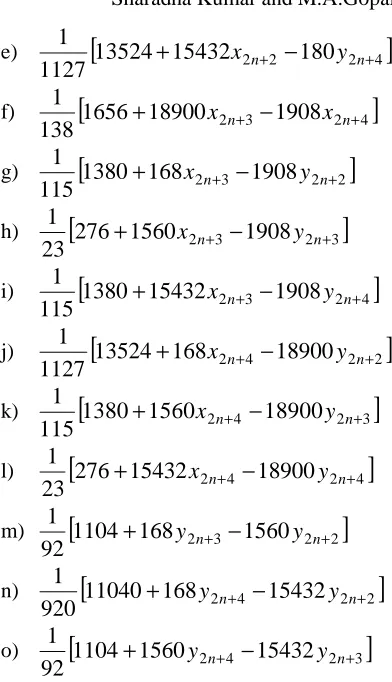
Each of the following expressions represents Nasty number:
a)
[
276 318 2 2 30 2 3]
231
+ + −
+ x n x n
b)
[
2760 3150 2 2 30 2 4]
2301
+ + −
+ x n x n
c)
[
276 168 2 2 180 2 2]
231
+ + −
+ x n y n
d)
[
1380 1560 2 2 180 2 3]
1151
+ + −
6
e)
[
13524 15432 2 2 180 2 4]
11271
+ + −
+ x n y n
f)
[
1656 18900 2 3 1908 2 4]
1381
+ + −
+ x n x n
g)
[
1380 168 2 3 1908 2 2]
1151
+ + −
+ x n y n
h)
[
276 1560 2 3 1908 2 3]
231
+ + −
+ x n y n
i)
[
1380 15432 2 3 1908 2 4]
1151
+ + −
+ x n y n
j)
[
13524 168 2 4 18900 2 2]
11271
+ + −
+ x n y n
k)
[
1380 1560 2 4 18900 2 3]
1151
+ + −
+ x n y n
l)
[
276 15432 2 4 18900 2 4]
231
+ + −
+ x n y n
m)
[
1104 168 2 3 1560 2 2]
921
+ + −
+ y n y n
n)
[
11040 168 2 4 15432 2 2]
9201
+ + −
+ y n y n
o)
[
1104 1560 2 4 15432 2 3]
921
+ + −
+ y n y n
3. Remarkable observations
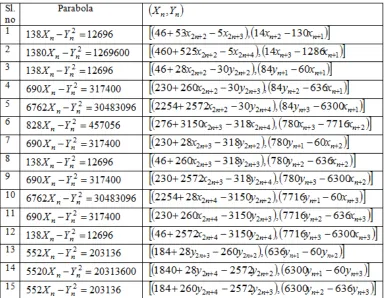
Employing linear combinations among the solutions of (1), one may generate integer solutions for other choices of hyperbola which are presented in table 2 below
Table 2: Hyperbola
Sl.no Hyperbola
(
)
n n
Y
X ,
1 6 2− 2 =12696
n
n Y
X
[
(
53
x
n+1−
5
x
n+2) (
,
14
x
n+2−
130
x
n+1)
]
2 6 2− 2 =1269600n
n Y
X
[
(
525
x
n+1−
5
x
n+3) (
,
14
x
n+3−
1286
x
n+1)
]
3 6 2− 2 =12696n
n Y
X
[
(
28
x
n+1−
30
y
n+1) (
,
84
y
n+1−
60
x
n+1)
]
4 6 2 − 2 =3174400n
n Y
X
[
(
260
x
n+1−
30
y
n+2) (
,
84
y
n+2−
636
x
n+1)
]
5 6 2 − 2 =30483096n
n Y
X
[
(
2572
x
n+1−
30
y
n+3) (
,
84
y
n+3−
6300
x
n+1)
]
6 6 2 − 2 =457056n
n Y
X
[
(
3150
x
n+2−
318
x
n+3) (
,
780
x
n+3−
7716
x
n+2)
]
7 6 2 − 2 =317400n
n Y
On the Hyperbola 2x-3y =23
7 8 6 2− 2 =12696
n
n Y
X
[
(
260
x
n+2−
318
y
n+2) (
,
780
y
n+2−
636
x
n+2)
]
9 6 2 − 2 =317400n
n Y
X
[
(
2572
x
n+2−
318
y
n+3) (
,
780
y
n+3−
6300
x
n+2)
]
10 6 2 − 2 =30483096n
n Y
X
[
(
28
x
n+3−
3150
y
n+1) (
,
7716
y
n+1−
60
x
n+3)
]
11 6 2 − 2 =317400n
n Y
X
[
(
260
x
n+3−
3150
y
n+2) (
,
7716
y
n+2−
636
x
n+3)
]
12 6 2− 2 =12696n
n Y
X
[
(
2572
x
n+3−
3150
y
n+3) (
,
7716
y
n+3−
6300
x
n+3)
]
13 6 2 − 2 =203136n
n Y
X
[
(
28
y
n+2−
260
y
n+1) (
,
636
y
n+1−
60
y
n+2)
]
14 6 2− 2 =20313600n
n Y
X
[
(
28
y
n+3−
2572
y
n+1) (
,
6300
y
n+1−
60
y
n+3)
]
15 6 2 − 2 =203136n
n Y
X
[
(
260
y
n+3−
2572
y
n+2) (
,
6300
y
n+2−
636
y
n+3)
]
Employing linear combination among the solutions for other choices of parabola which are presented in table 3 below
8
3.3. Properties
(i) Let
p,
q
be two non-zero distinct integers such thatp>q>0, treatp,
q
as the generators of the Pythagorean triangle T(
α,β,γ)
where
α
=
2
pq
,
β
=
p
2−
q
2,
γ
=
p
2+
q
2,
p
>
q
>
0
Treating
p
=
x
n+1+
y
n+1,
q
=
x
n+1, it is observed that T(
α,β,γ)
is satisfied by the following relations:23 2 3
α
−β
−γ
=γ
β
α
+ − =P A
4
1 1
2 =xn+ yn+
P A
whereA,P represents the area and perimeter of T
(
α,β,γ)
.(ii) Let M, N be two non-zero distinct positive integers.
Consider
2 1 ,
2
1 1
1− = −
= n+ yn+
M x
N
It is observed that 3 3
2t3,N − t3,M = , t3,M = Triangular number of rank M.
4. Conclusion
In this paper, we have presented infinitely many integer solutions for the Diophantine
equation, represented by hyperbola is given by 2x2 −3y2 =23. As the binary quadratic Diophantine equations are rich in variety, one may search for the other choices of equations and determine their integer solutions along with suitable properties.
REFERENCES
1. R.D.Carmichael, The Theory of Numbers and Diophantine Analysis, Dover Publications, New York (1950).
2. L.E.Disckson, History of theory of Numbers, Vol.II, Chelsea Publishing co., New York (1952).
3. L.J.Mordell, Diophantine Equations, Academic Press, London (1969).
4. M.A.Gopalan and R.Anbuselvi, Integral solutions of
4
ay
2−
(
a
−
1
)
x
2=
3
a
+
1
Acta Ciencia Indica, XXXIV (1) (2008) 291-295. 5. Gopalan et al., Integral points on the hyperbola
(
a
+
2
)
x
2−
ay
2=
4
a
(
k
−
1
)
+
2
k
2,
a
,
k
>
0
, Indian Journal of Science, 1(2) (2012) 125-126.6. M.A.Gopalan, S.Devibala and R.Vidhyalakshmi, Integral points on the hyperbola 5
3
On the Hyperbola 2x-3y =23
9
7. S.Vidhyalakshmi, et al., Observations on the hyperbola
ax
2−
(
a
+
1
)
y
2
=
3
a
−
1
Discovery, 4(10) (2013) 22-24.
8. K.Meena, M.A.Gopalan and S.Nandhini, On the binary quadratic Diophantine equation
y
2=
68
x
2+
13
, International Journal of Advanced Education and Research, 2(1) (2017) 59-63.9. K.Meena, S.Vidhyalakshmi and R.Sobana Devi, On the binary quadratic equation
32
7
22
=
+
x
y
, International Journal of Advanced Science and Research, 2(1) (2017) 18-22.10. K.Meena, M.A.Gopalan, S.Hemalatha, On the hyperbola
y
2=
8
x
2+
16
, National Journal of Multidisciplinary Research and Developement, 2(1) (2017) 1-5.11. M.A.Gopalan, K.K.Viswanathan, G.Ramya, On the Positibe Pell equation
13
12
22
=
+
x
y
, International Journal of Advanced Education and Research, 2(1) (2017) 4-8.12. K.Meena, M.A.Gopalan and V.Sivaranjani, On the Positive Pell equation
33
102
22
=
+
x
y
, International Journal of Advanced Education and Research, 2(1) (2017) 91-96.13. K.Meena, S.Vidhyalakshmi and N.Bhuvaneswari, On the binary quadratic Diophantine equation
y
2=
10
x
2+
24
, International Journal of Multidisciplinary Education and Research, 2(1) (2017) 34-39.
14. Gopalan et al., Integral points on the hyperbola
(
a+2)
x2 −ay2 =4a(
k−1)
+2k2,a,k >0, Indian Journal of Science, 1(2) (2012) 125-126.15. M.A.Gopalan and V.Geetha, Observations on some special pellian equations, Cayley J. Math., 2(2) (2013) 109-118.
16. M.A.Gopalan,S.Vidhyalakshmi and A.Kavitha,On the integer solutions of binary