Correlations of Biomechanical Characteristics with Ball Speed in Penalty Corner Push-In
Effect of Integrated Yoga Modules with and without Satvic Diet on Selected Physical Variables
among College Female Students
K.Akila1 & Dr.U.Narayani2
1Ph.D., Research Scholar, Department of Physical Education, Tamilnadu Physical Education and Sports University, Chennai, Tamilnadu, India. 2Directress of Physical Education, Sri Devi Kumari Women’s College, Kuzhithurai, Kanyakumari, Tamilnadu, India.
Received 21st August 2016, Accepted 15th September 2016
Abstract
The purpose of the study was to find out the effect of integrated yoga modules with and without satvic food on selected physical variables among college female students. To achieve the purpose of the present study, sixty college female students from Dhanalakshmi Srinivasan Group of Institutions, Perambalur, Tamilnadu, India were selected as subjects at random and their ages ranged from 18 to 21 years. The subjects were divided into three equal groups of twenty each. Group I acted as Experimental Group I (Integrated Yoga Module), Group II acted as Experimental Group II (Integrated Yoga Module with Satvic Diet) Group III acted as Control Group. The requirement of the experiment procedures, testing as well as exercise schedule was explained to the subjects so as to get full co-operation of the effort required on their part and prior to the administration of the study. Pre test was conducted for all the subjects on selected physical variables. This initial test scores formed as pre test scores of the subjects. The groups were assigned as Experimental Group I, Experimental Group II and Control Group in an equivalent manner. Experimental Group I was exposed to integrated yoga module, Experimental Group II was exposed to integrated yoga module with satvic diet and Control Group was not exposed to any experimental training other than their regular daily activities. The duration of experimental period was 12 weeks. After the experimental treatment, all the sixty subjects were tested on their physical variables. This final test scores formed as post test scores of the subjects. The pre test and post test scores were subjected to statistical analysis using Analysis of Covariance (ANCOVA) to find out the significance among the mean differences, whenever the ‘F’ ratio for adjusted test was found to be significant, Scheffe’s post hoc test was used. In all cases 0.05 level of significance was fixed to test hypotheses. The integrated yoga modules group had shown significant improvement in all the elected physical variables among college female students after undergoing integrated yoga modules for a period of twelve weeks. The integrated yoga modules with satvic diet group had shown significant improvement in all the elected physical variables among college female students after undergoing integrated yoga modules with satvic diet for a period of twelve weeks. The integrated yoga modules with satvic diet group had shown significant improvement in all the elected physical variables among college female students than the integrated yoga module and control group.
Keywords: Integrated Yoga Module, Satvic Diet, Physical Variables, Female Students.
© Copy Right, IJRRAS, 2016. All Rights Reserved.
Introduction
Balanced diet is essential requirement of good health. A balanced diet should include plenty of salads, fresh vegetables, fresh fruits, milk and raw nuts. Include these items in your existing dietary choices. Nutrition plays a very vital role in our life. Yoga and Ayurveda had laid down the foundations of dietetics. The valuable guidelines regarding various food articles and diet for Yoga Sadhaka, to achieve maximum benefits, are given in traditional yoga texts like Hatha Pradipika and Gheranda Samhitha. Now is the time to evaluate the place of nutrition in Yoga and to study how the dietetic principles in yoga will help to eradicate the national
Correspondence
problem of Mal-nutrition and poverty which is the pressing need of the moment (Desai, 1990). Satvic foods are soothing, nourishing and promote and maintain a quiet, steady mind as well as help to sharpen your intellect and give you a greater sense of empathy. Satvic foods are vegetarian and do not include foods derived from animals that have been harmed in any way. It is important that foods are grown naturally and do not contain preservatives, artificial flavors, or additives (Scott Gerson, 2002).
Pure, satvic food needs to be chewed carefully and eaten in modest portions. Overeating is definitely tamasic. The food should be enjoyed for its inherent taste and quality, rather than the spices and seasonings that are added. Too much salt and spice has a rajasic effect,
International
Journal of Recent Research and Applied Studies
driven by restlessness and desire”. A refined sense of taste leads to increased pleasure (Gary, 2015).
Methodology
The purpose of the study was to find out the effect of integrated yoga modules with and without satvic food on selected physical variables among college female students. To achieve the purpose of the present study, sixty college female students from Dhanalakshmi Srinivasan Group of Institutions, Perambalur, Tamilnadu, India were selected as subjects at random and their ages ranged from 18 to 21 years. The subjects were divided into three equal groups of twenty each. Group I acted as Experimental Group I (Integrated Yoga Module), Group II acted as Experimental Group II (Integrated Yoga Module with Satvic Diet) Group III acted as Control Group. The requirement of the experiment procedures, testing as well as exercise schedule was explained to the subjects so as to get full co-operation of the effort required on their part and prior to the administration of
the study. Pre test was conducted for all the subjects on selected physical variables. This initial test scores formed as pre test scores of the subjects. The groups were assigned as Experimental Group I, Experimental Group II and Control Group in an equivalent manner. Experimental Group I was exposed to integrated yoga module, Experimental Group II was exposed to integrated yoga module with satvic diet and Control Group was not exposed to any experimental training other than their regular daily activities. The duration of experimental period was 12 weeks. After the experimental treatment, all the sixty subjects were tested on their physical variables. This final test scores formed as post test scores of the subjects. The pre test and post test scores were subjected to statistical analysis using Analysis of Covariance (ANCOVA) to find out the significance among the mean differences, whenever the „F‟ ratio for adjusted test was found to be significant, Scheffe‟s post hoc test was used. In all cases 0.05 level of significance was fixed to test hypotheses.
Results
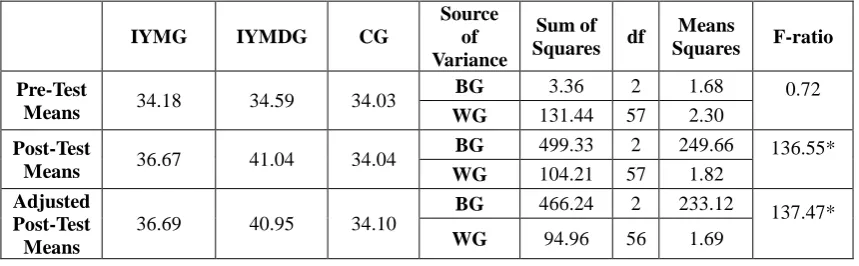
Table I. Computation of analysis of covariance of mean of integrated yoga module, integrated yoga module with diet and control groups on flexibility
IYMG IYMDG CG
Source of Variance
Sum of Squares df
Means
Squares F-ratio
Pre-Test
Means 34.18 34.59 34.03
BG 3.36 2 1.68 0.72
WG 131.44 57 2.30
Post-Test
Means 36.67 41.04 34.04
BG 499.33 2 249.66 136.55*
WG 104.21 57 1.82 Adjusted
Post-Test Means
36.69 40.95 34.10
BG 466.24 2 233.12 137.47*
WG 94.96 56 1.69
An examination of table - I indicated that the pre test means of integrated yoga module, integrated yoga module with diet and control groups were 34.18, 34.59 and 34.03 respectively. The obtained F-ratio for the pre-test was 0.72 and the table F-ratio was 3.15. Hence the pre-test mean F-ratio was insignificant at 0.05 level of confidence for the degree of freedom 2 and 57. This proved that there were no significant difference between the experimental and control groups indicating that the process of randomization of the groups was perfect while assigning the subjects to groups. The post-test means of the integrated yoga module, integrated yoga module with diet and control groups were 36.67, 41.04 and 34.04 respectively. The obtained F-ratio for the post-test was 136.55 and the table F-ratio was 3.15. Hence the post-test mean F-ratio was significant at 0.05
Table II. The scheffe‟s test for the differences between the adjusted post test paired means on flexibility
Adjusted Post-test means
Mean Difference Required CI Integrated yoga module Integrated yoga module with diet Control Group
36.69 40.95 --- 4.26*
1.06
36.69 --- 34.10 2.59*
--- 40.95 34.10 6.85*
* Significant at 0.05 level of confidence
The multiple comparisons showed in table II proved that there existed significant differences between the adjusted means of integrated yoga module and integrated yoga module with diet group (4.26), integrated yoga module and control group (2.59) and integrated
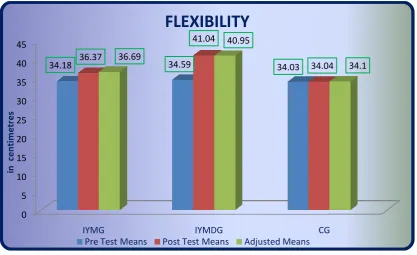
yoga module with diet and control group (6.85) at 0.05 level of confidence with the confidence interval value of 1.06. The pre, post and adjusted means on flexibility were presented through bar diagram for better understanding of the results of this study in Figure-1.
Figure - I. Pre post and adjusted post test differences of the, integrated yoga module, integrated yoga module with diet and control groups on flexibility
Table III. Computation of analysis of covariance of mean of integrated yoga module, integrated yoga module with diet and control groups on cardio respiratory endurance
IYMG IYMDG CG Source of
Variance
Sum of
Squares df
Means
Squares F-ratio
Pre-Test
Means 1392.25 1374.50 1397.00
BG 5625.83 2 2812.91 1.43
WG 111788.75 57 1961.20
Post-Test
Means 1631.75 1744.50 1406.25
BG 1186505.83 2 593252.91 403.51*
WG 83802.50 57 1470.21 Adjusted
Post-Test Means
1632.36 1742.60 1407.53
BG 1124204.34 2 562102.17 385.94*
WG 81559.80 56 1456.42 0
5 10 15 20 25 30 35 40 45
IYMG IYMDG CG
34.18 36.37 34.59 34.03
41.04
34.04 36.69
40.95
34.1
in
c
e
n
tim
e
tr
e
s
FLEXIBILITY
level of confidence for the degree of freedom 2 and 57. This proved that there were no significant difference between the experimental and control groups indicating that the process of randomization of the groups was perfect while assigning the subjects to groups. The post-test means of the integrated yoga module, integrated yoga module with diet and control groups were 1631.75, 1744.50 and 1406.25 respectively. The obtained F-ratio for the post-test was 403.51 and the table F-ratio was 3.15. Hence the post-test mean F-ratio was significant at 0.05 level of confidence for the degree of freedom 2 and 57. This proved that the differences between the post test means of the subjects were significant. The adjusted
post-test means of the integrated yoga module, integrated yoga module with diet and control groups were 1632.36, 1742.60 and 1407.53 respectively. The obtained F-ratio for the adjusted post-test means was 385.94 and the table ratio was 3.16. Hence the adjusted post-test mean F-ratio was significant at 0.05 level of confidence for the degree of freedom 2 and 56. This proved that there was a significant difference among the means due to the experimental trainings on cardio respiratory endurance. Since significant differences were recorded, the results were subjected to post hoc analysis using Scheffe‟s post hoc test. The results were presented in table IV.
Table IV. The scheffe‟s test for the differences between the adjusted post test paired means on cardio respiratory endurance
Adjusted Post-test means
Mean Difference Required CI Integrated yoga module Integrated yoga module with diet Control Group
1632.36 1742.60 --- 110.24*
31.23
1632.36 --- 1407.53 224.83*
--- 1742.60 1407.53 335.07*
* Significant at 0.05 level of confidence
The multiple comparisons showed in Table IV proved that there existed significant differences between the adjusted means of integrated yoga module and integrated yoga module with diet group (110.24), integrated yoga module and control group (224.83) and integrated yoga module with diet and control group
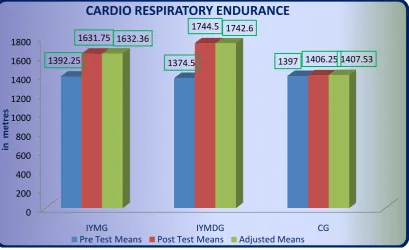
(335.07) at 0.05 level of confidence with the confidence interval value of 31.23. The pre, post and adjusted means on cardio respiratory endurance were presented through bar diagram for better understanding of the results of this study in Figure-II.
Figure I. Pre post and adjusted post test differences of the, integrated yoga module, integrated yoga module with diet and control groups on cardio respiratory endurance
0 200 400 600 800 1000 1200 1400 1600 1800
IYMG IYMDG CG
1392.25 1374.5 1397
1631.75
1744.5
1406.25 1632.36
1742.6
1407.53
in
m
e
tr
e
s
CARDIO RESPIRATORY ENDURANCE
Table V. Computation of analysis of covariance of mean of integrated yoga module, integrated yoga module with diet and control groups on muscular strength
Integrated yoga module
Integrated yoga module with diet
Control Group
Source of Variance
Sum of Squares
df Means
Squares
F-ratio
Pre-Test Means
6.05 5.75 6.15 BG 1.73 2 0.867 0.67
WG 73.25 57 1.28
Post-Test Means
8.85 10.60 6.05 BG 210.70 2 105.35 80.82*
WG 74.30 57 1.30
Adjusted Post-Test Means
8.83 10.67 6.00 BG 217.03 2 108.51 89.77*
WG 67.69 56 1.20
An examination of table - V indicated that the pre test means of integrated yoga module, integrated yoga module with diet and control groups were 6.05, 5.75 and 6.15 respectively. The obtained F-ratio for the pre-test was 0.67 and the table F-ratio was 3.15. Hence the pre-test mean F-ratio was insignificant at 0.05 level of confidence for the degree of freedom 2 and 57. This proved that there were no significant difference between the experimental and control groups indicating that the process of randomization of the groups was perfect while assigning the subjects to groups. The post-test means of the integrated yoga module, integrated yoga module with diet and control groups were 8.85, 10.60 and 6.05 respectively. The obtained F-ratio for the post-test was 80.82 and the table F-ratio was 3.15. Hence the post-test mean F-ratio was significant at 0.05 level of confidence
for the degree of freedom 2 and 57. This proved that the differences between the post test means of the subjects were significant. The adjusted post-test means of the integrated yoga module, integrated yoga module with diet and control groups were 8.83, 10.67 and 6.00 respectively. The obtained F-ratio for the adjusted post-test means was 89.77 and the table F-ratio was 3.16. Hence the adjusted post-test mean F-ratio was significant at 0.05 level of confidence for the degree of freedom 2 and 56. This proved that there was a significant difference among the means due to the experimental trainings on muscular strength. Since significant differences were recorded, the results were subjected to post hoc analysis using Scheffe‟s post hoc test. The results were presented in table-VI.
Table VI. The scheffe‟s test for the differences between the adjusted post test paired means on muscular strength
Adjusted Post-test means Mean Difference Required CI
Integrated yoga module Integrated yoga module with diet Control Group
8.83 10.67 --- 1.84* 0.89
8.83 --- 6.00 2.83*
--- 10.67 6.00 4.67*
* Significant at 0.05 level of confidence
The multiple comparisons showed in table VI proved that there existed significant differences between the adjusted means of integrated yoga module and integrated yoga module with diet group (1.84), integrated yoga module and control group (2.83) and integrated
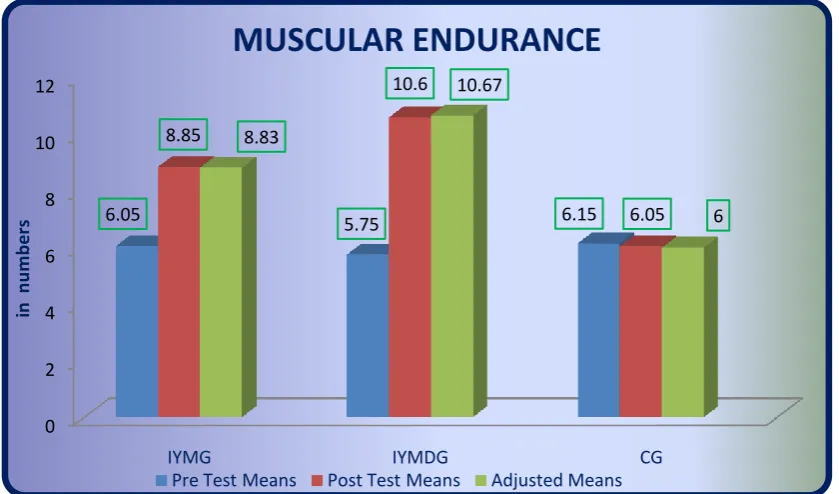
Figure III. Pre post and adjusted post test differences of the, integrated yoga module, integrated yoga module with diet and control groups on muscular strength
Conclusions
From the analysis of the data, the following conclusions were drawn:
1. The integrated yoga modules group had shown significant improvement in all the elected physical variables among college female students after undergoing integrated yoga modules for a period of twelve weeks.
2. The integrated yoga modules with satvic diet group had shown significant improvement in all the elected physical variables among college female students after undergoing integrated yoga modules with satvic diet for a period of twelve weeks. 3. The integrated yoga modules with satvic diet group
had shown significant improvement in all the elected physical variables among college female students than the integrated yoga module and control group.
References
1. Amadea, M. (1996). Cooking for the Spirit, Yoga Journal, 128, 44-46.
2. Andre Van Lysebeth, (1987). Yoga Self – Taught, Delhi: Tarage Paper Back.
3. Chokkalingam, Sony, K., Akhilesh K. B. & Nagendra, H. R. (2015). Effect of Integrated Yoga on Emotional Stability and Performance of Employees: An Action Research Study. Indian Journal of Management. 8,8.
4. Christopher, K. C. (2009). The Bhagavad Gita: Twenty-fifth–Anniversary Edition, State University of New York Press, pages 641-643.
5. Gary, G. (2015). The Sattvic or Yogic Diet Yoga. Chicago Magazine.
6. Gunasheela, S., Jayashree, R., Malini, A., Nagarathna, R., Nagendra, H.R. & Rakhshani, A. (2013). Effect of the integrated approach of yoga therapy on platelet count and uric acid in pregnancy: A multicenter stratified randomized single-blind study. International Journal of Yoga, 6, 1, 39-46.
7. Iyengar, B.K.S. (1986). Light on Yoga. London: George Allen and Unwin Publishing Ltd.
8. Joshi, K.S. Speaking of Yoga and Nature-Cure Therapy, Sterling Publishers, page 65-66.
9. Kasirajan, A. & Karuppiah. L. (2016). Effect of Selected Yogic Practices on Physical Variables among School Level Handball Players. International Journal of Recent Research and Applied Studies, 3, 2(16), 88 - 89.
10. Moorthy, A.M. & David, Manual. Raju. J. (1983).
Yoga for Health. Madras: M.J.Publishers.
11. Rajakumar, J. (2010). The Impact of Yogic Practices and Physical Exercises on Selected Physiological Variables among the Inter-Collegiate Soccer Players. Journal for Bloomers of Research, Vol. 2, No. 2.
12. Rajeev, C. (2011). Effect of Sahaja Yoga Meditation on the Nutritional Assessment of University Students. International Journal of Sports Science and Engineering, 05, 02, 077-084.
13. Steven Rosen (2011). Food for the Soul: Vegetarianism and Yoga Traditions, Praeger, 25-29. 0
2 4 6 8 10 12
IYMG IYMDG CG
6.05 5.75 6.15
8.85
10.6
6.05 8.83
10.67
6
in
n
u
m
b
e
rs
MUSCULAR ENDURANCE
Pre Test Means Post Test Means Adjusted Means