Correlations of Biomechanical Characteristics with Ball Speed in Penalty Corner Push-In
Effects of Intermittent and Strength Training on the Development of Muscular Endurance and
Flexibility of Inter Collegiate Male Kabaddi Players
Puttaswamy Gowda. P1 & Dr. M. Govindaraj2
1Research Scholar, Department of Physical Education, Karpagam Academy of Higher Education, Karpagam University, Coimbatore, Tamilnadu, India. 2Research Guide, Department of Physical Education, Karpagam Academy of Higher Education, Karpagam University, Coimbatore, Tamilnadu, India.
Received 1st July 2017, Accepted 10th August 2017
Abstract
The study was to find analysis and effects of intermittent and strength training on the development of muscular endurance and flexibility of the Inter collegiate male Kabaddi players. Forty five (45) inter collegiate male players were selected as subjects. Every one of the subjects took regular practice. The subjects age was ranged between 17 and 25 years from Mysore division Forty five male Kabaddi players were selected and randomly divided into 3 equal groups. The three groups were nominated as experimental group1 underwent (intermittent training -ITG, experimental groups 2 underwent (Strength training-STG and one group act as a control group-CG. Twelve weeks specific training programme for Experimental groups and there is no specific training for control group. 0.05 Level of confidence was stable to obtain ‘t’ value which was considered to be acceptable for the level of significance for the purpose of the study. The ANCOVA was used to discover the mean difference amongst the muscular endurance and flexibility groups. The outcomes of the study discovered a significant group test interface (p < 0.05). Continuation analyses specified that though group modifications in physical variables occurred amongst the three groups of the pre-test. Experimental groups were significantly improved performance compared to control group in post-test of physical variables. The conclusions of the current study propose that intermittent training enriched the physical variables on muscular endurance and flexibility of the Inter collegiate male Kabaddi players.
Keywords: ITG – Intermittent training group, STG: Strength training group. CG: Control Group, Muscular endurance & flexibility. © Copy Right, IJRRAS, 2017. All Rights Reserved.
Introduction
Kabaddi is fundamentally an Indian game, which has vast popularity in the India as well as in neighboring countries. Kabaddi has popular unique identity in different states of India. Southern parts of India, Kabaddi is called as Chedugudu or Hu-Tu-Tu, Kit-Kit (for women) and Hadudu (for men) in eastern region of India. The game is known as Kabaddi in northern India. The important aspects in Kabaddi is raid, dodging, Breath control, and movement of hand and feet which are the primary and basic skills that a player needs to obtain in order to pursue in Kabaddi. A player has to have power and should be specialized in both defensive and offensive skills to have command in the game and it includes the features of wrestling and rugby. From the pre historic times can be foundtheorigin of the Kabaddi. Kabaddi was mainly planned as a system to improve the speed and physical strength in young talents of India. Earlier days, Kabaddi was played to increase the self-protection skills and to improve rapid alertness to attacks. Kabaddi also improved the impulses of counter
Correspondence
Puttaswamy Gowda. P
E-mail: [email protected], Ph. +9198444 92346
attacks of the personalities, who frequently played in groups or teams. In Hindu mythology Kabaddi has discovered the place. In Mahabharata Arjunas son Abhimanyu trapped in Chakravyuha fixed by his enemies of the war is similar in Kabaddi. Historians advise that other olden scripts have showed that Kabaddi was in the pre-historic times in India. He could naturally sneak into the 'wall' of opponents, abolish them and come back unharmed. Recreational purpose Gautama Buddha had love towards the game of Kabaddi to show his strength as per Buddhist literature. Kabaddi is proven that from the manuscripts which were found by the historians and it was a much idolized game in the earlier decades.
Objectives of the Study
To find out whether the intermittent and strength training on the development of muscular endurance and flexibility of the Inter collegiate male Kabaddi players
Statement of the Problem
The purpose of the study was to find out the effects of the intermittent and strength training on the development of muscular endurance and flexibility of inter collegiate male Kabaddi players
International
Journal of Recent Research and Applied Studies
Puttaswamy et al. 2017 ISSN: 2349 – 4891
Hypotheses
1. It was hypothesized that intermittent training would significantly improve the muscular endurance and flexibility of inter collegiate male Kabaddi players. 2. It was hypothesized that intermittent training would
significantly improve the muscular endurance and flexibility of inter collegiate male Kabaddi players.
Methodology
The intent of the study was to evaluate the effects of intermittent and strength training on the development of muscular endurance and flexibility of inter collegiate male kabaddi players. For the present study Forty five inter collegiate male Kabaddi players were selected. All the players were took regular Kabaddi
practice. The subjects age was ranges between 17 to 25 years. 45 male Kabaddi players of Mysuru division were randomly distributed into three equal groups. Three groups were allotted as Intermittent training for experiment group –I, Strength training for experimental group -2 and control group (no training) for experimental group -3. For a period of twelve weeks Experimental groups underwent specific training programme and the control group doesn’t practice any specific training programme. The level of significance 0.05 was fixed to obtain ‘t’ value, which is to be acceptable for the determination of the study. Physical variables of muscular endurance and flexibility mean difference was determined by the ANCOVA statistical technique.
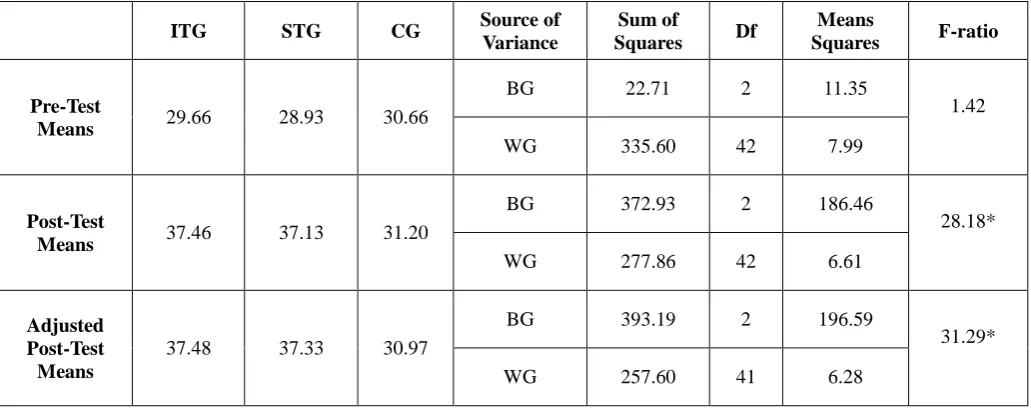
Table 1
Computation of ANOVA of intermittent and strength training and control groups on muscular endurance
ITG STG CG Source of
Variance
Sum of
Squares Df
Means
Squares F-ratio
Pre-Test
Means 29.66 28.93 30.66
BG 22.71 2 11.35
1.42
WG 335.60 42 7.99
Post-Test
Means 37.46 37.13 31.20
BG 372.93 2 186.46
28.18*
WG 277.86 42 6.61
Adjusted Post-Test Means
37.48 37.33 30.97
BG 393.19 2 196.59
31.29*
WG 257.60 41 6.28
An analysis of table 1 indicated that the scores of pre-test means of the intermittent and strength training and control groups were 29.66, 28.93 and 30.66 respectively. The resultant of F-ratio for the pre-test was 1.42 and the F table value was 3.21. Hence the pre-test mean F-ratio level of confidence for the degree of freedom 2 and 42 was insignificant at 0.05. The post-test means of the intermittent and strength training and control groups were 37.46, 37.13 and 31.20 respectively. The obtained F-ratio for the post-test was 28.18 and the F table value was 3.21. Hence the post-test mean F-ratio
Figure I
Shows the mean values of intermittent, strength training and control groups on muscular endurance
Table 2
Scheffe’s post hoc test of intermittent, strength training and control groups on muscular endurance
ITG STG CG Mean Difference CI Value
37.48 37.33 ---- 0.15 2.31
37.48 ---- 30.97 6.51* 2.31
---- 37.33 30.97 6.36* 2.31
* Significant at 0.05 level
Table 2 shows the adjusted means on muscular endurance and difference between the means of the intermittent, strength training and control groups. The mean differences of ITG, STG and CG were 6.51 and 6.36 respectively was greater than the CI value 2.31.
Hence there exists significant difference. The mean difference between ITG and STG was 0.15 lesser than the CI value 2.31. Hence there exists no significant difference.
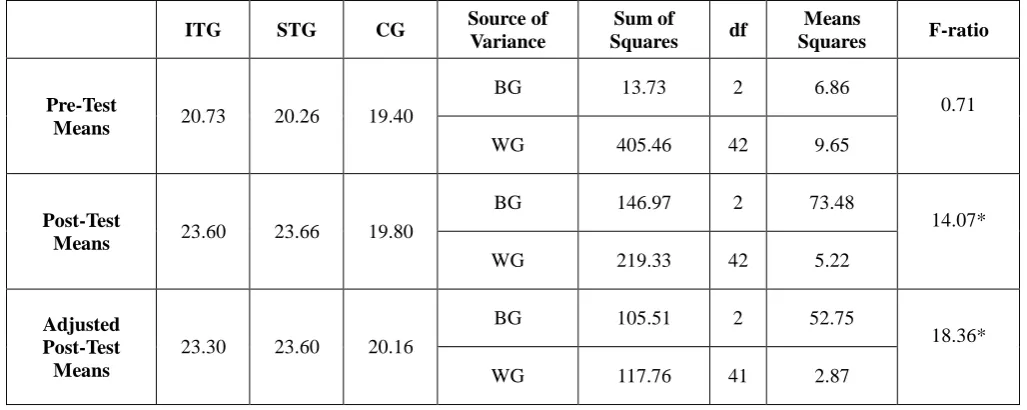
Table 3
Computation of analysis of covariance of intermittent and strength training and control groups on flexibility
ITG STG CG Source of
Variance
Sum of
Squares df
Means
Squares F-ratio
Pre-Test
Means 20.73 20.26 19.40
BG 13.73 2 6.86
0.71
WG 405.46 42 9.65
Post-Test
Means 23.60 23.66 19.80
BG 146.97 2 73.48
14.07*
WG 219.33 42 5.22
Adjusted Post-Test Means
23.30 23.60 20.16
BG 105.51 2 52.75
18.36*
WG 117.76 41 2.87
29.66 28.93 30.66
37.46 37.13
31.2
37.48 37.33
30.97
0 5 10 15 20 25 30 35 40
CTG CTWYPG CG
in
n
o
s Pre Test Mean
Post Test Mean
Puttaswamy et al. 2017 ISSN: 2349 – 4891
An investigation of table 3 showed that the scores of pre-test means of the intermittent, strength training and control groups were 20.73, 20.26 and 19.40 respectively. The resultant F-ratio for the pre-test was 0.17 and the F table value was 3.21. Hence the pre-test mean F-ratio level of confidence for the degree of freedom 2 and 42 was insignificant at 0.05. The post-test means of the intermittent, strength training and control groups were 23.60, 23.66 and 19.80 respectively. The resultant F-ratio for the post-test was 14.07 and the F table value was 3.21. Hence the post-test mean F-ratio
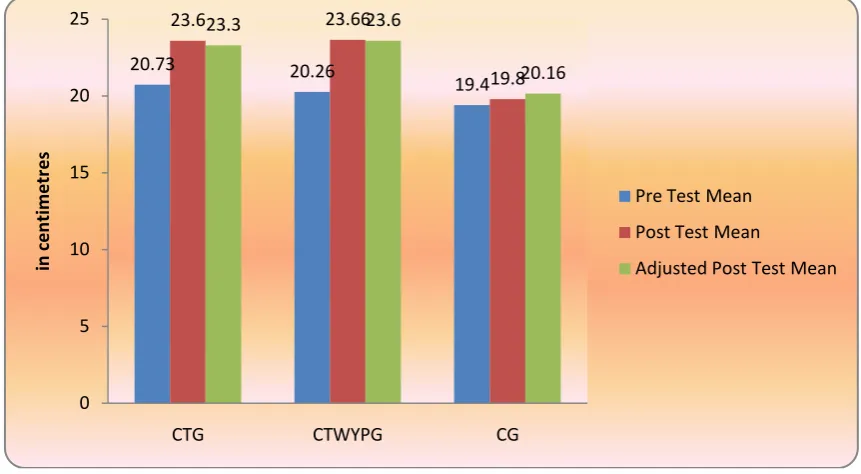
level of confidence for the degree of freedom 2 and 42 was significant at 0.05. The modified post-test means of intermittent, strength training and control groups were 23.30, 23.60 and 20.16 respectively. The resultant F-ratio for the adjusted post-test means was 18.36 and the F table value was 3.22. Hence the modified post-test mean F-ratio level of confidence for the degree of freedom 2 and 41 was significant at 0.05. Mean difference of the intermittent, strength training and control groups on flexibility was given in Figure II.
Figure II
Shows the mean values of intermittent, strength training and control groups on flexibility.
Table 4
The scheffe’s post hoc test of intermittent, strength training and as on flexibility
ITG STG CG Mean Difference CI Value
23.30 23.60 ---- 0.30 1.56
23.30 ---- 20.16 3.14* 1.56
---- 23.60 20.16 3.44* 1.56
* Significant at 0.05 level
Table 4 shows the adjusted means on flexibility and difference between the means of the intermittent, strength training and control groups. The mean differences of ITG, STG and CG were 3.14 and 3.44 respectively was greater than the CI value 1.56. Hence there exists significant difference.
The mean difference between ITG, STG and was 0.30 lesser than the CI value 1.56. Hence there exists no significant difference.
Conclusion
1. It was concluded that the intermittent training significantly improved the physical variable of
muscular endurance and flexibility of inter collegiate male Kabaddi player.
2. It was concluded that the strength training significantly improved the physical variable of muscular endurance and flexibility of inter collegiate male Kabaddi player.
3. It was concluded that the strength training significantly improved the physical variable of muscular endurance and flexibility better than the intermittent of inter collegiate male Kabaddi player.
Reference
1. Dr S Suthakar, Dr Sundar Raj Urs DP Shivakumar, 2016, Effect of Selected Yogic Exercises on
20.73 20.26
19.4
23.6 23.66
19.8
23.3 23.6
20.16
0 5 10 15 20 25
CTG CTWYPG CG
in
c
e
n
tim
e
tr
e
s
Pre Test Mean
Post Test Mean
Cardiovascular Endurance and Lung Capacity of Secondary School Children, IJESC, 6, 6 PP. 7286-7289.
2. Dr S Suthakar, Dr Sundar Raj Urs DP Shivakumar, 2016, Effect of selected yogic exercises on selected physiological variable of secondary school children., International Journal of Physical Education, Sports and Health, 4-114.
3. S.Suthakar and Dr.A.Pushparajan, Effects of Silambam and Karate with Yogic Training on Agility and Arm Explosive Power of Collegiate Male Students., International Journal of Innovative Research and Development|| ISSN 2278–0211 4. R.Ashok kumar Dr.S.Suthakar, K.M.Ashokkumar,
2016. An Effective Approach through Strength,
Endurance and Skill Training Program
Combinations on Muscular Strength and Endurance and Explosive Power of Male Basketball Players., International Journal of Innovative Research and Development., 5,4,218-220.
5. R. Ashok Kumar K. Babu , S. Suthakar, 2016. Effects of Volleyball Specific Resistance Training and Skill Training Packages on the Development of Leg Explosive Power and Speed on the Higher Secondary Level School Boys,2016/3, international
journal of innovative research and development, 5, 4,231-235.
6. Dr.S.Suthakar Venkata chalapathi G, 2016. Analysis of physical growth on specific fitness training
among tribal and non-tribal school boys,
2016/10/27, International Journal of Physical Education, Sports and Health3,6, 137-142.
7. Satheesh B. and Dr.S. Suthakar. 2016.A Study on the selected motor fitness variables among the bicycle beneficiaries and non beneficiaries of the secondary school children, 2016/10, Indian Streams Research Journal6,9,1-4.
8. M Sankar, S Suthakar, 2016. Influence Of Isolated And Combined Circuit And Fartlek Trainings On Selected Endurance Parameters Among College Men Students, 2016/9/15, International Education and Research Journal, 2,9.