ISSN: 2372-4919 (Print), 2372-4927 (Online) Copyright © The Author(s). All Rights Reserved. Published by American Research Institute for Policy Development DOI: 10.15640/jppg.v3n1a1 URL: http://dx.doi.org/10.15640/jppg.v3n1a1
Determinants of Judicial Institutionalization: A Study of the Post-Communist Constitutional Courts
Kirill M. Bumin1
Abstract
This study argues that institutional development of the courts is shaped primarily by the strategies of dominant political actors who attempt to maximize the congruence of the judiciary with their interests and its responsiveness to their priorities. To test this argument, this study identifies five factors – legislative fragmentation, the distribution of executive-legislative power, the transparency of the political environment, participation in the EU accession program, and direct foreign aid – which are hypothesized to affect the process of judicial reforms by altering the politicians’ interests, bargaining power, and the degree of electoral uncertainty. As an empirical test of these hypotheses, this paper examines institutionalization of 22 post-communist constitutional courts, from the beginning of the transition period through 2005. The findings suggest that there is a non-linear relationship between legislative fragmentation and judicial empowerment. In addition, this study finds that the participation in the EU accession program and executive power have an important impact on the development of viable constitutional courts. Transparent environment and foreign direct aid, on the other hand, do not exert a significant impact on the development of post-communist courts.
Keywords: Constitutional courts, institutionalization, legislative fragmentation, EU influence, electoral uncertainty
1. Introduction
Conventional wisdom acknowledges that an effective judiciary is important to the development and consolidation of democratic governments. This is due, in part, to the judiciary’s institutional responsibility to ensure the rule of law and establish a check on the political branches of government.
1 Assistant Professor, Department of Political Science and Public Administration, University of North
Yet, since courts do not possess the power of the ‘purse’ or the ‘sword’ they are dependent on the goodwill of other actors for support and compliance. This dependence begs the question of how observers can determine when the judiciary becomes a distinct force within governments. In particular, what are the conditions for successful judicial reforms and institutional development of courts in transitional polities?
To answer this question, this study evaluates an explanation of institutional change of the judiciary that focuses on the bargaining processes between political actors interested in maximizing their individual power under conditions of electoral uncertainty. This approach has been successfully adapted to a variety of political institutions to explain the variation in their initial design and subsequent transformation (see Fish, 2005; Ferejohn et al., 2004; Thorson, 2004; Ginsburg, 2003; Stone Sweet, 2000; Kitschelt and Malesky, 2000; Frye, 1997). This study applies this framework to explore the institutional development of 22 constitutional courts in the post-communist world, focusing on changes in their organizational structure and capabilities from the end of the communist era through 2005.
2. Explaining the Development of Judicial Institutions
First, this approach suggests that political actors make choice regarding judicial institutions with some autonomy from socio-economic groups – “political actors endowed with the power to make institutional choices are not captured by interest groups, but make choices based on a concern for their individual political power” (Frye, 1997, p. 4). Second, it suggests that preferences related to obtaining political power become preferences over institutional rules, if and when actors perceive that certain rules are more favorable to them than others (North, 1990). Throughout the democratization period, political actors will have preferences over the design of the constitutional court and over the provisions that maximize the receptivity of the court to their priorities. Among the institutional rules that determine the nature of political-judicial linkages are those that regulate professional requirements for the judicial office, selection procedures, term of service, procedures for removal, financing, as well as the procedural rules for the consideration of cases (Bumin et al., 2009). These rules define the extent to which political actors control the system of punishments and rewards that can be used to condition the behavior of the judges.
Third, this approach posits that the extent to which political actors can impose their preferred institutional design is dependent on their bargaining power in the relevant decision-making arenas. If the constitution-drafting process and the subsequent transition are dominated by a single party, the institutional capabilities of the judiciary are likely to be limited and the specific design of the courts will increase the responsiveness of the judges to the political branches controlled by the dominant party. In contrast, where courts are designed in conditions of intense competition between political forces, accessible and active judiciary will emerge.
Another, less-costly strategy available to these newly dominant actors is to block the passage of enabling legislation necessary to implement the judiciary’s design outlined in the founding constitution. By blocking the passage of enabling legislation, newly dominant political actors can affect the pace of judicial reforms and hinder the development of viable courts for years. Additionally, dominant actors can craft enabling legislation that would effectively modify the initial court design outlined in the founding constitution. Given that passage of such legislation requires fewer hurdles than constitutional amendments, it becomes an attractive venue for post-transition winners.
Fourth, this approach suggests that actors take into account the degree of uncertainty (about future electoral outcomes and the future balances of power) when designing judicial institutions (Magalhâes, 1999). In short, political actors have to choose between rules whose effects are contingent upon who controls the elected branches, and therefore upon uncertain outcomes (Geddes, 1999). Under conditions of low uncertainty, powerful actors can continue to efficiently translate their bargaining power into favorable institutional outcomes in the foreseeable future. Ginsburg (2003, p. 28-29) points out that where a single dominant party believes it is likely to hold on to power, it has little incentive to set up independent and active courts. Such power-seeking actors would prefer to retain the flexibility to dictate outcomes with minimal judicial and constitutional constraint because they do not expect their dominance to decline considerably in the future. Thus, although governments dominated by one party have the necessary capacity to pass judicial reform legislation, the incentives to do so are quite low in light of the party’s expectation to stay in power.
This logic suggests a linear relationship between electoral uncertainty and the development of courts: the more diffused the political forces and the higher the uncertainty about future electoral contests the greater the incentive to create an authoritative judiciary.
However, another possibility also exists. Magalhâes (1999, p. 47) points out that an extremely high uncertainty about future electoral outcomes also increases the uncertainty about the benefits that can be reaped from institutional change. Therefore, very high uncertainty about the benefits associated with the adoption of a powerful and independent judiciary, together with the transaction costs associated with its creation, may inhibit institutional development and freeze the existing rules. Put somewhat differently, there may be a non-linear, parabolic relationship between the degree of electoral uncertainty and the pace of institutional development of the judiciary. Once a certain point is reached, the greater number of policy-makers and the greater the uncertainty about future electoral victories will make it more difficult to achieve effective cooperation to pass legislation. Under such conditions, adding a strong judicial oversight would only further complicate the policy-making process. Moreover, when there are multiple political actors vying for power, it is more difficult to predict which ones will win control of the government in the future. In such scenarios, political actors may “hedge against limiting their own power should one’s own party achieve office” (Smithey and Ishiyama, 2000, p. 179). In sum, the relationship between political fragmentation, uncertainty, and judicial reforms may be linear, with greater fragmentation and uncertainty leading to greater propensity for establishing a powerful constitutional court, or, non-linear, with diminishing marginal returns once political forces are overly fragmented and uncertain of their future electoral prospects.
3. Judicial Institutional Development in the Post-Communist World
Focusing on the post-communist region provides some important advantages. Post-communist states present an excellent opportunity to test for the factors that should theoretically facilitate the process of institutional development of the judiciary. First, there is a clearly-marked break with the previous political system – all of the post-communist states transitioned to electoral democracies rather abruptly between 1989 and 1992. This provides a logical, easily-identifiable starting point for the analysis and makes it possible to compare how successful these states have been in empowering their courts, given roughly an equal amount of time to do so.
Second, all post-communist states are defined by heavily-patterned common legacies, or what Bunce (2000) called “regionally defined residues.” Communism was a distinctive domestic and international political-economic system – “it was recently in place, relatively long lived, unusually invasive, clearly demarcated in spatial terms, and relatively consistent over time and across country in its institutional design” (Bunce 2000, p. 725). All of these characteristics simplify the task of comparing the development of courts in the post-communist world by enabling one to control for the unique combination of elements of their legal and political history not present elsewhere. For the purposes of this analysis, three legacies are particularly important – the prior existence of non-competitive party systems under strong executive leadership, pervasive distrust in the legal system, and lack of traditions of legalism or constitutional culture (see Schwartz, 2000; Stone Sweet, 2000). Finally, despite common legacies, these states exhibit a large degree of variability in the variables of interest, including level of democracy, electoral uncertainty, political competitiveness, and judicial institutional development.
4. Measuring Judicial Institutional Development
Following Bumin, Randazzo, and Walker (2009), this study defines institutional development of constitutional courts as the process by which courts become
differentiated, durable, and autonomous. Differentiation refers to the distinctiveness of the
organization from its surrounding environment, whereas durability and autonomy reflect interactions between organizational capabilities and political (environmental)
pressures.2 This study expects constitutional courts to operate as viable, developed
institutions when all three components are attained at meaningful levels. Each dimension contributes positively to the overall standing of the constitutional court in relation to other political institutions.
This study uses a measure of institutional development of the post-communist constitutional courts developed by Bumin et al. (2009). This measure is available for all 28 post-communist constitutional courts and consists of eleven indicators of institutional development across the three conceptual dimensions noted above. To measure the dynamic changes within judicial institutions, Bumin et al. (2009) code the eleven variables for each country on an annual basis through the year 2005. Thus, the post-communist countries were coded during each year after the collapse of their communist regimes and the data collected capture changes in the ordinary and constitutional laws pertaining to the organization and function of constitutional
courts.3 Using principal factor analysis, the authors then convert raw annual data on
eleven indicators to derive a single, underlying indicator of institutional development for each court. The authors call this measure the “judicial viability score.” The scores for the entire post-communist sample range from -2.01 to 1.31 (centered at zero), with higher values representing greater degree of constitutional court development.
This measure is theoretically appropriate for the task at hand because it measures the outcomes of bargaining (in the form of enacted judicial reform legislation) by power-seeking politicians. Moreover, by looking beyond the provisions in the founding constitution to the dates of their implementation, judicial viability scores capture the political bargaining over the design of constitutional courts more accurately than static measures of judicial power that rely only on the provisions outlined in the founding constitution.
2 See Bumin et al. (2009) for the theoretical explanation of the component features and dimensions of
judicial institutionalization.
5. Determinants of Judicial Institutional Development
In the previous sections, this paper argued that power-seeking actors make choices regarding the shape of judicial institutions contingent on their bargaining power and the degree of electoral uncertainty. To test this argument it is necessary to identify structural and political conditions which may induce elected politicians to empower the constitutional courts and limit their own ability to influence its future composition and decisions. This paper hypothesizes that five factors – legislative fragmentation, the nature of legislative-executive relations, the transparency of the political environment, participation in the EU accession program, and contingent foreign aid – determine the specific contours of the initial institutional design of the constitutional court, as well as the subsequent institutional growth or decay. These factors should affect the process of constitutional court reforms by altering the politicians’ interests, bargaining power, and the degree of electoral uncertainty.
First, this study considers whether higher degrees of legislative fragmentation provide context that is more supportive for judicial reforms and institutional development of constitutional courts than environments where one party enjoys legislative dominance. Some scholars (e.g., Huntington, 1968, p. 11; Holland, 1991, p. 9) argue that the lack of competitive parties limits the development of a powerful and activist judiciary. Short horizons or forthcoming elections can also lead politicians who fear losing their office to enhance court’s jurisdiction and capabilities in order to limit the future options of their political opponents (see Ginsburg, 2003; Ferejohn et al., 2004; Epstein et al., 2001).
H1a: A constitutional court is more likely to develop into a viable actor in
environments where political forces in the legislature are diffused than in countries where a single party dominates.
Thus, it is possible that the relationship between legislative fragmentation and institutionalization of courts is non-linear; at some point, fragmentation, instead of facilitating reforms, inhibits them. However, the existing studies do not provide a solid footing for determining the point at which this may occur. Thus, the “diminishing returns” hypothesis regarding legislative fragmentation is loosely-framed.
H1b: At moderate levels of legislative fragmentation, judicial institutional
development is enhanced; at very high levels of legislative fragmentation, the development of constitutional courts is inhibited.
To test these hypotheses, this study uses Wolfram Nordsieck’s legislative elections data available for all post-communist countries since 1989. The effective number of parties (from hereon, ENP) in the legislature was calculated using the formula from Laakso and Taagepera (1979). This study imputes values for the years between election cycles as the number of legislative parties does not change from election to election. To test the non-linear relationship, a squared ENP term is added to the model. The ENP scores for the post-communist sample range from 1 in Turkmenistan (least fragmented legislature) to 10.2 in Poland (most fragmented). However, a vast majority of observations (approx. 90%) fall below 8.2 effective parties.
Thus, it is reasonable to expect that “superpresidentialism” – concentrated power in the executive branch, coupled with weak legislative oversight – should also have a negative impact on judicial reforms, including those targeted at the constitutional courts.
H2a: Constitutional courts located within countries dominated by more powerful presidents will be less likely to undergo institutional development.
Once again, as is the case with legislative fragmentation, the literature suggests an alternative hypothesis. Ackerman (1997, p. 789) argues that presidentialism is good for courts by providing them with a role as an arbitrator among law-making powers (also see Ginsburg 2003, p. 82-86). Arguably, the reason presidentialism supports judicial power is because of the significant potential for institutional divergences between the executive and the legislative branches. These divergent policy views can
be ameliorated by the presence of a strong and capable constitutional court.4 In
addition, under conditions of political uncertainty typical in many transitions, drafters of the constitution may “hedge their bets” and create judicial institutions that are less biased in favor of the dominant political actors. Yet, as argued earlier, there is a point of diminishing returns; “superpresidential” systems are not conducive to judicial institutional development. Holding the legislative fragmentation constant, this line of reasoning then predicts greater judicial institutionalization in those transitioning countries that choose modestly empowered executives or semi-presidential regimes than in those that adopt either superpresidential or pure-parliamentary (Westminster-style) systems. Hypothesis 2b is therefore designed to test this logic.
H2b: Balanced semi-presidential regimes are more conducive to institutionalization of constitutional courts than either superpresidential or pure-parliamentary regimes.
To assess the relative power of the executive, this study relies on an updated version of the executive strength index (ESI) proposed by Kitschelt and Malesky (2000). A significant advantage of this measure over other alternatives (e.g., Hellman, 1998; Frye, 1997) is that the authors incorporate temporal changes into their coding.
4 Moreover, where passage of legislation requires cooperation between two political bodies, “attacking”
The authors construct an index of executive-legislative power distribution that is specifically tailored to the capacity of presidents or legislatures to maintain or alter
the status quo of policy-making.5 This provides for a continuous measure of
presidential/executive power for 24 post-communist countries, with strong presidentialism (with a weak, reactive legislature) and pure parliamentarism as endpoints. Theoretically, the full index runs from zero (pure parliamentarism) to 18 (superpresidentialism). However, the range of actual scores for the post-communist sample is from 1.25 (very weak presidency in Estonia) to 15.0 (very strong presidency) in Turkmenistan and Uzbekistan. To test the non-linear relationship, a squared ESI term is added to the model.
Third, Vanberg (2001) suggests that the fear of public backlash or censure can be a powerful inducement for elected politicians to respect the institutional integrity of a court. The constitutional court, however, will be able to garner broad support from the politicians only if the political environment is sufficiently transparent for the public to effectively monitor the policy-making process (Vanberg, 2000). The threat of public censure will only deter politicians’ noncompliance or attacks on the court’s authority if they are sufficiently likely to be exposed both domestically and internationally for such actions.
H3: The more transparent the political environment the more likely the court will develop into a viable political actor.
This study includes a measure of political transparency – “Free press” – from the States of Nations dataset (Veenhoven, 2012). It is available for 22 post-communist states and assesses various influences on media content, including laws and regulations, political pressures and controls, and repressive actions (e.g. murder of journalists, censorship). It rates the transparency of the political environment from 0 to 100, where higher values mean less freedom.
5 The index assigns scores for levels of veto power, decree power, cabinet formation/dissolution,
Fourth, some scholars note that the European Union accession process has generated an unprecedented momentum for reforms in the candidate/applicant
countries.6 It is plausible that in exchange for financial perks and other inducements
associated with the EU membership, politicians in applicant countries may reciprocate by enacting policies that are in conformance with the EU standards. Several authors have applied this “external incentives model” to the study of judicial reforms and have empirically demonstrated the importance of EU’s role in improving judicial autonomy and capacity using case studies (e.g., Boulanger, 2002).
Moreover, as part of the EU accession process, the European Commission regularly evaluates candidate countries in a wide range of areas in the framework of its reports on the progress of each country towards fulfillment of the ‘‘Copenhagen criteria’’ (the political and economic criteria, and ability to take on the obligations of membership). Although these criteria do not specifically refer to judicial institutions, the fulfillment of the political criteria of ensuring ‘‘stability of institutions guaranteeing ... the rule of law’’ would be largely impossible without an institutionalized and capable judiciary. The available evidence indicates that the Commission indeed places some emphasis on the ability of judiciaries to safeguard citizens’ rights, contribute to a favorable business environment, implement EU legislation, and on the judiciary’s adjudicative and administrative autonomy.
In many of the applicant and new member countries, however, the adopted reforms were not implemented in a timely manner. Moreover, these efforts are not directly targeted at the development of the constitutional courts. Thus, the EU’s partial attention to legal and judicial reforms in applicant and member countries begs the question – has the accession process been effective in promoting the development of constitutional courts in these countries? This study hypothesizes that a country’s participation in the EU accession program should provide domestic politicians with incentives to advance the institutional development of their constitutional courts. And, by monitoring the countries’ commitment to the Copenhagen criteria, the EU accession program should also constrain dominant political actors interested in maximizing their hold on power.
6 In a study on compliance with EU trade practices in Central and Eastern Europe during the
In sum, this study expects a positive relationship between the participation in the EU accession program and the development of constitutional courts.
H4: A country’s participation in the EU accession program contributes positively to the institutional development of its constitutional court.
To gauge these influences empirically, this study relies on a dichotomous variable where 1 represents EU applicant status and zero otherwise, taking into the consideration the official dates when each applicant country obtained her status. By the year 2005, the following post-communist countries have participated in the EU accession program: Bulgaria, Czech Republic, Estonia, Hungary, Latvia, Lithuania,
Poland, Romania, Slovenia, and Slovakia.7
Fifth, this study considers another potential international influence – foreign direct aid – on the development of the post-communist constitutional courts. The European Bank for Reconstruction and Development (EBRD) was established in 1991 to foster the transition of the former communist countries to market economies. It finances 27 post-communist countries (with the exception of Mongolia) by providing more than €3.5 billion in loans and grants on an annual basis. The EBRD has thus far been the largest single investor in the region. The EBRD aims to foster an investor-friendly, transparent, and predictable legal environment and to encourage the economic and political reforms that underpin healthy investment climates. Because EBRD claims that “The mandate of the EBRD stipulates that it must only work in countries that are committed to democratic principles.… In the few countries in which reform efforts have stalled or reversed, investments have been limited,” this study considers whether EBRD aid is contingent, in part, on the progress of judicial
reforms.8 EBRD aid should provide incentives to the domestic politicians to commit
to judicial reforms, as well as constrain their ability to change the design of the constitutional court to increase its responsiveness to their priorities.
H5: The more financial aid the domestic actors receive from the EBRD, the more likely they are to empower the constitutional court and not impede its development.
7 Croatia and Macedonia became candidates in late 2005 but since the accession negotiations did not
start until November 2006, these states are not classified as candidates in this study.
8 The information regarding the role of EBRD in the post-communist region comes from its official
In this study, the EBRD annual investment for each county is measured by combining the total amount of loans and grants, and then dividing it by the total amount of investments for that year for the entire region. The variable represents the proportion of aid allocated to each of the 27 countries on an annual basis. Country values range from zero percent to 79.6% (Hungary in 1991), with an average annual investment of 4% of the total amount for each country.
Finally, this analysis includes three control variables – annual changes in GDP per capita, Freedom House’s political rights and civil liberties scores, and a measure of judicial viability lagged for one year. One strand of literature contends that choices regarding the institutional design and reforms are related to the state of the economy at the time those choices are being made (Becker, 1970; Przeworski, 1991). In states where economic conditions worsen over time, we may find greater pressure for strengthening of the executive power and less incentive to create viable constitutional tribunal to counterbalance the executive power. This study therefore includes a measure of GDP growth for all countries in the post-communist sample, using first year of a country’s transition as the base year, and expects that higher values for change in GDP growth should provide for an environment conducive to the development of constitutional courts.
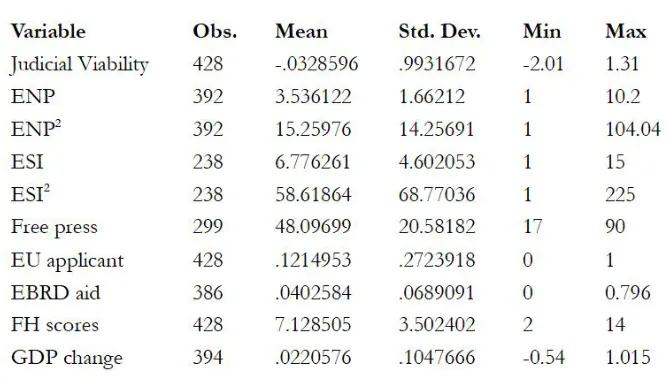
At last, because it is common practice to include a dependent variable with a one-year lag to control for autocorrelation, this measure (LDV) is also added. Descriptive statistics for the variables used in this study are listed in Table 1 below.
Table 1: Descriptive Statistics
6. Results and Discussion
To test the influences noted above this study relies on a cross-sectional time series regression with panel-corrected standard errors (PCSEs). This method allows estimation in the presence of autocorrelation within panels, cross-sectional
correlation, and/or heteroskedasticity across panels.9 Moreover, this method allows
for the fact that some countries in the sample have more observations than others (i.e., unbalanced panels). The explanatory variables are lagged by one year so that the coefficients can be interpreted as the effect on the change in an indicator of judicial viability from one year to the next. The unit of analysis is court-year.
9 Feasible generalized least squares (FGLS) regression can also be used for these purposes. Any anxious
Due to the fact that some variables used in this analysis are not available for
all post-communist states, some countries were dropped from the model.10 Therefore,
the analysis explores institutional development of 22 post-communist constitutional courts. The number of annual observations per country ranges from seven to twelve, with an average of ten court-year observations. Model 1 estimates the linear hypotheses for both legislative fragmentation and the executive power. Model 2 provides results for the non-linear hypothesis for legislative fragmentation (i.e., it includes as predictors both an independent variable and its squared term), while Model 3 explores the non-linear hypothesis for the executive power. Model 4 estimates the non-linear hypotheses for both legislative fragmentation and the executive power. The four models listed in Table 2 are similar in all other respects. Each model explains approximately 80% of the variance in the judicial viability scores.
Table 2: Cross-Sectional Time-Series PCSE Regressions of Judicial Viability Scores on Hypothesized Determinants
Note: *p < 0.05; **p < 0.01; ***p < 0.001; panel-corrected standard errors in
parentheses; ENP for legislative fragmentation; ESI for executive strength index; LDV for lagged dependent variable
10 Specifically, the model includes Albania, Armenia, Belarus, Bulgaria, Croatia, Czech Republic,
First, the results of the regression analysis seem to support Hypothesis 1a, which postulated a linear relationship between legislative fragmentation and the institutional development of the courts. However, the coefficients in Models 1 and 3 (both of which test the linear hypothesis for the legislative fragmentation) are somewhat small, indicating that the impact of the effective number of parties in the legislature (ENP) is rather modest. Second, the linear hypothesis regarding the effects of executive power (ESI) on the institutional development of constitutional courts (Hypothesis 2a) is also quite strong, but in a direction opposite to that posited by the theory. The coefficients in Models 1 and 2 (which test the linear hypothesis regarding executive power) are positive, implying that the more empowered the executive/ president vis-à-vis the legislature, the more likely the constitutional court reforms will be successful. The size of the executive power coefficient is comparable to that of the effective number of parties. In sum, the statistical tests indicate that legislative fragmentation and concentrated executive power are equally supportive of the judicial institutional development in the post-communist states.
Hypotheses 1b and 2b, which postulated that the relationship between these variables and judicial viability scores is curvilinear, receive strong support for the legislative fragmentation and no support for the executive power. Models 2 and 4 show that once the squared ENP term is added, the impact of legislative fragmentation is statistically significant and increases almost four-fold from the linear prediction. The negative and statistically significant coefficient for the squared term in Model 2 indicates that the relationship is curvilinear, with diminishing marginal returns for the institutional development of the judiciary. Model 4 indicates the same result although the squared ENP term fails to reach meaningful levels of statistical significance. Adjusted R-squared statistic for Model 2 points to an improvement in comparison to the linear models 1 and 3, accounting for the variance in judicial viability data slightly better.
This suggests that Ackerman’s (1997) argument – that presidentialism is good for courts by providing them with a role as an arbitrator among law-making powers – is supported. Because presidential systems limit the bargaining powers of the legislature vis-à-vis the executive, cautious political actors may “hedge their bets” and create judicial institutions that are less susceptible to the executive’s influence. Thus, the argument that predicts greater judicial development in those transitioning states that chose semi-presidential regimes than in those that adopted a strong presidential or a pure-parliamentary system does not find empirical support in this study.
Hypothesis 3, which proposed that transparent political environment serves to constrain the bargaining power of the dominant political actors and facilitates the development of constitutional courts, was also not supported. Although the “Free press” variable is statistically significant in Models 1, 2, and 4, the coefficient is in the direction opposite to that suggested by the theory and very small. In other words, statistical results seem to show that the less transparent the political environment, the greater the probability of courts developing into viable institutions. Substantively, a more reasonable interpretation seems to be that once we control for the other factors in the model any positive effects of transparency on judicial reforms simply wash out.
The hypotheses regarding the “external incentives and constraints” logic receive partial support. The hypothesis that the EU accession process facilitates the development of viable constitutional tribunals (Hypothesis 4) was supported in all four models. This analysis shows that incentives and constraints provided by a country’s participation in the EU accession program significantly influence the evolution of its constitutional court. In short, the results point out that the EU has been successful in influencing the calculations of dominant political actors to enact reforms targeted at the constitutional courts.
Although EBRD claims that “In the few countries in which reform efforts have stalled or reversed, investments have been limited,” this study finds evidence to the contrary. Some of the largest recipients in the 1990s and early 2000s are the countries where democratic reforms, including the reforms targeted at the constitutional courts, have been stalled or reversed (e.g., Kazakhstan). As this study hypothesized, the threat of the withdrawal of funds should only deter politicians’ noncompliance or attacks on the court’s authority if they are sufficiently likely to be exposed and punished for such actions.
Finally, the control variables – Freedom House (FH) democracy scores, GDP growth, and the lagged dependent variable (LDV) – are statistically significant and in the direction predicted by the theory. The coefficient for the FH scores is negative, as higher values indicate fewer political rights and civil liberties, and highly significant. The relative size of the coefficient, however, is modest in comparison to the coefficients the “EU applicant” and “ENP” measures, suggesting that judicial institutionalization is not wholly contingent on the country’s overall level of democracy. The notion that a positive relationship exists between good performance of the economy and the viability of constitutional courts was also supported. The improvements in a country’s economic performance seem to positively affect the political environment in which judicial reform choices are made. Thus, good (and improving) economic conditions provide greater demand for a viable constitutional court which can hold the elected politicians in check.
Second, Model 2, which postulated a curvilinear relationship between legislative fragmentation and institutional development of courts and a linear relationship between executive/presidential power and judicial institutionalization, seems to provide a more accurate assessment of the sources of judicial empowerment than the other models. In substantive terms, the evidence shows that very high levels of fragmentation in the legislature inhibit the passage of constitutional court reforms by increasing the uncertainty about its consequences. In line with Magalhâes (1999) and Smithey and Ishiyama (2000) findings, this study speculates that when the number of policy-makers involved is very large, it is more difficult to achieve effective cooperation among politicians to pass judicial reform legislation.
To provide a more intuitive interpretation of this curvilinear relationship, Figure 1 shows the quadratic prediction plot for ENP, it squared term, and judicial viability scores. It calculates the prediction for the dependent variable based on a linear regression of the judicial viability scores on ENP and its squared term, and plots the resulting curve. The graph indicates that the most conducive environment for judicial institutionalization is to be found in countries with more than 1.3 and less than 5.5 “effective” parties. Once the legislative fragmentation reaches 5.5 “effective” parties, its positive impact on judicial institutionalization begins to diminish.
Figure 1: Constitutional Court Development and Legislative Fragmentation
Figure 2: Scatter plot Matrix and Quadratic Prediction Plot
Third, the analysis of the effect of executive power on judicial institutional development produced results that are counter to both the linear hypothesis (H2a, which suggested a negative relationship between concentrated executive power and judicial reforms) and the curvilinear hypothesis (H2b, which suggested that semi-presidential systems are more conducive to judicial reforms than either pure parliamentary or strong presidential systems). Instead, the results point to a significant, albeit not very strong, positive linear relationship – as the independent executive power (vis-à-vis the legislature) increases, the probability of judicial institutionalization also increases. However, if not for the missing data on executive power (ESI) for Azerbaijan and transparent environment (Free press) for Tajikistan and Turkmenistan, it is possible that the curvilinear models would produce more robust results. In all three cases, the executive power is highly concentrated (ESI score
is 15 for Turkmenistan and 9.5 for Tajikistan)11 and the constitutional courts are
extremely weak and organizationally-inept.
11 Although Kitschelt and Malesky (2000) do not code their executive power measure for Azerbaijan, it
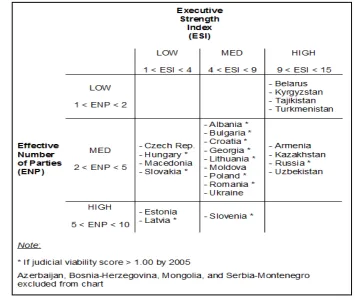
Figure 3 provides some support to this possibility and for the non-linear hypothesis regarding semi-presidentialism and judicial institutional development. To simplify presentation, ESI and ENP variables were classified “low,” “medium,” or “high.” Then, each country was placed on the matrix based on its mean ENP and ESI values. Finally, a country was assigned an asterisk if it had achieved a judicial viability
score of 1.00 or greater by the year 2005.12 As it becomes abundantly clear from this
illustration, the vast majority of countries that have achieved high levels of constitutional court development (seven out of 12 countries; 58.3% of the sample) have moderately-fragmented legislatures and semi-presidential regimes. Although it is not a direct test of the semi-presidentialism hypothesis, it remains possible that balanced semi-presidentialism provides the ideal constitutional configuration for the development of authoritative and independent constitutional courts.
Figure 3: Judicial Institutional Development, Legislative Fragmentation, and Executive Power
12 The 2005 judicial viability scores range from 0.47 to 1.31, with higher values representing greater
In sum, this study hypothesized that institutional development of the post-communist constitutional courts is shaped primarily by the strategies of dominant political actors who attempt to maximize the congruence of the judiciary with their interests and its responsiveness to their priorities. To test this argument, this study identified five factors – legislative fragmentation, the nature of legislative-executive relations, the transparency of the political environment, participation in the EU accession program, and EBRD aid – that should induce elected politicians to empower the constitutional court and limit their own ability to influence its future composition and decisions. These factors were hypothesized to affect the process of constitutional court reforms by altering the politicians’ interests, bargaining power, and the degree of electoral uncertainty. Overall, the empirical results suggest that the “electoral bargaining” and “external incentives” frameworks proved useful in explaining the development of post-communist constitutional courts. Additionally, this study’s findings point out that further analysis of the relationship between executive power and judicial institutionalization is needed. In particular, as Figure 3 suggests, further assessment of the impact of semi-presidential systems on the development of constitutional courts is likely to be fruitful.
The results also point to an interesting question for a future analysis: Is EU influence relevant only during the applicant stage? The finding that the conditionality of EU membership as an incentive and constraint was one of the key mechanisms that led to the adoption of viable constitutional tribunals by the applicant countries makes the question of post-accession dynamics even more interesting. In particular, it is interesting to know whether legal reform activities more or less achieved their purpose by the time the applicant countries formally acceded to the EU and whether the absence of EU accession incentives after the country joins the EU slowed down or even reversed the gains in terms of judicial institutional development.
References
Ackerman, B. (1997). The rise of world constitutionalism. Virginia Law Review, 83(4), 771-797.
Becker, T. L. (1970). Comparative judicial politics. Chicago, IL: Rand McNally & Company. Boulanger, C.(2002). Europeanisation through judicial activism? The Hungarian constitutional
court’s legitimacy and Hungary’s ‘return to Europe.’ Unpublished Manuscript. Retrieved from:
Bumin, K. M., Randazzo, K. A., & Walker, L. D. (2009). Institutional viability and high courts: A comparative analysis of post-communist states. Australian Journal of Political Science, 44(1), 127-153.
Bunce, V. (2000). Comparative democratization: Big bounded generalizations. Comparative Political Studies, 33(6-7), 703-734.
Epp, C. R. (1998). The rights revolution: Lawyers, activists, and supreme courts in comparative perspective. Chicago, IL: The University of Chicago Press.
Epstein, L., Knight, J., &Shvetsova, O. (2001). Comparing judicial selection systems. William and Mary Law Bill of Rights Journal, 10(1), 7-36.
Ferejohn, J., Rosenbluth, F., &Shipan, C. R. (2004). Comparative judicial politics. in Charles Boix and Susan Stokes, Eds., The Oxford handbook of comparative politics. Oxford: Oxford University Press.
Fish, S. M. (2005). Democracy derailed in Russia: The failure of open politics. Cambridge University Press.
Fish, S. M. (2006). Stronger legislatures, stronger democracies. Journal of Democracy, 17(1), 5-20.
Freedom House. (2014). Freedom in the world: Annual data reports. New York: Author. Retrieved from http://www.freedomhouse.org
Frye, T. (1997). A politics of institutional choice: Post-communistpresidencies. Comparative Political Studies, 39(5), 523-552.
Guliyev, F. (2005). Post-soviet Azerbaijan: Transition to sultanistic semiauthoritarianism? An attempt at conceptualization. Demokratizatsiya, 13(3), 393-435.
Geddes, B. (1999). What do we know about democratization after twenty years? Annual Review of Political Science, 2, 115-44.
Ginsburg, T. (2003). Judicial review in new democracies: Constitutional courts in Asian cases. New York, NY: Cambridge University Press.
Hellman, J. S. (1998). Winners take all: The politics of partial reform in postcommunist transitions. World Politics, 50(2), 203-234.
Herron, E. S. & Randazzo, K. A. (2003). The relationship between independence and judicial review in post-communist courts. Journal of Politics, 65(2), 422-438.
Holland, K. M. (1991). Judicial activism in comparative perspective. New York, NY: St. Martin Press.
Huntington, S. P. (1965). Political development and political decay. World Politics, 17(3), 386-430.
Huntington, S. P. (1968). Political order in changing societies. New Haven, CT: Yale University Press.
Keohane, R. O. (1969). Institutionalization in the United Nations General Assembly. International Organization, 23, 859-896.
Kitschelt, H. &Malesky, E. (2000). Constitutional design and postcommunist economic reform. Paper presented at the annual meeting of the Midwest Political Science Association in Chicago, IL. Retrieved from:
http://irps.ucsd.edu/assets/003/5283.pdf
Laakso, M. &Taagepera, R. (1979). ‘Effective’ number of parties: A measurewith application to Western Europe. Comparative Political Studies, 12(1), 3-27.
Larkins, C. M. (1996). Judicial independence and democratization: A theoretical and conceptual analysis. American Journal of Comparative Law, 44, 605-626.
Magalhâes, P. C. (1999). The politics of judicial reform in Eastern Europe. Comparative Politics, 32(1), 43-62.
Mainwaring, S.(1993). Presidentialism, multipartism, and democracy: The difficult combination. Comparative Politics Studies, 26(2), 198-228.
McGuire, K. T. (2004). The institutionalization of the U.S. Supreme Court. Political Analysis, 12(2), 128-142.
North, D. (1990). Institutions, institutional change, and economic performance. Cambridge, UK: Cambridge University Press.
Nordsieck, W. (2015). Parties and elections database. Retrieved from http://www.parties-and-elections.eu/countries.html
Polsby, N. W. (1968). The institutionalization of the U.S. House of Representatives. American Political Science Review, 62(1), 144-168.
Przeworski, A. (1991). Democracy and the market. Cambridge, England: Cambridge University Press.
Schimmelfennig, F., & Sedelmeier, U. (2005). Conclusions: The impact of the EU on the accession countries. in Frank Schimmelfennig, and Ulrich Sedelmeier, eds., The europeanization of Csentral and Eastern Europe. Ithaca, NY: Cornell University Press, 210-228.
Schwartz, H. (2000). The struggle for constitutional justice in post-communist Europe. Chicago, IL: University of Chicago Press.
Smithey, S. I. & Ishiyama, J. (2000). Judicious choices: Designing courts in post-communist politics. Communist and Post-Communist Studies, 33(1), 163-182.
Smithey, S. I. & Ishiyama, J. (2002). Judicial activism in post-communist politics. Law and Society Review, 36(4), 719-734.
Stepan, A., &Skach, C. (1994). Constitutional frameworks and democratic consolidation: Parliamentarism versus presidentialism. World Politics, 46(1), 1-22.
Stone Sweet, A. (2000). Governing with judges: Constitutional politics in Europe. Oxford, UK: Oxford University Press.
Thorson, C. (2004). Why politicians want constitutional courts: The Russian case. Communist and Post-Communist Studies, 37, 187-211.
Vanberg, G. (2000). Establishing judicial independence in West Germany: The impact of opinion leadership and the separation of powers. Comparative Politics, 32, 333-353. Vanberg, G. (2001). Legislative-judicial relations: A game-theoretic approach to constitutional
review. American Journal of Political Science, 45(2), 346-361.
Veenhoven, R. (2012). States of nations: World database of happiness, Rotterdam: Erasmus University. Retrieved from: