R E S E A R C H
Open Access
Performance analysis and working fluid selection
for geothermal energy-powered organic
Rankine-vapor compression air conditioning
Xianbiao Bu
1*, Lingbao Wang
1and Huashan Li
1,2* Correspondence: [email protected] 1Key Laboratory of Renewable
Energy and Gas Hydrate, Guangzhou Institute of Energy Conversion, Chinese Academy of Sciences, No.2, Nengyuan Rd, Wushan, Tianhe District, Guangzhou 510640, China
Full list of author information is available at the end of the article
Abstract
Background:To utilize geothermal energy from hot springs, an organic Rankine
cycle/vapor compression cycle (ORC/VCC) system was employed for air conditioning and a thermodynamic model was developed.
Methods:Six working fluids, R123, R134a, R245fa, R600a, R600 and R290, were
selected and compared in order to identify suitable working fluids which may yield high system efficiencies.
Results:The calculated results show that because of high system pressure for R290 and R134a, R600a is the more suitable working fluid for ORC in terms of expander size parameter, system efficiency and system pressure. In addition, R600a is also the most appropriate working fluid for VCC in terms of pressure ratio and coefficient of performance. R600 and R600a are more suitable working fluids for ORC/VCC in terms of overall coefficient of performance, refrigerating capacity per unit mass flow rate and chilled water yield from per ton hot water.
Conclusions:In sum, R600a is the most suitable working fluid for ORC/VCC through
comprehensive comparison of ORC efficiency, expander size parameter, pressure ratio, coefficient of performance, system pressure and chilled water yield from per ton hot water for six different working fluids. However, the flammability of R600a should attract enough attention.
Keywords:Working fluid selection; Waste heat; Air conditioning; Hot spring; Organic Rankine-vapor compression; Expander
Background
There are a lot of hot springs in the world, many of which exceed 70°C (Lund et al. 2005, 2011), while the proper bath temperature at the hot spring hotel is generally in the range of 30°C to 50°C, which causes the heat energy to be rejected to the atmosphere if the water temperature of the hot spring is higher than the bath temperature, resulting in greater waste of energy and the existence of thermal pollution in the surrounding environment. At the same time, most of the hot spring hotels need air conditioning. So, making use of these waste heats from hot springs released to the environment for air conditioning is of great significance.
At present, some effort has been devoted to the utilization of the vast amount of waste energy for refrigeration or air conditioning. Heat-operated absorption/adsorption systems
can utilize waste heat for refrigeration or air conditioning (Lu et al. 2013; Luo et al. 2012). Srikhirin et al. (2001) described a number of research options of absorption refrigeration technology and provided a comparison of the various types of absorption refrigeration sys-tems. Meunier (1998) claimed that solid sorption is very effective for low-grade cooling, not only for air conditioning but also for deep freezing. Wang et al. (2013) studied an absorption air-conditioning system driven by a low-grade geothermal heat source. Kairouani and Nehdi (2006) developed a novel combined compression-absorption refrigeration system assisted by geothermal energy. Davis and Wu (1997) used a finite-time thermodynamic approach to analyze a geothermal-powered low-temperature Rankine cycle for air conditioning. Rosiek and Batlles (2012) described a shallow geothermal system that was designed as an alternative to the cooling tower in a solar-assisted air-conditioning system installed in southern Spain. Lubis et al. (2011) carried out a thermodynamic analysis of a hybrid geothermal heat pump system. Kececiler et al. (2000) designed an absorption refrigeration system with geothermal energy and experimentally analyzed its performance.
relationships between working fluid properties and ORC common economic and ther-modynamic performance criteria from a theoretical and an analytical point of view.
In this paper, to utilize the vast amount of waste energy discharged from hot springs for air conditioning, the ORC/VCC system is employed and a thermodynamic model is developed. Six working fluids, including hydrochlorofluorocarbon (HCFC; e.g. R123), hydrofluorocarbons (HFCs; e.g. R134a and R245fa) and hydrocarbons (HCs; e.g. butane, isobutane and propane), are selected and evaluated to identify suitable working fluids which may yield high system efficiencies.
Methods
System design and working fluid selection
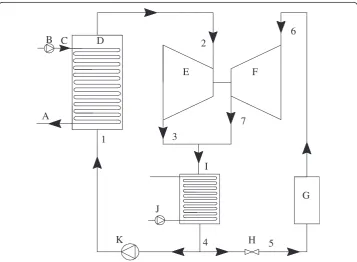
The system of ORC/VCC driven by waste energy from hot springs for air conditioning at hot spring hotels mainly consists of a geothermal water outlet, hot water pump, geo-thermal water inlet, generator, expander, compressor, evaporator, throttle valve, con-denser, cooling water pump and working fluid pump, as shown in Figure 1. The working principle of this system is as follows: waste heats collected from hot springs provide energy to heat and vaporize a working fluid with low boiling point. Energy is extracted from this vapor in an expansion engine that is used to drive a vapor compres-sor for air conditioning. Afterwards, the fluid exiting the expander is condensed and pumped back to the generator where it is again vaporized. A vertical generator is used and countercurrent is applied in the generator to improve the system efficiency. That is, the hot water flows in the generator from top to bottom, and the working fluid flows from bottom to top in the generator. A water-cooled condenser is used in this system,
J
5 7
6
H
G F
A
D
E
I
K
2
3
4 1
B C
which makes the system more compact and more powerful compared with the system cooled by air. The programmable logic controller, frequency converter and liquid level sensor are suggested to be adopted in the system to automatically control the liquid level of the working fluid in the generator and ensure high heat exchange efficiency in the generator. The temperature of waste heat from the hot spring and coolant usually varies along with the variation of ambient. To adapt the instability of heat source and coolant, the radial and axial flow expander is employed. To improve the drive effi-ciency, the compressor and the expander are directly coupled on the same shaft with-out gear and coupling. The same working fluid is used for both ORC and VCC to avoid the gas separation caused by leakage between them.
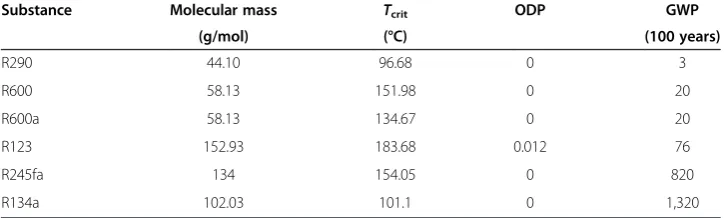
The common refrigerants HCFC (R123) and HFCs (R134a and R245fa) are selected as the working fluids for the ORC/VCC system. However, with increased environmental awareness, these refrigerants are now being regulated. It is well known that the HCs are environmentally friendly, non-toxic, chemically stable and highly soluble in conven-tional mineral oil. The only real argument against the application of HCs is flammabi-lity. So, the HCs, such as butane (R600), isobutene (R600a) and propane (R290), are also selected as the working fluids for the ORC/VCC system for air conditioning. The properties of six selected working fluids are shown in Table 1.
Thermodynamic models
To develop the thermodynamic models, the following assumptions are made:
1. Friction and heat losses in the ORC/VCC are negligible.
2. The power consumed by condensers for both ORC and VCC are negligible.
For ORC:
Wexp¼mpðh2−h3sÞηexp ð1Þ
Wpump;w¼mpðηh1s−h4Þ pump;w
ð2Þ
Qboi¼mpðh2−h1Þ ð3Þ
Wnet¼Wexp−Wpump;w ð4Þ
Table 1 Properties of working fluids
Substance Molecular mass Tcrit ODP GWP
(g/mol) (°C) (100 years)
R290 44.10 96.68 0 3
R600 58.13 151.98 0 20
R600a 58.13 134.67 0 20
R123 152.93 183.68 0.012 76
R245fa 134 154.05 0 820
R134a 102.03 101.1 0 1,320
ηp¼ Wnet
Qboi ð5Þ
Tboi¼
ffiffiffiffiffiffiffiffiffiffiffi
ThTc
p
ð6Þ
WRm¼Wnet
mp ¼ðh2−h3sÞηexp− h1s−h4
ð Þ
ηpump;w
ð7Þ
VFR¼V3
V2 ð
8Þ
SP¼—
ffiffiffiffiffiffi
V3
p
ffiffiffiffiffiffiffiffiffiffiffiffiffiffiffiffiffiffiffiffiffiffiffiffiffiffiffiffiffiffi
1;000ðh2−h3sÞ 4
p ð9Þ
For VCC:
Wcom¼Wexp ð10Þ
Qeva¼micðh6−h5Þ ð11Þ
Wcom¼micðh7sη−h6Þ com
ð12Þ
COPc¼WcomQeva ð13Þ
PR¼P7
P6 ð14Þ
CRPR¼COPc
PR ð15Þ
The overall performance of ORC/VCC is defined as follows:
COPs¼ηpCOPc ð16Þ
mN¼ Qeva
CpðTN1−TN2Þ ð
17Þ
N¼mNmh1;000 ð18Þ
CPRmA¼mpQevaþmic ð19Þ
Results and discussions
Considering the temperature difference of hot water from hot springs at different places and the temperature variation of coolant in different seasons and places, the temperature of hot water at the generator inlet,Th, is in the range of 70°C to 95°C, and
Effect of working fluid types on ORC
In Figures 2, 3, 4, and 5, the condensation temperature is 40°C.
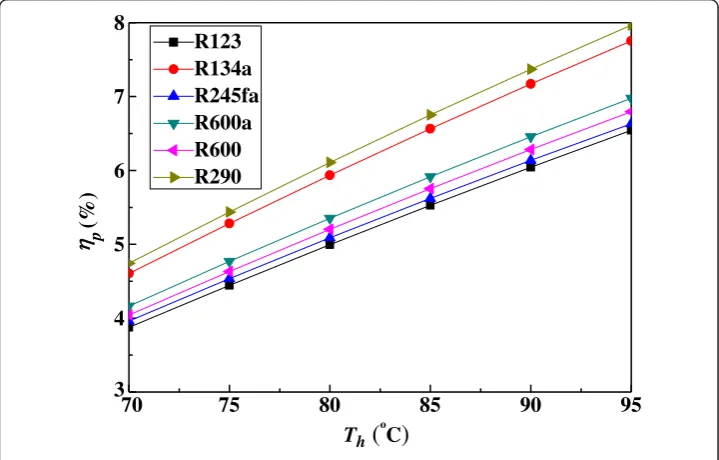
The temperature of hot water from hot springs varies according to the season and weather, leading to the temperature variation of hot water at the generator inlet. As a result, the generation temperatureTboivaries with the variation ofTh. Figure 2 exhibits ηpfor different working fluids as a function ofTh. It is obvious from Figure 2 that for
all working fluids, ηpdepends largely on Th and it increases with the increase of Th.
R290 has the maximum ηp compared with the five other working fluids for all heat source temperatures, followed by R134a, and R123 has the minimumηp. Except R134a,
ηpfor HCs is higher than those for R123 and R245fa.ηpis 6.75%, 6.57%, 5.92%, 5.75%, 5.62% and 5.53% for working fluids R290, R134a, R600a, R600, R245fa and R123, respectively, at Th = 85°C, signifying that ηp for R290 is 1.22 times higher than
that for R123.
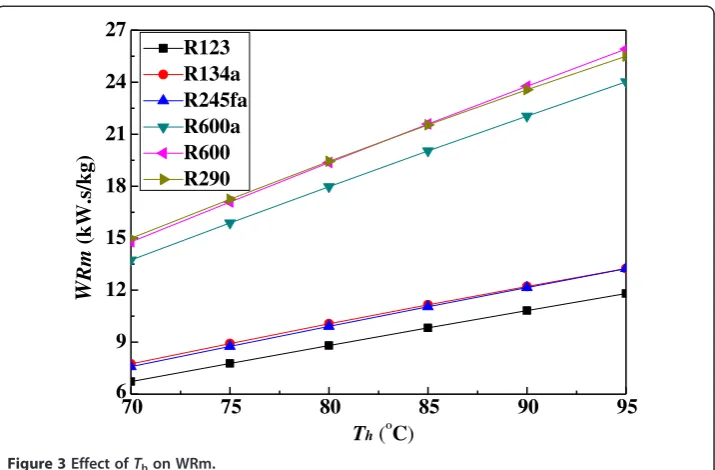
Figure 3 illustrates the variation of WRm with Th. WRm is defined as the ratio of
Wnettomp, reflecting the power capability of the working fluid per unit mass flow rate.
Observing the profiles from Figure 3 for all working fluids, WRm increases with the in-crease of Th. This is due to the fact that the difference between h2 and h3s increases
with increasing Th, while h1s andh4 remain unchanged when the condensation
tem-perature is invariable, thus leading to the increase of WRm according to Equation 7. WRm for R290 and R600 are almost the same and they are the maximum among the six working fluids. WRm for HCs is higher than those for R123, R245fa and R134a as shown in Figure 3. WRm for R123 and R600 is, respectively, 9.83 and 21.58 kW s/kg at Th= 85°C, the former being about 2.2 times as high as the latter.
VFR as a function of This plotted and presented in Figure 4. VFR is defined as the
specific volume variation across the expander in an isentropic process, which accounts for the effect of the compressibility through the expansion. As it is seen from Figure 4, with the increase ofTh, VFR for all working fluids increases. R123 has the highest VFR,
70
75
80
85
90
95
3
4
5
6
7
8
T
h(
oC
)
p
(%)
R123
R134a
R245fa
R600a
R600
R290
while R290 has the lowest VFR. Observing the profiles from Figures 2 and 4, a con-clusion can easily be drawn that low VFR leads to high ηp. This conclusion is consis-tent with that obtained by Macchi and Perdichizzi (1981). According to Macchi and Perdichizzi (1981), lower values of VFR deliver higher turbine efficiency. Moreover, Invernizzi et al. (2007) stated that in order to achieve a turbine efficiency higher than 80%, the VFR should be lower than 50. In this study, VFR for all working fluids is less than 2.2; thus, expander efficiency higher than 80% can be achieved.
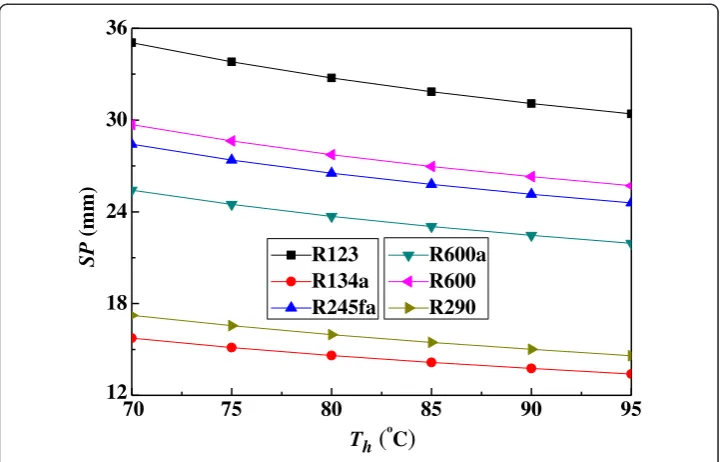
Figure 5 shows the expander size parameter SP plotted as a function of Th. The
ex-pander size parameter given by Equation 9 is an indicator of exex-pander size, and it is
70 75 80 85 90 95
6 9 12 15 18 21 24 27
Th(OC)
W
Rm
(kW.s/kg)
R123 R134a R245fa R600a R600 R290
Figure 3Effect ofThon WRm.
70 75 80 85 90 95
1.2 1.4 1.6 1.8 2.0 2.2
Th
(
oC)
VFR
R123 R134a R245fa R600a R600 R290
proportional to the actual expander size (Lakew and Bolland 2010; Stijepovic et al. 2012). As shown in Figure 5, SP decreases with increasingThfor all working fluids, and
this is attributed to the fact that higher Thleads to higher enthalpy drop between the
expander inlet and outlet as well as higherηpand thus less SP according to Equation 9. As it is seen from Figure 5, SP is lowest for R134a for all heat source temperatures compared with the five other working fluids and R290 is the second lowest. This is likely due to the fact that compared with the four other working fluids, R134a and R290 have higher pressure and thus higher density at the expander outlet, resulting in lowerV3and thus lower SP according to Equation 9.
Based on the above discussion, it is thus clear that in terms of ηp and SP, R290 and R134a are more suitable working fluids for ORC for recovering low-grade waste heat. However, the system pressures for working fluids R290 and R134a are also high, reaching 2,116 and 1,682 kPa, respectively, atTboi= 60°C, resulting in high system
in-vestment. Except R290 and R134a, R600a is superior to R600, R123 and R245fa in terms ofηpand SP. Moreover, the system pressures for R600a is also not high, reaching 868.3 kPa at Tboi = 60°C. To sum up the above discussion, R600a is the most suitable
among the six selected working fluids for ORC for recovering low-grade waste heat in the temperature range of 70°C to 95°C.
Effect of working fluid types on VCC
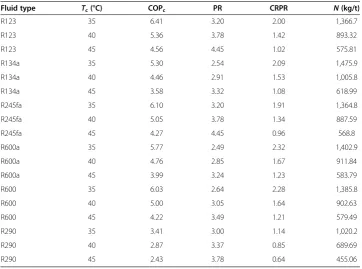
The condensation temperature varies with ambient. Table 2 shows the effects ofTcand
working fluid types on COPc, PR and CRPR. In Table 2,Th equals 85°C. As shown in
Table 2, COPc, PR and CRPR depend largely onTc, COPcand CRPR decrease withTc,
and PR increases with Tc. This is due to the fact that when the pressure and
tem-perature remain invariable at the compressor inlet, the increasing Tc leads to the
in-crease of pressure and enthalpy at the compressor outlet and thus the inin-crease of PR and the decrease of COPcas well as CRPR according to Equations 11 to 15.
70 75 80 85 90 95
12 18 24 30 36
R123 R134a R245fa
Th
(
oC)
SP
(mm)
R600a R600 R290
It is obvious from Table 2 that R123 has the maximum COPc while R290 has the
minimum COPc.PR for R123 and R245fa are almost the same and they are greater than
those for the four other working fluids. PR for R600a is the lowest among the six se-lected working fluids. It is well known that working fluids with high COPcand low PR
are suitable refrigerants for VCC. To evaluate working fluid refrigeration performance and the relationships between COPc and PR, CRPR is hence defined as the ratio of
COPc to PR, which is an indicator of working fluid refrigeration performance. Higher
CRPR indicates better refrigeration performance for working fluids. R600a has the max-imum CRPR compared with the five other working fluids, followed by R600, as shown in Table 2.
According to the comprehensive comparison of COPc, PR and CRPR for the six
dif-ferent working fluids, it is clear that R600a is the most suitable working fluid for VCC.
Effect of working fluid types on ORC/VCC
In Figures 6, 7, and 8, the condensation temperature is 40°C.
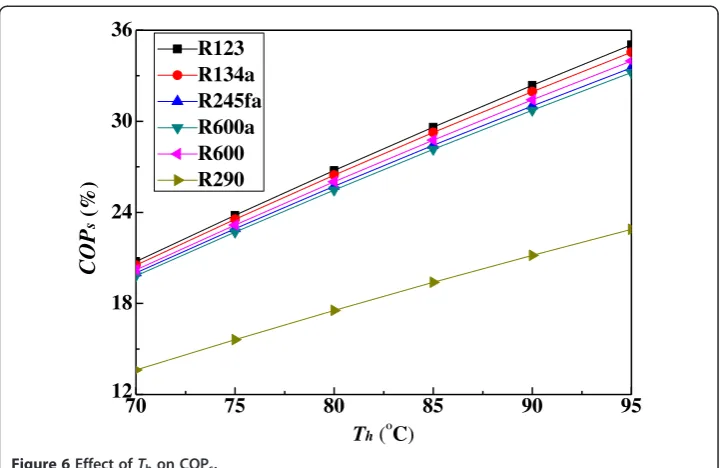
Figure 6 illustrates the variation of COPsas a function ofTh. In Figure 6, with the
in-crease ofTh, COPs increases for all working fluids. COPsequals the product ofηpand
COPc. ηpfor R123 is the lowest among the six working fluids, as shown in Figure 2,
and COPcis however highest for R123 among the six working fluids in Table 2; as a
re-sult, the product of ηp and COPc is highest. As evident in Figure 6, R123 has the
highest COPsand R290 has the lowest COPs for all heat source temperatures. Except
R290, the differences between COPs for the five other working fluids are very small.
For example, COPs is 26.76%, 26.45%, 26.01%, 25.72% and 25.47% for working fluids
R123, R134a, R600, R245fa and R600a, respectively, at Th= 80°C, and they respectively
increase to 35.04%, 34.55%, 33.97%, 33.52% and 33.21% atTh= 95°C.
Table 2 Performance of VCC with differentTc
Fluid type Tc(°C) COPc PR CRPR N(kg/t)
R123 35 6.41 3.20 2.00 1,366.7
R123 40 5.36 3.78 1.42 893.32
R123 45 4.56 4.45 1.02 575.81
R134a 35 5.30 2.54 2.09 1,475.9
R134a 40 4.46 2.91 1.53 1,005.8
R134a 45 3.58 3.32 1.08 618.99
R245fa 35 6.10 3.20 1.91 1,364.8
R245fa 40 5.05 3.78 1.34 887.59
R245fa 45 4.27 4.45 0.96 568.8
R600a 35 5.77 2.49 2.32 1,402.9
R600a 40 4.76 2.85 1.67 911.84
R600a 45 3.99 3.24 1.23 583.79
R600 35 6.03 2.64 2.28 1,385.8
R600 40 5.00 3.05 1.64 902.63
R600 45 4.22 3.49 1.21 579.49
R290 35 3.41 3.00 1.14 1,020.2
R290 40 2.87 3.37 0.85 689.69
The effect of Th on CPRmAis shown in Figure 7. CPRmA is defined as the ratio of
Qevato (mp+mic), which reflects the refrigerating capacity of the working fluid per unit
mass flow rate. As evident in Figure 7, CPRmAincreases withThfor all working fluids.
R600 and R600a have the highest and second highest CPRmA. CPRmA for HCs is
higher than those for R123, R134a and R245fa. So, HCs of R290, R600 and R600a are more suitable working fluids for ORC/VCC compared with working fluids R123, R134a and R245fa.
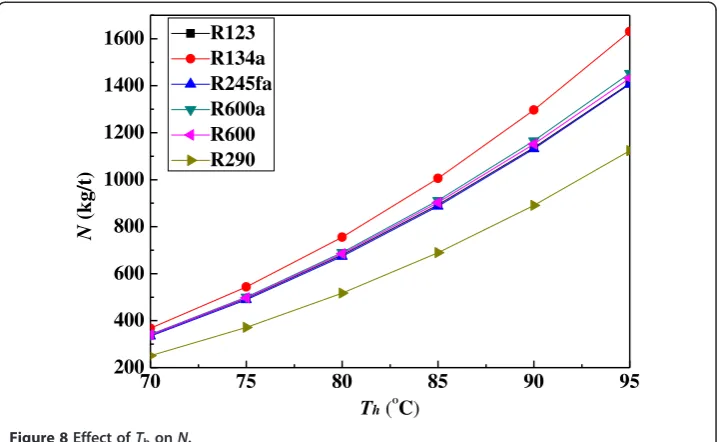
Nas a function ofThis plotted and presented in Figure 8. Figure 8 shows thatN
de-pends largely on Th and it increases with Th for all working fluids. R134a has the
highest N and R290 has the lowest N for all heat source temperatures. Except R134a
70 75 80 85 90 95
12 18 24 30 36
Th(OC)
COP
s
(%)
R123 R134a R245fa R600a R600 R290
Figure 6Effect ofThon COPs.
70 75 80 85 90 95
25 50 75 100
R600a R600 R290
Th(OC)
CPRm
A
(kW.s/kg)
R123 R134a R245fa
and R290, the differences between N for the four other working fluids are very small. For example, N is 755.41, 690.22, 684.76, 679.39, 673.73 and 517.1 kg/t for R134a, R600a, R600, R123, R245fa and R290, respectively, at Th= 80°C, and they respectively
increase to 1,409.8, 1,630.4, 1,406.5, 1,453.4, 1,432.1 and 1,123.6 kg/t atTh= 95°C.
So, in terms of COPs and N, R600 and R600a are more suitable working fluids for
ORC/VCC.
In addition, the condensation temperature has an important influence on N, as shown in Table 2. Taking R134a as an example, Nat Tc= 35°C, 40°C and 45°C is,
re-spectively, 1,475.9, 1,005.8 and 618.99 kg/t.NatTc= 35°C is 1.47 times larger than that
at Tc= 40°C and is 2.38 times larger than that atTc = 45°C, indicating that there is a
great difference of cooling capability for ORC/VCC air-conditioning system with differ-ent condensation temperatures. The condensation temperature depends on the ambidiffer-ent temperature, heat exchanger area of the condenser and cooling water flow rate, while the cooling water flow rate influences the heat exchanger area of the condenser and the selection of cooling water pump and thus the system investment and payback period. Thus, the system performance and payback period should be comprehensively consi-dered so as to decide the optimal condensation temperature during practical design.
In sum, R600a is the most suitable working fluid for ORC/VCC through the compre-hensive comparison ofηp, SP, COPc, PR, CRPR, COPs, CPRmA,Nand system pressure
for the six different working fluids; however, the flammability of R600a should attract enough attention.
Conclusions
To efficiently utilize waste heat from hot springs for air conditioning at the hot spring hotel, the organic Rankine-vapor compression cycle system was employed and a ther-modynamic model was developed. Six working fluids, R123, R134a, R245fa, R600a, R600 and R290, were selected and compared to identify suitable working fluids which may yield high system efficiencies. The calculated results show that in terms ofηpand
70 75 80 85 90 95
200 400 600 800 1000 1200 1400 1600
Th(OC)
N
(kg/t)
R123 R134a R245fa R600a R600 R290
SP, R290 and R134a are more suitable working fluids for ORC for recovering low-grade waste heat in the temperature range of 70°C to 95°C. However, their system pressures are too high, resulting in high system investment. Except R290 and R134a, R600a is the more suitable working fluid for ORC in terms of ORC efficiency, expander size param-eter and system pressure. R600a is the most appropriate working fluid for VCC in
terms of PR, COPc and CRPR. In terms of COPs, CPRmA and N, HCs of R600 and
R600a are more suitable working fluids for ORC/VCC compared with working fluids R290, R123, R134a and R245fa. In sum, R600a is the most suitable working fluid for ORC/VCC through the comprehensive comparison of ηp, SP, COPc, PR, CRPR, COPs,
CPRmA, Nand system pressure for the six different working fluids; however, the
flam-mability of R600a should attract enough attention.
Nomenclature
COPccoefficient of performance for VCC
COPsoverall coefficient of performance for ORC/VCC
Cp specific heat of chilled water (kJ/(kg K))
CPRmAratio ofQevato overall mass flows of ORC/VCC
CRPR ratio of COPcto PR
h1enthalpy at the working fluid pump outlet (kJ/kg)
h1senthalpy at the working fluid pump outlet based on an isentropic process (kJ/kg)
h2enthalpy at the expander inlet (kJ/kg)
h3senthalpy at the expander outlet based on an isentropic process (kJ/kg)
h4enthalpy at the working fluid pump inlet (kJ/kg)
h5enthalpy at the evaporator inlet (kJ/kg)
h6enthalpy at the evaporator outlet (kJ/kg)
h7senthalpy at the compressor outlet based on an isentropic process (kJ/kg)
mhmass flow rate for hot water (kg/s)
micmass flow rate of the working fluid for VCC (kg/s)
mNmass flow rate of chilled water (kg/s)
mpmass flow rate of the working fluid for ORC (kg/s)
Nchilled water yield from per ton hot water (kg/t) P6pressure at the compressor inlet (kPa)
P7pressure at the compressor outlet (kPa)
PR pressure ratio between the compressor inlet and outlet Qboigenerator heat input (kW)
Qevaevaporator power for the ice maker (kW)
SP expander size parameter (m)
Tboigeneration temperature in the generator (°C)
Tccondensation temperature (°C)
Tcritcritical temperature (°C)
Thhot water temperature at the generator inlet (°C)
TN1chilled water temperature at the evaporator inlet (°C)
TN2chilled water temperature at the evaporator outlet (°C)
V2volumetric flow at the expander inlet (m3/s)
V3volumetric flow at the expander outlet (m3/s)
Wcomcompressor work input (kW)
Wexpexpander work output (kW)
Wnetnet work output for ORC (kW)
Wpump,wworking fluid pump power consumption (kW)
WRm ratio ofWnettomp(kW s/kg) ηcomcompressor isentropic efficiency
ηexpexpander isentropic efficiency
ηporganic Rankine cycle efficiency
ηpump,wworking fluid pump isentropic efficiency
Competing interests
The authors declare that they have no competing interests.
Authors’contributions
Xianbiao Bu carried out the establishment and analysis of numerical model. Lingbao Wang and Huashan Li participated in the data analysis and article writing. All authors read and approved the final manuscript.
Acknowledgements
The authors gratefully acknowledge the financial support from the National Hi-Tech Research and Development Program (863) of China (no. 2012AA053003), the National Natural Science Foundation of China (no. 51106161) and Guangdong Province and Chinese Academy of Sciences Comprehensive Strategic Cooperation Projects (2012B091100263).
Author details
1
Key Laboratory of Renewable Energy and Gas Hydrate, Guangzhou Institute of Energy Conversion, Chinese Academy of Sciences, No.2, Nengyuan Rd, Wushan, Tianhe District, Guangzhou 510640, China.2University of Chinese Academy of Sciences, Beijing 100049, China.
Received: 3 June 2013 Accepted: 31 July 2013 Published: 23 August 2013
References
Aphornratana S, Sriveerakul T (2010) Analysis of a combined Rankine–vapour–compression refrigeration cycle. Energy Convers Manage 51(12):2557–2564
Davis GW, Wu C (1997) Finite time analysis of a geothermal heat engine driven air conditioning system. Energy Convers Manage 38(3):263–268
Demierre J, Henchoz S, Favrat D (2012) Prototype of a thermally driven heat pump based on integrated organic Rankine cycles (ORC). Energy 4(1):10–17
Guo T, Wang HX, Zhang SJ (2011) Selection of working fluids for a novel low-temperature geothermally-powered ORC based cogeneration system. Energy Convers Manage 52:2384–2391
Hung TC, Wang SK, Kuo CH, Pei BS, Tsai KF (2010) A study of organic working fluids on system efficiency of an ORC using low-grade energy sources. Energy 35:1403–1411
Invernizzi C, Iora P, Silva P (2007) Bottoming micro-Rankine cycles for micro-gas turbines. Appl Therm Eng 27:100–110 Kairouani L, Nehdi E (2006) Cooling performance and energy saving of a compression–absorption refrigeration system
assisted by geothermal energy. Appl Therm Eng 26(2–3):288–294
Kececiler A, Ibrahim Acar H, Ayla D (2000) Thermodynamic analysis of the absorption refrigeration system with geothermal energy: an experimental study. Energy Convers Manage 41(1):37–48
Lakew AA, Bolland O (2010) Working fluids for low-temperature heat source. Appl Therm Eng 30:1262–1268 Lu ZS, Wang RZ, Xia ZZ (2013) Study of a novel solar adsorption cooling system and a solar absorption cooling system
with new CPC collectors. Renew Energy 50:299–306
Lubis LI, Kanoglu M, Dincer I (2011) Thermodynamic analysis of a hybrid geothermal heat pump system. Geothermics 40(3):233–238
Lund JW, Freeston DH, Boyd TL (2005) Direct application of geothermal energy: 2005 worldwide review. Geothermics 34(6):691–727
Lund JW, Freeston DH, Boyd TL (2011) Direct utilization of geothermal energy 2010 worldwide review. Geothermics 40(3):159–180
Luo HL, Wang RZ, Dai YJ (2012) The effects of operation parameter on the performance of a solar-powered adsorption chiller. Appl Energy 87(10):3018–3022
Macchi E, Perdichizzi A (1981) Efficiency prediction for axial-flow turbines operating with nonconventional fluids. J Eng. for Power 103:718–724
Meunier F (1998) Solid sorption heat powered cycles for cooling and heat pumping applications. Appl Therm Eng 18(9–10):715–729
Qiu GQ (2012) Selection of working fluids for micro-CHP systems with ORC. Renew Energy 48:565–570
Rosiek S, Batlles FJ (2012) Shallow geothermal energy applied to a solar-assisted air-conditioning system in southern Spain: two-year experience. Appl Energy 100:267–276
Stijepovic MZ, Linke P, Papadopoulos AI, Grujic AS (2012) On the role of working fluid properties in organic Rankine cycle performance. Appl Therm Eng 36:406–413
Wang HL, Peterson R, Herron T (2011a) Design study of configurations on system COP for a combined ORC (organic Rankine cycle) and VCC (vapor compression cycle). Energy 36(8):4809–4820
Wang HL, Peterson R, Harada K (2011b) Performance of a combined organic Rankine cycle and vapor compression cycle for heat activated cooling. Energy 36(1):447–458
Wang EH, Zhang HG, Fan BY, Ouyang MG, Zhao Y, Mu QH (2011c) Study of working fluid selection of organic Rankine cycle (ORC) for engine waste heat recovery. Energy 36:3406–3418
Wang ZQ, Zhou NJ, Guo J, Wang XY (2012) Fluid selection and parametric optimization of organic Rankine cycle using low temperature waste heat. Energy 40:107–115
Wang XL, Bierwirth A, Christ A (2013) Application of geothermal absorption air-conditioning system: a case study. Appl Therm Eng 50(1):71–80
doi:10.1186/2195-9706-1-2
Cite this article as:Buet al.:Performance analysis and working fluid selection for geothermal energy-powered
organic Rankine-vapor compression air conditioning.Geothermal Energy20131:2.
Submit your manuscript to a
journal and benefi t from:
7Convenient online submission
7Rigorous peer review
7Immediate publication on acceptance
7Open access: articles freely available online
7High visibility within the fi eld
7Retaining the copyright to your article